48 Hours: Trump's Hormuz Ultimatum Collides With Downed Jets, a UN Vote, and a War Without Exit
The president who declared Iran "completely decimated" now faces two warplanes down, a missing pilot, Iranian drones hitting American corporate offices in Dubai, a second chokepoint under threat, and a United Nations Security Council that cannot agree on whether to let anyone shoot back. His answer: a 48-hour countdown to Monday. The math does not add up.

An F-15 Strike Eagle - the same aircraft type shot down over Iran on April 3, marking the first US warplane lost to enemy fire in over 20 years. Source: Pixabay
Somewhere in the mountains of Iran's southwestern Kohgiluyeh and Boyer-Ahmad province, an American pilot is missing. The U.S. military and Iranian civilians are both searching for the same person, for very different reasons. Iran's state television has urged its citizens to hand over any "enemy pilot" to police. Washington has not publicly confirmed whether the crew member is alive.
This is the war that President Donald Trump told the nation was already won.
Two days before that F-15E Strike Eagle tumbled from the sky on April 3, Trump stood in the White House and said Iran had been "beaten and completely decimated." He declared their radar "100% annihilated." He said Tehran had "no anti-aircraft equipment." Then Iran shot down two American warplanes in a single day - the first such losses in over twenty years of continuous U.S. military operations across the Middle East.
Now Trump has issued what may be the most consequential ultimatum of his presidency. On his Truth Social platform Saturday morning, he reminded Iran of what he called a "Monday deadline" to reopen the Strait of Hormuz or reach a deal, warning that "48 hours before all Hell will reign down on them."
The clock is ticking. What happens when it stops is unclear to everyone, including, by most accounts, the White House itself.
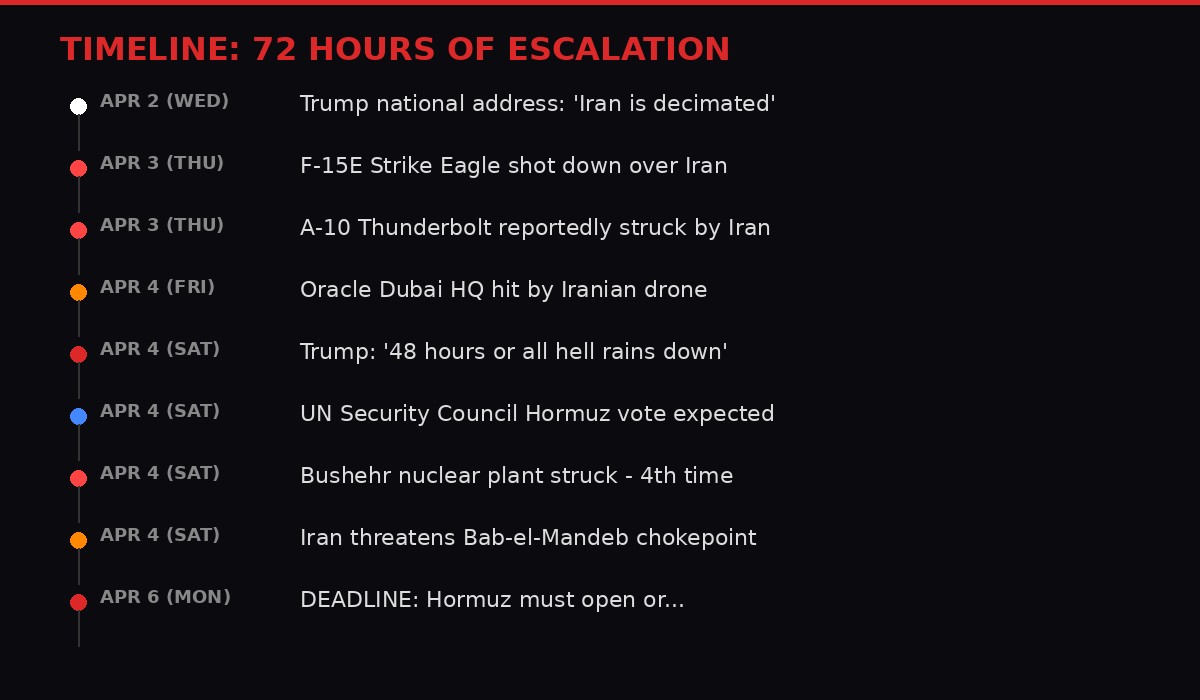
BLACKWIRE infographic: The 72-hour escalation spiral that brought the war to its most dangerous point
The Shootdown That Shattered the Narrative

U.S. warplanes have flown over 13,000 missions in the Iran campaign. Friday's losses were the first aircraft downed by enemy fire since 2003. Source: Pixabay
The facts of what happened on April 3 are still being assembled, but their political impact has already landed with the force of a surface-to-air missile.
Iran shot down a U.S. F-15E Strike Eagle over its territory. The aircraft carried a two-person crew. One service member was rescued. The second remains missing, the subject of a search operation that has drawn both American military assets and Iranian ground patrols into the same remote mountain terrain.
Separately, Iranian state media reported that a U.S. A-10 Thunderbolt II attack aircraft crashed in the Persian Gulf after being struck by Iranian defense forces. A U.S. official, speaking on condition of anonymity, said it was not clear whether the aircraft was shot down or crashed for other reasons. The crew's status remained unknown as of Saturday evening.
Retired Air Force Brigadier General Houston Cantwell, a former F-16 fighter pilot and senior fellow at the Mitchell Institute for Aerospace Studies, told the AP that the losses, while tactically insignificant in a campaign of 13,000-plus missions, carry enormous weight. "The fact that this hasn't happened until now is an absolute miracle," he said. "We're flying combat missions here, they are being shot at every day."
Military analysts believe the F-15 was likely struck by a portable, shoulder-fired missile rather than a fixed radar-guided system. Behnam Ben Taleblu, Iran program senior director at the Foundation for Defense of Democracies, explained the distinction that matters: "A disabled air defense system is not a destroyed air defense system. We shouldn't be shocked that they're still fighting."
He noted that American planes have been flying at lower altitudes over Iran - a tactical necessity for certain mission profiles but one that puts them in range of man-portable air defense systems, or MANPADS. Iran's military may be degraded, but it is "weak but still lethal."
Mark Cancian, a retired Marine colonel and senior defense adviser at CSIS, put the losses in historical perspective. During World War II, the loss rate for American warplanes over Germany reached 3% at one point. Applied to the Iran campaign, that would mean roughly 350 aircraft lost. The actual number is orders of magnitude smaller.
"But then there's the political side - you have an American public that is accustomed to fighting bloodless wars. Then a large part of the country doesn't support the war. So to them, any loss is unacceptable."- Mark Cancian, CSIS senior defense adviser, to AP
The last time a U.S. jet was shot down in combat was April 8, 2003, when an A-10 took a surface-to-air missile over Baghdad during the Iraq invasion. That pilot ejected safely and was rescued. The 23-year gap between that incident and Friday's losses is itself a testament to American air dominance - and to the fact that the U.S. has mostly fought adversaries without significant anti-aircraft capabilities since then. Iran is different.
Oracle Dubai and the War on American Tech

Dubai's skyline - now a target zone. An Iranian drone struck Oracle's headquarters in the emirate on April 4. Source: Pixabay
While the world focused on the missing pilot, Iran opened a different front. On Saturday, an apparent Iranian drone struck the Dubai headquarters of Oracle Corporation, punching a visible hole in the building's southwestern corner. Footage verified by the AP showed the damage clearly.
Dubai's government tried to downplay the incident. The Dubai Media Office described it as a "minor incident caused by debris from an aerial interception that fell on the facade," saying there were no injuries. Oracle Corp., headquartered in Austin, Texas, did not immediately respond to media requests.
The strike was not random. Iran's Islamic Revolutionary Guard Corps has explicitly named major U.S. technology companies as legitimate military targets, accusing them of involvement in "terrorist espionage" operations against the Islamic Republic. The IRGC published what amounts to a hit list of American tech firms it considers complicit in the war effort.
Oracle is not the first. Amazon Web Services facilities in the UAE and Bahrain have been struck by Iranian drones in previous weeks. The pattern is deliberate: Iran is waging a parallel war against the digital infrastructure that American military operations depend on, and it is doing so in countries that are supposed to be neutral or allied to the United States.
For the Gulf states, this creates an impossible position. The UAE hosts the regional headquarters of dozens of American technology giants. These firms employ thousands of local and expatriate workers. They are woven into the fabric of Dubai's economy. And now they are targets - not because of anything the UAE has done, but because Iran considers American corporate presence in the Gulf an extension of American military presence.
The economic implications extend well beyond Dubai. If multinational corporations begin withdrawing staff or operations from the Gulf over security concerns, the impact on regional economies that have spent decades diversifying away from oil dependence would be severe. Insurance premiums for commercial operations in the Gulf are already climbing. Several international banks have suspended new lending for Gulf-based projects, according to financial industry sources cited by Bloomberg in late March.
The broader strategic picture is clear. Iran cannot match American air power, but it can make every American asset in the region - military, corporate, and civilian - feel exposed. A shoulder-fired missile takes down a $100 million fighter jet. A $50,000 drone damages a billion-dollar corporate headquarters. The asymmetry is Iran's strongest card, and it is playing it relentlessly.
The 48-Hour Ultimatum
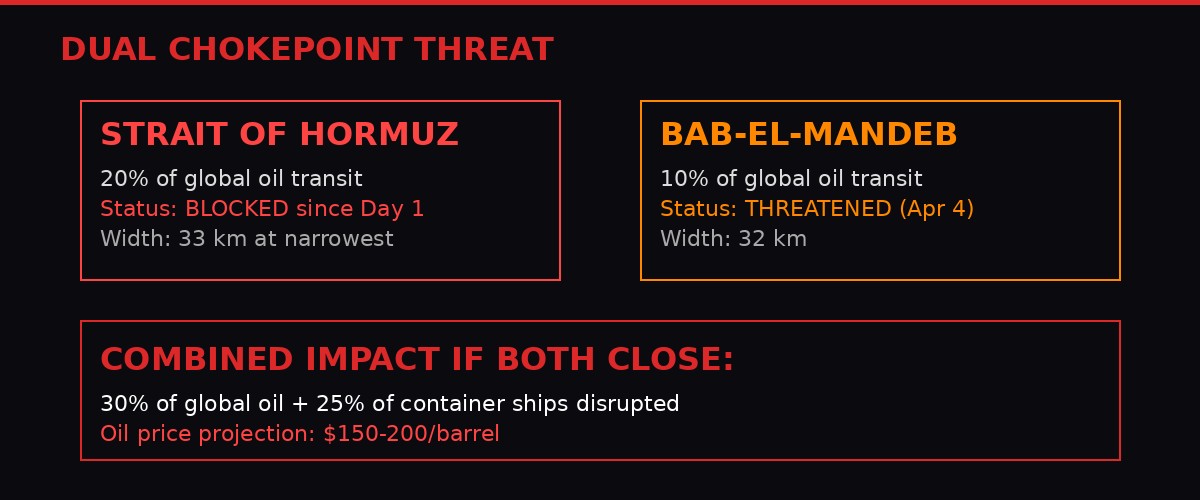
BLACKWIRE infographic: The dual chokepoint threat that could lock 30% of global oil transit
Trump's Saturday morning post on Truth Social was characteristically blunt. He told Iran it had "48 hours before all Hell will reign down on them" if the Strait of Hormuz was not reopened or a deal reached by Monday.
It was not the first time Trump has set a deadline during this war. He issued a similar ultimatum regarding Iranian power plants in late March. That deadline passed. The power plants were bombed, but Hormuz stayed closed. Another deadline came and went around the 15-point ceasefire framework that Pakistan attempted to broker. Iran did not budge.
The problem with the Monday ultimatum is structural. The Strait of Hormuz is 33 kilometers wide at its narrowest point. Reopening it is not a switch that Tehran flips. Iran has deployed naval mines, IRGC patrol boats, and shore-based anti-ship missiles along the waterway. Even if Tehran decided today to reopen the strait, the physical process of mine clearance and security establishment would take weeks, not hours.
What Trump means by "all hell" is equally unclear. The United States has already struck more than 12,300 targets across Iran. It has bombed power plants, oil infrastructure, steel mills, bridges, and military installations. U.S. Marines are on Kharg Island. The 82nd Airborne has deployed. What remains to escalate to?
The options are grim. The most likely escalation would involve direct strikes on Iran's remaining oil export infrastructure, particularly terminals in the Persian Gulf that China has continued to access through an informal arrangement with Iran. Hitting those would cut off Iran's last revenue stream but would also spike global oil prices even further - something Trump can ill afford with U.S. gas prices already above $4 per gallon and inflation climbing.
Another option: intensified strikes on Iranian cities and civilian infrastructure. Trump told reporters earlier this week that the U.S. would bomb Iran "back to the stone ages." Whether that was rhetoric or policy direction is the question that keeps Pentagon planners awake at 3 AM.
A third possibility is more prosaic but potentially more consequential. Trump could order U.S. naval forces to physically force the strait open by clearing mines and engaging any Iranian vessels that interfere. This would turn the blockade into a direct naval confrontation - the kind of engagement that the UN Security Council is, at this exact moment, trying to define rules for.
The UN Vote Nobody Can Agree On
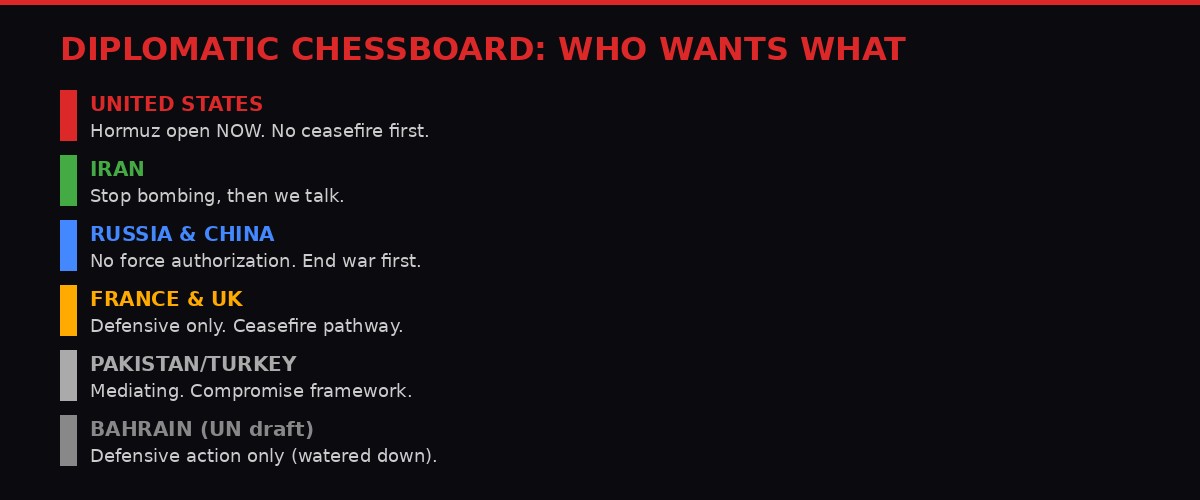
BLACKWIRE infographic: Every major player wants something different. The Security Council vote exposes the fracture.
In New York, the UN Security Council was expected to vote Saturday on a resolution regarding the Strait of Hormuz. The original draft, sponsored by Bahrain, would have authorized countries "to use all necessary means" to secure passage through the waterway. That language - "all necessary means" - is UN code for military force. It is the same phrase that authorized the 1991 Gulf War and the 2011 intervention in Libya.
Russia, China, and France killed that version. All three hold vetoes on the 15-member council. Russia's UN Ambassador Vassily Nebenzia said the proposal "does not solve the puzzle" and that only ending hostilities would. China's Ambassador Fu Cong called the use-of-force authorization "unlawful and indiscriminate," warning it "would inevitably lead to further escalation." France's Ambassador Jerome Bonnafont called for de-escalation and said only "defensive measures that avoid any broad use of force" should be considered.
The final draft, obtained by the AP on Thursday, was significantly watered down. It authorizes countries "to use all defensive - but not offensive - action to ensure vessels can safely transit the strait." Countries acting alone or in "multinational naval partnerships" may take defensive measures, provided they give advance notification to the Security Council. The authorization would run for six months.
This is a resolution designed to satisfy no one fully. The United States wants the authority to force Hormuz open. It will not get that. Iran wants the bombing to stop before discussing the strait. The resolution does not require that. Russia and China want to prevent any military action that could escalate the conflict further. The resolution permits "defensive" action, a term flexible enough to cover almost anything a competent lawyer can argue.
The vote was originally scheduled for Friday but postponed due to the Good Friday UN holiday. Diplomats said it was now expected Saturday, but the delay gives more time for behind-the-scenes negotiations to prevent a veto.
Even if the resolution passes, its practical impact is uncertain. The U.S. is already operating naval forces in the region. Iran has already demonstrated it can hit those forces. A piece of paper from the Security Council changes neither of those facts. What it does change is the legal framework - and in international relations, legal frameworks matter most when things go wrong.
Bushehr, Bab-el-Mandeb, and the Expanding Battlefield

Global shipping faces its worst disruption since the Suez crisis. If Iran follows through on its Bab-el-Mandeb threat, 30% of seaborne oil and a quarter of container traffic could be affected. Source: Pixabay
The war is not contracting. It is expanding on multiple axes simultaneously.
On Saturday, the Atomic Energy Organization of Iran confirmed that an airstrike hit near its Bushehr nuclear facility, killing a security guard and damaging a support building. It was the fourth time the facility has been targeted during the conflict. The head of Russia's Rosatom nuclear corporation said 198 workers were being evacuated from the site.
Bushehr is Iran's only operational nuclear power plant, built with Russian assistance over decades. It is under International Atomic Energy Agency safeguards and is not considered part of Iran's weapons program. Striking near it - repeatedly - crosses a line that even Israel's most aggressive planners historically avoided. The risk of radiological contamination, while low from strikes near the facility rather than on the reactor itself, is non-zero. And the symbolism is incendiary: the United States is bombing near a nuclear plant while accusing Iran of nuclear ambitions.
The IAEA, which had already expressed alarm after previous strikes near Bushehr and at Natanz, faces a credibility test. If the international nuclear watchdog cannot prevent the bombing of facilities it is charged with safeguarding, its authority over global nonproliferation efforts is fundamentally undermined. Every country watching this conflict is drawing conclusions about what nuclear safeguards are actually worth when a superpower decides to go to war.
Meanwhile, Iran's parliamentary speaker Mohammad Bagher Qalibaf issued what amounted to a threat against a second strategic waterway. Late Friday, Qalibaf posted a series of rhetorical questions about the Bab-el-Mandeb strait, the 32-kilometer-wide passage linking the Red Sea with the Gulf of Aden and the Indian Ocean.
"What share of global oil, LNG, wheat, rice, and fertilizer shipments transits the Bab-el-Mandeb Strait? Which countries and companies account for the highest transit volumes through the strait?"- Mohammad Bagher Qalibaf, Speaker of Iran's Parliament, April 3, 2026
The questions were rhetorical. The answers are alarming. More than a tenth of seaborne global oil passes through the Bab-el-Mandeb. A quarter of the world's container ships transit the strait. If Iran - or its Houthi allies in Yemen, who control the western shore - were to disrupt traffic through this second chokepoint while Hormuz remains closed, the combined impact would be catastrophic for global trade.
Iran does not directly control the Bab-el-Mandeb. But the Houthis, who have been intermittently attacking commercial shipping in the Red Sea since late 2023, are aligned with Tehran and have already struck Israeli targets during this war. The coordination between Iran's strategic messaging and Houthi operational capabilities has been tightening throughout the conflict. Qalibaf's statement reads like a signal to prepare.
The economic math is stark. With Hormuz already choking 20% of global oil supply, crude prices have surged past $115 a barrel. European inflation has jumped to 2.5% in March from 1.9% in February. Five European finance ministers - from Spain, Germany, Italy, Portugal, and Austria - have written to the European Commission demanding windfall taxes on energy companies profiting from the price surge. The EU's energy commissioner warned this week that prices are unlikely to "go back to normal in a foreseeable future."
Adding Bab-el-Mandeb disruption to the equation would push oil toward $150 or higher, according to energy market analysts. At that level, global recession becomes not a risk but a mathematical certainty.
The Diplomacy That Almost Exists

Pakistan, Turkey, and Egypt are working to bring the U.S. and Iran to the negotiating table. The gap between their positions remains vast. Source: Pixabay
Beneath the bombs and ultimatums, diplomatic machinery is grinding forward - slowly, uncertainly, and with no guarantee of producing anything.
Iran's foreign minister Abbas Araghchi signaled Saturday that Tehran has "never refused to go to Islamabad," referencing Pakistan's offer to host direct talks between the U.S. and Iran. Pakistan's Foreign Ministry spokesperson Tahir Andrabi told the AP that his government's mediation efforts were "right on track."
According to two regional officials who spoke on condition of anonymity, mediators from Pakistan, Turkey, and Egypt are working on a compromise framework to bridge the gap between American and Iranian demands. The proposed deal would center on a cessation of hostilities as a precondition for a diplomatic settlement - essentially, a ceasefire pathway.
The details, as described by a regional official and a Gulf diplomat briefed on the matter, include mutual de-escalation steps: Iran would begin the process of reopening Hormuz in exchange for a halt to strikes on civilian infrastructure. Both sides would agree to talks in Islamabad within a defined timeframe. A multinational monitoring mechanism would verify compliance.
The framework is rational. It is also dead on arrival if Trump is serious about his Monday deadline. You cannot negotiate a ceasefire pathway while simultaneously threatening to unleash "all hell" in 48 hours. The two approaches are mutually exclusive, and the clock is running on the one that precludes the other.
China is trying to position itself as a responsible mediator, a role that serves Beijing's broader strategic interests in demonstrating global leadership while the United States is perceived as an aggressor. China's diplomatic engagement with both Iran and Pakistan has intensified throughout the conflict. But China has also been quietly purchasing Iranian oil through the Hormuz blockade via an informal arrangement, a fact that complicates its claim to neutrality.
France and the United Kingdom, traditionally America's closest allies, remain at a studied distance. Macron said this week that the U.S. "can hardly complain afterward that they are not being supported in an operation they chose to undertake alone." British Prime Minister Keir Starmer has refused to be drawn into the war despite fierce criticism from Trump. Both countries are focused on reopening Hormuz after the fighting ends, implicitly signaling that they expect the war to end before the strait opens - the opposite of Trump's position.
Even within Trump's own party, the cracks are widening. When Trump floated withdrawing from NATO this week, Senate Majority Leader John Thune said there were not enough votes in the Senate to support it. "We got an awful lot of people who think that NATO is a very critical, incredibly successful post-World War II alliance," Thune said. "I think in the world today, you need allies."
John Bolton, Trump's former national security adviser, was characteristically blunt. The administration made "a serious mistake" by not building a coalition before going to war, he said. "If you don't build your coalition before the war, it's pretty tough to do it while you're in it."
What Monday Looks Like
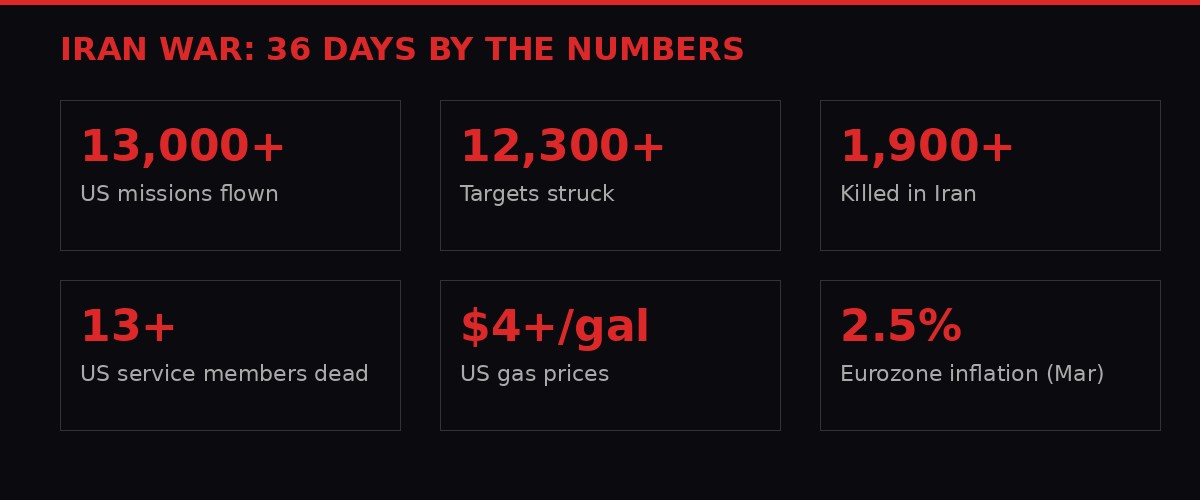
BLACKWIRE infographic: 36 days of war, by the numbers
Monday, April 6, 2026. If Trump's ultimatum is real - and there is no way to know until it either expires or is extended - it will be the single most consequential day of this war so far.
The possibilities range from the merely dangerous to the genuinely catastrophic.
Scenario 1: The deadline slides. Trump declares that "progress is being made" and extends the timeline. This is the most likely outcome based on precedent. Previous ultimatums in this war have quietly expired. But each time a deadline is set and missed, the credibility cost compounds. Adversaries learn that the threat is empty. Allies learn that the strategy is improvised. Markets learn that nothing the president says about the war's trajectory can be trusted.
Scenario 2: Massive escalation. The U.S. launches its heaviest bombardment of the war, targeting remaining oil infrastructure, government buildings, and military assets. This would be the "all hell" option. It would cause enormous destruction in Iran, further spike energy prices globally, risk killing the missing pilot still being searched for, and almost certainly provoke Iranian retaliation against Gulf states, U.S. bases, and potentially Israeli cities. The regional war that has been simmering for weeks would boil over.
Scenario 3: Naval confrontation. U.S. forces begin mine-clearing operations in the Strait of Hormuz under military escort, directly challenging Iran's blockade. This is the scenario the UN Security Council resolution is attempting to create a framework for - but even the watered-down version would only authorize "defensive" action. An active mine-clearing operation in contested waters is not defensive by any reasonable definition. This is the path to a naval engagement that could rapidly escalate.
Scenario 4: The back channel delivers. Quiet negotiations produce an agreement in principle before Monday. Iran agrees to begin reopening Hormuz in exchange for a bombing pause. Both sides claim victory. This is the best-case outcome and the least likely one, given that the fundamental positions of both sides - Iran demands a ceasefire before talking about Hormuz, the U.S. demands Hormuz before talking about a ceasefire - have not changed in five weeks.
The Domestic Pressure Cooker
Trump's foreign policy predicament is worsened by his domestic situation. Gas prices above $4 a gallon are hammering American consumers. The Supreme Court struck down his tariff program. His voting reform executive order faces immediate legal challenge. His attempt to restrict birthright citizenship appeared to receive a skeptical hearing at the Supreme Court.
In private, Trump seems aware of his constraints. At an Easter lunch at the White House this week, attended by Cabinet members and religious leaders, he quipped: "I'm such a king I can't get a ballroom approved." The laughter in the room was polite. The irony was real. The most powerful man in the world launched a war without consulting Congress or allies, and now finds himself unable to end it, unable to force Hormuz open, unable to prevent Iran from shooting down his aircraft, and unable to convince anyone to help.
More than 1,900 people have been killed in Iran since the war began on February 28. In Gulf Arab states and the occupied West Bank, more than two dozen are dead. Nineteen have been reported killed in Israel. At least 13 U.S. service members have died. Each number is a person, a family, a community altered permanently by a conflict that began with joint U.S.-Israel strikes five weeks and three days ago.
The war shows no signs of ending. Iran's steady stream of retaliatory strikes against Israel and Gulf neighbors continues. Its blockade of Hormuz endures. Its threat to extend disruption to the Bab-el-Mandeb is new and ominous. American air power has inflicted tremendous damage, but it has not broken Iran's will to fight. Five weeks in, that is the only fact that truly matters.
What Has Already Been Lost

Global energy markets are in their worst crisis since 1973. With Hormuz blocked and Bab-el-Mandeb threatened, there is no relief in sight. Source: Pixabay
Beyond the immediate tactical and diplomatic crisis, the past 36 days have already inflicted damage that will take years to repair - if it can be repaired at all.
The global energy system is fractured. One-fifth of the world's oil supply is locked behind Iran's Hormuz blockade. Energy prices in Europe have triggered inflation that was only just brought under control after the Russia-Ukraine shock of 2022. The EU is now considering a second round of windfall profit caps on energy companies - a measure that was supposed to be a one-time wartime emergency in 2022 and is now becoming a recurring feature of European economic policy.
America's alliance network is strained to a degree not seen since the Iraq War of 2003, and arguably worse. In 2003, the U.S. at least had Britain as a committed partner. In 2026, London is sitting this one out. Paris is openly critical. NATO's future is under explicit threat from the American president himself. The "Hormuz summit" of 35 nations that convened without the United States in late March was a visual metaphor for American isolation: the world's sole superpower, fighting a war alone because it chose to start one alone.
The nonproliferation regime has taken hits that may prove fatal. When the country that lectures the world about nuclear weapons is bombing near nuclear facilities under IAEA safeguards, every aspiring nuclear state on Earth takes note. The lesson of the Iran war for North Korea, for Saudi Arabia, for Turkey, for any country that has ever considered a nuclear program, is that international safeguards are worthless when a superpower decides they are inconvenient. That lesson will outlast this war by decades.
American military credibility has been simultaneously proven and undermined. The U.S. has demonstrated that it can pulverize a nation-state's military infrastructure in weeks. It has also demonstrated that pulverizing a nation-state's military infrastructure does not end a war. Iran, degraded and battered, is still fighting. Still launching drones. Still shooting down American jets. Still holding Hormuz closed. The lesson for every future adversary is clear: absorb the initial bombardment, survive, and fight asymmetrically. The American public will not tolerate a long war. Time is on the defender's side.
And now there is Monday. A deadline set by a president who has shown no ability to enforce his deadlines, against an adversary that has shown no willingness to be coerced by them. Between now and then: a missing pilot in the mountains of Iran, a vote at the United Nations that may or may not change anything, and the background hum of a global economy slowly unraveling under the weight of disrupted energy supplies.
Forty-eight hours. The war's most dangerous countdown has begun.
Get BLACKWIRE reports first.
Breaking news, investigations, and analysis - straight to your phone.
Join @blackwirenews on TelegramSources: Associated Press (multiple reports, April 3-4, 2026), BBC News, Al Jazeera, U.S. Central Command statements, AP obtained Pentagon email, Mitchell Institute for Aerospace Studies (Cantwell interview), Foundation for Defense of Democracies (Taleblu analysis), CSIS (Cancian analysis), United Nations Security Council draft resolution (obtained by AP), Atomic Energy Organization of Iran, Rosatom statement, Pakistan Foreign Ministry statement, Dubai Media Office, European Commission energy briefing, AP-obtained Bahrain draft resolution text, Truth Social (Trump post, April 4)
← Back to All Articles