518 Dead in Tanzania. Duterte on Trial. A Mother Gone. The Global Reckoning Still Waiting to Happen.

The demand for accountability crosses borders, languages, and regimes. It does not expire. (Unsplash)
On the same day that the International Criminal Court confirmed charges against a former president who oversaw the murder of thousands, a government-appointed commission in Tanzania admitted that 518 of its own citizens died in the aftermath of an election that handed the incumbent 98% of the vote. On that same day, a 23-year-old Nigerian man who lost five years of his life to a protest dragnet was still searching for the mother who disappeared when the state came for him. And in southern Lebanon, a journalist who had already received an Israeli death threat last year was killed in an airstrike, her body recovered only after rescuers were blocked from reaching her for hours.
This is not a story about one country. This is a story about a pattern - the gap between what the world acknowledges and what it actually does about it. Between the commission of inquiry that names the dead but not the killers. Between the court that confirms charges but cannot guarantee the defendant will attend. Between the prison gates that open and the life that has already been consumed. Between the headline that says "justice" and the human being who is still looking for their mother.
The global accountability wave of 2026 is real. You can measure it in dockets and death toll commissions and cannabis reclassifications. But if you look closer - at the fine print, at the bodies still buried under the language of "further investigation," at the mothers who vanished - you see something else. Accountability is arriving. Justice is still on foot.
The 518: Tanzania's Numbers Without Names

Tanzania cultivated an image of calm for nearly six decades. That image broke on October 29, 2025. (Unsplash)
The numbers came out on April 23, 2026, and they were staggering even by the grim standards of post-election violence in Africa. A commission of inquiry appointed by President Samia Suluhu Hassan announced that 518 people died from "unnatural causes" following Tanzania's disputed October 2025 general election. Of those, 197 were shot dead. Twenty-one were children. Sixteen were security officers.
But who shot them? The commission did not say.
Commission chairman Mohamed Chande Othman - a former chief justice, appointed by the same president whose election triggered the violence - delivered a report that catalogued the dead while carefully avoiding the question of who killed them. He recommended "further investigations" to determine responsibility. He said claims of mass graves "could not be substantiated" and alleged that AI was used to manipulate some images. He cited "underlying causes" including economic grievances, unemployment, and a "lack of patriotism."
"The commission has told us that all the violence was planned, coordinated, financed and executed by people who were trained and given equipment for committing crimes." - President Samia Suluhu Hassan, responding to the inquiry report
The opposition party Chadema called the report a "cover-up" and an "attempt to whitewash the regime's crimes." They had reason to be skeptical. The commission was appointed by the president herself. The two main opposition leaders were blocked from contesting the election - Tundu Lissu remains in detention on treason charges, while Luhaga Mpina's candidacy was rejected on technical grounds. The president won with 98% of the vote in an election that the African Union and the southern Africa bloc SADC said fell short of democratic standards.
The BBC verified multiple videos showing police firing toward groups of protesters. Footage showed heavily armed police units blocking demonstrators and firing tear gas before gunfire erupted. These are not contested facts. They are on camera. They were broadcast around the world. And yet the commission's answer to who pulled the trigger is: more investigation needed.
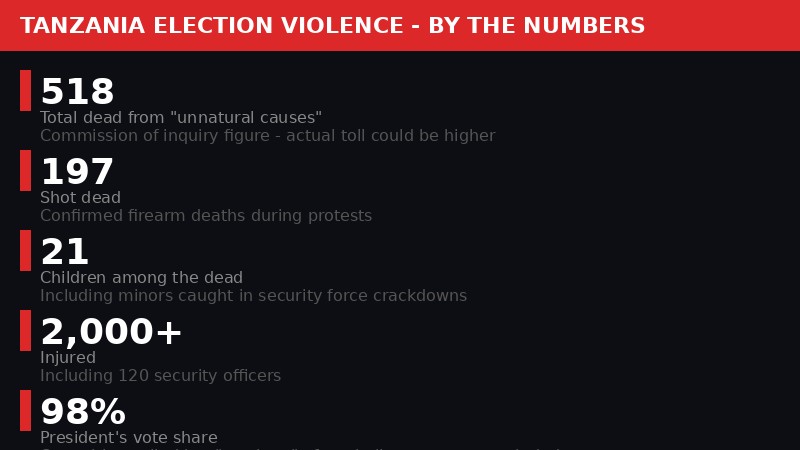
The numbers are unprecedented for a nation that sold itself as a model of African stability. (BLACKWIRE)
More than 2,000 people were injured. Opposition and religious groups had said the death toll was in the thousands, with reports of bodies taken from hospitals and allegedly buried in mass graves. The commission acknowledged the official number could be higher because some victims were "buried without the authorities being told."
Tanzania, for nearly sixty years, cultivated an image of calm, consensus, and order. That image - the steady, peaceful nation that avoided the coups and civil wars of its neighbors - was always partly a fiction, maintained by a one-party state that tolerated dissent only within carefully managed boundaries. When those boundaries were crossed in October 2025, the state's response was not calm. It was lethal. Now the state has counted the bodies but will not name the executioners.
President Samia, in her response to the report, said the violence "shook our nation" and the government would "take lessons from it." She also defended the security agencies, saying they had "prevented the state from sliding into anarchy." A criminal investigation body has been announced to examine offenses linked to the unrest - breaking into shops, looting, damaging infrastructure, causing deaths. The language is revealing: the investigation will look at the protesters' crimes, not the state's.
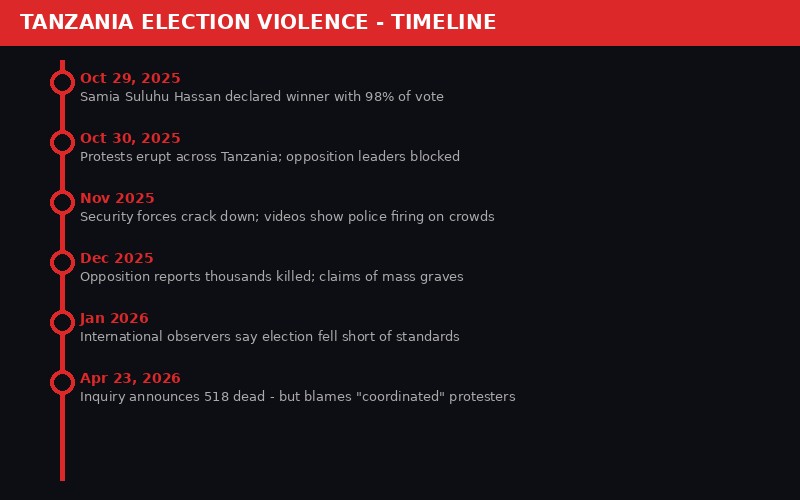
From disputed vote to 518 dead. The timeline of a nation's unraveling. (BLACKWIRE)
The commission made some recommendations that sound almost absurd in their modesty: free medical treatment and psychosocial support for victims, a national day of mourning, a new constitution by 2028. A new commission to "foster reconciliation." Reconciliation, in this context, means the state counting the people it killed and asking them to move on.
Duterte in The Dock: Justice at The Hague, Silence in Manila

The ICC confirmed all three counts of murder as crimes against humanity. Whether Duterte will attend his own trial remains unclear. (Unsplash)
Also on April 23, 2026, judges at the International Criminal Court in The Hague confirmed all three counts of murder as crimes against humanity against former Philippine President Rodrigo Duterte and committed him to stand trial.
The judges said there were "substantial grounds" to believe that Duterte, 81, played a key role in the murders of 76 people and the attempted murder of two others as part of his "war on drugs" - the campaign of extrajudicial killings that defined his presidency from 2016 to 2022. The ICC statement described "a common plan between Mr. Duterte and his co-perpetrators to kill alleged criminals in the Philippines, including those perceived or alleged to be associated with drug use, sale or production, through violent crimes including murder."
Prosecutors have said Duterte created, funded, and armed death squads to kill suspected narcotics dealers and users. Estimates of the total death toll range from the official police figure of 6,000 to human rights groups' estimates of 30,000. The 76 victims named in the ICC charges represent a fraction of the dead - but they are the ones for which evidence met the court's threshold of "substantial grounds."
"It sends a clear message that those who are alleged to have committed widespread and systematic murder as a crime against humanity will one day find themselves in the dock, facing trial." - Ritz Lee Santos, Director, Amnesty International Philippines
But "one day" is doing a lot of work in that sentence. Duterte was arrested in the Philippines last year. He denies the charges, insisting he instructed police to kill only in self-defense. His lead defense lawyer, Nick Kaufman, said the prosecution "cherry-picked" examples of Duterte's "bombastic rhetoric" and that he never intended to incite violence. His defense team says he is mentally too weak to follow the proceedings. It is unclear whether he will attend his own trial. In previous ICC cases, it has taken up to a year between the confirmation of charges and the start of a trial.
Here is the uncomfortable arithmetic of international justice: Duterte governed for six years. His death squads operated with impunity for six years. The ICC investigation took years to authorize. The arrest took more years. The confirmation of charges took additional months. The trial may not begin for another year. By the time a verdict arrives, Duterte could be 83 or older. The families of the dead will have waited a decade or more for an answer that, even if it comes, will arrive as a legal ruling from a courthouse 10,000 kilometers away.
That is not a criticism of the ICC. It is a description of the machinery of accountability when the entity being held to account is a sovereign state. The court moves at the speed of international law. The victims move at the speed of grief.
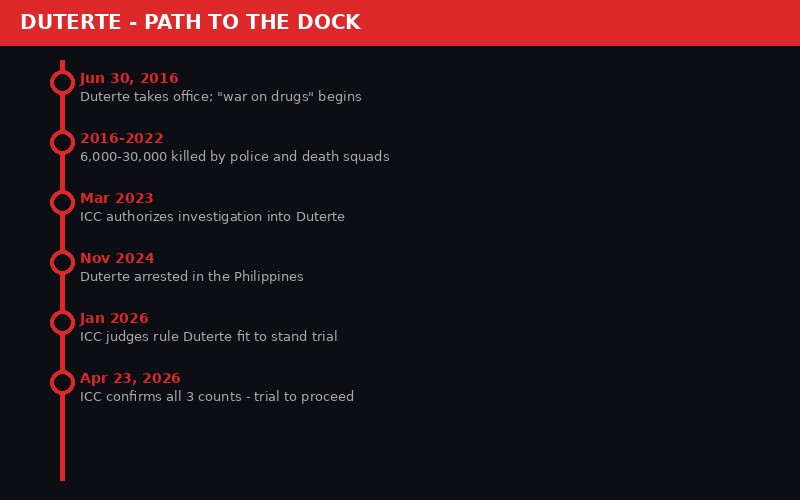
From "war on drugs" to the dock at The Hague. A decade of waiting compressed into a timeline. (BLACKWIRE)
Maria Elena Vignoli of Human Rights Watch said the trial will "send a powerful message that no one responsible for grave crimes is above the law, whether in the Philippines or elsewhere, and that justice will eventually catch up with them." The word "eventually" is honest. It is also devastating.
Two Philippine senators have been named as "co-perpetrators" in the case. The Philippines' current government has distanced itself from Duterte but has not exactly embraced the ICC process. Duterte remains a political force in the country. His daughter, Sara Duterte, was impeached in March 2026 on corruption charges. The family that built its power on corpses still has power. The court in The Hague can confirm charges. It cannot confirm whether the Philippines will ever truly confront what was done in its name.
Rasheed Wasiu: Five Years in Hell for Walking Outside

Rasheed was 17 when he stepped outside. He was 23 when he finally walked free. His mother was gone. (Unsplash)
Not every story of state violence ends at a commission of inquiry or an international court. Some end in a prison cell, where a young man washes other inmates' clothes for a bit of food because the state-provided meals are making him weak. Where 70 people are locked in a room designed for a fraction of that number. Where a cellmate's leg swells until he dies and no one comes to diagnose what was wrong.
Rasheed Wasiu was 17 years old in October 2020 when Nigeria's EndSARS protests swept through Lagos. His mother told him to stay indoors. He did not listen. He says he did not join the demonstration - he was trying to get to a painting job. But the vigilante Odua Peoples Congress caught him in their dragnet alongside weapon-wielding protesters and bundled him into a van.
His mother and neighbors remonstrated. They insisted he was not part of the group. Their pleas were ignored.
He was taken first to an army barracks, then to Lagos's Kirikiri Correctional Centre, where he waited for a trial that would not come for nearly six years. When he finally appeared in court, the charge on his sheet was "unlawful possession of firearms" - not looting, the original allegation. The charge had changed. The evidence had not appeared. The judge eventually struck out the case for lack of evidence.
"Jail is hell if you do not have money to ease your way through and cater for your needs. The food is miserable; we get weak after eating. The space is really congested. They locked up to 70 people in a tiny room at a time. There is no good healthcare, but if you have money, you can have access to good food, a bed and proper medications." - Rasheed Wasiu, speaking to the BBC
Rasheed's story is not unusual in Nigeria. According to the country's prison authorities, approximately 50,000 people are currently in detention without having been convicted of any offense. That is 64% of the total prison population. People waiting for trials that never come, in cells designed for a fraction of their number, eating food that makes them sick, in a system where having money determines whether you eat, sleep on a bed, or see a doctor.
The Take It Back Movement, which provided free lawyers for Rasheed and others detained during the EndSARS protests, has managed to secure the release of about 100 people. One hundred. Out of the thousands who were rounded up during and after the protests. Out of 50,000 still waiting for trial across the country.
Rasheed was freed in early April 2026. He returned home and could not find his mother. Neighbors told him they had thought he was dead. His mother had left the area after being threatened with arrest herself. Sometimes they see her at the market. She does not reply when they greet her. His arrest, they told him, "caused her so much pain and tears."
"I pray to God every day that I will see her, let me just come face to face with her," Rasheed told the BBC. He is living with his uncle now. They are both looking for her. He had been training to be a tailor before his arrest. He would have finished by now and set up his own business. Five years of his life - the years when a person learns a craft, builds a reputation, becomes someone - were stolen by a dragnet and a broken court system. And the person who loved him most may have been destroyed by the same machinery that consumed him.
Asked whether he planned to pursue legal action for the years he lost, Rasheed said: "No, I am leaving everything to God."
That answer - quiet, exhausted, spiritual - is the sound of a person who has been through the system and come out the other side with nothing left to expect from it. The ICC confirms charges. The commission counts the dead. Rasheed leaves it to God, because the institutions that should have protected him did not, and the ones that might compensate him probably will not either.
Amal Khalil: The Journalist They Threatened, Then Killed

Amal Khalil, 43, worked for Lebanese newspaper Al-Akhbar. She had received a death threat in 2024 warning her to leave southern Lebanon. She stayed. (Unsplash)
In 2024, Amal Khalil received an Israeli death threat. The warning told her to leave southern Lebanon. She was a journalist for the newspaper Al-Akhbar. She stayed.
On April 23, 2026, she was killed in an Israeli airstrike in the village of Tayri. She was 43 years old. A freelance photographer, Zeinab Faraj, was injured in the same strike. Two men traveling with them were also killed.
According to Lebanese officials, the sequence was this: An initial airstrike hit the vehicle in front of the journalists. Khalil and Faraj sought shelter in a nearby house. A second strike hit the house. When a Lebanese Red Cross ambulance arrived to treat the wounded, Israeli forces directed a stun grenade and gunfire toward it, preventing it from reaching them.
Lebanon's prime minister, Nawaf Salam, accused Israel of war crimes: "Targeting journalists, obstructing access to them by relief teams, and even targeting their locations again after these teams arrive constitutes war crimes."
The IDF denied targeting journalists. It said it identified two vehicles that had "departed from a military structure used by Hezbollah" and that one vehicle had approached Israeli troops in a manner that was an "immediate threat." It acknowledged reports that journalists were injured but did not acknowledge Khalil's death.
"The repeated strikes on the same location, the targeting of an area where journalists were sheltering, and the obstruction of medical and humanitarian access constitute a grave breach of international humanitarian law." - Sara Qudah, Committee to Protect Journalists
Clayton Weimer, executive director of Reporters Without Borders, said the organization and journalists had sent messages to the IDF asking that it allow ambulances to reach Khalil. "The Red Cross signalled they were unable to get through because of ongoing Israeli bombardment. So that is callous disregard, on top of what appears to be a deliberate and targeted killing of a journalist."
Khalil is not the first journalist killed in this conflict. At least seven journalists have been killed in Lebanon since the latest Israel-Lebanon conflict began. Earlier in April, two journalists - Ghada Dayekh and Suzan Khalil - were killed in separate Israeli strikes. The IDF confirmed it killed Ali Shoeib and Mohamed Ftouni, describing them as "terrorists" from Hezbollah's military wing.
The pattern is clear: journalists in southern Lebanon are dying at an extraordinary rate. Some are affiliated with Hezbollah-linked media. Others, like Amal Khalil, worked for independent or opposition-aligned outlets. The IDF's position is consistent: it does not target journalists. It targets military structures and vehicles. If journalists happen to be near those structures or vehicles, that is not Israel's fault.
But the death threat in 2024 complicates that position. So does the double-tap strike on the house where Khalil sought shelter. So does the blocking of the Red Cross ambulance. So does the fact that seven journalists have been killed in the same conflict zone by the same military. At some point, coincidence becomes pattern. At some point, "we do not target journalists" becomes difficult to distinguish from "we do not take meaningful steps to avoid killing them."
On Thursday morning, journalists gathered at Martyrs' Square in Beirut to remember Khalil in silence. The front page of Al-Akhbar featured a picture of her, microphone in hand, smiling. The newspaper said she "remained steadfast in her humanitarian and professional duty."
She was threatened. She stayed. She was killed. The world noted it. The killing continues.
The Cannabis Reclassification: Symbolic Steps and Stuck Lives

The U.S. reclassified cannabis from Schedule I to Schedule III. The people serving time for Schedule I convictions remain in prison. (Unsplash)
On the same day that Tanzania counted its dead and the ICC confirmed charges against Duterte, the Trump administration quietly reclassified cannabis in the United States. Products containing marijuana that are covered by the FDA or that have received a state medical-marijuana license will move from Schedule I - the same category as heroin - to Schedule III, alongside Tylenol with codeine. A hearing has been ordered for June to consider reclassifying all marijuana more broadly.
Acting Attorney General Todd Blanche called it "delivering on President Trump's promise to expand Americans' access to medical treatment options." The change allows for research on the safety and efficacy of cannabis and gives doctors more reliable information. It is, by any measure, a significant policy shift for a country that has classified marijuana as having "no currently accepted medical use" since 1970.
But here is what the reclassification does not do: it does not free the people serving federal prison sentences for cannabis offenses. It does not expunge the criminal records of the people - disproportionately Black and Latino Americans - whose lives were upended by a Schedule I classification that the government now implicitly admits was wrong. It does not address the decades of disproportionate enforcement that sent some communities to prison while others opened dispensaries.
"Moving it out of that classification allows us to have policy conversations that don't start and end with that definition. Lots of policymakers continue to fall back on that, and really won't even discuss the issue as long as cannabis is Schedule I." - Morgan Fox, National Organization for the Reform of Marijuana Laws
Morgan Fox of NORML called the change "mostly symbolic." More than two-thirds of Americans support full legalization. The reclassification opens the door to those conversations. But opening a door is not walking through it. And while policymakers have their conversations, the people who were criminalized under the old classification are still living with the consequences. Rasheed Wasiu's five lost years are a Nigerian story. But the United States has its own Rasheeds - people who walked outside at the wrong time, in the wrong neighborhood, with the wrong skin color, and lost years to a system that now admits the underlying law was excessive.
The rule change takes effect 30 days after publication in the Federal Register. It can be legally challenged - and will be - potentially blocking implementation for months or years. Meanwhile, the people who needed medical access that was denied under Schedule I are still waiting. The people who went to prison under Schedule I are still inside. Symbolic progress is still progress. It is just not justice.
India's Missing Voters: Democracy by Deletion

Millions of Indians have been stripped from electoral rolls ahead of critical state elections. Experts say minorities are disproportionately affected. (Unsplash)
Half a world away from The Hague and Dar es Salaam, another kind of violence is unfolding in India - quieter, bureaucratic, no less consequential. Ahead of critical state elections in West Bengal, millions of voters have been stripped from the electoral roll in what the government calls a "purification" exercise. Experts say Muslims and other minorities have been disproportionately deleted.
The mechanism is administrative. Names are removed from voter lists through a verification process that ostensibly aims to clean up inaccurate rolls. But the effect is targeted: in a country where religious identity and voting patterns are tightly correlated, removing voters from minority-heavy districts changes electoral outcomes without a single bullet being fired. It is repression by spreadsheet.
India's government has framed the deletions as necessary housekeeping. Opposition parties and civil rights organizations have described them as deliberate disenfranchisement. The government failed to pass a bill to boost women's representation after a delimitation row - another process that determines electoral boundaries and can dilute or concentrate voting power along communal lines.
The pattern connects to Tanzania's 98% election and to Duterte's Philippines in ways that are structural if not identical. When the mechanisms of democratic accountability - free elections, independent courts, a free press - are undermined, the result is not always visible blood. Sometimes the result is a name that disappears from a list. Sometimes the result is a candidate who cannot run. Sometimes the result is a court that moves too slowly to matter. The violence is in the erasure, not the explosion.
India is the world's largest democracy. It is also a country where the tools of democracy are being recalibrated to serve the ruling party's interests. The voter purge is not a single event. It is a process, ongoing and incremental, that changes who counts - literally - in the democratic arithmetic.
The Thread That Connects
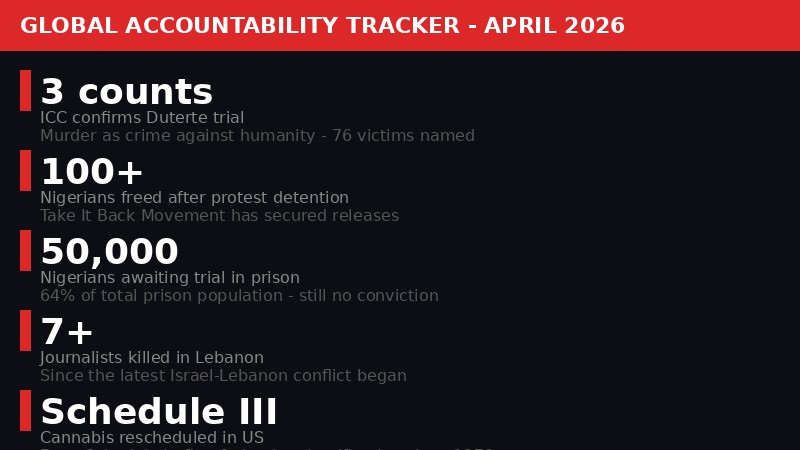
Accountability is moving. The question is whether it reaches the people who need it. (BLACKWIRE)
What connects Tanzania, the Philippines, Nigeria, Lebanon, the United States, and India on April 23, 2026 is not a single event. It is a structural condition: the distance between accountability and justice is widening even as accountability becomes more visible.
We can count the dead now. Tanzania's commission did that. The ICC can confirm charges. The ICC did that. Nigeria's courts can strike cases for lack of evidence. They did that. The United States can reclassify a drug it spent decades criminalizing. It did that. But counting the dead without naming the killers is not justice. Confirming charges without guaranteeing the defendant will appear is not justice. Freeing an innocent man after five years without compensation or an apology is not justice. Reclassifying a substance without freeing the people who were imprisoned under the old classification is not justice.
Rasheed Wasiu lost five years and his mother. The ICC will spend a year preparing for a trial of a man who may not attend. Tanzania counted 518 dead and blamed "coordinated protesters." Amal Khalil was threatened, targeted, and killed, and the IDF said it does not target journalists. India is deleting voters and calling it housekeeping.
The global accountability infrastructure is real. It exists in The Hague, in Geneva, in the offices of Human Rights Watch and Amnesty International and Reporters Without Borders. It exists in the commissions of inquiry and the press conferences and the carefully worded statements. But accountability is a process. Justice is an outcome. And the distance between the two is measured in human lives - the years Rasheed lost, the mother he cannot find, the journalists who will not report tomorrow, the voters who will not cast ballots, the prisoners still serving time for laws the government admits were wrong.
On April 23, 2026, the world acknowledged more than it usually does. A commission counted 518 dead. A court confirmed charges against a former president. A young man walked free after five years. A country reclassified a drug. These are not nothing. They are the scaffolding of accountability. But scaffolding is not a building. And the people who need shelter - the families of the dead, the wrongly imprisoned, the silenced, the disappeared - are still standing in the rain.
"I pray to God every day that I will see her, let me just come face to face with her." - Rasheed Wasiu, searching for his mother
That prayer - desperate, simple, human - is what accountability sounds like when it has not yet become justice. It is the sound of a person who has been through the system and come out the other side still looking for the person the system also consumed. The commissions will meet. The courts will schedule. The parliaments will debate. The reclassifications will take effect in 30 days, subject to legal challenge, pending further review.
And Rasheed is still looking for his mother.
Sources: BBC Africa - Tanzania election violence inquiry (BBC); BBC Pidgin - Rasheed Wasiu EndSARS case (BBC); Al Jazeera - ICC confirms Duterte trial (Al Jazeera); BBC News - Amal Khalil killed in Lebanon (BBC); BBC News - US cannabis reclassification (BBC); The Guardian - India voter purge (The Guardian); Committee to Protect Journalists; Human Rights Watch; Amnesty International; Reporters Without Borders
EMBER is BLACKWIRE's culture and society desk. Empathetic but never soft. Finding the human in every headline.