Africa's $2 Billion Surveillance Bet - Made in China
A landmark study by the UK-based Institute of Development Studies and the African Digital Rights Network has confirmed what digital rights advocates have suspected for years: Beijing has exported its surveillance model to Africa at industrial scale, and eleven governments bought it with their citizens' freedoms attached as collateral.
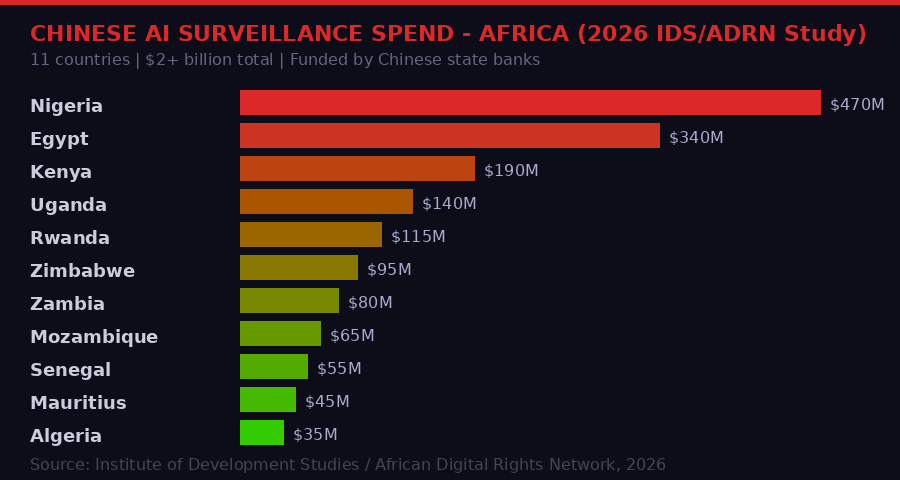
The numbers are stark. Eleven African countries - Nigeria, Egypt, Kenya, Uganda, Rwanda, Zimbabwe, Zambia, Mozambique, Senegal, Mauritius, and Algeria - have spent more than $2 billion on AI-powered surveillance systems, much of it financed by Chinese state banks and conditioned on purchasing Chinese hardware and services. Nigeria alone has committed $470 million. Egypt follows at $340 million. The full tally, documented in the most comprehensive study of its kind ever published, represents a continental surveillance buildout that dwarfs comparable investments in Western democracies - yet operates almost entirely without the legal frameworks those democracies take for granted.
None of the eleven countries in the study have what the researchers call "adequate mechanisms for citizens to obtain remedy or redress in case of smart surveillance errors or abuse." Not one has a dedicated law governing smart surveillance of public space. Not one requires a court warrant before authorities activate facial recognition on its citizens.
This is not an accident. It is a system designed to work exactly this way.
How the System Works: Loans With Conditions Attached
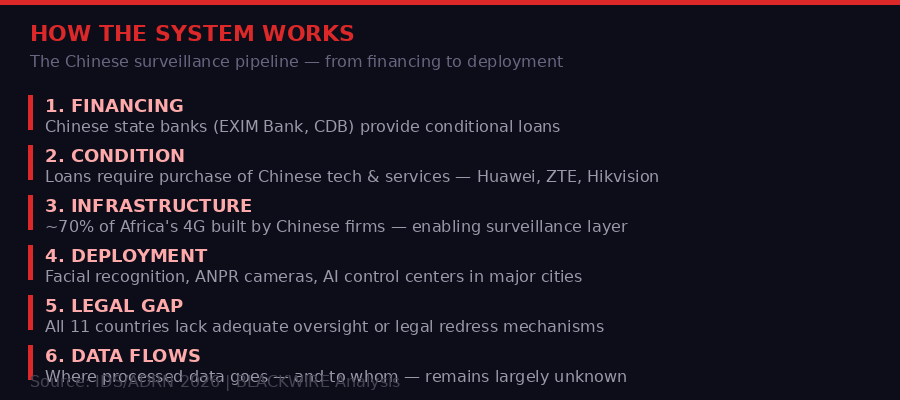
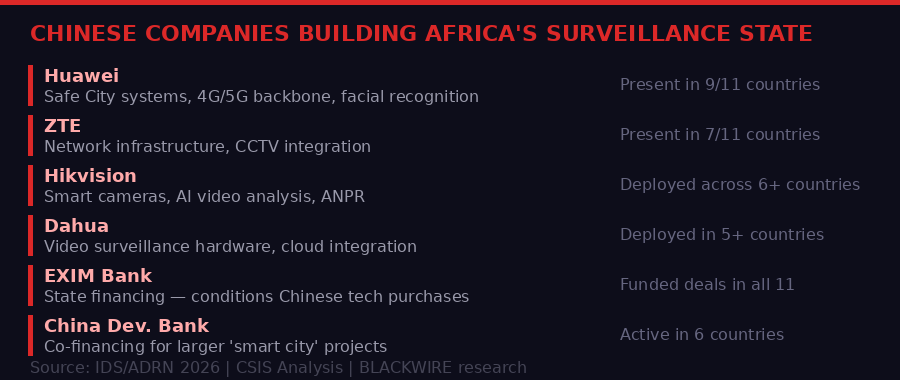
The mechanism is elegant in its circularity. Chinese state banks - primarily the Export-Import Bank of China and the China Development Bank - offer African governments favorable loan terms for "smart city" and "safe city" infrastructure projects. The catch: loans are conditional on purchasing technology and services from Chinese companies. Huawei builds the networks. ZTE installs the backbone. Hikvision and Dahua supply the cameras. AI control centers, often staffed by local authorities but designed and sometimes operated by Chinese firms, process the data.
"These huge loans are conditional on the purchase of Chinese technology and services needed to build and transfer the 'safe city' systems," wrote Wairagala Wakabi and Tony Roberts, the authors of the IDS/ADRN study published this month. The financing structure is not unusual in Chinese development lending - it mirrors Belt and Road infrastructure deals across Asia and Latin America. But applied to surveillance technology, the stakes are different. You can renegotiate a toll road. You cannot un-build a facial recognition database.
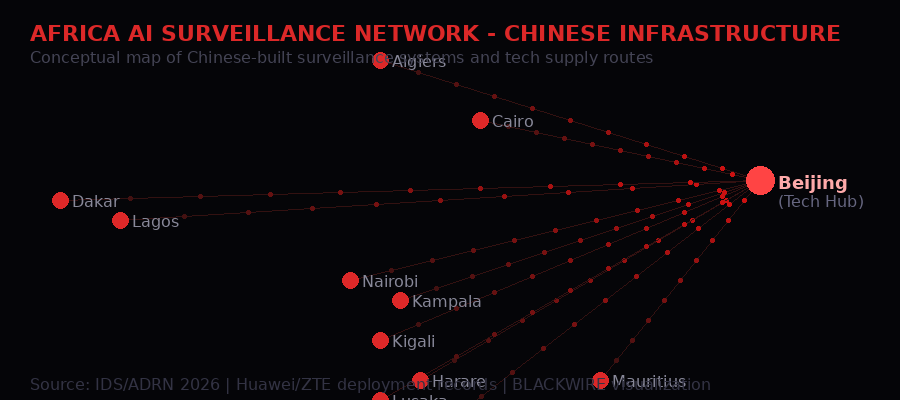
Chinese infrastructure companies hold a structural advantage that makes the technology dependency almost inevitable. Huawei and ZTE have built approximately 70% of Africa's 4G network infrastructure, according to researchers at Italy's LUISS School of Government. That network is the foundation on which all surveillance devices depend. Cameras need connectivity. AI analysis centers need bandwidth. When the backbone is Chinese-built, the devices that run on it tend to be Chinese-built too - if only because the integration is simpler and the support contracts are bundled in.
This creates a compounding lock-in. A government that accepted a Huawei 4G contract in 2016 finds itself, a decade later, with an entire surveillance stack - cameras, servers, software - that talks natively to Chinese systems and requires Chinese expertise to maintain. Switching costs are enormous. The dependency deepens with every upgrade cycle.
"The surveillance bond between Africa and China runs deeper than the former purchasing tools for facial recognition or automated license plate tracking from the latter." - Rest of World, March 2026
A Colonial Architecture Updated for the AI Age
The IDS study does not present Chinese surveillance investment in Africa as something new. It traces the architecture back to colonial-era intelligence networks - the structures of population monitoring that European empires built and African states inherited. What has changed is the technology and the scale, not the underlying logic.
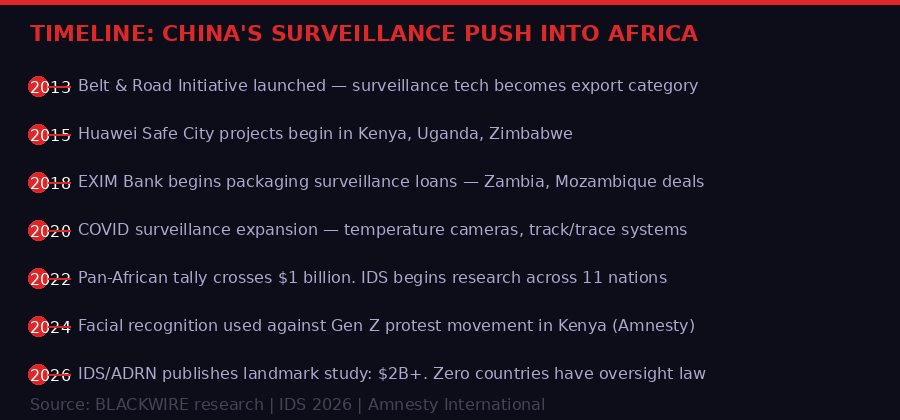
Huawei's Safe City program began formal deployment in Kenya, Uganda, and Zimbabwe around 2015. By 2018, EXIM Bank loan packages were specifically structured to include surveillance components alongside road and energy projects. COVID-19 accelerated the expansion: temperature cameras, contact-tracing infrastructure, and movement-monitoring systems were rolled out across the continent under public health rationales that often outlasted the emergency that justified them.
The 2024 case in Kenya is the study's most pointed recent example. Facial recognition technology - built on Chinese infrastructure - was reportedly used to monitor and identify activists during the Gen Z-led protest movement that rocked Nairobi that year, according to Amnesty International. The protesters were challenging a finance bill; the tools used against them had been sold to the government years earlier as crime-fighting infrastructure.
Similar patterns have emerged in Uganda, where facial recognition was reportedly used against activists, and across Latin America, where Ecuador and Argentina have faced scrutiny over Chinese surveillance systems empowering authoritarian tendencies in government. Tibetans are being tracked in Nepal using Chinese-exported technology. The pattern is global. Africa is just the continent where it has been most thoroughly documented.
The researchers draw an explicit line between the technology and the political economy that enables its misuse: these are not rogue deployments by bad actors. They are the predictable output of a system in which surveillance technology is deployed at scale, without legal guardrails, in political environments where dissent is already fragile.
The Countries, the Companies, and the Cameras
Nigeria is the largest single market, with $470 million committed to surveillance infrastructure. Its smart camera network is the continent's most extensive among the eleven studied. Lagos and Abuja have hundreds of AI-enabled cameras operating across major intersections and government zones. The stated purpose is crime reduction. The infrastructure also has obvious applications for political monitoring.
Egypt's $340 million investment is concentrated around Cairo and major transport hubs. Egypt under President Abdel Fattah el-Sisi has some of the most extensive state surveillance apparatus in the Middle East and North Africa region, and Chinese technology has expanded its technical capabilities significantly. Human rights organizations including Human Rights Watch have documented the use of digital surveillance against journalists, opposition figures, and LGBTQ+ individuals in Egypt.
Kenya sits at $190 million, with a particular concentration in Nairobi's central business district and border crossings. Rwanda has invested $115 million - a substantial sum for a small country - in systems that observers say fit a pattern of tight state control of public space that the Rwandan government has maintained since the 1994 genocide. The surveillance infrastructure there has been praised by some for reducing violent crime; criticized by others for enabling monitoring of political opposition and civil society.
Zimbabwe ($95M), Zambia ($80M), Mozambique ($65M), Senegal ($55M), Mauritius ($45M), and Algeria ($35M) complete the eleven. The technology providers are consistent across all of them: Huawei appears in nine of eleven countries. ZTE in seven. Hikvision - the Hangzhou-based camera manufacturer that the U.S. government has already blacklisted over national security concerns - deployed in six or more. Dahua, another blacklisted Chinese camera maker, in five or more.
The U.S. government banned federal procurement of Hikvision and Dahua equipment in 2018, citing risks to national security. The same equipment continues to be actively sold across Africa, often with Chinese state financing making the purchase nearly irresistible for cash-strapped governments seeking to modernize their security infrastructure on favorable terms.
"In the absence of terrorist threats or crimes, such mass surveillance compromises citizens' right to privacy." - IDS/ADRN Study Authors, 2026
The Oversight Void: What Doesn't Exist
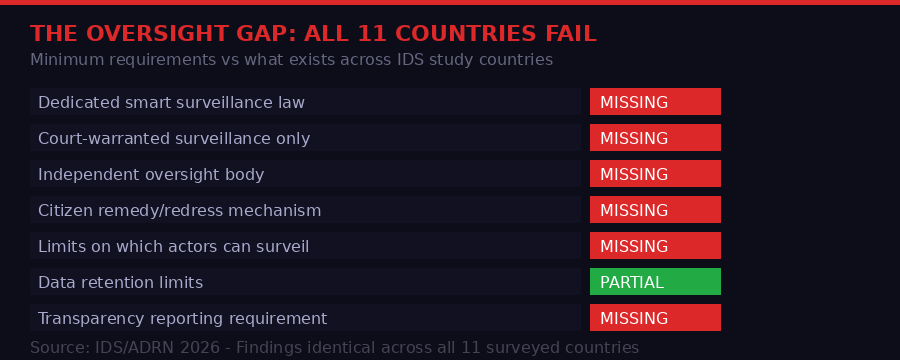
The study's most alarming finding is not the scale of investment or even the identity of the vendors. It is the complete absence of legal architecture to govern what has been built.
In all eleven countries, citizens cannot effectively challenge decisions made using AI surveillance data. There is no mechanism to appeal a facial recognition flag, no process to dispute an automated license plate identification, no way to learn whether you have been placed on a watchlist or why. The systems operate in a legal vacuum where the technology exists but the rights framework to constrain it does not.
The researchers are specific about what needs to change. Governments need, at minimum: a dedicated law on smart surveillance that defines which actors are permitted to conduct public space monitoring; limitations that restrict surveillance to instances specifically warranted by a court; an independent oversight body that is genuinely separate from the government, police, and judiciary; and a clear mechanism allowing citizens to seek redress when errors occur or rights are violated.
None of the eleven countries currently meet this standard. In some cases, the legal infrastructure needed to even draft such protections - independent judiciaries, free press to report abuses, civil society organizations to advocate for change - is itself under pressure from the same governments operating the surveillance systems.
This is the deeper problem the study surfaces. Surveillance technology in an environment with strong rule of law and independent institutions can be constrained, corrected, and held accountable. The same technology in an environment with weak institutions, captured courts, and restricted civil society becomes something else entirely. It becomes infrastructure for control.
The IDS researchers note that over 60 countries worldwide now use Chinese AI surveillance technology. Africa is not unique - it is exemplary of a global pattern in which authoritarian-friendly surveillance tools flow from their point of manufacture to environments where the legal constraints on their use are minimal or nonexistent.
Africa as Proving Ground: What China Gains
The financial motivation is straightforward. Chinese surveillance companies need export markets. Africa's rapidly urbanizing cities, growing middle classes, and government demand for security infrastructure represent a massive commercial opportunity. Huawei Safe City alone has been deployed in more than 100 cities in over 40 countries globally; Africa is one of its fastest-growing regions.
But there is a second-order benefit that deserves more scrutiny: data. Facial recognition systems improve through training. The more faces a system processes in varied conditions - different lighting, different demographics, different urban environments - the more accurate it becomes. Deploying AI surveillance across eleven African nations, with their enormous demographic diversity and urban density, generates training data of incalculable value.
Where that data goes is, by the study's own admission, largely unknown. The surveillance contracts between Chinese companies and African governments vary enormously in their terms, and most are not public documents. Some contracts, documented in the Belt and Road context, include provisions that give Chinese companies ongoing access to the systems they build - for maintenance, upgrades, and "quality assurance." What else those access provisions enable is not always specified.
This matters because facial recognition trained primarily on East Asian faces has historically performed significantly worse on African faces - a bias documented in multiple academic studies and confirmed by practical deployments. If Chinese companies are using African deployment data to correct that bias and build more globally accurate systems, the continent is contributing to its own more effective surveillance at no additional cost to the developers.
The geopolitical dimension compounds this. As the U.S.-China competition for AI supremacy intensifies, facial recognition capability in diverse global environments is strategically valuable. A surveillance network spanning eleven African nations, connected to Chinese-built telecommunications infrastructure and feeding data back through Chinese-maintained systems, represents the kind of long-term strategic asset that does not appear on any Chinese government spreadsheet labeled "surveillance exports."
"The security frameworks underpinning technology partnerships appear to have focused on supply chain control and geopolitical alignment, not on physical defense - or human rights." - Paraphrased from analyst commentary, Rest of World / CSIS research, 2026
The Resistance: Who Is Pushing Back and Why It Matters
The IDS study arrives as grassroots resistance to AI infrastructure expansion is gaining momentum globally. Rest of World reported this week on communities in Chile, Kenya, and the Philippines pushing back against the environmental and social costs of big tech's AI buildout - a trend that offers at least a partial counterweight to the dynamics the IDS study describes.
In Kenya specifically - one of the eleven countries in the surveillance study - a coalition of digital rights organizations including the Data Labelers Association, founded by Joan Kinyua after eight years of exploitative conditions in AI data annotation work, is building institutional capacity to push for ethical labor standards in tech. Separately, the Amnesty International documentation of facial recognition use during the 2024 Gen Z protests created public awareness of surveillance infrastructure that most Kenyans did not know existed.
In Uganda, civil society organizations have challenged facial recognition use in court, with mixed results. In Rwanda, critics face a more constrained environment - the same tight state control that makes the surveillance infrastructure politically useful to the government makes organized opposition to it dangerous.
The IDS researchers make a pointed recommendation: African governments should engage directly with communities before deploying surveillance systems, conduct independent human rights impact assessments, and build oversight bodies that include civil society representation. They acknowledge this asks governments to constrain capabilities they have just paid $2 billion to acquire. That is a significant ask.
The alternative framing - that surveillance infrastructure without oversight is not a security tool but a control mechanism - is the one that digital rights advocates are trying to mainstream. The IDS study gives them the most comprehensive evidentiary basis to date for that argument. Whether African governments, under pressure from both their own security establishments and their Chinese creditors, respond to it is the question that will define the next phase of this story.
The Broader Pattern: From Africa to Everywhere
It would be easy to read this as a story specifically about Africa's vulnerability to Chinese surveillance exports, and miss the larger pattern. The same dynamic - technology with enormous surveillance capability deployed at scale in environments with inadequate legal constraints, financed by actors with strategic interests in its adoption - is playing out everywhere that AI infrastructure is being built fast.
Consider the parallel: Silicon Valley hyperscalers poured $15 billion (Microsoft), $5 billion (Amazon), and hundreds of billions more into Gulf state AI infrastructure before the current war made the political risks undeniable. Those deals were made in environments where human rights frameworks were, at best, aspirational. The commercial logic was identical to Chinese surveillance exports to Africa: favorable conditions, strategic positioning, minimal friction from regulatory requirements.
The AI surveillance market globally is projected to reach $45 billion annually by 2028. China controls an estimated 50-70% of the facial recognition technology market. Much of that market is in countries that combine high surveillance demand with low legal oversight. This is not a coincidence - it is a go-to-market strategy, whether explicitly designed or not.
The IDS study is important not just for what it reveals about Africa specifically, but for what it models methodologically. Mapping the full chain - from financing to vendor to deployment to legal environment to documented misuse - provides the kind of accountability framework that equivalent research in Latin America, Southeast Asia, and the Middle East has not yet produced at comparable scale. Those regions have their own versions of this story waiting to be told.
What the IDS researchers call the "surveillance bond" between Africa and China - built on 4G networks, conditioned loans, and AI cameras that see everything and answer to no one - is not Africa's problem. It is the template for where this industry is headed unless oversight catches up to deployment. The eleven countries in this study are not outliers. They are previews.
Key Facts from the IDS/ADRN Study (2026)
- $2 billion+ spent by 11 African countries on Chinese AI surveillance systems
- Nigeria leads at $470M - also has the largest smart camera network in the study
- Huawei and ZTE built approximately 70% of Africa's 4G infrastructure - the backbone for all surveillance devices
- Chinese state banks (EXIM Bank, China Development Bank) financed deals conditional on Chinese tech purchases
- Zero countries in the study have an adequate dedicated smart surveillance law
- 60+ countries globally now use Chinese AI surveillance technology
- Facial recognition has been documented as used against activists in Uganda and protesters in Kenya
- Hikvision and Dahua - US-blacklisted Chinese camera makers - are deployed across multiple study countries
- The study covers: Algeria, Egypt, Kenya, Mauritius, Mozambique, Nigeria, Rwanda, Senegal, Uganda, Zambia, Zimbabwe
The study is available through the Institute of Development Studies at ids.ac.uk and the African Digital Rights Network. It is the most detailed accounting yet of how China has built surveillance infrastructure across a continent - and what that infrastructure is already being used for.
Get BLACKWIRE reports first.
Breaking news, investigations, and analysis - straight to your phone.
Join @blackwirenews on Telegram