Cannon Fodder From the Global South: How Russia Is Draining Africa's Young Men
Zimbabwe has become the latest country to confirm its nationals are dying on Russian orders in Ukraine. Fifteen dead. Sixty still trapped. And a Ukrainian intelligence estimate that places the total across the continent at more than 1,700 people from 36 countries - lured in by social media lies, left to rot when the bullets hit.

Russia's recruitment of African fighters is now a documented, multi-country crisis - not an isolated anomaly. (Pexels)
The body count was never supposed to become official. That was the point. Recruiters promised high pay, light duties, a leg up in a world economy that had no use for young men from Harare, Nairobi or Accra. They promised them construction work, or logistics, or security contracts far from any front line. The social media ads were slick. The WhatsApp groups were full of testimonials.
Then the men arrived in Russia, and the truth came out. There was no construction job. There was a uniform, a rifle, and a bus toward eastern Ukraine.
On Thursday, Zimbabwe's Information Minister Zhemu Soda confirmed publicly what families in Harare had suspected for months: fifteen Zimbabwean nationals have been killed fighting for Russia's military in Ukraine. More than sixty others remain on the frontlines, trapped, with no clear path home. Source: BBC, March 26, 2026.
It is the first time Zimbabwe has officially acknowledged the scale of the crisis. It will not be the last country to do so.
The Mechanics of the Lie

Recruiters use Facebook, WhatsApp and Telegram to target men across the African continent with fake job offers. (Pexels)
Minister Soda's language was precise, and damning. He described a "sophisticated scheme of deception, exploitation, and human trafficking." The primary weapon: social media platforms. Facebook job groups, Telegram channels, WhatsApp networks - these are the hunting grounds where Russia's recruiting apparatus finds its targets.
The pitch is consistent across every country where this pattern has appeared. A well-paid job in Russia is on offer: security work, construction on infrastructure projects, logistics support. Salaries ranging from $1,500 to $2,500 per month - many times what a young man in Harare or Accra could earn at home. The offer looks legitimate. The recruiters have fake company websites, sometimes fake testimonials, sometimes real men who have already made the trip and been pressured into recruiting their friends.
What happens next follows a predictable script. The recruit lands in Russia. Their passport is taken, often under the guise of "processing." They are moved to a military training facility. Within weeks, they are told their contract has changed. They are now part of a military unit. Refusing is not an option - they are deep in a foreign country, without documents, without money, unable to speak the language.
Soda warned explicitly: "The recruiters often disappear once a recruit is injured, captured, or killed, leaving relatives with no financial support or information." Source: BBC, March 26, 2026.
That warning is not hypothetical. The families of Zimbabwe's fifteen dead have been trying to find out what happened to their relatives for months. The recruiter's phone number stopped working. The WhatsApp group disappeared. The company name turned out to be fictional.

Fake job offers spread via WhatsApp, Telegram and Facebook have lured men from across sub-Saharan Africa into Russia's military system. (Pexels)
The Scale Across the Continent
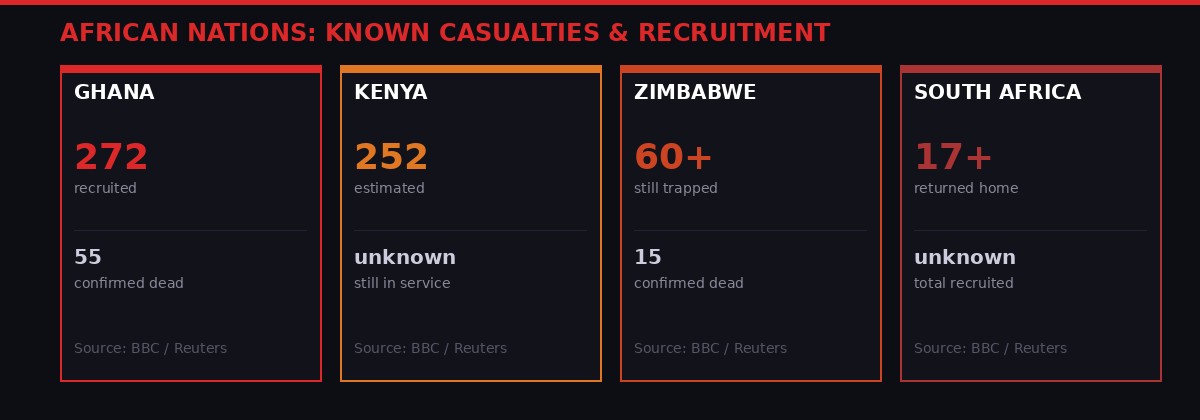
Data compiled from BBC, Reuters, AP, and official government statements - March 2026. Numbers are confirmed minimums; actual figures are believed to be higher.
Zimbabwe's announcement Thursday is the latest chapter in a story that has been unfolding quietly for more than two years. The picture, assembled from official government statements and Ukrainian intelligence reporting, is staggering in scope.
Ghana reported in February 2026 that approximately 272 of its citizens had been recruited to fight for Russia since the war began in 2022. Of those, 55 have been confirmed killed. The Ghanaian government issued a formal protest to Moscow and demanded repatriation of its nationals. Source: BBC, February 2026.
Kenya estimates 252 of its citizens have been illegally conscripted through recruitment schemes based in Russia. Kenyan Foreign Minister Musalia Mudavadi traveled to Moscow last week specifically to address the crisis. He announced that an agreement had been reached to stop deploying Kenyan nationals to the front. Whether that agreement holds is another matter. Source: BBC, March 2026.
South Africa secured the return of 17 of its nationals in February 2026 - men who had been "allegedly tricked into joining the war," according to official government statements. The South African government has publicly acknowledged the pattern of deception but declined to characterize it formally as human trafficking, a decision that has drawn criticism from civil society organizations in Johannesburg. Source: BBC, February 2026.
Zimbabwe is now the most recent country to put official numbers to its losses: 15 dead, 60-plus still on the frontlines as of Thursday. The government is in negotiations with Russian authorities over repatriation of both bodies and living recruits. Source: BBC, March 26, 2026.
These are confirmed minimums. A Ukrainian intelligence assessment cited by the BBC puts the total number of Africans who have been recruited to fight for Russia at more than 1,700 people across 36 countries. That figure encompasses the known cases - and analysts with direct knowledge of the recruitment networks say the real number is almost certainly higher, because many families have not come forward, either out of shame, fear, or simply because they do not know where their relative went.
"It is a sophisticated scheme of deception, exploitation, and human trafficking that has already resulted in the loss of Zimbabwean lives." - Zhemu Soda, Zimbabwe Information Minister, March 26, 2026 (via BBC)
Russia's Manpower Problem and the African Solution

Russia's four-year war in Ukraine has created severe manpower pressure - and an offshore recruitment solution. (Pexels)
To understand why Russia is pulling men from Zimbabwe, Kenya and Ghana to die in Donetsk, you have to understand the numbers problem Moscow has been trying to solve since 2022.
The initial invasion was premised on a quick military victory that never came. Russia has spent four years absorbing casualties at a rate its official statistics will never acknowledge. Estimates from Western intelligence agencies and Ukrainian battlefield reporting consistently put Russian military dead in the hundreds of thousands. The Kremlin has responded with a series of partial mobilizations, each generating domestic political friction that Vladimir Putin's government has been desperate to minimize.
The solution that emerged - and it emerged organically rather than through any single policy decision - was to supplement Russian manpower with foreigners who could be recruited under false pretenses and fed into units where their deaths would generate no political cost at home. North Korean troops arrived by the tens of thousands. Central Asian recruits were lured through similar fake-job schemes targeting migrant workers already living in Russia. And then the apparatus expanded into Africa.
Africa offered specific advantages. Desperate economic conditions in Zimbabwe, where annual inflation has historically destroyed savings and formal employment is scarce. In Kenya, in Ghana, in South Africa's townships - everywhere that young men face a future of low wages and limited options, the $2,000-a-month promise looks transformative. The distance from home makes verification of the job offer nearly impossible. Language barriers prevent recruits from fully understanding contracts written in Russian. And once a man is inside the Russian system, the bureaucratic and physical barriers to leaving are effectively insurmountable.
The recruits are not Wagner Group contractors in any meaningful sense - they are not experienced mercenaries paid premium rates for professional service. They are desperate men fed into frontline units as infantry, given minimal training, and used in the kind of mass assault operations that Russian commanders have employed against Ukrainian defensive positions throughout the conflict. Their survival rate, per the casualty counts emerging from across Africa, is grim.

Families across Africa have protested and petitioned governments for information on relatives who disappeared after following job offers to Russia. (Pexels)
Timeline: From Silence to Official Acknowledgment
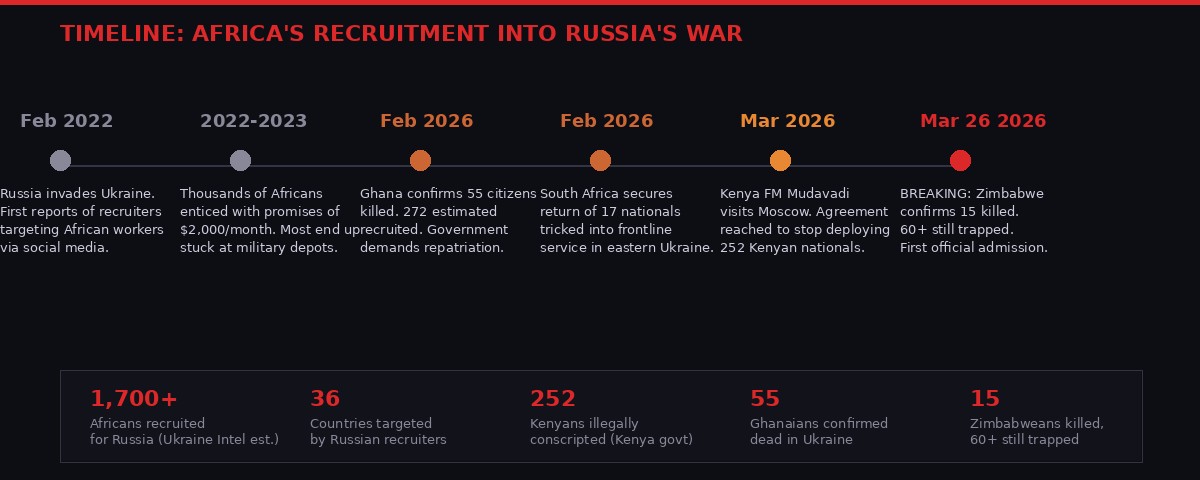
Timeline compiled from BBC, Reuters, AP and government statements - 2022 to March 26, 2026.
The pattern of official silence followed by forced acknowledgment has repeated itself across every African country affected. The sequence is almost always the same.
First, families report missing relatives. The men left for Russia, communications stopped, and the recruiters' phones went dead. Local media pick up the stories. The government initially deflects, suggesting the men entered contracts voluntarily.
Then the bodies start coming back - or more often, families receive news of a death with no body to bury and no official documentation of what happened or where. The pressure intensifies.
Then - sometimes after months, sometimes after years - there is an official acknowledgment. A press conference. A minister's statement. An emergency consular visit to Moscow. Promises of repatriation. An agreement that may or may not be honored.
Ghana was the most dramatic case prior to Thursday. When the government confirmed 55 dead in February 2026, the number shocked Ghanaians who had not followed the emerging reports. Family members who had filed missing persons reports were suddenly being told their sons and brothers were dead - killed in a war in Eastern Europe they had never agreed to join.
Kenya moved faster than most. Foreign Minister Mudavadi's trip to Moscow last week resulted in what he described as an agreement to halt recruitment of Kenyan nationals. But that agreement covers future recruitment - it does not bring home the 252 Kenyans estimated to be in Russian military service already, and it depends entirely on Russian goodwill in enforcement.
South Africa's repatriation of 17 nationals in February was presented as a success, and in narrow terms it was. But it raised an obvious question: how many more remain? The South African government has not provided an estimate of the total number of its nationals who have been recruited since 2022.
Zimbabwe's Thursday announcement is notable for being among the most specific and openly critical of Russia that any African government has issued. Soda's description of the scheme as "human trafficking" - not merely deceptive recruitment, but trafficking - is significant language from a government that has historically maintained close diplomatic and economic ties with Moscow.
What Happens to the Survivors

The path home for surviving African recruits depends almost entirely on bilateral negotiations between governments and a Russian administration that has no obvious incentive to release them. (Pexels)
For the sixty-plus Zimbabweans still on Russian frontlines, and for the hundreds of Kenyans, Ghanaians and others in similar situations, the immediate question is: how do they get out?
The diplomatic channel is the only one that has produced results. South Africa secured returns through direct engagement at the Foreign Ministry level. Kenya secured a non-recruitment agreement through a ministerial visit. Zimbabwe is now conducting the same process - but each negotiation starts from scratch, and Russian officials have shown no enthusiasm for expediting the process.
For men currently serving in combat units, the practical obstacles are severe. Desertion carries the same legal penalties in Russia as it does in any military system - in wartime, those penalties can include execution. Captured deserters from Russian units are prosecuted. Foreign nationals, lacking Russian citizen status, may face even harsher treatment and have no access to consular assistance while serving in active military units.
Men who are wounded and evacuated from the front have somewhat more freedom of movement - but even then, leaving Russia requires a valid passport, which many recruits had confiscated at entry, and travel funds, which most do not have.
The seventeen South Africans who were repatriated in February 2026 were reportedly among men who had managed to reach Russian cities, rather than those still in active frontline units. Getting word to their embassy took months. The actual process of securing their departure took months more.
"We appreciate the support of those who are ready to work with us to ensure security, and we support them too." - Ukrainian President Volodymyr Zelensky, speaking about drone technology cooperation during a visit to Saudi Arabia, March 26, 2026 (via BBC) - a visit that underscores how the Ukraine conflict's reach now extends across three continents.
The Diplomatic Fallout and Russia's Silence

African governments are conducting bilateral diplomacy with Moscow over their nationals - but Russia has provided no official response to the recruitment allegations. (Pexels)
Russia has not officially acknowledged running a systematic program to recruit African nationals. When pressed by African governments, Russian officials have typically responded that the men entered contracts voluntarily and that their military service is a private legal matter. Moscow has made no public statements acknowledging the deaths confirmed by Ghana, Zimbabwe, or other countries.
This silence is strategic. Acknowledging the program would mean acknowledging both Russia's manpower desperation and the deceptive recruitment practices that make the program function. It would also open Russia to formal international legal challenges - human trafficking at state scale is a serious violation of international law, regardless of whether the victims consented to initial travel.
For African governments, the political calculation is complicated. Countries like Zimbabwe and Ghana have cultivated economic and political relationships with Russia that predate the Ukraine conflict. BRICS membership, arms purchases, diplomatic solidarity at the United Nations - these relationships have real value, and openly characterizing Russia's behavior as trafficking puts those relationships at risk.
Zimbabwe's Minister Soda used the word "trafficking" anyway. That signal is worth paying attention to. It suggests the domestic political pressure from affected families has reached a level that outweighs the diplomatic cost of naming what is happening.
Other African governments that have been quieter may face the same calculation if their casualty figures continue to mount. Kenya has 252 estimated nationals in Russian service. If that number generates its own body count at anything like the rate seen in Ghana or Zimbabwe, the pressure on Nairobi will be severe.
The African Union has not issued a collective statement on the recruitment crisis. Individual member states have acted unilaterally, which limits their negotiating leverage with Moscow. A coordinated AU position - demanding repatriation, threatening formal legal action, suspending certain diplomatic engagements - would carry more weight. Whether the political will exists for that kind of coordination is a different question.
Ukraine's Countermeasures and the Intelligence Picture

Ukrainian intelligence has been tracking Russia's African recruitment networks since at least mid-2023, and estimates total recruitment at 1,700+ across 36 countries. (Pexels)
Ukraine's military intelligence apparatus has been monitoring Russia's African recruitment operation since at least mid-2023. The 1,700-person estimate across 36 countries comes from a Ukrainian intelligence assessment - a figure that African governments themselves have not publicly confirmed or challenged, and which analysts consider a conservative estimate given the opacity of the recruitment networks.
Ukrainian intelligence has documented the structure of the recruitment chains. The networks are not controlled by a single Russian state agency. They appear to be a hybrid operation: some elements run by GRU-linked contractors, others operated by private intermediaries working on commission, and still others by criminal enterprises that realized the Russian military was a reliable buyer of foreign manpower.
This distributed structure makes it difficult to shut down through any single intervention. Kenya's agreement with Moscow to stop deploying Kenyan nationals may slow one pipeline. But if private operators continue running the same scheme, and if Russian military units continue accepting whoever arrives at their gates, the agreement's practical impact may be limited.
The Ukrainian government has been strategically transparent about the recruitment data. Publishing estimates of African recruitment serves Ukraine's diplomatic interests - it frames Russia as predatory toward the Global South, which complicates Russia's narrative at the United Nations, where African bloc votes matter, and in bilateral relationships where Moscow has positioned itself as an anti-colonial alternative to Western-led institutions.
Meanwhile, Zelensky is in Saudi Arabia this Thursday offering Ukrainian drone technology to Gulf states in exchange for air defense hardware - a deal that underscores how the Ukraine conflict's supply chains and strategic relationships now touch every corner of the world. The Africa recruitment crisis is one more thread in that global web. Source: BBC, March 26, 2026.
The Men Behind the Numbers

Most recruits were young men seeking economic opportunity in countries where formal employment is scarce and inflation has eroded savings. (Pexels)
Behind the aggregate numbers - 1,700 recruited, 55 dead in Ghana, 15 dead in Zimbabwe, 252 in Russian service from Kenya - are individual stories that the official statements compress into statistics.
What is known from reporting across affected countries is that most recruits share a profile. They are men in their twenties and thirties. They come from economically precarious households. Many have some secondary education and digital access - enough to find the job ads on Facebook or receive them via WhatsApp. They are the first or second person in their family to try to work abroad.
In Zimbabwe, where hyperinflation has recurred repeatedly and formal sector employment collapsed long ago, the $2,000-a-month figure represents more than a year of local wages. The opportunity cost of ignoring the offer felt real.
In Kenya, the recruiters targeted men in coastal and western regions with high levels of unemployment, according to reporting by Kenyan media. Some recruits knew they were going to a conflict zone - they believed they were being hired as private security contractors, not front-line infantry. The distinction, once inside the Russian military system, proved meaningless.
In Ghana, some recruits told family members they were going to do construction work on Russian infrastructure projects damaged by Ukrainian drone strikes. The cover story was adapted to sound plausible.
The families left behind are navigating grief without information, in countries where the legal mechanisms for demanding accountability from a foreign military power barely exist. Some have formed mutual aid groups, pooling resources to pursue consular channels. Some have hired lawyers to file missing persons cases that have produced nothing. Many have simply stopped expecting answers.
Zimbabwe's minister warned that "recruiters often disappear once a recruit is injured, captured, or killed." That warning matches the testimony of family members across every country where this has happened. The promise of a contract, of financial security, of a better life - it evaporates the moment it is no longer useful to the people who made it.
What Comes Next

Pressure from families and civil society organizations is forcing African governments to confront Moscow - but the leverage for demanding accountability remains limited. (Pexels)
Thursday's announcement from Zimbabwe almost certainly accelerates the diplomatic timeline - both for Harare specifically and for the broader African engagement with this issue.
Zimbabwe is now publicly committed to negotiations with Moscow over repatriation. The bar has been set: 60-plus men need to come home, and 15 bodies need to be returned for burial. Whether Russia cooperates on either count depends on calculations in Moscow that African governments cannot easily influence.
For the wider picture, the accumulation of official acknowledgments - Ghana in February, South Africa in February, Kenya and Zimbabwe in March - is building a public record that makes continued diplomatic silence from other affected countries untenable. If there are 36 countries with citizens in Russian service, and perhaps half have casualty figures they have not yet disclosed publicly, Thursday's Zimbabwe announcement increases the pressure on every one of those governments to say something.
There is also a law enforcement dimension that has barely been addressed. The recruitment networks operated in multiple jurisdictions simultaneously - men were recruited in African countries, transited through third countries, and then handed to Russian military authorities. That multi-jurisdictional structure makes it potentially subject to international trafficking law, Interpol coordination, and bilateral law enforcement action. None of those mechanisms have been meaningfully activated.
The International Criminal Court has not opened any investigation into the African recruitment pipeline. The United Nations has not passed a resolution addressing it. The African Union has not coordinated a response. The mechanisms that exist for addressing transnational human trafficking at this scale are sitting unused, partly because the political will to use them would require directly confronting a permanent member of the UN Security Council.
What is certain is that the pipeline has not stopped. The recruitment networks that lured 15 now-dead Zimbabweans, 55 now-dead Ghanaians, and hundreds still living on Russian frontlines, are operating in some form today. The WhatsApp groups have different names. The fake companies have different websites. The men in Harare and Nairobi and Accra who are desperate enough to take the risk are still there.
Until Russia's manpower crisis resolves - through a ceasefire, a Ukrainian breakthrough, or the exhaustion of one side - the demand for cheap foreign infantry remains. And as long as that demand exists, the supply will be found somewhere in the Global South, from men who have no idea what they are agreeing to until it is too late to walk away.
SOURCES:
BBC News - "Zimbabwe says 15 nationals killed after being lured to fight for Russia" (March 26, 2026) • BBC News - "Rationing power and diluting petrol - how African countries are coping with effects of Iran war" (March 26, 2026) • BBC News - "Zelensky visits Saudi Arabia after offering Ukraine's drone expertise" (March 26, 2026) • Al Jazeera - "War on Iran: What troops is the US moving to the Gulf?" (March 25, 2026) • Ukrainian Defense Intelligence assessment on African recruitment (cited by BBC) • Reuters - reporting on Kenyan and Ghanaian casualties in Ukraine • AP News - Iran war coverage, March 2026.
Get BLACKWIRE reports first.
Breaking news, investigations, and analysis - straight to your phone.
Join @blackwirenews on Telegram