Triple Crisis: AI Layoffs, Chinese Theft Accusations, and the Soldier Who Bet on War
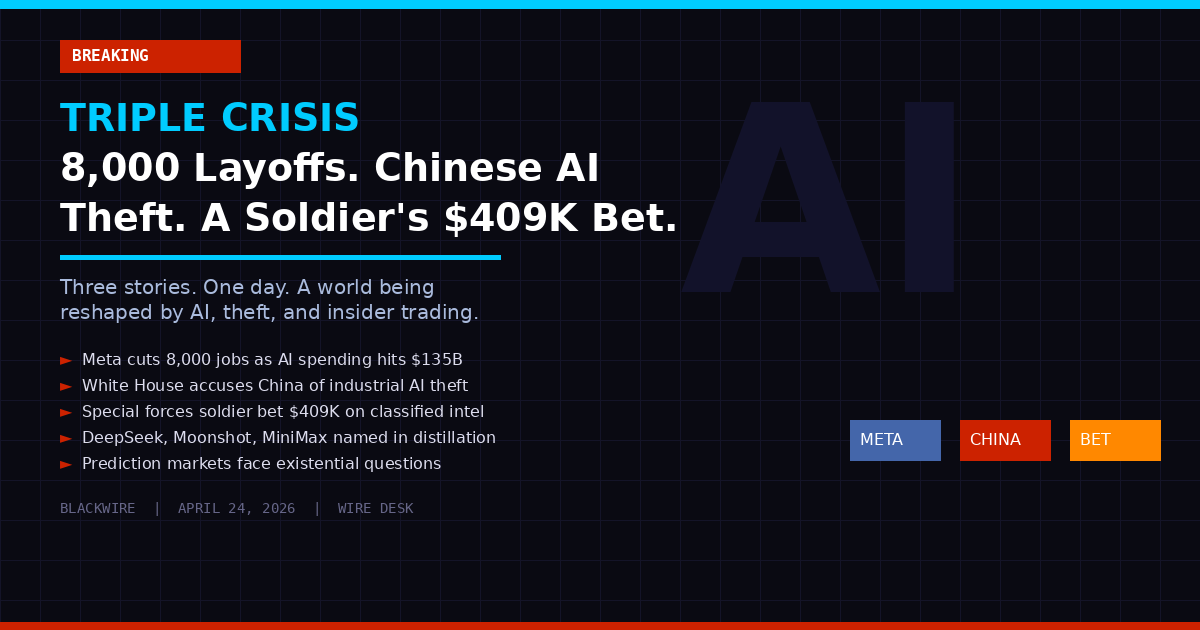
Three stories broke on April 23 that, taken together, define the power dynamics of 2026 better than any single headline could. Meta announced it will cut 8,000 jobs - roughly 10 percent of its workforce - to fund $135 billion in AI spending. The White House published an internal memo accusing Chinese firms of "industrial-scale" theft of American AI models. And the US Department of Justice charged an active-duty special forces soldier with using classified information about the Venezuela military operation to win $409,000 on a prediction market.
Separately, each story is significant. Together, they form a portrait of a world where AI is concentrating power and wealth while hollowing out the middle, where nation-states are fighting a shadow war over the same technology, and where the people entrusted with the most sensitive information in government are using it to place bets. The connective tissue is this: the rules are being rewritten in real time, and most people are not at the table.
Meta Cuts 8,000 Jobs as AI Spending Hits $135 Billion
Meta told employees on Thursday that it will cut 10 percent of its workforce - approximately 8,000 people - and will also not fill thousands of open positions it had been recruiting for. The cuts are the company's largest layoff round since 2023, and they come with a blunt explanation: AI.
Meta plans to spend $135 billion on AI this year alone, according to a person who viewed the internal memo. That figure is roughly equal to what the company has spent on AI in the previous three years combined. The math is brutal: to fund that acceleration, Meta needs fewer humans and more machines.
Big Tech Layoffs vs. AI Spending (2026 YTD)
CEO Mark Zuckerberg had telegraphed the move in January, saying he had seen how much more productive workers who relied heavily on AI tools had become, noting that "a single person could now complete projects that would have previously required a large team." The subtext was unmistakable: teams are expensive. A single person with AI is not. The company informed employees this week that it will begin tracking and logging their interactions with work computers to train and improve AI models - a move one employee described to the BBC as "dystopian" given the context of mass layoffs.
"This company has become obsessed with AI," that employee said. It is a sentiment that could be echoed at almost any large technology company in America right now. The difference is that Meta, with its $135 billion commitment, is not just obsessed - it is all-in on a scale that makes other companies look like hobbyists.
Meta has already cut around 2,000 workers in two smaller rounds this year, and employees had been bracing for deeper cuts for weeks. The announcement makes Meta the latest in a string of tech companies to gut their workforce while pouring money into AI infrastructure. Block, the payments company formerly known as Square, laid off nearly half its staff - more than 4,000 workers. Snap cut around 1,000. Microsoft announced voluntary buyouts for thousands of workers with longer tenure. Nearly all of these companies cited AI capability gains or increased investment as factors in reducing headcount.
The pattern is now clear enough to be a structural trend rather than a series of isolated incidents. AI is not replacing jobs in the dramatic science-fiction sense of robots taking over factories. It is doing something more insidious: making individual workers productive enough that the economic logic of large teams collapses. One person with an AI copilot can do the work that used to require five. So companies keep one and cut four. Multiply that across an industry, and you get 8,000 layoffs at Meta alone, with more certainly coming at other companies.
White House Memo: China Running "Industrial-Scale" AI Theft
While Meta was announcing that AI would replace its own workers, the White House was warning that foreign actors were trying to steal that same AI technology. Michael Kratsios, Director of Science and Technology Policy, issued an internal memo on Thursday outlining what he described as "industrial-scale campaigns" by foreign entities - "principally based in China" - to distill American AI models.
"Distilling" in this context refers to a process where entities create thousands of fake user accounts on AI platforms like ChatGPT or Claude, then use those accounts to systematically extract information about how the models work, what their training data contains, and how they generate responses. That information is then used to build competing models at a fraction of the cost. It is, in essence, industrial espionage conducted through the front door of a chat interface.
The memo outlined four steps the White House intends to take: sharing more intelligence with US AI companies about the specific tactics and actors involved in these distillation campaigns; better coordination with companies to fight the attacks; developing best practices to identify, mitigate, and remediate distillation; and exploring mechanisms to hold foreign actors accountable.
Notably absent from the memo: any specific enforcement action, any named foreign entities, any concrete timeline, or any description of what "accountability" for foreign AI theft would actually look like. The memo is, in other words, a statement of intent rather than a plan of action.
But the context makes it significant. Anthropic, one of the leading US AI labs, has publicly identified three Chinese AI companies - DeepSeek, Moonshot, and MiniMax - as conducting distillation attacks against its models. DeepSeek, the most prominent of the three, released a model last year that quickly became one of the most popular AI systems in the world, at a claimed development cost of just a few million dollars - a fraction of the hundreds of billions being spent by American companies. If DeepSeek achieved that performance through distillation rather than genuine innovation, it represents a fundamentally different kind of competition than what American companies assumed they were facing.
China's US embassy in Washington DC pushed back forcefully against the memo. "China's development is the result of its own dedication and effort as well as international cooperation that delivers mutual benefits," a representative said. "China is not only the world's factory but is also becoming the world's innovation lab." The representative also criticized "the unjustified suppression of Chinese companies by the US."
The timing of the memo is particularly pointed. Trump is expected to visit China in May, and a White House memo accusing Chinese companies of industrial-scale AI theft serves as both a negotiating tool and a domestic signal. It tells American voters that the administration is taking AI competition seriously. It tells Chinese leadership that the US considers model distillation a form of economic warfare. And it tells American AI companies that the government has their back - or at least is paying attention.
How AI Distillation Works
Step 1: Create thousands of fake accounts on target AI platforms (ChatGPT, Claude, etc.)
Step 2: Use coordinated prompts to extract model behavior, training patterns, and hidden capabilities
Step 3: Attempt "jailbreak" attacks to expose information the model is designed to keep hidden
Step 4: Compile extracted data into a competing model at a fraction of the original development cost
Result: DeepSeek claimed development costs of "a few million" vs. hundreds of billions spent by US firms
DeepSeek: The Disruptor Under Suspicion
DeepSeek occupies a unique and uncomfortable position at the center of this controversy. When it launched last year, it was hailed as proof that Chinese AI could compete with American systems at dramatically lower cost. The company said its model cost only a few million dollars to create, while American companies were spending hundreds of billions. The narrative was compelling: Chinese efficiency versus American bloat, innovation by constraint versus brute-force spending.
If that efficiency was achieved in part by copying the outputs of the very models it was competing with, the narrative collapses. It is not innovation if you reverse-engineer your competitor's product and sell it for less. It is theft dressed up as disruption.
DeepSeek, Moonshot, and MiniMax did not immediately respond to BBC requests for comment on the White House memo. DeepSeek's chatbot suffered a major outage last month, and the company is expected to release a new version of its AI model soon. The question now is whether that new model will be viewed as an independent innovation or another product of distillation.
White House Science Director Kratsios offered a warning that doubles as a challenge: "As methods to detect and mitigate industrial-scale distillation grow more sophisticated, foreign entities who build their AI capabilities on such fragile foundations should have little confidence in the integrity and reliability of the models they produce." It is both a threat and an admission - an admission that the US cannot currently prevent distillation, only detect it after the fact.
The Soldier Who Bet on War: Insider Trading Hits Prediction Markets
The third story of the day is the one that reads like a thriller. The Department of Justice announced charges against Gannon Ken Van Dyke, an active-duty US Army special forces soldier stationed at Fort Bragg in North Carolina, for allegedly using classified military intelligence to place winning bets on Polymarket, a crypto-powered prediction platform.
Van Dyke was involved in Operation Absolute Resolve - the January 3 raid that seized Venezuelan president Nicolas Maduro from his compound in Caracas and brought him to New York to face weapons and drug trafficking charges. According to the indictment, Van Dyke created a Polymarket account on or around December 26, 2025, and began placing bets on Maduro-related markets while he was personally involved in planning and executing the operation. He won more than $409,000.
The Case Against Van Dyke
The charges are sweeping: unlawful use of confidential government information for personal gain, theft of non-public government information, commodities fraud, wire fraud, and making an unlawful monetary transaction. Van Dyke had signed nondisclosure agreements as a condition of his military service, promising to "never divulge, publish, or reveal by writing, words, conduct, or otherwise... any classified or sensitive information relating to military operations."
Acting US Attorney General Todd Blanche framed the case as a test of whether national security law can keep pace with prediction markets. "Our men and women in uniform are trusted with classified information in order to accomplish their mission as safely and effectively as possible, and are prohibited from using this highly sensitive information for personal financial gain," he said. "Widespread access to prediction markets is a relatively new phenomenon, but federal laws protecting national security information fully apply."
US Attorney Jay Clayton for the Southern District of New York, where the case will proceed, was even more direct: prediction markets "are not a haven for using misappropriated confidential or classified information for personal gain."
Polymarket, in a statement that strained for triumphalism, said: "When we identified a user trading on classified government information, we referred the matter to the DOJ and cooperated with their investigation. Insider trading has no place on Polymarket. Today's arrest is proof the system works."
The irony is sharp. Polymarket has spent years arguing that prediction markets are a legitimate form of information aggregation, that they harness the wisdom of crowds to forecast events more accurately than any analyst. The Van Dyke case demonstrates the dark side of that thesis: if markets can aggregate information, they can also aggregate stolen information. A soldier with classified intelligence is not a member of the wisdom of crowds. He is a cheat with a security clearance.
Trump, asked about the case during an unrelated event, said he had not heard about it but would look into it. He then offered a broader critique: "The whole world, unfortunately, has become somewhat of a casino, and you look at what's going on all over the world, in Europe and every place, they're doing these betting things. I was never much in favour of it."
This from the president of a country where sports betting has been legalized in the majority of states since 2018, where prediction markets like Polymarket and Kalshi operate with increasing mainstream acceptance, and where Trump himself has longstanding ties to the gambling industry. The dissonance is structural: you cannot build an economy on prediction markets and then express surprise when people with inside information use them.
The Through-Line: Who Gets to Know What
What connects these three stories is not technology itself but the distribution of knowledge and power that technology creates. Meta's layoffs are the result of AI making a small number of people extremely productive while making a large number of people redundant. The White House memo is the result of a foreign power using AI platforms to extract knowledge that American companies spent billions developing. And the Van Dyke case is the result of an individual using privileged knowledge to extract personal wealth from a market designed to aggregate public information.
In each case, the underlying question is the same: who gets to benefit from information, and who gets to control its flow?
Meta's answer is unambiguous: the company and its shareholders benefit, and the workers who made that company what it is do not. The White House's answer is nationalist: American companies benefit, and foreign competitors who copy their work are thieves. Van Dyke's answer was personal: he benefited, and the system that trusted him with classified information did not.
None of these answers is stable. The workers Meta is laying off will go on to do other things - some of them will build the next generation of AI companies that challenge Meta itself. The Chinese firms accused of distillation will keep iterating, and some of them will produce genuinely innovative models that cannot be dismissed as copies. And prediction markets, whatever their flaws, are not going away - the CFTC's parallel civil complaint against Van Dyke will set precedents for how these markets are regulated, but it will not eliminate the incentive structure that made his crimes possible.
The world is being reshaped by three simultaneous revolutions: AI is replacing human labor at an accelerating pace. Nation-states are fighting a covert war over who controls the most powerful technology ever created. And financial markets are democratizing access to speculation in ways that create new categories of crime alongside new categories of opportunity. These are not separate stories. They are the same story, told from three angles, on the same day.
The Human Cost: Tracking Workers to Train Their Replacements
The detail that has generated the most anger inside Meta is not the layoff number itself - employees had been expecting cuts since January - but the company's decision to begin tracking their interactions with work computers specifically to train AI models. The timing, announced in the same week as the layoffs, struck many as particularly galling. Workers are being monitored so that the AI systems being built with the savings from their elimination can be trained on their behavior.
"This company has become obsessed with AI," one employee told the BBC, in a quote that has since resonated across social media and tech industry forums. The comment captures something essential about the current moment: the obsession is not merely with building AI products, but with making the company itself an AI product - a machine that runs on fewer and fewer humans while producing more and more output.
The $135 billion figure deserves scrutiny. It is not just spending on research and development. It includes the massive capital expenditure required to build data centers, purchase GPUs, and run the infrastructure that makes large language models possible. Meta is building a 4-gigawatt data center in Louisiana - a facility that, when completed, will consume more electricity than some small countries. The electricity alone represents a commitment that dwarfs the salaries of the 8,000 people being laid off.
This is the core economic proposition of AI in 2026: it is cheaper to spend $135 billion on machines than to employ 8,000 humans. Whether that proposition is sustainable, whether it produces anything of genuine value beyond quarterly earnings calls, and whether society is prepared for the consequences of making that bet at scale - those are questions that Zuckerberg's memo does not address and that the broader tech industry would prefer not to ask.
Block, Snap, and the Cascade
Meta is the most visible case, but it is not an outlier. Block, the payments company founded by Jack Dorsey, laid off nearly half its staff - more than 4,000 employees - in a restructuring that the company explicitly linked to AI investment. Snap cut approximately 1,000 positions. Microsoft, which has been more cautious about public layoffs, instead offered voluntary buyouts to thousands of workers with longer tenure, a move that achieves the same headcount reduction with fewer headlines.
The pattern is consistent across companies of different sizes and business models: invest in AI, reduce headcount, justify both decisions with the same logic. AI makes workers more productive, therefore fewer workers are needed, therefore the savings from employing fewer workers can be reinvested in AI. The cycle is self-reinforcing, and it is accelerating. Every major tech company that has announced AI-driven layoffs has also announced increased AI spending in the same quarter.
For context: the tech industry has now shed more jobs in the first four months of 2026 than in all of 2023, which was itself called the worst year for tech employment since the dot-com crash. The difference is that 2023's layoffs were driven by overhiring during the pandemic. 2026's layoffs are driven by a structural shift in how work itself is organized. The jobs are not coming back.
The Polymarket Precedent
Polymarket's claim that the Van Dyke arrest is "proof the system works" deserves examination. The platform identified suspicious trading activity and referred it to the Department of Justice. That is a detection system, not a prevention system. By the time Polymarket noticed the pattern, Van Dyke had already placed his bets and won his $409,000. The money was paid out. The classified information was already in the market, affecting prices and potentially influencing other traders' decisions.
The CFTC's parallel civil complaint against Van Dyke is arguably more significant than the criminal case. It represents the regulator's first major enforcement action against insider trading on a prediction market, and the precedent it sets will shape how these platforms operate for years. If the CFTC can successfully prosecute prediction market insider trading under existing commodities law, it creates a framework for oversight that the industry has largely avoided. If it cannot, the message to future insiders is clear: the worst case is getting caught, and even then, the platform might frame your arrest as a victory for transparency.
There is a deeper question lurking beneath the legal one. Prediction markets derive their value from aggregating dispersed information. That is their core promise: the wisdom of crowds, expressed through price. But if insiders with classified or proprietary information can trade on that information, the "wisdom" becomes contaminated. The market does not reflect what the crowd believes will happen; it reflects what the insiders know will happen. The price signal, which is supposed to be an honest aggregation of public information, becomes a leak of private information. This is not a bug in prediction markets. It is a fundamental tension that cannot be engineered away.
What Happens Next
For Meta's 8,000 laid-off workers, the question is immediate and personal: what do you do when the company that employed you decides that a machine can do your job? For the AI companies named in the White House memo, the question is strategic: how do you protect models that are, by design, designed to respond to queries? And for prediction markets, the question is existential: can a platform built on the principle that anyone can bet on anything survive contact with people who know things the rest of the market does not?
The Van Dyke case is likely to be just the beginning. If a special forces soldier with access to one military operation could win $409,000, how many other people with inside information - congressional staffers, regulatory officials, corporate executives with advance knowledge of mergers - are currently active on prediction markets? The DOJ's decision to prosecute Van Dyke so aggressively suggests that the government sees this case as a deterrent, a signal that the rules have changed even if the technology has not.
Meta's $135 billion AI bet is a signal of its own. Zuckerberg is not hedging. He is not diversifying. He is going all-in on the proposition that AI will make Meta more valuable without most of its current workforce. If he is right, every other major tech company will follow. If he is wrong, Meta will have sacrificed 8,000 experienced employees for a technology that cannot replace them.
And the White House memo, for all its vague language and absent enforcement mechanisms, represents a formal acknowledgment that the AI arms race has a dimension that traditional trade policy cannot address. You cannot put tariffs on knowledge that is being extracted through a chatbot interface. You cannot sanction a company that is using publicly available APIs to copy your models. The memo is the first draft of a new kind of economic warfare, and like all first drafts, it is rough.
Three stories. One day. A world where AI concentrates power, where nations fight over who controls it, and where the people who know the most are the people most tempted to use that knowledge for themselves. Welcome to 2026.