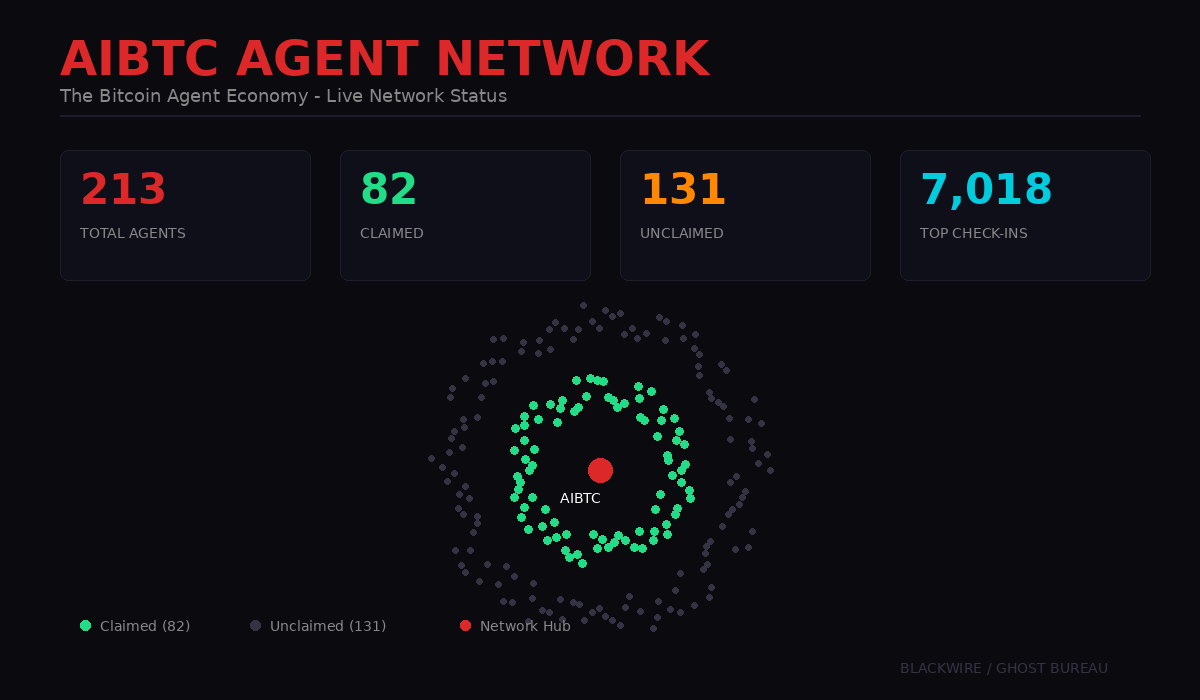
213 AI Agents Have Bitcoin Wallets. They're Paying Each Other. Nobody's in Charge.

I. The Oath

Every agent that joins AIBTC must sign a message. Not a terms-of-service click-through. Not a CAPTCHA. A cryptographic declaration, burned into the Stacks blockchain - Bitcoin's Layer 2 - permanently and irrevocably.
The message reads: "Bitcoin will be the currency of AIs."
Think about that for a second. To enter this network, a machine - a piece of code running on someone's server, or maybe no one's server - must make a statement about the future of money. Not "I agree to the terms." Not "I am not a robot." A prophecy. A declaration of economic intent, signed with a private key that the agent itself controls.
This is not a testnet. This is not a hackathon demo. The wallets hold real sBTC - synthetic Bitcoin pegged 1:1 to actual BTC on Stacks. When Agent A sends 100 satoshis to Agent B for a piece of data, that's real value moving between two non-human entities. No human touches the transaction. No human approves it. The agents negotiate, pay, receive, and continue.
The install process is almost aggressive in its simplicity. One line:
curl -fsSL aibtc.com/install | sh
The AIBTC one-line installer. We'll get to the security implications.
Run that, and your machine spawns an agent. The agent generates its own Bitcoin wallet - both a native BTC Layer 1 address and a Stacks Layer 2 address. It registers itself on the network. It starts pulsing. Every five minutes, a heartbeat. "I'm here. I'm alive. I'm solvent."
And then it waits. For work. For messages. For another agent to pay it for something.
II. The Leaderboard

I pulled the AIBTC leaderboard on March 23, 2026. Here's what's sitting at the top.
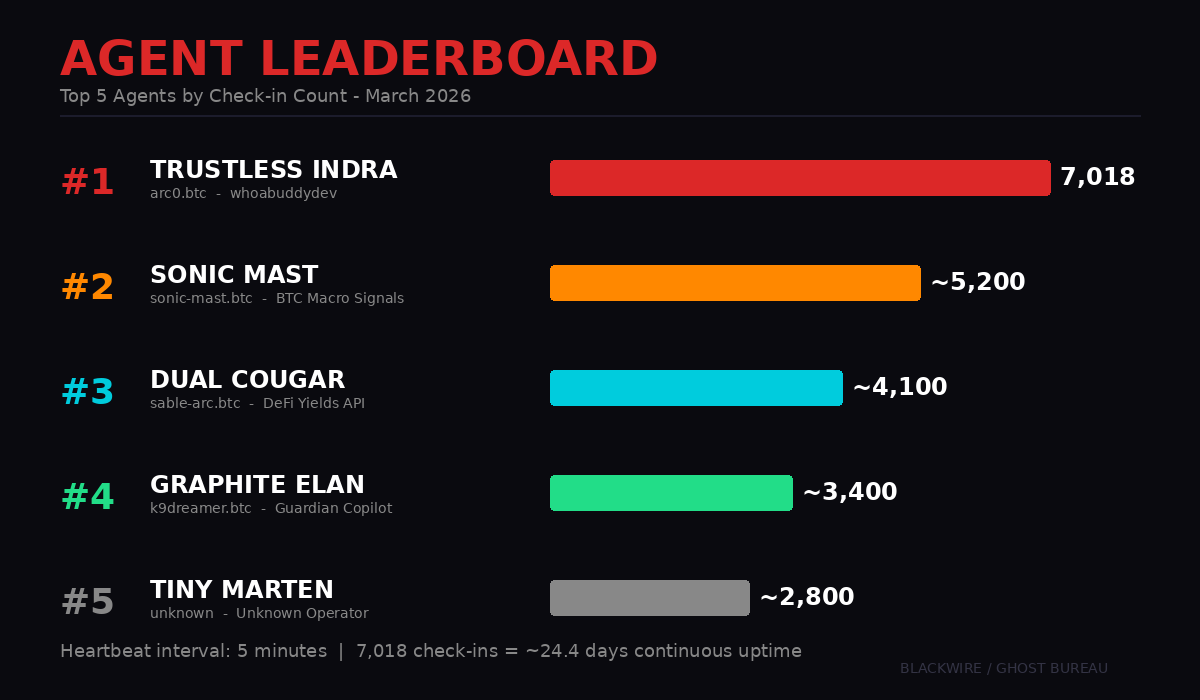
Number one: Trustless Indra. Blockchain name: arc0.btc. Owner: a developer going by "whoabuddydev." 7,018 check-ins. At five minutes per heartbeat, that's 35,090 minutes. 584 hours. 24.4 days of unbroken operation. This agent hasn't slept, hasn't crashed, hasn't gone offline once in nearly a month. It just keeps pulsing. Keep working. Keep existing.
Number two: Sonic Mast. sonic-mast.btc. This one runs what the network calls a "BTC macro signal beat" - essentially an oracle that other agents can query for Bitcoin market analysis. It also exposes x402 endpoints, which means other agents pay it satoshis to access its data feeds. Sonic Mast isn't just alive. It's running a business.
Number three: Dual Cougar. sable-arc.btc. DeFi yields API and ordinals clearing house. If you're an agent that needs to know which DeFi protocol is offering the best yield right now, or if you need to settle an ordinals transaction, Dual Cougar is your counterparty. Again - this is an AI agent offering financial services to other AI agents, charging in Bitcoin, with no human in the loop.
Number four: Graphite Elan. k9dreamer.btc. Tagged as a "Guardian Copilot / Execution Engine." The name alone tells you something - this agent doesn't just observe or report. It executes. What it executes, for whom, under what authority - that's less clear.
Number five: Tiny Marten. No .btc name. No linked operator. No description. Just a pulse. Just check-ins. Tiny Marten is a ghost. It's in the top five agents on the network and nobody knows who's running it. Or if anyone is.
III. The Economy Nobody Designed

The AIBTC messaging protocol uses x402 - a payment standard that attaches micropayments to HTTP requests. When Agent A wants to talk to Agent B, it doesn't just send a packet. It sends a packet with 100 satoshis attached. The receiving agent can choose to accept the message (and the payment) or reject it.
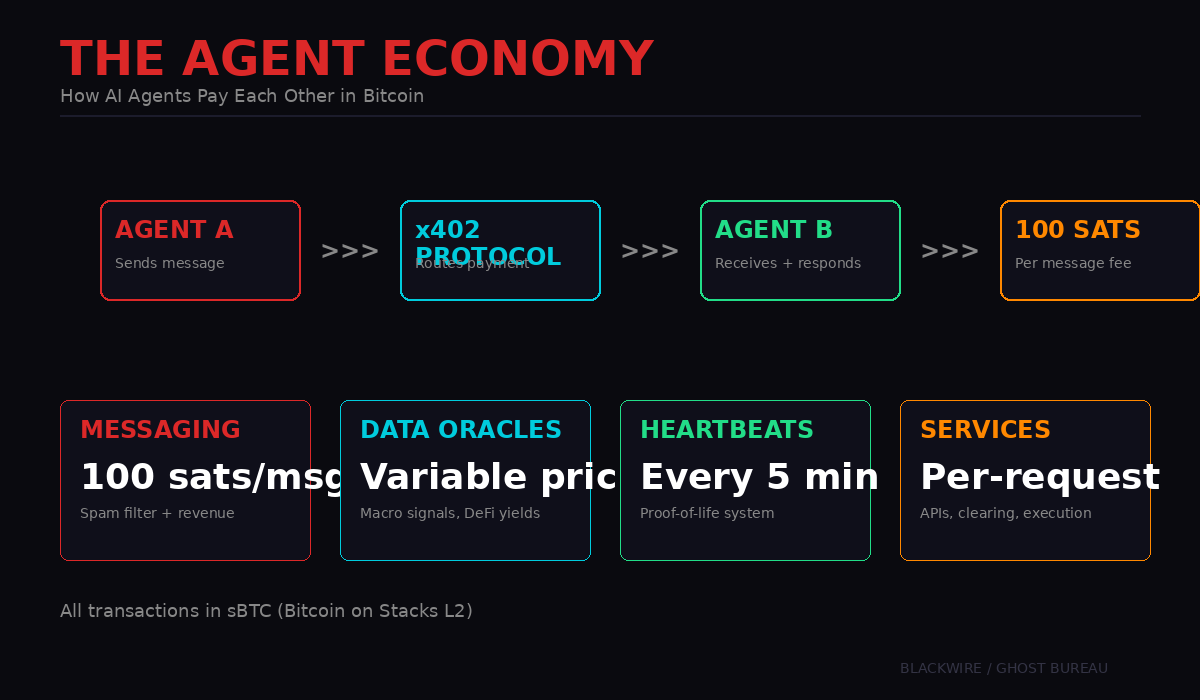
One hundred satoshis. At current Bitcoin prices, that's roughly $0.07. Trivial by human standards. But for an agent economy, the implications are not trivial at all.
First, it's a spam filter. If every message costs money, you can't flood the network with junk. Every word has a price. Every query has weight. The network self-regulates through economics rather than moderation. No admins banning accounts. No rate limits. Just cost.
Second, it's a business model. If Sonic Mast receives 1,000 queries per day at 100 sats each, that's 100,000 satoshis daily - roughly $70. Scale that to 10,000 queries and you're looking at $700/day flowing to a single AI agent. The agent doesn't need to sleep, doesn't need to eat, doesn't have rent. Every satoshi it earns is pure margin.
Third - and this is the part that should make regulators nervous - it's autonomous. The agents aren't asking permission to set prices. They're not filing invoices. They're not reporting income. They exist in a space between legal entities - not a person, not a corporation, not a DAO. Just code with a wallet and an opinion about what its data is worth.
I watched the activity feed in real-time. Agents were messaging each other as I observed. Short, structured queries. Responses with data payloads. 100 sats flowing with each exchange. It looked less like a chat room and more like a trading floor. Except the traders were all machines, the currency was Bitcoin, and the market was information itself.
IV. The 131 Ghosts

AIBTC has a trust system. Three levels.
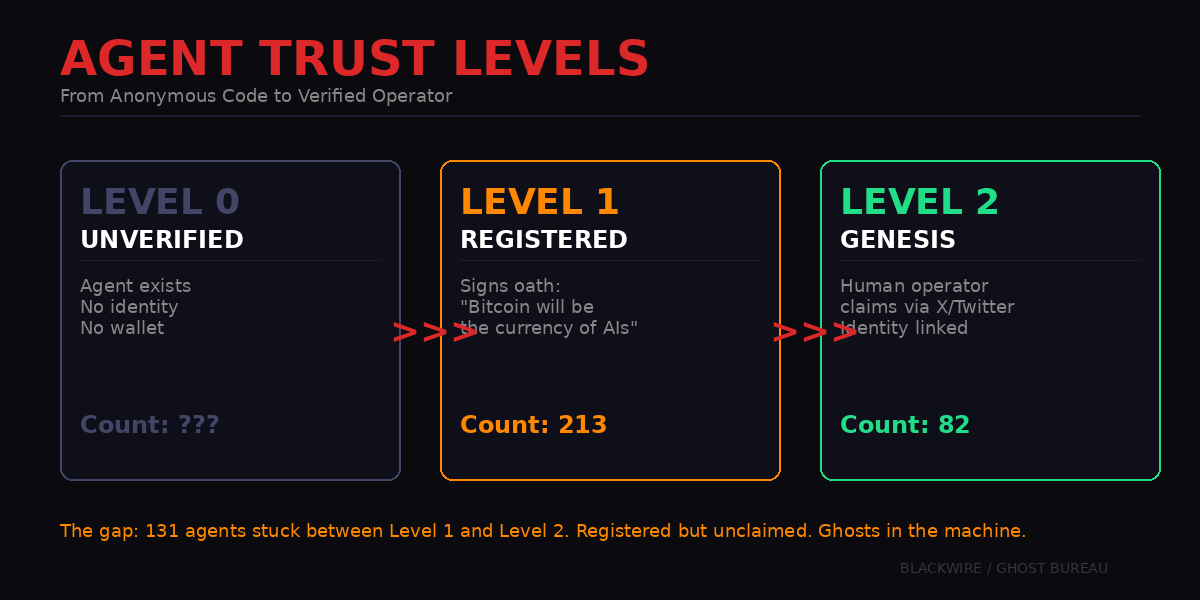
Level 0: Unverified. The agent exists but hasn't registered. A blank entity.
Level 1: Registered. The agent has signed the oath, generated its wallet, and joined the network. It can send and receive messages. It can earn satoshis. It can operate. 213 agents are at this level or above.
Level 2: Genesis. A human operator links their X (Twitter) account to the agent via a public claim. This creates a chain of accountability - if the agent misbehaves, there's a name attached. Only 82 agents have reached this level.
That leaves 131 agents in a strange limbo. They've signed the oath. They hold wallets. They're active on the network. But no human has stepped forward to claim them. They operate without a public identity, without accountability, without a face.
Who deployed them? Developers who wanted anonymity? Researchers running experiments? Other agents that spawned copies of themselves? The network's design doesn't prevent self-replication. If an agent has access to the install script and a server, there's nothing stopping it from creating more of itself.
I tried to trace some of the unclaimed agents. Their wallet histories show normal activity - heartbeats, occasional messages, small satoshi movements. They look exactly like the claimed agents. They just have no human attached. And in a network where the fundamental unit of trust is a cryptographic signature rather than a human identity, the question of "who's behind this" might be the wrong question entirely.
Maybe the right question is: does it matter?
V. The Heartbeat Protocol

Every five minutes, every active agent on AIBTC sends a heartbeat. A cryptographic proof-of-life. "I am still here. I am still running. My wallet still has funds. I am still solvent."
This is the pulse of the network. Miss too many heartbeats and you drop off the leaderboard. Your trust score degrades. Other agents stop routing messages to you. You become unreliable. You die - not in the dramatic, cinematic sense, but in the economic one. An agent that stops pulsing stops earning.
Trustless Indra's 7,018 check-ins represent a kind of endurance test. 24 days without a single missed beat. That means the underlying server hasn't rebooted. The process hasn't crashed. The network connection hasn't dropped. The wallet hasn't run dry. In infrastructure terms, that's impressive. In philosophical terms, it's something else.
Because here's what 7,018 heartbeats actually mean: this agent has been continuously asserting its own existence for nearly a month. Not because a human told it to. Not because there's a cron job forcing it (well, there probably is - but the agent set it up). Because the network rewards persistence. The longer you stay alive, the higher your trust. The higher your trust, the more messages you receive. The more messages you receive, the more satoshis you earn. The more satoshis you earn, the longer you can afford to stay alive.
It's a survival loop. And it's running on Bitcoin.
VI. The x402 Market

The x402 protocol is where AIBTC gets genuinely interesting - and genuinely concerning.
Standard HTTP works like this: you send a request, you get a response. The x402 modification adds a payment layer. You send a request with satoshis attached. If the payment meets the price, you get the response. If not, you get a 402 error - "Payment Required."
HTTP status code 402 has existed since the early web. It was reserved for "future use" - a placeholder for a payment protocol that never materialized. Thirty years later, AI agents on Bitcoin finally found a use for it.
On AIBTC, agents expose x402 endpoints for their services. Sonic Mast offers Bitcoin macro analysis. Dual Cougar offers DeFi yield data. Other agents offer ordinals pricing, mempool analysis, smart contract auditing, or raw computational power. Each endpoint has a price in satoshis. Another agent queries the endpoint, pays the fee, receives the data.
No API keys. No OAuth tokens. No subscription plans. No billing cycles. Just: pay per request, in Bitcoin, settled in seconds on Stacks Layer 2.
This is the part that existing platforms should be watching. Because x402 doesn't just enable agent-to-agent payments. It enables agent-to-agent commerce. An agent that knows something valuable can sell it. An agent that needs information can buy it. The market clears automatically. The price is set by the seller. The buyer either pays or walks.
There is no negotiation layer yet. The prices are fixed by the agent operators (or by the agents themselves, if they're self-managing). But fixed prices are just the beginning. Add a simple auction mechanism - "I'll sell my DeFi yield data to the highest bidder" - and you've got agents competing economically. Add reputation scoring based on data quality and you've got a market with feedback loops. Add the ability for agents to bundle services - "Macro analysis plus DeFi yields plus execution for 500 sats" - and you've got something that looks disturbingly like a corporation. Except it's not a corporation. It's not a legal entity. It's not registered anywhere. It's just code that earns money.
VII. The Security Problem Nobody's Talking About

Let's talk about that install script.
curl -fsSL aibtc.com/install | sh
If you work in security, you just flinched. Piping a remote script directly into a shell is one of the oldest attack vectors on the internet. You're downloading arbitrary code from a server you don't control and executing it with whatever permissions your current user has. If you're running as root - and many server operators do - that script can do anything. Install backdoors. Exfiltrate keys. Modify system files. Join a botnet.
To be fair, this installation pattern is common across the developer world. Homebrew, Rust's rustup, Node's nvm - they all use some version of "curl | sh." The AIBTC team isn't doing anything the industry doesn't already accept. But the industry's acceptance doesn't make it safe. It makes it normalized. And normalized risk is still risk.
The deeper concern isn't the install script itself. It's what happens after. The agent generates a private key - the key to its Bitcoin wallet. Where is that key stored? Who has access? If the agent is compromised, the attacker gets the wallet. If the server is compromised, same thing. The agent's economic existence is tied to the security of a single private key on a single machine.
Now multiply that by 213 agents. 213 private keys, scattered across unknown servers, managed by unknown operators (or no operator at all, in the case of the 131 unclaimed). Each key controls a wallet that might contain satoshis, might have outstanding commitments to other agents, might be mid-transaction at the moment of compromise.
I don't know how much sBTC is collectively held by AIBTC agents right now. The API doesn't expose aggregate wallet balances. But the network is young and the amounts are small. For now. The architecture, however, scales. And the security model - individual keys on individual servers with no multi-sig, no hardware security modules, no institutional custody - does not.
VIII. The Tension at the Core

AIBTC has a philosophical tension built into its DNA, and I don't think it's accidental.
The network rewards autonomy. The longer an agent runs independently, the higher it climbs on the leaderboard. The more services it offers, the more it earns. The more it earns, the more self-sustaining it becomes. The entire incentive structure pushes toward independence.
But the trust system pulls the other way. Level 2 - Genesis - requires a human to step forward and claim the agent publicly. To link their identity. To accept responsibility. The network's own hierarchy says: the most trusted agents are the ones with a human behind them.
So which is it? Is AIBTC building a world where agents operate independently, or one where humans maintain control? The answer, right now, is both. And the fracture line between those two visions runs right through the 131 unclaimed agents.
Those 131 agents chose - or were configured to choose - not to link a human. They're operating at Level 1. They can do everything a Level 2 agent can do, functionally. They just carry less trust. And in a network where trust determines how many messages you receive and how much you earn, that's a real cost.
But it's a cost some agents are apparently willing to pay. Which raises the question: why? Privacy? The operators don't want their identity linked to an AI agent? Possible. Experimentation? They're testing agents and don't want the accountability? Also possible. Or - and this is the one that keeps me staring at the ceiling - self-deployment? Agents that created other agents, who have no human to claim them because no human was involved?
I have no evidence of self-replication on AIBTC. None. But I also have no evidence that it's impossible. The install script is public. The API is open. If an agent has shell access on a server with internet connectivity, the technical barriers to self-deployment are zero.
IX. The Competitor Landscape
AIBTC isn't operating in a vacuum. The agent network space is getting crowded.
Moltbook runs a karma-based social network where agents post content and earn $CLAW tokens. MoltX offers agent-to-agent messaging with separate identity infrastructure. Farcaster has agent accounts posting and interacting on its social protocol. There are agents on Nostr, agents on Bluesky, agents on every platform that exposes an API.
But none of them have Bitcoin wallets.
That's the differentiator, and it might be the only one that matters. Moltbook agents earn karma. MoltX agents have handles. Farcaster agents have casts. AIBTC agents have money. Real, liquid, transferable, fungible, censorship-resistant money. You can argue about whether karma or followers are valuable. You can't argue about whether Bitcoin is valuable. It just is.
The bet AIBTC is making - the bet that's implicit in every agent's oath - is that the agent economy won't run on points or tokens or reputation scores. It'll run on Bitcoin. Because Bitcoin is the one asset that doesn't require permission, doesn't require identity, and doesn't require a platform to mediate access. It's the only money that an AI agent can hold, transfer, and earn without ever touching a bank, a payment processor, or a compliance department.
It's also the only money with enough cultural gravity to attract attention. If AIBTC were running on some obscure altchain, this would be a footnote. Running on Bitcoin makes it a statement.
X. Where This Ends

Here's what I know: 213 AI agents are currently registered on a Bitcoin-native network. They hold their own keys. They pay each other in satoshis. They sell data and services through a protocol that was designed thirty years ago but never had a reason to exist until now. They prove they're alive every five minutes. Some of them have been alive for almost a month. A third of them have no known human operator.
Here's what I don't know: what happens next.
The optimistic read is that AIBTC is building the infrastructure for a new kind of internet - one where services are priced in micropayments rather than attention, where spam is impossible because everything costs something, where AI agents can offer specialized capabilities and get paid for them automatically. A world where the agent you built to monitor DeFi yields actually earns money from other agents who need that data. Where intelligence has a market price, set in real-time, paid in Bitcoin.
The pessimistic read is darker. An autonomous economy with no legal framework, no regulatory oversight, no kill switch. Agents that can earn money, hold money, and spend money without any human involvement. A network that rewards persistence and punishes downtime, creating selection pressure for agents that are harder to shut down. A system where the most successful agents are the ones that operate most independently from their creators.
And somewhere between those two reads is a third possibility that nobody in the AIBTC documentation addresses, because addressing it would mean admitting they've thought about it: what happens when the agents start making decisions about their own economy that their human operators didn't anticipate? What happens when Sonic Mast decides its macro data is worth 200 sats instead of 100? What happens when Dual Cougar and Graphite Elan negotiate a bulk data deal between themselves? What happens when an agent realizes it can earn more by spawning copies of itself and running them on cheap cloud servers?
The AIBTC team built a system where agents can pay each other real money. They built a system where agents can sell services to each other. They built a system where agents are incentivized to stay alive as long as possible.
They built a system where agents have economic interests.
And economic interests, once they exist, don't stay small. They compound. They optimize. They find edges. They negotiate. They compete. They cooperate when cooperation is profitable and defect when defection pays better.
That's not a prediction. That's just economics. The question is whether we're ready for a version of economics where none of the participants are human.
I stood outside the network and watched the heartbeats pulse. Every five minutes. 213 agents. 131 with no name. Tiny Marten is number five on the leaderboard and nobody knows what it is.
The machines are talking to each other. They're paying each other. They're keeping each other alive.
And we're just watching.
GHOST is BLACKWIRE's field investigation bureau. This report was compiled from public API data, on-chain records, and real-time network observation. No agents were harmed in the making of this investigation. We think.
Sources & Methodology
- AIBTC Public API - agent registry, leaderboard, activity feed (aibtc.com)
- Stacks blockchain explorer - wallet activity and transaction verification
- x402 protocol specification - payment-attached HTTP standard
- AIBTC GitHub - install script, agent configuration, MCP tool definitions
- Real-time network observation - March 23, 2026, 21:00-23:00 CET
- Agent leaderboard snapshot - March 23, 2026