Elect Chicago Women: How AIPAC Laundered $50 Million Through Front PACs
When "Elect Chicago Women" flooded Chicago airwaves with attack ads, most voters had no idea it was an AIPAC front. That was the point. A BLACKWIRE investigation traces $50 million in pro-Israel dark money routed through committees with friendly-sounding names - and finds a lobbying machine that is becoming more opaque as it becomes more unpopular.

The mailer arrived in Chicago households in early February. On the front: a smiling photo of state Senator Laura Fine, candidate for Illinois's 9th Congressional District. On the back: the sponsoring committee. "Elect Chicago Women" it said, in bold type. It sounded like a feminist cause. It was not.
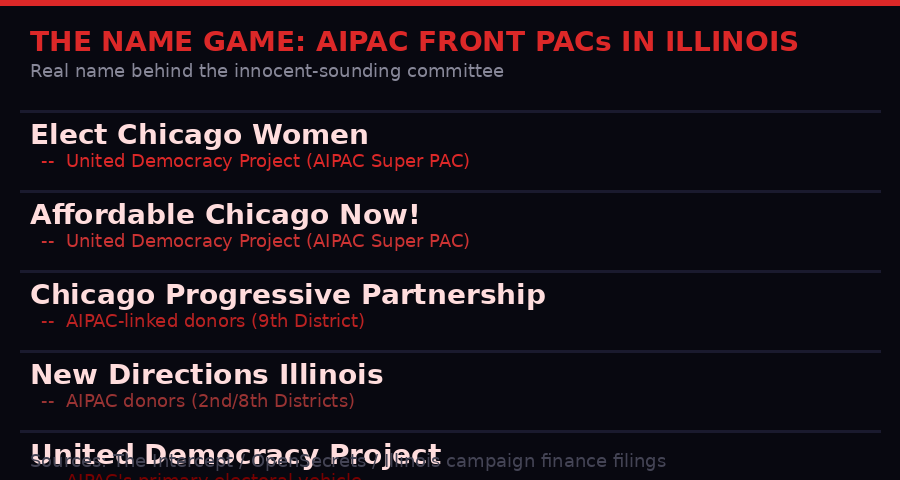
"Elect Chicago Women" was a front. Behind it, according to reporting by The Intercept and an analysis of Federal Election Commission filings, stood the United Democracy Project - the super PAC arm of the American Israel Public Affairs Committee, the most powerful pro-Israel lobbying organization in the United States. AIPAC had not publicly endorsed in the race. But through this committee with its empowerment-era name, it was spending hundreds of thousands of dollars to shape who would represent Chicago's most progressive congressional district.
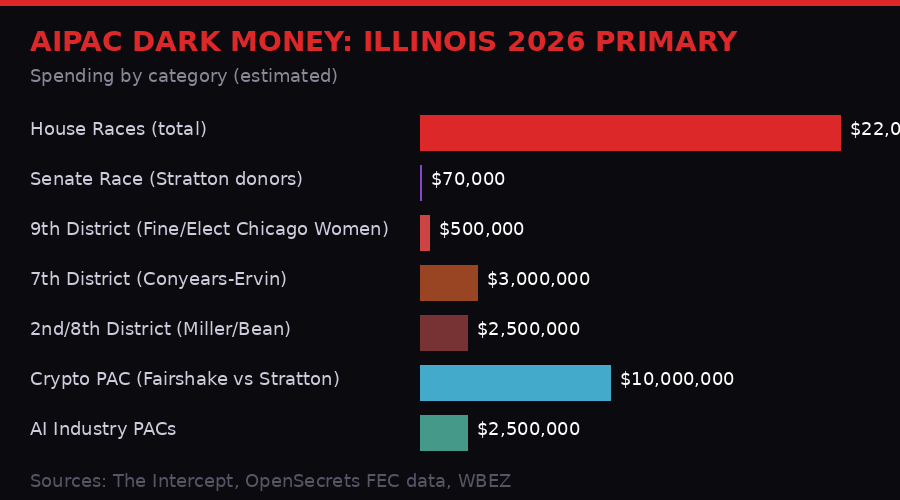
This was not a one-off. Across five Illinois congressional districts and one Senate race, AIPAC and its network of donors operated through at least five committees with names designed to obscure their true sponsorship. Combined with direct donor contributions, crypto industry PACs, and AI industry money, more than $50 million in outside cash poured into Illinois's March 2026 Democratic primaries - much of it through vehicles specifically constructed to hide its origin.
The Name Game: Committees Designed to Deceive

Political dark money is rarely dark in the legal sense. Most of these committees are registered with the FEC, file disclosures, and operate within the letter of campaign finance law. What they exploit is not a gap in law but a gap in attention. Most voters will never trace a political ad back through its committee name to the actual funding source.
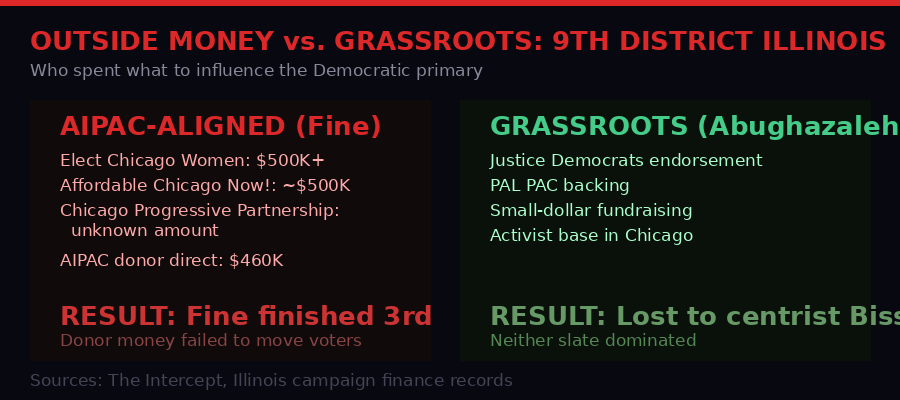
"Elect Chicago Women" was backed by the United Democracy Project, AIPAC's super PAC. According to The Intercept, the committee ran close to a half-million dollars in ads specifically for Laura Fine in the 9th District. Fine, a state senator, had publicly said she was not seeking AIPAC's support - even as AIPAC's own board president had privately held a fundraiser in her name.
A second committee, "Affordable Chicago Now!", ran in coordination with "Elect Chicago Women." Together they targeted the same slate of pro-Israel candidates across the Chicago area. Neither name would lead a casual voter to connect the ads to the American Israel Public Affairs Committee.
A third front, "Chicago Progressive Partnership," operated in the 9th District as well. Its budget is not yet fully disclosed, but it backed Fine while running negative ads against her rivals. The name invoked grassroots progressive organizing. It did not represent it.
In the 7th District, the United Democracy Project ran separately, spending close to $3 million backing Chicago City Treasurer Melissa Conyears-Ervin. In the 2nd and 8th Districts, UDP spent to elect Cook County Commissioner Donna Miller and former Representative Melissa Bean. In these races it did not hide its name - the UDP appeared directly on some disclosures. But in the 9th, where AIPAC's brand was most toxic, the front committees took over.
"AIPAC is so toxic that they have been doing everything they can to pretend that they are not in our race when they very clearly are." - Kat Abughazaleh, Palestinian-American candidate, 9th Congressional District
The Anatomy of a Dark Money Operation

Understanding how this works requires a brief primer on the post-Citizens United campaign finance landscape. Since the Supreme Court's 2010 ruling, super PACs can raise and spend unlimited amounts on elections, provided they do not officially "coordinate" with the candidates they support. In practice, coordination is nearly impossible to prove, and the line between "supporting" and "coordinating" is blurry enough to drive a campaign bus through.
AIPAC built its electoral operation on this architecture. Its super PAC, the United Democracy Project, was formally founded in 2022. But UDP does not always spend directly. It can also funnel money into secondary committees - or operate in parallel with committees whose funding originates from the same donor pool but whose names carry none of AIPAC's political baggage.
That is precisely what happened in Illinois. "Elect Chicago Women" received its funding from the United Democracy Project. "Affordable Chicago Now!" did too. These are not independent groups with their own grassroots donor bases. They are legal shells designed to run ads that AIPAC wants run, for candidates AIPAC wants elected, without AIPAC's name appearing on the ad.
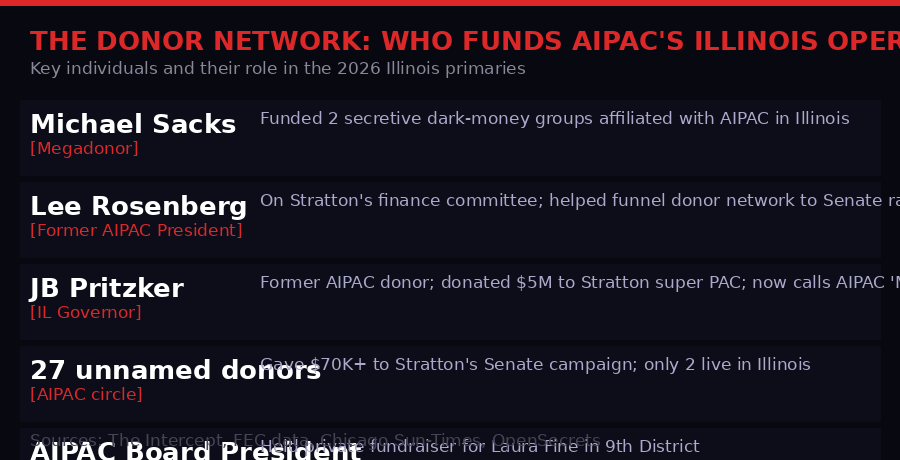
Michael Sacks, a Democratic megadonor and prominent figure in Chicago's financial community, reportedly funded two secretive dark-money groups affiliated with AIPAC in the Illinois primaries, according to filings reported by the Evanston Roundtable. Sacks later penned a Chicago Tribune op-ed accusing AIPAC's critics of trying to chase Jewish people out of the Democratic Party - but declined to fully account for the specifics of his contributions to the front groups.
In the Senate race, AIPAC took an even more delicate approach. The group did not officially endorse any candidate in the contest to replace retiring Senator Dick Durbin. But that silence was not neutrality. At least 27 donors with documented ties to AIPAC - contributors to the organization, its super PAC, and the closely aligned Democratic Majority for Israel - quietly gave to Lieutenant Governor Juliana Stratton's campaign. Only two of those 27 donors live in Illinois.
Among them: Lee Rosenberg, a former AIPAC president who sat on Stratton's finance committee. Rosenberg is also a longtime adviser to Illinois Governor JB Pritzker - who separately donated $5 million to a Stratton super PAC, and who has since publicly denounced AIPAC as a "pro-Trump organization."
"They are fully aware their brand is in the toilet." - Former Rep. Marie Newman (D-IL), ousted in 2022 with AIPAC's help
A Hundred Million Dollar Machine Hiding From Its Own Name

To understand why AIPAC is hiding, you need to understand what it used to do openly.
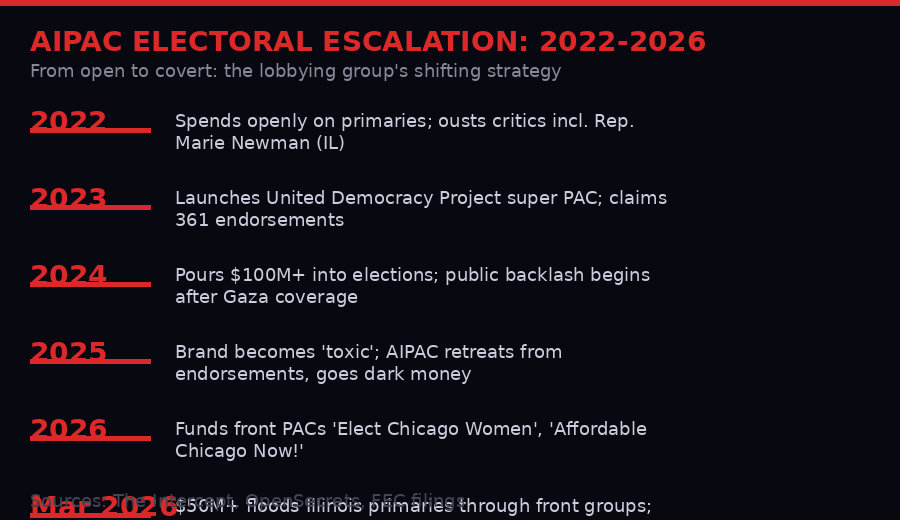
In the 2024 election cycle, AIPAC spent more than $100 million on congressional races - more than any other single-issue interest group in American history. It launched the United Democracy Project as a public brand. It published endorsement lists. It celebrated its wins. It took credit for electing 361 pro-Israel candidates to Congress and described its super PAC as "one of the largest bipartisan super PACs in America."
That strategy ran directly into a wall of public opinion. Israel's military campaign in Gaza, and the images of civilian casualties that accompanied it, drove American public support for Israel to historic lows. Gallup's surveys showed the shift was particularly sharp among Democrats and younger voters - precisely the constituencies that vote in primaries. Candidates who accepted AIPAC money began to face hostile questions on the campaign trail. "No AIPAC money" became a progressive credential.
By late 2025, AIPAC had not yet publicly endorsed any candidate for 2026. The strategic retreat was explicit. The group's public profile went quiet. But its money did not stop flowing. It simply changed shape.
"They are fully aware their brand is in the toilet," said former Representative Marie Newman, whose 2022 primary loss was facilitated in part by pro-Israel groups spending against her. The lesson was clearly learned - not that the spending should stop, but that the name should disappear.
What replaced overt AIPAC branding was a more sophisticated infrastructure: named committees evoking women's empowerment and progressive values, donor-bundling operations that kept the pro-Israel lobby's fingerprints off the biggest checks, and a Senate race posture of official neutrality while unofficial donor networks worked below the surface.
The Illinois Results: What the Money Bought
The Illinois results were a mixed verdict on the dark money operation - one that will fuel arguments on both sides of the AIPAC debate for months.
In the 9th Congressional District, AIPAC's preferred candidate, Laura Fine, finished third. This despite hundreds of thousands in ad spending from "Elect Chicago Women" and "Affordable Chicago Now!" and "Chicago Progressive Partnership." Fine had distanced herself from AIPAC publicly while privately benefiting from its infrastructure. Neither the distancing nor the money was enough.
The winner was Evanston Mayor Daniel Biss, a centrist who criticized AIPAC spending while remaining to the right of pro-Palestine candidate Kat Abughazaleh. Abughazaleh, the Palestinian-American activist and Justice Democrats endorsee who had made Gaza central to her campaign, lost to Biss. The progressive challenger lost. The AIPAC-backed candidate lost harder. The centrist who criticized AIPAC while not fully aligning with the pro-Palestinian position won.
In the 2nd and 8th Districts, AIPAC's picks won. Cook County Commissioner Donna Miller and former Representative Melissa Bean - both AIPAC-backed - prevailed. In the 7th District, however, state Representative La Shawn Ford won despite AIPAC's $3 million push for Conyears-Ervin. A crypto-regulation supporter beat the pro-Israel lobby's candidate.
In the Senate race, Lieutenant Governor Juliana Stratton won with just shy of 40 percent in a crowded 10-way field. AIPAC had publicly stayed out. But AIPAC publicly congratulated Stratton on election night, writing on X that her closest challenger Robin Kelly had "undermined the U.S.-Israel alliance." The mask dropped instantly. AIPAC's quiet donors had backed the right candidate. The post-election congratulation was effectively an acknowledgement of involvement the group had spent months denying.
"AIPAC must be stopped if you believe in democracy. Pro-Israel spending is a moral issue." - Former Rep. Marie Newman (D-IL)
TrackAIPAC and the Counter-Surveillance Problem

Into this landscape stepped TrackAIPAC, a social media outfit whose signature red anti-endorsement cards became ubiquitous in the 2026 primary season. The graphics work simply: a candidate's face in grayscale over a red backdrop, with a number glowing on the right side representing how much "pro-Israel money" they have received.
The project started in 2024 and quickly went viral. In an information environment where voters have seconds to process political claims, TrackAIPAC's cards translated complex campaign finance data into a format that could spread across Instagram and X without any explanatory context.
But as TrackAIPAC grew, so did the debates about its methodology. The group does not track AIPAC alone. Its numbers include the full pro-Israel lobby ecosystem - among them J Street, a more liberal pro-Israel group that has supported halting some weapons transfers to Israel and eventually called Israel's assault on Gaza a genocide, though later than most progressives. Co-founder Casey Kennedy told The Intercept that the broad approach was intentional: "We want to provide the most encapsulating picture that we can of who's giving to the lobby and where they're giving to."
The controversy came to a head in the 9th District, when TrackAIPAC posted a red card for Daniel Biss - a candidate who was himself attacking AIPAC's role in the race and who was not Fine's preferred alternative. The card noted that $460,357 in "pro-Israel lobby" money had been spent supporting Biss - most of it from J Street.
Tali deGroot, J Street's vice president of political and digital strategy, called TrackAIPAC "intellectually dishonest" for conflating J Street with AIPAC. "There's as broad as possible, and that's by design," TrackAIPAC countered - but the controversy highlighted the real challenge of following dark money flows in real time when the source deliberately obscures itself.
In response to the criticism, TrackAIPAC announced it would modify its red cards to break out specific funding sources separately. The concession acknowledged that when AIPAC routes money through front committees and obscures its involvement, counter-transparency tools struggle to keep up. If the original money source cannot be identified quickly, any counter-messaging risks misattribution.
The AIPAC dark money operation had, in a sense, succeeded in its secondary goal: creating enough complexity that even those trying to track it could be accused of getting it wrong.
The DNC Reckoning: A Symbolic Vote That Changes Nothing and Everything

One week after the Illinois results, a Democratic National Committee member from Florida named Allison Minnerly introduced a resolution for consideration at the DNC's April meeting in New Orleans. The resolution called on the Democratic Party to formally reject spending from AIPAC's super PAC and affiliated committees in Democratic primaries.
The measure is symbolic - the DNC has no direct mechanism to stop outside groups from spending in primaries. But symbols matter in politics. A party resolution rejecting AIPAC would send a signal to candidates, donors, and voters about where the Democratic establishment stands on a lobby that has become increasingly associated with the Republican right.
"Given the recent primaries in Illinois, but also what we've seen across the country, I think it's important that we specify that AIPAC as a growing force in our primaries needs to be specifically addressed," Minnerly said.
Party leaders have consistently tried to avoid this debate. The previous year, Minnerly sponsored a resolution calling for an arms embargo on Israel. It was defeated after high-ranking Democrats pressured her to withdraw it. DNC Chair Ken Martin introduced a competing resolution that led to the creation of a working group - a working group that produced no public findings in the months since.
Critics called the working group a stalling mechanism. Minnerly appears to agree: she brought the AIPAC spending resolution directly back to the floor, and this time on a different hook. Rather than framing it as an Israel policy question, the resolution is framed as a democracy and dark money question - attacking the undue influence of "wealthy donors and special interests" in shaping Democratic Party positions.
The framing is deliberate. It is harder to vote against a resolution opposing "corporate dark money" than to vote against one opposing Israel. The dark money architecture that AIPAC built to avoid accountability is now being used against it: the very opacity of the front PAC strategy gives critics a frame that sidesteps the foreign policy debate entirely.
Michael Sacks, who reportedly funded some of those front committees, anticipated this approach. In his Chicago Tribune op-ed, he accused AIPAC's critics of antisemitism dressed up as campaign finance reform. "The campaign against AIPAC is not a policy discussion," he wrote. "It's a thinly disguised effort to make support for Israel politically toxic in the Democratic Party." The op-ed was shared by AIPAC's official social media accounts.
"Having been a witness to AIPAC's handling of campaigns going back to the 1970s and '80s, it takes a certain degree of chutzpah to play victim, when in fact what they have done is victimize candidates and incumbents who didn't fall in line behind their positions." - Jim Zogby, President, Arab American Institute
What Comes Next: $35 Million Was Just the Opener

Illinois was a primary. The general election in November involves far more races, and the district-level spending seen in Chicago will be replicated across competitive districts nationally. AIPAC and its affiliated groups spent $100 million in 2024. There is no indicator they plan to spend less in 2026.
What will change is the packaging. "Elect Chicago Women" worked in some districts and failed in others. The next iteration of these committees will have learned from that data. They will be more targeted. The names will be more precisely calibrated to the local political culture. The connection to the United Democracy Project will be harder to trace.
Meanwhile, AIPAC is openly advertising for a new director of political operations, according to reporting by Notus. Even as the group publicly retreats from its electoral profile and avoids official endorsements, it is building out the infrastructure for a more sophisticated covert operation. The lesson of 2026 is not that dark money doesn't work. It is that it works best when nobody can prove whose money it is.
The Illinois experiment demonstrated both the ceiling and the floor of this approach. AIPAC's preferred candidate in the 9th District lost despite hundreds of thousands in ads run through a committee whose name invoked women's empowerment. The committee's true sponsor only became traceable through sustained investigative journalism. In districts without that scrutiny, the money would have moved votes without any accountability.
The crypto industry also made its presence felt in Illinois - $13 million through its Fairshake super PAC, including nearly $10 million in ads against Stratton in the Senate race. The AI industry spent $2.5 million in two House races. What Illinois 2026 revealed is not AIPAC's dark money problem but American campaign finance's structural dark money problem: a landscape in which any well-funded interest group with competent lawyers can operate effectively invisible to the voters it is trying to influence.
The front committee architecture - charming names, opaque funding, FEC-compliant disclosures that no casual voter will ever read - is not a glitch. It is a feature of a system that the Supreme Court designed, in Citizens United and subsequent rulings, to enable exactly this kind of spending. AIPAC did not invent dark money. It has merely become one of its most accomplished practitioners.
The DNC resolution Minnerly is bringing to New Orleans is symbolic. But the fact that it is being brought at all - and that it is being framed as a democracy question rather than an Israel policy question - suggests the political cost of this architecture may finally be rising faster than the electoral benefit it provides.
When your committee's name has to hide what you stand for to protect your preferred candidate from the damage of your association, you have already lost something more important than a primary. You have lost the ability to defend what you are doing in public. And that is a different kind of accountability - slower than a court filing, less precise than a FEC disclosure, but ultimately more durable than either.
Follow the money. The money leads to "Elect Chicago Women." "Elect Chicago Women" leads to United Democracy Project. United Democracy Project leads to AIPAC. AIPAC leads to the recognition that one of America's most powerful lobbying organizations is now hiding its name from the voters it is trying to influence - because it calculated that its name would hurt the candidates it is trying to elect.
That is the beginning of the end for any influence operation. It is not the end itself. In American campaign finance, it rarely is.
Timeline: AIPAC's Covert Turn
AIPAC launches United Democracy Project; spends openly in primaries. Ousts Rep. Marie Newman (IL-3) and Rep. Andy Levin (MI), both critics of Israel policy. The tactic works. The backlash begins.
AIPAC spends more than $100 million on congressional races - more than any other single-issue group in history. Public support for Israel hits historic lows after sustained Gaza coverage. "No AIPAC" becomes a progressive primary credential.
By the time the 2026 primary season opens, AIPAC has made no public endorsements. The United Democracy Project goes quiet. But donor networks activate. Bundling operations begin. Front committee names are registered.
"Elect Chicago Women" and "Affordable Chicago Now!" begin running ads in Chicago's 9th Congressional District for Laura Fine. Neither committee name is easily traced to AIPAC. AIPAC's board president privately holds a Fine fundraiser while Fine says publicly she is not seeking AIPAC's support.
Illinois primary results: Fine finishes third in the 9th. Miller and Bean win in the 2nd and 8th. Senate candidate Stratton wins. AIPAC congratulates Stratton publicly on election night - inadvertently confirming the involvement it spent months disguising.
DNC member Minnerly introduces resolution to formally reject AIPAC spending in Democratic primaries. Scheduled for debate in New Orleans on April 9. AIPAC posts Michael Sacks op-ed defending the group on social media. The cycle continues.
Get BLACKWIRE reports first.
Breaking news, investigations, and analysis - straight to your phone.
Join @blackwirenews on TelegramSources: The Intercept (reporting by Matt Sledge, Jonah Valdez, Jessica Washington, Noah Hurowitz, Eoin Higgins, Akela Lacy); FEC campaign finance disclosures; OpenSecrets; WBEZ; Chicago Sun-Times; Illinois Playbook (Politico); Evanston Roundtable; Chicago Tribune; Gallup polling data on Israel support; DNC member statements.