America Is Criminalizing Homelessness. From Alcatraz to Georgia, the Crackdown Has Never Been This Broad.

A homeless encampment in an American city. Across the country, the right to exist outdoors without shelter is vanishing. Photo: Pexels
Something is shifting in America, and it is not subtle. It is not hidden in committee rooms or buried in policy papers. It is out in the open, happening under fluorescent lights and news cameras, and it amounts to this: the country is deciding, state by state, city by city, federal directive by federal directive, that being homeless is not just a misfortune. It is a crime.
In the span of a single week in early April 2026, three developments collided that, taken together, paint a picture more alarming than any single headline can convey. President Donald Trump requested $152 million to reopen Alcatraz - the most notorious prison in American history - as a functioning federal facility. The Georgia state legislature passed a bill allowing property owners to sue their local governments for failing to clear homeless encampments. And a federal judge in Rhode Island struck down the Trump administration's attempt to weaponize homeless assistance funding for political ends.
These are not isolated events. They are nodes on a single wire, connected by a current that has been building for years and is now surging through the country's legal and social infrastructure at unprecedented speed. What we are witnessing is the most coordinated, multi-front assault on homeless Americans since the era of vagrancy laws that the civil rights movement fought to dismantle half a century ago.
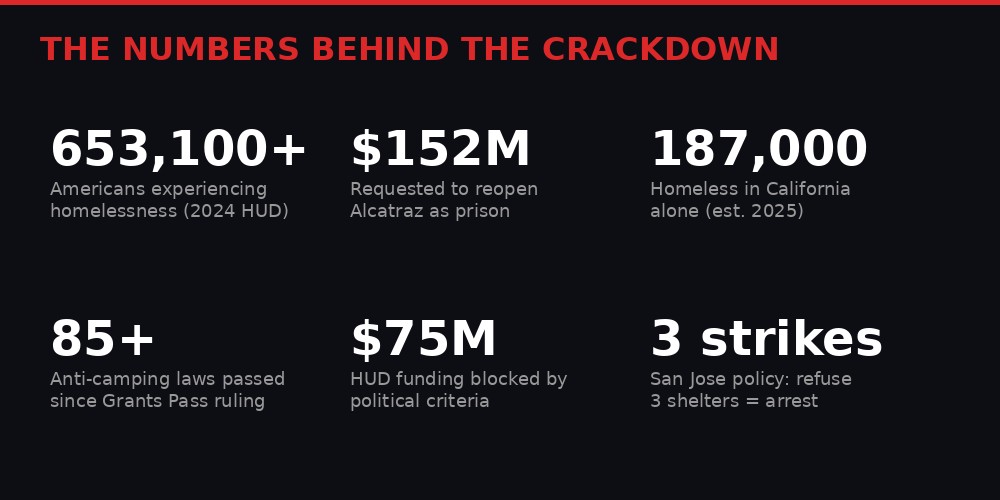
The numbers behind the crackdown. Sources: HUD 2024 Annual Homeless Assessment Report, AP News, Congressional Budget Office
The Alcatraz Gambit: $152 Million for a Symbol

Alcatraz Island, closed as a federal prison since 1963, currently generates $60 million annually as a tourist attraction. Photo: Pexels
Let us start with Alcatraz, because symbolism matters, and the symbolism here is deafening.
The Rock - the island fortress in San Francisco Bay that once held Al Capone, Machine Gun Kelly, and Mickey Cohen - was closed as a federal prison in 1963 because it was falling apart and costing three times more to operate than any other federal facility. For the last six decades, it has been a national park, drawing roughly 1.7 million visitors annually and generating an estimated $60 million in tourism revenue, according to the National Park Service.
Trump's fiscal year 2027 budget proposal includes $152 million to "rebuild Alcatraz as a state-of-the-art secure prison facility," with the funds covering only the first year of what would inevitably become a multi-billion dollar project. The island has no running water, no sewage system, and requires all supplies to be transported by boat. The original facility was abandoned precisely because these logistical realities made it economically insane to operate.
"Rebuilding Alcatraz into a modern prison is a stupid notion that would be nothing more than a waste of taxpayer dollars and an insult to the intelligence of the American people." - Nancy Pelosi, Former Speaker of the House
But Alcatraz was never really about logistics. Not when it was a prison, and not now. It was always about the message. In the 1930s, the message was that the federal government could lock away the most dangerous criminals on an island from which escape was theoretically impossible. In 2026, the message is different but equally blunt: there exists a class of people whom society wants to make disappear, and the government is willing to spend extraordinary sums to facilitate that disappearance.
The proposal is part of a broader $1.7 billion investment into the Bureau of Prisons outlined in Trump's budget. It arrives alongside an executive order, signed earlier this year, that directs Cabinet secretaries to prioritize funding to cities that crack down on open drug use and street camping. The order explicitly states that "shifting these individuals into long-term institutional settings for humane treatment is the most proven way to restore public order."
The language is clinical. The intent is carceral. And the target population, though the order does not say so directly, is overwhelmingly people who are poor, mentally ill, addicted, or all three at once.
Critics note the proposal would eliminate a $60 million annual revenue source while creating an ongoing operational cost that dwarfs anything the Bureau of Prisons currently manages. Even supporters of the administration's harder line on homelessness have been quiet about whether Alcatraz specifically makes any practical sense. The answer, of course, is that it does not need to make sense. It needs to make a statement.
Georgia's HB 788: Turning Property Owners Into Enforcement Arms

Public spaces are becoming contested territory. Georgia's new bill could turn every park bench into a potential lawsuit trigger. Photo: Pexels
If Alcatraz is the spectacle, Georgia's House Bill 788 is the machinery.
Passed by the state legislature in the early hours of April 4, 2026, the bill does something novel and, depending on your perspective, either innovative or terrifying. It allows property owners to file legal claims against local governments for compensation if they believe the city or county failed to enforce laws banning public camping, loitering, panhandling, or sanctuary city policies that limit cooperation with federal immigration authorities.
Read that again. A homeowner who feels their property has lost value because the city did not remove a nearby homeless encampment can now sue the municipality for damages.
The bill's sponsor, Athens Republican Rep. Houston Gaines, framed the legislation as accountability. "Allowing illegal encampments, theft and disorder to flourish is not kindness," Gaines said during floor debate. "It's neglect."
Democrats were considerably less charitable. State Sen. Josh McLaurin called the bill "nuclear bad policy," arguing that it invites a flood of lawsuits where proving causation - demonstrating that a property's value declined specifically because of unenforced camping bans - would be nearly impossible. "What you're inviting is a bunch of court cases where homeowners who are aggrieved at the local government can come make spurious claims about causation and have essentially a circus in court, which wastes judges' time, it wastes juries' time," McLaurin said.
A last-minute amendment expanded the bill further, allowing individuals to ask courts to order local governments to comply with bans on sanctuary policies - effectively using the homelessness issue as a Trojan horse for immigration enforcement.
"This bill is ineffective, cruel, and makes it harder to solve homelessness. It's also a thinly veiled attempt by lawmakers to score cheap political points on the backs of immigrant communities." - Jesse Rabinowitz, National Homelessness Law Center
The bill awaits Governor Brian Kemp's signature. If he signs it - and given his track record on law-and-order legislation, most observers expect he will - Georgia will become the first state in the nation where individual property owners have an explicit legal tool to force municipalities to crack down on homeless populations. The Cicero Institute, the conservative Texas-based think tank that drafted the bill's homelessness provisions, has been pushing similar legislation across the country. Georgia may be the template, but it will not be the last.
Justin Kirnon, who works for the city of Atlanta, warned during committee hearings that the bill misunderstands the fundamental nature of homelessness. Atlanta has made significant strides in reducing its homeless population, he noted, but people from surrounding counties often come to the city precisely because it offers more resources. "We all agree a lot of things have to be done on this topic, but this isn't the right approach," Kirnon said. "This essentially turns the city's general fund into a refund pool for any property owner that is dissatisfied with law enforcement's outcomes."
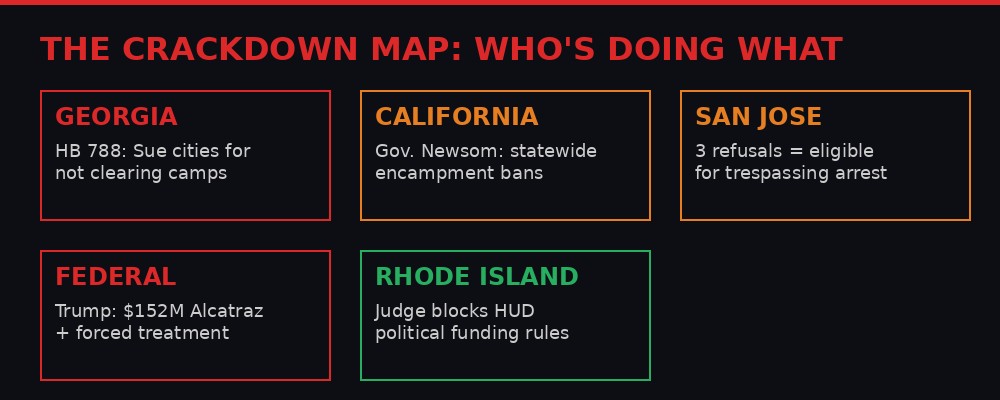
A snapshot of who is doing what in America's escalating war on homelessness. Sources: AP News, state legislatures, federal court filings
San Jose's Three-Strike Rule: Liberal Cities, Illiberal Policies

San Jose, in the heart of Silicon Valley, adopted one of the strictest anti-homeless policies in the country - from a Democratic mayor. Photo: Pexels
If you think this is exclusively a Republican project, San Jose would like a word.
The Silicon Valley city - Democrat-led, in the liberal San Francisco Bay Area, surrounded by tech wealth that makes the affordability crisis feel almost satirical - recently adopted what might be the most aggressive anti-camping policy in the country. Under Mayor Matt Mahan's "responsibility to shelter" provision, homeless individuals who refuse three offers of shelter become eligible for arrest on trespassing charges.
The City Council voted 9-2 in favor. Nine to two, in one of the most progressive metropolitan areas in America.
Mahan, a Democrat, frames the policy as accountability. "I think we need a cultural change, a culture of accountability for everyone involved," he told the Associated Press. "I don't want to use the criminal justice system to make vulnerable people's lives harder. I want to use it as a last resort."
But advocates for homeless populations say the framework is built on a false premise: that meaningful shelter options actually exist for the people being threatened with arrest. California has an estimated 187,000 homeless residents - roughly a quarter of the national total. The state has never come close to building enough shelter beds or permanent supportive housing to meet that demand. Offering someone a bed in a shelter 40 miles from the spot where they access their medication, their social worker, their community, and then arresting them when they decline, is not a genuine offer. It is a pretext.
"We are placing a huge amount of burden on an individual and framing it as a choice when the real culprit is a system that pushes people experiencing poverty into homelessness," said Pamela Campos, one of the two council members who voted against the measure.
Otto Lee, president of the Santa Clara County Board of Supervisors, was blunter. "Pushing people with mental health needs or drug addiction into incarceration - without any crime committed - is both inhumane and ineffective."
The San Jose policy did not emerge from nowhere. It grew directly from the soil tilled by the Supreme Court's 2024 decision in Grants Pass v. Johnson, which overturned a decade of Ninth Circuit jurisprudence holding that it was unconstitutional to criminalize sleeping outdoors when no shelter was available. That decision opened the floodgates. Since then, cities across the country have rushed to pass anti-camping ordinances, encampment bans, and loitering restrictions. Governor Gavin Newsom has repeatedly urged California cities to clear encampments. San Francisco's mayor, Daniel Lurie, has declared that it is "not appropriate" for people to live outdoors. Arrests for illegal lodging have soared in San Francisco.
The through-line is unmistakable: across the political spectrum, the answer to homelessness is increasingly not housing. It is removal. And the tools of removal are increasingly the tools of the criminal justice system.
The HUD Funding Wars: When Aid Becomes a Weapon

A federal judge in Rhode Island ruled the administration's changes to homeless funding criteria were "slapdash" and unlawful. Photo: Pexels
While states and cities have been tightening the screws at the local level, the federal government has been waging its own battle - this one over money.
The Trump administration attempted to reshape the Department of Housing and Urban Development's Continuum of Care Builds program, a $75 million pot of funding designed to build housing for homeless families and individuals. Under the new criteria, jurisdictions would be evaluated based on whether they supported sanctuary protections, harm reduction practices, or inclusive policies for transgender people. In other words, the administration tried to turn homeless assistance funding into a political loyalty test.
U.S. District Judge Mary McElroy, a Trump appointee, was not impressed. In her ruling, she described the new criteria as the result of a "slapdash imposition of political whims" and ordered HUD to scrap the revised policy entirely.
"Once again, this Court is faced with a case in which an executive agency has made a last-minute decision to make major, disruptive changes to grants within its purview, all for the express purpose of accomplishing the current administration's policy objectives." - Judge Mary McElroy, U.S. District Court, Rhode Island
The ruling was a win for the nonprofits that filed the lawsuit, including the National Alliance to End Homelessness and the Women's Development Corporation. But it was a narrow, technical victory. The court did not rule that the government cannot impose conditions on homeless funding. It ruled that this particular set of conditions was imposed without following proper administrative procedure. The administration could, in theory, come back with a properly noticed version of the same policy.
Ann Oliva, CEO of the National Alliance to End Homelessness, celebrated the ruling but acknowledged the broader picture remains grim. "Today's news reinforces a fundamental truth: that the work to end homelessness is not partisan, and never should be interfered with for political means."
But it is being interfered with. And the interference is not limited to funding criteria. The administration's executive order on homelessness, signed earlier this year, explicitly tasks Attorney General Pam Bondi and the secretaries for health, housing, and transportation to prioritize grants to states and local governments that enforce bans on open drug use and street camping. Devon Kurtz of the Cicero Institute called the order "a clear message to these communities that were still sort of uncomfortable because it was such a big change in policy."
The message is this: federal money flows to jurisdictions that punish. Jurisdictions that house, that treat, that provide harm reduction - those get to wait in line.
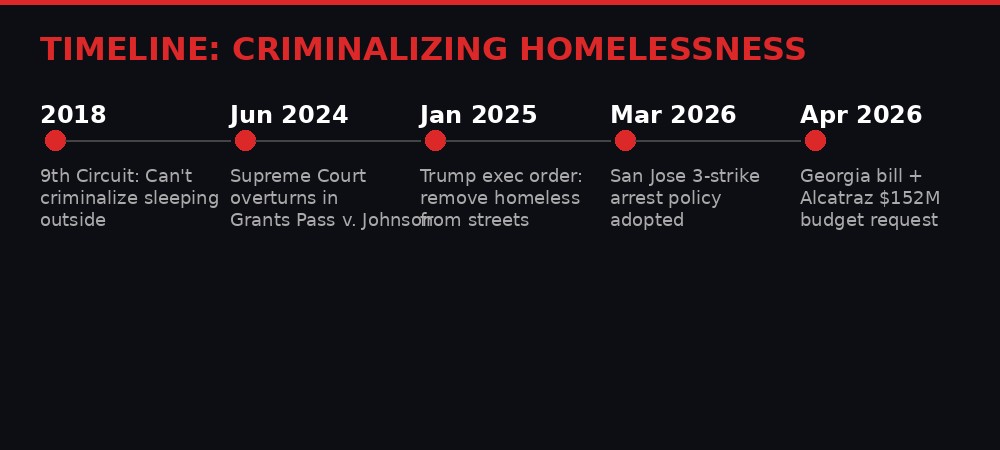
The escalation timeline. From constitutional protection to nationwide criminalization in under three years. Sources: SCOTUS, AP News, Congressional records
The Grants Pass Aftermath: What the Supreme Court Unleashed

The Supreme Court's 2024 Grants Pass decision removed the last constitutional guardrail against criminalizing homelessness. Photo: Pexels
To understand how America arrived at this moment, you have to go back to a small Oregon mountain town called Grants Pass, population 40,000, where tents in public parks became a battleground for a legal fight that ultimately reached the highest court in the land.
For years, the Ninth Circuit Court of Appeals had maintained a relatively simple principle: you cannot criminalize the act of sleeping outside if someone has nowhere else to go. This was established in a 2018 ruling and expanded in subsequent decisions challenging restrictions in Grants Pass specifically. Cities could prohibit tents. They could clear encampments. But they could not fine or jail people for the basic act of lying down and closing their eyes when no shelter bed was available.
Then, in June 2024, the Supreme Court overturned that entire framework. In Grants Pass v. Johnson, the court ruled that cities could indeed enforce anti-camping laws regardless of shelter availability. The Eighth Amendment's prohibition on cruel and unusual punishment, the majority held, did not extend to fining or jailing people for sleeping in public.
The decision united an unusual coalition. Democratic Governor Gavin Newsom and 22 conservative-led states both filed briefs supporting Grants Pass, arguing that lower court rulings had "hamstrung" their ability to deal with encampments. The opinion gave cities and states the legal green light they had been waiting for.
And they did not hesitate. In the two years since the ruling, anti-camping ordinances have proliferated across the country. The AP reported that by early 2025, arrests for illegal lodging had soared in San Francisco alone. Cities that had previously navigated a careful balance between enforcement and compassion suddenly found they no longer needed to balance anything at all.
The human cost has been documented by advocates on the ground. Forcing a person to clear out of an encampment sets them back in their search for stability. They lose important documents - IDs, Social Security cards, medical records - that are essential for applying for work and housing. They lose connections to outreach workers who know their case. They lose whatever fragile network of support they had managed to construct. And then, often, they reappear in the same place weeks later, because the conditions that made them homeless in the first place have not changed.
"Moving people from one street to the next or from the street to jail and back again will not solve this problem," said Los Angeles Mayor Karen Bass, one of the few Democratic leaders who has publicly resisted the sweep-and-arrest approach. Bass, notably, is at odds with both Governor Newsom and the Trump administration on this issue.
The Cicero Institute: The Think Tank Behind the Crackdown

The Cicero Institute, a conservative think tank based in Austin, Texas, has authored model legislation adopted in multiple states. Photo: Pexels
None of this is accidental, and none of it is organic. Behind the seemingly simultaneous emergence of anti-homeless legislation across multiple states sits a single organization that most Americans have never heard of: the Cicero Institute.
Founded by Joe Lonsdale, a co-founder of Palantir Technologies, the Austin, Texas-based think tank has been systematically drafting model legislation designed to crack down on homelessness and pushing it through state legislatures across the country. Georgia's HB 788 contains provisions drafted directly by Cicero. The organization publicly celebrated Trump's executive order on homelessness. Its policy director, Devon Kurtz, has been quoted in numerous news reports advocating for encampment bans and criminal penalties for refusing shelter.
The Cicero playbook is consistent across jurisdictions: frame the issue as public safety rather than housing, push for encampment bans and anti-camping ordinances, and create legal mechanisms that force cities to enforce these bans even when local officials might prefer a different approach. Georgia's innovation - letting property owners sue cities for non-enforcement - is arguably the most aggressive version of this strategy yet, because it removes enforcement discretion from elected officials entirely and puts it in the hands of private litigants.
The think tank's influence extends beyond direct legislation. By framing homelessness as primarily a law enforcement challenge rather than a housing and public health challenge, Cicero has shifted the Overton window of what policies are considered acceptable. Ten years ago, arresting someone for refusing a shelter bed would have been considered outrageous in most American cities. Today, it is city council policy in San Jose, and the mayor who proposed it is a Democrat.
This ideological infrastructure matters because it reveals the crackdown as something more than a collection of isolated policy decisions. It is a coordinated national strategy, funded by tech wealth, distributed through model legislation, and accelerated by a Supreme Court decision that removed the last constitutional guardrail.
The Human Math: Who Gets Criminalized

Behind the policy debates are real people. The majority of homeless Americans cite job loss, eviction, or medical crisis as the cause. Photo: Pexels
Numbers can obscure as easily as they reveal, but these are worth sitting with.
HUD's 2024 Annual Homeless Assessment Report counted more than 653,100 people experiencing homelessness on a single night in the United States - the highest number ever recorded. California alone accounts for roughly 187,000. Approximately 40% of homeless individuals are unsheltered, meaning they sleep in places not designed for human habitation: sidewalks, parks, cars, underpasses, abandoned buildings.
The demographics are not what the political discourse might suggest. The majority of people who become homeless cite job loss, eviction, domestic violence, or medical crisis as the precipitating cause. Mental illness and substance abuse are factors in a significant minority of cases, but they are not the majority driver, and the conflation of homelessness with addiction and mental illness has been weaponized to justify involuntary treatment and incarceration.
Trump's executive order explicitly references involuntary commitment as a solution, stating that "shifting these individuals into long-term institutional settings for humane treatment" is the path forward. Steve Berg, chief policy officer at the National Alliance to End Homelessness, noted that the United States abandoned forced institutionalization decades ago because it was prohibitively expensive, legally fraught, and ethically questionable. "What is problematic about this executive order is not so much that law enforcement is involved - it's what it calls on law enforcement to do, which is to forcibly lock people up," Berg said. "That's not the right approach to dealing with homelessness."
What is the right approach? The evidence has been consistent for decades. Permanent supportive housing - providing stable housing with wraparound services for mental health and addiction - has the strongest evidence base of any intervention. The "Housing First" model has been shown to reduce homelessness, reduce emergency room visits, reduce incarceration, and reduce overall costs to taxpayers compared to the revolving door of shelters, jails, and emergency services.
But Housing First requires building housing, which requires money, political will, and time. Criminalizing homelessness requires none of those things. It requires only the willingness to treat a person's presence in a public space as a violation of law. That willingness, clearly, is no longer in short supply.
The View from the Ground: Atlanta, San Francisco, Grants Pass

Encampments like this one have become the visual shorthand for a crisis that policy has failed to address. Photo: Pexels
In Atlanta, where the Georgia bill's effects will be felt most acutely, the memory of Cornelius Taylor has not faded. In 2025, a man was crushed inside his tent by a bulldozer during a homeless encampment clearing. The death galvanized advocates and briefly paused the legislative push - but only briefly. Republicans advanced the bill again weeks later, and this time it passed both chambers.
Taylor's death illustrates a paradox at the heart of the crackdown. The policies are justified as protecting public safety, but the people most endangered by them are the homeless individuals themselves. Encampment sweeps scatter people into less visible, more dangerous locations. Arrest records make it harder to secure employment and housing. Confiscation of personal belongings during clearings means the loss of medications, identification documents, and the few possessions that separate a person from total destitution.
In Grants Pass, where the Supreme Court case originated, Mayor Sara Bristol told the AP last month that homelessness has "dominated every single thing that I've done for the last 3 1/2 years." The town of 40,000 has issued hundreds of citations for camping or sleeping in public since 2013 - but its homeless population has not meaningfully decreased. The citations create debt. The debt creates warrants. The warrants create arrests. The arrests create criminal records. The criminal records create barriers to housing and employment. The cycle accelerates.
In San Francisco, where homeless arrests have soared, a tree doctor named Hiroyuki Wada made an observation this week about the city's aging cherry blossom trees that applies, perhaps inadvertently, to the humans sleeping beneath them. "Many trees in our daily lives were planted soon after the war and are now 70-80 years old and getting weaker," he said. "I hope people think about the climate change through what's happening to the cherry blossom trees, which is very symbolic."
It is symbolic. The infrastructure of care - for trees, for people, for the social fabric itself - was planted in a different era, under different assumptions. It is aging, underfunded, and cracking under pressures it was never designed to withstand. The response has not been to reinvest. It has been to remove what is visibly broken and hope the absence of the visible problem constitutes a solution.
Where This Goes: The Architecture of Disappearance

The next phase: as criminalization expands, the question becomes where the criminalized will go. Photo: Pexels
The trajectory is clear, and it points somewhere specific.
If the current wave of legislation, executive orders, and judicial decisions continues - and there is no meaningful countervailing force on the horizon - America will have effectively built a system where being homeless is a criminal offense in all but name. The Supreme Court has removed the constitutional barrier. State legislatures are passing laws that weaponize civil liability against municipalities that do not enforce hard enough. The federal government is conditioning aid on compliance with punitive approaches. And cities, even liberal ones, are adopting arrest-based policies because the political cost of visible homelessness now exceeds the political cost of cruelty.
The Alcatraz proposal, absurd on its face, is the logical terminus of this trajectory. If you criminalize existence, you need somewhere to put the criminals. And what more fitting symbol than a fortress on a rock in the middle of a bay, surrounded by water, designed from its inception to be a place from which there is no return?
But the proposal is also, paradoxically, a sign of desperation. The administration knows that its approach is not actually reducing homelessness. HUD's own numbers show the crisis deepening. The policy responses are becoming more extreme not because they are working, but because they are not working and no one is willing to pivot to what might actually work - namely, building enough affordable housing to meet demand, funding mental health and addiction treatment at scale, and addressing the structural economic conditions that push people into homelessness in the first place.
In the meantime, the people caught in the gears of this machinery are not abstractions. They are the woman in Grants Pass who is blind in one eye, being fined for staying in her tent too long. They are the residents of Atlanta's encampments, one of whom was crushed by a bulldozer. They are the unnamed thousands in San Jose who will now face arrest for declining a shelter bed that may not meet their needs.
They are, in short, Americans. And America has decided that the most efficient way to deal with their suffering is to make it illegal to be seen suffering.
That is not a policy. It is an erasure.
Sources: AP News (Charlotte Kramon, Michael Casey, Janie Har), BBC News, HUD 2024 Annual Homeless Assessment Report, U.S. District Court for the District of Rhode Island, National Alliance to End Homelessness, National Homelessness Law Center, Cicero Institute, National Park Service, Supreme Court of the United States (Grants Pass v. Johnson, 2024)
Get BLACKWIRE reports first.
Breaking news, investigations, and analysis - straight to your phone.
Join @blackwirenews on Telegram