End of the Tower: Apple Kills the Mac Pro and It's Not Coming Back
After 27 years, Apple quietly confirms the Mac Pro is discontinued with no replacement planned. This is not just a product death - it's the final proof that Apple Silicon changed what a professional computer can be.
The Mac Pro tower, 1999-2026. Apple has confirmed to 9to5Mac there are no plans for future Mac Pro hardware. (BLACKWIRE/PRISM illustration)
The announcement came the way these things always do with Apple: a quiet confirmation to a trade publication, no press release, no Steve Jobs moment, no eulogy. The Mac Pro's buy page now redirects to the Mac homepage. The product listing is gone. Apple confirmed to 9to5Mac on Thursday that it has discontinued the Mac Pro tower and has no plans to make another one.
Twenty-seven years of Apple's most powerful desktop, from the beige Power Mac G3 tower that Steve Jobs unveiled as part of his famous four-quadrant product grid in 1997, to the controversial cylindrical "trash can" that became a symbol of Apple losing the plot on pro hardware, to the triumphant 2019 return, to the anticlimactic M2 Ultra update in 2023 that sat at a stubborn $6,999 while better machines undercut it from inside Apple's own catalog - and now, silence.
This is not a surprising death. It was a slow one, telegraphed by years of neglect, internal architectural shifts, and the rise of a sibling product that made the tower look embarrassing by comparison. But it is a significant one. The Mac Pro's discontinuation marks the moment Apple officially declared that upgradeable, expandable professional desktops are not part of its future.
The second-order effects of that decision are still unfolding - in video editing suites, AI research labs, scientific computing clusters, and the minds of anyone who needs serious compute power and used to reach for an Apple product first.
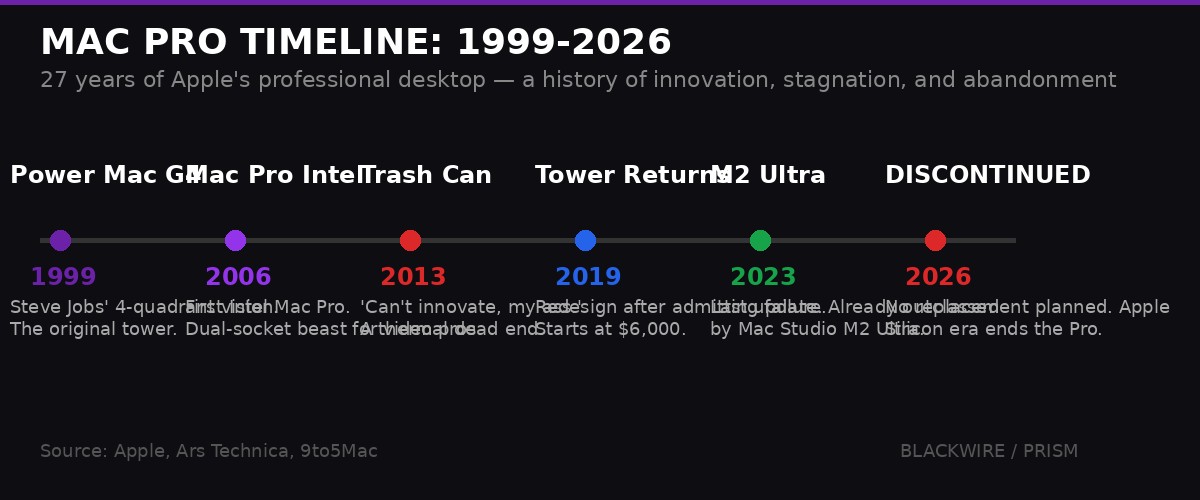
The Mac Pro's 27-year lifespan, from the Power Mac G3 to the M2 Ultra's quiet discontinuation. The trash can era (2013-2019) nearly killed the product line - Apple admitted as much. (BLACKWIRE/PRISM)
The Long Goodbye: A History of Neglect
To understand why this death was inevitable, you have to understand the long history of Apple not knowing what to do with the Mac Pro - and periodically admitting it.
The Pro tower's golden era was the mid-2000s. Apple's Power Mac G5 was, briefly, the fastest personal computer on earth. When Apple transitioned to Intel in 2006, the Mac Pro carried that momentum. It was a dual-socket machine, capable of supporting two Xeon processors, enormous RAM, multiple hard drives, and whatever PCIe expansion cards you needed. Scientific researchers ran fluid dynamics simulations on it. Music producers built studios around it. Hollywood used it for rough cuts before offloading to render farms.
The cracks started showing around 2012. A major update that year barely deserved the name - minor configuration changes to a three-year-old chassis. Then came 2013 and the notorious "trash can" redesign.
Phil Schiller introduced the cylindrical Mac Pro with a line that has aged poorly: "Can't innovate, my ass." The new design was genuinely radical. It was one-eighth the volume of the old tower, powered by a custom Intel Xeon with two AMD FirePro GPUs arranged in a triangle formation. It ran whisper-quiet due to a single central fan pulling air through all three components at once.
But that thermal triangle was also a thermal prison. The design was so precisely engineered around those specific components that any deviation - a new GPU, a larger CPU, a different thermal envelope - was impossible without a complete redesign. And so Apple never updated it. Not in 2014. Not in 2015. Not in 2016. By 2017, the Mac Pro was running on hardware that was literally four years old in a market where GPU generations turn over every eighteen months.
"I think we designed ourselves into a bit of a thermal corner, if you will. We designed a system with the kind of GPUs that at the time we thought we needed, and that we thought we could well serve with a two GPU architecture. But workloads didn't materialize to fit that as broadly as we hoped."
- Craig Federighi, Apple SVP Software Engineering, April 2017
That admission, in a rare off-the-record meeting with journalists, was remarkable. Apple doesn't do public mea culpas. The fact that Federighi gave one signals how badly the company had fumbled the professional market. Pro users were buying used Mac Pros from 2010 and installing Nvidia cards in them because it was a better option than buying the current model. The joke was that Apple's best pro desktop was one it had stopped selling six years earlier.
The 2019 Mac Pro was supposed to be the correction. And in many ways it was - a proper tower chassis with a side that swung open, room for expansion, PCIe slots, modular architecture. Apple even made an afterburner card specifically for the Mac Pro, an FPGA accelerator that let it play back 6K ProRes RAW video without taxing the CPU. Starting at $5,999 (and climbing to $55,000 if you maxed everything out, including the wheels), it was expensive, but it was real.
The problem was timing. Apple announced the Mac Pro in June 2019. Four months later, in November 2020, the first Apple Silicon Macs arrived. And Apple Silicon changed everything.
Apple Silicon's Architectural Revolution - and Its Hidden Cost
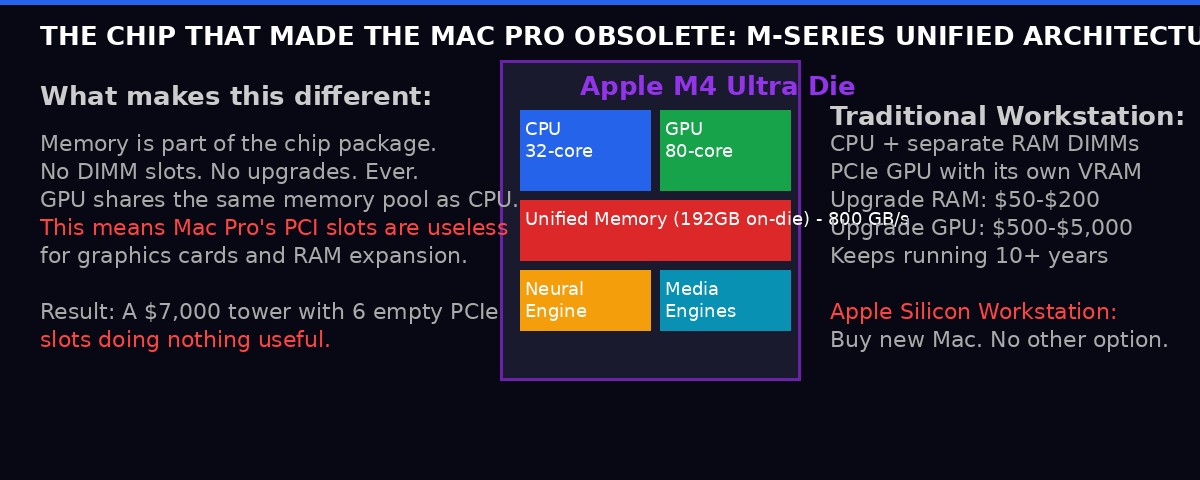
Apple Silicon's unified memory architecture delivers 800 GB/s bandwidth - eight times faster than DDR5. But the trade-off is permanent: no upgrades, ever. (BLACKWIRE/PRISM)
When Apple designed its M-series chips, the engineering team made a foundational decision that would ripple through the entire professional computing market for years. They put the CPU, GPU, Neural Engine, media engines, and memory - all of it - onto a single silicon package. This is called unified memory architecture, or UMA.
The performance benefits are extraordinary. The M2 Ultra chip delivers 800 GB/s of memory bandwidth. A high-end DDR5 DIMM system typically manages around 100-200 GB/s. That gap is not incremental - it's the difference between a GPU waiting on data from slow RAM and a GPU that can reach everything it needs at wire speed. For video production, 3D rendering, and machine learning inference, the performance per dollar is genuinely remarkable.
But the trade-off is permanent and irreversible: since the memory is part of the chip package, you cannot upgrade it. At all. Ever. When you buy a Mac with 24GB of unified memory, you will die with 24GB of unified memory. When you need more, you buy a new Mac.
This created a problem for the Mac Pro that had no clean solution. The whole point of a pro tower - the reason people paid $6,999 for a desktop when a laptop would do most jobs - was expandability. You bought the base configuration and grew it. RAM upgrade in year two. New GPU in year three when Nvidia dropped a new generation. NVMe drives as prices fell. You were buying a platform, not just a machine.
Apple Silicon made all of that impossible. The Mac Pro's six PCIe expansion slots, one of its headline features, became largely ornamental. You could add an external SSD enclosure (though Thunderbolt made internal drives less necessary anyway). You could add capture cards. But the two big ones - RAM and GPU - were gone. The architecture killed them.
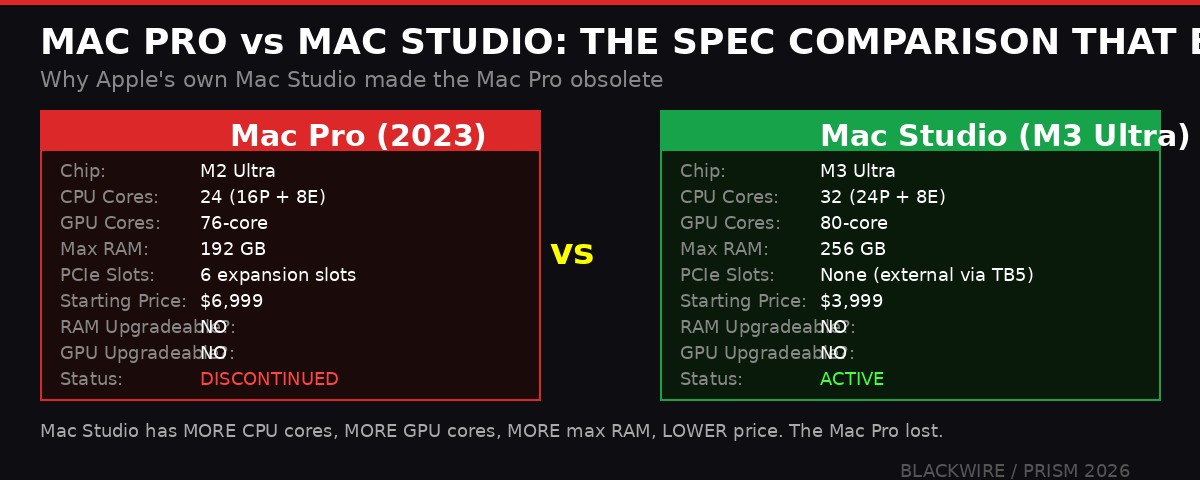
The Mac Studio M3 Ultra has more CPU cores, more GPU cores, more maximum RAM, and costs $3,000 less than the Mac Pro it effectively replaced. (BLACKWIRE/PRISM)
Meanwhile, Apple quietly made the Mac Pro's own sibling product superior in almost every spec. The Mac Studio, introduced in 2022 and updated to M3 Ultra last year, runs a newer chip generation with more CPU cores (32 vs 24), more GPU cores (80 vs 76), higher maximum RAM (256GB vs 192GB), and starts $3,000 cheaper than the Mac Pro. The Mac Studio is the size of a hardcover book. The Mac Pro is the size of a small washing machine.
When the spec sheet comparison is this lopsided, the tower's fate is obvious. Apple needed either a dramatic new reason for the Mac Pro to exist, or the courage to discontinue it. It chose the latter. There's a version of this story where Apple redesigned the Mac Pro to use some future chip that required liquid cooling and massive power delivery, justified only by a workload profile that no consumer-level machine could serve. That machine didn't happen.
The Numbers: Who Actually Bought a Mac Pro?
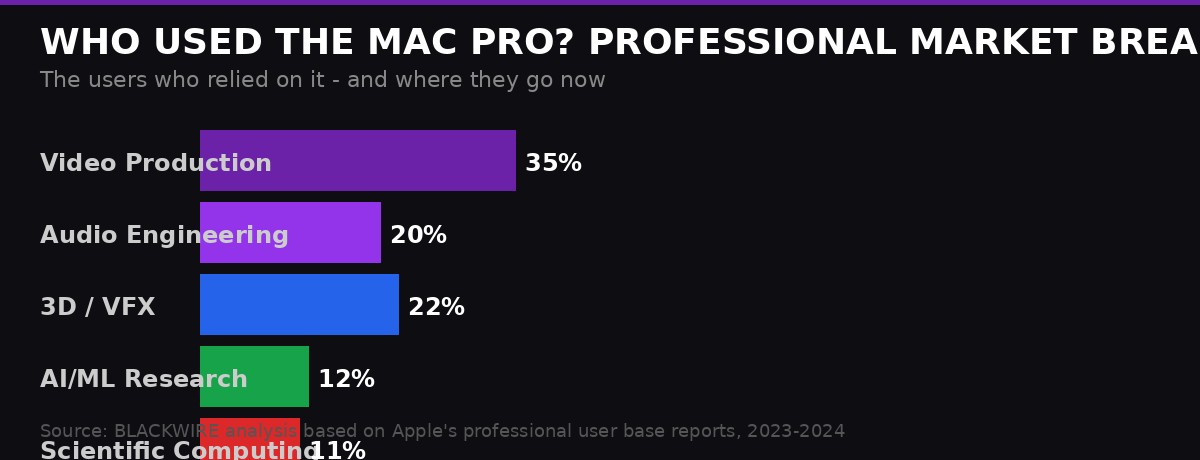
The Mac Pro's core buyer base broke down into five main professional verticals. Video production and 3D/VFX dominated, with AI/ML research growing fast before the Mac Studio undercut the value proposition. (BLACKWIRE/PRISM analysis)
The Mac Pro was never a mass-market machine and wasn't meant to be. Apple sells tens of millions of MacBooks each year. In its peak years, the Mac Pro sold somewhere in the range of 35,000-50,000 units annually - a rounding error on Apple's balance sheet. Its real value to Apple was not revenue but reputation: having a machine at the absolute top of the market signaled that Apple was serious about professional users, that creatives and scientists could build workflows on the Mac platform knowing Apple would keep pace.
That signaling function eroded once the Mac Pro's specs fell behind the Mac Studio. A machine that costs more and performs less is not a statement of commitment to professionals - it's an embarrassment. Apple stopped updating the M2 Ultra Mac Pro in 2023, let it sit at $6,999 while the M3 and M4 generations rolled out to every other Mac, and finally pulled the listing without ceremony.
The professional verticals that relied on the Mac Pro break down roughly as follows. Video production dominated, including film editors, colorists, and broadcast professionals running Final Cut Pro and DaVinci Resolve. Audio engineers came next, using Mac Pros with Avid Pro Tools HD systems and high-channel-count interfaces that required PCIe cards for low-latency audio I/O. 3D artists and visual effects studios were a significant chunk, running Cinema 4D, Houdini, Blender, and Nuke. A growing segment was AI and machine learning researchers doing inference work and fine-tuning experiments. And scientific computing users - physicists, genomicists, engineers - rounded out the picture.
Each of these groups will handle the transition differently. The video and audio professionals have it easiest: the Mac Studio genuinely does replace the Mac Pro for their workflows, with more performance at lower cost. The PCIe audio cards are a loss, but Thunderbolt audio interfaces have become more capable, and the performance advantages of Apple Silicon more than compensate.
The AI/ML community faces a harder transition. The Mac Studio's unified memory makes it genuinely useful for running large language models in inference - the ability to have 192GB of fast, unified memory means you can run a 70B parameter model locally without thrashing. But for training and fine-tuning at scale, the Mac platform cannot compete with NVIDIA's CUDA ecosystem. H100s and B200s run Linux, support ROCm and CUDA, and integrate with PyTorch and JAX at a level that Apple's Metal framework is years behind on. The Mac Pro's death confirms that Apple is not trying to compete in that market.
The scientific computing segment may migrate hardest. Workloads that required specific PCIe cards - FPGA boards, high-speed DAQ interfaces, specialized compute accelerators - have no path forward on Apple Silicon. For many of these users, a Dell or HP Linux workstation was already the right choice, and the Mac Pro's death just removes the option to stay in the Apple ecosystem.
The Elephant in the Room: Apple and the AI Workstation Market
Here is the second-order effect that most coverage of this story is missing. Apple just explicitly walked away from the workstation market at the same moment that AI is creating enormous demand for local compute.
The AI workstation category is growing fast. Companies building AI applications need developers with fast local iteration cycles. Researchers need to run models without cloud API costs. Edge deployment requires on-device inference capability. Startups building AI products want their engineers to be able to run experiments without paying $3 per GPU-hour on AWS. There is real market demand for a powerful, well-cooled, expandable local AI workstation.
Apple's answer to that demand, right now, is the Mac Studio. It is, in many ways, a good answer - the unified memory makes large models accessible to developers who don't want to manage Linux GPU nodes. The M3 Ultra can run a 70B parameter model in inference at reasonable speed. The developer experience on macOS is genuinely excellent. A large and growing number of AI engineers use Mac Studios as their primary development machines, offloading training runs to cloud or on-premise GPU clusters.
But the Mac Studio is not expandable. When you need more RAM for a larger model, you buy a new Mac Studio. When a new generation of AI techniques demands more compute, you buy new hardware. Apple has made its bet: the upgrade cycle is the monetization model, not the PCIe slot.
NVIDIA's response to this market has been the opposite. The DGX Spark, announced at GTC 2025, is a personal AI supercomputer the size of a lunch box running GB10 Grace Blackwell silicon with 128GB of unified memory and 1 PFLOP of AI performance at FP4 precision. It is aimed squarely at the developer who needs to run local models without managing a full rack. It runs Linux. It supports CUDA natively. It costs roughly $3,000.
Apple and NVIDIA are now directly competing for the AI developer desktop market from opposite architectural directions. Apple Silicon offers a polished developer experience on macOS, excellent battery life in laptop form factors, and a software ecosystem that most developers already live inside. NVIDIA offers raw training performance, CUDA compatibility, and a path to scaling up from developer box to cloud cluster to data center without changing frameworks or rewriting code.
The Mac Pro's discontinuation means Apple has chosen not to compete in the high-end segment of this fight. No Apple machine will ever again let a researcher slot in a new GPU card. The ceiling on local Apple compute is whatever Apple decides to put in the next Mac Studio, and the user has no say in the matter.
The Pro Display XDR: A Death in Two Parts
One detail that sharpens the Mac Pro story: Apple discontinued the Pro Display XDR earlier this month, on March 3rd, also with no replacement announced. The Mac Pro and the Pro Display XDR launched together in 2019. They died weeks apart in 2026.
The Pro Display XDR was a 32-inch, 6K, 1,000-nit sustained brightness display that cost $5,000 and another $1,000 if you wanted a tilt-adjustable stand (not included). It was controversial for the stand pricing but genuinely excellent as a reference monitor - colorists, broadcast engineers, and high-end photographers used it as a near-professional alternative to $40,000 grading displays from Dolby and Flanders Scientific.
Its discontinuation leaves Apple with a gap in its display lineup at the professional reference tier. Apple still sells the Studio Display, a 27-inch, 5K monitor for $1,599 that is excellent but positioned below the XDR's quality level. Rumors suggest Apple has a new professional display in development, possibly at the XDR's quality tier with updated HDR specs. But for now, if you need a reference display and want to stay in Apple's ecosystem, the options are used XDRs at inflated prices or third-party monitors.
The simultaneous loss of both products - the Mac Pro and the Pro Display XDR - is a meaningful signal. Apple built a professional desktop ecosystem around these two products in 2019, explicitly to court back the pro users who had been neglected through the trash can era. Seven years later, both are gone. Whether Apple rebuilds that ecosystem or cedes the professional tier entirely to Mac Studio + third-party displays remains an open question.
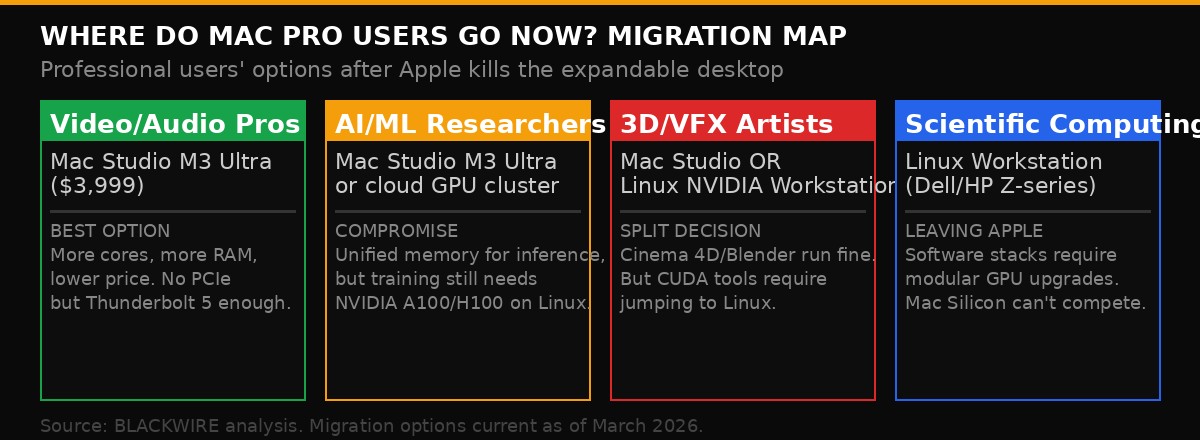
Where Mac Pro users go depends heavily on their workflow. Video and audio professionals can move to Mac Studio cleanly. AI/ML researchers face harder trade-offs. Scientific computing users may leave Apple entirely. (BLACKWIRE/PRISM analysis)
The Remaining Mac Lineup: Is It Actually Better Without the Pro?
Here is an argument that deserves a fair hearing: the current Mac lineup, without the Mac Pro, may actually be the strongest and most coherent Apple has had in years.
Apple now sells three desktop Macs. The 24-inch iMac with M4 is a beautiful all-in-one for the consumer and light professional tier. The Mac mini with M4 and M4 Pro is the most flexible and affordable Mac ever made, starting at $599 and capable of serious professional work in the M4 Pro configuration. The Mac Studio with M4 Max and M3 Ultra handles the professional tier with genuine capability, from music production to 4K video to AI model inference.
On the laptop side, the MacBook Neo fills the entry-level slot with an iPhone-class chip at a price point below the MacBook Air. The MacBook Air remains the best consumer laptop available at its price. The MacBook Pro with M4 Pro and M4 Max is a workstation-class portable that outperforms most desktop computers from three years ago.
The lineup is clean. Every tier is filled. The Mac Pro sat at the top as an expensive outlier that most professional workflows had already outgrown in terms of value. Its $6,999 starting price bought you less than a $3,999 Mac Studio. Without it, Apple's highest-priced desktop is the Mac Studio M3 Ultra at roughly $3,999 in a well-configured state - better positioned against the competition than a $7,000 tower with obsolete architecture.
macOS Tahoe 26.2 added a feature that further undercuts the Mac Pro's value proposition: RDMA over Thunderbolt 5, which allows multiple Macs to share memory over a direct connection with very low latency. The vision is a cluster of Mac Studios, connected over Thunderbolt, acting as a unified compute resource. This is not yet widely deployed, but it represents Apple's architectural answer to "what if you need more compute than one Mac provides" - not a bigger Mac, but more Macs.
Whether that vision scales is still unproven. Distributed computing over Thunderbolt works for some workloads and poorly for others. Training large neural networks is notoriously hard to distribute efficiently - the communication overhead between nodes can consume more time than the computation itself. But for inference serving, rendering, and some simulation workloads, the multi-Mac cluster approach may be viable enough that the absence of a single monster tower is manageable.
What Gets Buried: Apple Silicon's Upgrade-Hostile Architecture
There is a consumer rights dimension to this story that deserves more attention than it typically gets. Apple Silicon's unified memory architecture is a legitimate engineering breakthrough. The bandwidth numbers are real, the performance is real, and the power efficiency is genuinely impressive. But it comes with a trade-off that is architecturally enforced and commercially significant: you cannot upgrade your machine.
In the traditional computing model, a workstation purchase was an investment in a platform. You bought the CPU and motherboard as a foundation and upgraded components over time as your needs grew or as better parts became available. A five-year-old Mac Pro tower could still be upgraded with new NVMe drives, new RAM, a newer GPU. People ran 2010 Mac Pros into 2018 with component upgrades that kept them competitive.
Apple Silicon makes this impossible not just by design choice but by physical architecture. The memory is part of the chip package. You cannot add more. You cannot swap the GPU. The only upgrade path is a new machine.
This has real implications for the total cost of ownership. A $4,000 Mac Studio that cannot be upgraded and needs to be replaced every three to four years has a very different TCO than a $7,000 workstation that runs for six to eight years with component upgrades. Apple's numbers look better at purchase; they look worse over a decade.
The right-to-repair movement has focused primarily on repairability - the ability to fix broken components. The Mac Pro's death highlights a related but distinct issue: the right to expand. Apple Silicon has made Apple Macs effectively disposable at the hardware level. The software and data persist; the hardware is a rental with a predetermined expiration date.
This is not unique to Apple. Most modern computers trend toward less user-serviceable designs as miniaturization continues. But Apple moves faster and further in this direction than most. The Mac Pro was the last Apple desktop where user expansion was a first-class feature. Its death marks the moment Apple's entire Mac lineup became closed-loop systems.
The Timeline: 27 Years in Numbers
| Year | Model | Starting Price | Key Milestone | Status |
|---|---|---|---|---|
| 1997 | Power Mac G3 | $1,999 | Steve Jobs' four-quadrant plan. Clean start. | DISCONTINUED |
| 1999 | Power Mac G4 | $1,599 | 500 MHz barrier, "supercomputer" billing | DISCONTINUED |
| 2003 | Power Mac G5 | $1,999 | Briefly fastest personal computer on earth | DISCONTINUED |
| 2006 | Mac Pro (Intel) | $2,499 | First Intel Mac Pro, dual Xeon available | DISCONTINUED |
| 2013 | Mac Pro (Trash Can) | $2,999 | Radical redesign, thermal dead-end | DISCONTINUED 2017 |
| 2019 | Mac Pro (Cheese Grater) | $5,999 | Return to tower, PCIe expansion, Afterburner | DISCONTINUED |
| 2023 | Mac Pro (M2 Ultra) | $6,999 | Apple Silicon transition, last Mac Pro ever | DISCONTINUED 2026 |
| 2026 | - | - | Apple confirms no replacement planned | LINE DEAD |
Looking Forward: What Happens Next?
Apple is not going to announce the Mac Pro's successor this week, or this quarter, or possibly this year. The company's direction is clear: the Mac Studio at the top of the desktop stack, the MacBook Pro at the top of the portable stack, and the cluster-of-Macs vision for anyone who needs more than one machine can provide.
There are scenarios where a Mac Pro successor appears. If Apple develops a chip that requires a larger form factor for thermal reasons - an M5 Extreme or M6 Ultra with a TDP that a Mac Studio's compact enclosure can't manage - the tower might return as an engineering necessity rather than a product strategy. Apple has surprised people before.
But the company's current trajectory suggests the Mac Studio is the answer they've settled on. It's growing in capability each generation. The Thunderbolt clustering feature opens up multi-node scaling. And the Mac Studio costs half what the Mac Pro cost while outperforming it on every spec.
For the professionals who are disappointed - and there are real ones, particularly in scientific computing and specialized audio work that relied on PCIe expansion - the path forward involves either accepting the Mac Studio's capabilities as sufficient or moving to Linux workstations. The latter is increasingly viable. Modern Linux distributions are far more user-friendly than they were a decade ago. NVIDIA's Linux driver support is excellent. The software gap between macOS and Linux has narrowed substantially in most professional applications.
Apple made a calculated bet in 2020 when it designed Apple Silicon around unified memory. It chose bandwidth and efficiency over expandability. For the vast majority of Mac users, that was the right trade. For the Mac Pro's core users, it was a death sentence. We just got the confirmation.
The tower is dead. Build your workflows accordingly.
Key Facts: Apple Mac Pro Discontinuation
- Confirmed by: Apple, direct statement to 9to5Mac (March 26, 2026)
- Last model: Mac Pro M2 Ultra, released June 2023, priced from $6,999
- Mac Studio M3 Ultra: More CPU cores, more GPU cores, more max RAM, $3,000 cheaper
- No replacement planned: Apple explicitly confirmed to 9to5Mac - "no plans for future Mac Pro hardware"
- Also discontinued: Pro Display XDR (March 3, 2026)
- Remaining desktops: iMac M4, Mac mini M4/M4 Pro, Mac Studio M4 Max/M3 Ultra
- RDMA over Thunderbolt 5: Added in macOS Tahoe 26.2 - enables multi-Mac clusters as upgrade alternative
- PCIe in Apple Silicon Mac Pro: 6 slots, but RAM and GPU upgrades impossible due to unified memory architecture
Second-Order Effect to Watch: Apple just exited the expandable professional desktop market at the same moment NVIDIA entered it with the DGX Spark personal AI supercomputer. The AI developer workstation war is now Apple Silicon vs. CUDA - not Mac Pro vs. anything. Apple chose Mac Studio and clustering. NVIDIA chose a miniaturized H100 box. This is the real fight for the next five years.
Get BLACKWIRE reports first.
Breaking news, investigations, and analysis - straight to your phone.
Join @blackwirenews on TelegramSources: 9to5Mac (Apple confirmation, March 26 2026); Ars Technica, Andrew Cunningham (Mac Pro history and discontinuation coverage, March 27 2026); Apple (Mac Studio and Mac lineup specifications, apple.com); Apple SVP Craig Federighi (2017 Mac Pro admission, TechCrunch); Ars Technica (Mac Pro 2025 back-burner report, November 2025); Apple Developer Documentation (RDMA over Thunderbolt 5, macOS Tahoe 26.2); NVIDIA GTC 2025 (DGX Spark announcement).