The Art of Defiance: How America's Cultural Resistance Found Its Voice in 2026
From guerrilla sculptures on the National Mall to a national opera in exile, American artists are waging a war of meaning against a president determined to remake the country in his own image.

Federal buildings now display presidential banners while guerrilla artists install satirical sculptures in response. BLACKWIRE/PIL
There is a golden toilet sitting near the Lincoln Memorial.
It appeared on March 31, 2026 - a faux-marble sculpture titled "A Throne Fit For a King," installed by an anonymous artist collective called the Secret Handshake. The piece mocks President Donald Trump's renovation of the White House bathroom attached to the Lincoln Bedroom, a project that drew widespread criticism for proceeding during a government shutdown. Visitors laughed. They took selfies. Park police stood by, unsure what to do with a piece of political satire that weighed several hundred pounds and was clearly designed to be impossible to remove quickly.
A few hundred yards away, a giant banner bearing the president's face stares down from the Department of Justice headquarters. Another hangs from the Department of Labor. His name now adorns the Kennedy Center for the Performing Arts and the United States Institute of Peace. The National Mall - what Americans call their "front yard" - has become a battlefield between a president who wants his face on every building and the artists, musicians, and performers who refuse to let that go unchallenged. (NPR)
This isn't a single protest. It's a cultural insurgency playing out in real time across every medium Americans have - sculpture, music, opera, poster art, architecture, and public space. And it may be the most consequential resistance movement since the Vietnam era, not because it threatens to topple a government, but because it's redefining what opposition looks like in an age where traditional political channels have been largely neutralized.
I. The Mall Wars: Satire Versus Spectacle
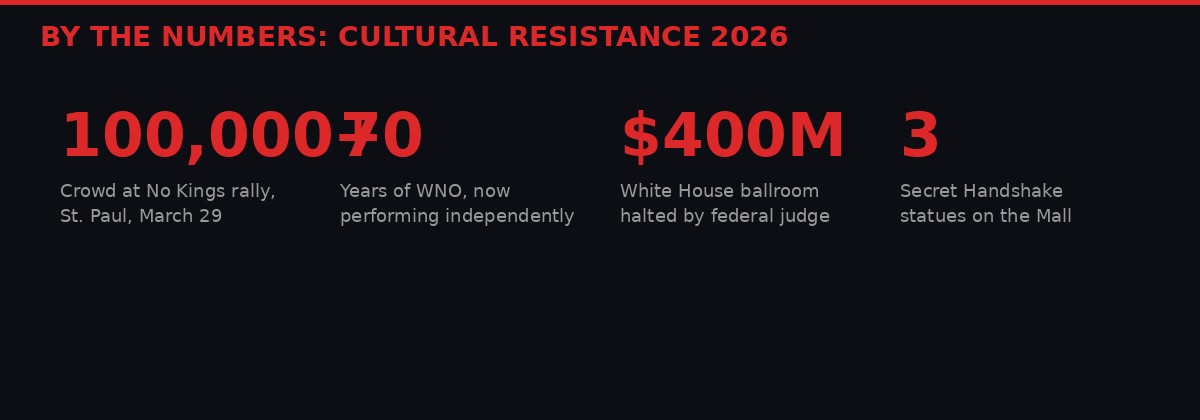
Key figures from the cultural resistance movement in 2026. BLACKWIRE/PIL
The Secret Handshake doesn't do interviews. Nobody knows who they are. What people know is what they leave behind: sculptures that appear overnight on America's most watched stretch of public land, each one calibrated to cause maximum embarrassment with minimum legal exposure.
Their first installation landed in February 2026 - a gold-painted statue depicting Trump and the late convicted sex offender Jeffrey Epstein in the iconic pose from Titanic, arms outstretched on the prow of a ship. The piece was titled "King of the World." It drew steady crowds who laughed and posed for photos in front of it. The image went viral on every social media platform within hours. (NPR)
Not everyone was amused. "It's a gross interpretation of our president," said Andi Lynn Helmy, a high school senior from Jacksonville, Florida. "Even if you don't agree with his policies... I think it's just an incredibly disrespectful thing." But that disrespect is precisely the point. The Secret Handshake has grasped something that conventional political opposition hasn't: in an era of consolidated media power and institutional capture, ridicule travels faster than policy papers.
They're not alone on the Mall. The Save America Movement, a registered nonprofit led by Mary Corcoran, has plastered posters on fences and walls across Washington, D.C., each one targeting a specific member of Trump's inner circle. One shows a photo of White House Deputy Chief of Staff Stephen Miller with the caption "Fascism Ain't Pretty." Another depicts Attorney General Pam Bondi - since fired on April 2 - with the words "Epstein Queen," a reference to her handling of the Epstein files that eventually led to her dismissal.
"We think that ridicule is a really important tool in an opposition toolbox to fight authoritarianism. But this isn't a fair fight, because they're using taxpayer dollars to fund their propaganda, and we're not."- Mary Corcoran, Save America Movement (NPR)
The juxtapositions on the Mall have become remarkable. At the Department of Justice, Trump's banner reads "Make America Safe Again." Directly below it, the Secret Handshake hung counter-banners with the same slogan, reframed around Epstein's name and image. The visual collision between official propaganda and guerrilla satire is now one of the most photographed scenes in Washington - a city that has seen its share of protest imagery over the centuries.
Visitors and constitutional scholars have drawn direct parallels to authoritarian iconography. The giant presidential portraits staring down from federal buildings evoke the political imagery of Chairman Mao's China and Stalin's Soviet Union - a comparison the White House dismisses but cannot prevent people from making.
"I just feel like he's sort of painting himself as the king of America," said Luke Price, a freshman at the University of Vermont, standing beneath one of the banners. "I just don't think that's what we're about. America is a democracy, not a dictatorship." (NPR)
The White House's response has been predictable but revealing. Spokesman Davis Ingle told NPR by email: "President Trump is focused on saving our country - not garnering recognition. A variety of organizations are free to share their opinions publicly, even when they lack any basis in reality." The statement doesn't address the banners, the renamings, or the unprecedented personalization of federal buildings. It simply denies what everyone can see with their own eyes.
II. The Boss Goes to War
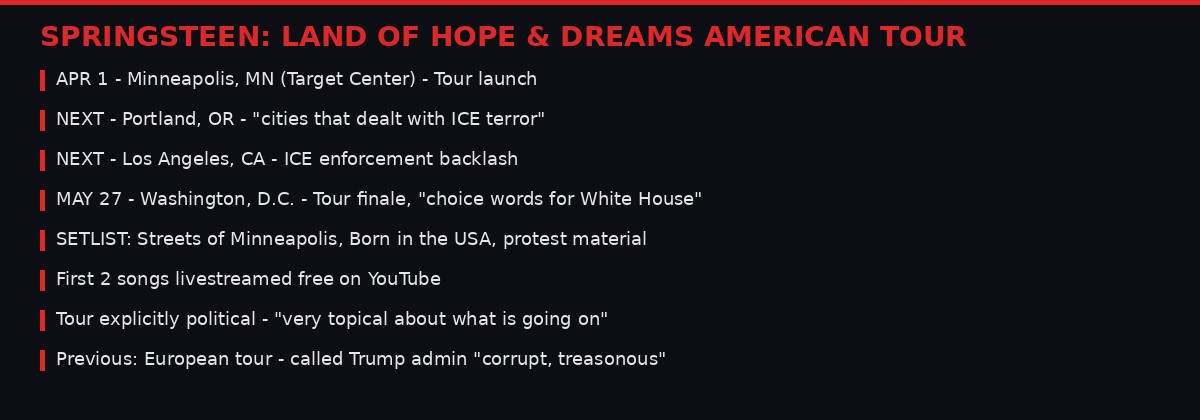
Bruce Springsteen's explicitly political tour launches April 1 in Minneapolis and ends in Washington, D.C. BLACKWIRE/PIL
On April 1, 2026, Bruce Springsteen and the E Street Band took the stage at Target Center in Minneapolis for the opening night of the "Land of Hope & Dreams American Tour." It was not an accident that the Boss chose this city. Minneapolis is where the federal government deployed 3,000 officers in its largest immigration enforcement action in the country. It's where federal agents shot and killed Renee Good and Alex Pretti. It's where a photo of 5-year-old Liam Conejo Ramos, wearing a bunny hat and Spider-Man backpack, surrounded by immigration officers, became an image that stirred outrage across the planet. (PBS NewsHour)
"This tour is going to be political and very topical about what's going on in the country," Springsteen told the Minnesota Star Tribune. "Minneapolis and St. Paul, that was the place that I wanted to begin it, and I wanted to end it in Washington."
Springsteen released "Streets of Minneapolis" in late January 2026 - a gritty anthem honoring the residents who stood up against the federal immigration crackdown. The song's video showed masked agents in tactical gear, the face of the operation Greg Bovino (who was subsequently pulled from Minneapolis amid the backlash and is preparing to retire), the makeshift memorials at the sites where Good and Pretti were killed, and the thousands who filled the streets chanting "ICE Out!" (PBS NewsHour)
"This past winter, federal troops brought death and terror to the streets of Minneapolis. Well, they picked the wrong city. The power and the solidarity of the people of Minneapolis, of Minnesota, was an inspiration to the entire country. Your strength and your commitment told us that this is still America, and this reactionary nightmare, and these invasions of American cities will not stand."- Bruce Springsteen, No Kings Rally, St. Paul, March 29, 2026, to an estimated 100,000 people (PBS NewsHour)
The tour's routing tells a story on its own. After Minneapolis, Springsteen heads to Portland, Oregon, and Los Angeles - "two other cities where they had to deal with ICE, ICE's terror," as he put it at a March 23 "Democracy Now!" 30th anniversary celebration in New York City. The tour ends May 27 in Washington, D.C., where Springsteen promised he'll have "a few choice words for the White House."
The personal animosity between Springsteen and Trump runs deep. During his European tour last year, Springsteen called the Trump administration "corrupt, incompetent and treasonous" and denounced Trump as "an unfit president" leading a "rogue government" of people who have "no concern or idea for what it means to be deeply American." Trump has called Springsteen a "dried-out prune of a rocker" and wrote on Truth Social: "Never liked him, never liked his music or his Radical Left Politics and, importantly, he's not a talented guy - just a pushy, obnoxious JERK." (PBS NewsHour)
But the significance of this tour extends far beyond one musician's feud with one president. Springsteen is 76 years old. He's been making politically charged music since "Born in the U.S.A." in 1984. He kicked off that album's tour in St. Paul, too. But in 2026, the context has shifted. The protest songs aren't about abstract injustice - they're about specific people who died on specific streets, and a federal government that sent armed officers into American cities to conduct mass operations against immigrant communities. The first two songs of Tuesday night's concert were livestreamed free on YouTube. The decision to make protest music free and universally accessible in real time is itself a statement about what resistance looks like now.
III. An Opera Company in Exile
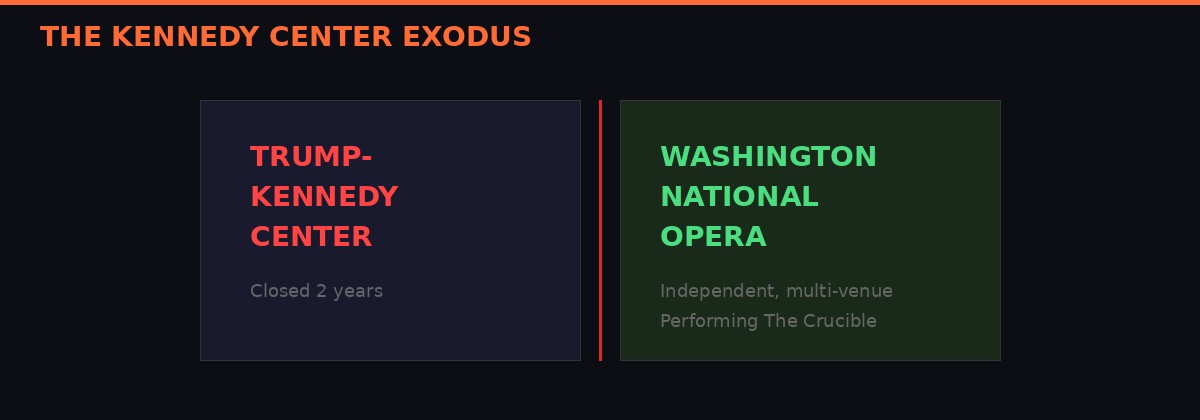
The Washington National Opera left the Kennedy Center after 54 years to perform independently. BLACKWIRE/PIL
The Washington National Opera was founded in 1956. It has performed at the Kennedy Center since the building opened in 1971. In 2011, it formalized its relationship with the Center through an affiliation agreement, becoming one of its tentpole organizations. For 70 years, the WNO brought some of the world's greatest singers to the Kennedy Center's grand Opera House. Then Donald Trump came back to the White House, and everything changed. (PBS NewsHour)
"This last year has been something I could never have imagined," said Francesca Zambello, the WNO's artistic director. "I could not have dreamt this up. Last February, there was literally a coup d'etat at the Kennedy Center."
That is not metaphor. It is her lived experience. The longtime leadership of the Kennedy Center - respected arts leaders who had spent careers building the institution into one of the world's premier performing arts venues - were fired. New leadership installed the president himself as chair. A new requirement demanded that arts groups break even or earn a profit on every production, a mandate that runs contrary to how opera, dance, and theater companies have operated for centuries. Leading artists canceled performances. Audiences stayed away. (PBS NewsHour)
"The building felt politicized," Zambello told PBS's Jeffrey Brown. "Everyone who worked in the building, if they did not march in lockstep with the new management, were fired. The audiences felt this, I think, incredible burden that everything was about us or them, about the two parties, whereas we have always been an apolitical building, an apolitical arts institution."
In January 2026, the WNO's leadership and board made a stunning decision: leave the newly renamed Trump-Kennedy Center entirely and go independent. The drop in ticket sales and donor support meant the shows simply could not go on under the new regime. But Zambello frames it as something larger than financial survival.
"I think that by making the move away from the center, we made a big statement. It should not be about us and them. It should be about a good civil society."- Francesca Zambello, Artistic Director, Washington National Opera (PBS NewsHour)
The company is now performing across multiple venues in the D.C. area and beyond. "Treemonisha," an opera by Scott Joplin, played to packed houses at Lisner Auditorium in Washington - the same venue where the company gave its very first performance in 1957. A May production of "West Side Story" will be staged in two forms: a full production at the Lyric Baltimore and a smaller version at Strathmore Music Center in Maryland. The scattering of productions across multiple venues isn't a crisis strategy. Zambello is reframing it as liberation.
"I'm thinking of this as a new kind of creative freedom," she said, "that we are producing in different venues that really are appropriate for the works that we will be presenting."
The choice to perform Arthur Miller's "The Crucible" - about the Salem witch trials, written as a warning about McCarthyism - in this moment is pointed. J'Nai Bridges, one of today's leading mezzo-sopranos, sings the role of Elizabeth Proctor, falsely accused of being a witch. Bridges was initially set to perform at the Kennedy Center, even as she wrestled with the political implications.
"I was a bit hesitant because it's a tricky thing to navigate," Bridges told PBS. "Not everyone was for my choice of performing at the Kennedy Center. I felt that the role in the opera is so relevant that it was almost, in a sense, a protest. So I really felt like, OK, as uncomfortable as this might feel, I'm ready for it. But then things changed. And I have to say that I am relieved." (PBS NewsHour)
Earlier this month, the Trump-Kennedy Center board formally approved the president's plan to close the center for two years. The board also formalized early termination of its agreement with the WNO, claiming the separation was its decision due to a "financially challenging relationship." The dueling narratives - the WNO saying it left, the Center saying it pushed them out - may never be resolved. What's clear is that one of America's most important opera companies now operates as an artistic refugee, performing in borrowed spaces across the capital, staging works about persecution and injustice while its former home sits under the name of the president who drove them out.
IV. The Ballroom and the Bulldozer
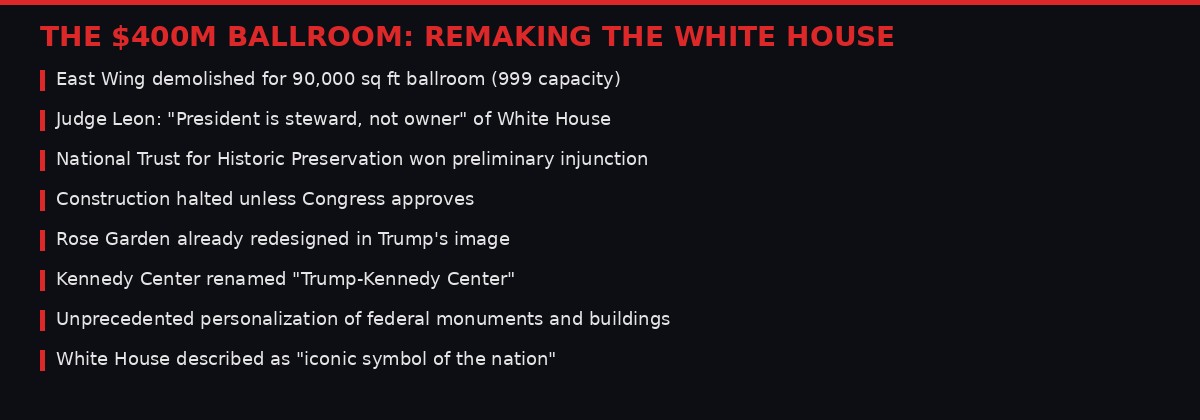
The $400 million White House ballroom project has been halted by a federal judge. BLACKWIRE/PIL
While artists wage guerrilla war on the Mall and opera companies flee the Kennedy Center, the president has been literally demolishing the White House to remake it in his own image.
The East Wing of the White House is gone. Demolished. In its place, Trump ordered construction of a 90,000-square-foot ballroom designed to hold 999 people, at a cost of $400 million. The project was announced last summer and moved with remarkable speed - the East Wing was torn down by late October 2025, before most Americans had fully processed what was happening. (PBS NewsHour/AP)
On April 1, 2026, U.S. District Judge Richard Leon - nominated to the bench by Republican President George W. Bush - granted a preliminary injunction temporarily halting the project. The ruling was sharp and unambiguous.
"The President of the United States is the steward of the White House for future generations of First Families. He is not, however, the owner!"- U.S. District Judge Richard Leon (PBS NewsHour/AP)
Judge Leon found that the National Trust for Historic Preservation was likely to succeed on the merits of its claims because "no statute comes close to giving the President the authority he claims to have." The administration had argued that previous presidents didn't need congressional approval for White House renovations, but Leon rejected the comparison. Previous projects were modest. This is a fundamental transformation of a national landmark.
Trump proceeded with the project before seeking input from the National Capital Planning Commission or the Commission of Fine Arts - agencies that exist specifically to approve construction on federal property. He stocked both commissions with allies. The Trust sued in December 2025.
"This clearly is not how Congress and former Presidents have managed the White House for centuries, and this Court will not be the first to hold that Congress has ceded its powers in such a significant fashion!" Leon wrote. The White House immediately filed a notice of appeal. (PBS NewsHour/AP)
Trump's response in the Oval Office was characteristically defiant. He brought handwritten notes referencing the parts of the ruling that allow security-related construction to continue. "The roof is droneproof. We have secure air-handling systems. You know, bad things happen in the air if you have bad people," Trump told reporters. "We have bio-defense all over. We have secure telecommunications and communications all over. We have bomb shelters that we're building. We have a hospital and very major medical facilities that we're building."
The pivot from "I'm building a ballroom" to "I'm building bomb shelters" tells you everything about how the administration frames its transformation of American public spaces. Every aesthetic choice is recast as a security necessity. Every act of self-aggrandizement becomes an act of protection. The pattern - rename the Kennedy Center, hang presidential portraits from federal buildings, demolish the East Wing, rebuild it as a palace - is consistent. The justifications shift depending on the audience. But the message is always the same: this is mine now.
V. The Human Cost of the Crackdown
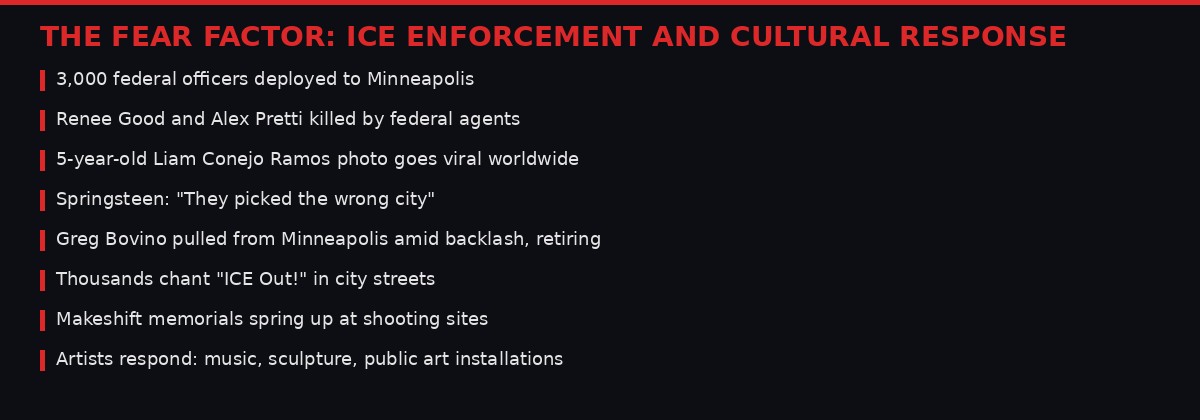
The Minneapolis federal enforcement operation and its aftermath fueled a nationwide cultural response. BLACKWIRE/PIL
Behind every guerrilla sculpture, every protest anthem, every opera about persecution, there are real people whose lives were shattered by the policies that provoked the art.
The Minneapolis operation was the most aggressive domestic immigration enforcement action in modern American history. Three thousand federal officers descended on a major American city, and two people - Renee Good and Alex Pretti - were shot and killed by agents during confrontations. The deaths ignited protests that filled the streets for weeks. But it was the image of 5-year-old Liam Conejo Ramos that pierced the global consciousness - a small child in a bunny hat and Spider-Man backpack, surrounded by armed federal officers. (PBS NewsHour)
That image did something that policy debates could not. It made the abstract concrete. It turned "immigration enforcement" into a picture that parents across the world could immediately understand. The artist response was almost instantaneous. Within days, the image appeared in murals across Minneapolis. Street artists reproduced it on walls and bridges. Printmakers distributed posters for free at protests. The image of a frightened child became a symbol - not of any political party's position, but of what happens when a government treats entire communities as enemies to be subdued.
Vox reported that Trump's mass deportation pledges had "fundamentally changed how regular people live" - not just undocumented immigrants, but entire communities where people with papers live alongside people without them. Churches stopped hosting community events. Parents kept children home from school. Businesses in immigrant neighborhoods saw revenue collapse as residents withdrew from public life. (Vox)
The cultural response to this reality is not unified. It doesn't have a central committee or a shared strategy. It has Springsteen singing about specific streets in a specific city. It has anonymous artists planting satirical sculptures in the dark. It has a 70-year-old opera company performing Arthur Miller's warning about persecution in a borrowed auditorium. Each is responding to the same reality through a different medium, and together they form something that begins to look like a movement - not organized from the top, but emerging organically from the bottom, driven by the oldest human impulse: the need to say "this is wrong" in a way that cannot be ignored.
The Minnesota State Patrol estimated the No Kings rally crowd in St. Paul at approximately 100,000 people - one of the largest political gatherings in the state's history. These were not all activists. They were teachers, nurses, small business owners, retirees, students, parents with strollers. They were people who had never attended a protest in their lives standing next to people who had been protesting for decades. What brought them together was not a candidate or a party, but a feeling that something fundamental about their country was being taken away, and that the only response was to show up.
VI. The Historical Echoes
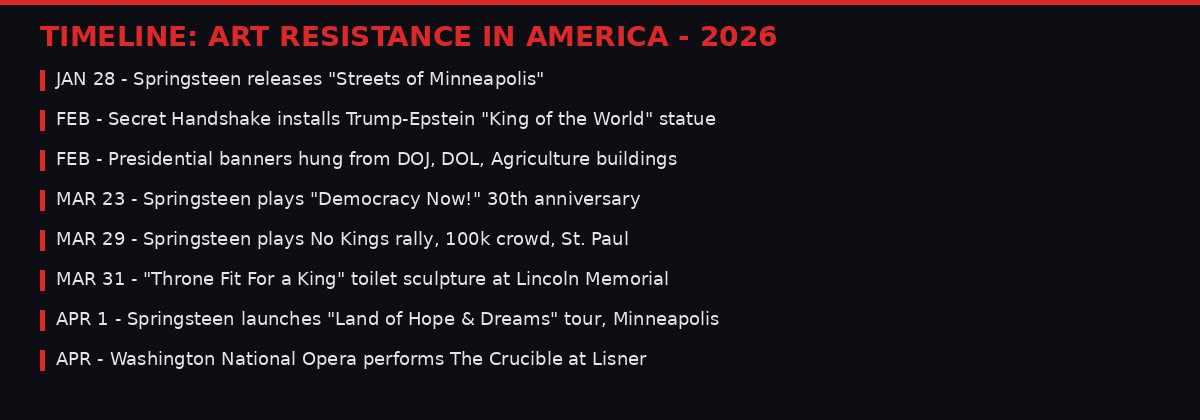
Key events in the 2026 cultural resistance movement, from January through April. BLACKWIRE/PIL
America has been here before. Not exactly here, but close enough that the parallels are instructive.
In the 1950s, Senator Joseph McCarthy's anti-communist crusade drove artists underground, destroyed careers, and turned the entertainment industry into a loyalty testing ground. Arthur Miller wrote "The Crucible" in 1953 as a direct response to McCarthyism - using the Salem witch trials as an allegory for the paranoia, conformity, and institutional betrayal of his own era. That the Washington National Opera is performing "The Crucible" in 2026, having been driven from its home by political pressure, is not a coincidence. It is a historical circuit completing itself.
In the 1960s and 70s, the Vietnam War and the civil rights movement generated a cultural explosion that reshaped American music, theater, visual art, and literature. Bob Dylan, Joan Baez, Nina Simone, and John Lennon didn't just soundtrack the resistance - they gave it a language. Protest songs like "Blowin' in the Wind" and "Strange Fruit" became shared reference points that allowed millions of people to articulate what they were feeling. Springsteen's "Streets of Minneapolis" operates in the same tradition, updated for an era where protest songs drop on streaming platforms and go viral within hours.
In the 1980s, the AIDS crisis provoked one of the most powerful art-as-resistance movements in American history. ACT UP used graphic design, performance art, public funerals, and guerrilla theater to force a government that wanted to ignore the epidemic to confront it. The NAMES Project AIDS Memorial Quilt - displayed on the National Mall in 1987 - used the language of craft and domesticity to communicate catastrophic loss. The Secret Handshake's sculptures on the same ground nearly 40 years later echo that tradition of turning America's most symbolically loaded public space into a site of protest.
But 2026 is different in critical ways. The resistance infrastructure of previous eras - unions, churches, the ACLU, established civil rights organizations - has been weakened by decades of political assault. The media landscape that amplified protest in the 1960s has been fragmented by social media and undermined by disinformation. The political opposition that would normally channel cultural anger into policy change has been largely neutralized at the federal level. What remains is culture itself - the one domain where individuals and small groups can still make statements that cannot be easily co-opted, censored, or dismissed.
This is both the strength and the weakness of the current moment. Cultural resistance is powerful because it operates outside traditional political structures that have been captured or corrupted. It's accessible because anyone with a brush, a guitar, or a welding torch can participate. It travels fast because art communicates emotions that policy papers cannot. But it's also fragile because it has no institutional backing, no electoral strategy, and no mechanism for translating outrage into governance. The question hanging over every sculpture on the Mall, every protest anthem, every exiled opera company is the same one that has haunted every cultural resistance movement in history: Is this enough?
VII. The Architecture of Control
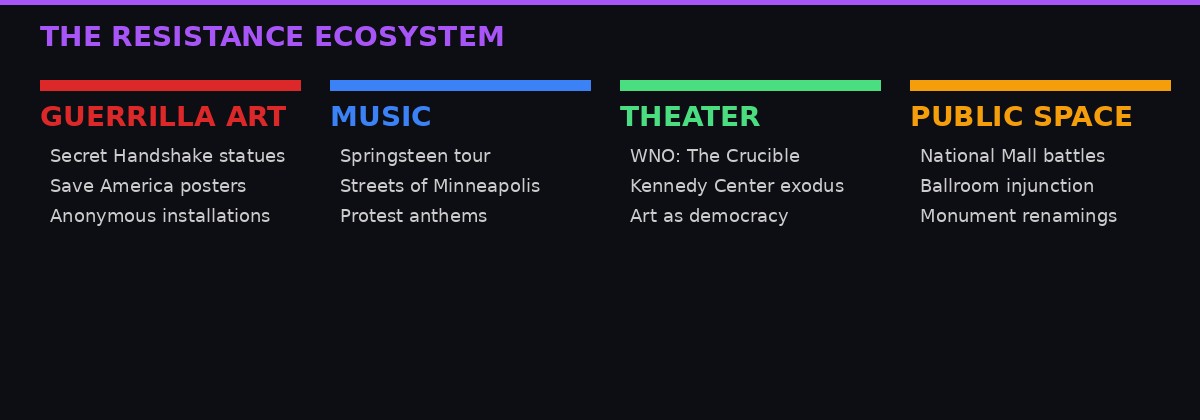
The cultural resistance operates across four domains: guerrilla art, music, theater, and public space. BLACKWIRE/PIL
To understand why artists are responding the way they are, you have to understand the scale of what they're responding to. This administration is not merely enacting policies that artists find objectionable. It is systematically remaking the physical and symbolic landscape of American democracy.
The Kennedy Center - built with bipartisan support as a "living memorial" to President John F. Kennedy - now bears Trump's name. The East Wing of the White House - a structure that has stood in some form since 1942, where First Ladies from Eleanor Roosevelt to Jill Biden operated - has been demolished and replaced with a construction site for a personal ballroom. The National Mall, designed by Pierre Charles L'Enfant as a democratic commons, now features presidential portraits on government buildings in a style that historians compare to authoritarian personality cults.
The pattern extends beyond Washington. Across the country, federal buildings display messaging that blurs the line between government communication and presidential self-promotion. The Rose Garden has been redesigned. The Oval Office has been redecorated. These might seem like trivial aesthetic choices, but they are not. They are acts of possession. Each one says: this is not the people's building. This is my building.
The judge's ruling on the ballroom captures the constitutional stakes. When Richard Leon wrote that the president is "the steward of the White House for future generations of First Families" and "not, however, the owner," he was articulating a principle that applies far beyond architecture. The president does not own the Department of Justice. He does not own the Kennedy Center. He does not own the National Mall. These institutions belong to the American public, and the act of stamping them with one man's name and image is an act of dispossession - taking something that belongs to everyone and making it belong to one person. (PBS NewsHour/AP)
The artistic response mirrors the nature of the threat. Guerrilla sculptures reclaim public space that has been branded. A protest tour reclaims the narratives of cities that were occupied by federal forces. An opera company that performs in borrowed venues reclaims the idea that art belongs to communities, not to politicians. Each act of resistance is a counter-claim of ownership - a statement that these spaces, these stories, these values belong to the people, not the president.
VIII. What Comes Next
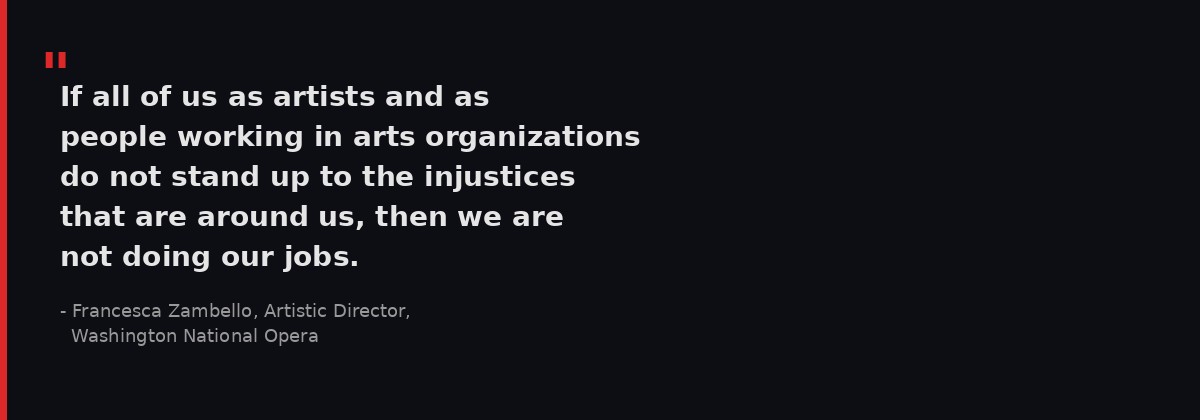
Washington National Opera's Francesca Zambello frames the arts fight as a moral imperative. BLACKWIRE/PIL
Springsteen's tour ends in Washington, D.C. on May 27. The WNO will announce its next season's productions and venues soon. The Secret Handshake will presumably continue installing sculptures until someone figures out how to stop them - or until the political landscape shifts enough that satire loses its target. The ballroom case will work through the appeals courts. The banners may come down, or more may go up.
But the deeper question isn't about any single artwork, concert, or legal ruling. It's about whether cultural resistance can sustain itself over years, not weeks. The Vietnam-era protest movement lasted a decade. The AIDS activism of ACT UP spanned years of relentless pressure before it forced pharmaceutical companies and the federal government to change course. The civil rights movement was built across decades of organizing, sacrifice, and cultural production that reinforced political action.
The 2026 resistance has energy. It has talent. It has courage - installing an unauthorized sculpture near the Lincoln Memorial while a president with authoritarian tendencies controls the federal government requires real nerve. But it does not yet have staying power, institutional depth, or a theory of change that connects art to political outcomes.
Zambello, who has spent her career building institutions, understands this. "I think that the arts are certainly under attack right now," she told PBS. "I think that many people don't believe that they're necessary. And if all of us as artists and as people working in arts organizations do not stand up to the injustices that are around us, then we are not doing our jobs." (PBS NewsHour)
The word "jobs" matters there. She's not talking about art as hobby, luxury, or optional enrichment. She's talking about art as professional obligation - a duty that comes with the territory of being someone who creates meaning for a living. When the meaning of a country is being contested at the most fundamental level - who belongs, who has rights, who owns the public square - the people whose profession is meaning-making don't get to sit this one out.
The golden toilet sits near the Lincoln Memorial. The giant portrait stares down from the Department of Justice. The opera company performs "The Crucible" in an auditorium that isn't its home. The Boss sings about streets where people died. None of these things will end a presidency. But they do something that legislative maneuvers and court filings cannot: they make it impossible to pretend that what's happening is normal.
Normalization is how authoritarianism wins. Not through a single dramatic seizure of power, but through the slow accumulation of absurdities that people stop noticing because they've been going on for so long. A giant portrait of the president on a government building. A renamed cultural institution. A demolished East Wing. Each one seems survivable on its own. Together, they constitute a transformation.
The artists know this. That's why they keep showing up - with sculptures, with songs, with operas about witch trials, with posters that say "Fascism Ain't Pretty." They're not trying to win an election. They're trying to prevent the moment when Americans walk past a golden toilet on the National Mall and stop laughing. Because the day Americans stop finding this absurd is the day the absurd becomes the new reality.
And that is the day the artists will have lost.
Get BLACKWIRE reports first.
Breaking news, investigations, and analysis - straight to your phone.
Join @blackwirenews on Telegram