Humanity Goes Back: Artemis II Nears the Moon, 53 Years After Apollo
Four astronauts are right now closing in on the moon at more than 2,000 miles per hour. Monday's flyby will send them farther from Earth than any human has ever traveled. This is not a drill, a rehearsal, or a simulation. It is the real thing - happening for the first time since Richard Nixon was president.

Artemis II launched April 1, 2026 - humanity's first crewed lunar mission since Apollo 17 in December 1972. The Orion capsule carries four astronauts on a free-return slingshot around the moon.
The Orion capsule carrying Reid Wiseman, Victor Glover, Christina Koch, and Canadian astronaut Jeremy Hansen departed Earth orbit on Thursday night, April 2, in a maneuver called translunar injection. A precisely timed engine burn accelerated the capsule to more than 24,000 miles per hour, breaking free from the gravitational pull that has kept all human beings within low Earth orbit for the past 53 years.
By Sunday afternoon, the crew was more than halfway to their destination. Their toilet was malfunctioning. Their faces were reportedly pressed against the capsule windows. And Earth was shrinking to the size of a marble behind them.
"The Earth is quite small, and the moon is definitely getting bigger," pilot Victor Glover reported to Mission Control, according to NASA communications. (Source: AP, April 5, 2026)
Monday's lunar flyby - scheduled to begin in the early hours of April 6 - will take the Orion capsule 4,000 miles beyond the moon's far side, reaching a maximum distance of approximately 252,000 miles (405,000 kilometers) from Earth. That breaks the record set by Apollo 13 in April 1970, when the crew of that famously crippled spacecraft reached 248,655 miles before making their emergency U-turn home.
Artemis II is not attempting a landing. The crew will not enter lunar orbit. They will perform what engineers call a free-return trajectory - a figure-eight slingshot that uses the gravity of the Earth and moon to send the capsule back without burning significant fuel. Splashdown in the Pacific Ocean is planned for April 10.
The last time humans traveled this far from Earth was December 1972, when Apollo 17 astronauts Eugene Cernan, Harrison Schmitt, and Ronald Evans completed humanity's final lunar mission. Nobody went back. For five decades, the moon watched Earth from a quarter-million miles away, and Earth watched the moon, and nobody crossed the gap.
That gap is closing again today.
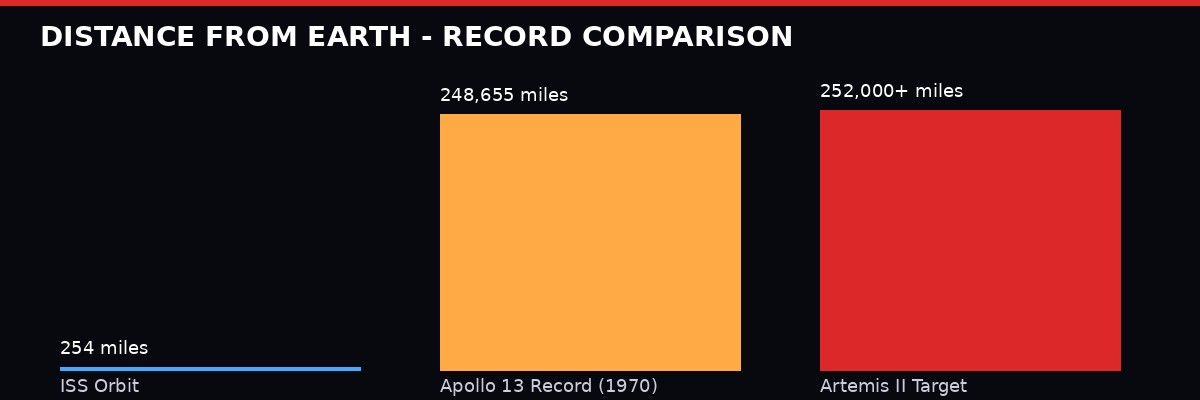
Distance comparison: The ISS orbits at just 254 miles. Apollo 13 set the previous human distance record at 248,655 miles. Artemis II will exceed 252,000 miles - a new record for human exploration.
The Four Who Are Making History Right Now
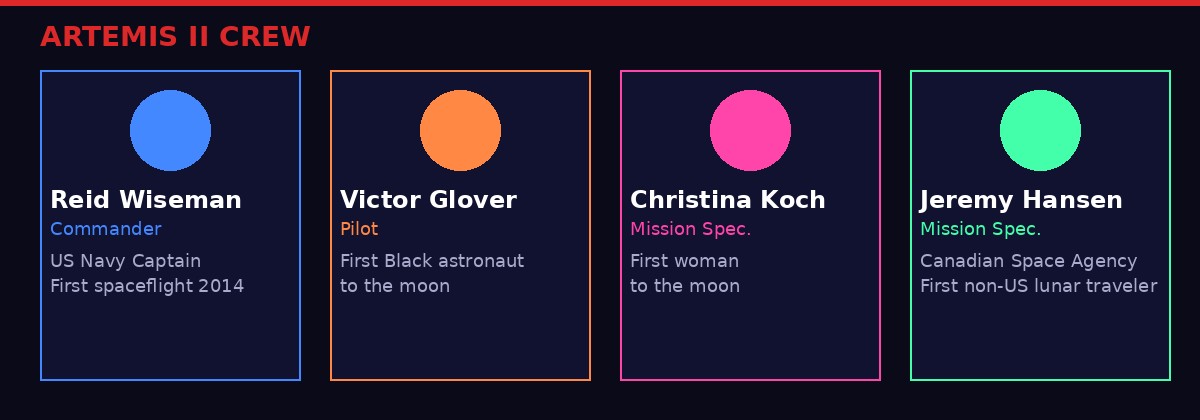
The Artemis II crew: Commander Reid Wiseman (USN), Pilot Victor Glover, Mission Specialist Christina Koch, and Mission Specialist Jeremy Hansen (CSA). First diverse crew to reach the moon.
The astronaut corps that flew Apollo was defined by what it excluded as much as what it achieved. Twenty-four white American men went to the moon between 1968 and 1972. Not one woman. Not one person of color. Not one person from outside the United States. The Artemis II crew makes all of those records obsolete at once.
Victor Glover, a Navy test pilot and NASA astronaut who flew to the International Space Station in 2020, is the first Black person in history to travel toward the moon. Christina Koch, who set the record for the longest single spaceflight by a woman during her 328-day ISS mission in 2019-2020, is the first woman to make the lunar journey. Jeremy Hansen of the Canadian Space Agency becomes the first non-American to travel to the moon.
Reid Wiseman commands the mission. A former Navy captain and ISS expedition commander, Wiseman has the steadiest voice in NASA's communications from the capsule. He described the moment the engine fired and pushed the crew toward the moon.
"I've got to tell you, there is nothing normal about this. Sending four humans 250,000 miles away is a herculean effort, and we are now just realizing the gravity of that."
- Commander Reid Wiseman, speaking to Mission Control after translunar injection, April 2, 2026 (Source: AP/NASA)
Koch, an engineer who spent a year aboard the ISS studying the effects of long-duration spaceflight on women for future deep space missions, has spent her career preparing for exactly this moment. She has already broken records. Now she is in the process of breaking the ultimate one.
Hansen's inclusion marks a pivotal shift in the geopolitical architecture of lunar exploration. Canada contributed the Canadarm robotic arm systems to the ISS program and committed significant resources to Artemis. Hansen's seat on the crew is both a technical collaboration and a statement - the moon no longer belongs to America alone. The Canadian Space Agency celebrated with a live television broadcast from Quebec as Hansen headed toward his lunar appointment.
"Today he is making history for Canada. As we watch him taking this bold step into the unknown, let his journey remind us that Canada's future is written by those who dare to reach for more."
- Lisa Campbell, President, Canadian Space Agency (Source: AP, April 5, 2026)
ARTEMIS II BY THE NUMBERS
- Launch: April 1, 2026 - Kennedy Space Center, Pad 39-B
- Maximum distance: ~252,000 miles (405,000 km) from Earth
- Previous record: 248,655 miles - Apollo 13 (April 1970)
- Lunar flyby: April 6, 2026 - ~40 minutes behind the moon
- Total mission duration: ~10 days
- Splashdown: April 10, 2026 - Pacific Ocean
- Rocket: Space Launch System (SLS) - 322 feet tall
- Capsule: Orion - previously tested in unmanned Artemis I flight (2022)
What Monday's Flyby Will Look Like
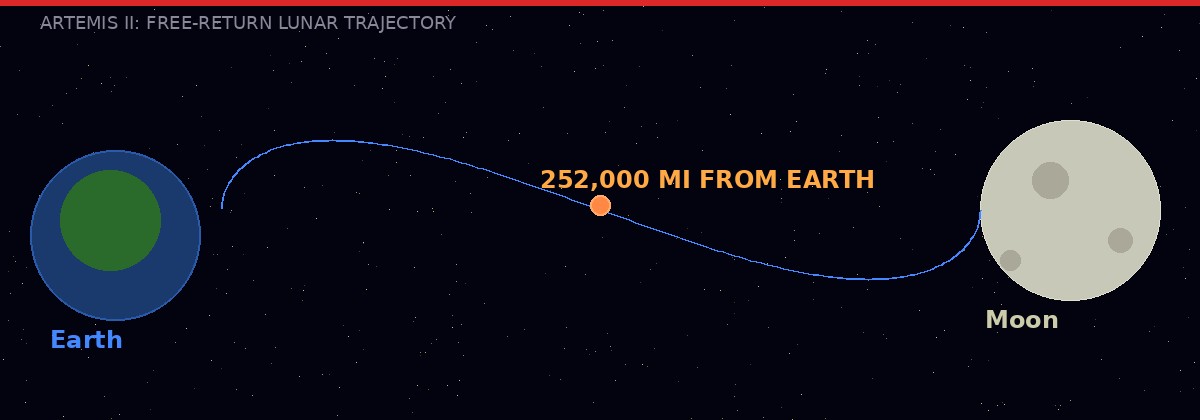
The free-return trajectory: Orion follows a figure-eight path using lunar gravity to slingshot back toward Earth without entering orbit. The same trajectory saved the Apollo 13 crew in 1970.
The Orion capsule will not brake into lunar orbit. It has no lunar landing module. There is no surface to touch down on, no flag to plant. Monday's flyby is a precision ballistics exercise wrapped in historic significance.
The capsule will swing around the moon's far side at roughly 2,000 miles per hour relative to the lunar surface. The far side of the moon is a place no human eye has ever seen in person. The Apollo astronauts who entered lunar orbit caught glimpses - but their cameras pointed mostly at landing sites and orbital photography targets. The Artemis II crew will be specifically positioned to observe and photograph large sections of the far side that human eyes have never directly witnessed.
NASA geologist Kelsey Young said the crew will be able to make out "definite chunks of the far side that have never been seen" by humans, including a substantial portion of Orientale Basin - one of the solar system's largest impact craters, spanning roughly 580 miles across. The crew spent months studying lunar geography flashcards. Monday, the flashcards become reality. (Source: AP, April 5, 2026)
The astronauts will split into pairs during the flyby, taking turns capturing images through the capsule's windows with a suite of professional-quality cameras. Each crew member also has an iPhone for informal photography. NASA intends to release all images taken during the flyby, and what comes back will be the closest human perspective on the lunar far side ever recorded.
There will also be a total solar eclipse - but not one visible from Earth. From the Orion capsule, as the moon interposes between the capsule and the sun, the crew will experience the moon blocking the sun entirely. The result: a view of the solar corona - the sun's outermost radiating atmosphere - visible only from deep space. The crew packed eclipse glasses specifically for this moment.
For approximately 40 minutes, the capsule will be completely behind the moon, out of radio contact with Mission Control. Every communication link drops. Houston goes silent. The Deep Space Network antennas in California, Spain, and Australia cannot reach a spacecraft behind 2,159 miles of solid rock. The Apollo crews lived through the same blackouts on every lunar orbit. Now the Artemis crew joins them.
Flight director Judd Frieling described the Artemis II mission with historical clarity. "I suspect everybody understands that this is a once-in-a-lifetime moment," he told reporters Friday. (Source: AP, April 4, 2026)
The Toilet Problem That Space Cannot Escape
For all the grandeur of a quarter-million-mile journey into deep space, the Artemis II mission has been accompanied by a problem that is deeply, mundanely human: the bathroom is broken.
The Orion capsule's toilet malfunctioned almost immediately after the crew reached orbit on Wednesday evening, April 1. Mission Control talked astronaut Koch through a series of plumbing troubleshooting procedures. She got the system working - but only partially. The so-called "lunar loo" has been intermittently functional since then. By Saturday, engineers suspected that ice was blocking the urine disposal line, preventing complete drainage overboard. The toilet remained operational for solid waste. The crew was issued backup urine collection bags.
Debbie Korth, NASA's Orion program deputy manager, confirmed to reporters that the crew had also reported a smell from the bathroom area - embedded in the capsule floor behind a door and curtain. (Source: AP, April 5, 2026)
Korth framed the situation with bureaucratic composure: "Space toilets and bathrooms are something everybody can really understand. It's always a challenge." John Honeycutt, chair of the mission management team, noted the astronauts were "OK" and had "trained to manage through the situation."
The toilet issue is not safety-critical. Astronauts on the ISS and shuttle missions dealt with similar problems across decades of spaceflight. But it has become the most humanizing detail of a mission that could otherwise feel entirely abstract. Four people are sailing toward the moon right now, doing it with a broken toilet and backup bags. Deep space exploration stripped down to its most essential hardware.
A version of the Orion toilet was previously tested aboard the ISS. Engineers will use anomaly data from this flight to redesign the system before Artemis IV's planned 2028 lunar landing, when a malfunction on the lunar surface would carry considerably higher stakes.
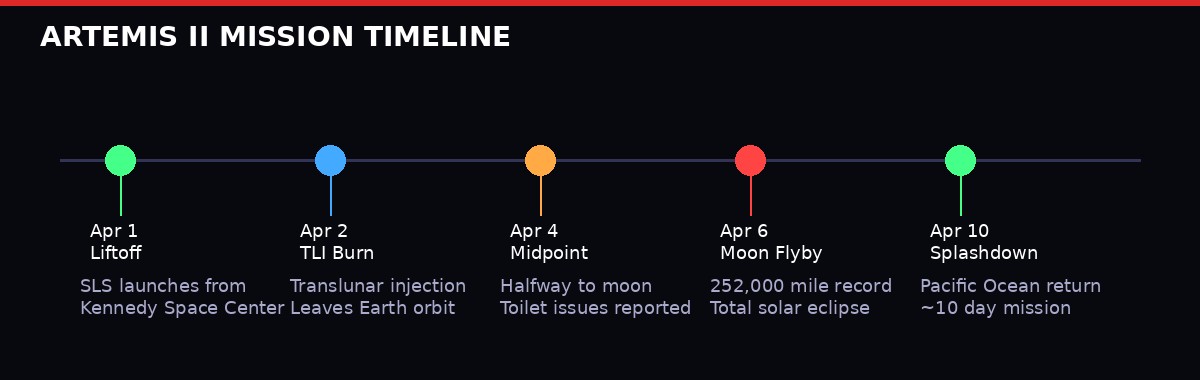
Mission timeline: From April 1 liftoff through the record-breaking April 6 moon flyby to the April 10 Pacific splashdown. A 10-day mission 53 years in the making.
Why 53 Years Passed Before We Came Back
The gap between Apollo 17 and Artemis II is not an accident of technology or capability. The United States had the engineering knowledge to return to the moon within a decade of the last Apollo mission. The gap is political - a long, expensive chronicle of budget cuts, competing priorities, canceled programs, and institutional indecision spanning six presidential administrations.
Apollo was born out of national emergency. Sputnik had humiliated the American intelligence establishment in 1957. Yuri Gagarin's first orbit in 1961 sent Washington into genuine panic. John Kennedy's 1961 moon speech was not a vision statement - it was a geopolitical counterstrike aimed directly at the Soviet Union's chest. The entire program had a deadline and an enemy. Both drove it to completion in eight years.
After Apollo 17's December 1972 splashdown, neither condition existed. There was no Soviet lunar program to beat - their N1 heavy-lift rocket had exploded on four consecutive launch attempts. There was no presidential deadline for the next phase. Nixon canceled Apollo 18, 19, and 20 for budget reasons. The shuttle program filled the following 30 years. The International Space Station absorbed the next generation's energies and funding.
Multiple lunar return programs were proposed and killed. President George H.W. Bush's Space Exploration Initiative in 1989 called for a moon base by 2019. It died in Congress within two years. President George W. Bush's 2004 Vision for Space Exploration proposed lunar return by 2020. That produced the Constellation program, which was canceled by the Obama administration in 2010. The Space Launch System that now carries the Artemis II crew is a direct descendant of Constellation's Ares V heavy-lift concept - proof that hardware, at least, persists across administrations even as political support crumbles.
The Artemis program itself was formally established in 2017. It nearly collapsed in 2020 when the lunar lander competition triggered legal battles between SpaceX and Blue Origin, delaying contract finalization by months. It survived. The first uncrewed Artemis I test flight circled the moon in November 2022, validated the capsule's thermal protection system and deep-space communications, and splashed down successfully. Artemis II followed four years later.
In February 2026, new NASA administrator Jared Isaacman - the private astronaut and entrepreneur who flew SpaceX's Inspiration4 mission in 2021 - overhauled the Artemis roadmap. He restructured the mission sequence to prioritize orbital practice before attempting a landing, inserting a new Artemis III mission focused on docking practice in Earth orbit. The lunar landing was pushed to Artemis IV in 2028. Isaacman has been explicit about the competitive driver: China. (Source: AP/NASA)
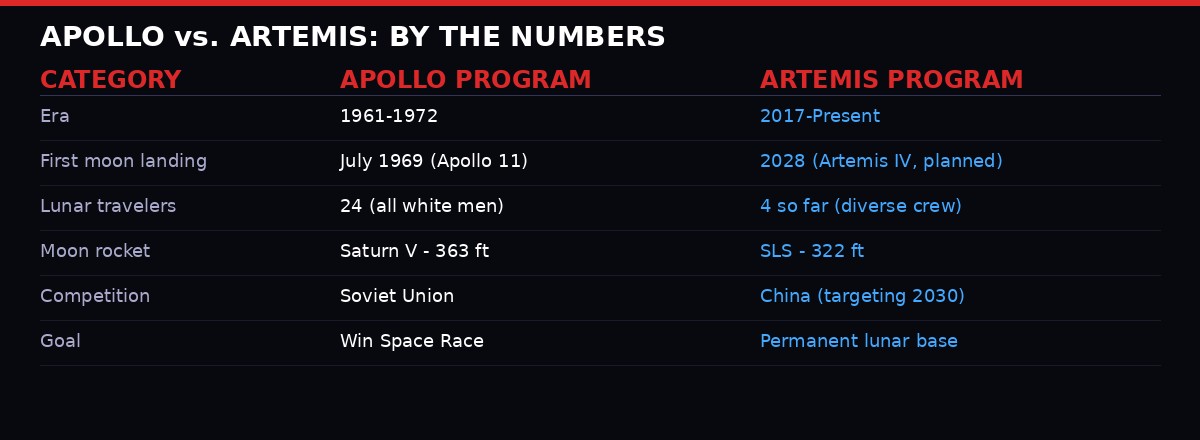
Apollo vs. Artemis: Two programs sharing a heritage but differing fundamentally in purpose, crew composition, and the geopolitical landscape driving them forward.
The Second Space Race and the Lunar South Pole

The real prize: water ice deposits at the lunar south pole. Both NASA and China are targeting the same shadowed craters. Whoever establishes a permanent base there first gains a strategic logistical advantage for all future deep space missions.
The moon's south pole is not a romantic destination. It is a logistics problem with trillion-dollar implications.
Permanently shadowed craters near the lunar south pole contain water ice accumulated over billions of years, deposited by cometary impacts and solar wind interactions. Multiple robotic missions - including India's Chandrayaan-1 in 2008, NASA's LCROSS impactor in 2009, and China's Chang'e probes - have confirmed the presence of water ice in substantial quantities in the permanently shadowed regions.
Water ice at a lunar base means two things. First, drinking water and life support for long-duration surface missions without the prohibitive cost of launching water from Earth. Second - and strategically more significant - ice can be electrolyzed into hydrogen and oxygen, the same propellant combination used by the Space Launch System and most high-performance upper-stage rocket engines. A lunar south pole base with access to ice becomes a refueling depot for all deep space exploration. The economics of a Mars mission transform completely if crews can refuel at the moon rather than lifting all propellant from Earth's deep gravity well.
China's Chang'e 7 mission, currently scheduled for 2026 launch, is specifically designed to survey south pole ice deposits in detail. The China National Space Administration's crewed lunar program targets a south pole landing by 2030. NASA has publicly identified the same region - terrain near Shackleton Crater where solar energy is nearly continuous and ice deposits sit within short rover range - as the Artemis IV landing zone.
There is no international agreement defining who controls lunar resources extracted at permanent bases. The 1967 Outer Space Treaty prohibits national sovereignty claims on celestial bodies - but says nothing about resource extraction by commercial or governmental entities. The Artemis Accords, a US-led bilateral agreement now signed by dozens of partner nations, establishes norms for resource extraction that favor US-aligned partners. China has not signed the Accords. Russia has not signed them either. The legal framework for the south pole resource competition does not exist in any binding form.
Monday's moon flyby is the opening move in an endgame that will play out across the 2030s and beyond. The astronauts aboard the Orion capsule are not thinking in those terms - they are thinking about camera positions and sleep schedules and a toilet that may or may not be functioning at full capacity. But the path their capsule traces around the moon on April 6, 2026, is the opening argument in a geopolitical dispute that no one has yet figured out how to adjudicate.
Earth as a Marble: Images From Deep Space
Three days into the mission, on Friday afternoon, NASA released the first images downlinked from the Orion capsule. Taken by Commander Wiseman shortly after translunar injection, these represent the first photographs of Earth taken by human hands from beyond low Earth orbit since the final Apollo missions of the early 1970s.
The first image shows a curved slice of Earth framed in one of the capsule's circular windows. The second shows the full globe - oceans capped by spiraling cloud formations, a green aurora glowing at the frame's edge. The images are technically similar to hundreds of photographs taken from the ISS. The difference is the distance and the direction of travel. These photographs were taken while leaving.
"It was the most spectacular moment, and it paused all four of us in our tracks."
- Commander Reid Wiseman, describing the crew's first clear view of Earth from deep space (Source: AP, April 4, 2026)
Victor Glover, in a live television downlink from the capsule, reflected on the view of Earth from a perspective that only 24 humans before him had ever experienced - and one that no human being had experienced since 1972.
"Trust us, you look amazing. You look beautiful. And from up here you also look like one thing: homo sapiens. As all of us no matter where you're from or what you look like, we're all one people."
- Pilot Victor Glover, first Black astronaut to travel to the moon (Source: NASA/AP, April 2, 2026)
NASA's Lakiesha Hawkins, an exploration systems leader at Mission Control in Houston, described the images with characteristic precision. "It's great to think that with the exception of our four friends, all of us are represented in this image," she said. (Source: AP, April 4, 2026)
Jeremy Hansen, watching his home planet recede from a quarter-million miles away, described the views as "extraordinary." The moon-bound perspective has a way of making national categories feel provisional.
As the capsule approaches its closest point to the moon, Mission Control will lose contact for approximately 40 minutes during the behind-the-moon phase. No radio signal bends around a 2,100-mile-diameter rock. For those 40 minutes, four human beings will be more isolated from the rest of their species than any people alive. Then they will emerge from the far side, fire a brief engine burst to correct their trajectory, and begin the long coast home.
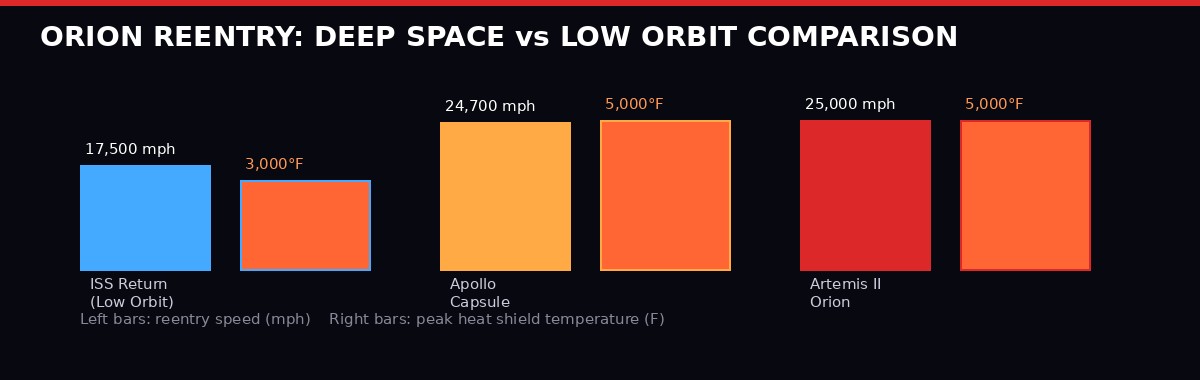
The heat shield test: Artemis II's Orion capsule will re-enter at 25,000+ mph - significantly faster than ISS returns - exposing the corrected heat shield design to real-world conditions for the first time with crew aboard.
What Comes Next: The Path to a Moon Landing
Artemis II is a test flight. NASA needs to validate that the Orion capsule's life support, thermal protection, navigation, communication, and crew systems work as designed when carrying human beings through the radiation environment of deep space - a fundamentally different environment from the ISS's relatively sheltered low Earth orbit.
The heat shield is a particular focus. Orion's thermal protection must withstand entry temperatures exceeding 5,000 degrees Fahrenheit - significantly higher than ISS return missions because of the higher velocity at which deep-space capsules re-enter Earth's atmosphere. The Artemis I test flight in 2022 revealed that some heat shield material ablated more aggressively than models predicted. Engineers identified the cause and modified the thermal protection design. Artemis II will be the first test of the corrected system with human lives depending on it.
Pending successful Artemis II completion, the program calls for three subsequent missions:
Artemis III (2027): Crewed Orion capsule in Earth orbit practicing docking with lunar landers - specifically the SpaceX Starship Human Landing System and Blue Origin's Blue Moon lander. Both companies have been awarded NASA contracts. Neither has yet performed a crewed lunar docking. Artemis III establishes those procedures before anyone stakes lives on them at the moon.
Artemis IV (2028): The landing attempt. Two astronauts descend to the lunar south pole while two remain in Orion in lunar orbit. The surface crew conducts scientific investigations, collects samples, and begins preliminary assessment of ice access logistics near Shackleton Crater. The mission profile parallels the Apollo surface landings but in a region Apollo never reached, with hardware Apollo never had.
Artemis V and beyond (2030s): NASA's long-term goal is a permanent lunar Gateway station in lunar orbit and eventually a surface outpost at the south pole. The timeline for those objectives extends into the next decade. The geopolitical competition with China gives those timelines a different kind of urgency - not the sprint of Apollo but the sustained institutional pressure of a rival who is catching up and has stated their intentions with clarity.
Elon Musk's SpaceX and Jeff Bezos' Blue Origin are both actively developing competing lunar landers. Both have received government contracts. Both are racing to demonstrate the capability first. The outcome of that competition will shape which company dominates the infrastructure architecture of deep space logistics for the next generation of exploration.
ARTEMIS PROGRAM ROADMAP
- Artemis I (Nov 2022): Uncrewed test - Orion orbits moon, returns safely
- Artemis II (Apr 2026): Crewed lunar flyby - 4 astronauts, no orbit or landing
- Artemis III (2027): Crewed Earth orbit - lunar lander docking practice (SpaceX/Blue Origin)
- Artemis IV (2028): First crewed lunar landing since Apollo 17 (1972)
- Artemis V+ (2030s): Lunar Gateway station and permanent south pole outpost
- Competition deadline: China targeting south pole crewed landing by 2030
The Weight of 53 Years
Gene Cernan, the last human to stand on the moon, scratched his daughter Tracy's initials in the lunar dust before climbing back into the Apollo 17 ascent stage in December 1972. He said at the time that he believed humanity would return "not too long hence." He died in January 2017 without seeing it happen.
Harrison Schmitt, the only professional geologist to walk on the moon and the second-to-last human to leave the lunar surface, is 90 years old. He was reportedly present at the Kennedy Space Center on April 1, 2026, watching the Space Launch System rise from the same launch complex where he and Cernan departed 53 years earlier. The SLS is larger than the Saturn V in thrust if not in height. The pad next door to where he launched is now leased by SpaceX. Everything is different. The fundamental ambition is the same.
The astronauts who flew Apollo were defined by speed. Kennedy gave them a decade and they beat the deadline. The generation that built Artemis took 53 years - through canceled programs, exploded rockets, political reversals that stretched across administrations, a global pandemic, budget battles that dwarfed anything Apollo faced, and public indifference that Apollo never had to contend with. They got there anyway.
Right now, four human beings are closer to the moon than any person has been since Gene Cernan climbed those last ladder rungs in December 1972. Victor Glover is looking out a window at a destination that none of his predecessors looked like him could have imagined reaching. Christina Koch is taking photographs of an Earth she trained for two decades to leave. Jeremy Hansen is representing a country that never sent anyone this far from home. Reid Wiseman is flying the most consequential test mission in the history of human space exploration.
Tomorrow morning, they will swing around the far side of the moon. For 40 minutes, they will be completely alone in a way that no human being has been since the last Apollo crew made the same passage. Then they will come back.
And the next crew - the one with the landing module, the south pole coordinates, the ice-sampling drill - will depart knowing the gap can be crossed. Because these four crossed it first.
Sources: Associated Press (April 1-5, 2026), NASA mission communications and press briefings, Canadian Space Agency official statements, NASA Orion program management statements. All direct quotes attributed to original AP wire reports and official NASA communications.
Get BLACKWIRE reports first.
Breaking news, investigations, and analysis - straight to your phone.
Join @blackwirenews on Telegram