T-4 Days to the Moon: Artemis II Crew Arrives in Florida as History Holds Its Breath
Four astronauts landed at Kennedy Space Center Friday to meet the 322-foot rocket that could send them around the Moon in four days - completing a 53-year gap since the last humans left Earth's orbit. Everything could still go wrong. NASA says it's ready anyway.

Reid Wiseman stepped off his T-38 training jet Friday morning at Kennedy Space Center, looked at the 300 journalists, dozens of NASA managers, and the Canadian Space Agency president waiting on the tarmac, and shouted three words:
"Hey, let's go to the moon!" - Commander Reid Wiseman, March 28, 2026 (AP News)
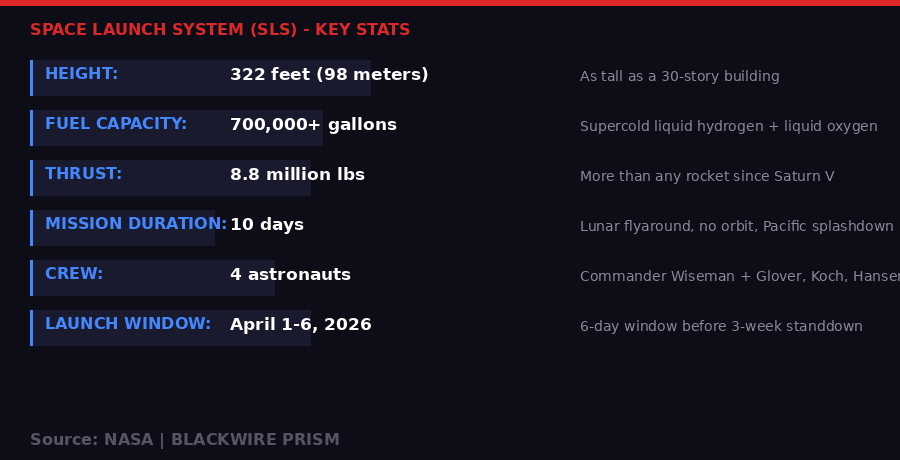
The crowd roared. Behind him, the 322-foot Space Launch System rocket stood on Pad 39B, freshly repaired, fueled, and pointing at the sky. Launch window opens Wednesday, April 1. The six-day window runs through April 6. Miss it and the next opportunity is April 30 at the earliest.
This is Artemis II - the first mission to carry humans to the Moon since December 1972, when Apollo 17's Gene Cernan became the last person to walk on lunar soil. Fifty-three years. Three generations. Two space shuttle programs, a cold war's end, the rise of the internet, smartphones, and AI - all without a single human being venturing beyond low Earth orbit.
That gap ends in four days, if everything goes right. And with this mission, "if everything goes right" carries real weight.
The Machine That Almost Didn't Make It

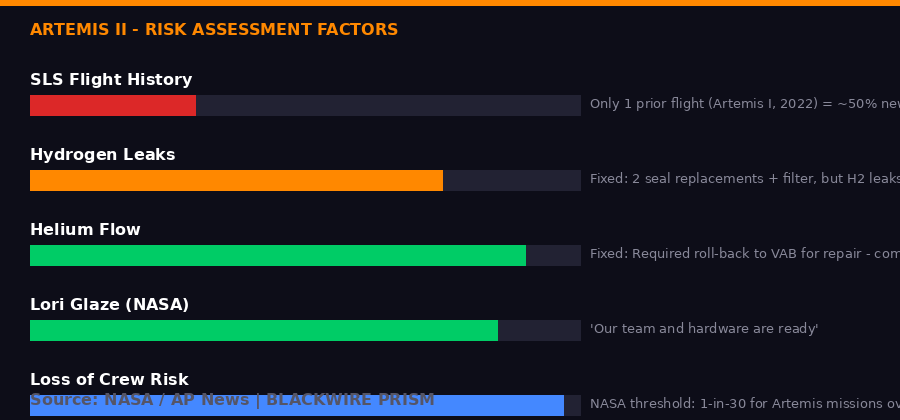
The Space Launch System rocket currently sitting on Pad 39B has been in Florida since early this year, and it has been a troubled stay. Hydrogen fuel leaks first appeared during the dress rehearsal in January - the same problem that plagued SLS during its 2022 Artemis I test flight. NASA engineers replaced two seals and a clogged filter, patching the leaks at the pad.
Then came the helium problem. Clogged helium lines in the core stage couldn't be fixed at the pad. In late February, NASA made a decision that had only been made a handful of times in space history: roll the rocket back to the Vehicle Assembly Building - a 4-mile, 11-hour crawl on a massive transporter that dates to the Apollo era - for repair.
That took weeks. The mission, originally targeting a March launch window, slipped into April. Two months of delays, two hangar-to-pad rollouts, a repaired rocket, and now this: launch readiness review completed, crew in Florida, window open Wednesday.
"It's a test flight and it is not without risk, but our team and our hardware are ready." - Lori Glaze, NASA official, flight readiness review briefing (AP News)
The honesty in that statement is worth noting. NASA officials declined to provide specific risk probability numbers at the review. John Honeycutt, chair of the mission management team, offered historical context instead: historically, a new rocket design has roughly a 50% chance of success on its first flight. Artemis I was SLS's first flight. Artemis II is the second - but after a three-year gap.
"It's not the first flight," Glaze acknowledged. "But we're also not in a regular cadence. So we definitely have significantly more risk than a flight system that's flying all the time."
That three-year gap between SLS flights is one reason NASA's new administrator Jared Isaacman has already begun redesigning the refueling system. The connections between the rocket and launch pad will be rebuilt before Artemis III. The hydrogen leak problem, which has followed SLS's heritage engines from the space shuttle era, needs a structural fix - not just a patch.
Who's Going: The Most Historic Crew Composition in 50 Years

The four people who flew into Kennedy Space Center on Friday represent something NASA has explicitly designed to be visible: the most diverse crew composition ever assigned to a lunar mission.
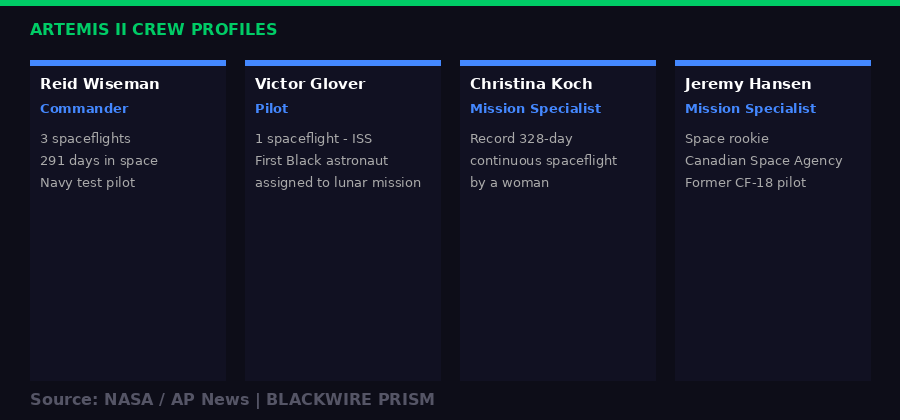
Reid Wiseman, the commander, is a Navy test pilot on his third spaceflight. He logged 291 days aboard the International Space Station during a previous mission and commanded the ISS. He's methodical, experienced, and known for his ability to stay calm under pressure.
Victor Glover is the pilot - and the first African American astronaut assigned to a Moon mission. He flew to the ISS in 2020 aboard SpaceX's Crew Dragon on one of the first operational commercial crew flights. His selection for Artemis II was deliberate: NASA wanted the historic crew to look different than Apollo's all-white male lineup of military test pilots.
Christina Koch holds the world record for the longest continuous spaceflight by a woman: 328 days on the ISS from 2019 to 2020. She becomes the first woman assigned to a lunar mission in the history of spaceflight. She'll be farther from Earth than any woman has ever traveled.
Jeremy Hansen is the crew's sole space rookie - and Canada's representative in the mission. A former CF-18 Hornet fighter pilot, Hansen is flying courtesy of Canada's contributions to NASA programs over the decades: the Canadarm robotic arm systems on the Space Shuttle and ISS have been worth their weight in mission slots. He speaks both English and French, and at arrival told reporters: "Allons-y!" - let's go.
"This is humanity's crew." - Former NASA Administrator Bill Nelson, at the crew announcement (AP News)
The diversity is not merely symbolic. It's a statement about what the Artemis program is supposed to mean at a time when geopolitical competition with China - which has its own lunar program - is accelerating. NASA is trying to demonstrate that the American approach to space exploration includes the full breadth of humanity, not just the same profile of astronaut that flew Apollo missions half a century ago.
What they will not do on this mission is land. Artemis II is a lunar flyaround - a free-return trajectory around the Moon, no orbital insertion, no descent. The Orion capsule will swing within roughly 8,900 kilometers of the lunar surface, giving the crew a closer view of the Moon than any human has had since Apollo 17, then slingshot back toward Earth for a Pacific Ocean splashdown ten days after launch.
The Free-Return Trajectory: What Actually Happens Up There

The technical term for Artemis II's trajectory is a "hybrid free-return." It's more complex than the simple free-return paths used by Apollo 13 as a rescue maneuver, but the fundamental principle is the same: use the Moon's gravity to swing the spacecraft around and back to Earth without requiring a major engine burn for return.
After launch from Kennedy Space Center, the SLS will place the Orion capsule on a translunar injection trajectory - roughly a 3-4 day journey to the Moon. The crew will perform a series of minor trajectory correction burns during the transit using Orion's European Service Module, built by the European Space Agency.
The lunar flyby itself will happen on approximately day five of the mission. For roughly two hours, the crew will have a view of the Moon that no living human has experienced. The far side - forever hidden from Earth - will pass beneath them. The crater-scarred surface. The terminator line between lunar day and night. The absolute black of space with Earth as a marble behind them.
NASA's cameras will capture it. The crew will capture it. The world will watch on NASA+ and every major broadcast network.
Then Orion slingshots back, the service module is jettisoned, and the crew module re-enters Earth's atmosphere at roughly 40,000 km/h - the fastest re-entry speed attempted for a crewed capsule. The heat shield, developed at enormous expense over nearly a decade, will face its first real crewed test. It was tested on Artemis I without crew. This time, there are four people behind it.
Mission Milestones
- T+0: SLS launch from Pad 39B, Kennedy Space Center, April 1-6
- T+3-4 days: Translunar transit, trajectory correction burns
- T+5 days: Lunar flyby - closest approach ~8,900 km from surface
- T+6-9 days: Return transit to Earth
- T+10 days: Atmospheric re-entry at ~40,000 km/h, Pacific splashdown
The Program Behind the Mission: How Artemis Got Here
The Artemis program was formally approved under the Trump administration's Space Policy Directive 1 in 2017 and has been continuously funded - with varying levels of congressional enthusiasm - through multiple administrations. The name is deliberate: Artemis is the twin sister of Apollo in Greek mythology. The program that will return humans to the Moon carries the name of Apollo's female counterpart.
Getting here has cost more than $93 billion by most estimates, a figure that includes SLS development, the Orion capsule, the ground systems at Kennedy Space Center, and the European Service Module. The Space Launch System's cost overruns have been a persistent source of criticism from space policy analysts and competing commercial space advocates who point out that SpaceX's fully reusable Starship - now in regular test flights - represents a fundamentally different cost structure.
NASA's inspector general has repeatedly flagged cost issues with the SLS program, estimating the per-launch cost of a single SLS mission at over $4 billion when development costs are amortized. By comparison, SpaceX has committed to much lower per-launch figures for Starship, though the vehicle is still in development for crewed missions.
The original Artemis timeline called for a Moon landing by 2024. That goal was never realistic, and it slipped to 2025, then 2026, then 2028 under the current plan. NASA Administrator Jared Isaacman - a tech billionaire who purchased his own flights to orbit and performed the world's first private spacewalk - took over in December 2025 with an explicit mandate to accelerate.
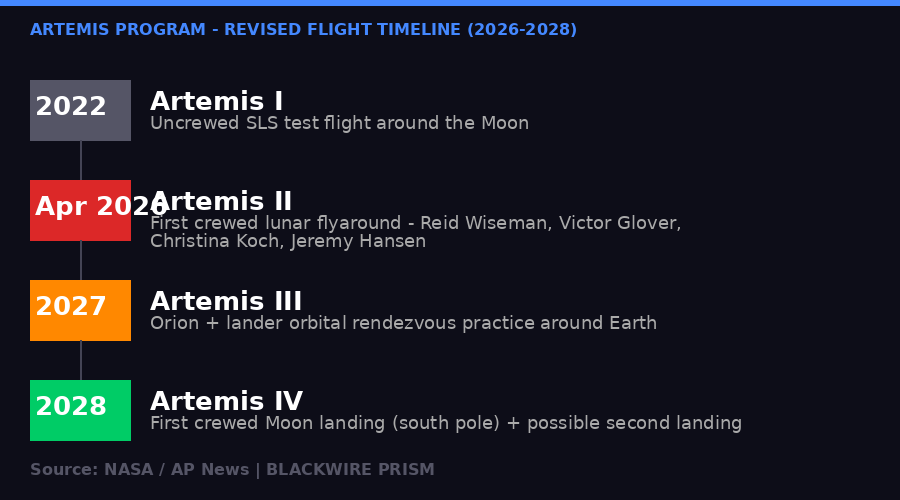
Late last month, Isaacman announced a major overhaul of the Artemis flight plan. The original Artemis III mission - which would have attempted a South Pole landing directly - was replaced with an orbital rehearsal in 2027: an Orion capsule docking with SpaceX's Starship or Blue Origin's Blue Moon lander in Earth orbit, practicing the procedures needed for the actual Moon landing without the risk of committing to the surface.
"Everybody agrees. This is the only way forward. No one at NASA forgot their history books. They knew how to do this. Now we're putting it in action." - Jared Isaacman, NASA Administrator (AP News)
The reference to Apollo is pointed. During the Apollo program, NASA went from first orbital flight to Moon landing in approximately four years, with missions following each other in rapid succession - sometimes just months apart. The Artemis program has taken nine years to reach its first crewed flight, with three-year gaps between missions. Isaacman's goal is to compress that to one year or less between flights.
What's Actually at Risk: The Honest Safety Picture
NASA's inspector general published a report this week that requires serious attention. The office found that the space agency does not yet have a viable crew rescue plan for lunar surface operations - a gap that won't matter for Artemis II (which stays in the flyaround trajectory) but becomes critical for the 2028 landing attempt.
The report identified lunar landers as the top contributor to potential crew loss during the first few Artemis Moon landings. Landing near the Moon's south pole - the target for Artemis because of its permanently shadowed craters containing water ice - is significantly more dangerous than the equatorial landing zones used during Apollo. The terrain is more rugged, communications windows are less predictable, and emergency return options are constrained.
NASA's stated loss-of-crew threshold is 1-in-40 for lunar operations and 1-in-30 for Artemis missions overall. Whether those thresholds can be met with the current hardware remains an open question, according to the inspector general.
For Artemis II specifically, the risks are different. Mission management team chair John Honeycutt was refreshingly direct at the flight readiness review: a rocket with only one prior flight, after a three-year gap, cannot be assessed with the same confidence as a system flying in regular cadence. The hydrogen management system - the root cause of previous delays - has been repaired but not redesigned. If leaks reappear at the pad during terminal countdown, NASA can hold or scrub. Once the engines ignite, the crew is committed.
The Orion capsule itself is designed with extensive abort systems. From the moment the rocket clears the tower to orbit insertion, the Launch Abort System can pull the capsule free in milliseconds if a catastrophic failure occurs. The system was tested successfully on previous uncrewed flights. That's the kind of backup that makes spaceflight survivable rather than just risky.
The heat shield remains an item of scrutiny. During Artemis I's re-entry in December 2022, the shield performed well - but post-flight inspection revealed unexpected charring patterns that took months to analyze. Engineers determined the entry was successful and safe, but the data informed modifications for Artemis II. Whether those modifications are sufficient will be proven definitively on day ten of the mission.
China, Competition, and Why This Mission Matters Beyond the Numbers

Strip away the human drama, the engineering challenges, and the history - and what remains is a geopolitical race that most media coverage still underweights.
China's Chang'e program has been executing lunar missions with consistent success. Chang'e 5 returned lunar samples to Earth in 2020. Chang'e 6 returned samples from the Moon's far side in 2024 - a first for any nation. China has declared its intention to land taikonauts on the Moon by 2030. The China National Space Administration has been building toward that goal methodically, without the political disruptions and program overhauls that have repeatedly delayed Artemis.
If Artemis II succeeds in April, NASA maintains a meaningful lead in the crewed lunar race. The 2027 orbital rehearsal and 2028 landing missions - if they execute on schedule - put American astronauts on the Moon roughly two years before China's stated target. That gap matters for more than prestige: the Artemis Accords, signed by 43 nations, are building a framework for lunar governance, resource rights, and base placement that China has not signed.
The first nation to establish a permanent presence near the lunar south pole - where water ice represents both a life support resource and hydrogen for rocket fuel - will have a substantial strategic advantage in all subsequent deep space operations. The Moon is not a destination. It's a waypoint.
NASA and the Trump administration have also been explicit about the security implications. SpaceX's Starship, which will serve as NASA's Human Landing System for Artemis IV and beyond, gives the United States a massive launch vehicle capable of placing enormous payloads in lunar orbit. The same capability applies to military applications that neither NASA nor the Department of Defense discusses publicly in detail.
What Artemis II represents, beyond the engineering and the history, is a proof that the American program can still execute. After years of delays, overruns, and political uncertainty, four astronauts are in Florida, the rocket is on the pad, and the launch window opens in four days.
"That's this business. It will go when the engines light at T-zero, and we totally understand that." - Victor Glover, Artemis II pilot, at Kennedy Space Center arrival (AP News)
What Comes Next: The Road to 2028 Landing

If Artemis II launches successfully and the crew returns safely, the program shifts into a faster gear. Isaacman has been explicit: the Apollo program's one-year cadence between missions is the model. Three years between SLS flights is not acceptable.
The 2027 mission - now designated Artemis III under the revised numbering - will be an orbital rendezvous test. An Orion capsule carrying crew will launch to Earth orbit and practice docking with SpaceX's Starship HLS or Blue Origin's Blue Moon lander. Both companies have been accelerating their development since Isaacman announced the 2028 landing target. SpaceX has completed multiple full-stack Starship flights. Blue Origin's Blue Moon has been in development since the 2010s and is finally approaching operational readiness.
Artemis IV - the landing - is currently targeting 2028. Two astronauts will descend to the Moon's south pole in a lunar lander while two others remain in Orion in orbit. The south pole landing is significantly more complex than Apollo's equatorial approaches: the terrain is rougher, lighting conditions at certain sites can be challenging, and the distances involved mean Earth-based mission control communications have a roughly 2.6-second round-trip delay.
The inspector general's warning about crew rescue plans for surface operations is the program's most pressing near-term challenge. Getting to the Moon is hard. Getting humans home if something goes wrong on the surface is harder. Apollo's lunar module could serve as a rescue vehicle in certain scenarios. The current architecture relies on the lander for return - and if it fails, options are limited.
Isaacman's overhaul also plans for potentially two Moon landings in 2028 - an aggressive target that would require both SpaceX's Starship HLS and Blue Origin's Blue Moon to be ready simultaneously. Whether that's achievable is debatable; what's not debatable is the intent to accelerate beyond Artemis II and not let momentum stall.
NASA astronaut Christina Koch put the bigger picture simply at the Florida arrival: "We're in a relay race. And if nothing else this just fired us up for that all the more."
Revised Artemis Flight Schedule
- Artemis I (Nov 2022) - Uncrewed SLS test flight, lunar orbit and return
- Artemis II (April 2026) - First crewed flight, lunar flyaround, 10-day mission
- Artemis III (2027) - Crewed Orion + lander orbital rendezvous in Earth orbit
- Artemis IV (2028) - First crewed Moon landing since 1972, lunar south pole
- Artemis V (2028 or later) - Possible second Moon landing if schedule holds
The Weight of 53 Years
Gene Cernan climbed out of the Taurus-Littrow valley on December 14, 1972, and left the last human footprints on the Moon. He died in 2017. He spent the last decades of his life watching Congress fund and defund and refund and reorganize the programs that were supposed to return humans to the Moon. He never saw it happen.
Fifty-three years is a long time. A child born the day Apollo 17 launched is now eligible for AARP membership. The computers that ran Apollo's guidance systems had less processing power than a modern USB drive. The world has changed in ways that would have been incomprehensible to the engineers who built Saturn V.
And yet the fundamental problem of getting humans to the Moon and back is essentially unchanged. The physics doesn't care about political cycles or budget disputes. A 322-foot rocket still has to generate 8.8 million pounds of thrust. Liquid hydrogen is still the most efficient fuel available - and the most temperamental. The heat shield still has to handle 40,000 km/h of atmospheric friction. The astronauts still have to trust that all of it works.
Four days from now - weather permitting, hardware holding - four people will strap into a spacecraft and leave Earth's orbit for the first time in more than half a century. They will see the Moon not as a photograph or a telescopic image, but as a world. They will see Earth as a pale marble against the void. They will travel farther from home than any human alive has ever been.
Whether it matters depends on what comes after. If Artemis II is a one-off demonstration that gets celebrated and then allowed to stall - as previous space milestones have been - then it joins a long list of impressive but ultimately inconclusive achievements. If it genuinely accelerates the program toward a 2028 landing, if Isaacman's Apollo-cadence ambitions survive contact with reality, if the commercial landers are actually ready - then Artemis II is the beginning of something.
Wiseman's three words at the tarmac this morning were not a policy statement. They were just what a person says when they're standing four days from the Moon. Sometimes that's enough.
Get BLACKWIRE reports first.
Breaking news, investigations, and analysis - straight to your phone.
Join @blackwirenews on TelegramSources: AP News - Artemis II crew arrives at Kennedy Space Center (March 28, 2026); AP News - NASA revamps Artemis moon program; AP News - NASA aims for April moon launch; AP News - 1st moon crew in 50 years includes woman, Black astronaut; AP News - NASA moon rocket returns to launch pad; AP News - NASA fuels giant moon rocket for second test; NASA Office of Inspector General lunar crew rescue report; NASA flight readiness review briefing statements.