T-Minus: Artemis II Crew Is at the Pad. Humanity Goes Back to the Moon April 1 - If It Holds.
Four astronauts touched down at Kennedy Space Center on Friday. A 322-foot rocket is sitting on Pad 39B. The launch window opens April 1. If everything holds - the fuel lines, the helium seals, the Florida weather, the sheer engineering audacity of sending people around the moon for the first time in 53 years - history gets made in four days.

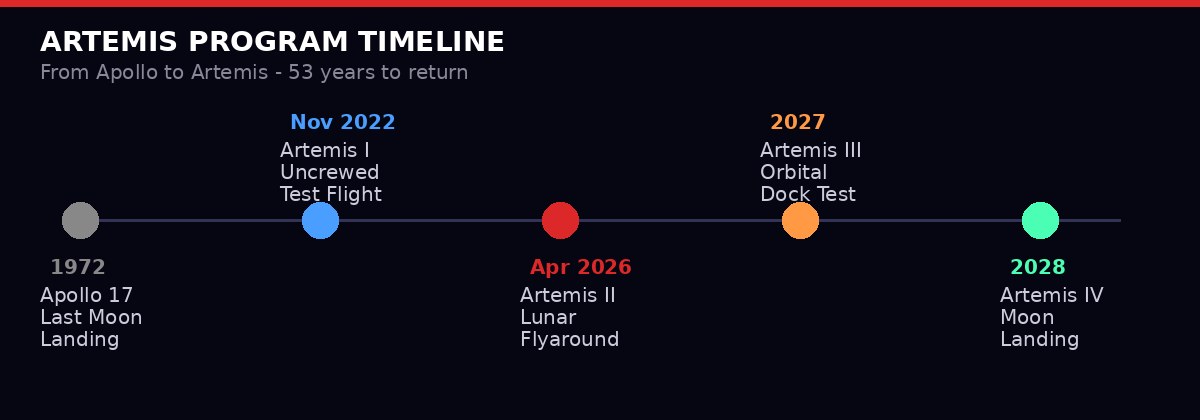
The last time human beings flew to the moon, the world looked completely different. Richard Nixon was president. The Vietnam War was still hot. The internet did not exist. The youngest of the four Artemis II astronauts had not yet been born. And Apollo 17 commander Gene Cernan stepped off the lunar surface on December 14, 1972, climbed back into the ascent module, and became the last person - until now - to leave footprints on another world.
That was 53 years, four months, and 15 days ago.
On April 1, 2026, NASA intends to end that silence. The Artemis II mission will not land on the moon - this is a flyaround, a shakedown of hardware and procedures that has never been tested with people aboard. But it will send four human beings deeper into space than any person has traveled since the final Apollo mission. They will zip around the far side of the moon, see the lunar surface rise above them, and come home.
If it works, it sets up the most consequential steps in NASA's plans: a 2027 orbital docking rehearsal, and a 2028 crewed moon landing. The space race is back - and this time it is not just two superpowers. China's Chang'e program is advancing. SpaceX and Blue Origin are building the landers. The stakes have never been higher, or more commercial.
Fuel Leaks, Helium Lines, and a Rocket That's Only Flown Once
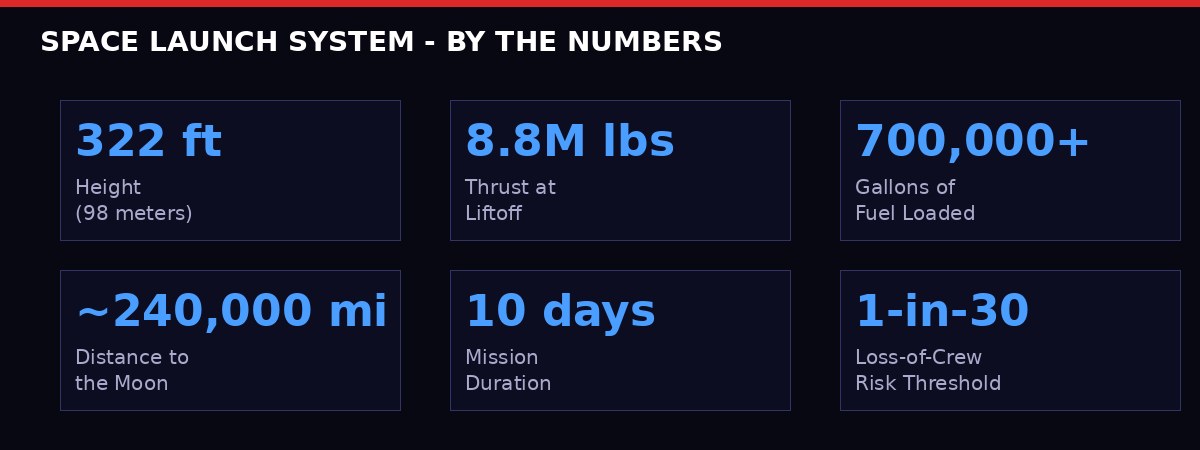
The path to April 1 has been anything but smooth. The Artemis II crew was supposed to be home by now. The mission was originally targeting a launch earlier in 2026, but the Space Launch System rocket - at 322 feet tall and capable of producing 8.8 million pounds of thrust, the most powerful operational rocket in history - proved difficult to tame.
The first problem was hydrogen. Liquid hydrogen is the most challenging propellant in rocketry: it is the lightest element, the coldest cryogenic fuel, and it finds its way through any microscopic gap in any seal. During a pre-launch dress rehearsal, dangerous amounts of supercold liquid hydrogen escaped from the connections between the pad and the rocket. NASA replaced seals and filters. A second fueling test in March showed minimal leakage, well within safety limits.
Then came helium. Clogged helium flow lines forced NASA to do something it dreaded: roll the rocket back off the pad and haul it the 4 miles back to the Vehicle Assembly Building - the same massive structure used since the Apollo era - for repairs. That was the second rollback this year. The rocket returned to the pad last week, crawling atop the same gigantic transporter used since the 1960s. The trip took 11 hours, delayed several times by high wind.
"It's a test flight and it is not without risk, but our team and our hardware are ready." - Lori Glaze, NASA, following the flight readiness review
The flight readiness review - a two-day process where every system is evaluated and cleared for launch - concluded earlier this week. The verdict: go for April. The launch window opens April 1 and runs through April 6. If NASA cannot launch in that window, the next opportunity is April 30 into early May.
The Space Launch System's track record is thin. It has flown exactly once - the uncrewed Artemis I test flight in November 2022 - and that mission itself was delayed for months by fuel leaks similar to the ones plaguing Artemis II. John Honeycutt, chair of the mission management team, noted that historically a new rocket has essentially a 50% chance of success on its first crewed flight.
"It's not the first flight," NASA's Glaze said. "But we're also not in a regular cadence. So we definitely have significantly more risk than a flight system that's flying all the time."
Who They Are: The Four Who Will Circle the Moon
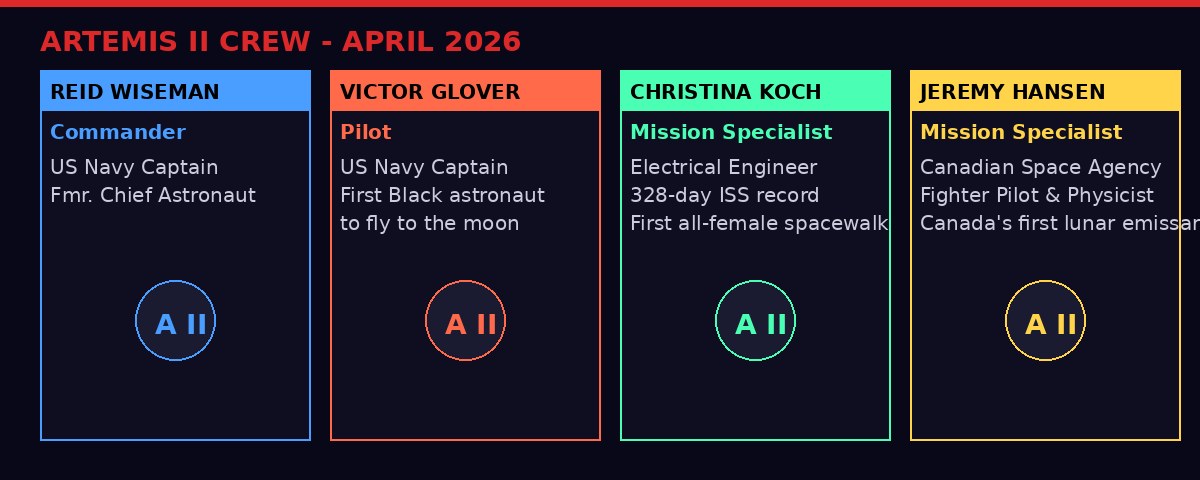
The Artemis II crew arrived at Kennedy Space Center on Friday, landing their T-38 training jets at the airfield beside the complex. NASA administrator Jared Isaacman was on the tarmac to greet them. Over 100 journalists watched. Commander Reid Wiseman shouted to the crowd: "Hey, let's go to the moon!"
They bear no resemblance to the Apollo astronauts - white military test pilots selected from a Cold War filtering system designed to find the most homogeneous possible operators. This crew is something different, and not just demographically. They are the products of a post-ISS astronaut culture that values adaptability, scientific depth, and the ability to handle a decade of delays with composure.
Reid Wiseman, 50, commands the mission. A retired Navy captain from Baltimore, he was serving as NASA's chief astronaut when asked three years ago to lead humanity's first lunar trip since 1972. His wife Carroll died from cancer in 2020. He has two teenage daughters who initially had "zero interest" in him launching again. He persuaded them with a single argument: "Of all the people on planet Earth right now, there are four people in a position to go fly around the moon. I cannot say no to that opportunity." The next day, homemade moon cupcakes were waiting.
Victor Glover, 49, is the pilot - and one of NASA's few Black astronauts. As a Navy captain and former combat pilot from Pomona, California, he has spent years listening to Gil Scott-Heron's "Whitey on the Moon" before missions, for what he calls "perspective." His presence on this crew is, in his own words, "a force for good." His four daughters are in their late teens and early 20s. He describes his mission in relay-race terms: run his leg well, hand the baton off for the 2028 moon landing.
Christina Koch, 47, is the mission specialist who holds the record for the longest single spaceflight by a woman - 328 consecutive days on the International Space Station. She participated in the first all-female spacewalk in 2019. Before NASA, she spent a year at a South Pole research station. When asked about nerves, she said most of her family and friends had been "inoculated" by her previous absences. Her rescue dog Sadie Lou is reportedly unconcerned about the 10-day trip.
Jeremy Hansen, 50, is the Canadian Space Agency's representative - a fighter pilot and physicist from London, Ontario, who will become the first Canadian to travel to the moon. He has been waiting for this since the agency selected him as an astronaut in 2009. "When I walk out and I look at the moon now, it looks and feels a little bit farther than it used to be," he said. "I just understand in the details how much harder it is than I thought."
What They're Actually Doing - and Why It Matters
Artemis II is not a moon landing. Let that be clear. The mission profile is a free-return trajectory - the same basic path Apollo 8 flew in 1968 when astronauts Frank Borman, Jim Lovell, and Bill Anders became the first humans to orbit the moon. The Orion capsule will leave Earth atop the SLS, fire its engine to loop around the moon at a distance of roughly 4,600 miles from the lunar surface, and use lunar gravity to slingshot back toward Earth. The entire trip takes about 10 days and ends with a Pacific Ocean splashdown.
What makes Artemis II more extreme than Apollo 8 is not the destination but the depth. The mission will take the crew approximately 40,000 miles beyond the moon - farther from Earth than any human being has ever traveled. At its most distant point, Earth will be roughly 280,000 miles away. The crew will see the far side of the moon - the hemisphere permanently facing away from Earth, rarely photographed from human eyes - in a way no astronaut ever has.
The technical goals are straightforward: validate the Orion capsule's life support systems, communication links, navigation, and crew interface with a real crew aboard. Orion flew successfully without people on Artemis I in 2022, but a crewed test reveals failure modes that no amount of simulation can replicate. Thermal stresses, human physiological responses, the actual crew loading on systems - these can only be measured with people inside.
There is also the heat shield question. The Orion heat shield must survive reentry at lunar return velocity - faster and hotter than a return from low Earth orbit. Artemis I revealed some unexpected erosion in the heat shield's ablative material. Post-flight analysis concluded the shield performed within acceptable parameters, but the data was unexpected. Artemis II will collect more reentry data with actual humans depending on that shield to survive.
Artemis II: Mission Fast Facts
- Launch vehicle: Space Launch System Block 1 (322 ft tall, 8.8M lbs thrust)
- Crew capsule: Orion Multi-Purpose Crew Vehicle
- Target launch date: April 1, 2026 (window through April 6)
- Mission duration: approximately 10 days
- Farthest point from Earth: approximately 280,000 miles (farther than any human has traveled)
- Lunar closest approach: approximately 4,600 miles from surface
- Recovery: Pacific Ocean splashdown
- Source: NASA, AP News
The Risk Math: Why NASA Is Flying Anyway
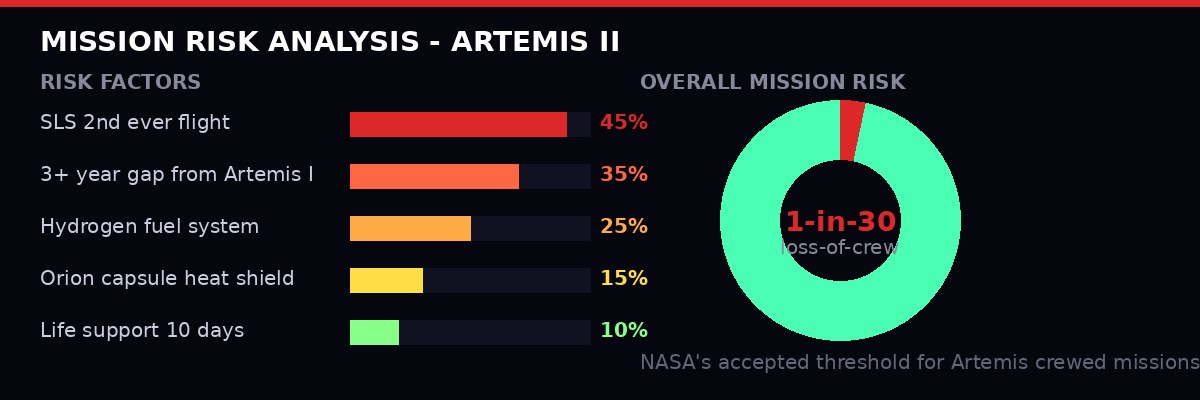
NASA's Office of Inspector General released an audit this week warning the agency needs to develop formal rescue plans for lunar crews. The report cited the lunar landers - still in development at SpaceX and Blue Origin - as the top contributor to potential crew loss during the first Artemis moon landings. It listed NASA's accepted loss-of-crew threshold at 1-in-40 for lunar operations and 1-in-30 for Artemis missions overall.
Compare that to Space Shuttle: by the final missions, NASA had gotten the crew-risk probability down to roughly 1-in-200 per flight. The Shuttle program still lost two crews in 135 flights. Artemis is operating at a risk level more than six times higher per mission.
Why accept that? Because the alternative - continuing to delay until risk drops to shuttle-era levels - means the moon does not get revisited in this decade. And in the current geopolitical environment, that is a choice with consequences that extend far beyond science.
China's lunar program is not waiting. The Chang'e VI mission returned samples from the far side of the moon in 2024 - a first in history. Chang'e VII is targeting the south pole. Chinese space officials have stated an intent to land taikonauts on the moon before 2030. If NASA slips its 2028 timeline, the United States risks arriving at the lunar south pole to find Chinese infrastructure already there.
The south pole matters because of water ice. Permanently shadowed craters near both poles contain ice deposits confirmed by orbital probes and landers. That ice is not just scientifically interesting - it is mission-critical infrastructure. Water can be split into hydrogen and oxygen for rocket propellant. A sustainable lunar presence, a base that does not require continuous resupply from Earth, depends on harvesting that ice. Whoever establishes a working extraction operation first has a structural advantage that compounds over decades.
"No one at NASA forgot their history books. They knew how to do this. Now we're putting it in action." - Jared Isaacman, NASA Administrator
Isaacman's Overhaul: Apollo Speed, Artemis Scale
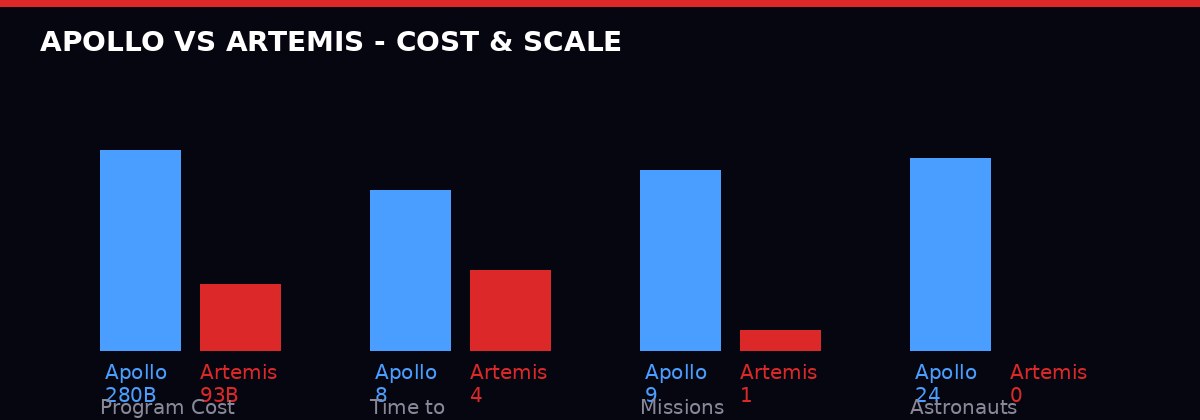
The man who decided to launch despite the risks is himself remarkable. Jared Isaacman, NASA's new administrator, is a tech billionaire who bought his own SpaceX trips to orbit and performed the world's first private spacewalk. He took the NASA helm in December 2025. Within two months, he had already announced a fundamental restructuring of the Artemis program.
His diagnosis was blunt: the pace was unacceptable. Apollo sent 24 astronauts to the moon across nine missions between 1968 and 1972. Artemis took four years to even get to a crewed flyaround - and was then targeting a three-year gap before the next moon landing. Three years between lunar missions, Isaacman said, is not a space program. It is a schedule.
His fix: add an extra mission. What was Artemis III - a direct landing attempt at the south pole - has been pushed to Artemis IV. A new Artemis III, targeted for 2027, will instead fly an Orion crew capsule to rendezvous and dock in Earth orbit with either SpaceX's Starship HLS (Human Landing System) or Blue Origin's Blue Moon lander - or both. This gives astronauts hands-on experience with the actual landers before attempting to fly them to the moon's surface.
It is a direct imitation of Apollo's architecture. Apollo 8 flew to the moon first. Apollo 9 tested the lunar module in Earth orbit. Apollo 10 flew the full stack to lunar orbit and descended to within 50,000 feet of the surface - a full dress rehearsal - before Apollo 11 actually landed. Each mission fed data to the next. Each crew built skills the next crew depended on.
Artemis has never had that architecture. It had individual missions separated by years, each treated as a near-standalone event. Isaacman wants to change that to a relay: rapid cadence, each flight building directly on the last, crews who can support each other rather than starting fresh every time.
He also wants to standardize the rocket. The current SLS configuration has evolved through multiple design iterations, and each change requires re-qualification of components. Standardizing would allow production to accelerate, cost per flight to drop, and the institutional knowledge to compound across missions rather than reset.
SpaceX, Blue Origin, and the Commercial Lander Gamble
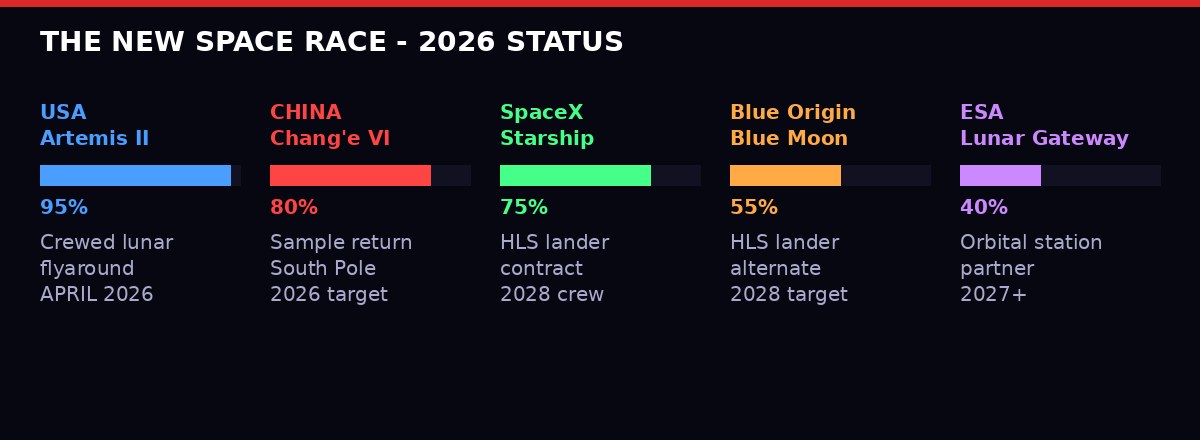
The most consequential variable in the 2028 moon landing is not NASA. It is SpaceX and Blue Origin. Both companies have contracts to provide Human Landing System landers that will carry astronauts from lunar orbit down to the surface - and back. Neither lander has flown to the moon. Neither has been tested in the lunar environment. The Artemis IV landing in 2028 depends entirely on both companies delivering working hardware in time.
SpaceX's candidate is Starship - the massive stainless-steel vehicle that has been undergoing iterative testing since 2021. Starship has now achieved multiple successful suborbital flights and is closing in on orbital capability. But the lunar version of Starship requires in-orbit refueling - multiple tanker launches to fill the propellant tanks before the actual crew vehicle departs for the moon. This is a logistical challenge of enormous complexity. A single refueling shortfall aborts the mission. Multiple tanker flights in tight succession, each of which must succeed.
Blue Origin's Blue Moon lander is a more conventional design but less flight-tested. The company has been notoriously opaque about technical progress. Its New Glenn rocket is now flying - that milestone arrived in early 2025 - but the lunar lander itself remains largely undemonstrated at scale.
Both companies have been "speeding up work" according to NASA, in response to Isaacman's compressed timeline. But the Inspector General's report flagged both as significant risk contributors. The technical challenges of refueling in lunar orbit, landing near the polar terrain, and returning safely are categorically harder than landing anywhere near the equatorial regions the Apollo missions targeted. The south pole has craters the size of cities, permanent darkness, temperatures that swing hundreds of degrees between sunlit ridgelines and shadowed crater floors, and communication geometry that makes real-time contact with Earth intermittent.
The Inspector General did not recommend abandoning the south pole target. It recommended NASA develop contingency plans - abort modes, rescue scenarios, alternate landing sites - that do not currently exist in finalized form.
What Artemis II Means Beyond the Flight

Strip away the technical details and what Artemis II represents is simpler and larger: it is proof that human civilization still reaches outward.
The 1970s moon landings ended not because the technology failed or the science was exhausted. They ended because the political will ran out. Apollo was a weapon in the Cold War - a demonstration of American technological supremacy over Soviet communism. Once that demonstration was sufficiently made, and once the Vietnam War was consuming national attention and budget, the moon missions were canceled. Apollos 18, 19, and 20 were ready to fly. They never did.
What is different now is the texture of the motivation. The United States is not simply trying to beat one adversary. It is trying to establish a permanent presence in cislunar space - the region between Earth and the moon - before that space becomes contested in ways that echo how maritime dominance defined empires for centuries. The moon's resources, its communication relay potential, its gravitational relationship with deeper space missions - these are not abstract. They are the infrastructure layer of whatever comes next.
There is also the domestic symbolism. Victor Glover, as one of NASA's few Black astronauts, made explicit what his flight means. He listens to "Whitey on the Moon" - Gil Scott-Heron's 1970 protest poem about the disparity between Apollo's glory and the suffering of Black Americans during that era - before missions. "I listen to those for perspective," he said. "It captures what we did well, what we did poorly." The fact that a Black pilot is taking the Artemis II crew to the moon is not incidental. It is a direct answer to a question Scott-Heron asked 56 years ago.
Christina Koch's presence answers a different question. Women have been flying in space since the 1960s. Women have been astronauts since 1978. But no woman has ever flown to the moon. Of all the humans who have left Earth orbit - 24 men across the Apollo program - none were women. Koch, who holds the record for the longest single spaceflight by a woman, changes that on April 1.
"It's about celebrating the fact that we've arrived to this place in history where women can fly to the moon," she said.
The Countdown Clock Is Running
On Friday morning, the Artemis II crew arrived at Kennedy Space Center. They stepped off their T-38 jets and stood on the ramp with the Vehicle Assembly Building looming behind them - the same structure that assembled the Saturn V rockets that took Apollo to the moon. NASA administrator Jared Isaacman shook their hands. The Canadian Space Agency president was there. More than 100 journalists watched.
Commander Wiseman shouted "Hey, let's go to the moon!" Canadian mission specialist Jeremy Hansen added "Allons-y!" - French for let's go.
The window opens in four days.
The mission carries its full weight of risk. A 1-in-30 loss-of-crew probability. A rocket that has flown once. Fuel systems that have leaked twice. A heat shield with unexplained erosion data. The sheer 53-year gap in institutional knowledge of what it actually feels like to put people in deep space and bring them home.
And yet. The rocket is on the pad. The crew is in Florida. The fuel - 700,000 gallons of supercold liquid oxygen and liquid hydrogen - will flow into the tanks next week. Four people are about to go where no one has been since 1972.
History has a way of happening when everything is finally ready, even if it took five decades to get there.
For whatever comes next - the 2027 orbital rehearsal, the 2028 south pole landing, the water ice extraction, the permanent base, the Mars missions that Isaacman has also been talking about - Artemis II is the door. It opens April 1.
All of this depends on the fuel lines holding.
Artemis Program: What Comes After
- Artemis III (2027): Orion crew docks with SpaceX Starship HLS and/or Blue Origin Blue Moon in Earth orbit - first crew-lander rendezvous practice
- Artemis IV (2028): First crewed moon landing since Apollo 17 in 1972 - two astronauts to the lunar south pole
- Artemis V+ (2028-2030): Possible second 2028 landing; Lunar Gateway space station construction begins
- Long-term: Permanent crewed lunar base, water ice extraction, cislunar infrastructure - the foundation for eventual Mars missions
- Competition: China targeting crewed lunar landing before 2030 with Chang'e program and Long March 10 rocket
- Source: NASA, AP News, NASA Inspector General
Get BLACKWIRE reports first.
Breaking news, investigations, and analysis - straight to your phone.
Join @blackwirenews on Telegram