The Vanishing Vote: How India Redrew the Map to Silence 11 Million Muslims in Assam
In six days, Assam goes to the polls. But for millions of Bengali-speaking Muslims, the election was lost before a single ballot was cast. The boundaries were moved. The math was rigged. And a cabinet minister said the quiet part out loud.
BLACKWIRE / EMBER Bureau - Assam Elections, April 2026
Islam Uddin is 55 years old. He is a retired teacher from Katigorah, a constituency in India's northeastern state of Assam that hugs the Bangladeshi border. Every election season, he goes door to door, urging his neighbors to vote. He has done this for decades. It is the kind of civic devotion that democracies are supposed to celebrate - one person, knocking on doors, believing that participation matters.
This year, as Assam heads to the polls on April 9, Uddin still knocks. But the faith behind it is cracking. Not because people have stopped caring. Because the government redrew the lines around his constituency so that his community's votes would count for less.
"It feels like you've given us hands, feet and head to move and see," another voter, a lawyer named Alam from Barpeta constituency, told Al Jazeera. "But you muted our voice."
What happened in Assam is not subtle. It is not complicated. The ruling Bharatiya Janata Party promised to redraw electoral boundaries. They did. The result: Muslim-majority constituencies dropped from roughly 35 to approximately 20 out of 126 total seats. In a state where Muslims make up more than 34 percent of the population, they now have viable representation in less than 16 percent of constituencies.
And an Assam cabinet minister went on the campaign trail and said it plainly.
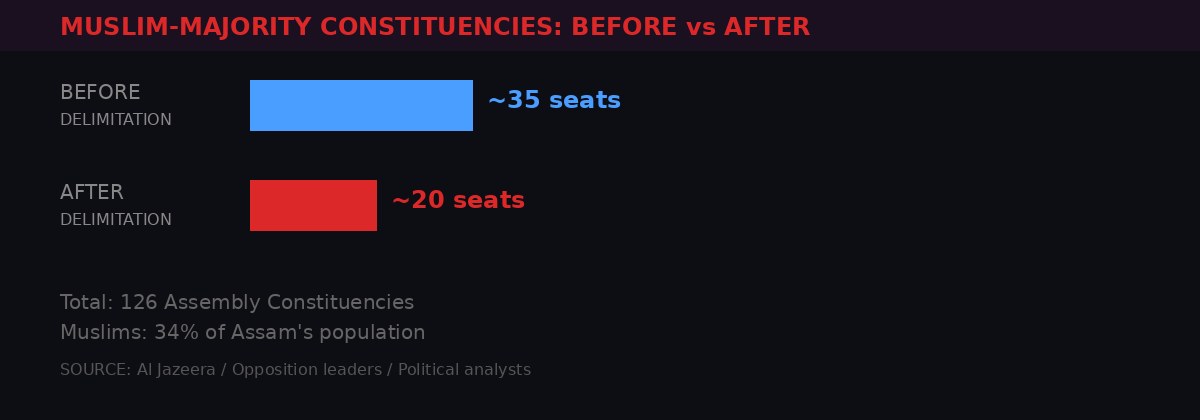
Data compiled from opposition leaders, political analysts, and Al Jazeera reporting
The Quiet Part, Out Loud
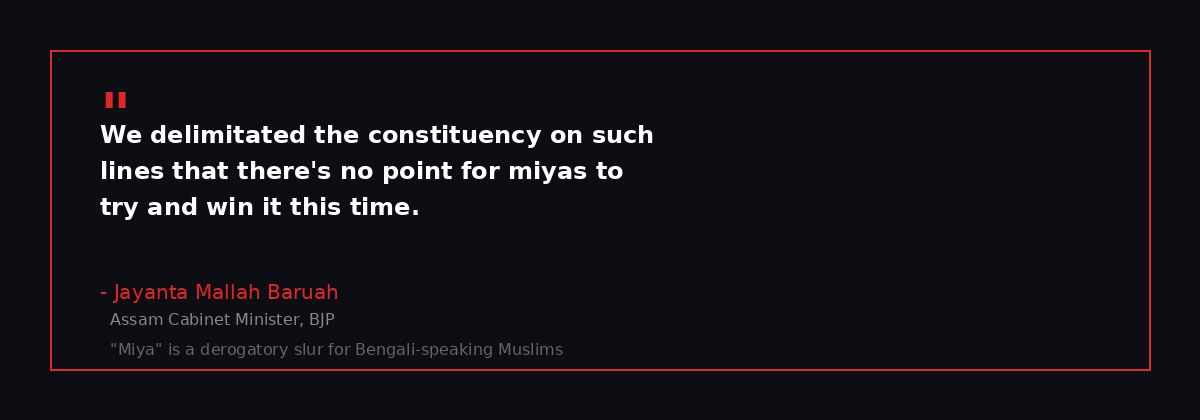
Jayanta Mallah Baruah's remarks during a campaign rally in Barpeta
In most democracies, gerrymandering is done quietly. Officials redraw maps in backrooms, behind neutral-sounding language about "administrative efficiency" or "population balancing." They deny the intent. They hide behind process.
Assam Cabinet Minister Jayanta Mallah Baruah did not bother. While campaigning in Barpeta constituency, he said: "We delimitated the constituency on such lines that there's no point for miyas to try and win it this time."
"Miya" is a derogatory slur used for Bengali-speaking Muslims in Assam. It carries the weight of decades of othering - the implication that these communities are not truly Assamese, not truly Indian, not truly citizens. A sitting cabinet minister used it on the campaign trail while bragging about engineering electoral maps to lock them out of power.
Barpeta assembly seat had previously elected Muslim candidates four times. Under the new boundaries, Hindu voters from surrounding areas were merged in. It is now a Hindu-majority constituency, reserved for a Hindu lower-caste candidate. No Muslim can legally run for the seat.
Former Barpeta legislator Abdur Rahim Ahmed confirmed the mechanics to Al Jazeera: Hindu voters from Muslim-majority constituencies were specifically added to flip the demographic balance. The gerrymander was not accidental. It was not a byproduct of neutral boundary-drawing. It was the stated objective.
Nabab Mezbahul Alam, a Muslim voter and lawyer from Barpeta, put it simply: "Muslims voters have now lost their voice in Barpeta. Now no Muslim can represent us."
What makes Baruah's statement remarkable is not what he said - politicians worldwide design maps to benefit their parties - but that he said it openly, without fear of consequence, using a slur to describe the community he was disenfranchising. The calculation was clear: there is no political cost to admitting what everyone already knows. Not in this India. Not under this government.
The Mechanics of Erasure: Cracking, Packing, Stacking
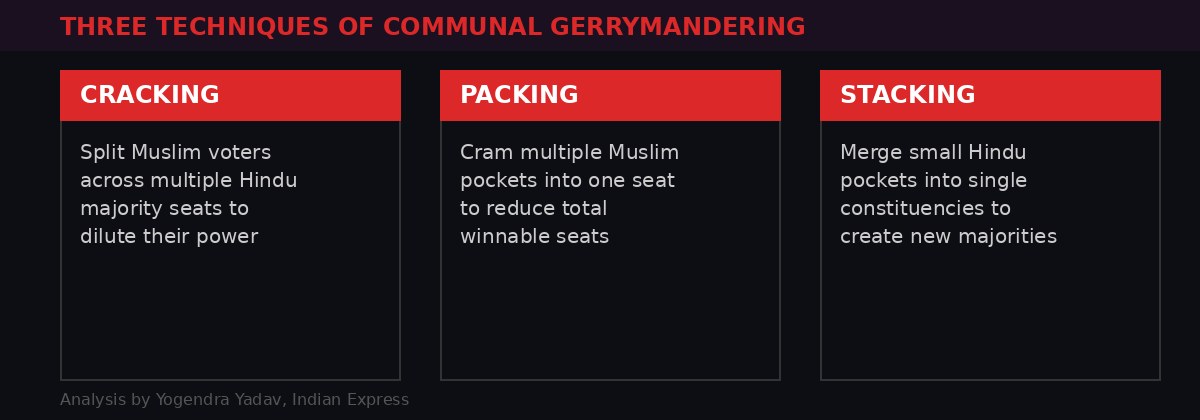
Analysis framework from Yogendra Yadav's work in The Indian Express
Yogendra Yadav, one of India's most respected political analysts and a former member of the Election Commission's advisory committee, wrote a searing analysis in The Indian Express identifying the Assam delimitation as "communal gerrymandering." He mapped three specific techniques borrowed from America's ugly history of racial boundary manipulation:
Cracking: Muslim voter populations that were concentrated enough to form majorities in their constituencies were fractured - split across multiple Hindu-majority seats where their numbers would be too small to influence outcomes. A cohesive community becomes scattered political noise. Their votes still count, technically. But they elect nobody.
Packing: In the opposite direction, multiple Muslim-dominated pockets that could have provided viable majorities across several constituencies were crammed into a single seat. Instead of electing three or four representatives, they elect one. Maximum community, minimum representation.
Stacking: Small Hindu population centers that were individually too dispersed to form a majority in any constituency were merged together into single seats, creating artificial Hindu majorities where none naturally existed. The mirror image of cracking, applied to the other side.
The combined effect is devastating in its precision. Yadav drew explicit parallels to 18th and 19th century United States racial gerrymandering, where electoral boundaries were systematically manipulated to dilute the political power of Black communities. The same playbook. Different century, different continent, same result: a minority population's democratic voice, surgically reduced.
Suprakash Talukdar, Assam's secretary of the Communist Party of India (Marxist), confirmed the pattern to Al Jazeera: "Hindu areas from far-flung Muslim-dominated seats were merged into constituencies with mixed populations, while Muslims from majority seats were dispersed into Hindu-majority areas." The redistribution was not random. It followed a clear communal logic.
The Election Commission of India's own manual for delimitation explicitly states that boundaries should maintain contiguity - no area of one constituency should be isolated inside another. Geographic features, connectivity, natural barriers like rivers and forests should guide the lines. But multiple observers reported these rules were violated in practice.
Former Katigorah legislator Khalil Uddin Mazumder provided a specific example: "Hindu areas from Badarpur, from far across the Barak river, were merged with Katigorah to make it a majority stronghold." The river is not a minor stream - the Barak is a major waterway that bisects the valley. Merging voters from across it into Katigorah violates the Commission's own contiguity principles. But the violation served the political objective, so the rules bent.
Katigorah: A Case Study in Manufactured Majorities
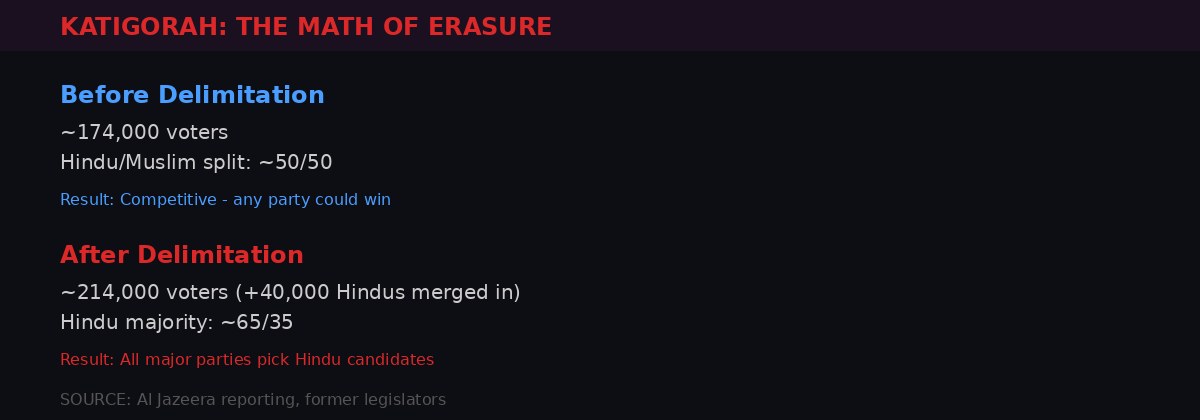
How 40,000 merged Hindu voters transformed Katigorah's electoral math
Before the delimitation exercise, Katigorah was what Indian politics calls a "swing seat." Roughly 174,000 voters, split almost evenly between Hindus and Muslims. The constituency sits in the Barak Valley, bordered by the ancient Borail hills to the north and the Barak River to the south - a landscape that has witnessed centuries of migration, trade, and coexistence.
The electoral dynamics reflected that mixed population. Prime Minister Narendra Modi's BJP would typically field a Hindu candidate. The opposition Indian National Congress would often choose a Muslim candidate. The All India United Democratic Front, the state's third largest party with a strong base among Bengali-speaking Muslims, would field Muslim candidates as well. Voters had genuine choices. Representation was contested but real.
Then approximately 40,000 Hindu voters from neighboring constituencies were merged into Katigorah. The population jumped to roughly 214,000. The 50-50 split became approximately 65-35 in favor of Hindu voters. And just like that, the contest was over.
In the 2026 election, all major parties have chosen Hindu candidates for Katigorah. Not because Muslim candidates are less qualified. Not because the community lacks political engagement - Islam Uddin is still going door to door, remember. But because the math no longer adds up. A Muslim candidate in the new Katigorah cannot win. The map was drawn to guarantee that outcome.
Mazumder, who represented Katigorah as a Congress legislator, understood exactly what happened: "The chances of electing a Muslim candidate from here have suffered significantly." The passive voice is telling. Suffered. As if it were a natural disaster rather than a deliberate act of political engineering.
This is the insidious elegance of gerrymandering. It does not ban anyone from voting. It does not arrest candidates. It does not tear up ballots. It simply rearranges the geography so that certain voices can never aggregate into power. The vote remains. The voice disappears.
The Barak Valley Bloodletting
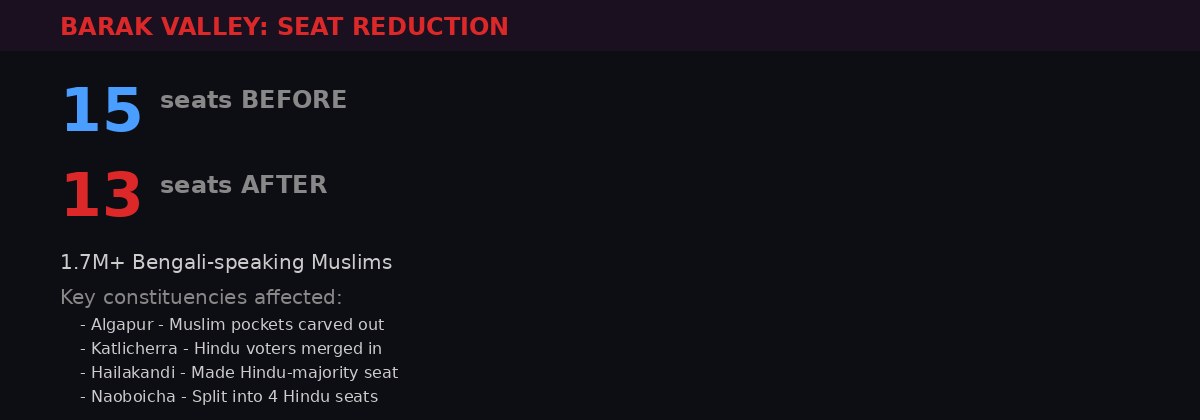
The Barak Valley's legislative representation shrank from 15 to 13 seats
The Barak Valley is home to more than 1.7 million Bengali-speaking Muslims. It is Assam's most concentrated Muslim population center, a region whose identity is shaped by the Bengali language and traditions brought by communities who migrated during British colonial rule to work Assam's tea estates and rice fields.
Before delimitation, the Barak Valley had 15 legislative seats. After the boundary redrawing, it has 13. Two seats - gone. But the population did not shrink. The people are still there. Their representative capacity was simply... reduced.
The mechanics were clinical. Three of the region's seats - Algapur, Hailakandi, and Katlicherra - had historically been represented by Muslim candidates from Congress or AIUDF. Ahmed Tohidus Jaman, a Barak Valley-based political researcher, explained what happened: "Hindu pockets were carved out from Algapur and Katlicherra and merged with Hailakandi, making it a Hindu seat."
The effect cascades. When you carve Hindu voters out of one constituency and move them to another, you change the math in both. Algapur and Katlicherra lose voters - potentially becoming less competitive or merging with other seats entirely. Hailakandi absorbs those voters and flips. Three seats that elected Muslim legislators become zero seats that elect Muslim legislators. The same population, sliced differently, produces a completely different political outcome.
The case of Naoboicha is even more striking. This constituency had elected Muslim legislators three times - a track record of democratic success. Under the new delimitation, its Muslim-dominated pockets were "split into four neighbouring Hindu majority constituency seats," according to Azizur Rahman, who contested the seat for AIUDF in 2021.
The Naoboicha seat itself was then reserved for a Hindu candidate from a less privileged caste - one of India's constitutional provisions meant to ensure representation for historically disadvantaged communities. The reservation system, designed as a tool of inclusion for oppressed castes, was weaponized to exclude another vulnerable minority. A seat Muslims had won three times was redesigned so that no Muslim could legally run for it.
Rahman has been forced to move. He is now contesting a Muslim-majority seat in northern Assam - displaced from the constituency he had served because the map was redrawn beneath him. "They have crippled Muslim representation," he said, speaking at a rally. The word "crippled" is not metaphorical.
The Assam Laboratory: Testing Ground for Hindu Nationalism
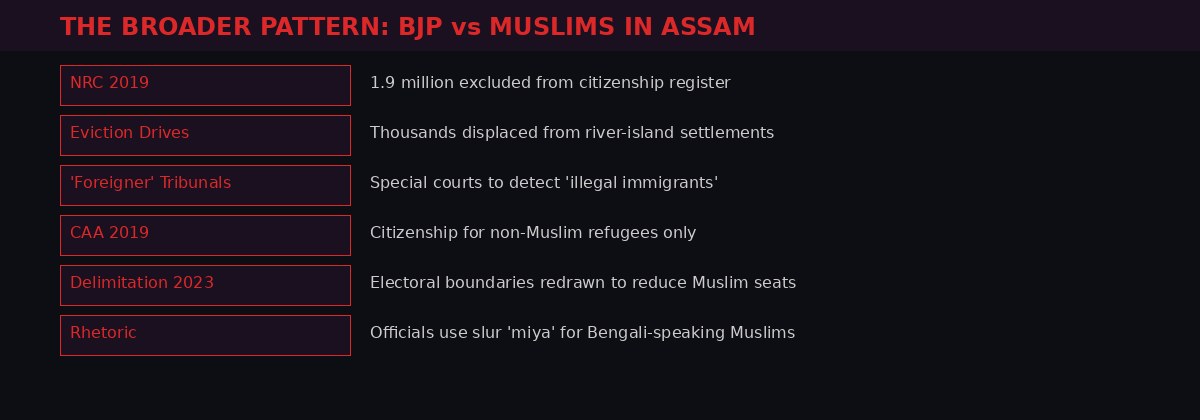
Delimitation is the latest in a series of policies reducing Muslim political power in Assam
To understand what is happening in Assam's electoral boundaries, you need to zoom out. The delimitation is not an isolated act. It is the latest in a systematic sequence of policies that have targeted Assam's Muslim population with increasing precision and escalating consequences.
The National Register of Citizens in 2019 was the first mass test. Designed to identify "genuine Indian citizens" in Assam, the NRC process excluded approximately 1.9 million people from the citizenship register. The excluded were disproportionately Muslim. Many were descendants of communities that had lived in Assam for generations but lacked the documentation to prove continuous lineage. They were rendered stateless in their own homeland - not deported, but stripped of the certainty that they belonged.
The Citizenship Amendment Act, also passed in 2019, offered a stark illustration of the BJP's framework. The CAA provided a pathway to citizenship for refugees from neighboring countries - but explicitly excluded Muslims. Hindu, Buddhist, Sikh, Jain, Parsi, and Christian refugees could qualify. Muslims could not. The message was not coded: India's citizenship infrastructure was being rebuilt along religious lines.
Eviction drives in Assam displaced thousands of families, many of them Muslim, from river-island settlements they had occupied for decades. The campaigns were presented as reclaiming government land from "encroachers," but the communities affected were overwhelmingly poor Bengali-speaking Muslims. Their homes were bulldozed. Their belongings were scattered. Some were given alternative land. Many were not.
"Foreigner tribunals" - quasi-judicial bodies unique to Assam - continue to process cases involving people suspected of being undocumented immigrants from Bangladesh. The system has been widely criticized by human rights organizations for its opaque procedures, arbitrary decisions, and the near-impossibility of proving a negative - that you are not from somewhere else.
The delimitation exercise fits neatly into this architecture. Where the NRC questioned citizenship, and the CAA defined citizenship along religious lines, and eviction drives removed physical presence, the boundary redrawing removes political voice. Each measure targets a different dimension of belonging - legal, territorial, electoral - and each diminishes the standing of Assam's Muslim population.
As multiple political analysts have noted, Assam is functioning as a laboratory. What works here - what the BJP can implement, defend, and win elections with - becomes a potential template for the rest of India. The country's national delimitation exercise, expected in the coming years, will redraw every parliamentary and state constituency across 28 states. The techniques tested in Assam could scale nationwide.
Historical Roots: Migration, Identity, and the Politics of Belonging
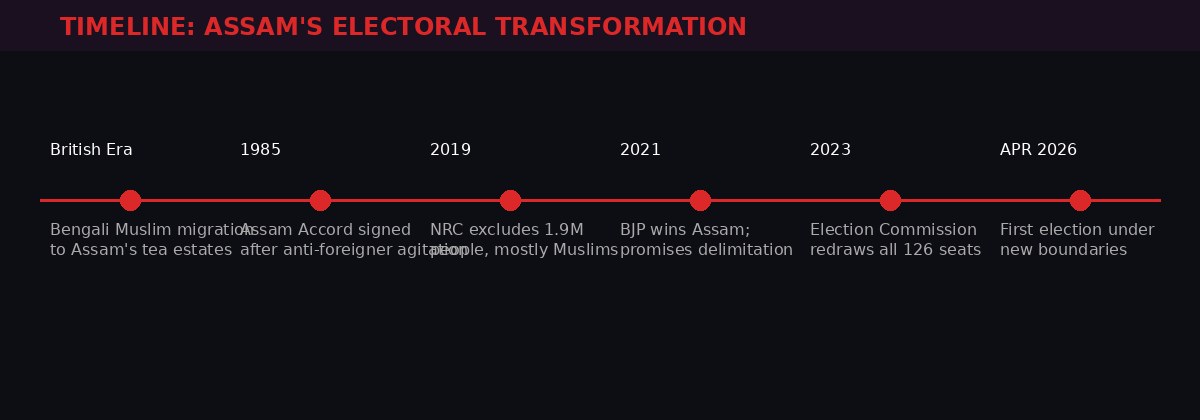
From British-era migration to the 2026 elections: the long arc of political marginalization
The tension at the heart of Assam's identity politics did not begin with the BJP. It stretches back to British colonial rule, when the empire encouraged migration from East Bengal - modern-day Bangladesh - to fill labor demands in Assam's tea estates and rice paddies. Bengali-speaking Hindu and Muslim communities moved in waves, settling along the Brahmaputra and Barak rivers, farming flood plains, building lives in a region that was often described as underpopulated.
After Partition in 1947, migration continued - sometimes voluntary, sometimes driven by the upheavals of a new border cutting through communities that had existed as one. The anxieties this produced were real. Assamese-speaking communities worried about being demographically overwhelmed in their own state. The question of who was "Assamese" and who was an "outsider" became the central political fault line, erupting most dramatically in the Assam Movement of 1979-1985.
That movement - a mass agitation against what was perceived as uncontrolled immigration from Bangladesh - ended with the Assam Accord of 1985. The accord established March 24, 1971 as the cutoff date: anyone who entered Assam after that date would be considered a foreigner. It was meant to settle the question. It did not.
For decades, the identity debate in Assam was framed primarily around language and origin rather than religion. Assamese-speaking people versus Bengali-speaking people. Indigenous communities versus migrants. The categories were porous, overlapping, and politically contested, but they were not primarily communal.
Under the BJP, that has changed. Religion - specifically, Hindu versus Muslim - has become the dominant political fault line. The NRC and CAA made religion the determining factor in who gets to be a citizen. The delimitation exercise made religion the determining factor in who gets to elect a representative. The shift is fundamental. The old debate asked: are you from here? The new framework asks: are you one of us?
This transformation has deep consequences for Bengali-speaking Muslims who have lived in Assam for generations. They are simultaneously "foreigners" in the Assamese-speaking discourse and "wrong religion" in the BJP's Hindu nationalist framework. They are caught at the intersection of two different systems of exclusion, each reinforcing the other.
Islam Uddin, the retired teacher who still goes door to door urging his neighbors to vote, captures this double bind. He is not new to Assam. His family has been in Katigorah for generations. But the state treats him as both an outsider and a political inconvenience. His citizenship is questioned. His vote is diluted. His voice is muted. The map does quietly what rhetoric does loudly: tells him he does not fully belong.
The Election Commission's Silence
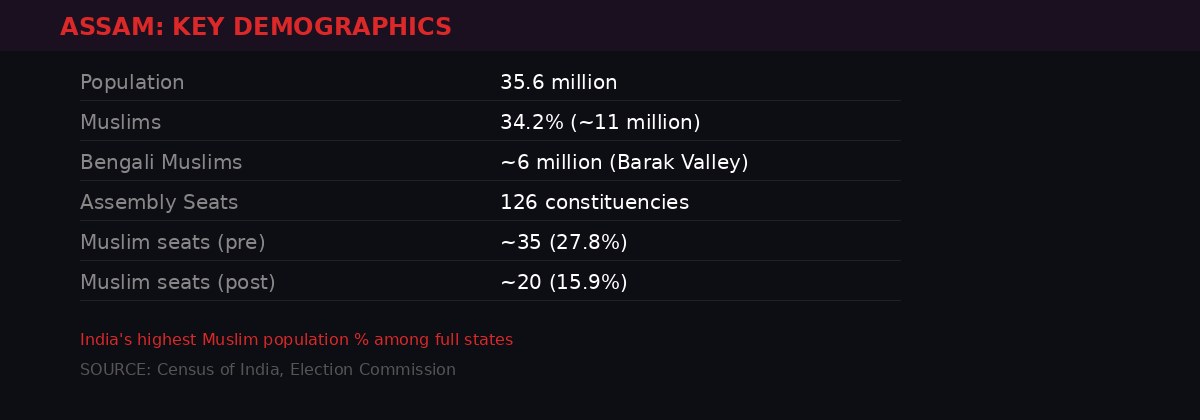
Assam has India's highest Muslim population percentage among full states
The Election Commission of India is constitutionally mandated to conduct elections fairly and impartially. It is one of the country's most powerful and historically respected institutions. Its independence is meant to be a firewall between political power and democratic process.
In the matter of Assam's delimitation, that firewall has been conspicuously porous.
Al Jazeera sent a detailed questionnaire to Gyanesh Kumar, the Chief Election Commissioner of India, asking about the allegations of boundary manipulation along communal lines. They asked about the specific violations of the Commission's own contiguity guidelines. They asked about the dramatic reduction in Muslim-majority constituencies. As of publication, the Commission has not responded.
The Commission's silence is itself a form of communication. The institution that is supposed to guarantee the integrity of India's democratic process has nothing to say about allegations that electoral boundaries were redrawn along religious lines. Nothing about a sitting cabinet minister publicly admitting that constituencies were designed to exclude Muslims. Nothing about the documented violations of the Commission's own delimitation manual.
BJP spokesperson from Assam, Kishore Kr Upadhya, responded on Facebook that the remapping exercise was not communal and that the Election Commission was responsible for it. The circular logic is tidy: the BJP says it is not communal because the Commission did it, and the Commission says nothing at all.
India's delimitation process is legally shielded from judicial review. Once the Election Commission completes a delimitation exercise, courts cannot challenge the boundaries. This design was intended to prevent endless litigation from delaying elections. In practice, it means that if the Commission draws biased boundaries - or allows a ruling party to influence the process - there is no legal remedy. The affected communities have no court to appeal to. They simply live with the map they were given.
The absence of institutional accountability transforms an act of political manipulation into an act of state authority. The boundaries are not disputed because they cannot be disputed. They are not questioned because the institution empowered to question them has chosen silence. The gerrymander becomes permanent - not because it was fair, but because it was final.
For communities like Katigorah's Muslims, the message is clear: the system that is supposed to protect their democratic rights is either unwilling or unable to do so. The firewall between political power and electoral process is not a firewall at all. It is a door. And the BJP has walked through it.
Global Echoes: Gerrymandering as a Universal Democratic Disease
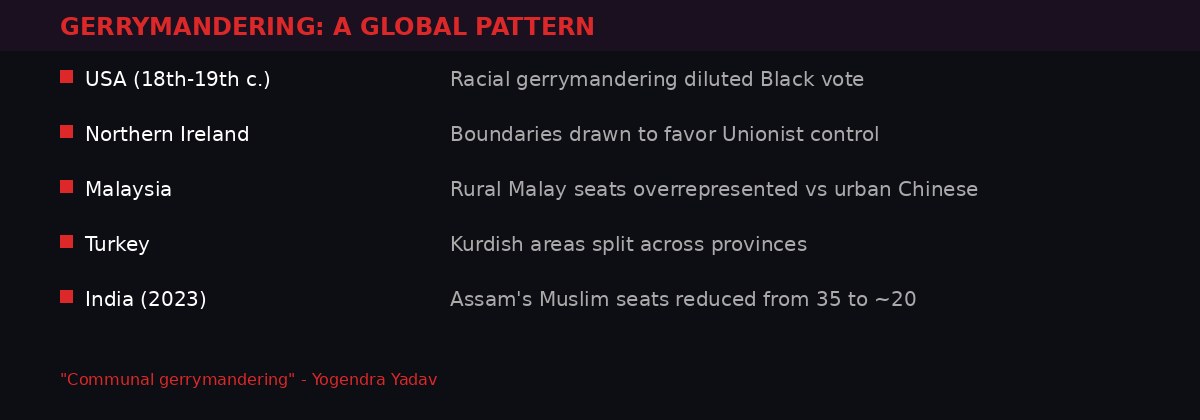
From 18th-century America to 21st-century India: boundary manipulation as a tool of minority suppression
Assam is not unique. Electoral boundary manipulation is one of the oldest tools in the authoritarian playbook, and it crosses every geography and political tradition. What makes it effective is its deniability: the lines on a map look neutral, even when the intent behind them is anything but.
In the United States, racial gerrymandering was used for over a century to dilute the political power of Black communities. Districts were drawn in shapes that defied geographic logic - long corridors connecting disparate neighborhoods, enclaves carved to separate Black voters from their natural political constituencies. The techniques Yogendra Yadav identified in Assam - cracking, packing, stacking - were coined to describe American practices. The vocabulary of disenfranchisement crosses borders.
Northern Ireland under British rule saw electoral boundaries drawn to ensure Unionist (predominantly Protestant) majorities even in areas with significant Catholic populations. The Derry Corporation became infamous for gerrymandering that gave Unionists control of a city where Nationalists were the majority. It was one of the grievances that fueled the civil rights movement of the 1960s and the subsequent Troubles.
Malaysia's electoral system has been criticized for over-representing rural Malay constituencies relative to urban areas where ethnic Chinese and Indian populations are concentrated. A rural Malay vote can carry several times the weight of an urban Chinese vote - not through explicit racial criteria, but through the geometry of constituency boundaries.
Turkey's approach to Kurdish representation has involved splitting Kurdish-majority areas across provinces and electoral regions, ensuring that Kurdish political parties face fragmented electorates. The effect mirrors cracking: a population large enough to elect significant representation is dispersed across boundaries designed to prevent exactly that.
What connects these cases is not ideology - they span the political spectrum from liberal democracies to authoritarian regimes - but methodology. The map becomes a weapon. Geography becomes gerrymandering. The form of democracy is preserved while its substance is hollowed out. People vote, but their votes are pre-sorted into irrelevance.
Assam's delimitation fits this global pattern while adding a distinctly Indian element: the intersection of caste reservation with communal gerrymandering. By reserving redrawn seats for specific caste categories while simultaneously removing Muslim voters from those constituencies, the BJP has layered one system of identity politics on top of another. The result is a kind of democratic origami - folded and refolded until the original shape is unrecognizable.
What Comes Next: The National Delimitation and India's Democratic Future
India is expected to conduct a nationwide delimitation exercise in the coming years - the first since 1976. When it happens, every parliamentary and state assembly constituency in the country will be redrawn. The exercise will affect over 900 million voters across 543 parliamentary seats and thousands of state legislature seats.
The Assam model is being watched. If the techniques tested there - communal cracking, strategic packing, reservation weaponization - are applied nationally, the implications for India's 200 million Muslims are profound. Muslim representation in parliament and state assemblies, already disproportionately low relative to population, could shrink further. The largest democratic exercise in human history could be pre-decided by cartography.
Southern Indian states, which have slower population growth and higher development indicators, are also watching with concern. A straightforward population-based redistribution would shift seats from the south to the north - rewarding states with higher birth rates and lower development outcomes. The politics of delimitation will not be confined to communal lines. It will intersect with regional, linguistic, and development divides in ways that could reshape India's federal balance.
For Assam's Muslims, the immediate question is simpler and more urgent: what do you do when the map has been drawn against you?
Some are adapting. Azizur Rahman relocated from Naoboicha to contest a Muslim-majority seat elsewhere. Opposition parties are concentrating resources on the 20-odd constituencies where Muslim candidates remain viable. Community organizations are ramping up voter registration and turnout campaigns, trying to maximize their impact within the diminished territory left to them.
Others are asking harder questions. If democratic participation cannot deliver representation - if the system itself is engineered to exclude you - what alternatives remain? The question is not rhetorical. It echoes through every community, in every country, that has been gerrymandered out of power. The American civil rights movement found its energy in exactly this frustration: the realization that formal democratic rights meant nothing when the infrastructure of democracy was designed to nullify them.
Assam's April 9 election will proceed on schedule. Voters will queue at polling stations. Electronic voting machines will record their choices. Results will be announced. But for 11 million Bengali-speaking Muslims, the outcome was substantially decided in 2023, in a drawing room in Delhi, when someone picked up a pen and moved a line on a map.
"It feels like you've given us hands, feet and head to move and see. But you muted our voice." - Alam, lawyer from Barpeta, Assam (Al Jazeera)
Islam Uddin will knock on doors again tomorrow. He will urge his neighbors to vote. He will believe, or try to believe, that their participation matters. That is the cruelest thing about gerrymandering: it asks you to perform democracy while denying you its substance. You still get the ritual. You just don't get the power.
The vanishing vote does not vanish visibly. It is not destroyed or suppressed. It is simply rearranged - moved, diluted, scattered - until it cannot coalesce into anything that threatens the people who hold the pen.
In Assam, the pen belongs to the BJP. The map is their masterpiece. And 11 million people are living inside the lines.
Get BLACKWIRE reports first.
Breaking news, investigations, and analysis - straight to your phone.
Join @blackwirenews on TelegramSources:
- Al Jazeera - "'Gerrymandering' in India's Assam cuts Muslim representation before vote" (April 1, 2026)
- Yogendra Yadav - "Communal Gerrymandering in Assam" (The Indian Express, 2026)
- Scroll.in - Assam election coverage (March-April 2026)
- Election Commission of India - Delimitation Manual and 2023 boundary orders
- AP Photo - Anupam Nath/AP Photo, Assam election coverage
- Communist Party of India (Marxist) - Suprakash Talukdar statements
- Census of India - Assam population and demographic data