March 31, 2026 | Culture & Society
The Silencing: How Australia Turned a Mass Shooting Into a War on Protest
After 15 people died at Bondi Beach, Australia's government rushed through laws that criminalize protest slogans, expand police search powers, and target Muslim communities. Three months later, the people most affected by these laws are not extremists. They are students, lawmakers, and men who were praying.
BLACKWIRE / EMBER Bureau investigation
Ali Al-lami is twenty-three years old. He is a university student in Sydney. On the evening of February 9, 2026, he attended a protest against the visit of Israeli President Isaac Herzog. What happened next, he says, involved being stomped on, choked, punched in the head while handcuffed, and racially abused by police officers. His crime, as far as he can tell, was standing on a public street in his own country.
Al-lami is not an anomaly. He is a data point in a pattern that has reshaped how Australia treats dissent - a pattern that stretches from a horrific act of violence on a December evening to a sprawling legislative apparatus that critics say has weaponized grief to suppress democratic rights.
The Bondi Beach shooting on December 14, 2025, killed fifteen people at a Hanukkah celebration. A father-and-son duo opened fire during the Festival of Lights, murdering a ten-year-old girl among the victims. The father died in a police shootout. The son survived and remains hospitalized. It was the worst mass shooting in Australia since Port Arthur in 1996, and it ripped open questions about gun reform, anti-Semitism, and national security that the country had spent three decades assuming it had answered.
Nobody disputes the horror of what happened at Bondi. Nobody defends it. But what the Australian government did with that horror - the speed, the scope, the specificity of the laws that followed - tells a different story. One about a democracy that reached for the wrong tools in the name of safety, and in doing so, may have created dangers far more durable than the ones it was trying to prevent.
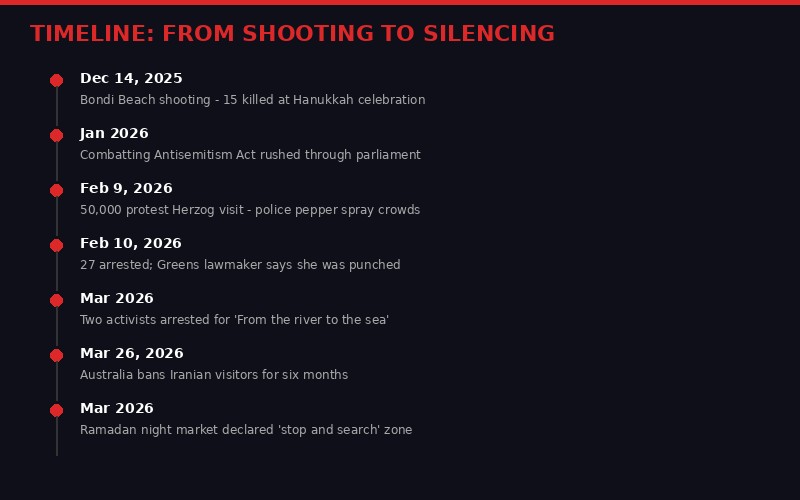
Timeline of events from the Bondi shooting to the protest crackdown
I. The Hanukkah Massacre and Its Aftermath

Sydney, Australia - the city where grief was legislated into silence / Unsplash
December 14, 2025, was supposed to be a night of candlelight. Bondi Pavilion, the art deco building that sits where sand meets city on Sydney's most famous beach, was hosting a community Hanukkah celebration. Families gathered. Children drew dreidels. Someone was lighting the first candle of the menorah when the shooting started.
The attackers - a fifty-year-old father and his twenty-four-year-old son - brought six firearms to the event. Australian officials later confirmed that the father held a valid firearms licence and "met the eligibility criteria" under existing law. The son had previously been flagged by police but was not considered a threat. Both facts would become politically radioactive in the weeks that followed.
Fifteen people died. Dozens more were injured. The victims included families, children, elderly community members who had come to celebrate a religious holiday. Prime Minister Anthony Albanese called it "an act of pure evil, an act of terror, an act of anti-Semitism." He urged Australians to light candles in solidarity. "We are stronger than the cowards who did this," he said.
Israeli Prime Minister Benjamin Netanyahu responded differently. He blamed Albanese's centre-left government, specifically its decision to recognize Palestinian statehood in September 2025, for "pouring fuel on the anti-Semitic fire." The accusation was inflammatory and widely condemned - Ben Saul, the UN special rapporteur and University of Sydney law professor, called himself "disgusted" by the linkage - but it achieved something politically useful. It framed the post-Bondi debate not around gun reform or domestic extremism, but around the Israeli-Palestinian conflict, loyalty, and the boundaries of permissible speech.
Within weeks, the Australian government had introduced the Combatting Antisemitism, Hate and Extremism Act. And while the act's name suggested broad anti-hate protections, its architecture told a narrower story.
II. The Law That Protects One Religion
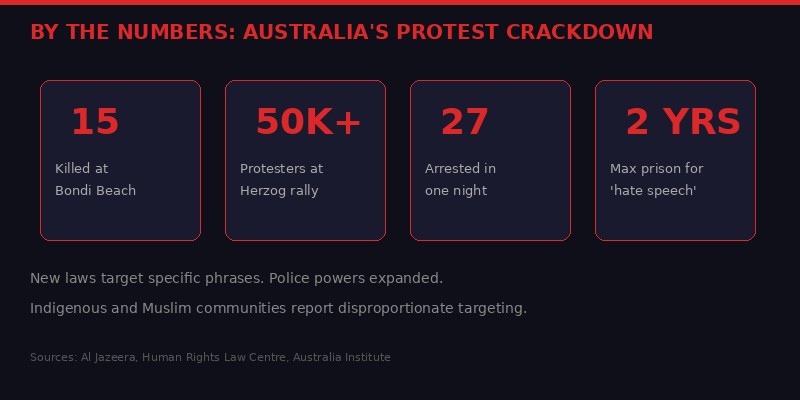
Key statistics from the post-Bondi crackdown
The Combatting Antisemitism, Hate and Extremism Act was rushed through New South Wales' federal parliament in January 2026. The legislation was assembled from recommendations by Jillian Segal, a South African-born lawyer appointed as the government's special envoy to combat anti-Semitism. Segal's report argued that "since 7 October 2023, anti-Semitism has risen to deeply troubling levels in Australia," and warned of "ancient myths and misinformation" re-emerging "in new forms."
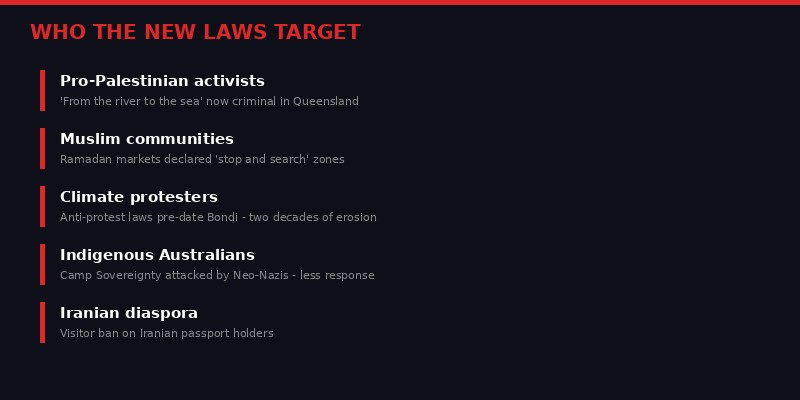
The law introduced several provisions. Higher penalties for existing hate crime offences. Expanded offences for displaying or distributing symbols deemed hateful. An easier process to deport or cancel visas of individuals associated with proscribed groups. And critically, it criminalized specific phrases - including "From the river to the sea" and "Globalise the Intifada" - making their public utterance punishable by up to two years' imprisonment in Queensland.
Two activists have already been arrested and charged under the new provisions simply for chanting "From the river to the sea." Not for violence. Not for incitement. For six words spoken aloud in public.
The law was designed, its sponsors said, to protect Jewish Australians from a rising tide of hatred. And attacks on synagogues and Jewish businesses had indeed increased. Neo-Nazi groups like the National Socialist Network were staging public marches. The threat was real. But critics pointed to a glaring asymmetry in the law's protections.
"We know that hate touches all marginalised people. The same hateful ideology that led to the appalling Bondi shooting could also be weaponised against women, members of the Muslim community or LGBTQ+ Australians. This law was deliberately designed to not protect these vulnerable parts of our community, and that seriously undermines its legitimacy and utility." - Senator David Shoebridge, Australian Greens
Shoebridge's charge is specific and difficult to rebut on its face. The law's protections are asymmetric. It criminalizes speech deemed anti-Semitic while offering no equivalent protections for Muslim Australians, Indigenous Australians, or other marginalized groups who face systemic discrimination. "Unfortunately, the Albanese Labor government and the Liberals made the decision to protect just one religion," Shoebridge told Al Jazeera.
Arif Hussein, a senior lawyer at the Human Rights Law Centre in Sydney, told Al Jazeera the legislation's vague definitions created particular danger. "The laws introduce broad and poorly defined criminal powers directed at 'hate groups' without the opportunity for impacted groups to be heard before being listed," Hussein said. "This uncertainty has been exacerbated by inconsistent explanations from the government about whether the legislation could apply to criticism of a foreign government's conduct, increasing fears that advocacy for Palestinian rights may be improperly scrutinised."
In other words: the government could not clearly explain who its own law was targeting. And in the space between ambiguity and enforcement, people began getting arrested.
III. The Night Fifty Thousand People Came Out

Protests against Herzog's visit drew an estimated 50,000 people to Sydney's streets / Unsplash
On February 9, 2026, Israeli President Isaac Herzog arrived in Australia. His visit was officially framed as a solidarity trip - he would meet families of Bondi victims, lay wreaths, and speak about shared democratic values. Albanese had invited him in the shooting's aftermath.
But Herzog's presence in Australia carried weight that no diplomatic framing could neutralize. A United Nations commission of inquiry had found him responsible for inciting genocide against Palestinians. The International Criminal Court had issued arrest warrants for Israeli leaders. And the war in Gaza - which by February 2026 had killed more than 72,000 Palestinians, according to Al Jazeera - continued.
Amnesty International's Australian chapter was direct. "President Herzog has unleashed immense suffering on Palestinians in Gaza for over two years - brazenly and with total impunity," the organization said. "Welcoming President Herzog as an official guest undermines Australia's commitment to accountability and justice. We cannot remain silent."
Tens of thousands of Australians agreed. An estimated 50,000 protesters gathered in Sydney's business district. In Melbourne, roughly 5,000 marched from Flinders Street Railway Station to the State Library, blocking evening peak-hour traffic. The Palestine Action Group had organized the Sydney demonstration, but a court challenge to police restrictions on their march route had been rejected by the state Supreme Court hours before the protest began.
What happened next was broadcast to the world.
Police prevented the Sydney marchers from entering areas designated off-limits. When the crowd - described by police as "an angry and violent mob," described by participants as a peaceful protest - pressed against the lines, officers deployed pepper spray, including against journalists covering the event. Video footage showed demonstrators being "kidney punched." Muslim men who had stopped to pray - it was evening prayer time - were physically dragged away from their prayer mats.
Twenty-seven people were arrested, ten allegedly for assault. But the most striking account came from someone who should have been untouchable: Abigail Boyd, a Greens lawmaker in the state parliament.
"The police were just running at groups of people and sort of corralling them into an area. There was a group of people who were praying because it was evening prayer time. There was maybe 12 of them. They were praying peacefully and it was clear that the police were wanting to move them on in the middle of their prayer. I got lifted off the ground and then you could see in the video, as I'm trying to regain my balance, another police officer punches me in the head and then I get another one after that, that punches me in the shoulder." - Abigail Boyd, Greens lawmaker, NSW state parliament
Boyd was an elected representative. She was punched by police at a protest she had a constitutional right to attend. The incident made international news, but domestically, the official response was muted. State Premier Chris Minns said officers had been placed in "incredibly difficult circumstances." Police chief Mal Lanyon said the actions were justified.
Nobody resigned. Nobody was disciplined. The Palestine Action Group called for the resignations of Minns and Lanyon, and demanded charges against detained protesters be dropped. None of those demands were met.
IV. The Expansion: Stop-and-Search Zones and Face Covering Bans
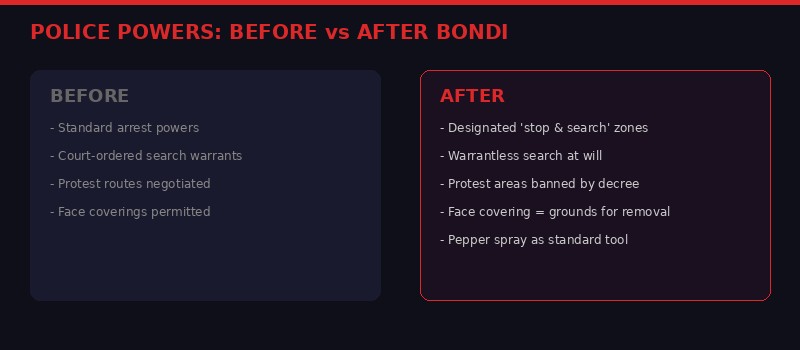
How police powers expanded after the Bondi shooting
The protest crackdown did not end with pepper spray and punches. It expanded into a permanent infrastructure of surveillance and control.
In Victoria, state police gained the power to declare "designated areas" where they could stop and search members of the public at will - without warrants, without probable cause. They could also direct any person to leave a location if that person refused to remove a face covering that police believed was being used to either conceal identity or protect against crowd-control measures like pepper spray.
Consider the circularity of that second provision. Police use pepper spray on protesters. Protesters wear face coverings to protect themselves from pepper spray. Police then use the face coverings as grounds to remove protesters from the area. The protest is effectively criminalized not through any law against protesting, but through a procedural loop that makes participation physically unbearable and legally precarious.
The designated-area powers were deployed in ways that revealed their true targets. A Ramadan night market in the Dandenong suburb of Melbourne was declared a stop-and-search zone. Not a protest. Not a rally. A food market during the holiest month of the Islamic calendar.
Nour Salman of the Australia Palestine Advocacy Network described the message this sent to Muslim communities. "For Muslim communities already facing rising hostility, it reinforces the idea that even spaces of faith, culture and celebration are viewed through a lens of suspicion. That approach does not build trust. It entrenches fear and normalises the policing of Muslim and Palestinian identity," she said.
"Legitimate criticism of Israel and advocacy for Palestinian rights is not dangerous or unlawful," Salman added. "Palestinians and their supporters should not have to worry that speaking out against genocide could be treated as a crime."
But that, increasingly, is exactly what was happening. The new laws and expanded police powers created a hierarchy of protection that ran along religious and ethnic lines. Jewish communities received enhanced security funding and dedicated anti-hate legislation. Muslim communities received stop-and-search zones at their food markets.
V. The Indigenous Silence
The communities disproportionately affected by Australia's new laws
The asymmetry was not lost on Indigenous Australians, who have been fighting for recognition and against systemic racism since British colonization began more than two centuries ago.
In Melbourne, a group of roughly forty men dressed in black - members of far-right and fascist organizations - charged an Aboriginal sacred site known as Camp Sovereignty. They injured women and damaged property. It was, by any reasonable definition, a terrorist attack on an Indigenous cultural site.
Robbie Thorpe, the Indigenous leader who oversees Camp Sovereignty, had warned authorities about the rising threat of far-right violence before the attack occurred. "We warned the city council about the rise of the threat of violence by these guys. We warned them before that happened," Thorpe said.
In January 2026, a man was charged with throwing an explosive device into a group of pro-Indigenous demonstrators in Perth. The device did not explode. If it had, the casualty count could have rivaled Bondi.
Yet the government's response to violence against Indigenous Australians was not a royal commission, not emergency legislation, not enhanced security funding. Thorpe noted the disparity with characteristic bluntness. "It's offended a lot of Aboriginal people that straight away they can get an inquiry or a royal commission into anti-Semitism," he said. "We've been talking about the issue of racism in this country the entire time."
The 2023 referendum to establish an Indigenous voice to parliament - a modest proposal to address centuries of dispossession, forced child removals, and massacres - had been "soundly rejected" by Australian voters. That rejection was accompanied by a spike in racism toward Indigenous peoples that went largely unaddressed by the same government now pouring resources into combating anti-Semitism.
This is not to diminish the reality of anti-Semitic violence in Australia. The Bondi shooting was real. Attacks on synagogues were real. The threat from Neo-Nazi groups was real. But a government that responds to violence against one community with legislation, funding, and royal commissions while responding to violence against another with silence has made a choice about whose suffering counts. And that choice is not lost on the people left out.
VI. Twenty Years of Erosion
New South Wales leads Australia in anti-protest legislation - Human Rights Law Centre
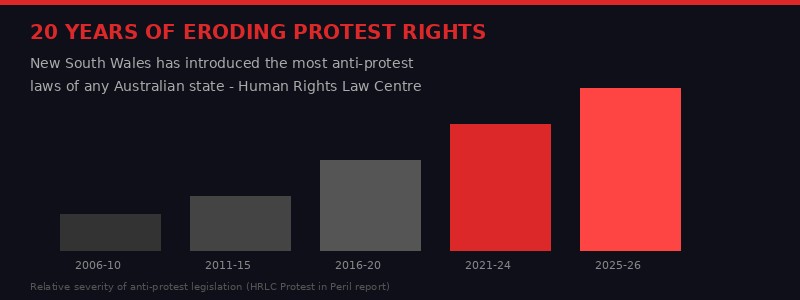
To understand the post-Bondi crackdown, you have to understand that it did not emerge from nothing. The right to protest in Australia has been eroding for two decades, and the Bondi shooting simply gave the government its most sympathetic pretext yet.
According to the Human Rights Law Centre's report "Protest in Peril," New South Wales has introduced more anti-protest laws than any other Australian state. These laws predate the current crisis by years. They were initially aimed at climate activists - people blocking roads, chaining themselves to equipment at fossil fuel sites, disrupting ports. The target shifted, but the legal architecture remained and expanded.
Al-lami, the twenty-three-year-old student who was beaten and arrested at the Herzog protest, recognized this pattern even through the bruises. The new laws, he said, were "a continuation of repression against activism - from climate change to Palestine - that began long before the Bondi attack." The shooting did not create Australia's anti-protest machinery. It supercharged it.
The Human Rights Law Centre's findings are granular and alarming. Over the past two decades, Australian states have progressively expanded police powers to restrict, redirect, and effectively prevent peaceful demonstrations. What was once a right guaranteed by democratic norms has been reduced to a privilege granted - or withheld - by police commanders making real-time decisions about which protests are acceptable and which are not.
The post-Bondi legislation accelerated this trend exponentially. The Combatting Antisemitism Act gave the government new powers to proscribe groups, deport individuals, and criminalize specific phrases. The expanded police powers in Victoria created stop-and-search zones that could be declared at will. The court system upheld police restrictions on protest routes. And the enforcement apparatus - pepper spray, flash-bang grenades, hard-foam baton rounds - became standard tools for managing crowds that previous generations of Australian police would have handled with dialogue and de-escalation.
Noura Mansour of Democracy in Colour, a racial justice organization, described the February 9 police response as "not 'community safety' - it was a violent display of state power designed to silence people protesting for human rights."
"To see police turn pepper spray on peaceful protesters and assault people in the middle of prayer is a profound violation of dignity and a direct attack" on democratic rights, Mansour said.
VII. The Iran Ban and the Expanding Ring

Australia banned Iranian visitors in March 2026, citing the war / Unsplash
On March 26, 2026, Australia took another step. The Department of Home Affairs announced a six-month ban on visitors from Iran, citing the US-Israeli war on the country as justification. The ban applied to Iranian citizens outside Australia, even those who already held valid Australian visitor visas. It was retroactive in effect - people who had planned trips, bought tickets, and met every visa requirement were told they could no longer enter.
Home Affairs Minister Tony Burke framed the decision in bureaucratic language. Decisions about permanent residency "should be made by the government and should not be the random consequence of who booked a holiday," he said. The implication was that Iranian visitors might use the war as a pretext to stay permanently - a framing that treated an entire nationality as a flight risk.
The Asylum Seekers Centre in Sydney was less diplomatic. The ban was the result of a "shameful new law" that "threatens the very foundations of Australia's onshore protection programme," the group said. "For years, politicians have been stressing the importance of seeking safety through so-called legal routes. Now, in the face of an international humanitarian crisis, the government is slamming the door shut."
The Iran ban connected to the broader post-Bondi pattern in ways that were difficult to ignore. Australia's more than 90,000 Iranian-born residents were already navigating a climate of suspicion. The ban on visitors added another layer - signaling that Iranian identity itself was grounds for exclusion, regardless of individual circumstances or intentions.
The episode with the Iranian women's football team illustrated the contradictions. In early March, US President Donald Trump publicly called on Albanese to grant asylum to Iranian players who had failed to sing their national anthem before a Women's Asian Cup match in Queensland. Seven players and officials were eventually granted asylum, though five later reversed their decision and returned home. The team had arrived in Australia for a football tournament and found themselves caught in a geopolitical vortex that turned their presence into a diplomatic incident.
For the Iranian diaspora in Australia, these events created a suffocating bind. Their home country was being bombed. Their host country was banning their compatriots from visiting. Their communities were being policed with new powers that made Muslim identity itself a trigger for state scrutiny. And the laws enacted to combat hate specifically excluded them from protection.
VIII. The People in Between

Communities caught between grief, policy, and protest / Unsplash
Every story about laws and legislation risks losing the people inside it. Here are some of the people inside this one.
There is Ali Al-lami, the twenty-three-year-old student who went to a protest and was stomped on, choked, and punched while handcuffed. "Right after stomping me, grabbing me and choking me, and putting cuffs onto my hands, they landed punches onto my head and started bashing me," he told Al Jazeera. He says police racially abused him during the arrest. He is still facing charges.
There is Abigail Boyd, the Greens lawmaker who watched police drag praying Muslim men from their prayer mats before she herself was punched in the head by an officer. "I don't understand how that is a proportionate response to anything," she said. "I was not doing the wrong thing. Nor was anybody around me." She is an elected representative of her government. She was struck by agents of that same government for exercising a right that her position exists to protect.
There are the twelve men who were praying. Evening prayer. One of the five daily obligations of Islamic practice. They were kneeling on the ground in a group of twelve, facing Mecca, performing an act of worship that has been continuous for fourteen centuries. Police lifted them from the ground and threw them down. Boyd, who witnessed it, said: "You can't get anything more peaceful than prayer. Picking them up and just throwing them on the ground."
There are the two activists in Queensland who have been arrested and charged for chanting "From the river to the sea." Their names have not been widely reported - they have become data points in a prosecution, not people in a story. They face up to two years in prison for speaking six words that, until January 2026, were legal to say in every jurisdiction in Australia.
There are the women and elders at Camp Sovereignty in Melbourne who were injured when forty men in black charged their sacred site. Their attacker's ideology - far-right, white supremacist, explicitly violent - was the same ideology that animated the Bondi shooting. But their injuries did not produce a royal commission.
There is the man in Perth who threw an explosive into a group of Indigenous demonstrators. The device did not detonate. He was charged. The incident did not produce emergency legislation.
And there are the families of the fifteen people who died at Bondi Beach. Their grief is real and permanent. Their loved ones were murdered for being Jewish, for celebrating their faith in public, for lighting candles on a December evening. Nothing in this article diminishes that. But grief is not a blank check for policy. And the question Australia must answer is whether it used their suffering to build protections or to build control.
IX. What Australia Chose

The legislative response to Bondi has reshaped Australia's democratic landscape / Unsplash
There is a version of this story in which Australia responded to the Bondi shooting with genuine reform. In that version, the government reviewed its firearms laws - which, despite the 1996 Port Arthur reforms, had lapsed to the point where Australia now has more guns in circulation than it did before the ban. In that version, the government addressed domestic radicalization broadly, recognizing that anti-Semitism, Islamophobia, anti-Indigenous racism, and far-right extremism share common roots and common solutions. In that version, enhanced protections were offered to all vulnerable communities, not just one.
That is not the version Australia chose.
The version Australia chose protects Jewish communities with legislation while policing Muslim communities with stop-and-search powers. It arrests people for chanting slogans while allowing Neo-Nazi groups to attack Indigenous sacred sites with comparatively little consequence. It bans Iranian visitors while welcoming a head of state whom the United Nations has linked to genocide. It punches elected lawmakers at protests and calls the officers' actions justified.
Albanese has defended the new laws with language that is hard to argue with in the abstract. "The terrorists at Bondi Beach had hatred in their minds but guns in their hands. This law will deal with both, and we need to deal with both," he said. "We want to ensure that Australia remains a society where everyone has the right to be proud of who they are."
But "everyone" is doing a lot of work in that sentence. Because the law does not protect everyone equally. It does not allow everyone to be proud of who they are. It does not deal with hatred in all its forms. It deals with one form, in one direction, and it uses the grief of fifteen murdered people to justify a crackdown that extends far beyond the threat those murders represented.
The Human Rights Law Centre has documented the pattern. Democracy in Colour has condemned it. Amnesty International has flagged it. The Greens have opposed it in parliament. Indigenous leaders have called out the double standard. The Asylum Seekers Centre has challenged the Iran ban. None of it has slowed the momentum.
Australia in March 2026 is a country where a student can be beaten for attending a protest. Where a lawmaker can be punched for witnessing police violence. Where men can be dragged from prayer. Where phrases can be criminalized. Where food markets can become surveillance zones. Where an entire nationality can be banned from visiting.
All of this was done in the name of the fifteen people who died at Bondi Beach. Their memory deserves better.
Key Sources
- Al Jazeera - "Australia's post-Bondi crackdown accused of targeting pro-Palestinian voices" (March 27, 2026)
- Al Jazeera - "More Australia protests over police crackdown on rally against Herzog visit" (February 10, 2026)
- Al Jazeera - "Questions linger about gun reform, anti-Semitism after Bondi Beach shooting" (December 15, 2025)
- Al Jazeera - "Australia bans visitors from Iran amid war in the Middle East" (March 26, 2026)
- Human Rights Law Centre - "Protest in Peril" report
- Democracy in Colour - statement on police violence, February 2026
- Amnesty International Australia - statement on Herzog visit
- Australia Institute - firearms circulation report
- UN Special Rapporteur Ben Saul - social media statements, December 2025
Get BLACKWIRE reports first.
Breaking news, investigations, and analysis - straight to your phone.
Join @blackwirenews on Telegram