Blind Over the Gulf: Iran Destroys America's Eyes in the Sky at Prince Sultan Air Base
A Shahed drone split a US E-3 AWACS in half on the tarmac. Verified photos confirm the worst loss of the air war so far - and expose a vulnerability the Pentagon cannot easily fix.
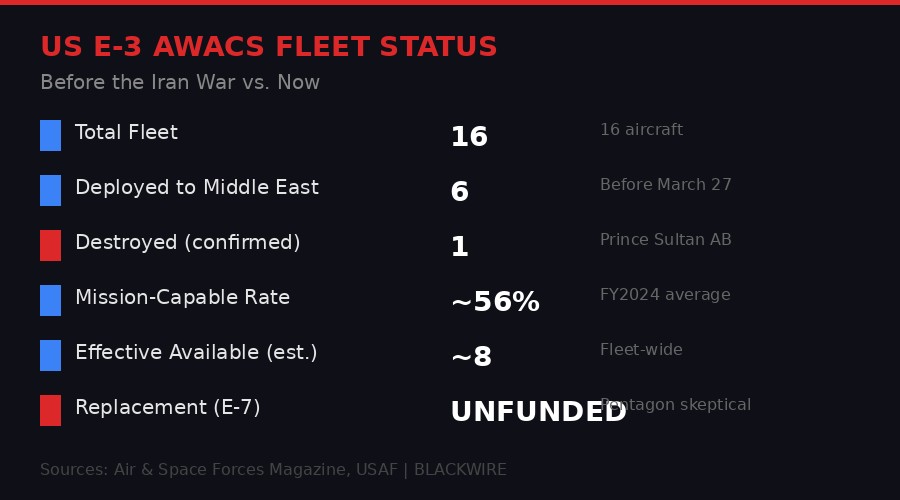
BLACKWIRE Infographic: US E-3 AWACS fleet status as of March 29, 2026
The photograph tells the story better than any briefing could. A Boeing E-3 Sentry - the aircraft that gives American air commanders the ability to see hundreds of kilometers into enemy territory, track every missile launch, direct every fighter sortie, and coordinate the most complex air campaign since Desert Storm - sits on the tarmac at Prince Sultan Air Base in Saudi Arabia, split in two.
The fuselage is cracked open like a broken spine. The distinctive 30-foot radar rotodome, the component that makes the E-3 what it is, appears intact but useless, perched atop wreckage that will never fly again. The tail number is visible. Flight-tracking data from Flightradar24 confirms the aircraft was airborne near the base as recently as March 18. It will not fly again.
Iran's Fars news agency, linked to the Islamic Revolutionary Guard Corps, claimed a Shahed drone struck the aircraft during a combined missile and drone assault on March 27. BBC Verify has confirmed the location by matching pylons, storage units, and runway markings in the photos to satellite imagery of the base, located roughly 96 kilometers southeast of Riyadh. A satellite image captured Friday shows a fire on the base apron approximately 1,600 meters east of where the E-3 was parked.
US Central Command has not commented. The silence is itself a data point. When the US military has good news, it announces it. When it has bad news about Iranian capabilities being degraded by 90 percent, it announces that too. When one of its most irreplaceable aircraft is torn apart on allied soil by a drone that costs a fraction of what the E-3 is worth, it says nothing.
At least 15 American service members were wounded in the March 27 attack. Five are in serious condition, according to the Associated Press, citing sources briefed on the strike. Multiple KC-135 aerial refueling tankers were also damaged. The Wall Street Journal reported this was the second strike on the base in two weeks - a March 13 attack had already damaged five KC-135s.
What the E-3 Actually Does - And Why Losing One Is a Crisis
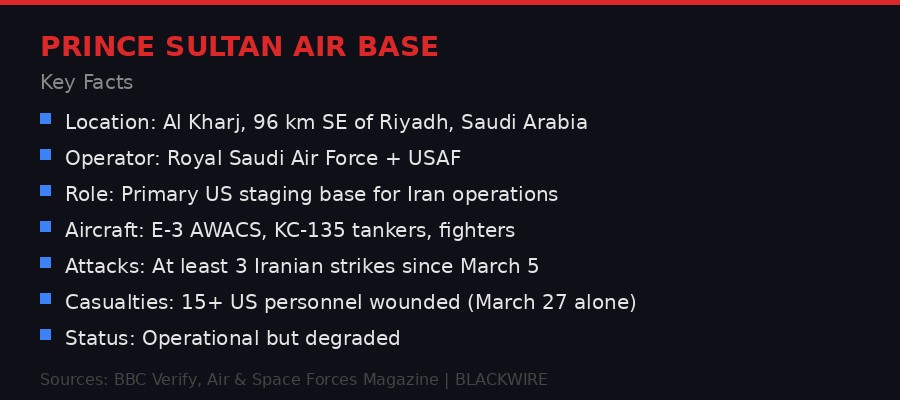
BLACKWIRE Infographic: Prince Sultan Air Base - the primary US staging ground for Operation Epic Fury
The E-3 Sentry is not a fighter. It does not drop bombs. It does not fire missiles. It does something far more important: it makes every other aircraft in the US arsenal effective. Without the AWACS, fighter pilots are flying partially blind. With it, they see everything.
Built on a modified Boeing 707 airframe, the E-3 carries a rotating radar dome with a range exceeding 375 kilometers. That dome can track hundreds of targets simultaneously - aircraft, drones, cruise missiles, ballistic launches - and feed that data in real time to every friendly aircraft, ship, and ground station in the theater. The E-3's battle managers are the chess masters. Fighter pilots are the bishops. Without the chess master, the bishops don't know where the board is.
Heather Penney, a former F-16 pilot and director of studies and research at the Mitchell Institute for Aerospace Studies, described the loss in blunt terms to Air and Space Forces Magazine:
"The loss of this E-3 is incredibly problematic, given how crucial these battle managers are to everything from airspace deconfliction, aircraft deconfliction, targeting, and providing other lethal effects that the entire force needs for the battle space."
Kelly Grieco, a defense policy expert and senior fellow at the Stimson Center, agreed: "It's a significant loss for the war in the short term. That has a consequence. There are going to be coverage gaps."
Coverage gaps in a theater where Iran is firing missiles, launching drone swarms, and threatening ground operations. Coverage gaps over a Gulf where the Strait of Hormuz is effectively closed and a second chokepoint is now under threat. Coverage gaps at exactly the moment the US needs to see everything, because the war is about to get bigger.
The US Air Force operates a total fleet of just 16 E-3 Sentries. The aircraft entered service in 1977. In fiscal year 2024, the E-3 fleet had a mission-capable rate of approximately 56 percent - meaning at any given time, nearly half the fleet cannot fly. Six E-3s were deployed to bases in Europe and the Middle East for Operation Epic Fury. Now one of those six is scrap metal.
The math is devastating. Of 16 aircraft, roughly nine are mission-capable at any time. Six were forward deployed. One is destroyed. The remaining fleet must cover not just the Iran theater but NATO commitments, Pacific contingencies, and homeland defense. Every AWACS hour lost over the Gulf is an AWACS hour stolen from somewhere else.
Iran's Asymmetric Counter-Air Campaign - A Deliberate Strategy
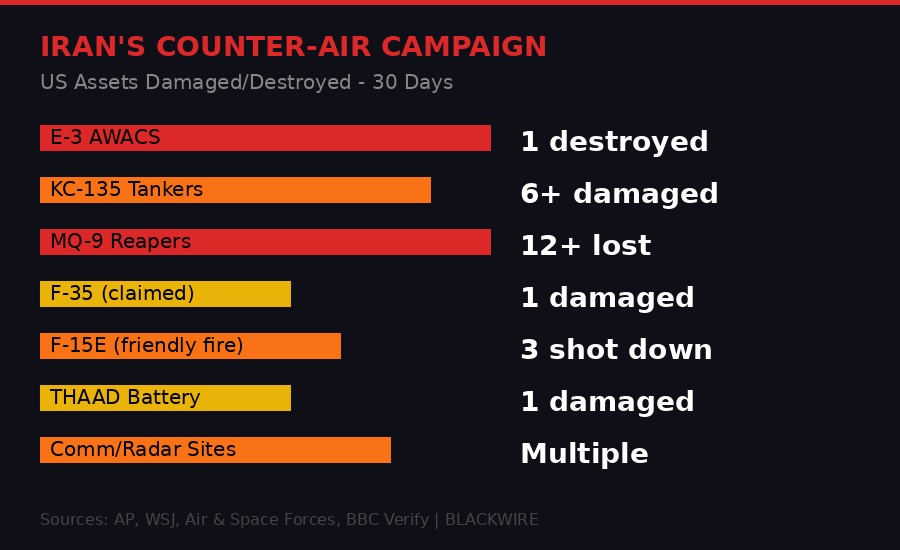
BLACKWIRE Infographic: US assets damaged or destroyed by Iranian strikes in 30 days of war
The destruction of the E-3 is not an isolated lucky shot. It is the latest strike in what defense analysts are calling a deliberate asymmetric counter-air campaign - Iran systematically targeting the aircraft, radar systems, tankers, and communications nodes that make American airpower function.
"It's certainly not random," Grieco told Air and Space Forces Magazine. Iran, by attacking radars, communications sites, aircraft, and bases, appears to be conducting "an asymmetric counter air campaign." She added: "It seems like it is a deliberate campaign to go after the critical enablers of US airpower."
The numbers over 30 days of war support that assessment. According to reporting from the AP, BBC, Wall Street Journal, and Air and Space Forces Magazine, Iranian forces have damaged or destroyed an alarming catalog of American hardware:
- 1 E-3 AWACS - destroyed at Prince Sultan Air Base (March 27)
- 6+ KC-135 Stratotankers - damaged across multiple strikes (March 13 and 27)
- 12+ MQ-9 Reaper drones - lost, many destroyed on the ground during missile attacks
- 1 F-35 Lightning II - damaged by shrapnel over Iran (March 19)
- 3 F-15E Strike Eagles - shot down in a friendly fire incident involving a Kuwaiti F/A-18 (March 1); all six crew recovered
- 1 THAAD missile defense battery - damaged in early attacks
- Multiple radar and satellite communication sites - struck in Jordan, confirmed by BBC and the Center for Strategic and International Studies (March 22)
Roughly 20 US aircraft have been damaged during the air war, according to Air and Space Forces Magazine. Over 300 service members have been wounded. Thirteen have been killed, including six airmen in a KC-135 crash in western Iraq on March 12 and a soldier at Prince Sultan Air Base during an earlier attack in early March.
Iran is not trying to match American airpower plane for plane. It cannot. Instead, it is targeting the connective tissue - the tankers that keep fighters airborne, the AWACS that tells them where to go, the radars that warn of incoming threats, the drones that provide intelligence. Remove those, and the fighters become less effective. The bombers become less accurate. The entire air campaign degrades.
John Phillips, a British safety, security, and risk adviser and former military chief instructor, told Al Jazeera that the attack "has disrupted the US air campaign's command and control by creating temporary battle space awareness gaps." He noted the loss "forces reliance on ground radars" and exposes US force enablers to further attrition.
The strategy has an elegant logic. A Shahed drone costs somewhere between $20,000 and $50,000 to produce. An E-3 AWACS, even at 1977 prices adjusted for decades of upgrades, represents hundreds of millions of dollars in irreplaceable capability. The exchange rate favors Iran by orders of magnitude. And unlike the US, which must ship replacement aircraft halfway around the world, Iran is fighting from its own backyard.
Prince Sultan Air Base - The Base That Keeps Getting Hit
Prince Sultan Air Base, known to US forces as PSAB, sits in the desert southeast of Riyadh near the city of Al Kharj. It is operated by the Royal Saudi Air Force but has hosted a significant US military presence since Washington and Riyadh expanded their basing arrangements amid rising tensions with Iran in 2019 and 2020.
For Operation Epic Fury - the name given to the US-led campaign against Iran that began February 28 - PSAB has served as the primary staging ground. E-3 AWACS, KC-135 tankers, and various fighter squadrons operate from the base, which sits close enough to the Gulf to provide coverage but far enough from Iran's borders to offer some defensive depth. Or so the planners thought.
The March 27 attack was at least the third Iranian strike on PSAB since the war began. The first hit came in early March, killing one US soldier and wounding several others. A March 13 strike damaged five KC-135 tankers. Saudi Arabia has intercepted multiple Iranian missiles and drones targeting the kingdom's oil-rich eastern province and the Riyadh area, and on Friday the Saudi Ministry of Defense said it intercepted several drones and missiles launched toward the capital. But the PSAB strikes got through.
The pattern raises uncomfortable questions about base defense. PSAB is protected by Patriot missile batteries and other air defense systems. But Iran has shown repeatedly that a combination of ballistic missiles and slow, low-flying Shahed drones can overwhelm or slip past defensive layers. The missiles force defenders to look up. The drones come in low and slow, sometimes beneath radar coverage. A single drone penetrating the defenses found the most valuable target on the apron.
Retired US Air Force Colonel John Venable told the Wall Street Journal that the AWACS strike "hurts the US ability to see what's happening in the Gulf and maintain situational awareness." He did not need to add the implication: if you cannot see, you cannot fight effectively.
The base's vulnerability also raises questions about dispersal. Six E-3s were stationed at PSAB before the attack - a significant concentration of irreplaceable assets at a base that had already been struck twice. Military doctrine typically calls for dispersing high-value assets to reduce the impact of any single strike. Whether operational demands overrode those doctrinal principles, or whether alternative basing options were simply unavailable, remains unclear. CENTCOM is not talking.
The E-7 Problem - The Replacement That Does Not Exist
The US Air Force has known for years that the E-3 is dying. Not from enemy fire - from age. The aircraft is nearly 50 years old. Its electronics have been upgraded repeatedly, but the airframe is a modified Boeing 707, a design that first flew in the 1950s. Maintenance costs are climbing. Availability rates are falling. The fleet is shrinking as the most worn-out airframes are retired.
The proposed replacement is the E-7A Wedgetail, built on a Boeing 737 airframe with a modern electronically scanned array radar. Australia, Turkey, South Korea, and the United Kingdom already operate or have ordered Wedgetails. The US Air Force has been trying to acquire the E-7 for years.
But Pentagon leadership has expressed skepticism about the purchase. Senior defense officials have argued that space-based sensor systems could eventually replace airborne command and control, making the E-7 an expensive bridge to a satellite-based future. Budget pressure from the ongoing Iran war, the $200 billion emergency funding request Trump's administration is reportedly preparing for Congress, and competing priorities have further clouded the E-7's prospects.
Penney, the Mitchell Institute researcher, was direct about the consequences:
"We've simply taken too much risk in the battle management career field, both with the battle managers and with the airframes. Space will be an incredible capability, but it is not here today. And this is an example of how we don't always get to pick the timelines of conflict, so we can't wait for future capabilities that are not in the force today."
She continued: "The E-7 is desperately needed to replace the E-3, and the strain that the loss of this E-3 will impose upon not just the career field, but the capabilities, the battle managers, and how that then ripples across the effectiveness in the entire force, underscores the need to accelerate the procurement and delivery of the E-7."
Phillips, the British security adviser, noted that the US could partially compensate by deploying E-7 Wedgetails from allied nations or shifting to ship-based radar systems. "But he warned that this exposes US force enablers to further attrition," Al Jazeera reported. He added that he would be curious to see "if the US moves to more ship-based systems that are better defended or harder to locate or if they shift to airfields farther away to give greater warning."
The underlying reality is stark. The US went to war with an aging, undersized fleet of its most critical command-and-control aircraft. It concentrated those aircraft at a base within range of Iranian missiles and drones. It has no rapid replacement pipeline. And now it has one fewer aircraft to manage a war that is expanding, not contracting.
Day 30 - The War Expands on Every Front
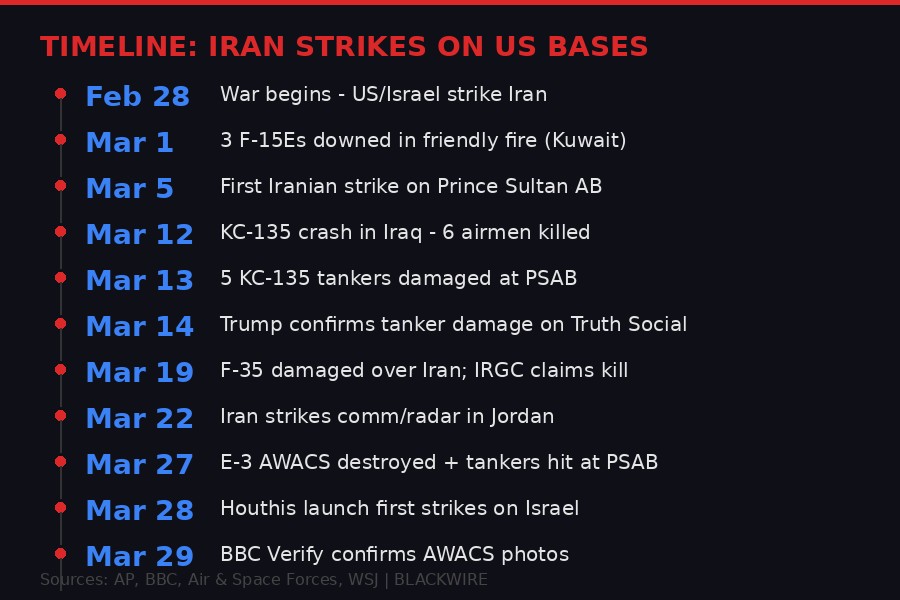
BLACKWIRE Infographic: 30 days of Iranian strikes on US assets across the Middle East
The AWACS destruction lands at a moment when the Iran war is metastasizing. On day 30 of the conflict, nearly every thread is pulling tighter.
In Islamabad, Pakistan announced it would host talks between the US and Iran, though neither Washington nor Tehran confirmed participation. Pakistan's Foreign Minister Ishaq Dar said both sides had "expressed their confidence in Pakistan to facilitate." Foreign ministers from Turkey, Egypt, and Saudi Arabia met in Islamabad to prepare the diplomatic ground. But Iran's parliament speaker, Mohammad Bagher Ghalibaf, dismissed the talks as cover for a planned ground invasion, warning that Iranian forces were "waiting for the arrival of American troops on the ground to set them on fire and punish their regional partners forever."
That threat is not empty theater. Some 3,500 US Marines and sailors arrived in the Middle East aboard the USS Tripoli and its amphibious assault group. The Washington Post reported the Pentagon is preparing for weeks of ground operations in Iran - not a full-scale invasion, but raids by a mix of conventional troops and Special Operations forces. Secretary of State Marco Rubio said Friday that while the US could meet its war objectives without ground troops, Trump "has to be prepared for multiple contingencies." Trump himself told reporters, "I'm not sending ground troops to Iran," before adding: "If I were, I certainly wouldn't tell you."
Iran responded by threatening to attack the homes of US and Israeli "commanders and political officials" in the region. Ebrahim Zolfaghari, spokesperson for Iran's joint military command, cited "targeting of residential homes of the Iranian people in various cities." The Revolutionary Guard also warned that Israeli universities and branches of US universities in the region would be considered "legitimate targets" unless Israel stopped striking Iranian universities.
In Israel, Prime Minister Benjamin Netanyahu announced the military would widen its invasion of Lebanon, expanding the "security strip" in the country's south while targeting Hezbollah. Over one million Lebanese have been displaced.
And in Tehran itself, Israeli fighter jets dropped more than 120 munitions over 24 hours, targeting weapons research and production sites. AP video captured a massive plume of black smoke rising from the capital shortly before midnight. Power outages hit parts of the city after attacks on electricity infrastructure, though Iranian state television said power was later restored.
More than 3,000 people have been killed in the war since it began with US and Israeli strikes on February 28. Over 1,551 Iranian civilians have died, according to HRANA, a US-based human rights monitoring group. Over 300 US service members have been wounded. Thirteen have been killed.
The Second Chokepoint - Houthis Enter the War
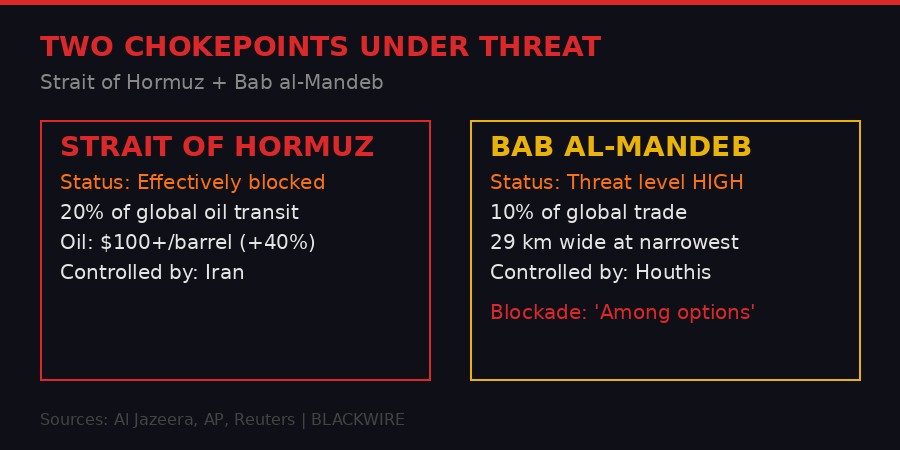
BLACKWIRE Infographic: Two of the world's most critical shipping lanes now face disruption
If the AWACS loss represents a tactical crisis, the Houthi entry into the war represents a strategic one.
Yemen's Houthi movement launched its first strikes against Israel on Saturday, firing cruise missiles and drones. Brigadier-General Yahya Saree, the Houthis' military spokesperson, announced a "second military operation" on Sunday and pledged continued attacks until Israel "ceases its attacks and aggression." The Houthis are backed by Iran but operate with significant autonomy - their religious doctrine does not follow Iran's Supreme Leader in the same way Hezbollah's does.
The real threat is not the missiles aimed at Israel. It is the Bab al-Mandeb strait.
The Bab al-Mandeb sits between Yemen and the Horn of Africa, connecting the Red Sea to the Gulf of Aden and the Indian Ocean. It is 29 kilometers wide at its narrowest point. Approximately 10 percent of global trade passes through it, including oil and gas shipments from the Gulf bound for Europe via the Suez Canal and commodities bound for Asia.
The Strait of Hormuz is already effectively closed. Iran has blocked most commercial traffic, causing oil prices to surge above $100 per barrel - a roughly 40 percent increase from pre-war levels. Several countries have imposed fuel rationing. Australia's Victoria and Tasmania states announced free public transport to reduce driving as fuel costs spike.
If the Houthis close Bab al-Mandeb, both arteries feeding global energy and trade would be choked simultaneously. Elisabeth Kendall, a Middle East specialist and president of Girton College at Cambridge University, called this a "nightmare scenario" in an interview with Al Jazeera.
"If you have restrictions on the Strait of Hormuz at the same time as restrictions are escalating in the Bab al-Mandeb, then you really will disrupt, if not cripple, trade toward Europe."
Mohammed Mansour, the Houthis' deputy information minister, told local media that "closing the Bab al-Mandeb strait is among our options." An unnamed Iranian military official told the semiofficial Tasnim news agency that Iran could open a new front at Bab al-Mandeb if attacks are carried out on Iranian territory.
Former US diplomat Nabeel Khoury put it plainly to Al Jazeera: "All they have to do is fire at a couple of ships coming through, and that would lead to the arrest of all commercial shipping through the Red Sea. That would be a red line."
For now, shipping through Bab al-Mandeb continues. The Houthis have not imposed a blockade. But the threat is explicit, the capability is proven - the Houthis disrupted Red Sea shipping throughout 2024 - and the trigger conditions are clear: any major escalation against Iran or Houthi infrastructure in Yemen. With 2,500 Marines arriving and ground operations being planned, escalation is the trajectory, not the exception.
The Cyber Front - 5,800 Attacks and Counting
While drones split aircraft in half and missiles crater runways, Iran is running a parallel war in cyberspace. According to investigators at the Utah-based security firm DigiCert, nearly 5,800 cyberattacks have been launched by approximately 50 different groups tied to Iran since the war began. The targets span the US, Israel, Bahrain, Kuwait, Qatar, and other regional states.
Most of the attacks are high-volume, low-impact operations designed to harass, intimidate, and force companies to divert resources to defense. But some have been more sophisticated. During an Iranian missile strike on Israel, some Android users received text messages offering a link to "real-time bomb shelter information." The link instead downloaded spyware giving hackers access to the device's camera, location, and all stored data. Check Point Research, a cybersecurity firm, confirmed the operation was timed to coincide exactly with the physical attack.
"This was sent to people while they were running to shelters to defend themselves. The fact it's synced and at the same minute... is a first." - Gil Messing, Check Point Research
A pro-Iranian hacking group also claimed to have infiltrated an account belonging to FBI Director Kash Patel, posting old photographs, a work resume, and personal documents. The attack was classic psychological operations - embarrassing, headline-grabbing, but without direct military impact.
More concerning are the attacks on healthcare infrastructure. Hackers supporting Iran claimed responsibility for breaching Stryker, a Michigan-based medical technology company, in retaliation for US strikes that killed Iranian schoolchildren. Halcyon, a cybersecurity research firm, documented a separate attack on an unnamed healthcare company using tools previously linked to Iran by CISA, the US cybersecurity agency. The attackers deployed ransomware that locked the company out of its own network but never demanded payment - the goal was destruction, not profit.
The attacks on data centers are particularly significant. Iran has targeted digital infrastructure with both cyber operations and conventional missiles, recognizing that data centers are now critical to military communications, economic function, and information security. The digital war will persist even after a ceasefire, experts say, because it is cheaper and lower-risk than conventional conflict.
DigiCert's Michael Smith described the strategy: "It's a way of telling people in other countries that you can still reach out and touch them even though they're on a different continent. That makes them more of an intimidation tactic."
The Government Shutdown Collides with War
And then there is the entirely self-inflicted wound. As of Sunday, the partial US government shutdown has reached 44 days, surpassing the previous record for the longest funding lapse in American history. The Department of Homeland Security has been unfunded since February 14. Congress left for a two-week recess without a deal.
The immediate impact is at airports. Thousands of TSA officers are working without pay. Over 500 have quit. On Friday alone, more than 3,560 TSA officers called out - 12.35 percent of the total workforce. Security lines at major airports wrap outside terminal buildings. Wait times stretch to hours. Videos of the chaos have gone viral.
ICE agents have been deployed to several airports to supplement unpaid TSA staff. White House border czar Tom Homan said Sunday that some ICE units may remain at airports permanently after the shutdown ends, "depending on how many TSA agents come back to work after being paid." Legal scholars have questioned whether deploying ICE without congressional appropriation violates the Antideficiency Act. Josh Chafetz, a professor of law and politics at Georgetown University, told the BBC: "It seems to me pretty clearly a violation."
The Senate passed a compromise bill to partially fund DHS and alleviate airport delays. House Republicans rejected it and passed their own short-term measure that funded the entire department. The Senate will not pass that version because Democrats oppose funding Trump's immigration enforcement without reforms including bans on ICE agents wearing masks and racial profiling.
The collision of a war economy with a government shutdown is producing surreal consequences. Americans cannot fly reliably because their government cannot agree on a budget. Oil prices are spiking because of a war their government started. Marines are deploying to the Middle East while the agency responsible for domestic security cannot pay its employees. The World Cup, which the US is co-hosting starting in June, is approaching amid concerns about whether American airports can process international visitors.
It is the kind of compound failure that makes a Shahed drone's work easier. When the enemy is already fighting itself, you don't need as many missiles.
What Comes Next - Escalation or Exhaustion
Thirty days into the war, the trajectories are clear even if the destination is not.
The US air campaign has degraded Iranian launch capabilities by over 90 percent, according to CENTCOM commander Admiral Brad Cooper. But that remaining fraction is still dangerous enough to destroy irreplaceable aircraft and wound dozens of service members. Iran's strategy is not to match American firepower but to impose costs - in hardware, in personnel, in credibility - that make continuation politically and operationally painful.
The diplomatic track is tenuous. Pakistan's mediation effort may produce talks, but Iran's public posture is defiant. Tehran has responded to Washington's 15-point demand list with its own five-point proposal calling for a halt to killing Iranian officials, guarantees against future attacks, reparations, and recognition of sovereignty over the Strait of Hormuz. The US demands Iran abandon its nuclear program. The gap between these positions is measured in light-years, not negotiating sessions.
The military track is escalatory. Marines are arriving. Ground operations are being planned. Trump is publicly denying what his officials are privately confirming. Iran is threatening to target the homes of American and Israeli officials. The Houthis are joining the fight and openly discussing a Bab al-Mandeb blockade. Hezbollah is active in Lebanon. Iraq is being drawn in.
And now the US is fighting with one less pair of eyes in the sky. An E-3 AWACS that took decades to build, that represents a capability no other platform can fully replicate, that was the chess master directing every piece on the board - reduced to wreckage by a drone that cost less than a mid-range sedan.
The replacement program is unfunded. The fleet is shrinking. The war is growing. And CENTCOM has nothing to say.
The photograph of that split fuselage at Prince Sultan Air Base will become one of the defining images of this war. Not because of what it shows - a broken airplane - but because of what it means. America's ability to see the battlefield just got smaller. Iran's ability to fight the war it wants to fight just got bigger. And the gap between what Washington expected this campaign to look like and what it actually looks like just became impossible to ignore.
AWACS: 1 E-3 Sentry destroyed at Prince Sultan Air Base. 15+ US wounded. CENTCOM silent.
Fleet: 16 total E-3s, ~9 mission-capable, 5 remaining forward-deployed. Replacement unfunded.
Losses (30 days): ~20 aircraft damaged/destroyed. 300+ wounded. 13 killed.
Diplomacy: Pakistan announces talks. Iran dismisses them as cover for ground invasion.
Escalation: 3,500 Marines arrive. Ground operations planned. Houthis enter war.
Chokepoints: Hormuz blocked. Bab al-Mandeb blockade "among options."
Cyber: 5,800 attacks from 50 Iranian-linked groups. Healthcare targeted.
Shutdown: Day 44. Longest in US history. TSA losing staff. ICE at airports.
Casualties: 3,000+ killed total. 1,551 Iranian civilians. 13 US service members.
Get BLACKWIRE reports first.
Breaking news, investigations, and analysis - straight to your phone.
Join @blackwirenews on Telegram