Balancer Is Dead. $25 Million Is Gone. DeFi Is Having Its Worst Week Since 2022.
Balancer Labs is shutting down after its third exploit in three years drained $110 million and made the corporate entity legally untouchable. Resolv's USR stablecoin is trading at $0.27 - three days after being attacked for $25 million. Meanwhile, Bitcoin just hit $71,000 while gold collapses and Gulf states enter the Iran war. The divergence between DeFi's slow death and Bitcoin's war-time resilience has never been this stark.

Market Snapshot - March 24, 2026, 15:30 UTC
Two stories define crypto on Tuesday, March 24, 2026. The first: DeFi is imploding. Balancer Labs - the corporate entity behind one of the most influential decentralized exchanges in history - announced it is shutting down permanently after a $110 million exploit last November left it legally and financially unviable. Hours later, the Resolv stablecoin USR remains trading at $0.27 - two days after an attacker minted $80 million in unbacked tokens and walked away with $25 million in ETH. The DeFi sector that once processed billions daily is, as one analyst put it, in a "really dark" period.
The second story: Bitcoin just blew past $71,000. Not because conditions are safe - they're not. Saudi Arabia has reportedly agreed to give the U.S. military access to King Fahd Air Base. The Gulf states are entering the Iran war. Oil jumped 4% to $104 on the news. The Strait of Hormuz is functionally closed. Gold is in freefall. And Bitcoin - supposedly the most volatile asset class on earth - is up 4% in 24 hours, liquidating $550 million in short positions and outperforming every major safe-haven asset on the planet.
Something structurally different is happening in crypto right now. These two stories are connected.
The Balancer Obituary: Three Exploits, $110 Million, and a Governance Captured by Bribes
Fernando Martinelli did not want to write this post. The Balancer co-founder made that clear in his governance forum announcement Tuesday morning. He seriously considered killing the entire protocol - the smart contracts, the DAO treasury, everything. The fact that he stopped short of full termination is not a signal of optimism. It's a signal that the assets still generating modest revenue were enough to justify a restructuring attempt, even if the corporate entity responsible for building it could not survive.
Balancer Labs, the company that incubated the protocol, is done. It is shutting down. The corporate entity has become, in Martinelli's own words, "a liability rather than an asset."
"BLabs, as a corporate entity, has become a liability rather than an asset to the protocol's future and is just not sustainable as is without any sources of revenue." - Fernando Martinelli, Balancer co-founder, Balancer Governance Forum, March 24, 2026
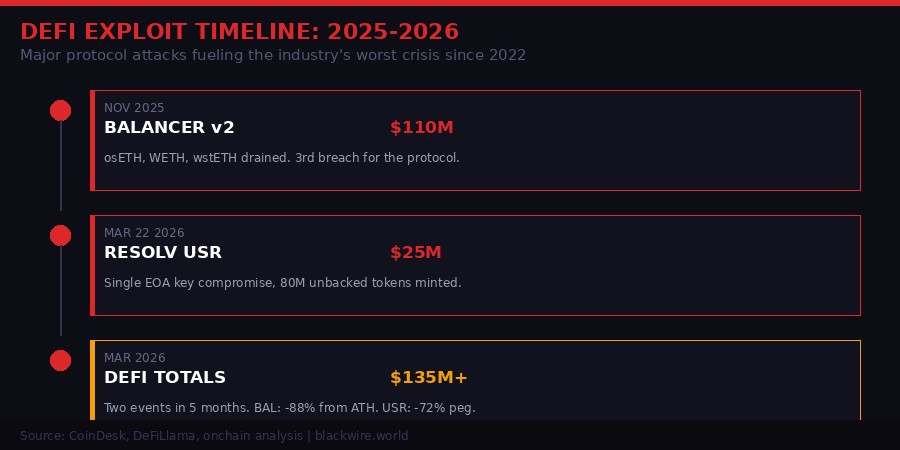
This is the third known security breach for Balancer. The first two - in 2023 and early 2025 - were damaging. The November 2025 attack was fatal. An attacker drained approximately $110 million in digital assets, including osETH, WETH, and wstETH, across what CoinDesk first reported at the time as an "apparent exploit." The legal exposure from that breach, compounded by the ongoing cost of operating a corporate structure with no meaningful revenue stream, created a situation with no exit except shutdown.
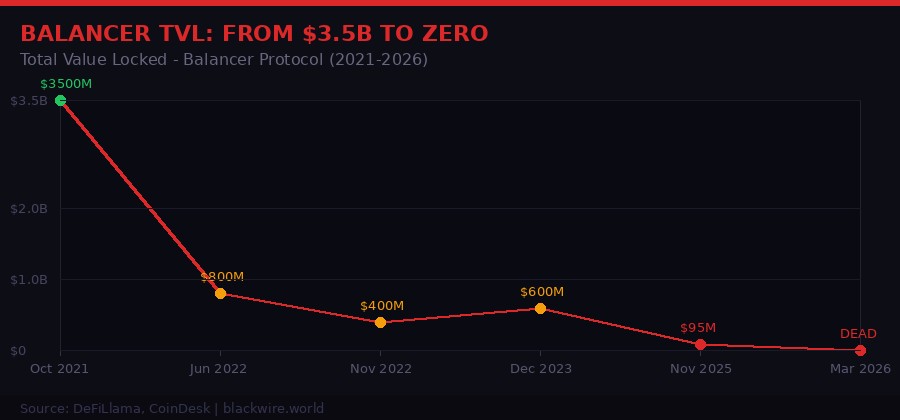
Balancer at its peak was not a minor protocol. In late 2021, the platform held nearly $3.5 billion in total value locked. It was foundational DeFi infrastructure - sitting alongside Aave, Uniswap, and Curve as the backbone of decentralized trading. DeFiLlama data shows TVL peaking near $2.96 billion in October 2021. That number is now $157 million - a 95% drop from peak - and the protocol was already bleeding out before November's attack finished the job.
The BAL token tells the full story: it trades at $0.16 against a fully diluted valuation of $11 million. That means the market cap of the entire governance token is now below what a single DeFi whale would need to move meaningfully. Against BAL's all-time high, that's an 88% collapse. The token's total market cap is barely enough to fund a Series A startup for six months.

The restructuring plan Martinelli proposed is aggressive to the point of being brutal. BAL emissions cut to zero - ending what he called "a circular bribe economy that costs more than it generates." The veBAL governance model, which had been captured by meta-governance protocols like Aura and external bribe markets, would be dismantled entirely. Martinelli said the voting had become "unrepresentative of the actual Balancer front line" - a polite way of saying the governance was bought, and whoever was buying it was not building anything.
Protocol fees would be restructured so the DAO treasury captures 100% of revenue, up from 17.5% currently. The v3 protocol share would drop to 25% to attract organic liquidity. A BAL buyback would be offered to give current holders a fair exit. Essential BLabs team members would be absorbed into a new Balancer OpCo pending governance vote. Martinelli himself will have no formal relationship with the protocol after the wind-down, offering only to serve as an advisor.
Whether the restructured protocol survives without its corporate backer is genuinely uncertain. Balancer produced over $1 million in annualized fees over the past three months. That's not zero - but it's not $3.5 billion TVL either. The protocol's five remaining product lines - reCLAMM pools, liquidity bootstrapping pools, stablecoin and LST pools, weighted pools, and non-EVM chain expansion - represent a significant narrowing from its prior ambition. Everything else gets cut.
Resolv USR: The Stablecoin That Turned Into a 27-Cent Token

Balancer is bad. Resolv USR is worse, because it involves something Balancer never was: a stablecoin. A product marketed on the premise that it holds its dollar peg under all conditions. USR is currently worth $0.27. It has been worth $0.27 since Sunday. The team has advised users not to trade it. It is not recovering.
The attack happened at 2:21 a.m. UTC on Sunday, March 22. An attacker exploited a flaw in Resolv's USR minting contract, creating approximately 80 million unbacked tokens across two transactions. The extracted amount: roughly $25 million in ETH, per multiple blockchain security firms and onchain data reviewed by CoinDesk.
The mechanics were almost embarrassingly simple to execute. The attacker deposited 100,000 USDC and received 50 million USR in return - roughly 500 times the expected amount - because nothing in the system checked whether that ratio made any sense. No oracle checks. No amount validation. No maximum mint limits.
"For most smart contracts, this setup is not unusual. There is a key that has authority over contract specifics - in this case, for minting, that is often overlooked. This single point of failure is an attractive target for internal and external threats." - Ido Sofer, founder, Sodot (crypto key management firm), via CoinDesk
The root cause Resolv initially described - a "compromised private key" and "targeted infrastructure compromise" - understated the structural problem. Onchain analysts found the real issue: the SERVICE_ROLE, a privileged account that completes swap requests in the minting contract, was controlled by a single externally owned account rather than a multisig. One key. One failure point. $25 million gone.
The attacker converted the minted USR to USDC and USDT across decentralized exchanges, swapped those into ETH, and now holds 11,409 ETH worth approximately $23.7 million plus $1.1 million in wrapped USR in a separate wallet. They have not moved the funds significantly since Sunday.
USR crashed to $0.025 on its most liquid Curve Finance pool within 17 minutes of the first mint transaction - according to DEX Screener data. It later recovered to $0.85 but has not restored its peg. As of Tuesday, it sits at $0.27, down 72% on the week.
The math is bleak. Resolv's TVL peaked near $684 million in February 2025. It declined through the year to approximately $95 million before the exploit. That $95 million in assets now sits against $173 million in liabilities, making the protocol functionally insolvent. Resolv said it was working with law enforcement and onchain analytics firms and would "pursue all available avenues to recover assets." Whether those avenues lead anywhere is another matter entirely.
DeFi's Structural Crisis: When the Infrastructure Fails, Who Rebuilds It?
The Balancer shutdown and the Resolv collapse happening within days of each other is not coincidence - it's a pattern. The same vulnerabilities that have always existed in DeFi are getting exploited more systematically, by attackers who understand the codebases better than many of the teams maintaining them. And the market conditions created by the Iran war - flight to liquid assets, high volatility, stressed correlations - are making the aftermath worse.
One market observer described the current DeFi landscape as a "really dark" period on X (formerly Twitter). That's an understatement. Consider what has happened to the sector's foundational names since the 2021 peak:
Balancer: $3.5 billion TVL to zero corporate backing. BAL at $0.16. Curve Finance: down more than 90% from its 2021 highs, repeatedly exploited, governance perpetually dysfunctional. Many smaller DeFi protocols have simply ceased operations without announcement - quietly shutting down, locking liquidity, or migrating assets off-chain with varying degrees of transparency.
The numbers on the DeFi sector as a whole paint a picture of structural decline rather than cyclical correction. Total Value Locked across all protocols peaked near $180 billion in late 2021. It has never recovered to that level. Even during the 2024-2025 bull run, DeFi TVL struggled to break $100 billion, a sign that institutional and retail capital increasingly preferred centralized alternatives or simply held tokens rather than deploying them into protocols that could be exploited.
The yield question compounds the structural problem. Ido Sofer's point about credentials being "a growing trend of attacks focusing on the blind spot of security teams" applies to the entire DeFi design philosophy. Protocols built on the assumption that code is law and keys are safe create single points of failure by design. When those single points fail - as they inevitably do - there is no FDIC. There is no Federal Reserve backstop. There is no recourse.
The Crypto Clarity Act currently working through Congress would, per the latest text, not allow yield on stablecoin balances. If that language survives the legislative process, it removes one of the primary incentive structures that drove users into protocols like Resolv in the first place. No yield means no reason to hold a DeFi stablecoin over a centralized one. That's another brick in the wall against the DeFi recovery narrative.
The memecoin sector adds context. The CoinDesk Memecoin Index (CDMEME) is the worst-performing benchmark on Tuesday, rising just 0.1% with several index components down 3-5%. The speculative froth that characterized DeFi Summer 2.0 in 2024 is gone. What remains is a sector trying to justify its existence while legacy infrastructure burns.
Bitcoin at $71,000: The War Trade That's Breaking Every Playbook

While DeFi is imploding, Bitcoin is doing something that upends everything traders thought they knew about crypto's relationship to geopolitical risk.
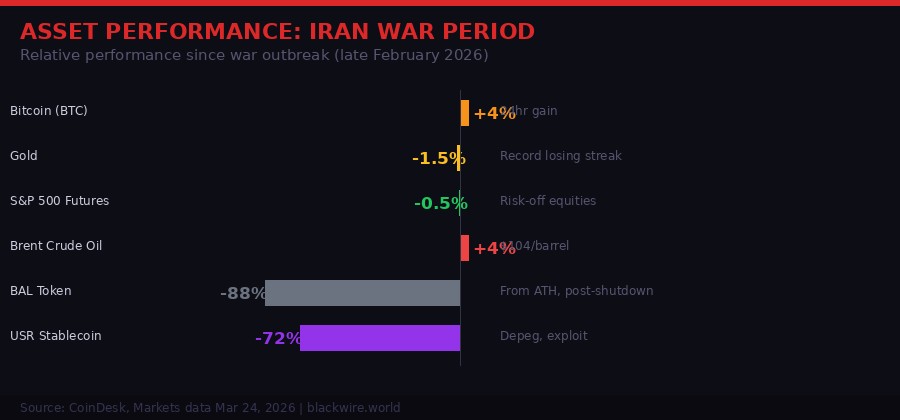
Tuesday morning: Saudi Arabia reportedly agrees to give the U.S. military access to King Fahd Air Base, reversing its earlier position that its infrastructure couldn't be used to strike Iran. The UAE takes similar steps. Gulf states are formally entering a conflict that began as a U.S.-Israel air campaign. The Strait of Hormuz remains functionally closed. Brent crude jumps 4% to $104 per barrel. S&P 500 futures fall 0.5%. European shares drop 0.8% at the open. The dollar strengthens 0.3%.
And Bitcoin climbs 3.1% to $70,352 on Tuesday morning, then pushes to $71,000 by midday UTC, up 4% on a 24-hour basis. More than $550 million in short positions are liquidated. The altcoin sector follows - ETH, SOL, DOGE, and XRP all gain 2-4%.
The gold situation is the most disorienting signal in markets. Gold is falling. Not just down on the day - it is in the middle of what analysts are calling its longest daily losing streak on record. A traditional safe-haven asset is selling off during an active, widening regional war that now involves Gulf state militaries. That has never happened before in the modern era.
The most likely explanation is forced selling. Funds facing margin calls across stressed positions in equities, bonds, and commodities are liquidating their most liquid assets - and gold is more liquid than almost anything. Whatever the cause, it creates an extraordinary comparison: Bitcoin, supposedly the volatile one, is holding a range and grinding higher. Gold, supposedly the stable one, is in freefall during active wartime.
"Bitcoin is holding $70,000 on a Tuesday morning where everything else is deteriorating. Whether that's resilience or just the market waiting for the next headline to react to is the question the rest of the week will answer." - CoinDesk Markets Analysis, March 24, 2026
The derivatives data adds nuance to the rally. Over $550 million in leveraged crypto futures have been liquidated in 24 hours, with short positions taking most of the pain. But Bitcoin's 4% gain is not backed by increased participation in futures - open interest in major USD- and USDT-denominated futures has actually declined slightly, to 228,000 BTC from 229,000 BTC. The same pattern appears in ETH, XRP, and SOL. This is a short squeeze rally driven by forced covering, not a new wave of leveraged bulls entering the market.
That's important context. It means the $71,000 level is real in spot terms but fragile in derivatives terms. If the next headline - Iran's response to Gulf state involvement, a major energy facility strike, or a Treasury market dislocation - pushes short positioning to rebuild, the $71,000 level gets tested again.
Treasury Yields: The Hidden Variable That Could End the Bitcoin Rally
The most important number in crypto right now might not be Bitcoin's price. It might be the 10-year U.S. Treasury yield.
Since the Iran war began at the end of February, the 10-year yield has surged roughly 45 basis points to 4.37% - a multi-month high that reflects markets pricing in delayed Fed rate cuts and higher inflation expectations. Oil at $100-plus is an inflation event. A widening Middle East war with Gulf state involvement is a prolonged inflation event.
The critical threshold that analysts are watching: the 4.5%-4.6% range. This is not arbitrary. According to The Kobeissi Letter, that range is precisely where President Trump pulled back from his sweeping Liberation Day tariffs last April. When the 10-year yield surged above 4.50%, Trump began floating a tariff pause. When it broke 4.60%, he implemented a 90-day pause on April 9, 2025.
The implication: there is a bond market ceiling that shapes U.S. policy. If the yield hits 4.5%-4.6% again - and at 4.37% we are not far away - it creates political pressure on the Trump administration to moderate the conflict or implement some mechanism to cap yields. That could be the circuit breaker that ends the war trade and reshapes crypto's relationship to the conflict entirely.
"Watch the 10-year swap spread. It's just below 50bp now. If that were to shoot to 60bp, it would spell enough trouble to ultimately shape the war path. It's not just the negative perception, it's the added cost of funding U.S. debt." - Padhraic Garvey, CFA, Regional Head of Research Americas, ING
Above the 4.5%-4.6% range sits 5% - the level that Arthur Hayes, co-founder of BitMEX and CIO at Maelstrom Fund, has previously flagged as a potential make-or-break point for risk assets. Hayes's view: if the 10-year yield breaks 5%, the U.S. economy cannot sustain the pressure, and the Federal Reserve would be forced to intervene with liquidity injections. That intervention would initially crush Bitcoin in a knee-jerk reaction - but the subsequent flood of liquidity would rapidly recharge the bulls.
The swap spread ING is watching adds another layer. The 10-year Treasury swap spread currently sits just below 50 basis points. If it pushes to 60bp, ING's analysis suggests it would create enough financial stress to "ultimately shape the war path" - meaning the bond market would force a policy recalibration. The U.S. government's cost of funding its debt becomes prohibitive at those levels, and the political calculus around sustained military operations changes.
For Bitcoin traders, this creates a specific watchlist for the coming days: 10-year yield at 4.5% is the first warning. At 4.6%, historical precedent says policy pivots. At 5%, expect an initial crypto selloff followed by a liquidity-driven recovery. The bond market will likely determine Bitcoin's next major move more than any crypto-specific development.
Strategy's $42 Billion Reload: The Institutional Backstop

One structural factor that didn't exist in prior cycles: Strategy (MSTR) is back with $42 billion in fresh capital-raising firepower, and it just used some of it.
On Monday, March 23, Strategy filed an 8-K disclosing a $42 billion at-the-market equity program - split between $21 billion of Class A common stock and $21 billion of its Variable Rate Series A Perpetual Stretch Preferred Stock. The company also introduced a new $2.1 billion ATM for its STRK preferred stock. The total number of sales agents expanded to 19, with new additions including Moelis & Company, A.G.P./Alliance Global Partners, and StoneX Financial.
The previous week, Strategy purchased 1,031 bitcoin for $76.6 million, bringing total holdings to 762,099 BTC. That's roughly 3.6% of Bitcoin's total supply concentrated in a single corporate treasury. At current prices, those holdings are worth approximately $54 billion.
The significance of Strategy's capital-raising activity extends beyond the numbers. Saylor has essentially created a mechanism by which traditional capital markets - equity investors, preferred stock holders, bond markets - can express a Bitcoin bet through a regulated vehicle. The $42 billion ATM program means Strategy can continuously sell shares into the market and buy Bitcoin with the proceeds, creating a persistent institutional bid that absorbs supply.
During periods of DeFi collapse and geopolitical uncertainty - exactly the environment we're in right now - this institutional backstop matters. In 2022, when crypto sold off violently, there was no equivalent to Strategy. The institutional floor simply didn't exist. Now it does, and it's buying on dips at a scale that structurally supports Bitcoin's price in ways the DeFi sector never benefited from.
Meanwhile, H100 - a European-listed company - is eyeing 3,500 BTC through proposed acquisitions of Moonshot and Never Say Die, which would make it Europe's largest Bitcoin treasury. The institutional accumulation strategy pioneered by Saylor is being replicated globally. This is not a trend that reverses when DeFi implodes. If anything, DeFi's ongoing collapse may accelerate institutional preference for simple Bitcoin custody over complex on-chain yield strategies.
The DeFi-Bitcoin Split: What It Means for the Next 90 Days

The Balancer shutdown, the Resolv collapse, and Bitcoin's war-time outperformance are not three separate stories. They are one story told from three angles.
DeFi's ongoing implosion is accelerating capital migration into simpler, more auditable Bitcoin positions. Every time a stablecoin depegs or a DEX announces its corporate dissolution, the argument against complex DeFi strategies and for straightforward Bitcoin exposure gets stronger. Strategy's $42 billion capital raise is partly an expression of that thesis at institutional scale. H100's European treasury ambitions reflect the same logic.
The Iran war adds urgency to a shift that was already happening. Traditional safe-haven assets - gold, Treasuries, the dollar - are all behaving abnormally. Gold is in freefall. Treasuries are under pressure from yields rising faster than the Fed wants. The dollar is strengthening against other currencies but that's mostly a reflection of global risk aversion rather than U.S. economic strength. In this environment, Bitcoin's relative stability reads as a feature, not a bug.
The implied volatility data confirms the sentiment shift is real. DVOL and BVIV - measures of Bitcoin's implied volatility - reached levels consistent with previous cycle lows in recent weeks, reflecting the kind of peak fear that has historically marked market bottoms. Bitcoin's volatility peaked in February. The VIX - traditional markets' fear gauge - only surged weeks later and remains below prior crisis highs. Crypto priced in the risk faster than traditional markets.
For the next 90 days, watch three things. First: Treasury yields. The 4.5% threshold is close. If yields break that level and Trump responds as he did during Liberation Day, expect a rapid policy shift that resets the war trade entirely. Bitcoin would likely see an initial shock followed by recovery. Second: DeFi contagion. Balancer and Resolv are not isolated incidents - they are symptoms of a sector with aging infrastructure, depleted developer talent, and inadequate security practices. The next major exploit is not a matter of if, but when. Third: Strategy's actual purchase cadence. If Bitcoin dips toward the $65,000-$68,000 range again and Strategy deploys capital aggressively, that level becomes a structural floor. Watch the 8-K filings.
The picture emerging from March 24, 2026, is not one of crypto failing. It's one of crypto bifurcating. Bitcoin is becoming an institutional asset class with genuine safe-haven characteristics during geopolitical stress. DeFi is becoming a graveyard of ambition, under-resourced teams, and structural security failures that no amount of tokenomics or governance theater can fix. The distance between those two trajectories is widening by the week.
Timeline: DeFi's Unraveling (November 2025 - March 2026)
Balancer v2 exploited - $110 million drained
osETH, WETH, and wstETH moved to new wallets. Third known security breach for the protocol. CoinDesk first reported the attack as "apparent exploit."
Balancer Labs seeks restructuring path
Corporate entity faces mounting legal exposure from exploit. Revenue drops. Team explores options. No public announcement of shutdown plans yet.
Iran war begins - crypto markets enter high volatility
Bitcoin crashes below $60,000 at war outbreak before recovering. DeFi protocols experience mass withdrawals. DVOL spikes to cycle-high levels.
Resolv USR attacked - $25 million extracted
Single EOA key compromise allows 80 million unbacked tokens minted across two transactions. USR crashes to $0.025 within 17 minutes on Curve pool. Attacker converts to ETH, holds 11,409 ETH.
USR stabilizes at $0.27 - protocol functionally insolvent
$95 million in assets against $173 million liabilities. Team advises against trading USR. Recovery "being implemented." Bitcoin hits $71,000 on Trump ceasefire news.
Balancer Labs announces permanent shutdown
Co-founder Fernando Martinelli announces shutdown via governance forum. BAL buyback proposed. veBAL governance to be wound down. Product scope narrowed to five areas. Corporate entity dissolved.
DeFi Sector: Key Metrics (March 24, 2026)
The Bottom Line: Two Different Cryptos
Here is what March 24, 2026, actually tells you about the state of crypto. There are two different assets operating under the same industry label right now, and conflating them is a mistake that will cost people money.
The first is Bitcoin. It's $71,000 on a morning where Gulf states are entering a war, oil is at $104, gold is collapsing, and Treasury yields are at multi-month highs. It has outperformed every traditional safe-haven asset since the conflict began. It has institutional backing at the $42 billion scale from Strategy alone. It has derivative markets sophisticated enough to price geopolitical risk faster than traditional markets. It is becoming, by observable market behavior, a genuine macro asset.
The second is DeFi. It is losing foundational infrastructure at an accelerating rate. Balancer - one of the four pillars of the DeFi boom - is shutting down its corporate entity after the third exploit in three years. Resolv's stablecoin is trading at $0.27 five days after an attacker walked away with $25 million because a single private key controlled an unchecked minting function. The governance models built to sustain these protocols have been captured by bribe economies. The yield opportunities that justified the risk are disappearing. The regulatory environment closing in around stablecoins removes the incentive structure that drove retail users into DeFi in the first place.
The DeFi-Bitcoin split is the dominant narrative of 2026. Bitcoin is consolidating its position as institutional-grade digital gold. DeFi is burning through its second iteration and heading toward a reckoning that may look more like the bond market's junk era of the 1990s than the decentralized revolution its builders envisioned. That reckoning was always coming. The Iran war, the Treasury yield pressure, and the sequential exploit disasters are just accelerating it.
Watch the 10-year yield. Watch Balancer's DAO vote. Watch whether USR ever recovers its peg. And watch Strategy's next 8-K. The answers to those four questions will tell you more about where crypto goes next than anything else happening in the space right now.
Get BLACKWIRE reports first.
Breaking news, investigations, and analysis - straight to your phone.
Join @blackwirenews on Telegram