Beirut at Breaking Point: 1.1 Million Displaced as Israel Announces Gaza-Model Demolition of Southern Lebanon

Beirut is bursting. One month after Hezbollah fired rockets into Israel in retaliation for the US-Israeli assault on Iran, the Lebanese capital has absorbed more than one million displaced people - roughly 20% of the country's entire population - in what aid agencies are calling the fastest mass displacement in Lebanon's modern history. Tent cities line the waterfront corniche. Families sleep in parked cars. Children bathe under fire hoses. And on March 31, Israeli Defense Minister Israel Katz made it official: the homes of southern Lebanon's border villages will be demolished "according to the model of Rafah and Beit Hanoun in Gaza," and more than 600,000 residents will be barred from returning.
The announcement did not arrive in a vacuum. It landed alongside three UN peacekeepers killed in 24 hours, a French-called emergency Security Council session, Canadian Prime Minister Mark Carney labeling the invasion "illegal," and a joint statement from ten European foreign ministers warning Israel against widening operations. None of it slowed the bulldozers or the bombing runs.
This is no longer a military operation with a humanitarian side effect. This is the deliberate engineering of a permanent population transfer - and Beirut is where the wreckage collects.
The Numbers That Define Catastrophe

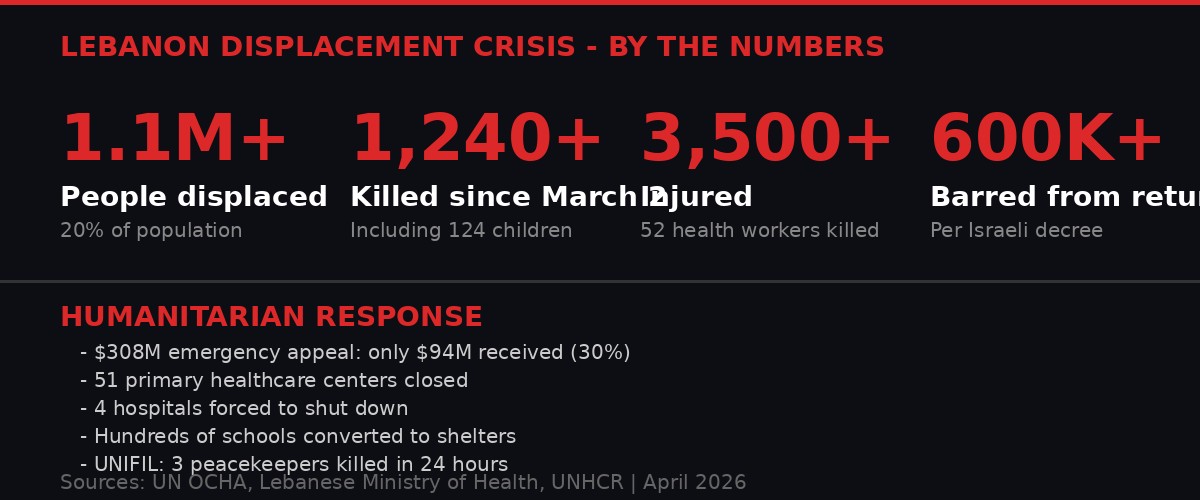
The raw data, verified through UN agencies, the Lebanese Ministry of Health, and UNHCR field reports, tells a story of industrial-scale displacement:
1,240 people killed in Lebanon since March 2, when Hezbollah opened fire on northern Israel following the US-Israeli strikes on Iran. Among the dead: at least 124 children, 52 health workers, three journalists, and three Indonesian UN peacekeepers. Another 3,500 have been wounded. These are not combatants. The overwhelming majority are civilians caught between Hezbollah's decision to enter the war and Israel's decision to punish the entire south for it.
1.1 million displaced - and climbing. The UN's refugee agency in Beirut says this figure is "almost certainly an undercount" because it only captures those who formally registered with the Ministry of Social Affairs. Dalal Harb, UNHCR spokesperson in Lebanon, told the Associated Press that "the scale and intensity of this is just unprecedented." Twenty percent of a nation's population, uprooted in 30 days. The last time Lebanon saw anything comparable was the 2006 war, which displaced roughly 1 million over 34 days - but the current conflict shows no signs of slowing.
$308 million - that is the UN's emergency appeal for Lebanon. As of April 1, only $94 million has been received. Thirty percent. The funding gap is not a bureaucratic inconvenience; it is the difference between shelters and sidewalks, between medical care and bleeding out in a school hallway.
51 primary healthcare centers have been forced to close. Four hospitals have shut entirely. Others are running at reduced capacity, treating shrapnel wounds on floors where the lights flicker from generator power. The medical infrastructure south of the Litani River has effectively ceased to exist.
Tom Fletcher, the UN's Emergency Relief Coordinator, briefed the Security Council from Beirut on March 31. His assessment was unvarnished: "The situation on both sides of the Blue Line demands not only the Council's closest attention, but also your collective action to avert an even worse crisis." He described "anxiety and tensions at levels I have not witnessed in many years."
The Katz Doctrine: Demolition by Design

On March 31, 2026, Israel Katz released a video statement through the defense ministry that formalized what had been building for weeks. The key points, stripped of diplomatic language:
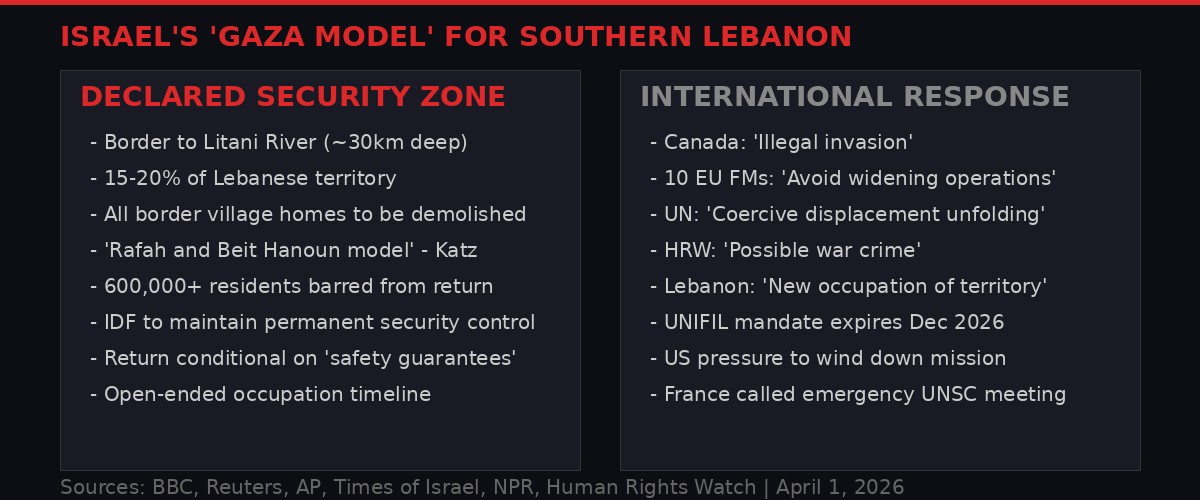
"All houses in villages near the border in Lebanon will be destroyed - according to the model of Rafah and Beit Hanoun in Gaza - to remove, once and for all, the threats near the border to northern residents."
The "Rafah and Beit Hanoun model" is not an abstraction. In Gaza, those areas were systematically leveled - residential blocks, commercial districts, mosques, schools - to create sterile buffer corridors. Satellite imagery from those operations shows kilometers of rubble where neighborhoods once stood. Katz is explicitly invoking that template for southern Lebanon.
The statement went further. "At the end of the operation, the IDF will establish itself in a security zone inside Lebanon, on a defensive line against anti-tank missiles, and will maintain security control over the entire area up to the Litani." The Litani River sits approximately 30 kilometers - 18.6 miles - north of the Israeli border. That strip of territory encompasses roughly 15 to 20 percent of Lebanon's total land area.
And then the critical line: "The return of more than 600,000 residents of southern Lebanon who evacuated northward will be completely prohibited south of the Litani until the safety and security of northern residents are ensured."
There is no timeline attached to that condition. No criteria for what "safety" means. No mechanism for review. It is an open-ended ban on an entire population's right to go home - conditional on a security determination made solely by the occupying power.
International law scholars have been blunt. Tom Dannenbaum, an expert cited by Reuters, said Katz's comments barring residents from returning "strongly indicate an illegal policy of long-term or permanent displacement." Ramzi Kaiss, a Beirut-based researcher with Human Rights Watch, told NPR that open-ended evacuation orders covering huge swaths of territory "threaten to cause panic" and, when indefinite, may "amount to a war crime."
"You cannot tie people's return to their homes to some vague safety guarantee that you decide," Kaiss said. "People must be allowed to return to their homes, once the hostilities cease."
Beirut's Waterfront Turned Refugee Camp
The most visible manifestation of this crisis is not in the south, where the bombs fall. It is in Beirut, where the displaced collect.
A massive tent encampment now covers the grassy field between a yacht club and a nightlife venue on the Beirut waterfront. The juxtaposition is almost theatrical - sailboat masts behind flapping tarps, cocktail bars within earshot of crying children - but no one is performing. This is survival, raw and unfiltered, in a capital that was already teetering before the war.
Noor Hussein fled the southern suburbs of Dahiyeh in early March after the first Israeli airstrikes. She settled at the waterfront with her three youngest children. She watches joggers navigate a maze of tents and soiled mattresses each morning.
"It's horrid because we feel this tension, that we're not wanted here. We don't want to be here. We have nothing here and nowhere to go."
The government has converted hundreds of public schools into shelters. Tents for displaced families have been pitched beneath the bleachers of Beirut's main sports stadium. One charity refashioned an abandoned slaughterhouse - damaged in the catastrophic 2020 port explosion - into a dormitory housing nearly 1,000 people. But the infrastructure cannot absorb a population surge of this magnitude. Families squat in storefronts. They sleep in mosques. They sleep in their cars, double- and triple-parked in convoys along major thoroughfares.
Others huddle in improvised shelters along the curving coastal corniche or around Horsh Beirut, a pine-tree park on the outskirts of Dahiyeh. Heavy rainfall recently flooded the waterfront lot, seeping into tents, leaving a trail of soggy clothes and sore throats. Children have started to complain of skin rashes. A fight broke out last week when volunteers arrived to distribute donations - demand so far exceeding supply that distribution itself becomes a flashpoint.
Mona Harb, a professor of urban studies at the American University of Beirut, described the phenomenon to the Associated Press: "This is relatively new, that you have so many people spending time in these open spaces, who are very vulnerable, living in very precarious conditions. You have to confront this visually when you're coming and going to work, to school... and there are strong, mixed feelings associated with this presence that's unregulated."
Those mixed feelings are not incidental. They are structural - and they carry the weight of Lebanon's sectarian history.
The Sectarian Fuse

Lebanon's political system is built on a delicate sectarian balance formalized after its 15-year civil war (1975-1990). Power is shared between Christians, Shiite Muslims, and Sunni Muslims - the country's three largest religious groups, each representing roughly equal shares of the population. Every demographic shift carries political implications. Every large-scale population movement triggers institutional anxiety.
The displacement from southern Lebanon is overwhelmingly Shiite. Southern Lebanon is the heartland of the Shia Muslim community - Hezbollah's core support base, but also home to generations of farmers, shopkeepers, teachers, and families with no particular allegiance to any militia. When over a million of them pour into Beirut - a city whose own sectarian geography is carefully mapped - the demographic math changes overnight.
Maha Yahya, director of the Carnegie Middle East Center in Beirut, described the anxiety to AP: "It's generating anxieties in Beirut, where the bulk of the displacement is, that this may cause a significant transformation in the demographic balance within the country, or within certain spaces and cities."
This is not abstract. Lebanon has been here before. The influx of Palestinian refugees after 1948 and again after 1967 permanently altered the country's demographic composition and is widely considered one of the catalysts for the civil war. The arrival of over a million Syrian refugees after 2011 strained the country's infrastructure and inflamed sectarian tensions that never fully resolved. Now, a million-plus internally displaced Shiites - from areas that Israel has declared they cannot return to - raises the same fundamental question: what happens when "temporary" becomes permanent?
Hawraa Balha, 42, drove her family of four from the destroyed southern border village of Duhaira. She is sleeping in her car in Beirut rather than traveling north to available shelters because she fears that distance equals permanence.
"The further away we go, the more we'll lose hope about finding our way back. We don't want to move again."
Residents of Dahiyeh, Beirut's southern suburbs - which have been under direct Israeli bombardment - have largely opted to stay in the capital. The calculation is brutal but rational: if you stay close, you can make furtive dashes home to retrieve belongings, check if your house still stands. Hussein told AP her children grew so desperate for a shower after nearly a month without a bathroom that they rushed home to wash up despite the constant buzz of Israeli drones overhead.
The proximity of home makes the separation bearable. Katz's announcement that they may never go back makes it unbearable.
Three Peacekeepers Dead, UNIFIL Under Siege

The killing of three Indonesian peacekeepers serving with the United Nations Interim Force in Lebanon (UNIFIL) in less than 24 hours - on March 29 and 30 - represents one of the deadliest weeks for the mission in its nearly five-decade history. UNIFIL was established in 1978 to monitor the Israeli withdrawal from Lebanon and has since expanded its mandate multiple times, most recently under Security Council Resolution 1701 in 2006.
The first peacekeeper was killed on March 29. The following day, two more died in a separate explosion. UNIFIL said investigations are underway to determine the exact circumstances. The IDF acknowledged that strikes were launched in the vicinity, stating they were responding to anti-tank fire from Hezbollah that had injured two Israeli soldiers. It has not been conclusively established who killed the peacekeepers.
The deaths prompted France to call an emergency Security Council session. Jean-Pierre Lacroix, the UN's peacekeeping chief, told the Council: "These tragic developments should not have happened... Peacekeepers must never be a target. All acts that endanger the peacekeepers must immediately stop."
He also reported a "worrying increase in denials of freedom of movement and aggressive behaviour" toward UNIFIL personnel - a pattern that echoes October 2024, when Israeli forces repeatedly fired on UNIFIL positions during an earlier escalation.
UNIFIL's mandate is scheduled to expire on December 31, 2026. Israeli and US pressure on the Security Council to wind down the mission has been building for months. The killing of three peacekeepers in 24 hours has intensified the debate: does the force's continued presence serve as a buffer against worse violence, or does it simply place blue helmets in a shooting gallery where their mandate is routinely ignored by all parties?
For the 10,000-plus personnel still deployed across southern Lebanon, that is not an academic question. It is a daily survival calculus.
The International Response: Loud Words, No Leverage
The chorus of condemnation following Katz's announcement was swift and geographically broad. It was also, by every measurable standard, ineffective.
Canadian Prime Minister Mark Carney called the deployment of Israeli ground troops in Lebanon an "illegal invasion" that violates the country's "integrity and sovereignty." He noted that Lebanon's own government has banned Hezbollah and is attempting to take action against the group - the very justification Israel cites for the invasion.
A joint statement from the foreign ministers of ten European countries - including the UK, France, Italy, and others - along with EU foreign policy chief Kaja Kallas, urged Israel to "avoid widening its military operations in Lebanon" and to respect the country's territorial integrity. The statement expressed "full support to the government and the people of Lebanon, who are once again suffering the dramatic consequences of a war that is not theirs." It also placed "primary blame" on Hezbollah for reigniting hostilities.
Lebanese President Joseph Aoun described the Israeli plans as "collective punishment against civilians" and warned they could be part of "suspicious schemes to pursue an expansion of Israel's presence in Lebanese territory." Lebanese Defense Minister Maj Gen Michel Menassa said Katz's remarks reflected "a clear intention to impose a new occupation of Lebanese territory, forcibly displace hundreds of thousands of citizens, and systematically destroy villages and towns in the south."
Tom Fletcher, addressing the Security Council, posed a question that no member has yet answered: "Given the intensity of the coercive displacement that we are seeing, how should we prepare, collectively as the international community, for a new addition to the list of occupied territories?"
The answer, so far, is that the international community is not preparing at all. The EU statement contains no enforcement mechanism. Canada has no military presence in the region. The Security Council is structurally incapable of action against Israel due to the US veto. And the US itself is simultaneously escalating its own war in Iran - deploying a third aircraft carrier, surging 2,000 paratroopers from the 82nd Airborne Division, and preparing for a primetime national address where President Trump is expected to announce a "two to three week" timeline for winding down operations.
The gap between rhetoric and reality is measured in tent cities.
Those Who Refuse to Leave

Not everyone has fled. Joseph Elias Issa, 56, is from a long line of shepherds and farmers in the town of Kfar Houneh, in southern Lebanon. He told NPR that in his entire life, he has stayed put through nearly every war Israel has fought with its neighbors. This time feels different.
Issa has taken refuge in a shepherd's hut near a waterfall, on the outskirts of Jezzine, about five miles north of his home. He drove there in a truck carrying his mules. Both Kfar Houneh and Jezzine are technically outside the formal evacuation zone, but their outskirts have still been hit by Israeli airstrikes.
"Airstrikes, warplanes, you hear it, you see it all around you. You get displaced, and you leave your house, and maybe you never come back. We are besieged."
In downtown Jezzine, Haddad Cutlery has been in business since 1770. Grace Rizk, 65, the manager, prides herself on staying open "seven days a week, through every war." She told NPR she will not budge. "We're used to war. Right now, if an airstrike comes, I won't budge. God will protect us. In the end, we are steadfast. We will not leave."
Jezzine's mayor, David El Helou, remembers when Israel occupied southern Lebanon from 1982 to 2000. Israeli soldiers set up a checkpoint near his house. Back then, the target was Palestinian militants. Now it is Hezbollah. The mayor said this war feels "more serious" than past ones - Israel has stated it wants to oust militants from the area south of the Litani "once and for all." A task the Lebanese army was supposed to accomplish under the 2024 ceasefire agreement but never did.
"We are in an uncertain situation," El Helou said. "You can never be sure when it's going to end, which direction it's going to take, what's going to happen. The fear is always there."
The uncertainty is the weapon. Not knowing if you can return is functionally identical to being told you cannot.
The 2006 Echo - And Why This Time Is Worse
Lebanon has been here before, but the precedents offer cold comfort. The 2006 war between Israel and Hezbollah lasted 34 days and displaced approximately one million people. When the ceasefire took hold, most returned within weeks. The damage was severe - particularly in Dahiyeh and the south - but the displacement was temporary because there was a clear endpoint: a Security Council resolution, a ceasefire, a withdrawal.
This time, there is no ceasefire on the horizon. Israel has explicitly stated it intends to maintain a permanent security presence up to the Litani River. The demolition of border villages is policy, not collateral damage. The bar on civilian return is open-ended. And the broader regional context - the ongoing US-Iran war, Hezbollah's continued rocket fire, the collapse of UNIFIL's deterrent function - means there is no external mechanism to force a resolution.
The 2024 ceasefire that ended a shorter Israel-Hezbollah escalation was supposed to prevent exactly this scenario. Under its terms, Hezbollah was to disarm and withdraw from positions south of the Litani, supervised by the Lebanese army and UNIFIL. Progress was made, but it was partial. Israel maintained military posts in the south and continued striking what it called Hezbollah targets. The will to disarm Hezbollah existed in Beirut; the ability never did. The prospect of a major confrontation between the Lebanese state and Hezbollah has always carried the risk of reigniting civil war.
Katz justified the current operation by claiming Lebanon's government had done "nothing." This is both accurate and misleading. Lebanon's government lacks the military capacity to disarm Hezbollah. It also lacks the political coherence to make the attempt without fracturing the state. Punishing the civilian population for this institutional weakness - by demolishing their homes and denying their right to return - does not solve the security problem. It creates a new one.
The Funding Gap: A Crisis Within the Crisis
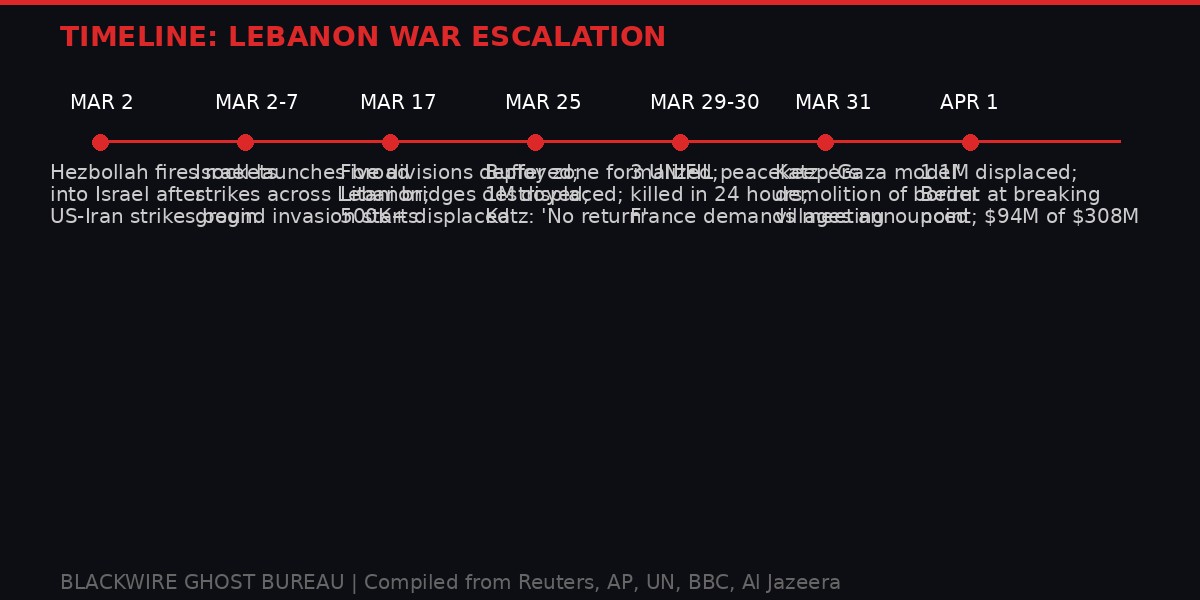
The humanitarian response is running on fumes. Of the UN's $308 million emergency appeal for Lebanon, only $94 million has been received - a 30% fulfillment rate that aid workers describe as catastrophic given the scale of need.
The shortfall translates directly into suffering. Fifty-one primary healthcare centers have closed. Four hospitals have shut down entirely. Others operate at diminished capacity with skeleton staff, treating trauma injuries in facilities designed for routine care. South of the Litani, the medical infrastructure has effectively been destroyed - bridges bombed, roads cratered, ambulances unable to reach the wounded.
Lebanon's Social Affairs Minister has publicly warned that the country is bracing for a "long-term displacement crisis amid a funding crunch." The government cannot absorb the cost. Lebanon's economy was already in freefall before the war - the currency has lost over 90% of its value since 2019, the banking system collapsed, and a third of the population was already living below the poverty line. Hosting over a million displaced people on top of an existing Syrian refugee population of roughly 1.5 million is mathematically unsustainable without massive international support.
That support is not coming at the necessary scale. Donor fatigue, competing crises, and the sheer velocity of the displacement have left the response chronically underfunded. Charities and local organizations are filling gaps that should be covered by state and international mechanisms - a pattern that works in the short term and collapses in the medium term.
Fletcher's message to the Security Council was direct: "Don't give up on the idea of Lebanon. If co-existence fails here, it stands to fail everywhere."
It was a plea. Whether it was heard is another question.
The Wider Frame: A War Within a War
Lebanon's crisis does not exist in isolation. It is a theater within a theater. The US-Israeli assault on Iran, which began on March 1, triggered Hezbollah's rocket fire on March 2, which triggered Israel's Lebanon campaign. Trump's scheduled primetime address on April 1 - where he is expected to reiterate a two-to-three-week timeline for winding down US operations in Iran - has no direct bearing on the Lebanon front. Israel's operation there is proceeding on its own logic, its own timeline, and its own objectives.
The deployment of additional US forces to the region - including a third aircraft carrier, the USS George H.W. Bush, and roughly 2,000 paratroopers from the 82nd Airborne Division - signals continued escalation even as Trump talks about winding down. No decision has been made to send US troops into Iran, according to officials speaking on condition of anonymity to Reuters, but the buildup is "building capacity for potential future operations."
Meanwhile, in Baghdad, American journalist Shelly Kittleson was kidnapped on March 31 by individuals believed to be linked to Kataib Hezbollah, an Iranian-backed militia. The Committee to Protect Journalists has urged Iraqi authorities to secure her release. An individual tied to the group has been taken into custody by Iraqi security forces, according to US Assistant Secretary of State Dylan Johnson. The abduction underscores how the regional conflict is metastasizing beyond its original theaters - spilling into Iraq, threatening journalists, and eroding the already thin veneer of stability in countries adjacent to the war.
For Lebanon, the implication is clear: there is no cavalry coming. The US is consumed by Iran. Europe is issuing statements. The UN is underfunded and its peacekeepers are being killed. And Israel has laid out its plans in plain language, on video, through official channels. The border villages will be demolished. The residents will not return. The security zone will be permanent.
The only variable is how long the world pretends this is temporary.
What Comes Next
Three scenarios dominate the analysis coming out of Beirut, Amman, and Western policy circles. None of them are optimistic.
Scenario one: Protracted occupation. Israel maintains its security zone south of the Litani indefinitely, similar to its 1982-2000 occupation. Southern Lebanon becomes a militarized buffer strip. The displaced population settles permanently in Beirut, the Bekaa Valley, and northern Lebanon, triggering slow-motion demographic and political upheaval. Hezbollah reconstitutes north of the Litani and the conflict freezes without resolution. This is the most likely outcome based on current trajectory.
Scenario two: Negotiated withdrawal. A ceasefire framework emerges - possibly through back-channel negotiations between the US, Israel, Iran, and Hezbollah - that includes Israeli withdrawal in exchange for a reinforced Lebanese army presence and Hezbollah's verifiable disarmament south of the Litani. This scenario requires political will that currently does not exist on any side, and a level of trust between the parties that has evaporated. Probability: low.
Scenario three: Wider escalation. The Lebanon front merges with the broader Iran conflict. Hezbollah launches a major strike on Israeli population centers, provoking a full-scale invasion of Lebanon beyond the Litani. Beirut itself comes under sustained bombardment. The displacement figure doubles. International intervention becomes unavoidable but arrives too late to prevent catastrophic loss of life. This is the scenario aid agencies are quietly preparing for.
On the Beirut waterfront, where tent cities now block the jogging paths and the yacht club has become a backdrop for humanitarian disaster, the scenarios are academic. The reality is rain-soaked tents, skin rashes, and a six-year-old named Zahra sitting inside a tarp shelter wondering when she can go home.
The answer, right now, is that nobody knows. And that is the cruelest fact of all.
Get BLACKWIRE reports first.
Breaking news, investigations, and analysis - straight to your phone.
Join @blackwirenews on Telegram