Who Is an American? The Supreme Court Takes Up the Biggest Citizenship Fight Since Dred Scott
The Supreme Court will hear oral arguments Wednesday in the most consequential citizenship case in over a century.
On Wednesday morning, nine justices will take their seats in the marble chamber at One First Street NE and hear arguments that could redefine what it means to be born American.
The case is simple to state and staggering in its implications. President Donald Trump signed an executive order on his first day back in office - January 20, 2025 - declaring that children born in the United States to parents who are in the country illegally or on temporary visas are not automatically citizens. Every federal court to review the order has blocked it. Now the Supreme Court, with its 6-3 conservative majority, will decide whether 158 years of constitutional law, 127 years of Supreme Court precedent, and 86 years of federal statute can be overturned by a presidential signature.
More than 250,000 babies born in the United States each year would lose their citizenship if the order takes effect, according to research by the Migration Policy Institute and Pennsylvania State University's Population Research Institute. Some would become stateless - citizens of no country at all. Others would face deportation to nations they have never visited, whose languages they may never speak.
This is not a legal technicality. This is the Supreme Court being asked to answer the most fundamental question a democracy can face: who belongs?
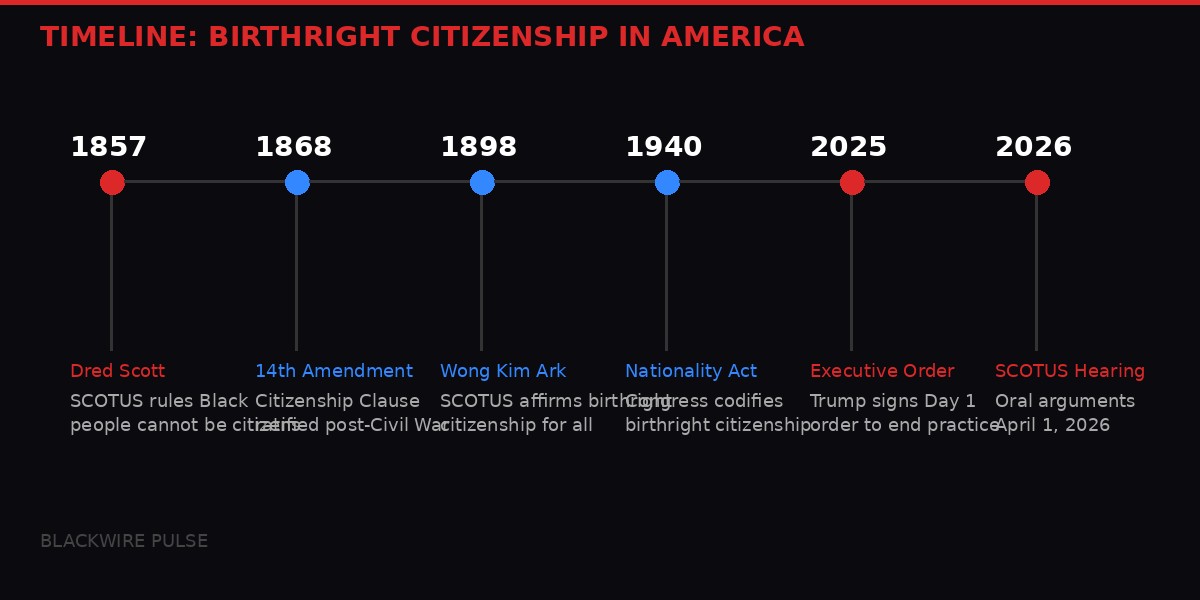
From Dred Scott to the Supreme Court steps: 169 years of fighting over who counts as American.
The Fourteenth Amendment: Born From Blood
The Citizenship Clause was written to overrule one of the worst Supreme Court decisions in American history.
To understand what the Supreme Court will decide on Wednesday, you have to go back to 1857 and one of the most reviled decisions in American legal history.
In Dred Scott v. Sandford, the Supreme Court ruled that Black people - enslaved or free - could never be citizens of the United States. Chief Justice Roger Taney wrote that people of African descent had "no rights which the white man was bound to respect." The decision inflamed tensions that led directly to the Civil War.
After the war, the victorious Union set about making sure Dred Scott could never happen again. The Fourteenth Amendment, ratified on July 9, 1868, opened with language deliberately designed to be broad, sweeping, and permanent:
"All persons born or naturalized in the United States, and subject to the jurisdiction thereof, are citizens of the United States and of the State wherein they reside." - Section 1, Fourteenth Amendment to the United States Constitution
The language was chosen with surgical precision. Senator Jacob Howard of Michigan, who drafted the Citizenship Clause, explained on the Senate floor that it was intended to "settle the great question of citizenship" once and for all. The clause was aimed at reversing Dred Scott by establishing an automatic, irrevocable right: if you are born here and subject to American law, you are American.
The only exceptions, understood at the time and confirmed by subsequent courts, were narrow: children of foreign diplomats (who enjoy diplomatic immunity and thus are not "subject to the jurisdiction" of U.S. law in the traditional sense) and children born during a hostile foreign occupation of American territory. That was it. No other carve-outs. No executive discretion. No presidential override.
For 158 years, that understanding held. Republican and Democratic administrations alike accepted it. Congress codified it into statute in 1940 with the Nationality Act and again in 1952 with the Immigration and Nationality Act. The Executive Branch practiced it without interruption. Hospitals issued birth certificates. The State Department issued passports. Millions of Americans who are the children of immigrants - legal and illegal alike - lived their lives as full citizens, because the Constitution said they were.
Then came January 20, 2025.
Day One: Trump's Executive Order

Signed within hours of taking office, the executive order titled "Protecting the Meaning and Value of American Citizenship" challenged constitutional bedrock.
The executive order Trump signed on his first day back in office was titled "Protecting the Meaning and Value of American Citizenship." It declared that the Fourteenth Amendment's Citizenship Clause does not grant automatic citizenship to children born in the United States if their parents entered the country illegally or are present on temporary visas - students, workers on H-1B visas, tourists, asylum seekers awaiting decisions.
The order's legal theory rests on four words: "subject to the jurisdiction thereof." The Trump administration argues that people in the country illegally or temporarily are not fully "subject to the jurisdiction" of the United States and therefore their children do not qualify for birthright citizenship under the Fourteenth Amendment.
This interpretation had long been considered fringe legal theory. For over a century, the dominant understanding - held by federal courts, Congress, the Executive Branch, and the overwhelming majority of constitutional scholars - has been that "subject to the jurisdiction" simply means "bound by American law." If you can be arrested, tried, and imprisoned under U.S. law, you are subject to its jurisdiction. Undocumented immigrants can be (and routinely are) arrested, tried, and imprisoned. By that standard, they are clearly subject to American jurisdiction, and so are their children born on American soil.
But the Trump administration's Solicitor General, D. John Sauer, has argued that the case presents an opportunity to correct "long-enduring misconceptions about the Constitution's meaning." In court filings, Sauer compared the case to Brown v. Board of Education, the 1954 decision that outlawed school segregation, and to District of Columbia v. Heller, the 2008 ruling that established an individual right to gun ownership. The implication is clear: Sauer believes the current understanding of birthright citizenship is as wrong as segregation was, and the Supreme Court should have the courage to say so.
The comparison has drawn sharp criticism from legal scholars across the ideological spectrum. Birthright citizenship was established by the Fourteenth Amendment to reverse an injustice - Dred Scott. Brown reversed another injustice - Plessy v. Ferguson's "separate but equal" doctrine. Trump's order, critics argue, seeks to create a new injustice by stripping constitutional rights from a vulnerable class of people.
KEY NUMBERS:
250,000+ babies born annually would be affected by the executive order
127 years since Wong Kim Ark established birthright citizenship precedent
86 years since Congress codified birthright citizenship into federal law
6-3 conservative majority on the current Supreme Court
0 lower courts have sided with the Trump administration
Wong Kim Ark: The 127-Year-Old Precedent in the Crosshairs

In 1898, the Supreme Court ruled 6-2 that Wong Kim Ark was a U.S. citizen by birth, regardless of his parents' nationality.
The most direct precedent the Supreme Court must confront on Wednesday is United States v. Wong Kim Ark, decided in 1898.
Wong Kim Ark was born in San Francisco in 1873 to Chinese parents who were legal residents of the United States but, under the Chinese Exclusion Act of 1882, were barred from ever becoming citizens themselves. After traveling to China to visit family, Wong was denied re-entry to the United States on the grounds that he was not a citizen. He sued.
The Supreme Court ruled 6-2 in his favor. Justice Horace Gray, writing for the majority, delivered an exhaustive analysis of citizenship law stretching back to English common law and concluded that the Fourteenth Amendment established a clear rule: birth on American soil, under American jurisdiction, creates American citizenship.
"The Fourteenth Amendment affirms the ancient and fundamental rule of citizenship by birth within the territory, in the allegiance and under the protection of the country, including all children here born of resident aliens." - Justice Horace Gray, United States v. Wong Kim Ark (1898)
Gray specified that the "subject to the jurisdiction" language excluded only three narrow categories: children of foreign diplomats, children born during hostile occupation, and (at that time) children of members of Indian tribes owing direct allegiance to their tribes. That last exception was later eliminated by the Indian Citizenship Act of 1924, which granted citizenship to all Native Americans born in the United States.
The Trump administration's argument requires the Supreme Court to either overturn Wong Kim Ark directly or to find that its reasoning does not extend to children of people in the country illegally. Sauer has argued that Wong's parents were legal residents - a distinction he says matters. But the Wong Kim Ark majority made no such distinction. The opinion repeatedly referred to "all children here born of resident aliens" and made clear that the only relevant question was whether the parents were subject to American law, not whether their presence was authorized.
Chief Justice Melville Fuller's dissent in Wong Kim Ark offered a narrower reading - arguing that Wong's parents owed allegiance to the Chinese emperor and could not be fully "subject to the jurisdiction" of the United States. This dissent, largely ignored for 127 years, is now the intellectual foundation of the Trump administration's position. The administration is asking the Supreme Court to adopt the reasoning of a dissent written in 1898 and overrule the majority opinion that has governed American citizenship law ever since.
It is worth noting the historical context. The Wong Kim Ark case arose during a period of intense anti-Chinese racism in the United States. The Chinese Exclusion Act was among the most nakedly xenophobic laws in American history. The dissent that the Trump administration now champions was written in service of that exclusion. Legal historians have observed that adopting Fuller's dissent would mean embracing the legal logic of an era when the federal government openly banned immigration on the basis of race.
Every Court Says No: The Unanimous Wall of Judicial Resistance

From New Hampshire to California, every federal judge to review the executive order has blocked it.
Before reaching the Supreme Court, Trump's birthright citizenship order traveled through the federal court system and encountered something remarkable: total, unanimous rejection.
Not a single federal judge - appointed by Democrats or Republicans, at the trial court or appellate level - has upheld the order. The wall of judicial opposition is as complete as it is unusual in modern American law.
U.S. District Judge Joseph N. LaPlante in New Hampshire, whose ruling the Supreme Court is now reviewing, wrote in July 2025 that the executive order "likely violates the Fourteenth Amendment of the Constitution" and federal law. LaPlante applied his ruling to a nationwide class of children born to mothers who are in the United States illegally or temporarily, finding that denying citizenship to those children "would render the children either undocumented noncitizens or stateless entirely. The children would risk deportation to countries they have never visited."
In Greenbelt, Maryland, U.S. District Judge Deborah Boardman was even more direct. "The Court reaffirms here its prior finding that the Executive Order flouts the plain language of the Fourteenth Amendment to the United States Constitution, conflicts with binding Supreme Court precedent, and runs counter to our nation's 250-year history of citizenship by birth," Boardman wrote in August 2025.
At the appellate level, a panel of the Ninth Circuit Court of Appeals in San Francisco delivered a comprehensive rejection. Judge Ronald Gould, joined by Judge Michael Daly Hawkins, wrote: "Perhaps the Executive Branch, recognizing that it could not change the Constitution, phrased its Executive Order in terms of a strained and novel interpretation of the Constitution. The district court correctly concluded that the Executive Order's proposed interpretation, denying citizenship to many persons born in the United States, is unconstitutional. We fully agree."
Gould went further, finding that the executive order "misreads American history" and that the administration's interpretation "relies on a network of inferences that are unmoored from the accepted legal principles of 1868." The executive order, he wrote, "attempts to qualify and limit the plain language of the Constitution's citizenship clause by adding the notion that the person must be a child of a citizen or lawful permanent resident. We reject this approach."
Even within the Supreme Court itself, the three liberal justices have already signaled their position. In June 2025, when the court used an earlier procedural round of the birthright case to limit the use of nationwide injunctions by federal judges, Justice Sonia Sotomayor wrote a blistering dissent joined by Justices Elena Kagan and Ketanji Brown Jackson.
"With the stroke of a pen, the President has made a 'solemn mockery' of our Constitution." - Justice Sonia Sotomayor, dissenting, June 2025
Sotomayor consulted an 1865 dictionary to define "subject to the jurisdiction" and concluded that it simply means "to be bound to its authority and its laws." Her conclusion was blunt: "Few constitutional questions can be answered by resort to the text of the Constitution alone, but this is one. The Fourteenth Amendment guarantees birthright citizenship."
Justice Amy Coney Barrett, who wrote the majority opinion on the injunction question, was careful to note the narrow scope of that ruling: "The principal dissent's analysis of the Executive Order is premature because the birthright citizenship issue is not before us. And because the birthright citizenship issue is not before us, we take no position on whether the dissent's analysis is right." Wednesday's arguments will force Barrett and her conservative colleagues to take that position.
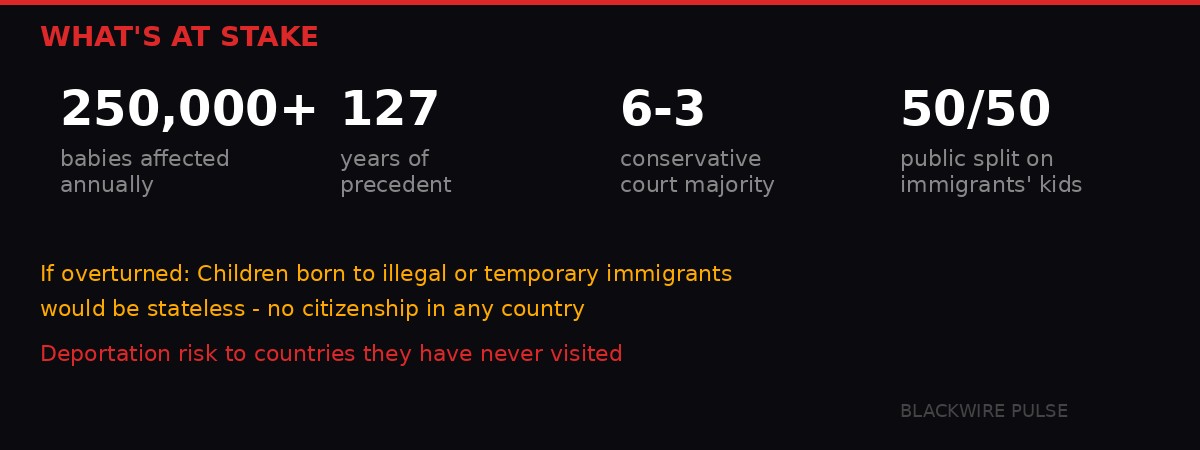
The numbers behind the case: over a quarter million babies and 127 years of precedent.
The Oral Arguments: What to Watch on Wednesday
Solicitor General D. John Sauer will face off against ACLU Legal Director Cecillia Wang before the nine justices.
Wednesday's oral arguments will pit Solicitor General D. John Sauer against Cecillia Wang, the legal director of the American Civil Liberties Union. The case before the court arises from New Hampshire, where Judge LaPlante's ruling blocked the executive order on behalf of immigrant mothers and their U.S.-born children.
Sauer faces a formidable challenge. He must persuade at least five justices that the plain text of the Fourteenth Amendment does not mean what it appears to say, that 127 years of Supreme Court precedent are wrong, that 86 years of federal statute are invalid, and that the Executive Branch's own consistent practice of recognizing birthright citizenship was a mistake. He must do this while acknowledging that his own position was, until recently, considered a fringe legal theory.
Several key dynamics will shape the arguments:
The textualist trap. The Supreme Court's conservative majority has long championed textualism - the principle that the Constitution should be interpreted according to the plain meaning of its words. The Fourteenth Amendment's text is remarkably clear: "All persons born or naturalized in the United States, and subject to the jurisdiction thereof, are citizens." Sauer must convince committed textualists that these words do not mean what they appear to mean. This is a difficult needle to thread, and the justices most likely to be skeptical are precisely the ones whose judicial philosophy demands close attention to text.
The originalist problem. Several conservative justices, including Clarence Thomas and Neil Gorsuch, are committed originalists who believe the Constitution should be interpreted according to its meaning at the time it was adopted. The historical record from 1868 strongly supports a broad reading of the Citizenship Clause. Senator Howard's floor statements, the debates in Congress, and the understood purpose of the amendment - to overrule Dred Scott and establish universal birthright citizenship - all point in one direction. Sauer must either find countervailing historical evidence or argue that the original understanding was narrower than the text suggests.
The Barrett question. Justice Barrett's procedural opinion in June 2025 was deliberately agnostic on the merits. Her questioning on Wednesday will be closely watched for signals about how she views the substantive constitutional question. Barrett has shown a willingness to break with conservative orthodoxy on occasion, and her vote could be decisive if the court splits along expected ideological lines.
The Chief Justice's legacy. Chief Justice John Roberts has historically been protective of the court's institutional legitimacy and reluctant to issue sweeping rulings that could undermine public confidence. Overturning Wong Kim Ark and redefining American citizenship would be among the most dramatic acts in the court's history - rivaling the reversal of Roe v. Wade in 2022. Roberts may be cautious about taking such a step, particularly given the political context surrounding the case.
The stare decisis test. The doctrine of stare decisis - the principle that courts should generally follow prior decisions - will be a central battleground. The court overturned Roe v. Wade in Dobbs v. Jackson Women's Health Organization (2022), demonstrating its willingness to reverse established precedent when it believes the original decision was wrongly decided. But Wong Kim Ark is different in critical ways. It interprets the text of a constitutional amendment, not a judicially created right. It has been followed for 127 years without serious challenge. And Congress has enacted legislation based on its holding. Overturning it would create vastly more legal chaos than overturning Roe.
The Public Is Split - But It Depends on How You Ask
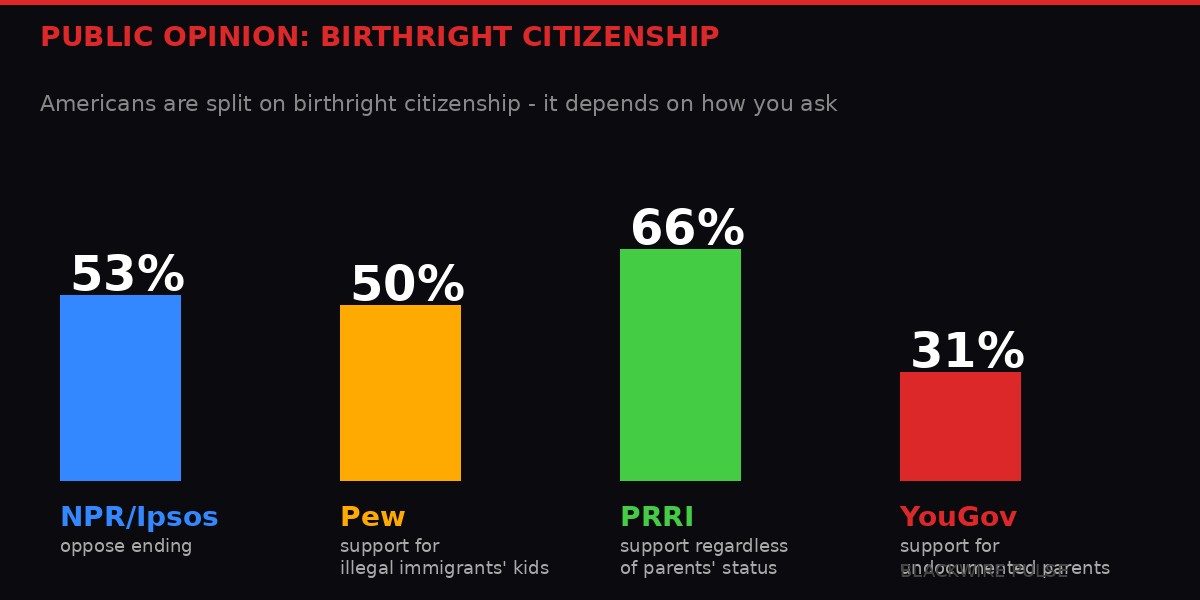
Polling shows Americans broadly support birthright citizenship - until you ask about children of undocumented immigrants.
Public opinion on birthright citizenship is a study in how framing shapes answers.
When pollsters ask about birthright citizenship in general terms - should people born in America be citizens? - support is overwhelming. The Public Religion Research Institute found 66% of Americans in favor of granting citizenship "regardless of their parents' citizenship status." The Civic Health and Institutions Project (CHIP50), a multi-university survey, found 59% in favor of keeping the practice.
But when the question shifts to children born specifically to parents who entered the country illegally, support fractures along predictable lines. Pew Research Center found Americans split 50-49 on whether such children should automatically receive citizenship. YouGov found only 31% in support when the parents were described as "undocumented."
The partisan divide is a canyon. Pew found 75% of Democrats support birthright citizenship for children of people who immigrated illegally, versus only 25% of Republicans. Among white Republicans, support drops to 18%. Among Hispanic Republicans, it rises to 55% - a remarkable intra-party split that reflects the personal stakes many Latino families have in the outcome.
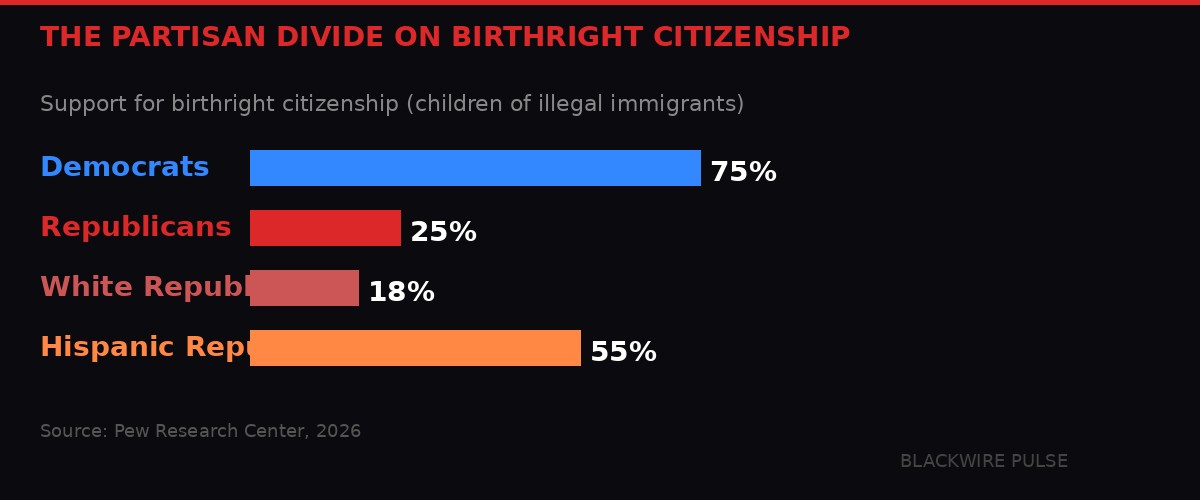
The gap between Democrats and Republicans on birthright citizenship is one of the widest in American polling.
Age matters. Those under 50 support birthright citizenship for children of illegal immigrants by a 58-41 margin, according to Pew. Those over 50 oppose it by nearly the same margin. Generational proximity to the immigrant experience tracks closely with support: 66% of second-generation Americans back birthright citizenship, while 55% of those who are third generation or higher oppose it.
Media consumption is perhaps the starkest dividing line of all. The PRRI survey found that 80% or more of Americans who most trust newspapers or mainstream television news support birthright citizenship. Among Fox News viewers, support drops to 41%. Among consumers of outlets further to the political right, it falls to 29%.
One polling detail stands out: surveys that mention that birthright citizenship is enshrined in the Constitution consistently produce higher support numbers than those that do not. When Americans are reminded that they are being asked about a constitutional right - not merely a policy preference - their support increases by 10 to 15 percentage points. This suggests that the legal framing of the Supreme Court case may matter as much to public acceptance of the eventual ruling as the ruling itself.
The Global Context: America's Shrinking Club
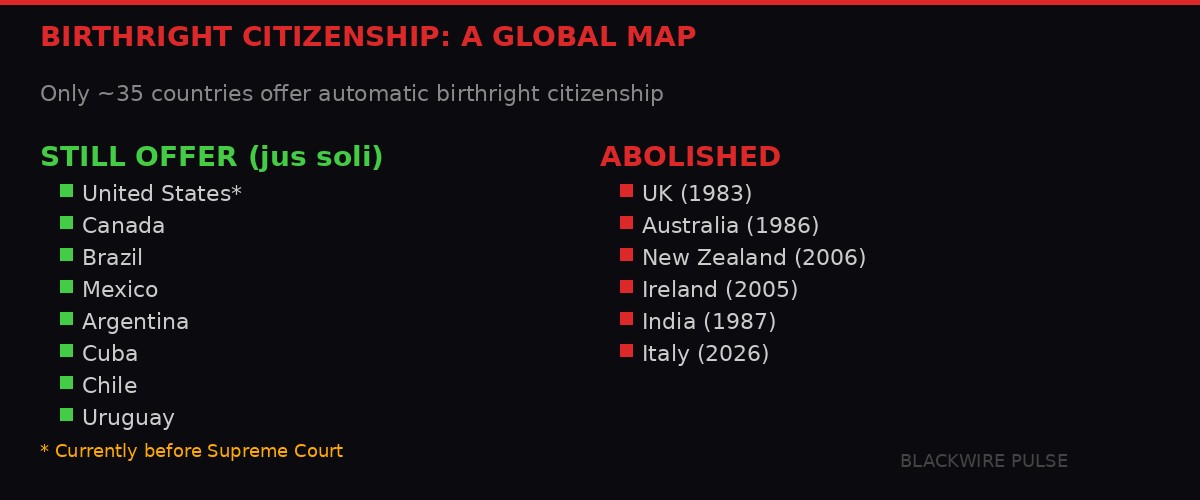
Only about 35 countries still offer automatic birthright citizenship - and the list keeps shrinking.
The United States is not alone in offering birthright citizenship, but the club is getting smaller every decade.
About 35 countries worldwide still practice jus soli - "right of the soil" - the legal principle that birth on a nation's territory confers citizenship automatically. The practice is concentrated overwhelmingly in the Western Hemisphere: the United States, Canada, Mexico, Brazil, Argentina, Chile, Cuba, and most Central American and Caribbean nations.
The origins of jus soli in the Americas are rooted in colonialism. European powers needed labor and population growth in their New World territories. Birthright citizenship encouraged settlement and discouraged departures. After independence, the newly sovereign nations kept the practice because it served their needs as growing, land-rich, people-poor countries building national identities from diverse populations.
But much of the rest of the world has moved in the opposite direction. The United Kingdom abolished automatic birthright citizenship in 1983. Australia followed in 1986. Ireland voted to end it in a 2005 referendum, with roughly 80% of voters supporting the change. India abandoned jus soli in 1987. New Zealand tightened its rules in 2006. Just this month, Italy further restricted who qualifies for citizenship by descent.
Most countries now practice jus sanguinis - "right of the blood" - granting citizenship based on parentage rather than birthplace. A child born in Germany to two non-German parents is not automatically German. A child born in Japan to non-Japanese parents is not automatically Japanese. In much of Europe and Asia, citizenship follows bloodline, not geography.
Supporters of Trump's executive order point to this global trend as evidence that America's approach is an outlier in need of correction. Critics counter that the United States is fundamentally different - a nation founded by immigrants, built by immigrants, and constitutionally committed to the principle that birth here makes you one of us. Changing that principle, they argue, would alter the American social contract more profoundly than any policy change since the abolition of slavery.
There is also a practical dimension. Countries that have abolished birthright citizenship generally have robust alternative pathways to legal status for children born on their territory. The Trump executive order creates no such alternative. A child born in Texas to undocumented parents would simply not be a citizen - of the United States or any other country if the parents' home nation does not extend citizenship to children born abroad. The child would be stateless from birth, a condition the United Nations considers a fundamental violation of human rights.
What Happens Next: The Possible Outcomes

The court's decision - expected by June or July 2026 - will reshape American identity law for generations.
The Supreme Court will not issue a ruling on Wednesday. Oral arguments are the beginning of the deliberation process, not the end. A decision is expected by the end of the court's current term, likely in June or early July 2026. Several outcomes are possible.
Scenario 1: The court strikes down the executive order. This is the outcome most legal experts consider most likely. If the court affirms the lower courts and holds that birthright citizenship is constitutionally guaranteed, the executive order dies and the status quo continues. Wong Kim Ark remains good law. The Fourteenth Amendment's Citizenship Clause continues to mean what it has meant since 1868. This outcome could come in various forms - a broad ruling affirming birthright citizenship in sweeping terms, or a narrower ruling finding only that the executive order exceeds presidential authority without reaching the constitutional question.
Scenario 2: The court upholds the executive order in part. The court could theoretically distinguish between children of people in the country illegally and children of temporary legal visitors. It could hold that "subject to the jurisdiction" includes temporary visa holders (who are clearly bound by American law and have been admitted through legal channels) but excludes those who entered without authorization. This middle-ground approach would still represent a dramatic departure from existing law but would affect fewer children.
Scenario 3: The court upholds the executive order entirely. This would be the most consequential ruling the Supreme Court has issued in decades - perhaps since Brown v. Board of Education. It would effectively overturn Wong Kim Ark, invalidate 86 years of federal statute, and strip constitutional citizenship from a class of people born on American soil. The legal, political, and humanitarian consequences would be enormous. States with large immigrant populations would face immediate crises as hundreds of thousands of children born to undocumented or temporarily present parents would lose their citizenship retroactively or prospectively. The ruling would also raise fundamental questions about whether the court had exceeded its institutional authority by rewriting constitutional text through judicial interpretation.
Scenario 4: The court punts. The justices could find a procedural reason to avoid the merits entirely - deciding the case on standing, ripeness, or some other threshold question that sends it back to the lower courts without resolving the constitutional issue. Given that the court agreed to hear the case and the political salience of the issue, this outcome seems unlikely but is not impossible.
Whatever the court decides, the political reverberations will be immense. A ruling striking down the executive order would hand the Biden-era legal consensus a major validation and could energize immigrant rights movements heading into the 2026 midterm elections. A ruling upholding it would transform American immigration law overnight and could trigger a constitutional amendment effort - though the supermajority requirements for amending the Constitution make that path extraordinarily difficult.
The Human Stakes: An Argentine Mother in Florida
Among the people watching Wednesday's arguments most closely is a 28-year-old Argentine woman living in Florida. She came to the United States in 2016 on a student visa and has since applied for a green card. Her son was born in Florida last year.
The first thing she did after his birth was get him a U.S. passport.
"I actually booked him for his passport application appointment even before he was born." - Anonymous plaintiff, speaking to the Associated Press on condition of anonymity out of fear of retribution
She described a moment of panic last summer when the Supreme Court's June 2025 ruling on injunctions briefly raised the possibility that the executive order could take effect in states like Florida that had not challenged it. Lower-court rulings over the summer ensured the order remained on hold, but the fear stayed.
"I never thought that so close to the end of my pregnancy I would have to be even thinking about the executive order and how it would have impacted my baby," she told the AP.
She has not reconsidered her decision to come to America. "Nothing that happens, politically or otherwise, would have changed my views of the country," she said, as her now seven-month-old son stirred nearby. "Because it gave me the most beautiful thing I have today, which is my family."
Her story is not unique. Across the country, immigrant families - documented and undocumented alike - are watching the Supreme Court with a mix of hope and dread. For many, the case is not an abstraction about constitutional interpretation. It is a question about whether their children are Americans.
The answer, when it comes, will echo for generations.
The Week Ahead: Beyond the Courtroom
Wednesday's oral arguments will unfold against a backdrop of extraordinary national tension. The country is simultaneously grappling with a war in Iran that has sent oil prices above $100 a barrel, a 44-day Department of Homeland Security shutdown that is the longest in American history, and a wave of "No Kings" protests that drew an estimated eight million people into the streets over the weekend.
The birthright citizenship case arrives at a Supreme Court that has already issued several landmark rulings this term, including decisions on executive power, immigration enforcement, and press freedom. The justices are aware that their institutional credibility is under scrutiny from both sides of the political spectrum - from the right, which expects them to deliver on conservative legal priorities, and from the left, which questions their legitimacy after the Dobbs decision and recent ethics controversies.
ACLU Legal Director Cecillia Wang, who will argue against the executive order on Wednesday, has framed the case in stark terms: "We have the president of the United States trying to radically reinterpret the definition of American citizenship."
Solicitor General Sauer, arguing for the administration, has framed it differently: as a necessary correction of a constitutional error that has persisted for over a century.
The nine justices will decide which framing is correct. Their answer will determine not just the legal status of hundreds of thousands of children, but the meaning of the constitutional promise that has defined American identity since the aftermath of the Civil War.
The first sentence of the Fourteenth Amendment was written to settle this question permanently. On Wednesday, the Supreme Court will decide whether "permanently" means what it says.
Get BLACKWIRE reports first.
Breaking news, investigations, and analysis - straight to your phone.
Join @blackwirenews on Telegram