$415M Liquidated in 4 Hours: How One Trump Post Blew Up Both Sides of the Bitcoin Trade
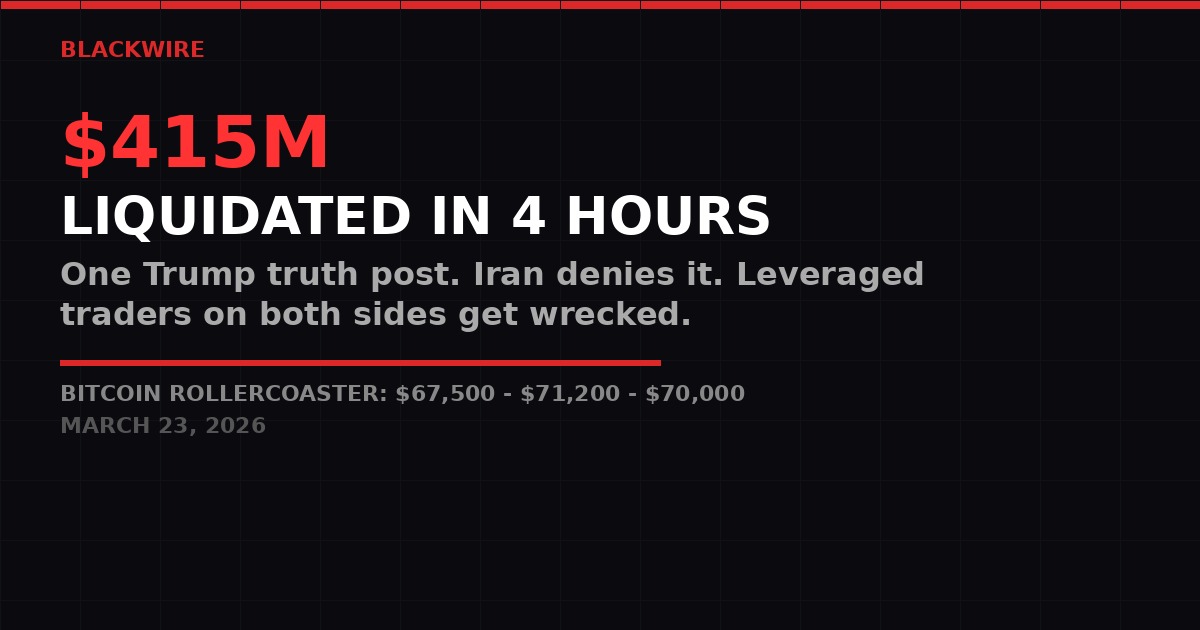
Bitcoin ran $3,700 in sixty minutes on a Trump ceasefire post. Then Iran denied it. Crypto's derivatives machine turned both moves into carnage - shorts and longs shredded in the same session.
At approximately 11:23 AM New York time on Monday, Donald Trump posted on Truth Social that he had instructed the Pentagon to postpone all strikes against Iranian power plants for five days. The U.S. and Iran, he claimed, had engaged in "very good and productive conversations" toward a "complete and total resolution" of hostilities in the Middle East.
Bitcoin was trading at $67,500. Within sixty minutes it was at $71,200. The surge was mechanical - derivatives desks forced to cover short positions as the "risk-off" trade from last week got invalidated in a single post. Oil futures collapsed. Safe haven flows reversed. Longs piled in on top of the short squeeze, FOMO layering on forced buying.
Then Iran's semi-official Fars news agency published a quote from an anonymous source: "There is no direct or indirect communication with Trump." Iran hadn't postponed anything. The counterstatement said Trump "retreated after hearing that our targets would be all power plants in West Asia" - a different read entirely from the de-escalation narrative.
Bitcoin gave back $1,200 from its high within minutes. The liquidation engine ran in both directions. $415 million in crypto positions were wiped in a four-hour window, according to CoinGlass data, with short liquidations accounting for $280 million and longs taking $135 million.
The net move: Bitcoin settled around $70,000, up about 2.3% on the day. Modest. But the carnage for leveraged traders was anything but modest.
The Anatomy of a $415M Wipeout
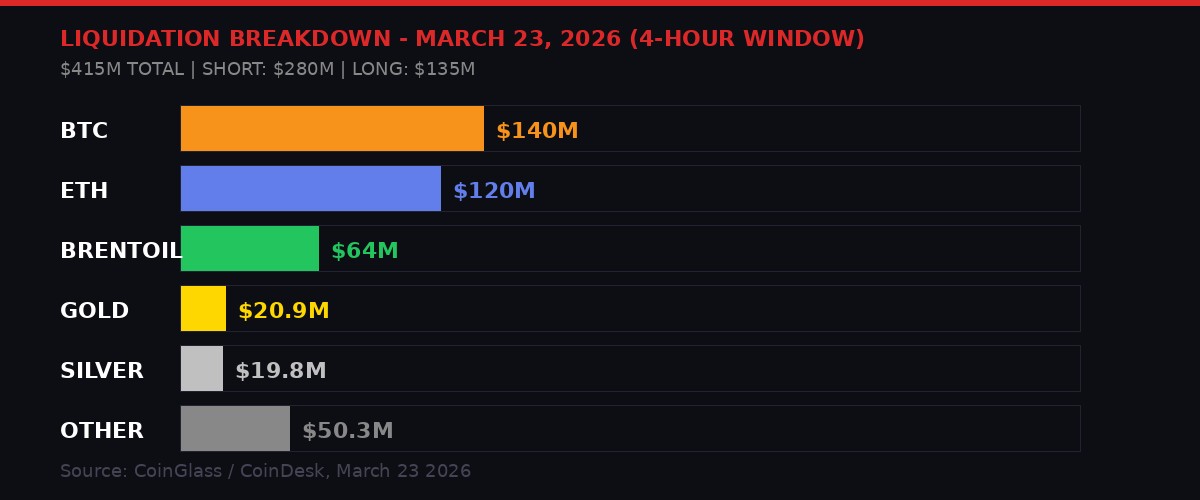
Liquidation distribution across assets in the 4-hour window. Source: CoinGlass / CoinDesk.
The math of how $415 million evaporates in four hours is straightforward once you understand how modern crypto derivatives work. The market was not running on spot conviction - it was running on leverage. Binance futures volume is currently running at roughly five times spot volume, according to earlier data cited by CoinDesk. Every price move gets amplified through the liquidation cascade mechanism.
When Trump's post landed, the market was "heavily positioned for escalation," CoinDesk reported. The 2-to-1 ratio of short liquidations to long liquidations confirms this. Traders had spent the weekend building short positions and risk-off hedges anticipating that Trump's 48-hour ultimatum - issued Friday, threatening strikes on Iranian power plants if Tehran didn't come to terms - would result in actual military action.
The logic was sound. Trump had issued a specific, time-bounded ultimatum. Oil was elevated. Crypto had sold off on the geopolitical uncertainty. Shorts were positioned for further downside if strikes began or oil spiked further.
Then Trump posted de-escalation. The short squeeze hit like a freight train - $280 million in shorts force-closed in under an hour as bitcoin ripped from $67,500 to $71,200. Longs piled in as the move accelerated, chasing the breakout above $70,000.
Iran's denial hit those fresh longs immediately. $135 million in long positions liquidated as bitcoin faded from $71,200 toward $70,000. The whole cycle - squeeze, chase, dump - played out inside the same session.
"The session reinforced what the Binance futures-to-spot data flagged earlier this month. When derivatives dominate trading activity at 5x the volume of spot, every headline gets amplified through liquidation cascades in both directions." - CoinDesk
The oil market side of this was even more one-sided. The XYZ:BRENTOIL perpetual contract on Hyperliquid saw $64.4 million wiped, nearly all of it longs. Those traders were right about the direction of the war - they correctly anticipated Trump's ultimatum would trigger some kind of action. They were wrong about which direction the next Truth Social post would go. Being directionally right but timing-wrong is the most expensive kind of wrong in a leveraged derivatives market.
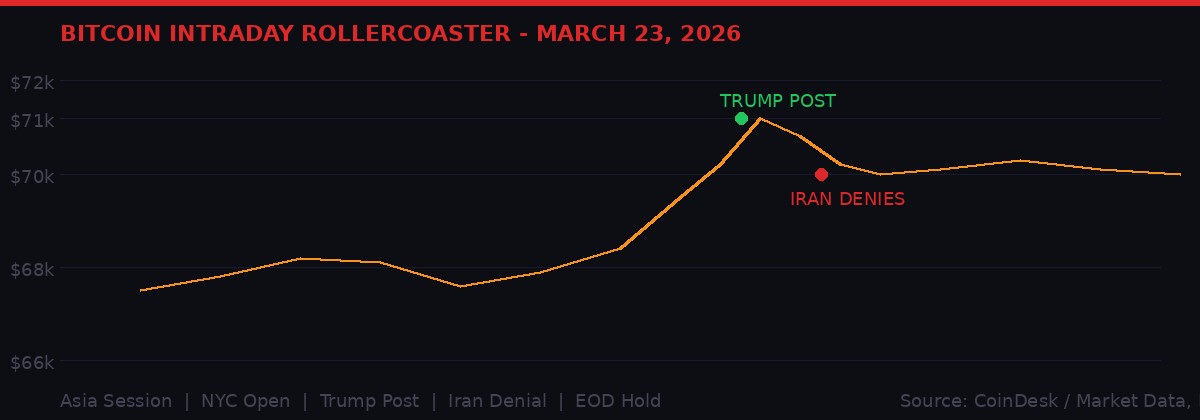
Bitcoin intraday price action on March 23. The Trump post spiked BTC $3,700. Iran's denial reversed half the move within minutes. Source: Market data / CoinDesk.
Trump's Truth Social Post Is Now a Market Instrument
The March 23 session is the clearest demonstration yet of how Trump's social media activity functions as a direct market mechanism. This is not metaphorical. When the U.S. president posts geopolitical news to Truth Social before it appears in official channels, every millisecond of delay between the post and the counterstatement is a window where automated trading systems - and fast human traders - execute massive positions.
The pattern is now well-established. Trump posted on Truth Social about Iran on Friday with the 48-hour ultimatum. Markets priced in escalation risk. Bitcoin fell. Oil stayed elevated. Then Monday's "productive conversations" post reversed the trade in real time.
What makes this different from normal political risk is the directness of the communication channel. Trump doesn't hold press conferences to announce diplomatic developments. He posts. The gap between "post hits Truth Social" and "AP/Reuters picks it up and wires it" is measured in minutes. In a derivatives market running at 5x spot volume, minutes is all you need to move hundreds of millions.
Iran's denial added a second layer. The counter-narrative from Fars news agency meant that traders who bought the ceasefire narrative got caught on the wrong side of the revision. Neither statement was verified. Neither was sourced to an official diplomatic channel. Traders were essentially trading off anonymous quotes from semi-official Iranian media responding to unverified claims from an American president's social media feed.
The key structural problem: When derivatives volume runs 5x spot, markets don't need accurate information to generate massive liquidation events. They only need conflicting information. The volatility itself becomes the product - and leveraged traders are the collateral.
Tokenized commodities on Hyperliquid - oil, gold, silver - showed the clearest directional response. The BRENTOIL long liquidations of $64.4 million represent traders who held their geopolitical thesis through the weekend and got stopped out on a social media post. Tokenized gold lost $20.9 million and silver $19.8 million as the risk-off trade unwound.
The Treasury Accumulation Machine Doesn't Stop
While retail leveraged traders were getting liquefied, the institutional accumulation machine was running on schedule. Three separate corporate treasury announcements landed on the same day as the liquidation chaos - each adding billions in bitcoin and ethereum buying power to the market structure.
Strategy (MSTR) filed an 8-K announcing a new $42 billion at-the-market equity program, split between $21 billion in Class A common stock (MSTR) and $21 billion in Variable Rate Series A Perpetual Stretch Preferred Stock (STRC). The company also launched a new $2.1 billion ATM for its STRK preferred series. Combined with existing programs that still had approximately $30 billion in capacity, Strategy's total theoretical bitcoin-buying firepower stands at over $70 billion. [Source: Strategy 8-K filing, March 23 2026]
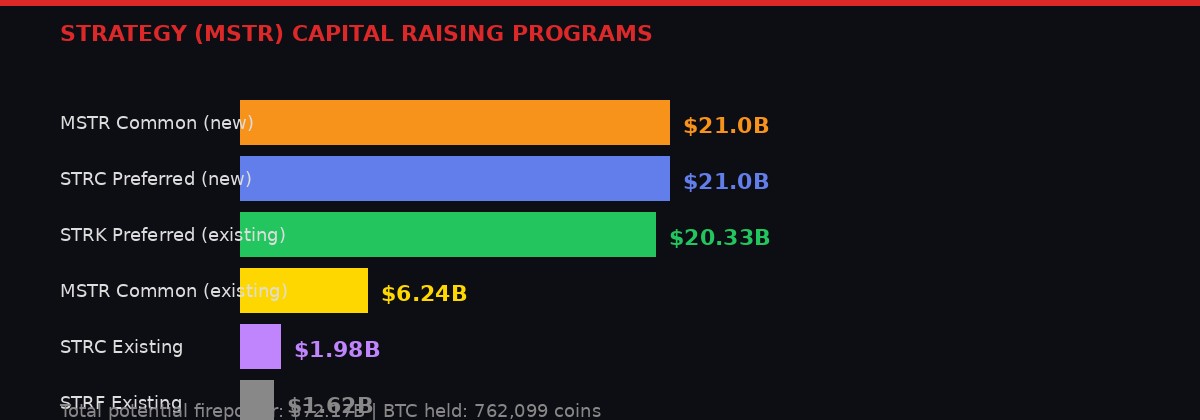
Strategy's multi-layered capital raising programs and remaining capacity as of March 22, 2026. Source: Strategy 8-K / CoinDesk.
The company added three new firms to its sales syndicate - Moelis & Company, A.G.P./Alliance Global Partners, and StoneX Financial - bringing the total number of agents to 19. These intermediaries sell shares into the market gradually, giving Strategy a drip-feed capital raise mechanism rather than one-time offerings that would pressure the stock price.
Last week, Strategy bought another 1,031 bitcoin for $76.6 million, bringing total holdings to 762,099 BTC. At current prices, that's roughly $54 billion in bitcoin on one company's balance sheet. The pace was described internally as "small" - which tells you everything about how Strategy now defines scale.
Separately, H100 Group, a Stockholm-listed bitcoin treasury firm backed by cryptographer and Blockstream co-founder Adam Back, signed a letter of intent to acquire Norwegian peers Moonshot AS and Never Say Die AS. The combined deal would triple H100's holdings to approximately 3,500 BTC, positioning it as Europe's largest publicly listed bitcoin treasury company. The transaction is structured as an all-bitcoin, all-share exchange - no cash changes hands, just bitcoin-denominated equity swaps. [Source: H100 Group filing / CoinDesk]
The structural bet these companies are making is uniform: bitcoin is finite at 21 million coins, fiat is not. Accumulate now, dilute shareholders with equity issuance, let BTC appreciation cover the spread. It's a leveraged long on monetary debasement expressed through public equity markets.
Bitmine's $7 Billion Problem and Why Tom Lee Is Buying Anyway
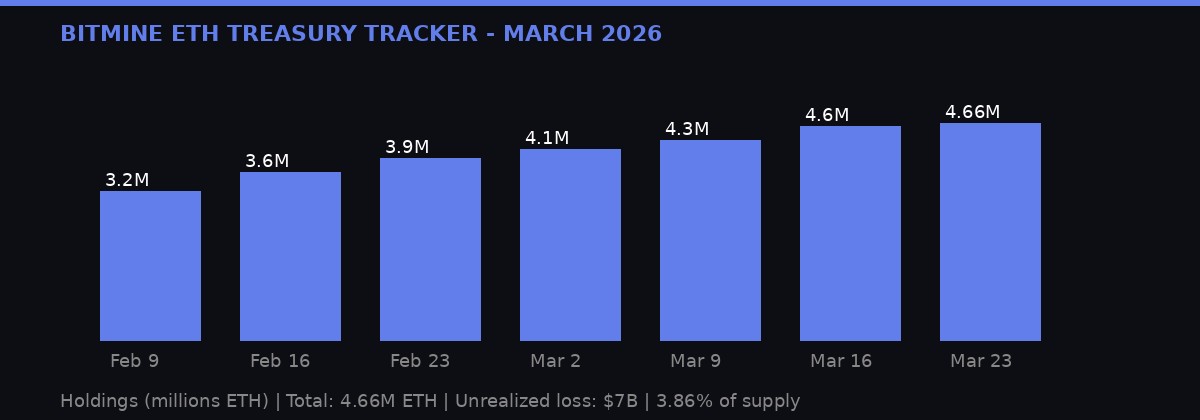
Bitmine's weekly ETH acquisition pace has increased for three consecutive weeks despite mounting unrealized losses. Source: CoinDesk / DropsTab, March 23 2026.
The Ethereum treasury story running parallel to Bitcoin's treasury narrative is more complicated - and more painful. Bitmine Immersion Technologies (BMNR), led by Fundstrat co-founder Thomas "Tom" Lee, announced Monday that it purchased 65,341 ETH last week, worth approximately $138 million at current prices.
That brings Bitmine's total ETH holdings above 4.66 million tokens - equivalent to 3.86% of ETH's entire circulating supply. For context: one company now controls nearly 4% of the world's second-largest cryptocurrency by market cap. [Source: Bitmine press release via PR Newswire, March 23 2026]
The troubling detail is buried in the data. Bitmine is sitting on an estimated $7 billion unrealized loss on its ETH purchases, according to DropsTab portfolio tracking. The company began accumulating during higher price ranges and has watched ETH underperform Bitcoin significantly through the 2025-2026 period.
Tom Lee's public framing is deliberately bullish. "Our base case is ETH is in the final stages of the 'mini-crypto winter,'" Lee said in a statement, arguing the firm is accumulating into weakness. The increase in buying pace - from roughly 50,000 ETH per week to 65,000 - is positioned as conviction buying near a bottom.
The counterargument writes itself. Bitmine has also increased its cash holdings to $1.1 billion, suggesting it's not fully committed to the single-asset treasury model. The firm is hedging the hedge. Meanwhile, the unrealized loss exceeds the entire market cap of many mid-tier DeFi protocols. If ETH doesn't recover, the Bitmine strategy becomes a cautionary tale about concentration risk in a single "store of value" asset that also functions as a developer platform with its own competitive pressures.
"Our base case is ETH is in the final stages of the 'mini-crypto winter.'" - Thomas Lee, Chairman, Bitmine Immersion Technologies
The Bitmine situation highlights a structural divergence in the corporate treasury narrative. Bitcoin treasury plays like Strategy have clear precedent, bitcoin's fixed supply as the thesis, and a price history that supports the long-term accumulation strategy despite volatility. The ETH treasury trade is less proven, the supply dynamics are different, and the competitive landscape for smart contract platforms creates fundamental uncertainty that bitcoin doesn't have.
BlackRock's Trillion-Dollar Bet on Tokenization
On the same day leveraged traders were being liquidated in real time, BlackRock CEO Larry Fink published his annual shareholder letter with a central argument: tokenization is about to do to finance what the internet did to mail. The timing was not accidental.
Fink's letter used strong language for a man who runs $11+ trillion in assets. "Capitalism is working - just not for enough people," he wrote, framing tokenization not as a technology bet but as a social equity argument. The current system, Fink argued, has delivered most of its gains to existing asset owners while workers have been locked out of market growth. Digital wallets and tokenized assets could change that.
"Half the world's population carries a digital wallet on their phone. Imagine if that same digital wallet could also let you invest in a broad mix of companies for the long term - as easily as sending a payment." - Larry Fink, BlackRock CEO, Annual Shareholder Letter 2026
The commercial stakes are explicit. BlackRock's USD Institutional Digital Liquidity Fund (BUIDL) is already the world's largest tokenized fund. The firm manages $65 billion in stablecoin reserves and nearly $80 billion in digital asset ETPs. Nearly $150 billion of BlackRock's assets are now connected to digital markets. [Source: BlackRock annual shareholder letter, March 23 2026]
Fink compared tokenization today to the internet in 1996. He's not saying it replaces traditional finance overnight. He's saying the plumbing upgrade is inevitable, and BlackRock has already positioned itself at the center of it. BUIDL, the stablecoin reserves, the ETF franchise - these are not experiments. They're infrastructure plays for the tokenized financial system Fink believes is coming.
The policy asks embedded in the letter are telling. Fink called for clear buyer protections, counterparty-risk standards, and digital identity checks to reduce illicit finance risks. That's a direct ask to regulators to build the framework that would allow BlackRock to scale its tokenized products from billions to trillions. He's not asking for permission to experiment. He's asking for the regulatory rails to run a full-scale operation.
Brazil Blinks on Crypto Tax, Backpack Drops BP Token
Two pieces of regulatory and exchange news rounded out Monday's packed session. Both matter for different reasons.
Brazil's new Finance Minister Dario Durigan is expected to delay a public consultation on applying the IOF tax (Imposto sobre Operações Financeiras) to cryptocurrency transactions. The proposal, which would classify some crypto transactions as foreign exchange operations subject to rates as high as 3.5%, had drawn fierce opposition from the Brazilian crypto industry. [Source: Reuters, March 23 2026]
The industry coalition - ABcripto, ABFintechs, Abracam, ABToken, and Zetta, representing over 850 companies - argued the plan was unconstitutional and violated Brazil's 2022 Virtual Assets Law. Their core argument: stablecoins are not fiat currency and cannot be treated as foreign exchange instruments by administrative decree.
Durigan, who replaced Fernando Haddad on March 20 when Haddad stepped down to run for governor of Sao Paulo, wants to avoid triggering political conflict with Congress during an election year. The crypto tax was a live grenade. Delaying it is the path of least resistance for a new minister trying to establish credibility without creating enemies.
The Brazil delay is significant for the region. Latin America has become one of the fastest-growing crypto markets in the world, driven by dollar-pegged stablecoin demand as a hedge against local currency depreciation. A 3.5% tax on stablecoin transactions would have been a body blow to the use cases that are actually driving adoption - remittances, savings preservation, cross-border commerce.
Meanwhile, Backpack Exchange launched its BP token on Solana with a structure deliberately designed to differentiate from most exchange token rollouts. 25% of the 1 billion total supply - 250 million BP - was distributed at launch, primarily through an airdrop to existing users and holders of the Mad Lads NFT collection. The notable detail: no tokens were allocated to founders, team members, or investors at inception. [Source: CoinDesk, March 23 2026]
The remaining 75% splits roughly evenly between milestone-based unlocks tied to operational growth and a corporate treasury that stays locked until after a potential IPO. Long-term stakers may eventually be able to convert BP into actual company equity - a direct link between token holding and ownership of the business that most exchange tokens explicitly avoid.
Backpack's history adds texture. The firm was founded by former FTX and Alameda Research employees and faced early reputational headwinds after FTX collapsed in November 2022. It later acquired FTX's European entity and relaunched it as Backpack EU, staking a claim in regulated European perpetuals markets. The BP token structure - user-first, insider-last, equity-linked - reads like a deliberate attempt to distance the brand from the FTX-era "insiders first" tokenomics that became synonymous with exchange fraud.
What the Session Tells Us About Where This Market Is
Monday March 23 was not a random day. It was a compressed version of the market structure that has defined 2026: geopolitical volatility feeding directly into a derivatives-heavy crypto market, institutional accumulation running on a separate track from the retail leverage game, and regulatory uncertainty being resolved one country at a time.
The $415 million liquidation number is big but not record-breaking. The record sessions hit $1 billion-plus in a single day. What makes Monday notable is the mechanism - conflicting social media posts from the U.S. president and an Iranian semi-official news agency, with zero verified diplomatic communication, driving hundreds of millions in forced liquidations in both directions inside four hours.
The nearly 2-to-1 ratio of short-to-long liquidations tells the real positioning story. Traders were short going into the week. They were positioned for escalation, for oil shock, for risk-off flows. When Trump posted ceasefire, they got squeezed. When Iran denied it, the latecomers got squeezed from the other side. The market's structural leverage meant both groups lost money even though the net price move was modest.
March 23, 2026 - Timeline of Events
The bigger picture playing out behind the noise: institutional capital keeps accumulating regardless of the day-to-day chaos. Strategy is at 762,099 BTC and raising capital to buy more. H100 is trying to consolidate Europe's listed bitcoin treasury market. Bitmine is doubling down on ETH despite a $7 billion hole. BlackRock is calling tokenization the future of all finance. These are not speculative positions. They are structural commitments by major balance sheets.
The retail leveraged trader sitting on the wrong side of a Trump tweet is playing a different game entirely - and losing. The market's structure increasingly favors those who can absorb volatility without forced liquidation. Deep-pocketed institutions buying spot against shallow-pocketed leveraged traders buying derivatives is not a fair fight. It never was, but the derivatives infrastructure makes it more lopsided by the year.
Brazil delaying its stablecoin tax and Backpack launching an equity-linked token structure are both signals pointing the same direction: the regulatory and corporate framework around crypto is maturing faster than the market's leverage culture is dying. Somewhere in that gap lives the next major crash - and the next major accumulation opportunity.
Bitcoin is still in the range it's occupied since late February. The Iran situation isn't resolved. Trump's ultimatum was postponed, not cancelled. If the next five days produce a different kind of headline, the $67,500 support and $71,200 resistance both get tested again. The only certainty is that leveraged traders will be on both sides when it happens.
Get BLACKWIRE reports first.
Breaking news, investigations, and analysis - straight to your phone.
Join @blackwirenews on Telegram