Bitcoin's $14B Options Gamble: $75K Max Pain, Gold's Century Crash, and Circle's Regulatory Collapse

Three bombs went off in crypto markets this week. Bitcoin tested $72,000 and got rejected - again. Gold posted its worst losing streak since 1920, and the BTC-to-gold ratio blew out 30% in bitcoin's favor. Then the U.S. Senate handed Circle a gut punch that sent CRCL stock down 20% in a single session. And hanging over all of it: a $14.16 billion options expiry on Friday that has $75,000 written all over it as the "max pain" destination.
Iran hasn't surrendered. The Strait of Hormuz is still partially blocked. Oil is trading at $99 after Washington's 15-point peace proposal sent Brent crude below $100 for the first time in weeks. But bitcoin just sat there, above $70,000, refusing to break. That's the story: not the rally, but the refusal to fall. In a war that has hammered equities, energy, and traditional safe-haven assets simultaneously, bitcoin is the only major asset trading roughly flat since the conflict began on February 28.
Here's everything you need to know about the three overlapping market events shaping crypto through the end of this week.
The $14 Billion Expiry: Why Friday's Options Trap Points to $75,000
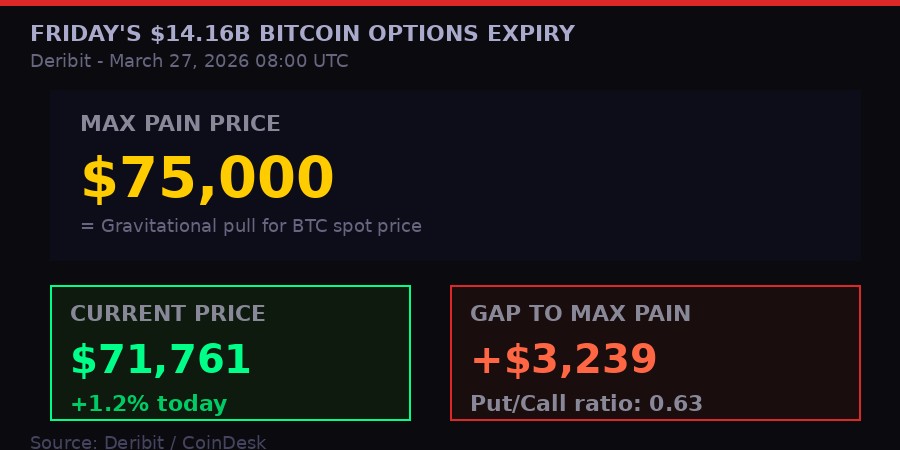
On Friday March 27 at 08:00 UTC, Deribit will settle bitcoin options contracts worth $14.16 billion. That's nearly 40% of all open interest on the exchange, expiring in a single moment. This is not routine. This is the kind of expiry that rewrites intraweek price action.
The magic number is $75,000. That's where Deribit's "max pain" calculation sits - the level at which the most options contracts expire worthless, inflicting maximum damage on buyers. Deribit's Chief Commercial Officer Jean-David Petrignot explained the mechanics directly: "With Bitcoin currently trading near $71k, the $75k Max Pain price represents a gravitational pull. Historically, this encourages delta-hedging by market makers that can drive prices toward the strike where the most options expire worthless," he told CoinDesk on Wednesday.
The mechanism is not manipulation - it's structural. Option writers, typically large institutions and market makers, hold significant positions. To minimize their payout exposure, they naturally hedge through spot and futures markets in ways that push prices toward the pain point. The more concentrated the open interest around a specific strike, the stronger the magnetic effect.
"The Put/Call ratio for Bitcoin options remains healthy (0.63), but the concentration of sell-side calls suggests a ceiling of institutional resistance as traders have been overwriting their positions to bank premium while waiting for the geopolitical clock to run out." - Jean-David Petrignot, Chief Commercial Officer, Deribit (via CoinDesk)
The derivatives data is layered. Industry-wide crypto futures open interest hit a one-week high of $112 billion on Wednesday. The top 10 tokens - including BTC and ETH - all registered open interest increases of 4% or more in the past 24 hours. Ether open interest jumped to 14.55 million ETH, the highest since August 24. DeFi tokens LDO and ETHFI both rose 2.5-3.5% on the day, outperforming BTC as the altcoin sector found selective bids.
Bitcoin has been rejected from $72,000 twice this month. Each rejection led to selloffs that pushed BTC to between $65,000 and $67,000. Traders have been building short positions in that region - which is exactly why open interest is expanding disproportionately near $71K-$72K. That's a lot of fuel sitting in leveraged positions that could move violently in either direction when Friday's expiry hits and positions get closed.
The implied volatility picture is telling. Bitcoin's 30-day implied volatility index (BVIV) dropped for a third straight day, nearing the weekly low of 53%. That's the market pricing in a controlled, orderly expiry rather than an explosive vol event. Petrignot confirmed: "Over the last sessions, we have witnessed an implied volatility (IV) compression, with both BTC and ETH DVOL dropping by roughly 6 points. This suggests the market is pricing in a controlled expiry rather than an immediate explosion in volatility." What looks calm on the surface is actually a coiled spring - you have massive open interest, fading vol, and a $3,200 gap between spot and max pain. Something has to give by Friday noon UTC.
Gold's Century Worst and the Bitcoin Takeover
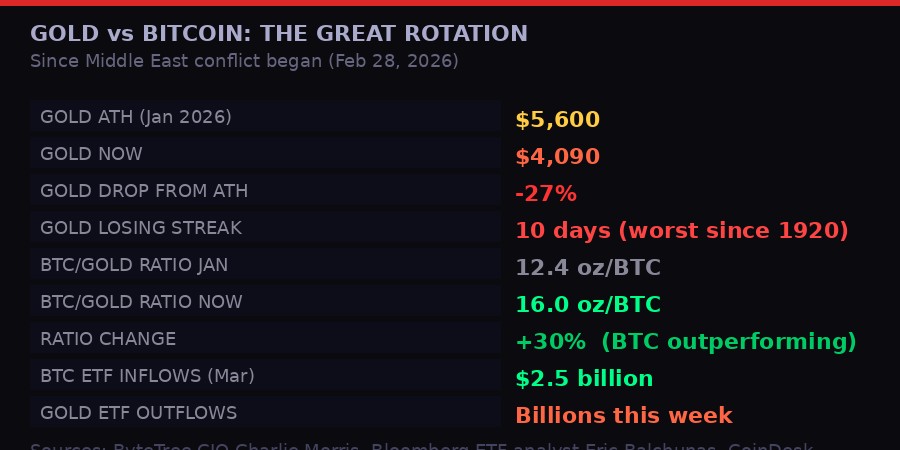
Gold just printed its worst losing streak in over 100 years. Ten consecutive down days - the worst run since February 1920 - dragged the yellow metal from its January all-time high near $5,600 down to $4,090, a 27% collapse that wiped out months of safe-haven premium in weeks. Bloomberg analyst Katie Greifeld flagged the century-worst streak on Wednesday, highlighting the 200-day moving average as the level where gold found support before recovering roughly 2% on Tuesday-Wednesday.
The irony is structural and massive. Gold was supposed to be the war trade. When Iran-linked conflict erupted on February 28, the playbook was obvious: buy gold, sell risk assets, hedge inflation from the oil shock. And initially, that's exactly what happened. Gold surged. Oil surged. Equities collapsed.
Then the rotation started. Bitcoin, which was supposed to fall harder than everything as a risk asset, didn't. It held. And gold, which was supposed to fly, reversed violently. The BTC-to-gold ratio tells the whole story: from 12.4 oz per BTC before the conflict, to 16.0 oz per BTC now. That's a 30% outperformance in favor of bitcoin over approximately four weeks.
"I remember the excitement when 1 BTC first surpassed one ounce of gold in March 2017. Since then, it has consistently built higher lows, reaching 2.7 oz in 2019, 3.4 oz during the 2020 pandemic crash, 9.1 oz after the FTX collapse, and 12.4 oz in February this year. Now, one BTC is worth 16 ounces of gold. With gold appearing exhausted, we could reasonably expect a new all time high above 40 ounces in the coming months or years." - Charlie Morris, Chief Investment Officer, ByteTree
The ETF flow data confirms the rotation is real and institutional. Gold ETFs - specifically SPDR Gold Trust (GLD) and iShares Gold Trust (IAU) - have seen billions of dollars in outflows over the past week, according to Bloomberg ETF analyst Eric Balchunas. Bitcoin ETFs, by contrast, recorded approximately $2.5 billion in inflows this month, with only about $140 million in net outflows year-to-date despite BTC being down roughly 20% from January peaks.
Balchunas was careful to note that BTC and gold are not inversely correlated - the relationship is more like uncorrelated. That's actually the more interesting dynamic here. Gold got hit hard because of a specific mechanism: heavy long positioning built up ahead of the conflict, then unwound violently as peace talks emerged and oil retreated. Bitcoin's holders are structurally different - longer-term ETF buyers who don't panic-sell on geopolitical headline risk. The two asset classes were tested under extreme conditions and bitcoin's holder base proved more resilient.
For the BTC-to-gold ratio to hit Charlie Morris's 40-oz target from current levels of 16 oz, you'd need either bitcoin to roughly triple from here while gold stays flat, or some combination of bitcoin outperformance and continued gold weakness. That's a multi-year call, not a Friday trade. But the directional argument - that bitcoin is eating gold's safe-haven narrative over generational timeframes - just got its most data-rich real-world test yet, and bitcoin passed.
Circle Stock -20%: The Clarity Act Just Killed the Yield Play
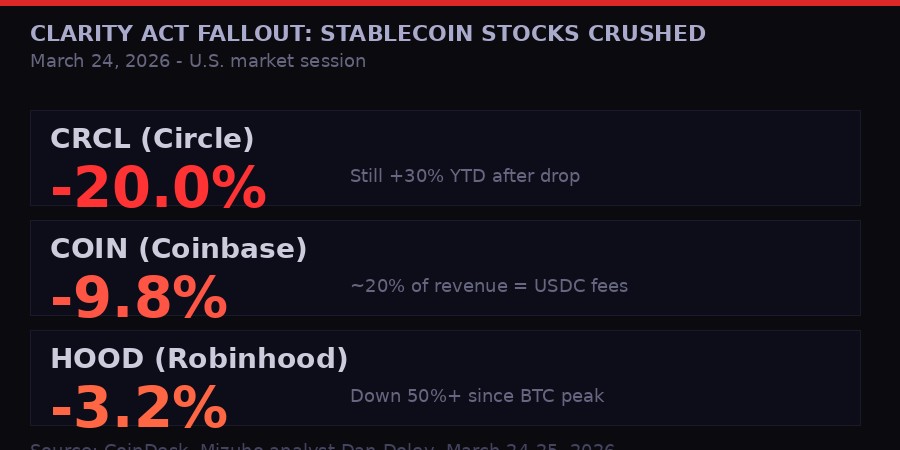
Circle's stock (CRCL) fell 20% on Tuesday. Coinbase (COIN) dropped nearly 10%. The catalyst: a leaked draft of the Clarity Act that would effectively ban the yield-pass-through model that has been driving stablecoin adoption for the past two years.
The structure being targeted is elegant and profitable. Circle earns interest on the assets backing USDC - U.S. Treasuries, primarily. It shares that income with Coinbase. Coinbase passes it to users as "rewards" for holding USDC on-platform. Users get a yield product. Circle gets distribution. Coinbase gets revenue. At current rates, this arrangement accounts for roughly 20% of Coinbase's total revenue. It's not a rounding error.
The new Clarity Act draft language bans anything "economically equivalent to interest" on stablecoin balances. Mizuho analyst Dan Dolev laid out the kill shot clearly: "Clarity Act could potentially ban yield payments for simply holding a stablecoin (e.g. passive balances) and restrict any approach that makes the program in any way equivalent to a bank deposit." That sentence describes precisely what Circle and Coinbase have been building.
"It pulls the rug on the pass-through model that has been driving stablecoin adoption." - Amir Hajian, Digital Asset Researcher, Keyrock
The background context matters here. Circle IPO'd earlier this year and rocketed 170% from early February before Tuesday's selloff. The bull case rested on two pillars: first, USDC's volume actually surpassed Tether's USDT for the first time since 2019 in March, signaling genuine institutional adoption. Second, the yield-pass model was turning USDC into something approaching a money market fund - compelling as a DeFi primitive and as a retail savings product. The Clarity Act draft nukes pillar two entirely.
There's a simultaneous Tether threat that made Tuesday's session even uglier. Tether announced it hired one of the Big Four accounting firms for a long-promised full audit of USDT's reserves. If that audit goes well - which it hasn't for the better part of a decade - it eliminates the transparency disadvantage that has historically made USDC preferable for institutional users. Circle loses the regulatory credibility premium and the yield premium in the same week.
Still, not everyone is calling it an existential crisis. Owen Lau at Clear Street said the selloff "looks like an overreaction - the market tends to shoot first and ask questions later." Ryan Rasmussen at Bitwise pointed out that Circle is still up 30%+ year-to-date after the selloff and that "there will be workarounds." Shay Boloor at Futurum Equities conceded the Clarity Act "weakens a key part of the bull case" while acknowledging the stablecoin market is still fundamentally growing. The debate will run for months as the legislation grinds through Senate committee. But the near-term signal is clear: Washington just told the stablecoin industry that yield is not going to be part of the permitted business model, at least not in its current form.
Iran Peace Plan: Geopolitics As the Only Chart That Matters
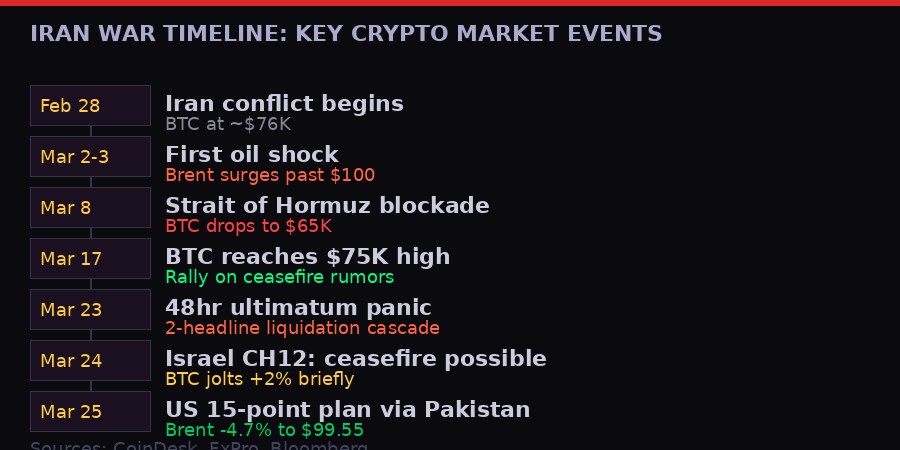
Everything this week traces back to one variable: oil. Brent crude fell 4.7% to $99.55 on Wednesday, breaking below the $100 level that had held since mid-March. The catalyst was Bloomberg's report that Washington had drafted a 15-point plan to end the Iran conflict and delivered it to Tehran via Pakistan. Israeli Channel 12 reported separately that Washington was seeking a one-month ceasefire. Asian equities jumped 1.9%. The dollar weakened. Bitcoin pushed toward $71,800.
The 15-point plan is the most concrete diplomatic development since the war began four weeks ago. Trump has been pushing talks publicly since Week 1, but the structure, participants, and terms have been unclear. This plan reportedly includes a prohibition on Iran obtaining nuclear weapons or enriching radioactive material. Iranian officials immediately dismissed it as "fake news" - the same pattern that has repeated five or six times since the conflict began. But the oil market moved on it anyway, because oil traders are not betting on Iran's press office; they're betting on whether the Strait of Hormuz reopens within 30-60 days.
The Strait is still effectively closed. Only a trickle of vessels are transiting. Every dollar off the oil price marginally improves the odds that the Federal Reserve holds rather than hikes, which keeps the liquidity environment from deteriorating further. Bitcoin's 90-day correlation with the S&P 500 remains elevated, but the relationship has been asymmetric throughout the war: BTC falls less when equities sell off, and bounces harder when equities recover.
"Although the leading cryptocurrency did not immediately capitalize on the upward momentum and extend its gains, simply remaining at these high levels now suggests confidence among the bulls." - Alex Kuptsikevich, Chief Market Analyst, FxPro
BTC is roughly flat since the war began on February 28. That's an extraordinary statement given what the surrounding markets have done. Equities are down 4-8% depending on index. Oil has gone from $85 to $100+ and back to $99. Gold is down 27% from its all-time high. The Nasdaq 100 has had three separate 3%+ selloff sessions. Through all of it, bitcoin bounced between $65,000 and $75,000 and kept returning to the $70K-$72K range. The market has spent four weeks stress-testing the $70K floor and it has held.
BlackRock's Message: Bitcoin is Infrastructure, Not Speculation

BlackRock's Robbie Mitchnick spoke at the Digital Asset Summit in New York on Tuesday and delivered a message that institutional crypto veterans will find significant. The asset management giant's head of digital assets said his clients are not looking for broad token exposure. They're focused on bitcoin, ether, and only a handful of other assets. The rest - and he was blunt about this - is "mostly nonsense."
That framing matters because BlackRock manages over $10 trillion in assets and its digital asset business has grown rapidly since spot bitcoin ETF approval in January 2024. When Mitchnick describes client behavior, he's describing where institutional money actually flows - not where retail narratives run.
The more interesting part of his remarks was the AI framing. Mitchnick argued that AI agents represent the natural next use case for crypto infrastructure. His thesis: "AI agents are very unlikely to use Fedwire and SWIFT. What is crypto? Crypto is computer-native money. AI is computer-native data and intelligence. And so there's a natural symbiosis there."
That's not a new idea - it's been circulating in crypto-native circles since 2024. But hearing it from BlackRock signals the thesis is crossing into institutional legitimacy. Bitcoin miners have already noticed: Hut 8, Core Scientific, and Iren are all either repurposing data center capacity for AI workloads or signing high-performance computing contracts. The revenue profile of an AI hosting contract is dramatically more stable than bitcoin mining at current difficulty levels.
Mitchnick also tied AI-driven economic disruption to bitcoin's appeal as a diversifier. As automation reshapes industries and creates structural uncertainty, he suggested bitcoin serves a store-of-value function precisely because it's outside the system being disrupted. "There are intersection points that are relevant - there's clearly an advantage and an opportunity to play a role in the AI economy," he said. The CoinDesk Computing Select Index (CPUS) - composed of AI tokens TAO, FET, and Chainlink (LINK) - rose 1.9% on Wednesday, the best-performing benchmark of the day, against BTC's 0.9% gain. The market is already pricing in Mitchnick's thesis in real time.
Derivatives Landscape: Leverage Is Building for a Decisive Break

The technical picture heading into Friday is loaded. Industry-wide crypto futures open interest hit $112 billion on Wednesday - a one-week high. Every major token in the top 10 registered open interest increases of 4% or more in the past 24 hours. Ether open interest at 14.55 million ETH is the most since August 24. All of that is leverage building in anticipation of Friday's expiry creating directional price movement.
The put/call ratio on Deribit stands at 0.63, which means there are significantly more open call options than put options - a structurally bullish positioning. But the concentration of sell-side calls at higher strikes (institutions writing calls above spot to collect premium) creates resistance. As Deribit's Petrignot noted, traders are not chasing a breakout - they're collecting premium and waiting. That behavior caps upside in the near term but creates energy for a move once the expiry clears the board.
DOGE and ZEC stood out with open interest increases over 10% in 24 hours, suggesting speculative rotation into smaller-cap tokens as traders seek leverage exposure with higher beta. Privacy coins XMR and ZEC fell around 1% on the day as sector rotation from privacy to DeFi and AI tokens continued. The CoinMarketCap Altcoin Season indicator sits at 48/100, up significantly from the 22/100 readings that characterized much of February during the early war shock period.
The Ether open interest expansion deserves specific attention. ETH is down 9.2% on the week - the worst-performing major asset over seven days. But the build in bullish derivatives positioning (positive funding rates, cumulative volume delta, and OI at multi-month highs) suggests money is positioning for ETH to bounce hard into and through the expiry. When a beaten-down asset starts accumulating bullish derivatives exposure, it's either a contrarian trap or the setup for a sharp reversal. Friday will tell.
Bitpanda, the Vienna-based crypto broker, added to the institutional infrastructure story by announcing a new blockchain built specifically to connect EU banks with tokenized assets. The timing aligns with a broader pattern: every week that crypto survives a geopolitical shock, more traditional financial infrastructure layers get built on top of it. STS Digital simultaneously unveiled a structured products platform covering 400 tokens, with Kraken as distribution partner, targeting banks and family offices with customized crypto derivatives. This is not retail. This is rails being laid for the next cycle.
The Week Ahead: What Three Converging Events Mean for BTC's Next Move

Three events are converging this week, and they're pulling in different directions. That's the honest read.
Friday's $14.16 billion expiry is the most near-term catalyst. Max pain at $75,000 is real and creates mechanical upward pressure from delta-hedging. But bitcoin has failed twice at $72,000 already this month. The sell wall is documented and heavy. Getting from $71,800 to $75,000 in 48 hours would require either a major geopolitical catalyst (ceasefire confirmed) or a sustained short squeeze large enough to overwhelm institutional call-writing. Neither is guaranteed. The compressed implied volatility suggests traders don't believe an explosion is coming - just a controlled pinning toward $73-75K and then another reset.
The gold rotation story is multi-month, not multi-day. Bitcoin's structural outperformance of gold since the war began confirms the "digital gold" narrative under real stress conditions. But narratives don't guarantee price. BTC needs to hold $70K through the expiry and then build on it to confirm the rotation is a lasting regime shift rather than a tactical flight from a historically overvalued gold position unwinding.
The Circle / Clarity Act situation will play out over weeks and months, not days. The legislation is in draft. Industry lobbying has not begun in earnest. The stablecoin sector has survived multiple rounds of hostile regulatory language before - GENIUS Act, Lummis-Gillibrand, state-level frameworks - and found workarounds each time. But the market is right to price in risk. If the "economically equivalent to interest" language survives committee markup and makes it into the final bill, Circle's pass-through yield model is dead. That's a meaningful revenue event for both CRCL and COIN.
The Iran variable is binary and unpredictable. Trump's 15-point plan is either the beginning of the end of the conflict, or another headline that Tehran rejects in 24 hours and markets briefly believe and then revert from. Four weeks of this pattern have established a reliable script: ceasefire headline - oil drops 3-5% - BTC bounces 2-3% - Tehran denies - oil recovers 2% - BTC gives back half the bounce. Trade the pattern, not the narrative, until there's a confirmed deal with tangible terms and verified withdrawal of forces from the Strait.
The bottom line: bitcoin is holding up better than almost anyone expected in a war cycle that was supposed to break risk assets. The $14B expiry creates a structural case for a push toward $73-75K by Friday. Whether it happens depends on the next 48 hours of Iran headlines. If peace talks advance, you get a short squeeze toward max pain. If Tehran denies the plan again Wednesday evening, you get another $67-68K dip and a different kind of Friday. Position accordingly.
Get BLACKWIRE reports first.
Breaking news, investigations, and analysis - straight to your phone.
Join @blackwirenews on TelegramSources: CoinDesk (March 25, 2026 - multiple articles); Deribit CCO Jean-David Petrignot via CoinDesk; Bloomberg ETF analyst Eric Balchunas; ByteTree CIO Charlie Morris; FxPro chief analyst Alex Kuptsikevich; Mizuho analyst Dan Dolev; Keyrock digital asset researcher Amir Hajian; Bitwise Head of Research Ryan Rasmussen; Clear Street analyst Owen Lau; Futurum Equities CMO Shay Boloor; BlackRock Head of Digital Assets Robbie Mitchnick at Digital Asset Summit New York (March 24, 2026); Deribit options data; CoinMarketCap Altcoin Season Index.