Bitcoin Civil War: Faked Nodes, Fink's $150B Wallet Manifesto, and the $75K Battle
Three forces are colliding on Bitcoin today. Inside the protocol, a governance war over censorship and data spam is heating up - with Jameson Lopp publicly accusing BIP-110 supporters of running thousands of fake nodes to manufacture consent. At the top of TradFi, Larry Fink just dropped his most Bitcoin-native chairman's letter ever, putting $150 billion behind a thesis that crypto wallets are finance's next distribution frontier. And the price itself is stuck at $69,557, grinding below $75,000 where the real institutional showdown begins.

Market Snapshot - March 24, 2026 (~19:33 UTC)
The Node War: Jameson Lopp vs. the BIP-110 Army

Bitcoin has a governance problem, and Jameson Lopp just put a name on it. On March 23, the veteran security engineer and cypherpunk published a chart captioned "Spot the Sybil Attack" - calling out what he says is an artificial surge in nodes signaling support for BIP-110, a controversial proposal that would clamp down hard on non-monetary data on the Bitcoin blockchain.
The timing matters. BIP-110 is a direct reaction to Bitcoin Core 30.0, released October 10, 2025, which effectively removed the old 80-byte OP_RETURN data limit and permitted multiple OP_RETURN outputs per transaction. For the Bitcoin maximalists, that was a line crossed. Core 30 opened the floodgates to what they see as arbitrary data bloat - NFT-style inscriptions, ordinals, and any other non-monetary use of the chain. BIP-110 is the counterpunch.
The proposal, filed by developer Dathon Ohm and crediting Luke-Jr with original drafting, would impose a hard cap of 34 bytes on new output scripts (except OP_RETURN, capped at 83 bytes), limit data pushes and witness elements to 256 bytes, restrict Taproot control blocks to 257 bytes, and disable OP_SUCCESS opcodes during deployment. It would activate via a modified BIP9 mechanism requiring 55% miner signaling, with a deadline around September 1, 2026.
The node numbers look alarming to BIP-110 supporters - and suspicious to Lopp. According to Smart Wicked Bitcoin data as of March 23:
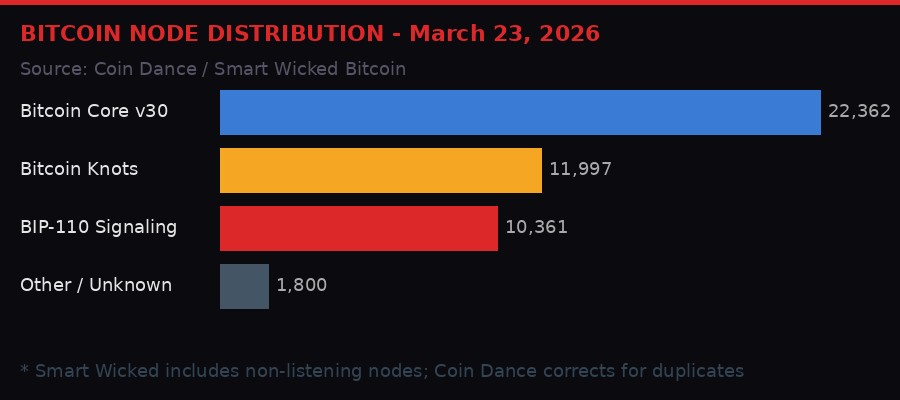
Bitcoin Node Distribution (Smart Wicked Bitcoin, Mar 23 2026)
Lopp's specific complaint is architectural. In his detailed BIP-110 explainer, he laid out why reachable-node signaling carries no economic weight: thousands of nodes can be spun up cheaply, Tor addresses cost essentially nothing, and the Bitcoin governance battles that actually mattered - SegWit2x in 2017, Bitcoin Unlimited before that - were never resolved by node counts. They were resolved by miners, exchanges, wallet providers, and large-scale economic participants.
"Reachable-node signaling is governance theater manufactured at low cost. A surge in BIP-110 signaling nodes, even a genuine one, leaves the question of activation entirely open." - Jameson Lopp, March 23, 2026 (via X)
He's not wrong about the infrastructure dynamics. On February 6, myNode released version 0.3.41 with a "Bitcoin Knots + BIP-110 Custom Bitcoin Version" as a one-click install option. A RaspiBlitz pull request on February 19 added BIP-110-enabled builds to its Knots installer. The official BIP-110 website explicitly encourages users to run signaling nodes - listing simplified setup paths for Start9, Umbrel, myNode, Parmanode, and Docker.
The result: the surge in signaling nodes almost certainly reflects a combination of genuine organic support from the inscriptions-skeptic community and coordinated node-spinning by motivated actors. Separating the two is impossible from the outside. That ambiguity is exactly what makes Lopp's "Spot the Sybil" accusation so sharp - it doesn't require proving fraud to be damaging.
The deeper stakes are constitutional. Bitcoin Core 30's OP_RETURN liberalization was itself a contentious move, made by the Core development team over sustained protest from the Knots faction led by Luke-Jr. BIP-110 is an attempt to reverse that liberalization not through Core itself but through a separate soft fork that could activate if miners go along. A fork that activates at 55% miner signaling leaves 45% of hashrate potentially producing blocks the activated chain would reject. That's not a theoretical chain split risk - it's an architectural one baked into the activation design.
Bitcoin has survived governance crises before. The 2017 SegWit2x battle ended without a split partly because the economic majority - exchanges, Coinbase, BitPay, the large custodians - held the line. Whether that coalition holds again, and whether it cares enough about data spam to engage at all, is an open question. BIP-110's September 2026 deadline makes this summer's miner signaling window critical. Watch hashrate pools, not node counts.
Larry Fink's $150B Wallet Manifesto: Finance's Next Distribution Layer

On the same day Bitcoin's governance war was making noise on crypto Twitter, the world's largest asset manager dropped something more consequential for the long-term price trajectory. Larry Fink published BlackRock's 2026 chairman's letter - and this time, it reads like a product roadmap.
The headline: $150 billion in digital-asset-linked AUM. That's $65 billion in stablecoin reserves (the USDC Circle Reserve Fund, standing at $68.167 billion as of March 20, already above the $65B figure Fink cited), plus nearly $80 billion in digital-asset ETPs. Add to that BUIDL, BlackRock's tokenized Treasury fund, which crossed $2 billion deployed across eight blockchain networks as of March 23.
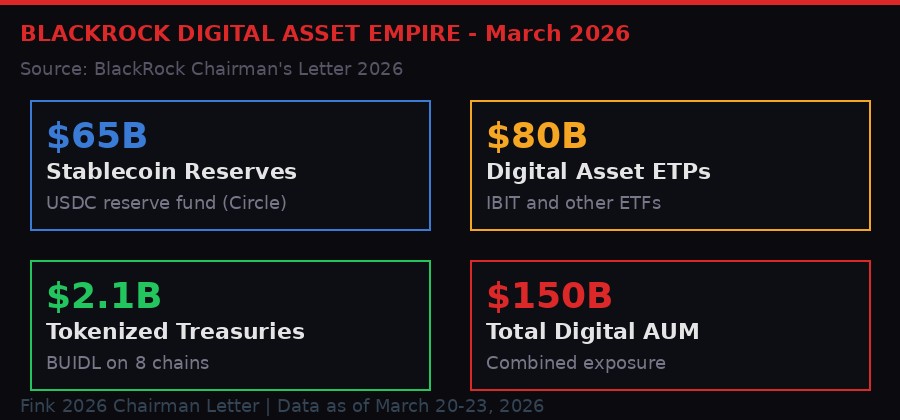
The numbers are real. But what's interesting is the forward-looking architecture Fink is describing.
"Today, there is very little access to traditional investment products in digital wallets. BlackRock plans to lead the charge in changing that." - Larry Fink, 2026 Chairman's Letter
In plain language: Fink wants to put ETFs, tokenized bonds, private credit stakes, and digital euros into the same app people use to hold crypto. Not as a gimmick - as a structural distribution upgrade. He points to India's JioBlackRock partnership, which brought in more than a million investors in under a year on smartphone-native infrastructure, as proof the model works. Half the world carries a digital wallet already. The friction isn't the user. It's the product layer.
What makes this credible rather than just aspirational is that BlackRock already sits at three critical points in the digital financial stack simultaneously:
1. Stablecoin reserves: Through the Circle Reserve Fund, BlackRock holds the majority of USDC's backing - $68 billion at last count. That's the dollar layer everything else runs on.
2. Tokenized Treasuries: BUIDL is the largest tokenized Treasury fund in the world by a wide margin. As of March 23, RWA.xyz shows the total tokenized US Treasury market at roughly $12 billion - and BlackRock is the dominant player. In February, Uniswap Labs and Securitize announced BUIDL would be tradable through UniswapX, with Securitize managing KYC compliance for allowlisted investors.
3. Digital Asset ETPs: IBIT, BlackRock's spot Bitcoin ETF, is the world's largest with roughly $50 billion in AUM. The firm also runs a spot Ethereum ETF. Total digital ETP exposure sits near $80 billion.
The bull case for Fink's wallet thesis is that these three layers - stablecoin cash, tokenized assets, and ETP wrappers - are already large enough to function together as a distribution system. BlackRock doesn't need to build from scratch. It needs to connect what already exists into a consumer interface.
The bear case is structural: BUIDL currently requires a $5 million minimum and US qualified purchaser status. The on-chain architecture runs on institutional rails that ordinary users never see. Franklin Templeton's Benji platform is the closest precedent for what wallet-native fund access looks like, and it has remained firmly in the early-adopter tier rather than breaking into mass retail.
But the direction is unmistakable. When the CEO of the world's largest asset manager - running $11.6 trillion in total AUM - writes publicly that digital wallets are the next distribution frontier and that BlackRock will "lead the charge," that's not speculative commentary. That's a capital allocation signal. Watch for BUIDL's minimum investment to drop, USDC integration into BlackRock's retail fund products, and partnerships with major wallet providers in H2 2026.
Strategy's $64 Billion Reload: The Capital Stack Behind 762,099 Bitcoin

While the node war and Fink's letter were making headlines on March 24, Strategy (formerly MicroStrategy) quietly filed an 8-K that reshaped its entire capital stack. The document, filed March 23, added new ATM (at-the-market) programs and terminated one old one - leaving the company with approximately $64.15 billion in active issuance capacity across multiple instruments.
To put that in perspective: Strategy holds 762,099 Bitcoin. At current prices around $69,557, that position is worth roughly $52.97 billion. The company paid an average of $75,700 per Bitcoin - a total acquisition cost of approximately $57.7 billion. According to SaylorTracker, the position is sitting on an unrealized loss exceeding $3 billion.
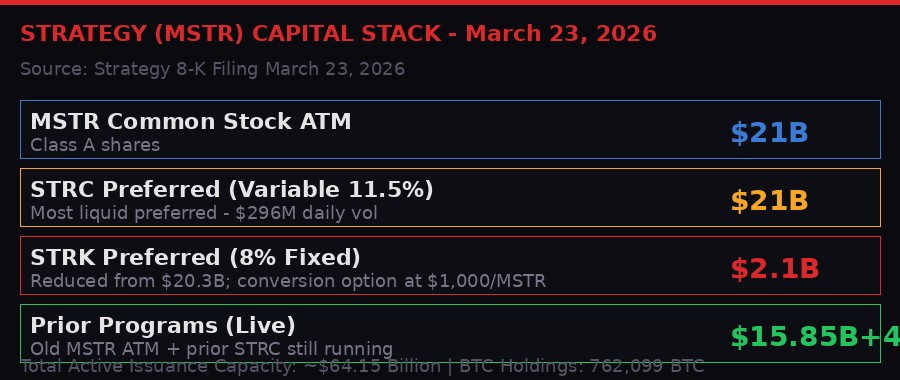
The new structure breaks down as follows:
Strategy Active Issuance Capacity (Post March 23 8-K)
The most significant shift is the divergence between STRC and STRK - Strategy's two main preferred stock instruments. STRC is the Variable Rate Series A Perpetual Stretch preferred, paying 11.5% dividend yield. Strategy increased its authorized STRC share count from 70.4 million to 282.6 million - an increase of 212 million shares. STRK, meanwhile, had its authorized share count slashed from 269.8 million to 40.3 million, and the prior $20.34 billion STRK ATM program was terminated outright on March 22.
The divergence tells you where institutional demand has settled. STRC now averages approximately $295.9 million in daily trading volume - more than the seven closest competing preferred issues combined, per data shared by Michael Saylor. That includes preferred stock from Boeing, KKR, and Four Corners Property Trust. BlackRock's iShares Preferred and Income Securities ETF is among the institutional holders of STRC, alongside Anchorage and Strive.
STRK's relative downgrade is notable given its embedded call option. At a conversion price of $1,000 per MSTR share, STRK converts to common stock when MSTR trades high enough. That feature briefly sent STRK to $129 per share in July 2025 - a 29% premium above its $100 liquidation preference. It's since deflated to $77, and Strategy's decision to shrink the authorized count and terminate the large ATM signals the firm sees better capital efficiency through the variable-rate STRC structure than through the fixed-convertible STRK.
None of the $64 billion has been raised. The 8-K explicitly says these are securities the company "may issue and sell" over time. But Strategy has consistently used its capital programs to buy Bitcoin, and the market reads these filings as a forward purchasing map. The company added Moelis, A.G.P./Alliance Global Partners, and StoneX to its syndicate of sales agents - broadening its distribution capacity for future issuance. Saylor isn't done buying.
The $75,000 Resistance: Why Bitcoin Can't Break Out

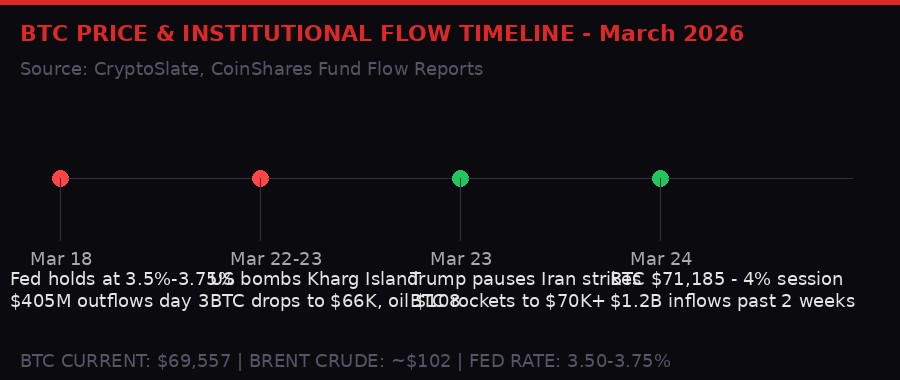
Bitcoin's price action on March 24 tells a precise story. The coin touched $71,185 intraday - up roughly 4% during the session - before fading back to $69,557 by evening. The catalyst was familiar: Trump's five-day pause on planned US strikes against Iranian power and energy infrastructure, announced March 23, triggered a relief rally across risk assets.
But relief rallies aren't bull markets. Three structural headwinds are keeping Bitcoin below $75,000 right now.
Headwind 1: Oil above $100. Brent crude collapsed more than 13% from its $108 peak when Trump announced the Iran pause - briefly touching $96. But it's already recovered above $102. The Strait of Hormuz carries approximately 25% of global seaborne oil trade and roughly 20% of global LNG, per the International Energy Agency. Iran has pushed back publicly on the idea of direct talks with the US. The five-day pause is not a diplomatic breakthrough - it's a countdown clock. Every dollar of crude above $90 is an implicit tax on global liquidity, tightening conditions for risk assets including crypto.
Headwind 2: The Fed is done cutting. The Federal Reserve held its benchmark rate at 3.5%-3.75% on March 18. Policymakers projected headline and core PCE inflation at 2.7% for 2026, and the median end-year estimate for the federal funds rate remained at 3.4%. That's a Fed that is barely in easing mode. Rate-cut expectations for 2026 have collapsed - CoinShares data showed $405 million in digital-asset product outflows on the day following the March 18 Fed decision alone, after $635 million in inflows in the first two days of that week.
Headwind 3: Strategy's average buy price is $75,700. Michael Saylor bought aggressively on the way up. His average cost basis of $75,700 per Bitcoin means the largest institutional holder in the world is currently underwater. That creates psychological resistance at the $75,000-$76,000 zone: it's where Strategy breaks even, where short sellers know to concentrate, and where institutional sellers who bought at 2025 highs start evaluating exits.
The bullish case is real but depends on sequencing. CoinShares reported $1.2 billion in digital-asset product inflows over the past two weeks, with Bitcoin accounting for roughly $900 million. Assets under management in digital-asset products have risen almost 10% to over $140 billion since the Iran crisis began - suggesting investors are buying dips rather than running from geopolitical risk. If oil pulls back decisively toward $85, rate-cut expectations reprice higher, and Bitcoin clears $75,000 with volume, the next resistance is $82,000-$85,000. That's a 20% move from here.
Timeline: The Week That Defined the March Setup

What Happens Next: Four Scenarios for Q2 2026

Three variables will define the next 60 days for crypto markets: oil price, Fed policy signals, and the outcome of US-Iran diplomatic back-channel talks. Here's how the scenarios play out.
Scenario 1 - Iran Ceasefire + Oil Sub-$90: The five-day pause extends into actual negotiations. Crude falls back below $90. Rate-cut expectations for H2 2026 reprice higher. Bitcoin breaks $75,000-$76,000 with conviction. Strategy resumes heavy buying. Target: $82,000-$88,000 by June. Probability: 25%.
Scenario 2 - Stalemate + Oil $95-$105: The pause extends but no talks materialize. Iran resumes low-level proxy activity. Oil grinds between $95 and $105. The Fed stays on hold. Bitcoin trades in a $65,000-$75,000 range for two to three months, grinding out a base. ETF inflows continue at reduced pace. Target: $70,000-$78,000 by June. Probability: 45%.
Scenario 3 - Escalation Resumes + Oil Spike: Ceasefire collapses. US strikes resume. Strait of Hormuz partially disrupted. Crude spikes above $120. Stagflation narrative dominates. Fed is trapped - can't cut while inflation surges. Bitcoin trades as a risk asset, not a hedge. Support at $60,000-$62,000. Target: $58,000-$65,000 by June. Probability: 20%.
Scenario 4 - Bitcoin Protocol Crisis: BIP-110 Sybil accusations escalate into a genuine fork attempt. Miner signaling starts moving in late April or May. Exchange panic around which chain is "Bitcoin" generates acute uncertainty. This scenario is low-probability but non-zero - the September 2026 activation deadline is close enough that markets will start pricing it in by summer if signaling continues. Additional 10% downside risk in this tail. Probability: 10%.
The base case - Scenario 2 - is a grind. Bitcoin has proven it can hold $65,000 even through oil-shock geopolitics and a hawkish Fed. The $1.2 billion in institutional ETF inflows over two weeks signals that large allocators are not running. But $75,000 is not just a price level. It's where Strategy breaks even, where the $64 billion reload program needs Bitcoin to be viable, and where the market has to decide whether this institutional adoption thesis is real or just prepositioning for a higher exit.
Larry Fink thinks the wallets win. Jameson Lopp thinks node theater is fake governance. Michael Saylor has committed $64 billion to the thesis. The price will settle the argument by June.
Get BLACKWIRE reports first.
Breaking news, investigations, and analysis - straight to your phone.
Join @blackwirenews on Telegram