Bitcoin Options Hit All-Time Fear: Rate Hikes at 12%, Oil War, and What the Data Actually Predicts

The Options Market Is Pricing Maximum Dread

According to VanEck's mid-March 2026 Bitcoin ChainCheck, bitcoin's options market is registering a level of defensive positioning that has almost no precedent in the asset's post-2020 history. The put/call open interest ratio averaged 0.77 over the past 30 days and peaked at 0.84 - the highest reading since June 2021, when China cracked down on crypto mining and wiped out roughly 50% of the global hashrate overnight.
The numbers get sharper when you look at premium flow. Traders spent approximately $685 million on put options over the 30-day window. Call premiums - the contracts that profit when prices rise - fell 12% to roughly $562 million. That means investors were spending more money betting on downside than on upside. Not by a small margin.
Relative to spot trading volume, put premiums hit roughly 4 basis points - an all-time high in VanEck's dataset, according to their report. To put that in context: during the Terra/Luna collapse in May 2022, which wiped $50 billion in crypto value in 72 hours, and during the Ethereum staking liquidity crisis that followed, put premiums reached only one-third of current levels.
"Relative to spot volume, put premiums reached an all-time high of roughly 4 basis points, roughly 3x the levels seen in mid-2022 following the Terra/Luna stablecoin collapse and the Ethereum staking liquidity crisis." - VanEck mid-March 2026 Bitcoin ChainCheck
The positioning makes logical sense. Investors burned by years of crypto volatility, now staring down a Middle East war, a potential Fed rate hike, oil shock, and crumbling bond markets, are buying insurance. They are not confident. They are scared - and they are paying record prices to hedge that fear.
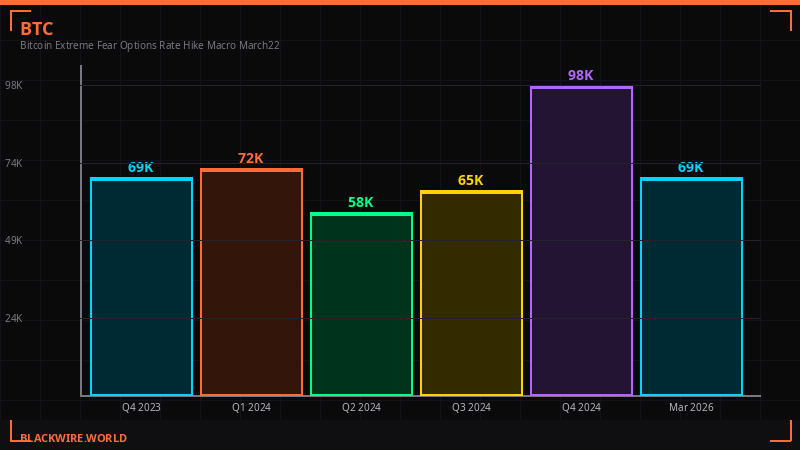
However - and this is the part most traders miss - VanEck's historical data shows that extreme fear in bitcoin's options market has been a remarkably reliable contrarian signal. When the options skew has been this stretched in the past six years, bitcoin gained an average of 13% over the following 90 days and 133% over the following 360 days. That is not a cherry-picked sample. That covers 2021 through 2026, including multiple bear markets and macro shocks.
The current spot price has also stabilized. Bitcoin's 30-day average price fell 19% from the prior period according to VanEck's report - reflecting the initial shock of the Iran war. But realized volatility dropped from approximately 80 to just above 50. Futures funding rates eased from 4.1% to 2.7%. Leveraged speculation has cooled. Onchain activity remains weak. Miners are not selling aggressively. The structure looks more like a market digesting bad news than a market in free fall.
The Iran War, Oil Shock, and the 50% WTI Surge Nobody Priced

The proximate cause of the current macro stress is a conflict involving Iran that disrupted oil transit through the Strait of Hormuz - one of the most strategically critical chokepoints in global energy supply. Roughly 20% of the world's seaborne oil passes through this 33-mile-wide passage. When it gets disrupted, the entire global energy pricing system convulses.
West Texas Intermediate crude spiked 50% in roughly three weeks following the war's outbreak, hitting approximately $108 per barrel at its peak before retreating. As of March 20, WTI stood at $93.80 - down nearly 2% after Britain, France, Germany, Italy, the Netherlands, and Japan issued a joint statement announcing collaborative steps to stabilize energy markets and ensure safe passage through the strait.
U.S. Treasury Secretary Scott Bessent added fuel to the retreat by signaling the U.S. could remove sanctions from Iranian oil tankers and tap its Strategic Petroleum Reserve. The combination was enough to knock a few dollars off crude - but nowhere near enough to undo the shock.
The damage was already done across financial markets. Gold, which ran hard higher as a traditional war safe haven - reaching approximately $5,500 per ounce in early March - has since collapsed to $4,569, a drawdown of more than 16% in three weeks. Silver hit $95, then crashed to $69.50. These are not small moves. These are the kinds of moves that liquidate leveraged portfolios and trigger margin calls across prime brokerage desks.
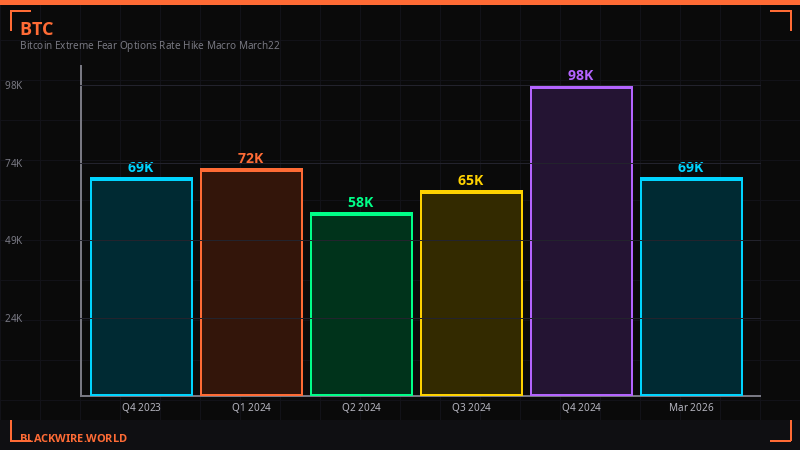
Bitcoin, by contrast, has been relatively calm. Starting the month near $68,000-$70,000, BTC has oscillated but avoided the dramatic directional moves seen in precious metals. Bitwise European Head of Research Andre Dragosch called bitcoin the "canary in the macro coal mine" - arguing that at current levels, bitcoin is already pricing a recession while many traditional assets are not.
"Bitcoin has once again acted as the canary in the macro coal mine. At current levels, bitcoin is already pricing a recession, while many traditional assets are not." - Andre Dragosch, European Head of Research, Bitwise
The S&P 500 closed below its 200-day simple moving average on Thursday for the first time since May 2025. Down 0.9% on Friday and on pace for a fourth straight weekly decline, the index has lost more than 5% since late February. The Nasdaq is down similarly. Traditional equity markets are not leading this crisis - they are lagging it.
Rate Hike Bets Go from Zero to 12% in Three Weeks

Six weeks ago, the entire Fed debate was about rate cuts. How many? Would they cut in March or wait until May? The consensus was dovish - a soft landing, inflation trending toward target, and a Fed ready to ease into the second half of 2026. That narrative is now in tatters.
According to CME FedWatch data, the probability of the Fed hiking at its April meeting has jumped from 0% one week ago to 12%. That sounds small - but zero-to-twelve in a week is a seismic shift in market psychology. Bond traders do not price things at 12% without serious conviction that 12% could become 30%, 40%, 50% if the data continues to turn.
The data is indeed turning. February headline inflation came in at 2.4% annually. Core inflation was 2.5%. Both numbers were recorded before the war, before the oil shock, before WTI's 50% surge. Inflation in March - the data that will inform the April Fed decision - will almost certainly be higher. Energy costs flow through to transportation, manufacturing, food production, and nearly every consumer-facing service. The lag is short.
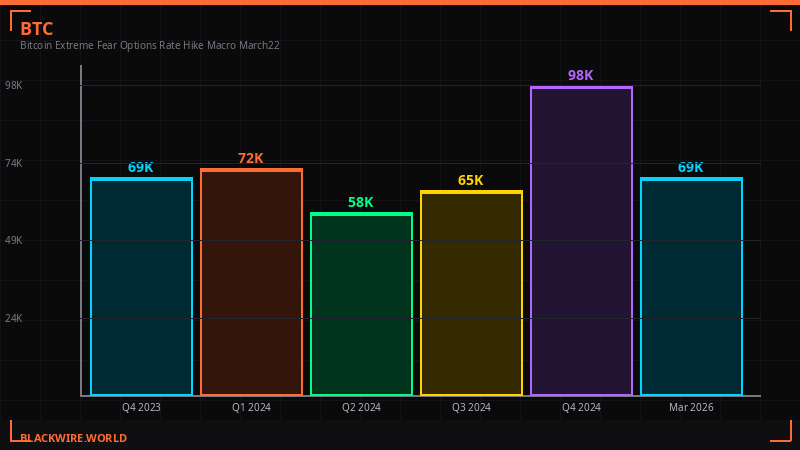
The bond market is not waiting to see what the Fed does. The 10-year U.S. Treasury note jumped another 10 basis points on Friday to 4.38%, having started March below 4%. That is a 43 basis point move in three weeks. The bond selloff is global - UK gilts crossed 5%, up 15% in the past month and at their highest yield since 2008. German Bunds and Japanese government bonds are both trending higher.
This is the stagflation playbook. Growth slowing - S&P 500 down, manufacturing PMIs softening - while inflation accelerates on oil shock. The Fed has no clean option. Cut and inflation reaccelerates. Hike and a slowing economy tips into contraction. Hold and get accused of being behind the curve. Every path has serious costs.
For crypto markets, the implications are acute. Bitcoin and risk assets broadly have been priced for rate cuts. ETF inflows slowed dramatically in Q1 2026 relative to 2025 levels. Institutional positioning pulled back. If rate hike bets move from 12% to 25% or 35% - driven by March CPI data or continued oil pressure - risk assets face another leg down. The options market is telling you traders are positioning for that scenario.
Morgan Stanley Files MSBT - Wall Street's Bitcoin Accumulation Continues

While retail investors panic and options traders buy puts at record prices, Wall Street continues its methodical accumulation of bitcoin infrastructure - fear or no fear. Morgan Stanley filed an amendment with the SEC on March 20 revealing that its planned spot bitcoin ETF will trade under the ticker MSBT, seeded with $1 million at launch.
The filing disclosed key structural details. The ETF requires a 10,000-share creation unit to build positions. BNY Mellon will handle cash management and administration. Coinbase will serve as prime broker and custodian - the same role Coinbase holds for BlackRock's IBIT and several other approved ETFs.
If approved by the SEC, MSBT would join 11 other spot bitcoin ETFs that have been active since January 2024. Those funds have collectively attracted over $56 billion in investor inflows despite a market that has been grinding sideways-to-lower for months. The institutional appetite for bitcoin exposure through regulated vehicles is not slowing. It is deepening.
Morgan Stanley also filed for a Solana ETF in early 2026, though no amendments have been submitted for that product. The Solana ETF pipeline - with multiple issuers including Franklin Templeton and others queued up - represents the next phase of institutional product development, assuming the SEC maintains its pro-crypto regulatory posture under Chairman Paul Atkins.
The MSBT filing is not noise. Morgan Stanley manages approximately $1.5 trillion in client assets. When the world's fourth-largest bank-affiliated wealth manager decides to build a spot bitcoin ETF, it signals that their compliance teams, risk committees, and regulatory relationships are aligned for mass distribution to retail brokerage clients. That channel does not yet fully participate in bitcoin - but the pipes are being built.
The contrast with the current fear environment is worth noting. Options traders are paying record premiums for downside protection. Morgan Stanley is filing SEC amendments and seeding a bitcoin fund. One of these parties has a 12-month time horizon. The other is thinking in years, not weeks.
SBF's Pardon Gambit - Trump, Iran, and a 25-Year Sentence

Sam Bankman-Fried, the jailed founder of collapsed crypto exchange FTX, is trying something audacious from behind bars. Through prison-approved communications and proxies, SBF has been publicly backing Donald Trump's policy decisions - including the Iran strikes - in what is being widely interpreted as a calculated play for a presidential pardon.
In a recent X post written through a proxy, Bankman-Fried endorsed Trump's decision to launch military strikes against Iran. He framed it as a necessary move to counter nuclear risk and claimed the operation significantly degraded Iran's military capacity. Earlier posts credited Trump with lower gas prices compared to the Biden era, and praised Trump for replacing former SEC Chair Gary Gensler with Paul Atkins - calling the shift a move that "saved" the crypto industry from regulatory persecution.
The political calculation is transparent. Presidential pardons have historically extended to financial crimes. Trump has already demonstrated willingness to grant high-profile clemency - Ross Ulbricht, who was serving life in prison for operating Silk Road, was pardoned by Trump shortly after the 2025 inauguration. Bankman-Fried's lawyers filed a motion for a new trial in February 2026, which federal prosecutors have opposed.
His public alignment with Trump lands at a complicated moment. Bankman-Fried's Iran commentary arrives as Trump's decision faces growing criticism for its potential to strain public finances, drive inflation higher through sustained oil disruption, and complicate relationships with European allies who preferred diplomatic channels.
"His public messaging suggests he is trying to shape an outcome beyond the courtroom." - CoinDesk, March 21, 2026
Meanwhile, the remnants of Bankman-Fried's former empire continue to unwind. The FTX Recovery Trust announced it will distribute approximately $2.2 billion to creditors as part of ongoing Chapter 11 proceedings - pushing recovery rates close to full repayment for some claim classes. The creditor recovery story has become one of the more remarkable in crypto history, with estate lawyers managing to recover billions from illiquid investments, venture funds, and foreign subsidiaries.
For the broader market, SBF's pardon campaign is primarily political theater. It does not change the legal or regulatory landscape. But it is a reminder that crypto's most prominent fraud case remains alive - and that the people convicted in 2022's industry implosion have not been forgotten, even if some prefer they were.
DeFi's $380 Million Ghost: Gauntlet and the Incentive Campaign Hangover

Gauntlet's total value locked collapsed 22.84% in seven days - dropping from approximately $1.72 billion to $1.325 billion, erasing roughly $380 million in a single week. The single-day drop on Thursday reached 7.57%. The cause: the conclusion of OKX's pre-deposit campaign on the DeFi-focused Katana blockchain, which had incentivized users to park capital in anticipation of a protocol launch.
Pre-deposit campaigns work like artificial tide. Protocols offer token rewards, elevated yields, or future airdrop eligibility to attract capital ahead of launch. The capital piles in, TVL metrics surge, launch hype builds. Then the campaign ends, or the airdrop happens, or better yields appear elsewhere - and the capital drains just as fast as it came.
The outflows are predominantly stablecoin-based. Gauntlet manages three vaults - USDC, BTC, and WETH - with the USDC vault currently offering 4.86% APY. But competing protocols are more attractive. Jito, operating on the Solana blockchain, currently offers 5.69% yield on SOL-based strategies. Yield-seekers rotate fast in DeFi. A 0.83% yield gap is enough to move hundreds of millions.
Understanding what Gauntlet actually does matters for context. It is not a yield protocol or a lending market in the traditional sense. It functions as a risk management consultancy for DeFi - setting the parameters that govern how lending markets and vaults behave. It defines, for example, the collateral requirements for borrowers, the liquidation thresholds at given price levels, and the concentration limits for specific assets.
When $380 million leaves Gauntlet's managed systems, it is not necessarily a signal that Gauntlet is failing. It may simply be capital rotating to higher-yield or newly-incentivized venues. Gauntlet itself pointed to this framing, noting the firm has "navigated large capital swings before due to incentive campaign endings, airdrops, and shifts in market conditions which regularly produce short-period swings in either direction."
The precedent is relevant. In October 2025, Gauntlet's USDT vaults absorbed a single $775 million transaction - a 40x TVL increase - and recovered to pre-deposit levels within ten days through active reallocation and new collateral market additions. That episode ended without crisis. The current outflows may follow the same pattern.
But the Gauntlet episode highlights a persistent structural problem in DeFi: TVL is a deeply unreliable metric. It inflates during incentive campaigns, deflates when campaigns end, and can swing hundreds of millions in days with no fundamental change in the underlying protocol's safety or functionality. Institutional risk management firms that advise on DeFi protocols need investors who understand this. Most retail participants do not.
What Comes Next: The Data, the Timeline, and the Scenarios

The next four weeks are critical. March CPI data - which will capture the oil shock's full impact - comes out in mid-April, days before the Fed's April meeting. That meeting will be the most watched monetary policy event since the post-COVID tightening cycle. The options market is already pricing defensive scenarios. Here is what each outcome means:
Rate hike bets evaporate. Fed holds. Risk assets rally hard. Bitcoin put/call reversal triggers short squeeze. VanEck's contrarian signal plays out - 13% gain over 90 days looks conservative.
Fed signals "higher for longer" with no cut in 2026. Rate hike probability moves to 25-35%. Stocks take another leg down. Bitcoin treads water near $65,000-$72,000. Institutions buy the dip quietly. Retail exits.
Emergency Fed meeting scenario. Everything sells simultaneously. Bitcoin could test $55,000-$60,000 support levels. Gold may find new buyers despite recent selloff. This is the tail risk the put buyers are hedging against.
Michael Saylor's Strategy has purchased 89,618 BTC so far in Q1 2026 - the biggest buying quarter since Q4 2024. Two Mondays remain in Q1. Expect another purchase announcement. $761,068 total BTC holdings creates a buying floor that is not trivial.
The structural long thesis for bitcoin remains intact. Morgan Stanley filing for MSBT. Strategy accumulating 89,618 BTC in Q1 alone. Eleven spot ETFs with $56 billion in aggregate inflows. SEC under Paul Atkins adopting a pro-industry posture. The GENIUS Act stablecoin legislation advancing in the Senate. The regulatory moat around crypto deepens every week.
The cyclical headwinds are real but potentially temporary. Oil shocks historically resolve in 90-180 days as production adjustments kick in and diplomatic pressure mounts. Rate hike cycles do not materialize overnight - the Fed would need multiple prints above 3% CPI before pulling the trigger. The 12% hike probability is a warning signal, not a certainty.
VanEck's historical data may be the most honest framing available. Extreme fear in bitcoin's options market has been wrong before - as a bearish signal, that is. The market that pays $685 million for puts in a 30-day window is often the market that regrets not buying spot. The record put premiums do not tell you prices will fall. They tell you fear has reached maximum price.
Maximum fear and maximum price are rarely the same thing.
For traders watching the next 72 hours: WTI crude holding above $92 is bearish for risk. A break below $90 and sustained could reverse the macro narrative significantly. The S&P 500's relationship with its 200-day moving average - now broken to the downside for the first time since May 2025 - needs to be reclaimed for equity sentiment to stabilize. And watch the 10-year Treasury yield. If it approaches 4.50% or higher, that is when the carry trade unwind truly begins and everything correlates to one.
Get BLACKWIRE reports first.
Breaking news, investigations, and analysis - straight to your phone.
Join @blackwirenews on TelegramSources
- CoinDesk - Bitcoin options signal extreme fear, VanEck ChainCheck (March 21, 2026)
- VanEck - Mid-March 2026 Bitcoin ChainCheck Report
- CoinDesk - Bitcoin's latest fear unlocked as rate hike bets rise (March 20, 2026)
- CME FedWatch Tool - April 2026 meeting probability
- CoinDesk - Bitcoin jumps to $70,800 as oil retreats (March 20, 2026)
- CoinDesk - Morgan Stanley sets MSBT ticker (March 20, 2026)
- SEC EDGAR - Morgan Stanley MSBT S-1 Amendment
- CoinDesk - Sam Bankman-Fried backs Trump's Iran strikes (March 21, 2026)
- CoinDesk - Gauntlet sees $380 million exit after OKX campaign ends (March 19, 2026)
- DeFiLlama - Gauntlet TVL data, March 2026