The Great Bitcoin Treasury Unwind: Riot, MARA, and Bhutan Dump BTC as Oil Hits $107 and Markets Bleed Red

The corporate bitcoin treasury trade - the single most popular institutional narrative of 2024 and 2025 - is cracking under pressure. On the one-year anniversary of Liberation Day, with crude oil surging past $107 a barrel and the Fear and Greed Index stuck at 8, the companies and governments that loaded up on bitcoin during the bull run are now selling it to stay alive.
MARA Holdings dumped $1.1 billion in BTC. Riot Platforms moved 500 coins this week alone. Empery Digital liquidated to repay loans. Genius Group exited entirely. Bhutan's sovereign wealth operation has shed over 3,100 BTC since the war started. And on the other side of the trade, Metaplanet just became the world's third-largest corporate bitcoin holder by buying what everyone else is selling.
This is the story of a thesis that worked perfectly in a bull market and is now getting pressure-tested by war, oil shocks, tariff chaos, and a Federal Reserve that refuses to cut rates. The results are ugly.
The Speech That Killed the Rally

On Tuesday, April 1, hope was everywhere. Trump told reporters the Iran war could end within weeks. That a deal with Tehran was not necessarily required. Asian stocks surged 4%. S&P 500 futures jumped. Bitcoin briefly touched $69,000. The mood was the most optimistic since the conflict began five weeks ago, according to CoinDesk.
Then came the primetime address. In nearly 20 minutes on Wednesday evening, Trump didn't outline any de-escalation pathway. He didn't announce a ceasefire framework. Instead, he told the nation the U.S. military would hit Iran "extremely hard" over the coming two to three weeks to secure a decisive win. He warned that Iranian energy infrastructure would be targeted if no deal is reached. He urged Gulf countries - Saudi Arabia, the UAE, and regional allies - to pressure Tehran to relinquish control of the Strait of Hormuz.
The Strait, the world's most critical oil shipping lane, has been effectively shut since mid-March. Trump said it would reopen "naturally" once hostilities subside. He offered no timeline.
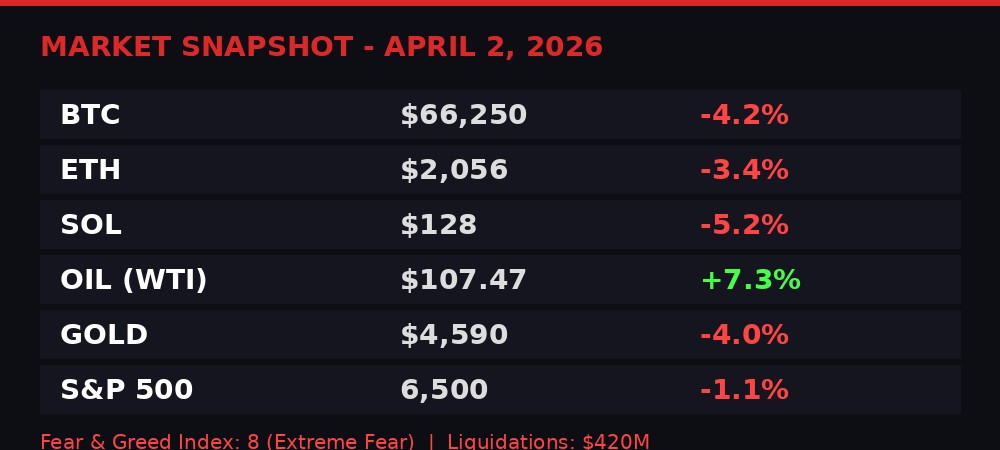
The market reaction was immediate and violent. Brent crude jumped 5% to above $106. WTI surged 7.3% to $107.47, according to StockMarketWatch data. Asian shares fell 2.1%. Japan's Nikkei 225 dropped 2.4% to 52,463. South Korea's KOSPI fell 2.6%. India's Sensex tanked 1,500 points. S&P 500 futures fell more than 1%, with the index sliding to 6,500 - down 4.6% for the quarter. Nasdaq futures also moved lower.
Bitcoin dropped from $69,000 to $66,250 in hours - a 4% reversal that wiped out two days of gains in a single session. Ethereum fell 3.4% to $2,056. Solana led the carnage at -5.2%, extending its weekly decline to 13%. XRP lost 2.5% to $1.31. BNB dropped 3.9% to $591, per CoinDesk.
Total crypto liquidations topped $420 million across leveraged markets, with $255 million coming from long positions. Bitcoin and Ethereum each accounted for roughly $64 million in long liquidations, according to Coinglass data. The single largest liquidation was a $17.17 million oil position.
The Treasury Thesis Breaks: Who's Selling and Why
The corporate bitcoin treasury strategy was supposed to be simple. Buy bitcoin. Hold it on the balance sheet. Watch it appreciate. Use it as collateral. Print more shares if needed. Strategy (formerly MicroStrategy) proved the model worked when bitcoin was going up. Dozens of companies copied it through 2024 and 2025.
Now the model is being tested by prolonged price consolidation, and the results tell you everything about which companies actually believed in the thesis and which ones were just chasing momentum.
MARA Holdings: The $1.1 Billion Exit
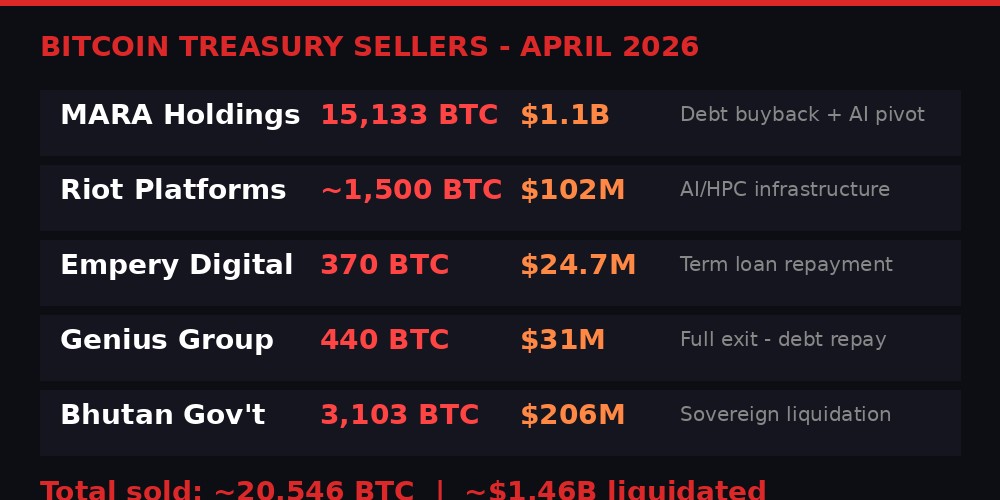
MARA Holdings, one of the largest publicly traded bitcoin miners in the United States, sold 15,133 BTC between March 4 and March 25 for approximately $1.1 billion, according to CoinDesk. The proceeds funded a major balance sheet overhaul - a tender offer to repurchase $1.0 billion in 2030 convertible notes and $925 million in 2031 notes.
After the repurchases, MARA's 2030 notes were reduced to $632.5 million and its 2031 notes to $291.6 million. The company cut its total debt by roughly 30%. Its stock jumped 10% on the announcement, a telling signal: Wall Street rewarded the miner for selling bitcoin, not holding it.
MARA's pivot goes deeper than debt management. The company is reallocating capital toward AI and high-performance computing infrastructure - a trend now visible across the entire mining industry. The message is clear: when the price isn't going up, the "HODL forever" narrative gives way to survival math.
Riot Platforms: Quiet Selling, Loud Pivot
Riot Platforms, another heavyweight miner, moved 500 BTC for roughly $34.13 million on Wednesday, according to blockchain data tracked by Lookonchain. This is not an isolated event. Riot sold approximately $200 million worth of bitcoin in the final two months of 2025 alone, per CoinDesk reporting.
The company reached peak holdings of over 19,000 BTC and now holds roughly 17,500 BTC. Like MARA, Riot is funneling proceeds into AI and high-performance computing - a strategic pivot that acknowledges the mining business model needs diversification when bitcoin spends months range-bound between $60K and $73K.
Empery Digital and Genius Group: The Smaller Casualties
Empery Digital announced on Wednesday that it sold 370 BTC at an average price of $66,632, generating $24.7 million. The firm used proceeds to fully repay its outstanding term loan and released approximately 1,800 BTC that had been held as collateral. Empery began building its bitcoin treasury in July 2025, reaching a peak position of roughly 4,000 BTC. It now holds 2,989 BTC. Its shares are down 75% from the 2025 all-time high of $15.80, per the company's investor relations filings.
Genius Group, an AI-focused education company that adopted a bitcoin treasury strategy, has gone further: it completely exited its position. The company liquidated its last remaining 84 BTC to repay $8.5 million in debt. It had held up to 440 BTC in March 2025. Genius Group stated it will resume building its bitcoin treasury "when market conditions are more favorable" - the corporate euphemism for "we needed the cash."
Bhutan: The Sovereign Seller
The Kingdom of Bhutan, which built its bitcoin holdings over several years through state-backed hydroelectric mining operations, continues to reduce its position. Total sovereign sales have reached 3,103 BTC, with a single transaction on March 30 alone liquidating 375 BTC, according to Glassnode data. Bhutan reached peak holdings of over 13,000 BTC in October 2024.
Sovereign selling hits different. When a country mines bitcoin using renewable energy and then sells into weakness, it signals something beyond balance-sheet management. It suggests the sovereign treasury thesis - that nations would accumulate bitcoin as a strategic reserve asset - has practical limits when budgets need funding and prices aren't cooperating.

The Counter-Trade: Metaplanet's $405 Million Bet
While MARA, Riot, and the smaller players sell, one company is running the opposite playbook. Metaplanet, the Tokyo-based firm that has become Japan's answer to Strategy, acquired 5,075 BTC in Q1 2026 for approximately $405 million at an average price of roughly $79,898 per coin, according to the company's filings.
As of March 31, Metaplanet holds 40,177 BTC total, acquired for approximately $4.18 billion, with an average cost basis of about $104,106 per BTC. The firm has generated a BTC yield of 2.8% year-to-date.
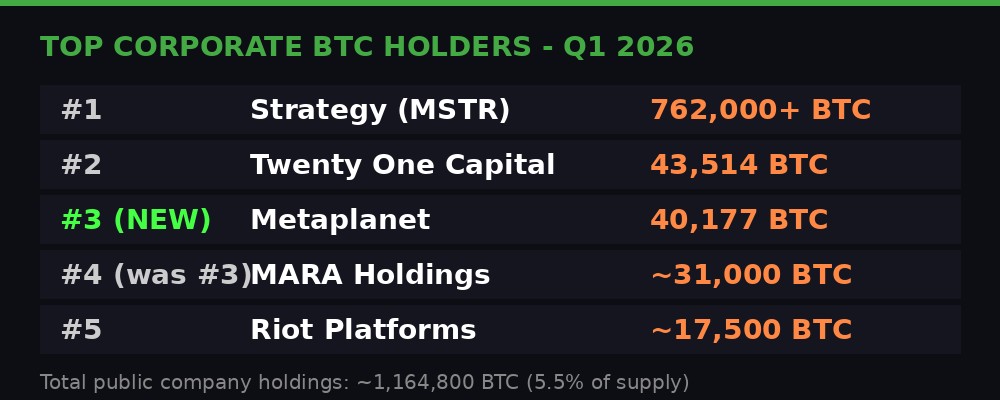
Metaplanet is now the third-largest corporate bitcoin holder worldwide, overtaking MARA Holdings after the miner reduced its stack. The current leaderboard: Strategy (MSTR) leads by a massive margin with over 762,000 BTC. Twenty One Capital holds second place at 43,514 BTC. Metaplanet sits third at 40,177 BTC. MARA has dropped to fourth with roughly 31,000 BTC. Riot rounds out the top five at approximately 17,500 BTC, according to BitcoinTreasuries.net.
There's an irony worth noting. Metaplanet's average cost basis is $104,106 per BTC. Bitcoin trades at $66,250. That's a 36% unrealized loss on the total position. The company's shares were down 2% on Wednesday, trading at 302 yen ($1.89). In a bull market, this is called "buying the dip." In a war-driven consolidation, it's called "catching a knife." Which one it turns out to be depends entirely on whether bitcoin recovers before Metaplanet's balance sheet can't absorb the mark-to-market losses.
Public bitcoin treasury companies still hold around 1,164,800 BTC collectively - over 5.5% of total supply, according to BitcoinTreasuries.net. That's a massive concentration. If the unwind accelerates, the supply hitting exchanges could push prices meaningfully lower.
The Oil Factor: Why $107 Changes Everything

Crude oil at $107 per barrel is not just a commodity price. It's an inflation accelerant, a rate-cut killer, and a recession catalyst all wrapped into one number.
WTI crude jumped 7.3% on Wednesday after Trump's speech, according to StockMarketWatch data. The Strait of Hormuz - through which roughly 20% of the world's oil passes daily - has been effectively shut since mid-March. Every day it stays closed adds pressure to global energy prices, which feeds directly into inflation readings.
The Federal Reserve is watching this with growing concern. Fed Chair Jerome Powell told reporters in March that elevated inflation readings "largely reflect inflation in the goods sector, which has been boosted by the effects of tariffs." Add $107 oil on top of tariff-driven price increases, and the Fed has zero room to cut rates.
Kansas City Fed President Jeff Schmid warned this week against assuming higher energy prices will have only a transitory effect on inflation, noting that inflation was running near 3% even before the Iran war began. St. Louis Fed researchers estimate that tariffs can explain about half of the excess 12-month inflation above 2%, according to Yahoo Finance.
Fed Governor Stephen Miran remains a dissenting voice, telling CNBC that policymakers should disregard the current energy price spike unless there are signs it will have longer-lasting impacts. "If I saw a wage-price spiral, or I saw evidence that inflation expectations are starting to pick up, then I would get worried about it," he said.
For crypto markets, the math is straightforward: higher oil means higher inflation means no rate cuts means no liquidity expansion means risk assets stay under pressure. Bitcoin's strongest historical rallies have been fueled by loose monetary policy. That environment is nowhere on the horizon.
Liberation Day, One Year Later: The $166 Billion Reckoning
Today marks exactly one year since Trump stood in the Rose Garden and announced sweeping tariffs on virtually everything the U.S. imports. He called it "Liberation Day." He promised jobs and factories would come "roaring back." He said consumer prices would fall. He declared April 2 would go down in history as "the day we began to make America wealthy again."
The scorecard is in, and it reads like a policy autopsy.
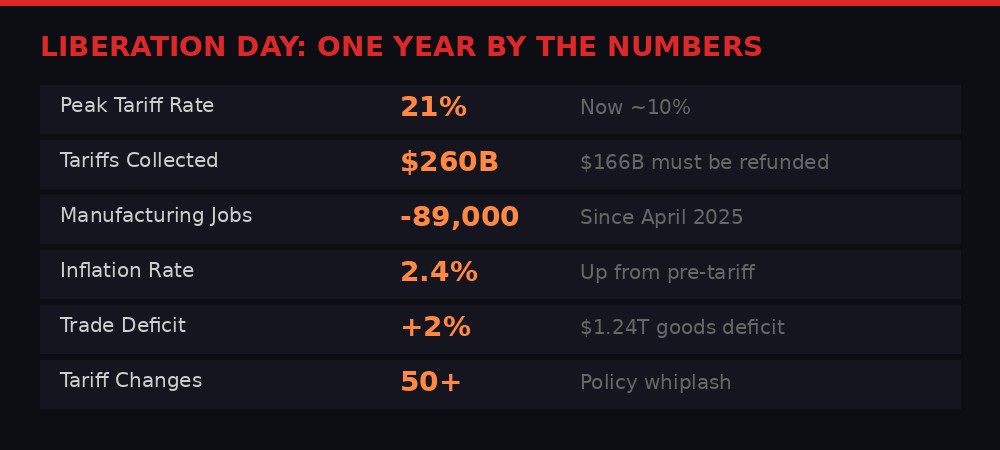
The average tariff rate soared to 21% in the days following Liberation Day, according to the Tax Foundation. Goods from China were briefly subject to 145% tariffs, which brought imports from that country to a virtual standstill. Chinese goods now represent less than 10% of America's overall imports - comparable to levels last seen in 2000 and down from over 20% in 2016, per BBC reporting of Census data.
But the manufacturing boom never arrived. U.S. factories employed 89,000 fewer people in February 2026 than they did in April 2025, when the tariffs took effect, according to NPR's analysis of Bureau of Labor Statistics data. Foreign direct investment was $288 billion last year - slightly less than the previous year and below average for the past decade.
The government collected $151 billion from tariffs in the first five months of the fiscal year - nearly four times the previous year's figure. Most of that tax bill was paid by U.S. importers, and in many cases passed on to consumers. Goldman Sachs estimated in October 2025 that about 55% of new tariff charges were passed through to consumer prices.
Then came the Supreme Court. On February 20, 2026, the Court ruled in Learning Resources, Inc. v. Trump that the International Emergency Economic Powers Act (IEEPA) does not grant the president authority to impose tariffs. The government estimated it collected $166 billion from more than 330,000 businesses in IEEPA tariffs - money it now has to give back.
Customs and Border Protection chief Brandon Lord stated in a March 6 filing that the government was "not able to comply" with the refund order due to the "unprecedented volume of refunds" overwhelming the agency's technology. The refund logistics are still being worked out.
"By our count, tariffs changed more than 50 times between Liberation Day and now. There was just no way for businesses to plan." - Erica York, VP of Federal Tax Policy, Tax Foundation
The total goods trade deficit actually rose 2% to $1.24 trillion. Imports increased 4% to $3.4 trillion despite the tariffs. The decoupling from China was real but uneven - increased imports from Vietnam and Mexico, where Chinese firms boosted investments, suggest supply chains rerouted rather than reshored.
The current effective tariff rate sits at roughly 10%, according to the Tax Foundation - half the Liberation Day peak but still four times higher than the average import tax before Trump returned to the White House. The administration has vowed to resurrect its tariff policies using alternative legal authorities after the Supreme Court ruling. How hard it pushes before the November midterms remains to be seen.
The Divergence: Gold Crashes Too, Everything Correlates to One

The most unsettling signal on Wednesday wasn't bitcoin's drop or stocks selling off. It was gold crashing 4% to $4,590 alongside everything else.
Gold is supposed to be the safe haven. When geopolitical risk spikes, when wars escalate, when inflation fears rise, gold is supposed to go up. Instead, it fell sharply. Silver crashed 7.5%. Both precious metals got hit by the same force that hammered equities and crypto: the surging dollar.
When oil spikes, the dollar strengthens (oil is priced in dollars). A stronger dollar makes gold more expensive for foreign buyers, reducing demand. At the same time, rising inflation expectations push Treasury yields higher, increasing the opportunity cost of holding non-yielding assets like gold and bitcoin.
The result is a correlation spike where everything moves in the same direction - down. Stocks, crypto, gold, silver, foreign equities - all red. The only green: oil, the dollar, and defense stocks. When correlations go to one, there is no hedge. There is no safe haven. There is only cash and crude.
Gold had already endured a 23% crash from its all-time high of $5,595 reached earlier in 2026, according to Middle East Insider analysis. It was in the process of recovering when Trump's speech reversed the rally. For bitcoin maximalists who argue BTC is "digital gold," the fact that actual gold can't hold its bid during a geopolitical escalation is a sobering data point. If physical gold can't be a safe haven in a war, what chance does a volatile digital asset have?
Asian markets bore the brunt. India's BSE Sensex fell 1,500 points (roughly 2%), with the Nifty cracking below 22,300. This was directly attributed to rising crude oil prices - India imports over 80% of its oil, making it extremely vulnerable to price spikes. The rupee weakened against the dollar, compounding the equity selloff.
The Seasonal Mirage and the Path Forward

Bulls will point to seasonality. April has historically been one of bitcoin's strongest months, finishing green 10 out of 15 years with an average gain of 20.9% versus an average decline of 8.8% in down years, according to CoinDesk analysis. Bitcoin also bounced firmly off its two-month uptrend support near $60,000 last week and is attempting to reclaim the 50-day moving average.
But seasonality is a pattern, not a law. It works until it doesn't. And the macro environment facing crypto in April 2026 is unlike anything the seasonal data captures: an active shooting war in the Middle East, oil above $100, a hostile Fed, tariffs in legal limbo, and corporate treasury holders selling into weakness.
The derivatives market tells its own story. Funding rates have turned deeply negative, and open interest is rising - indicating traders are actively shorting BTC and ETH, according to CoinDesk's derivatives reporting. This positioning could fuel a short squeeze if the war actually de-escalates, but it also means the market's base case is further downside.
Implied volatility remains elevated across the options market. The put/call ratio suggests institutional hedging is near its highest level since the initial war shock in early March. Options desks are pricing in a wide range of outcomes: a ceasefire could send bitcoin quickly back toward $73,000-$75,000, while a Strait of Hormuz escalation could test the $60,000 floor that has held so far.
The bitcoin range - $60,000 to $73,000 - has persisted for five weeks. Every escalation headline sends it to the bottom of the range. Every de-escalation headline sends it to the top. And each time, the market ends up roughly where it started. This isn't trading. It's headline arbitrage, and it will persist until the conflict resolves or the range breaks.
What the Treasury Unwind Really Means

The bitcoin treasury unwind is not - yet - a panic. It's a stress test. And the results so far reveal a clear hierarchy among corporate bitcoin holders.
At the top sits Strategy, with over 762,000 BTC and a founder-CEO in Michael Saylor who has made bitcoin his entire identity. Strategy has not sold. At the bottom sit companies like Genius Group, which adopted the bitcoin treasury strategy as a marketing narrative rather than a core conviction. When prices dropped, they folded.
The middle ground is where it gets interesting. MARA selling $1.1 billion to retire debt is rational treasury management. Riot selling to fund AI infrastructure is strategic diversification. These aren't panic moves. They're acknowledgments that holding bitcoin in a flat-to-down market has an opportunity cost, and that capital can be deployed more productively elsewhere.
The concern is what happens if bitcoin drops below $60,000. That's where Metaplanet's $104,106 cost basis becomes a liability rather than an aggressive bet. That's where smaller treasury companies face margin calls on BTC-collateralized loans. That's where the forced selling could cascade into a feedback loop: prices drop, collateral value falls, loans get called, more bitcoin hits the market, prices drop further.
Public companies still hold 1,164,800 BTC collectively. At current prices, that's roughly $77 billion in value. If 10% of that were to hit the market over a quarter, it would represent roughly $7.7 billion in sell pressure - dwarfing the daily spot volume on most exchanges. The treasury trade created a new class of structural buyer on the way up. On the way down, it creates a new class of structural seller.
For now, the selling is orderly. Companies are taking losses strategically, repaying debt, diversifying into AI, and managing balance sheets. The question is whether it stays orderly if the war drags on, oil stays above $100, and the Fed signals no relief through the end of 2026.
The Convergence: War, Oil, Tariffs, and the Fed Walk Into a Market
April 2, 2026 sits at a unique intersection. It's the anniversary of Liberation Day, a tariff policy that the Supreme Court struck down, that cost businesses $166 billion in refunds, that failed to bring manufacturing back, and that added half a percentage point to inflation. It's also the day after Trump told the nation the Iran war is about to intensify, sending oil past $107 and crypto into another round of liquidations.
These are not separate stories. They're the same story. Tariffs raised costs. War raised energy prices. Both feed inflation. Inflation prevents the Fed from cutting rates. Tight monetary policy crushes risk assets. Crushed risk assets force bitcoin treasury companies to sell. Corporate selling adds supply to a market already drowning in fear.
The feedback loop is not theoretical. It's happening right now, in real time, on the screens of every trader watching bitcoin oscillate between $60K and $73K while waiting for the next presidential tweet to determine which direction it moves next.
For Iran, the market needs a ceasefire or at minimum the reopening of the Strait of Hormuz. For tariffs, it needs clarity on which legal authority the White House will use and whether the Supreme Court will block that too. For the Fed, it needs inflation data to cool - which can't happen while oil is above $100 and tariffs are still in effect. For bitcoin, it needs all three of those things, plus time for the treasury unwind to stabilize.
That's a lot of "needs." And none of them are in sight today.
Bitcoin at $66,250. Oil at $107. Fear index at 8. S&P at 6,500. Gold at $4,590. Manufacturing employment down 89,000. Tariff refunds pending at $166 billion. Corporate BTC selling accelerating.
Liberation Day's first anniversary feels less like a celebration and more like a damage report. For markets, the bill is still being tallied. For bitcoin treasury companies, the thesis is being tested. And for everyone watching, the only certainty is that the next Trump speech - on Iran, on tariffs, on anything - will move markets more than any fundamental ever could.
Welcome to Q2 2026. Buckle up.
Get BLACKWIRE reports first.
Breaking news, investigations, and analysis - straight to your phone.
Join @blackwirenews on Telegram