$415M Wiped in 4 Hours: Trump's Truth Social Post Turned Bitcoin Into a Geopolitical Liquidation Machine
One Truth Social post. $3,700 price swing in under an hour. $415 million in leveraged positions vaporized across crypto and commodity futures. This is what it looks like when geopolitics and derivatives collide without warning - and it happened again Monday afternoon, live, with Bitcoin as the instrument.

Bitcoin saw a $3,700 swing in under 60 minutes on Monday following competing headlines from Trump and Iran. (Pexels)
How One Post Moved $415 Million

The derivatives market amplified the headline impact roughly 5x compared to spot market reactions. (Pexels)
Bitcoin opened the Asian session Monday grinding between $67,500 and $68,500. Low volatility. Directionless. Traders were positioned for escalation - the market consensus was that Trump's 48-hour ultimatum to Iran, issued over the weekend, would lead to strikes on Iranian power plants. Shorts had built up. Volume was thin. The setup was loaded.
Then, at approximately 11:00 AM Eastern, President Trump posted on Truth Social that he had instructed the Pentagon to postpone all strikes against Iranian energy infrastructure for five days. He cited "very good and productive conversations" between the U.S. and Iran toward a "complete and total resolution" of hostilities.
Bitcoin spiked from $67,500 to above $71,200 in under an hour. The short squeeze was immediate and violent. CoinGlass data shows $280 million in short positions were liquidated in the four-hour window following the post - the market had been positioned for war, and peace wiped them out.
Then came the counter-punch. Iran's semi-official Fars news agency published a statement from an anonymous source saying: "There is no direct or indirect communication with Trump." The same source added that Trump "retreated after hearing that our targets would be all power plants in West Asia." Iran denied the talks. They denied the peace. Bitcoin gave back roughly $1,200 from its high within minutes.
Longs who chased the spike were hit for $135 million. The session ended with Bitcoin holding $70,000 - up 2.3% on the day - sitting in the middle of a range carved out by two contradictory Truth Social-driven headlines inside of 90 minutes.
Source: CoinDesk, CoinGlass data, March 23, 2026
The Liquidation Map: Bitcoin, Ether, and Brent Oil on Hyperliquid
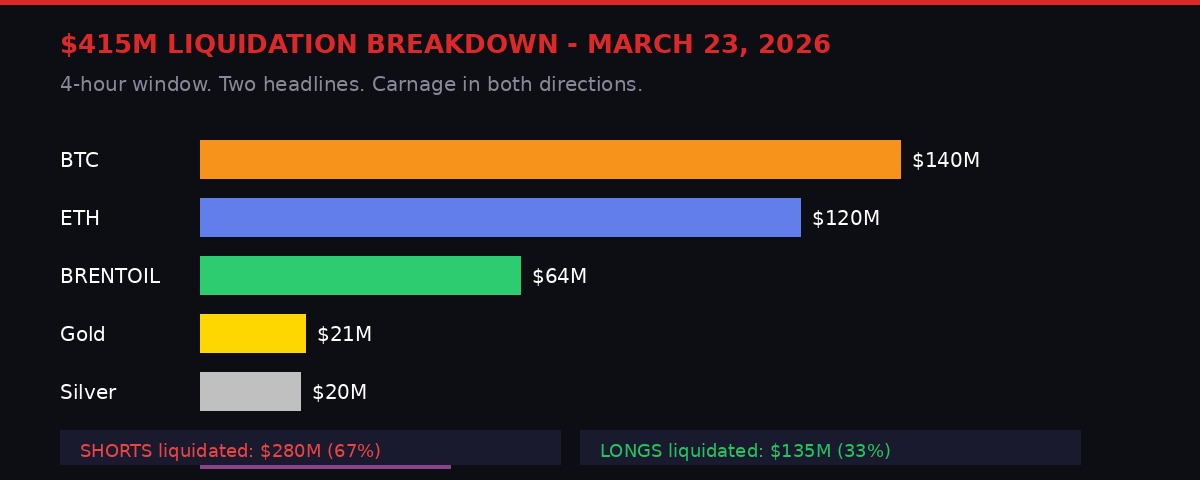
Full liquidation breakdown by asset. Oil longs on Hyperliquid were almost entirely one-sided. (BLACKWIRE / CoinGlass)
The damage was not contained to Bitcoin. The four-hour liquidation cascade spread across multiple assets simultaneously, each responding to the same geopolitical signal but from different directions.
Bitcoin absorbed $140 million of the total - the largest single-asset portion. Ether followed at $120 million. These were diversified between longs and shorts as the market whipsawed in both directions. But the most telling number came from a corner of the market that most traditional finance desks don't watch closely: Hyperliquid's XYZ:BRENTOIL perpetual contract.
Brent oil futures on Hyperliquid saw $64.4 million wiped - and the losses were almost entirely one-sided. Longs. Traders who had correctly anticipated that Trump's ultimatum to Iran meant imminent military action against energy infrastructure had loaded up on oil longs, expecting supply disruptions from Middle Eastern oil infrastructure to push crude prices higher. They were right about the geopolitics. They were wrong about the tweet.
Tokenized gold lost $20.9 million. Tokenized silver lost $19.8 million. These "safe haven" derivatives sold off as risk appetite briefly surged on the Trump peace signal - exactly the wrong response for anyone who had loaded gold as a geopolitical hedge and assumed the conflict was about to get worse.
"The nearly 2-to-1 ratio of short liquidations to long liquidations suggests the market was heavily positioned for escalation when Trump's post landed," CoinDesk noted in its analysis of the session data. The short positioning made sense given the context. The failure mode was assuming that the next headline would be a bombing, not a peace announcement.
"The macro ceiling has shifted. How much room opens up depends on the next five days." - Jasper de Maere, OTC Trader, Wintermute
Source: CoinDesk, Wintermute, March 23, 2026
The Iran Factor: What's Actually Happening and Why Markets Can't Price It

Markets are trading geopolitical headlines with the same leverage tools built for earnings reports. The mismatch is creating cascading volatility. (Pexels)
The underlying situation is genuinely uncertain - which is precisely why the market is being serially punished for taking directional bets.
Trump issued a 48-hour ultimatum to Iran over the weekend, threatening to strike Iranian power plants unless Tehran agreed to halt uranium enrichment. That deadline created a countdown that derivatives traders could build positions around: either the strikes happen, oil goes up, safe havens go up; or a deal gets done, oil goes down, risk assets rally.
The problem is that the information flow is not bilateral. Trump announces peace talks. Iran announces there are no peace talks. Nobody in the market knows which signal is real, which is strategic messaging, and which is one party trying to position the other diplomatically. The result is a market that gets whipsawed by every statement from every actor with a microphone.
By Tuesday morning, the situation deteriorated further. Reports emerged that Saudi Arabia and the UAE were moving to allow U.S. forces to use their military bases for operations against Iran, signaling a potential broader regional coalition. Traditional markets reversed Monday's gains. Oil jumped 4% on the news. But Bitcoin - unusually - held above $70,000 even as equities slid.
That divergence is worth noting. For most of 2025, crypto tracked equities almost mechanically. The fact that Bitcoin is demonstrating any independence from traditional risk-off moves may signal a structural shift in how institutional players are allocating between asset classes during geopolitical stress periods.
Timeline: The 48-Hour Whipsaw
Derivatives at 5x Spot: How the Liquidation Amplifier Works
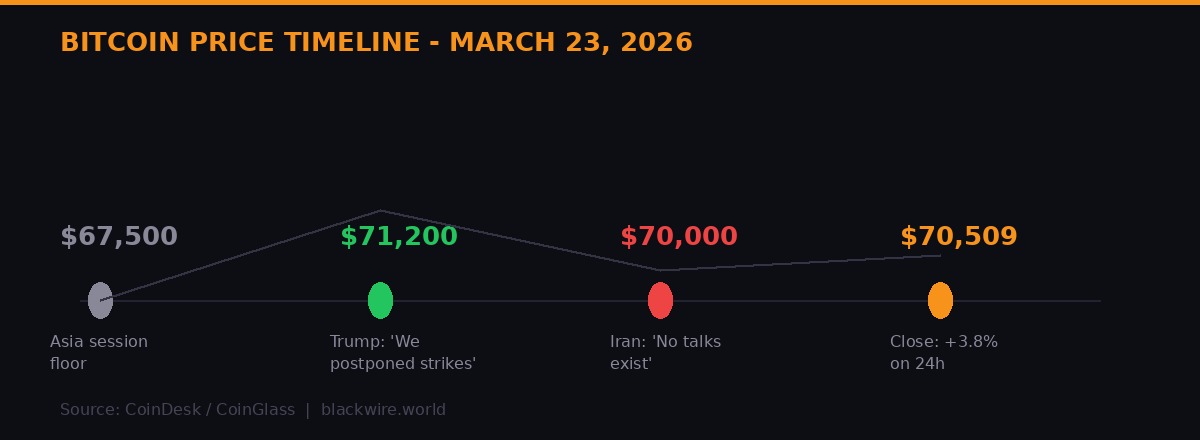
Bitcoin's full price arc on March 23: two headlines, two direction reversals, moderate net gain, massive derivative damage. (BLACKWIRE / CoinDesk)
The session reinforced a dynamic that has been building for months. As CoinDesk noted earlier this month, Bitcoin futures trading on Binance is now running at five times the volume of spot markets. That ratio matters enormously when a shock hits.
In a market where derivatives volume dwarfs spot by 5x, every external shock gets run through a leverage amplifier. The mechanics are straightforward: when a bullish headline arrives, short positions start getting squeezed and forced to close. Those forced closures push the price up further, which triggers more short liquidations. The cascade feeds itself until the leveraged positions are cleared. Then, when a bearish counter-headline arrives, the same mechanism runs in reverse for longs.
The net price movement often ends up modest - Bitcoin was only up 2.3% on the day after all of Monday's fireworks. But the cost to leveraged traders is not modest. $415 million cleared in four hours while the underlying asset barely moved on a closing basis.
This is not a bug. It's the feature. Derivatives markets exist to let participants take leveraged directional bets. The problem is that when the underlying signal generating those moves is a social media post from the president of the United States about whether or not he is bombing a country, the pricing mechanism becomes structurally unreliable. The information asymmetry between Trump (who knows what the actual diplomatic situation is) and the market (who knows only what was posted to Truth Social) is not something that technical analysis can bridge.
Wintermute's Jasper de Maere outlined the clean binary for the next five days. If talks materialize and oil stabilizes, inflation concerns ease, rate-cut expectations return, and Bitcoin could make another run at the $74,000-$76,000 range that has capped recent rallies. If talks collapse and the Strait of Hormuz faces renewed disruption pressure, Bitcoin likely revisits the mid-$60,000s.
There is a third scenario that de Maere didn't name explicitly but that Tuesday's Saudi-UAE reports are making more plausible: a broader regional war that pushes oil toward $120-$130 and creates a genuine macro shock. In that case, the mid-$60,000s may be the optimistic floor.
Strategy's $42B Reload: Saylor Stays Systematic While Markets Panic

Strategy's systematic accumulation continues regardless of geopolitical volatility. The company now holds 762,099 BTC across all market conditions. (Pexels)
While traders were getting liquidated in real time on Monday, Michael Saylor's Strategy was filing paperwork to reload its buying capacity to $42 billion.
The company filed an 8-K with the SEC on March 23 detailing a new at-the-market equity program split between $21 billion in Class A common stock (MSTR) and $21 billion of its Variable Rate Series A Perpetual Stretch Preferred Stock (STRC). The company also introduced a new $2.1 billion ATM program for its STRK preferred series, replacing a prior program.
The capital-raising syndicate was also expanded. Strategy added Moelis and Company, A.G.P./Alliance Global Partners, and StoneX Financial to its network of sales agents, bringing the total to 19 firms. These intermediaries sell shares gradually into the market rather than executing large one-time block deals, allowing Strategy to accumulate capital without triggering sharp moves in its own stock price.
As of March 22, Strategy still had significant capacity remaining on existing programs: approximately $6.24 billion of common stock, $1.98 billion of STRC, $20.33 billion of STRK, and $1.62 billion of STRF available for issuance. The new programs essentially top up and extend the machine that has been running continuously since August 2020.
The previous week, Strategy added 1,031 Bitcoin for $76.6 million - described internally as a "small" purchase - bringing total holdings to 762,099 BTC. At current prices near $70,000, that stash is worth approximately $53.3 billion.
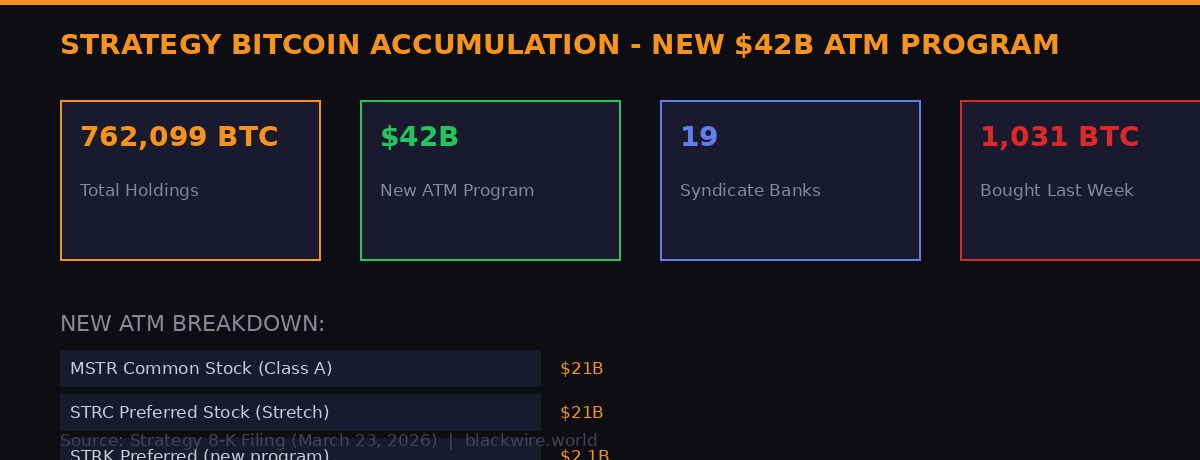
Strategy's new $42B ATM program breakdown and current holdings as of March 23, 2026. (BLACKWIRE / Strategy 8-K)
The contrast with Monday's market action is stark. While $415 million in leveraged positions were being liquidated in four-hour windows by traders trying to front-run Trump's Truth Social posts, Saylor's machine was filing paperwork to add tens of billions more in systematic Bitcoin-buying capacity. The two approaches represent fundamentally different philosophies about how to interact with Bitcoin's volatility: one is trying to trade it, the other is ignoring it.
Strategy's approach has worked at the macro scale - the position is enormously profitable over any multi-year horizon. But it's also backed by infinite buying power sourced from equity and preferred stock markets that retail traders don't have access to. Comparing the retail leveraged trader getting liquidated on Monday to Saylor's machine is not apples to apples. It's apples to a fruit distribution company.
Source: Strategy 8-K Filing (March 23, 2026)
Fink Goes All-In on Tokenization: BlackRock's $150B Bet on Digital Finance

BlackRock's BUIDL fund is now the largest tokenized fund in the world, managing nearly $150B in digital asset-connected assets. (Pexels)
The same day Bitcoin was getting whipsawed by geopolitics, BlackRock CEO Larry Fink published his annual letter to shareholders - and it reads like a manifesto for the tokenization of the entire financial system.
Fink's letter covers a lot of ground - inequality, Social Security reform, the limits of traditional finance. But the crypto-relevant section is explicit and ambitious. He argues that tokenization is "the internet of finance" - specifically comparing the current moment to 1996, when the internet was already technically real but had not yet reached mainstream application.
"Half the world's population carries a digital wallet on their phone. Imagine if that same digital wallet could also let you invest in a broad mix of companies for the long term - as easily as sending a payment." - Larry Fink, BlackRock CEO, Annual Shareholder Letter, March 2026
This is not theoretical positioning from Fink. BlackRock has built the infrastructure to back the bet. The company's USD Institutional Digital Liquidity Fund (BUIDL) is now the largest tokenized money market fund in the world. The firm manages $65 billion in stablecoin reserves - largely through Tether and Circle partnerships on the back end. And it controls nearly $80 billion in digital asset exchange-traded products, including the spot Bitcoin ETF that launched in 2024.
Total digital asset-connected assets under BlackRock management: approximately $150 billion. That's not a footnote in a diversified portfolio. That's a core strategic commitment from the largest asset manager on earth.
Fink's proposed end state is a world where digital wallets on phones hold not just payment tokens but fractional ownership of ETFs, bonds, infrastructure projects, and private credit. The plumbing that currently requires T+2 settlement, clearinghouses, custodians, and brokers would be replaced - gradually - by programmable digital ledgers that execute instantly and cheaply.
He stopped short of naming specific chains or protocols, which is consistent with BlackRock's policy of operating across multiple platforms rather than picking infrastructure winners. BUIDL runs on Ethereum. Their distribution partnerships span Solana, Aptos, and others. Fink is not a maximalist - he's an allocator, and he's allocating institutional credibility to the category without betting on a single horse.
The political dimension is also notable. Fink's letter comes at a moment when the U.S. Crypto Clarity Act is stalled in the Senate over the stablecoin yield question (more on that below). His public endorsement of tokenization as infrastructure-level reform creates political pressure for legislators who might otherwise delay. When the CEO of a $10 trillion asset manager says digital wallets and tokenized assets are the future of capitalism, senators on the fence have to reckon with that signal.
Source: BlackRock Annual Chairman's Letter, March 2026
The Stablecoin Yield War: Congress Can't Close the Deal

The Crypto Clarity Act is stalled over who gets to earn yield on stablecoins - crypto protocols or traditional banks. (Pexels)
One floor below the geopolitical chaos and institutional accumulation stories sits a quieter but potentially more consequential battle: Congress is still trying to figure out stablecoins, and the latest draft of the Crypto Clarity Act has frustrated the industry.
On Friday, Senators Angela Alsobrooks and Thom Tillis announced they had reached a compromise on the stablecoin yield question - the key sticking point that had blocked progress on the Digital Asset Market Clarity Act for months. On Monday, the crypto industry got its first look at the actual legislative language in a closed-door Capitol Hill session.
The reaction was not positive. According to a person familiar with the review, the new language bans yield payments for simply holding a stablecoin and further restricts any approach that makes a stablecoin yield program functionally equivalent to a bank deposit. The mechanics of what is actually allowed - activity-based rewards rather than balance-based yields - remain unclear in the current draft.
The banking industry had lobbied hard for these restrictions. The argument: if stablecoins can pay 4-5% yield on balances (comparable to money market rates), they become a direct competitor to bank deposits, which could starve lending capacity and destabilize the deposit base that banks use to fund loans. Bankers wanted the Clarity Act to draw a bright line between stablecoins and deposits.
The crypto industry's counter-argument is equally coherent: DeFi protocols like Aave, Compound, and Maker already pay yield on stablecoin deposits. Millions of users are already earning that yield. If the Clarity Act bans the practice for regulated issuers while leaving it intact for unregulated DeFi protocols, the legislation creates a competitive asymmetry that drives activity toward less compliant structures - exactly the opposite of what regulators want.
Bull Case for Clarity Act
- First major crypto legislation in U.S. history would eliminate regulatory uncertainty
- Could unlock institutional capital that has been sitting on the sidelines
- DeFi oversight provisions would give banks comfort that unregulated competition gets addressed
- Market structure framework comparable to what EU MiCA provides
Bear Case / Sticking Points
- Stablecoin yield ban would disadvantage regulated issuers vs. DeFi protocols
- Democrats insisting on Trump personal profit ban (aimed at TRUMP token / World Liberty)
- DeFi oversight language remains vague - won't satisfy anti-illicit-finance advocates
- Senate Banking Committee hearing still not scheduled
The Democrats have also maintained a separate demand that almost certainly will not survive: a provision banning senior government officials from personally profiting from the crypto industry. That provision is aimed squarely at President Trump, whose TRUMP meme token and World Liberty Financial project have generated substantial personal income since taking office. Republicans are not going to vote for a bill that functionally attacks the sitting president's business portfolio.
The GENIUS Act - the simpler stablecoin-only bill - became law last year and represented a meaningful first step. But the Clarity Act is supposed to be the comprehensive framework that actually brings crypto into the regulated financial mainstream. As long as yield and DeFi oversight remain unresolved, the institutional flood gates that Fink and others are counting on stay partially closed.
Source: CoinDesk Policy Desk, March 23, 2026
What Happens Next: The Five-Day Window That Prices Everything

The next five days will determine whether Bitcoin runs to $74K-$76K or retreats to the mid-$60,000s. Oil and diplomatic signals are the variables. (Pexels)
Trump's five-day pause expires this weekend. Between now and then, every diplomatic signal, every Iranian statement, every Saudi positioning move will hit the Bitcoin price in real time - amplified 5x through the derivatives stack.
Wintermute's framework is clean. Oil stability plus diplomatic progress equals Bitcoin at $74,000-$76,000. Oil shock plus conflict escalation equals Bitcoin at mid-$60,000s. The Tuesday reports of Saudi Arabia and the UAE entering the coalition alignment are not pointing toward the first scenario.
The longer-term picture has at least three separate forces all moving simultaneously. Geopolitical risk is rising - the Middle East situation is expanding, not contracting, regardless of Monday's temporary pause. Institutional accumulation is accelerating - Strategy just reloaded to $42 billion in buying capacity, Fink is publicly evangelizing tokenization, and Tom Lee's Bitmine purchased another $138 million in Ethereum last week. Legislative clarity remains elusive - the Clarity Act's stablecoin yield dispute is not resolved and a Senate Banking Committee hearing is still not scheduled.
These forces don't point in the same direction. Geopolitical escalation pressure pulls Bitcoin down. Institutional accumulation pulls it up. Legislative clarity (if it comes) pulls it up. The market is caught between all three simultaneously, which is exactly why a single Truth Social post can generate $415 million in liquidations in four hours - there's no consensus on fair value because there's no consensus on which macro regime we're actually in.
The derivatives market's 5x size advantage over spot means the volatility will continue to be amplified. Anyone running leverage through this period is betting on the right answer to questions that have not been answered yet. That's not analysis. That's a coin flip with borrowed money.
The traders who got liquidated Monday were not stupid. They read the situation correctly - Trump had threatened Iran, the deadline was real, the ultimatum language was serious. The failure mode was assuming that the first Trump social media post of the day would be about the bombing, not the postponement. In a world where foreign policy runs through Truth Social, that's the risk you take.
Saylor doesn't take that risk. He buys every week, regardless of the macro. It's boring. It has worked for six years straight. And on Monday, while everyone else was getting liquidated, his company filed paperwork to do it even more aggressively.
Get BLACKWIRE reports first.
Breaking news, investigations, and analysis - straight to your phone.
Join @blackwirenews on Telegram