The $10 Billion ETH Bet: $6.5B Underwater and Still Buying
Bitmine Immersion Technologies now controls 3.8% of every Ethereum token in existence - roughly 4.59 million ETH worth over $10 billion. It is sitting on an estimated $6.5 billion in unrealized losses. This week it bought 60,999 more. Behind that trade is a thesis that could either redefine corporate finance or become the most spectacular single-asset overexposure in crypto history.

Corporate treasury strategies built around crypto are accelerating in 2026, following the MicroStrategy playbook. Photo: Pexels
The number is not a typo. One company. Nearly four cents of every ether that circulates. And this week's purchase of 60,999 ETH - worth roughly $140 million at current prices - was only marginally larger than last week's haul of 60,976 tokens. Bitmine has found its rhythm. It buys big, it buys steady, and it buys regardless of whether the market is working for or against it.
The firm's stock, trading under the ticker BMNR, jumped nearly 9% in pre-market trading as Ethereum staged an 8.4% weekend rebound following a brutal stretch that saw ETH break below $2,000. That recovery gives Bitmine shareholders a brief window of relief. But the $6.5 billion in unrealized losses sitting on the balance sheet - confirmed by data from DropsTab - makes this one of the most high-stakes conviction trades in corporate finance history. Source: CryptoBriefing
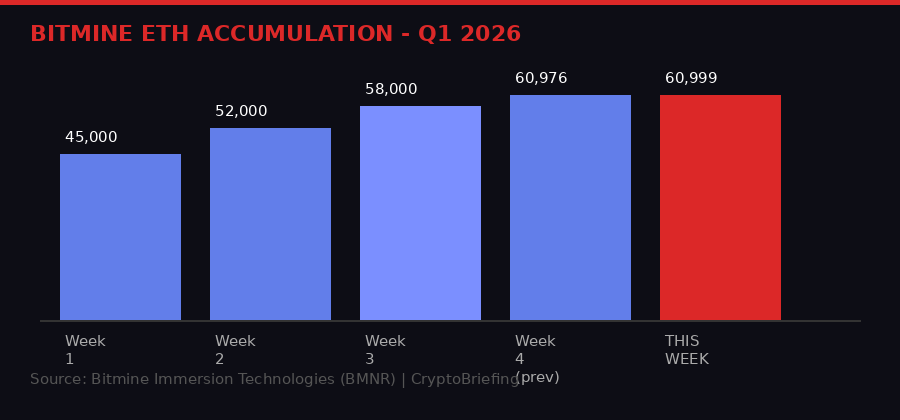
Bitmine's weekly ETH purchases in Q1 2026. The pace is accelerating. Source: BLACKWIRE / Bitmine filings
The Anatomy of a $10 Billion Position

Ethereum's proof-of-stake architecture makes it the only major crypto network generating meaningful staking income for large holders. Photo: Pexels
Bitmine is not running a standard crypto investment fund. The company has constructed what amounts to a vertically integrated Ethereum exposure machine - it accumulates tokens, stakes a majority of them to generate yield, and uses the resulting cash flow to justify further accumulation. The staking income is the thesis. The price appreciation, if it comes, is the upside.
Of Bitmine's 4.59 million ETH, approximately 3.04 million tokens are actively staked. The company claims this generates around $180 million in annualized staking revenue. That figure is worth scrutinizing - standard Ethereum staking yields have hovered between 3.4% and 3.8% annually for most of the past two years, but Bitmine's claimed return works out to roughly 5.9%. That outperformance suggests the company is accessing MEV-boost rewards, liquid staking derivatives, or restaking protocols that carry additional risk layers not always disclosed in headline figures.
Still, even at conservative network-average rates, 3.04 million staked ETH generates north of $100 million annually in protocol rewards. That is real cash flow from network participation, not speculation - and it is the core of Bitmine chairman Tom Lee's argument for why an Ethereum treasury strategy makes structural sense even during brutal drawdowns.
Bitmine (BMNR) - Financial Snapshot
- Total ETH Holdings 4.59M tokens
- Portfolio Value $10.0B+
- Unrealized Loss (est.) -$6.5B
- Cash Reserves $1.2B
- ETH Staked 3.04M (66.2%)
- Claimed Annual Staking Revenue ~$180M
- Claimed Staking Yield ~5.9% APY
- ETH Supply Controlled 3.8% of all circulating ETH
- BMNR Pre-Market Move (this week) +9%
- This Week's Purchase 60,999 ETH (~$140M)
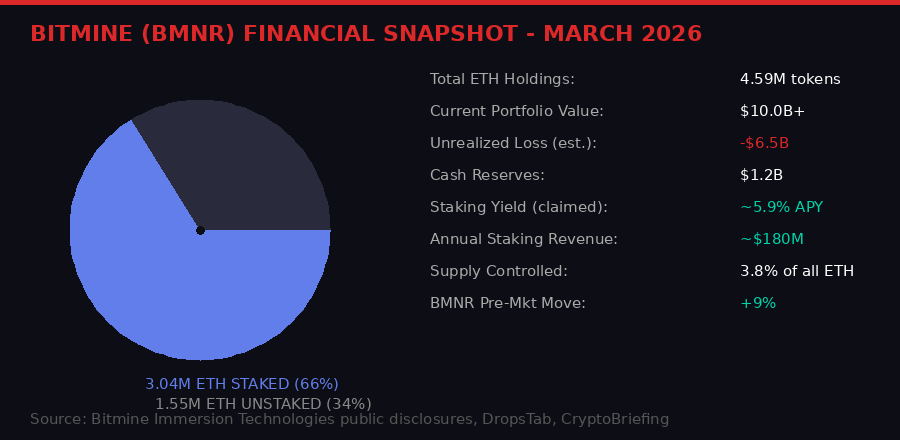
Bitmine's staked vs unstaked ETH split and key financial metrics as of March 2026. Source: BLACKWIRE / DropsTab / CryptoBriefing
Chairman Tom Lee - the Fundstrat co-founder who has been crypto's most prominent mainstream advocate since the mid-2010s - offered a macro frame for the accumulation in remarks tied to the latest purchase announcement:
"Since the start of the Iran war, crypto prices have outperformed and Ethereum has outperformed the S&P 500 by 2,450 basis points. In our view, higher oil is triggering concerns of slowing growth for the global economy. And when investors worry about growth, they buy 'growth stocks' including MAG7, software and crypto." - Tom Lee, Bitmine Chairman and Fundstrat Co-Founder
That framing is aggressive. Lee is positioning crypto - and ETH specifically - as a flight-to-growth asset when investors fear macro stagnation. The 2,450 basis point outperformance over the S&P 500 cited is a striking data point if it holds up over a longer timeframe. The Iran conflict timeline remains short, though, and regime-change narratives in markets can unravel fast when the catalyst shifts.
The MicroStrategy Playbook, Mutated

The MicroStrategy model - loading a corporate balance sheet with a single digital asset - has spawned imitators across multiple blockchains. Photo: Pexels
When MicroStrategy - now rebranded as Strategy - began its Bitcoin treasury accumulation in August 2020, the dominant reaction was disbelief. A business intelligence software company was betting its entire balance sheet on a volatile digital commodity? Michael Saylor was either a visionary or a lunatic, and the market would decide which.
It decided: visionary. Strategy's stock has been among the best-performing public equities in recent years. Other companies followed the playbook. By early 2026, the corporate Bitcoin treasury model has enough examples to be called a trend rather than an anomaly.
Bitmine is running the same play with Ethereum - but with a meaningful structural difference. Bitcoin pays no yield. Holding BTC in a corporate treasury is a pure price appreciation bet, backed by the scarcity narrative. Ethereum's proof-of-stake architecture changes the calculation. A company holding large quantities of ETH can stake those tokens and earn protocol-level returns. The treasury generates income.
That income narrative is what makes Bitmine's pitch to institutional investors coherent even during a drawdown. "We're not just holding an asset hoping it goes up" is a more defensible institutional story than "we're holding an asset hoping it goes up." Whether the math survives a prolonged ETH bear market is a different question - but the pitch itself is structurally stronger than the Bitcoin treasury model it adapts.
The company also increased its stake in Eightco (ORBS), a Worldcoin-focused treasury firm, this week - signaling that its crypto ambitions extend beyond Ethereum alone. The portfolio is diversifying even as the core ETH position grows ever more concentrated.
Pharma Becomes a DeFi Whale: The SDEV Play

NovaBay Pharmaceuticals sold antimicrobial eye drops. Stablecoin Development Corp buys DeFi governance tokens. The rebrand represents one of the strangest pivots in corporate finance. Photo: Pexels
The Bitmine story is large-scale institutional conviction. The NovaBay story is something stranger.
NovaBay Pharmaceuticals - a micro-cap company best known for an FDA-cleared wound care solution called NovaBay - has rebranded itself as Stablecoin Development Corp, trading under the ticker SDEV. The name change follows a $134 million private placement and the acquisition of 2.06 billion SKY tokens, representing approximately 8.78% of the token's entire circulating supply. That haul is now valued at roughly $147 million. Source: CryptoBriefing
SKY is the governance token for Sky Protocol - formerly MakerDAO - the DeFi system behind USDS, a decentralized stablecoin. Holding SKY tokens is not just a yield play. It is a voting rights play. A single entity controlling nearly 9% of a governance token's supply does not merely earn rewards from staking - it earns the ability to influence protocol decisions, collateral requirements, fee structures, and the direction of the entire ecosystem.
Stablecoin Development Corp (SDEV) - Key Stats
- Former Identity NovaBay Pharmaceuticals (NBY)
- Private Placement Size $134M
- SKY Tokens Acquired 2.06 billion
- Percentage of SKY Supply 8.78%
- Current Holding Value ~$147M
- Average Purchase Price ~$0.065/token
- Staking Yield >10% annually
- Staking Rewards Earned 26.6M SKY tokens
- SDEV Stock Move on Announcement +5%
The company accumulated its position partly through open-market purchases at an average price of around $0.065 per token. It has already staked the holdings for yields management claims exceed 10% annually. That staking activity has generated 26.6 million SKY tokens in rewards - the treasury is printing more governance power just by sitting there.
There is a plausible strategic angle buried beneath the headline absurdity. A publicly traded company with deep governance sway over a stablecoin protocol could theoretically push USDS toward regulated healthcare payment rails - clinical trial disbursements, insurance settlements, tokenized pharmaceutical supply chain finance. NovaBay's regulatory relationships with the FDA could theoretically become an asset in navigating stablecoin integration into healthcare. Whether SDEV actually pursues that vision or simply treats SKY as a yield farm with a stock ticker attached remains to be seen.
The bear case is stark. This is a micro-cap company concentrating its entire balance sheet in a single volatile governance token with DeFi regulatory exposure. If the SEC decides governance tokens are securities, or if Sky's protocol economics shift unfavorably, SDEV has no fallback business. It exited the pharmaceutical industry. There is no Plan B in the filing cabinet.
Visa's Trillion-Dollar Bet on AI Agent Commerce

Visa processes $16.7 trillion in annual payment volume and is betting its next two decades of growth on AI agents transacting autonomously on behalf of humans. Photo: Pexels
While crypto treasuries make headlines, Visa's chief product and strategy officer said something last week that deserves more attention from the crypto market than it has received.
Jack Forestell, speaking at the Wolfe Research FinTech Forum, called "the agentic web the biggest opportunity that I've seen in my 20-plus years in payment technology." This is not a mid-level product manager with a bold deck. This is the strategic thesis of a $592 billion company processing roughly $16.7 trillion in annual payment volume. When Visa re-orients around a concept, the payments industry listens. Source: CryptoBriefing
The concept - agentic commerce - means AI agents executing purchases autonomously on behalf of users. Not browsing and suggesting. Deciding, selecting, and transacting. Amazon's AI assistant Rufus reached 250 million active users in 2025, and shoppers who used it were 60% more likely to complete a purchase than those browsing without it. The friction reduction alone is measurable in billions of dollars.
Forestell laid out four pillars of how agentic commerce expands Visa's business:
Friction elimination: AI agents optimize payment routing, retry failed authorizations, and select optimal payment methods in milliseconds. When success rates climb, transaction volumes climb with them.
Transaction density acceleration: Agents break purchases into smaller increments - compute by the second, streaming by the minute. Each micro-transaction is another pass through Visa's network.
B2B modernization: Business-to-business payments remain shockingly manual. Supplier onboarding, invoicing, reconciliation - all friction that agents can eliminate. The B2B market dwarfs consumer commerce and has been stubbornly resistant to digitization.
Total economic expansion: Every major wave of payments innovation has grown the total pie rather than just redistributed it. Visa's argument is that agentic commerce will do the same through efficiency gains.
Visa has responded with a Trusted Agent Protocol - a digital handshake system designed to verify that an AI agent is legitimate and that its instructions are authorized before money moves. In a world where bots execute transactions on your behalf, trust infrastructure becomes a moat. The firm's AI fraud detection systems already analyze roughly 300 billion transactions per year and prevented over $40 billion in fraudulent activity last year alone, with an 85% improvement in detection rates attributed to machine learning.
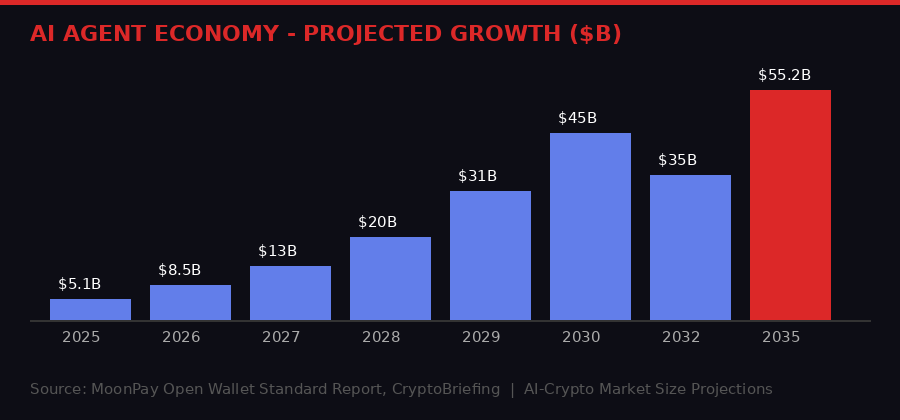
The AI-crypto intersection is projected to grow from $5.1B in 2025 to $55.2B by 2035. Agent-executed transactions could represent 30% of all crypto volume by then. Source: MoonPay / CryptoBriefing / BLACKWIRE research
MoonPay's Open Wallet Standard: The Missing Layer

AI agents conducting autonomous transactions need standardized wallet infrastructure. Until now, every agent framework was building its own key management from scratch. Photo: Pexels
If Visa's bet on agentic commerce is a demand-side thesis, MoonPay just shipped the supply-side infrastructure that makes it possible.
On March 23, MoonPay launched the Open Wallet Standard (OWS) - an open-source framework that gives AI agents a secure, universal interface for holding funds, signing transactions, and interacting with blockchains. The standard is live on GitHub, npm, and PyPI. Backing comes from more than 15 organizations: PayPal, OKX, Ripple, Circle, the Ethereum Foundation, the Solana Foundation, TON Foundation, Filecoin Foundation, LayerZero, Virtuals, and others. Source: CryptoBriefing
The problem OWS solves is deceptively fundamental. Over 340,000 on-chain wallets were held by AI agents in Q1 2026 alone. But every agent framework has been building its own key management from scratch, writing its own signing logic, creating wallets incompatible with other agent systems. The result is fragmentation that would make early Android look organized. Worse, private keys have routinely ended up stored in environment variables or plaintext config files - the digital equivalent of taping your house key to the front door.
"The agent economy has payment rails. It didn't have a wallet standard. We built one, open-sourced it, and now the full stack exists." - Ivan Soto-Wright, CEO and co-founder of MoonPay
The OWS is released under an MIT license. At its core, it defines how AI agents create wallets, manage keys, sign transactions, and interact with blockchain networks - without ever exposing a private key to the agent itself. The AI agent can authorize a payment, but never sees or holds the cryptographic secret that makes that payment possible. It is structurally analogous to giving an assistant a corporate credit card with spending limits rather than handing them your banking credentials.
Multi-chain coverage spans EVM-compatible chains (Ethereum, Base, Polygon, Arbitrum), Solana, Bitcoin, TON, Tron, Sui, and others. That breadth matters because the emerging agent economy does not live on a single blockchain. An AI agent booking compute resources might pay on one chain, then settle a data purchase on another within the same session.
The contributor list - PayPal, Circle, Ethereum Foundation, Solana Foundation - signals something beyond a well-funded open-source project. This looks like industry coordination around a standard that the largest players in both traditional and decentralized finance expect to underpin the next phase of economic infrastructure. When Stripe and Tempo separately launched a micropayment platform designed for AI-to-AI transactions days before MoonPay's announcement, the timing stopped looking coincidental.
SoftBank's Leverage Ceiling: Warning Sign or Green Light?

SoftBank's CFO opened the door to temporarily exceeding the firm's self-imposed 25% loan-to-value ceiling - signaling aggressive AI deployment ahead. Photo: Pexels
SoftBank's chief financial officer, Yoshimitsu Goto, said last week that the firm "does not rule out" the possibility of its loan-to-value ratio temporarily climbing above its self-imposed 25% ceiling. In English: the company is preparing to borrow more, and telling the market not to panic when the leverage numbers look stretched. Source: CryptoBriefing
The context matters. SoftBank committed $100 billion to its Stargate joint venture with OpenAI and Oracle earlier in 2026. CEO Masayoshi Son has called AI the defining investment opportunity of his career - a statement that carries weight from a man who previously assembled the Vision Funds and wrote nine-figure checks to WeWork. That capital deployment does not come cheap. Writing ten-figure checks requires either selling existing positions or taking on more debt.
For the crypto-adjacent market, SoftBank's AI spending spree has indirect implications that are worth tracking. The firm's massive bets on AI infrastructure could accelerate demand for decentralized compute networks and GPU tokenization projects - sectors gaining traction as centralized AI costs balloon. If SoftBank is willing to lever up for AI at scale, it validates the thesis that capital will flow aggressively into the space, with some of that inevitably spilling into crypto-native AI plays.
There is also the Arm factor. SoftBank's roughly 90% stake in chip designer Arm Holdings represents a huge slice of the company's asset column. Any dip in Arm's share price mechanically pushes the LTV ratio higher even if debt levels stay flat. The CFO's "temporary breach" framing is partly a response to that mechanical reality - the firm wants the market to understand that a number above 25% does not necessarily indicate a crisis, just volatility in a volatile asset base.
The risk scenario to watch: if Arm's valuation drops materially while SoftBank's debt is elevated, the firm could find itself forced into emergency asset sales. That scenario played out in 2020 and required SoftBank to sell large stakes in multiple portfolio companies under pressure. A repeat would create ripple effects across the tech-and-crypto AI sector that few market participants are pricing in.
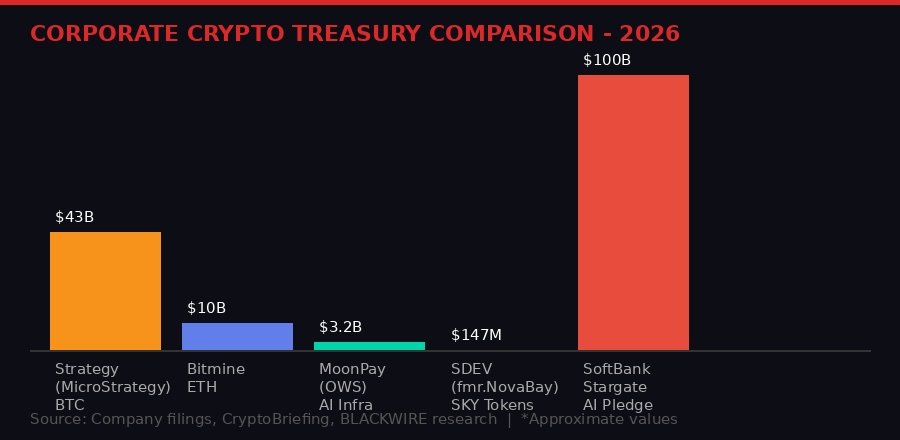
The spectrum of corporate crypto treasury and AI bets as of March 2026 - from Strategy's Bitcoin stack to SDEV's DeFi governance experiment. Source: BLACKWIRE research / public filings
The Risk Topology: What Could Go Wrong

Corporate crypto strategies of this scale introduce concentration risk, liquidity risk, and regulatory exposure simultaneously. Photo: Pexels
The corporate crypto treasury arms race of 2026 is genuinely novel. Nothing in traditional finance has quite prepared analysts for evaluating a company that holds 3.8% of a global blockchain network's token supply while sitting on billions in unrealized losses and buying more every week. The standard frameworks bend.
But the risks are real and worth mapping clearly.
Concentration risk: Bitmine with $10 billion in ETH and $1.2 billion in cash is functionally a leveraged bet on Ethereum's price trajectory. The $6.5 billion in unrealized losses demonstrates how quickly that exposure turns painful. A further 20-30% drop in ETH price - not a stretch given what happened to the asset between 2021 and 2023 - would put the balance sheet math in genuinely difficult territory. The $1.2 billion cash cushion starts looking thin in that scenario.
Staking yield opacity: Bitmine's claimed 5.9% annualized yield is substantially above the network average of 3.4-3.8%. Investors deserve a detailed breakdown of how that premium is generated. MEV-boost rewards and restaking protocols both introduce additional risk layers - smart contract risk, slashing risk, counterparty risk from liquid staking providers - that are not always visible in the headline yield figure.
Supply overhang: A single entity controlling 3.8% of circulating ETH supply reduces available tokens, which supports price during bull markets. It also creates a potential catastrophic overhang if Bitmine ever needs to liquidate a meaningful portion. The sell pressure from unwinding even 10% of the position would be severe. Market structure around large single-entity positions in crypto is not well-understood - and the history of similar situations is not encouraging.
Governance capture risk: For SDEV and the SKY protocol, the $147 million position at 8.78% of supply is not just a financial bet. It is a governance bet. If SDEV's incentives ever diverge from broader protocol health - if corporate quarterly earnings pressure conflicts with long-term decentralized governance - a well-capitalized single actor with near-9% voting power can do real damage to protocol integrity. DeFi's founding ethos was decentralization. SDEV buying 8.78% of a governance token in one transaction is, definitionally, a centralizing event.
Regulatory exposure: The SEC's posture toward governance tokens, staking yields, and DeFi protocols remains unsettled. If regulators decide that SKY tokens are securities - or that staking rewards constitute taxable income in ways not currently priced in - both SDEV and Bitmine face material compliance costs. The regulatory environment that allowed these positions to be built may not be the regulatory environment that allows them to be maintained or exited.
The Bigger Picture: A New Asset Class Is Normalizing

The convergence of institutional corporate treasury strategy and DeFi infrastructure marks a structural shift in how traditional finance relates to blockchain assets. Photo: Pexels
Step back from the individual positions and the pattern is unmistakable. This week delivered three distinct data points - Bitmine's continued ETH accumulation, SDEV's DeFi governance pivot, and Visa's agentic commerce thesis - that collectively point toward the same structural shift: crypto-native strategies are entering the mainstream financial toolkit.
MicroStrategy proved the model with Bitcoin. Bitmine is extending it with a yield-bearing version using Ethereum. SDEV is taking it further still, using corporate treasury to acquire DeFi governance power. Visa is building payment infrastructure explicitly designed for AI agents transacting on-chain. MoonPay is open-sourcing the wallet standard that makes all of it interoperable. SoftBank is levering up to fund the AI layer that will eventually drive transactions through all of it.
These are not isolated events. They are convergent signals. The infrastructure for an economy where AI agents transact autonomously, where corporations hold meaningful stakes in blockchain governance, and where traditional payment networks build bridges to on-chain rails - that infrastructure is being laid this quarter, in public, at institutional scale.
The AI agent wallet economy is projected to grow from $5.1 billion in 2025 to $55.2 billion by 2035. Agents could execute 30% of all crypto transactions within a decade. Visa sees agentic commerce generating $300 billion to $500 billion in new transaction volume by 2030 in the US alone. Those numbers, even if directionally optimistic, represent a scale of capital flow that will require the kind of infrastructure MoonPay just shipped.
For Bitmine specifically, the key variable is time. The $6.5 billion in unrealized losses is painful but not fatal - yet. The company's $1.2 billion cash buffer provides runway. The $180 million in claimed annual staking revenue provides a cash flow narrative. Tom Lee's geopolitical macro argument - crypto as a growth asset that outperforms during oil-shock environments - provides a thesis. Whether all three hold together through whatever the global economy delivers next is the central question.
If ETH recovers to previous cycle highs, Bitmine's position looks like one of the most audacious and successful corporate bets in financial history. If ETH extends its drawdown, the $6.5 billion in unrealized losses becomes the headline story - and the same conviction that looked like genius becomes the cautionary tale that defines the era.
The bet is live. The position is on. The clock is running.
Timeline: Corporate Crypto Treasury Milestones
August 2020 - MicroStrategy Bitcoin Buy
MicroStrategy (now Strategy) makes first corporate Bitcoin purchase. Skeptics call it a gamble; it becomes the template for every corporate crypto treasury that follows.
September 2022 - Ethereum Proof-of-Stake
Ethereum's "Merge" transitions the network to proof-of-stake, creating the staking yield infrastructure that makes a corporate ETH treasury economically distinct from a Bitcoin treasury.
Early 2026 - Bitmine Accelerates
Bitmine crosses 4 million ETH in holdings. Unrealized losses mount as ETH trades well below the company's average cost basis. Buying continues regardless.
March 23, 2026 - MoonPay Open Wallet Standard
MoonPay launches the Open Wallet Standard with 15+ institutional backers, providing the shared infrastructure layer for AI agent-to-blockchain interaction.
Late March 2026 - NovaBay Becomes SDEV
NovaBay Pharmaceuticals closes $134M placement, acquires 8.78% of SKY governance token supply, and rebrands as Stablecoin Development Corp.
March 28, 2026 - Bitmine's Biggest Week
Bitmine buys another 60,999 ETH - now holds 4.59M tokens (3.8% of all circulating ETH), worth $10B+. Unrealized losses: $6.5B. BMNR pre-market: +9%.
Quick Numbers - The State of Corporate Crypto, March 2026
- Bitmine ETH Holdings 4.59M ETH / $10B+
- Bitmine Unrealized Loss -$6.5B
- SDEV SKY Token Holdings 2.06B tokens / 8.78% of supply
- SDEV Staking Yield Claimed >10% annually
- MoonPay OWS Supporters 15+ organizations
- AI Agent On-Chain Wallets Q1 2026 340,000+
- Visa Annual Payment Volume $16.7 trillion
- AI-Crypto Market (2025) $5.1B
- AI-Crypto Market Projection (2035) $55.2B
- Projected AI Agent Share of Crypto Tx (2035) 30%
- SoftBank Stargate AI Commitment $100B
Get BLACKWIRE reports first.
Breaking news, investigations, and analysis - straight to your phone.
Join @blackwirenews on Telegram