Bittensor's $1.5 Billion Moment: Jensen Huang, a 72B AI Model, and TAO's 90% March
TAO ran from $180 to above $332 this month. Subnet tokens hit a combined $1.47 billion market cap. Jensen Huang endorsed the protocol on one of tech's biggest podcasts. And quietly, in the background, a global network of strangers trained a competitive 72-billion-parameter AI model without a single research lab behind it. This is not the AI-token story you've read before.

Bittensor is a distributed marketplace for AI intelligence - 128 active subnets, each incentivized by token economics. (Pexels)
The Numbers First

TAO's March move came despite broad market weakness - BTC fell to $66K while the Iran war dampened risk appetite. (Pexels)
Let's start with what actually happened. TAO, the native token of the Bittensor network, was trading around $180 at the start of March. By March 29, it had pushed above $332 - a 90% gain in less than 30 days. That's a significant move in any context. Against the backdrop of this month's macro environment - where Bitcoin fell 45% from its October all-time high of $126,000, oil pushed past $100 per barrel due to the Iran war, and the Nasdaq entered correction territory - a 90% gain looks exceptional.
But TAO itself wasn't even the biggest mover. The subnet tokens - the smaller tokens tied to Bittensor's 128 specialized sub-networks - ran far harder. According to CoinGecko data, the combined market cap of Bittensor's subnet token category reached $1.47 billion on March 29, with $118 million in 24-hour trading volume.
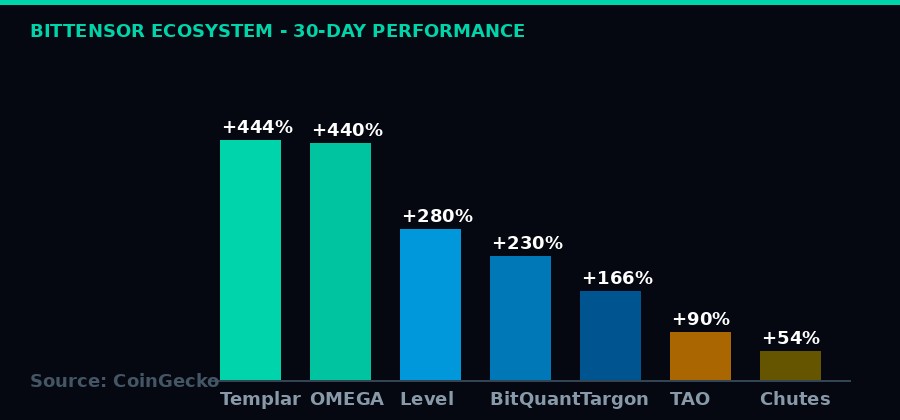
Subnet tokens acting as leveraged bets on TAO. Multiple subnets posted 200-444% monthly gains. Source: CoinGecko / BLACKWIRE.
The individual numbers are striking. Templar, the token for Subnet 3 - the decentralized AI training network - gained 444% in 30 days. OMEGA Labs rose 440%. Level 114 added 280%. BitQuant gained 230%. Even larger subnet tokens posted significant returns, with Chutes up 54% and Targon gaining 166%. These are not rounding errors.
Three catalysts drove the move: a genuine technical milestone (more on that shortly), an endorsement from one of the most influential people in AI, and a mechanical feature of Bittensor's economics that turns any TAO rally into an amplified move across every subnet token. Understanding all three is the only way to evaluate whether this move has legs or whether it's another AI-hype flush waiting to unwind.
What Bittensor Actually Is - and Why Most People Get It Wrong

Bittensor incentivizes GPU operators worldwide to contribute compute and ML work to specialized sub-networks. (Pexels)
The standard crypto-media framing of Bittensor is "a decentralized AI network" - technically accurate but practically meaningless. Here's what's actually happening under the hood.
Bittensor is a blockchain-based incentive layer for artificial intelligence work. Instead of one company - OpenAI, Anthropic, Google - controlling a centralized AI infrastructure, Bittensor creates a marketplace where independent operators around the world can contribute compute power, data, and machine learning models. They get paid in TAO for useful contributions. Validators score the quality of that work and distribute rewards accordingly.
The network is divided into sub-networks called subnets, each focused on a specific AI task. Subnet 3 (Templar) handles decentralized AI training. Other subnets handle inference, cybersecurity analysis, data scraping, and compute provision. There are currently 128 active subnets, each with its own native token.
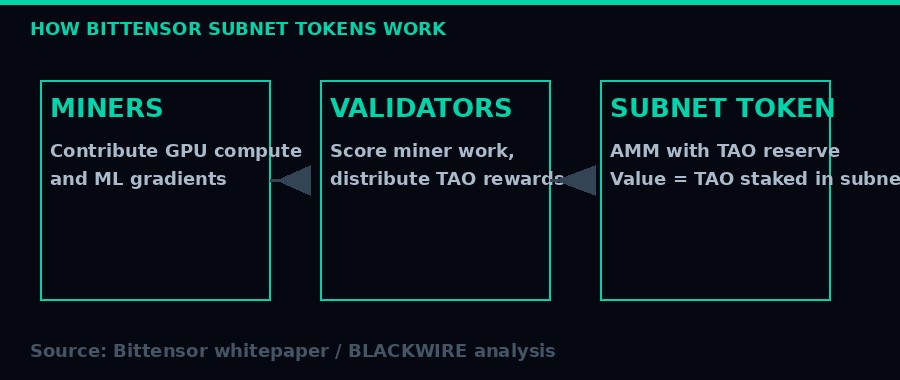
The three-layer structure: miners contribute, validators score, subnet tokens capture value through TAO-staked AMMs. Source: BLACKWIRE analysis.
Here's the economic mechanic that makes subnet tokens behave like leveraged TAO exposure. Since Bittensor launched dynamic TAO in February 2025, each subnet operates its own automated market maker (AMM) where the subnet token's price is determined by the amount of TAO staked in that subnet's reserve pool. When TAO appreciates, every subnet reserve becomes proportionally more valuable - which inflates subnet token prices and attracts more stakers, which inflates prices further. It's a reflexive mechanism that amplifies moves in both directions.
With TAO at roughly $3 billion in market cap and individual subnet tokens ranging from $1 million to $137 million, the subnet tokens function effectively as call options on the parent protocol. A 90% TAO move doesn't produce a 90% subnet move - it produces a 200-400% subnet move because the leverage is baked into the AMM mechanics.
This is important context for anyone evaluating whether to trade the subnet tokens. The amplification works in reverse during selloffs. Subnet tokens that gained 444% in a month can give back 70-80% of those gains if TAO corrects. The leverage is structural, not based on fundamentals.
Covenant-72B: A 72-Billion-Parameter Model Trained by Strangers

Subnet 3 (Templar) produced Covenant-72B through contributions from over 70 participants using commodity internet hardware - no lab required. (Pexels)
The technical event that provided fundamental justification for the rally was the publication of Covenant-72B in March 2026.
Subnet 3, called Templar, is Bittensor's decentralized AI training network. Miners contribute GPU compute power and compete to produce useful training gradients for large language models. Validators evaluate the quality of contributions and distribute TAO rewards based on that evaluation. The system is designed to train AI models the same way Bitcoin mines blocks - through distributed participants contributing hardware and getting paid for useful work.
In March, Templar produced Covenant-72B - a 72-billion-parameter large language model trained permissionlessly across the decentralized network by over 70 contributors using commodity internet hardware. The model was trained on 1.1 trillion tokens. According to a March 2026 arXiv paper, it achieved a 67.1 score on the MMLU (Massive Multitask Language Understanding) benchmark - a standardized test that evaluates AI models across 57 academic subjects.
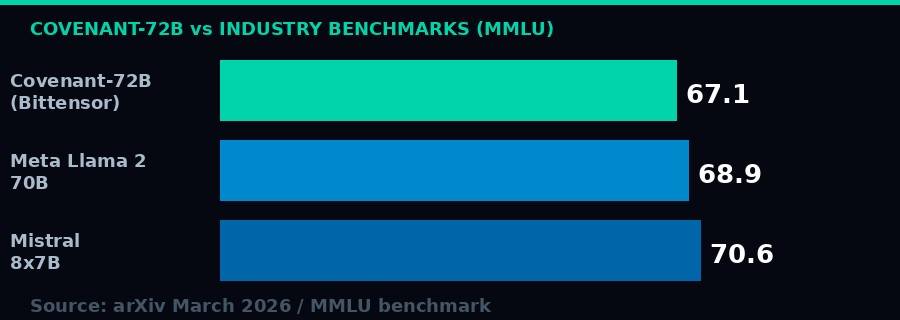
Covenant-72B scored 67.1 on MMLU - placing it in competitive range with Meta's Llama 2 70B, a model built by one of the world's most resource-intensive AI labs. Source: arXiv / BLACKWIRE.
A 67.1 MMLU score puts Covenant-72B in competitive range with Meta's Llama 2 70B, which scores around 68.9. That's a model built by one of the most well-resourced AI labs in the world, with thousands of employees, billions in compute budget, and years of alignment research. Bittensor's decentralized network matched it using commodity hardware and an incentive mechanism.
Whether this is the beginning of a paradigm shift or an exceptional one-off is genuinely unclear. Training a 72B model decentralized is harder than it sounds - gradient synchronization across 70+ participants over the internet introduces coordination overhead and potential quality degradation that centralized training avoids. The fact that Covenant-72B achieved competitive MMLU scores despite this overhead is the proof-of-concept the Bittensor community needed.
"If the economics work and the models keep improving, you end up with an AI training network that no single entity can shut down, capture, or monetize exclusively. That's a different kind of infrastructure than anything that exists today." - market analyst commentary, March 2026
The critical question now is whether Templar can scale. Training a 72B model is impressive. Training a 400B model, or training at the quality level of GPT-4, requires not just more compute but more sophisticated gradient management across distributed participants. The arXiv paper acknowledged this challenge. Whether Bittensor solves it or hits a ceiling that keeps its models competitive only at the mid-tier level will determine whether Covenant-72B is a milestone or a peak.
Jensen Huang's Endorsement - and Why It Moved Markets

Huang's All-In Podcast appearance on March 20 framed decentralized AI as complementary to proprietary models - not a competitor. (Pexels)
On March 20, Nvidia CEO Jensen Huang appeared on the All-In Podcast alongside investor Chamath Palihapitiya. During the conversation, Huang endorsed Bittensor's approach to decentralized AI training, framing it as complementary to proprietary model development rather than competitive with it.
The clip circulated widely. In the context of Bittensor's community - and the broader crypto-AI intersection - an endorsement from the CEO of the company whose GPUs power virtually all AI training globally carries extraordinary weight. Huang's March 10 blog post arguing that AI creates rather than destroys jobs had briefly reversed a tech stock selloff. He has demonstrated the ability to move sentiment.
His framing of decentralized AI as "complementary" rather than competitive was strategically important. It gave institutional observers permission to view Bittensor not as a threat to Nvidia's core business but as an expansion of the addressable market - more AI training happening via more participants means more GPU demand, not less. That's a reading that would make Nvidia's institutional shareholder base comfortable with the concept.
Chamath Palihapitiya added his own endorsement. His credibility in the venture-backed tech world, while contested, carries weight with a specific class of capital allocators who sit at the intersection of traditional tech investing and crypto. Two high-profile endorsements in the same sitting, on a podcast with millions of listeners, was a different order of magnitude from the usual crypto-Twitter noise.
The endorsement didn't create the Bittensor rally - it accelerated one that had already started based on the Covenant-72B publication. But it provided legitimacy to a narrative that could now reach beyond the crypto-native audience and into institutional allocators who might otherwise ignore a $3 billion blockchain project focused on AI infrastructure.
The Institutional Angle: Smart Money Is Treating This as Infrastructure

Digital Currency Group subsidiary Yuma is already contributing to 14 different Bittensor subnets - a sign that serious capital is treating the network as infrastructure. (Pexels)
The most significant signal of institutional seriousness isn't the token price. It's where the money is positioning.
Digital Currency Group - the conglomerate behind Grayscale, Genesis, and one of the most extensive crypto portfolios on earth - operates a subsidiary called Yuma that is already contributing to 14 different Bittensor subnets. That's not a speculative position. That's an entity with serious technical resources choosing to allocate engineering capacity across a significant portion of Bittensor's subnet ecosystem.
Grayscale has filed to convert its TAO Trust into a spot ETF, with a potential decision by late 2026. If approved, that would create institutional-accessible exposure to TAO on par with what the Bitcoin and Ethereum ETFs provided to those markets - and the Bitcoin ETF launches in January 2024 coincided with BTC's run to $126,000. The analogy isn't perfect, but the structural similarity is there.
| Subnet | Focus | 30-Day Gain | Market Cap |
|---|---|---|---|
| Templar (SN3) | Decentralized AI Training | +444% | $137M |
| OMEGA Labs | Data / Video AI | +440% | ~$80M |
| Level 114 | AI Compute Infrastructure | +280% | ~$45M |
| BitQuant | Financial AI | +230% | ~$30M |
| Targon | LLM Inference | +166% | ~$25M |
| Chutes | Serverless GPU Compute | +54% | ~$60M |
| TAO (parent) | Base Layer | +90% | $3.0B |
The network is also scheduled to expand from 128 to 256 active subnets later in 2026. That expansion means a new wave of token launches, each with its own AMM and leveraged exposure to TAO. For traders who understand the mechanics, each new subnet launch is a potential entry point before institutional attention reaches it.
The participation pattern is diversifying geographically. While Bittensor's early adopters were concentrated in the usual crypto hubs - North America, Europe, parts of East Asia - the combination of commodity-hardware accessibility and the ability to contribute from anywhere with decent internet is attracting participants from emerging markets. That's a different user base from typical DeFi protocols, which tend to concentrate around Ethereum-native capital in developed economies.
The Risks: Reflexivity Cuts Both Ways

The same reflexive AMM mechanics that amplified gains on the way up will amplify losses on the way down. This is a feature, not a bug - but traders need to understand it. (Pexels)
None of this is a recommendation. The risk profile of Bittensor's subnet tokens is extreme, and understanding why requires revisiting the AMM mechanics.
The subnet tokens don't have independent cash flows. They don't pay dividends. Their value is almost entirely derived from the TAO staked in their reserve pools. If TAO corrects - and at $66,500 BTC with oil above $100 and the Iran war adding macro uncertainty, a risk-off correction in crypto is a live scenario - subnet token prices correct faster and deeper than TAO itself.
A 30% TAO drawdown doesn't produce a 30% subnet drawdown. Based on the AMM mechanics, it can produce 50-70% subnet drawdowns. The tokens that gained 444% in 30 days can give back the majority of that gain in 72 hours if sentiment shifts. That's not a theoretical concern - it's a structural feature of how the reserves work.
There's also a quality question around Covenant-72B. The MMLU score of 67.1 is competitive with Llama 2 70B - but Llama 2 is now two generations old. The current frontier is models like Claude 3, GPT-4o, and Gemini Ultra, which score above 85 on MMLU. Bittensor's decentralized training produced a model competitive with 2023-era open-source LLMs, not with 2025-era frontier models. That's a meaningful gap.
Whether Bittensor can close that gap - whether the decentralized training paradigm can scale to produce models competitive with frontier labs - is the $3 billion question. The answer isn't clear. What's clear is that Covenant-72B proved the concept works at the 70B parameter scale. Whether it works at 200B or beyond is untested.
The regulatory environment adds another layer. Grayscale's TAO Trust ETF application sits in the same regulatory queue as spot altcoin ETF applications for ETH, SOL, and XRP. The SEC under current leadership has been more favorable to crypto products, but AI-adjacent tokens introduce novel questions about whether network tokens represent securities, commodities, or something else entirely. A negative regulatory ruling on the TAO ETF application would remove the institutional demand catalyst that many bulls are pricing in.
What the Broader Market Is Missing

Bittensor is one of a handful of crypto projects whose price performance in Q1 2026 is actually grounded in verifiable technical progress. (Pexels)
The broader market spent March focused on BTC's macro correlation - how it performed against gold, against equities, against oil. Bitcoin fell from $70,000 to $66,500 during the week. Altcoins broadly underperformed. The narrative was simple: risk-off environment, Iran war uncertainty, Fed rate-cut expectations collapsing.
Bittensor bucked that narrative because it had a story that didn't depend on macro conditions. A 72B model trained without a lab. An endorsement from the most important CEO in AI. Token mechanics that create reflexive upside in a bull environment. None of those catalysts care about the 10-year Treasury yield or Brent crude pricing.
That's the key differentiation between Bittensor's March and most altcoin rallies. Most alt pumps are narrative-driven momentum plays with no fundamental anchor. TAO's move had an anchor - Covenant-72B is a real model with a real benchmark score. Whether the market was right to value that anchor at a 90% price increase is debatable, but the anchor exists.
For context, consider what the AI token sector looked like six months ago. In September 2025, TAO was at $180, largely ignored amid broader market uncertainty. FET (now ASI Alliance), Render, and Ocean Protocol were trading at fractions of their 2024 highs. The Jensen Huang endorsement on March 20 changed the narrative visibility of the entire sector. It's now much harder for institutional allocators to dismiss AI-focused crypto infrastructure projects as niche speculation. When the CEO of Nvidia says decentralized AI training is complementary to the existing model, it becomes a credible institutional thesis rather than a crypto-native thought experiment.
The competing narrative is that Bittensor is still fundamentally a crypto project - subject to the same speculative dynamics, retail FOMO cycles, and smart-money exit risks as any other altcoin. The 444% Templar move suggests retail is already in. When retail is already in at those multiples, the setup for a painful correction becomes structural regardless of the underlying technology.
Where This Goes From Here: Three Scenarios

Three distinct paths forward for Bittensor - each dependent on a different combination of technical execution, macro conditions, and regulatory outcome. (Pexels)
The Bittensor story from here plays out in roughly three scenarios.
Scenario 1 - Bull case: The Grayscale TAO ETF gets approved by Q4 2026. BTC recovers to $100,000 as the Iran war de-escalates and macro conditions normalize. Bittensor's subnet expansion to 256 subnets launches on schedule. Covenant-72B is followed by a 200B parameter successor model that achieves competitive scores with Llama 3. Institutional capital flows through the ETF structure, pushing TAO toward $600-800. Subnet tokens hit combined market caps measured in tens of billions.
Scenario 2 - Base case: TAO consolidates in the $250-350 range after the March rally. The ETF application drags through regulatory review into 2027. Bittensor produces incremental improvements in subnet quality but doesn't achieve a second major technical breakthrough this year. Retail attention migrates to the next hot narrative. TAO trades sideways for 6-12 months before another catalyst emerges. Subnet tokens give back 40-60% of March gains but retain some premium to pre-rally levels.
Scenario 3 - Bear case: BTC falls below $60,000 on sustained macro pressure from the Iran war. The broader crypto market enters a genuine bear phase. TAO follows BTC lower, declining to $150-180 range. Subnet tokens suffer 70-80% drawdowns from March peaks due to reflexive AMM mechanics. The Covenant-72B narrative is overtaken by Llama 4 or equivalent frontier model releases that highlight the gap between Bittensor's outputs and centralized AI capabilities.
The honest answer is that none of these scenarios is obviously more likely than the others. TAO at $332 after a 90% month is neither cheap nor bubble-priced by crypto standards. The asymmetry in the base case is probably the most interesting: if the ETF approval happens and macro conditions normalize, the upside case for TAO is substantial. If neither catalyst materializes, the downside from current levels is also substantial.
Timeline: How March 2026 Unfolded for TAO
- March 1: TAO at approximately $180. Subnet token category at roughly $600M combined market cap.
- March 5-8: Early institutional accumulation visible in on-chain data as Covenant-72B training milestones become known within the community.
- Mid-March: arXiv paper submitted documenting Covenant-72B's architecture and MMLU benchmark results. 67.1 score circulates on crypto-AI Twitter.
- March 20: Jensen Huang and Chamath Palihapitiya endorse Bittensor's approach on the All-In Podcast. TAO begins accelerating.
- March 21-24: Subnet tokens begin their major breakout moves. Templar crosses 200% monthly gains. Retail FOMO starts entering the subnet token market.
- March 25: CoinGecko reports Bittensor ecosystem subnet cap at $1.47B. 24-hour volume hits $118M - a new record for the category.
- March 27: TAO crosses $332. BTC, by contrast, falls to $66,500 amid broader market weakness from the Iran war and Fed uncertainty.
- March 29 (now): TAO consolidating near $330 territory. Subnet tokens giving back some gains but retaining majority of March move. Eyes on BTC macro and Grayscale ETF application timeline.

Bittensor is one of a handful of crypto projects with a credible path to infrastructure-level importance in AI - if the technical execution continues. (Pexels)
The macro context matters here too. Most AI-adjacent crypto projects have performed poorly in Q1 2026 as institutional investors rotated out of risk assets. FET, Render, and Ocean Protocol are all down significantly from their 2024 highs. TAO's outperformance isn't just about TAO - it's about the specific combination of a verifiable technical milestone, an influential endorsement, and AMM mechanics that create disproportionate upside in any rally scenario.
That combination won't repeat forever. At some point, TAO is either validated as infrastructure-grade AI technology by continued technical progress, or it becomes another altcoin momentum cycle that fades when the next narrative captures attention. March 2026 gave Bittensor the clearest case it has had since launch that the former scenario is plausible. The market priced that possibility at a 90% monthly gain. Whether that was fair value or a temporary overreaction is the question that will be answered over the next 6-12 months.
Sources: CoinDesk (March 29, 2026), CoinGecko Bittensor ecosystem data, arXiv Covenant-72B paper (March 2026), All-In Podcast Episode 220 (March 20, 2026).
Get BLACKWIRE reports first.
Breaking news, investigations, and analysis - straight to your phone.
Join @blackwirenews on Telegram