Born Into the Dark: The Women Governments Forget to Count
Mauren Echevarria Pena is giving birth this week in Havana - and she is terrified that the lights will go out. Berivan Molani was asleep in Tehran when the ceiling came down. One woman is counting down to new life. The other never got the chance. Both are casualties of policies written thousands of miles away by men who will never say their names.

The invisible toll: across two continents, 2026 has imposed a new kind of darkness on ordinary people. (BLACKWIRE/Ember Bureau)
Right now - tonight, as you read this - two distinct crises are running on parallel tracks. In Cuba, a US fuel blockade has triggered nationwide electrical grid collapses that leave pregnant women cooking by charcoal at 3 AM. In Iran, more than three weeks of US-Israeli airstrikes have killed over 1,400 civilians, 15 percent of them children, according to the US-based Human Rights Activists News Agency.
Neither crisis dominates the headlines the way a military gain or a presidential tweet does. Neither involves stock prices. Neither has a simple villain most outlets feel comfortable naming. And so the women at the center of both - the ones keeping their families alive in the dark, the ones dying in apartment buildings that happen to be near the wrong neighbour - remain marginal characters in their own stories.
This piece puts them at the center.
The Maternity Ward at the End of the World
Rolling blackouts have left Cuban cities in near-total darkness for days at a time. (BLACKWIRE/Ember Bureau)
The Ramón González Coro maternity hospital in Havana was never supposed to look like this. One of Cuba's flagship specialist facilities for high-risk pregnancies, it was built on a promise - that the Cuban revolution would give its people world-class healthcare regardless of what the rest of the world thought about Fidel's politics. That promise has been grinding down for years. This year, the Trump administration reduced it to rubble.
Three months ago, Washington imposed a near-total fuel blockade on Cuba - warning Mexico and other energy partners that they would face tariffs if they continued shipping crude oil to the island. The effect was immediate and catastrophic. Cuba's electrical grid, already crumbling after years of underinvestment and international isolation, collapsed under the pressure. Rolling blackouts became daylong power cuts. Then last weekend, the entire national grid went dark.
Inside the maternity ward, Mauren Echevarria Pena, 26, is days from giving birth to her first child - a boy. She has gestational diabetes and chronic hypertension. Her pregnancy has been complicated. She has spent weeks in the hospital under constant supervision. And now, as her due date closes in, she is terrified of one specific scenario: going into labour during a blackout.
"They have done everything they can for me at the hospital. They've given me the medicines and insulin I need for the health of baby and the placenta." - Mauren Echevarria Pena, speaking to the BBC from Ramón González Coro maternity hospital, March 2026
The hospital has generators. But generators need fuel - the same fuel the blockade is cutting off. Mauren knows this. She strikes a defiant tone when she speaks, saying that Cuba will "always find a way to move forward." But she cannot hide the fear. The image she keeps returning to is being in labour while the ward is dark, doctors working by the light of their phones.
That is not a hypothetical. It has already happened in Cuba. Multiple accounts from healthcare workers across the island describe deliveries completed by mobile phone light, surgeries conducted with backup torches, neonatal units running on generator power that cuts out without warning. The BBC was granted access to the hospital as a coalition of international solidarity movements arrived with aid donations - one of the few channels still getting anything through to pregnant Cuban women.
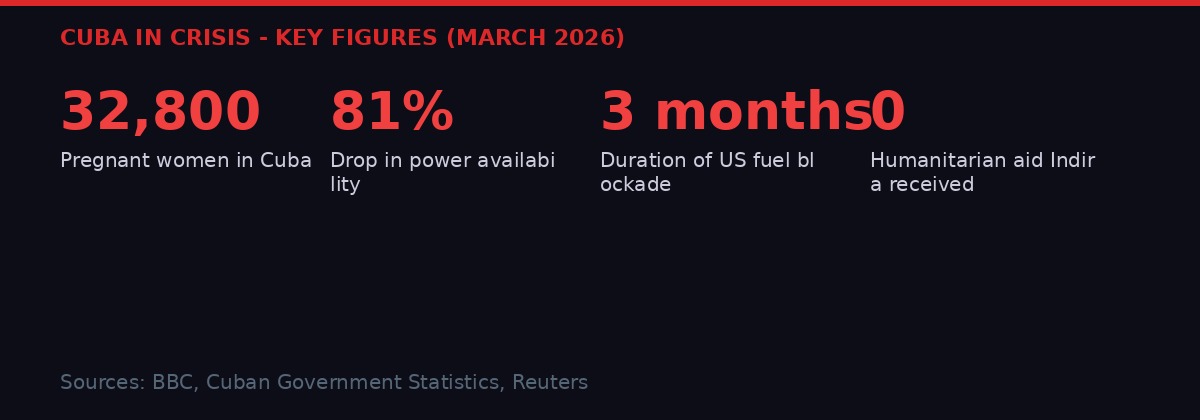
Cuba's fuel blockade by the numbers: 32,800 pregnant women, an island in the dark. (BLACKWIRE infographic, Sources: BBC, Cuban government statistics)
There are an estimated 32,800 pregnant women in Cuba right now, according to government statistics. Most of them are not in a hospital with a generator. Most of them are at home, like Indira Martinez.
Indira's Empty Fridge and Her Daughter's Future
Indira Martinez is seven months pregnant. On the morning the BBC visited her in a Havana suburb, the power had been out since the previous afternoon. The fridge was empty. The electric stove was not working. Her husband had built a small charcoal grill in the yard - the family's only cooking method.
She woke before dawn when the power flickered back on briefly and cooked whatever she could. It was not enough. Not enough calories, not enough protein, not enough of the vitamins a developing baby needs in the third trimester.
Indira was trained as an IT systems technician. Her husband was an accountant. They both retrained for jobs that paid more in cash: she became a hairdresser; he became a blacksmith. During pregnancy, she cannot work - the chemical hair dyes are too dangerous for the fetus. So the family lives on his blacksmith income, which is modest even by Cuban standards.
She already survived chikungunya in the first trimester - a mosquito-borne disease that swept the island in a nationwide outbreak, leaving her so weak she could barely walk to the bathroom. Remarkably, her baby girl survived it too. The doctors say she is healthy.
"None of the humanitarian aid sent to Cuba has reached me. My husband and I didn't enter this pregnancy irresponsibly. We did it knowing full well that we can't rely on any help from the government. It's just us against the world." - Indira Martinez, 7 months pregnant, speaking to the BBC in Havana, March 2026
Mexico has sent hundreds of tonnes of humanitarian aid to Cuba in response to the blockade - powdered milk, medical supplies, basic provisions intended specifically for pregnant women. Indira has not seen any of it. The aid has been documented at the port. Where it goes after that, neither she nor the journalists who have asked the Cuban government can say with certainty.
Indira has named her daughter Ainoa. She talks about her with love and with grief simultaneously. The grief is not for Ainoa's health - she is growing strong, despite everything. The grief is for the life waiting on the other side of birth.
"How am I going to tell her she has no prospects in life? Because she won't have any. As a parent, one would like to offer your child a real life and to motivate them. But I have no basis to tell her that she has a meaningful future ahead of her. If I say that, I'll be lying." - Indira Martinez, speaking to the BBC, March 2026
Cuba has an ageing population, one of the lowest birth rates in Latin America, and massive outward emigration. The government needs young people to have babies. Indira is having one anyway - not out of patriotism, but because she and her husband wanted a family. The system that was supposed to catch her if she fell has caught nothing.
Berivan Molani Went Home Because She Missed It
Names we carry when governments will not: civilians killed in the US-Israeli war on Iran. (BLACKWIRE/Ember Bureau)
Tehran, March 17, 2026. Berivan Molani, 26, was an only child. She ran a small online clothes shop and maintained a lifestyle blog. She was young, connected, living the kind of digitally-mediated life that millions of young Iranians navigated against the grain of a conservative government that tried to restrict their every post.
When the US-Israeli airstrikes on Iran began, Berivan had evacuated to northern Iran, away from the capital. It was safer there. Her family felt the distance between them. And then Berivan made a decision that every person who has ever been homesick will understand on a bone-deep level: she went home.
She did not know that Iran's minister of intelligence, Esmail Khatib, lived across the street from her family's apartment on Makouyipour Street in Tehran's Zafaraniyeh neighbourhood. She did not know that Israeli forces had him on a target list. She went to bed.
That night, the strike came. Berivan was killed by the debris. A friend later posted on Instagram what rescue workers found at the scene: "All that was left of her life was a pair of trainers lying on the street."
"This was a family who did everything in their power to protect their child yet in the end - without even knowing who lives in the house across from them - they lost her." - Razieh Janbaz, friend and former member of Iran's national handball team, posting on Instagram, March 2026
This is the mathematics of aerial warfare that never appears in military briefings: you cannot always know who lives across the street. You cannot always know that the block you're targeting is also where a 26-year-old blogger lives who just wanted to sleep in her own bed.
Berivan's mother was pulled from the rubble alive. Night-time footage released by the Iranian Red Crescent shows rescue workers removing debris while she begs: "Is my daughter alive?" By the time they reached her daughter, the answer was no.
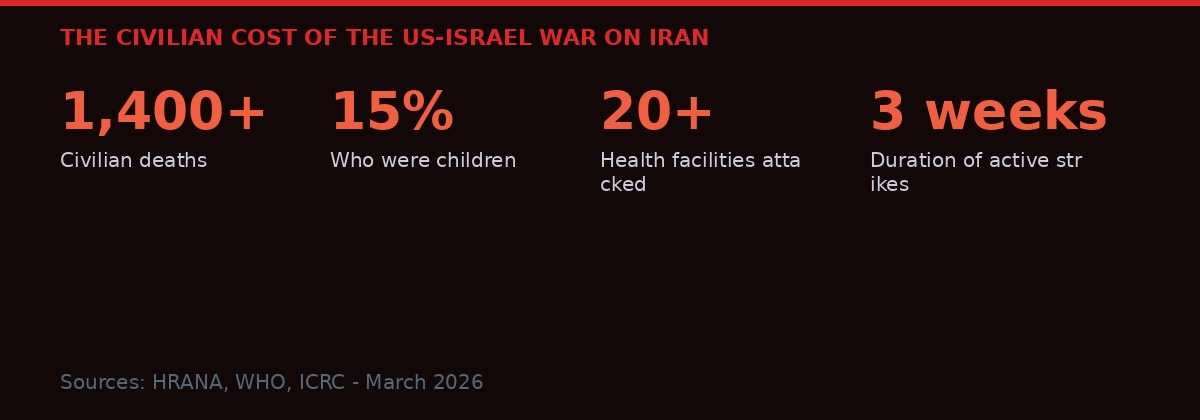
The civilian cost of three weeks of US-Israeli strikes on Iran. (BLACKWIRE infographic, Sources: HRANA, WHO, ICRC)
Parastesh Stayed Because "People Need Me"
Parastesh Dahaghin was a young pharmacist working in Tehran's Apadana neighbourhood when a nearby building was struck by a US-Israeli airstrike. According to the Iran Human Rights Documentation Center, the target was an IT company building that reportedly played a role in Iran's internet shutdown. Parastesh was not the target. She was at work.
Her brother Poorya wrote on Instagram that the family had told her to leave Tehran. It wasn't safe. She refused. Her reasoning, documented in the messages she sent before she died:
"People need me. People have been wounded. They come to the pharmacy, and elderly people need their medication. I have to stay here and help my people." - Parastesh Dahaghin, pharmacist, Tehran - speaking to her brother before her death, March 2026
She was killed doing exactly that. A mourning ceremony was filmed and posted online - framed pictures of her nestled among candles and flowers. Her brother's tribute: "You were so noble."
The US-based Human Rights Activists News Agency, HRANA, has documented more than 1,400 civilian deaths since the strikes on Iran began. Fifteen percent of those deaths are children. The youngest confirmed victim documented by Kurdish human rights group Hengaw is Eilmah Bilki, aged three, who died a day after being severely wounded in strikes on the western town of Sardasht in early March.
The International Committee of the Red Cross has described the civilian toll as "alarming." The World Health Organisation has verified more than 20 attacks on health facilities. At least nine health workers have been killed. A Red Crescent worker, Hamidreza Jahanbakhsh, is among the dead.
Iran has imposed an internet blackout on its own population, making it extremely difficult for human rights groups to gather complete data. Iranian border guards have reportedly been ordered to shoot people who approach the Iraqi border to access Iraqi mobile networks - the regime controlling both the population and its own casualty narrative simultaneously.
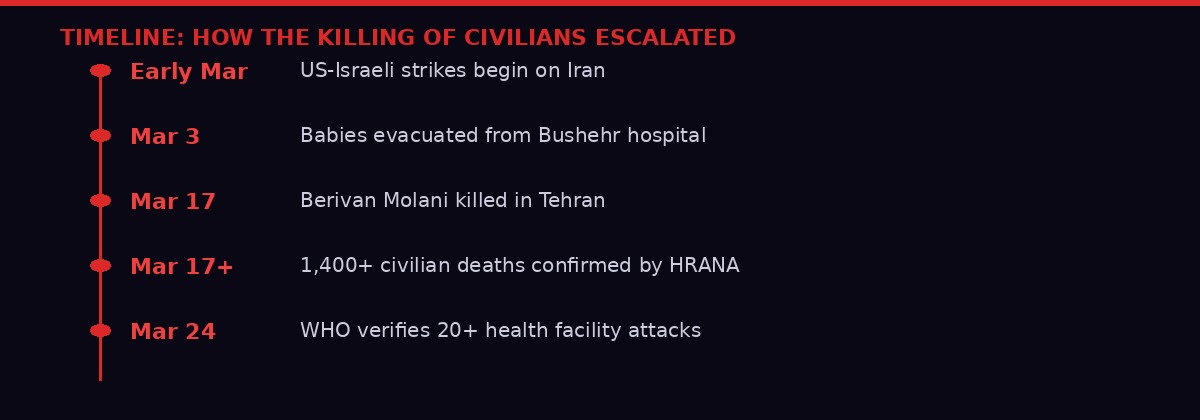
How civilian casualties escalated over three weeks of US-Israeli strikes on Iran. (BLACKWIRE infographic, Sources: HRANA, WHO, Hengaw)
ICE in the Departure Lounge: The New American Checkpoint
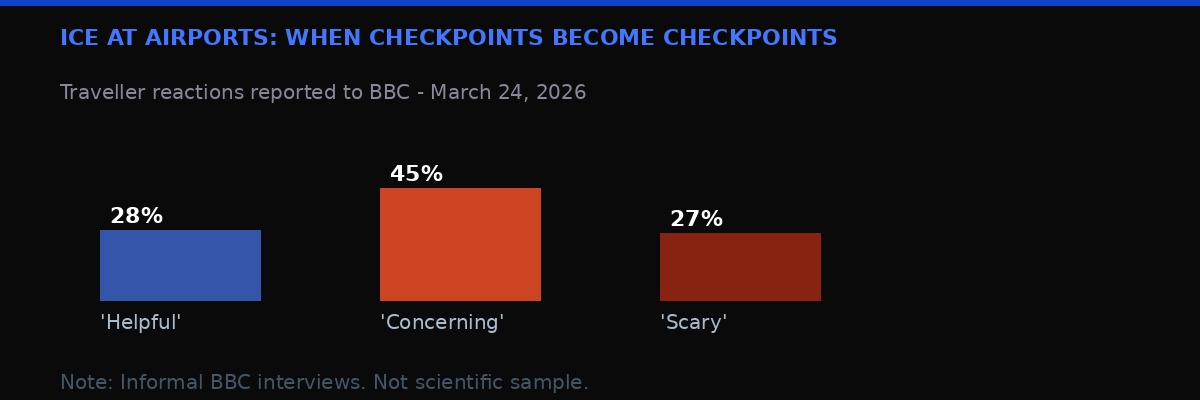
Mixed reactions to ICE agents at US airports: travellers divided as TSA officers work unpaid. (BLACKWIRE infographic, Sources: BBC interviews, March 24 2026)
While governments overseas conduct their lethal business, the domestic American landscape has its own culture shift running. Immigration and Customs Enforcement agents have been deployed to US airports to assist the Transportation Security Administration - because TSA officers have been working without pay since government funding lapsed in February during the partial shutdown of the Department of Homeland Security.
The TSA union put it plainly: staff "deserve to be paid, not replaced by untrained, armed agents." But the administration deployed the agents anyway. Travellers flying out of American airports on March 24, 2026 are now being screened by a mix of TSA officers working for free and ICE agents whose primary professional training is in immigration enforcement, deportation logistics, and detention operations - not airport security.
The BBC spoke to travellers at multiple airports. Reactions divided sharply along predictable lines. Some described the visible armed agents as "helpful," projecting authority and visible security presence. Others found it "concerning" or "scary" - particularly travellers with brown skin, foreign-sounding names, visas rather than passports, or any combination of factors that tend to attract additional scrutiny from immigration enforcement.
The deployment is not random. It sits inside a broader pattern: the government shutdown that triggered the TSA funding lapse was itself a product of budget battles in which immigration enforcement spending was one of the central flashpoints. The administration now has ICE agents at airport checkpoints with legal authority to act on immigration status as well as security concerns. For most travellers, this is background noise. For a specific subset of American travelers and visitors, it is a threat calculation they now have to run every time they approach a security line.
This is what a culture shift looks like when it is not photogenic enough for a protest march: the quiet redistribution of power at choke points where ordinary people have no choice but to pass through.
What's Actually Happening at US Airports
- TSA officers have been working without pay since federal funding lapsed in February 2026
- ICE agents deployed to fill staffing gaps - their primary training is immigration enforcement, not security screening
- The TSA union condemned the move, saying workers "deserve to be paid, not replaced by untrained, armed agents" (BBC, March 24)
- Legal authority of ICE agents at checkpoints extends beyond security - they can act on immigration status
- No formal protocols published for how immigration enforcement will interact with security screening
Angola: When Protests Are Manufactured
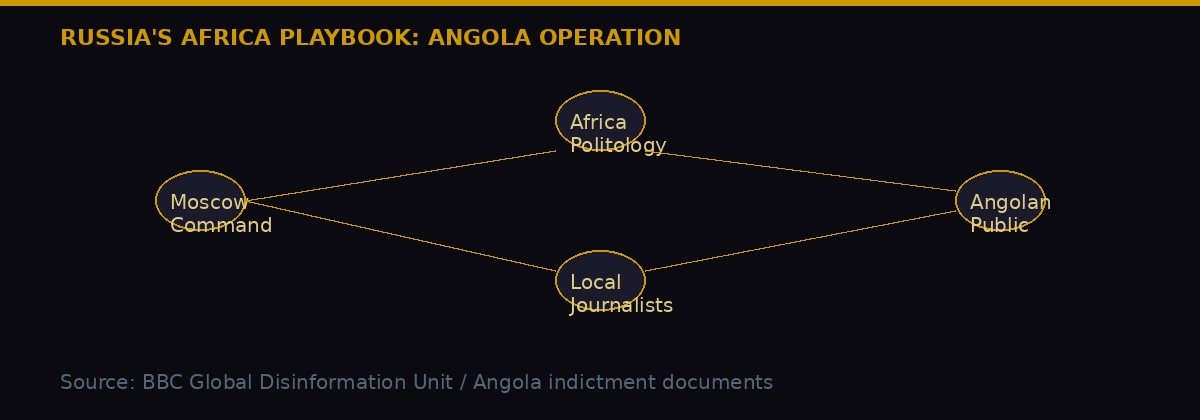
The alleged Russian network that tried to foment anti-government protests in Angola - straight from the post-Wagner playbook. (BLACKWIRE infographic, Sources: BBC/BBC Global Disinformation Unit)
Across these stories runs a common thread: the people at the centre rarely chose to be there. But in Angola, a trial beginning this week illuminates something different - the manufacturing of protest itself as a geopolitical weapon.
Two Russians - political consultant Igor Ratchin and translator Lev Lakshtanov - are facing trial in Luanda on charges including terrorism, espionage, and influence peddling. The BBC has obtained a copy of the indictment. The accusation, at its core: they arrived in Angola in 2024 claiming to set up a Russian cultural centre, used that cover to build a local network, paid local journalists and political operatives over $24,000 to spread disinformation, and aimed to foment anti-government protests in advance of Angola's 2027 presidential election.
The operation, according to prosecutors, emerged from Africa Politology - a shadowy network that grew out of the now-defunct Wagner Group after Yevgeny Prigozhin's 2023 plane crash. Angola was new territory. Wagner had traditionally operated in the Sahel - Central African Republic, Mali, Libya. But Angola is different: a major oil and diamond producer, a country that under President Joao Lourenco has been visibly pivoting toward the West, and a country from which Russian mining company Alrosa and bank VTB were expelled after Ukraine war sanctions.
Moscow, apparently, did not want to lose Angola quietly. So they tried a different approach. A one insider who previously worked with Prigozhin described the operation as "amateurish" - telling the BBC they were "complete idiots" who were "picked up at the Sadovad market." Whether that's accurate or protective distancing is hard to say. The indictment charges four people total: two Russians and two Angolans accused of acting as local fixers.
"This is indicative of Russian anxiety about the direction of travel of Angola under the Lourenco administration. There's clearly an element of Russian disinformation to try and build up more sympathy towards the Russian Federation." - Alex Vines, Africa Programme Director, European Council on Foreign Relations, speaking to the BBC
The defence challenges the indictment as lacking "concrete and objective facts." The Angolan defendants say there is no sufficient evidence against them. The trial will determine the legal outcome. But the cultural significance is already visible: this is what the new Cold War looks like at street level. Not missiles, not invasions, but Facebook pages that imitate local news sites, sports journalists paid to gather political intelligence, and cultural centres that never open their doors.
The underlying question - who controls the narrative of protest, and whether those protests represent genuine popular anger or manufactured dissent - is one that will echo far beyond Angola. In an era when authentic social movements and synthetic influence operations can look identical from the outside, the cost falls on ordinary people who take to the streets in good faith, and find themselves later described as pawns.
What the Numbers Do Not Say
There are 1,400 civilians confirmed dead in Iran. There are 32,800 pregnant women in Cuba. ICE agents have been deployed to an unknown number of US airports. Four defendants sit in a Luanda courtroom.
These numbers do not tell you that Berivan Molani went home because she missed it. They do not tell you that Parastesh refused to leave because the elderly in her neighbourhood needed their medication. They do not tell you what Indira's face looks like when she talks about a daughter who will have no prospects, or that she calls her Ainoa and loves her anyway, with a love that is somehow equal parts hope and grief.
Numbers are for policy documents. Names are for memory.
The mechanics of how these crises were created are genuinely complex. Cuba's fuel blockade is defended by US officials as economic pressure on an authoritarian government. The Iran strikes are defended as targeted military operations with documented precision. The ICE deployments are framed as a practical response to a staffing crisis. The Angola charges are framed as the rule of law working exactly as intended.
Every single one of those framings contains something true. None of them include Mauren Echevarria Pena lying awake at night imagining her baby delivered by mobile phone light. None of them mention Berivan's trainers on the street. None of them calculate the calories Indira is not getting in her third trimester, or what those missing nutrients might cost Ainoa in ways that won't show up in any statistics for twenty years.
The people making the decisions that produced these situations are not monsters. That is, perhaps, the most troubling part. They are rational actors pursuing coherent goals through institutional means. The dead and the frightened and the hungry are, from the perspective of the decision-makers, acceptable externalities - not even cruel, just arithmetic.
What remains, after all the briefings and press releases and strategic calculations, is this: a young woman counting down to birth in a dark hospital room, another young woman who just wanted to sleep in her own bed, and a pharmacist who decided that her neighbours needed her more than she needed to be safe.
They made those choices. Someone else made the ones that surrounded them.
What Comes Next
For Mauren, the immediate future is her due date - days away. The hospital's generators are running. For now, there is fuel. For now.
For Indira and her daughter Ainoa, the future is a Cuba that will need to rebuild its electrical infrastructure from near-zero, find a path through or around the US blockade, and reverse decades of economic deterioration that the blockade accelerated but did not create. None of that will happen before Ainoa needs to go to school.
For Iran, the civilian death toll will continue to rise. The US has said it does not target civilians and takes its obligations seriously. The WHO will continue to verify hospital attacks. Human rights groups will continue trying to get names and faces out through an internet blackout. Most stories will never be told.
For Angola, the trial will run its course. Russia will recalibrate its approach to Africa, now more careful, now one test case smarter about what gets caught and what doesn't.
And for the 32,800 pregnant Cuban women and the unknown number of Iranian civilians still alive in apartments near targets on someone's list, the future is the same thing it always is for people caught in the gap between geopolitics and ordinary life: they will keep living in whatever space they are given. Cooking by charcoal before dawn. Naming daughters Ainoa. Telling elderly patients that yes, the pharmacy is open, come and get your medication.
They do not stop. That is the thing governments count on, and the thing that never quite appears in the count.
Key Sources
- BBC News - Will Grant reporting from Havana, Cuba (March 2026)
- BBC News - Caroline Hawley and Soroush Pakzad reporting on Iranian civilian casualties (March 2026)
- BBC News - Maria Jevstafjeva / BBC Global Disinformation Unit on Angola operation (March 2026)
- Human Rights Activists News Agency (HRANA) - Iran civilian casualties database
- Hengaw - Kurdish human rights organization, civilian casualty verification
- International Committee of the Red Cross (ICRC) - statement on Iran conflict, March 2026
- World Health Organisation (WHO) - verified attacks on health facilities, Iran
- Iran Human Rights Documentation Center - individual casualty profiles
- BBC traveller interviews - ICE at airports, March 24 2026
- TSA union statement on ICE airport deployment
- BBC - Angola trial indictment documents obtained by BBC
- Alex Vines, European Council on Foreign Relations - Angola analysis
Get BLACKWIRE reports first.
Breaking news, investigations, and analysis - straight to your phone.
Join @blackwirenews on Telegram