On Tuesday, a Seattle-based startup called BRINC announced a drone. Not just any drone - Guardian, the first commercially available unmanned aerial vehicle equipped with Starlink satellite connectivity, capable of chasing a car at highway speeds, swapping its own batteries autonomously, and staying airborne for over an hour without human intervention.
The company, valued at approximately $480 million (Forbes, Dec 2025), already deploys its drones across more than 900 American cities, covering over 20% of SWAT teams in the United States. Guardian represents a generational leap in that footprint - turning what was once a useful supplementary tool into something that could permanently reshape how American cities are policed and surveilled.
The first-order effect is obvious: faster emergency response. But the second-order effects are where it gets complicated. When a drone that never needs to rest, carries its own satellite uplink, and can outrun any vehicle on the road is deployed across most major American cities - you no longer have a drone program. You have infrastructure.
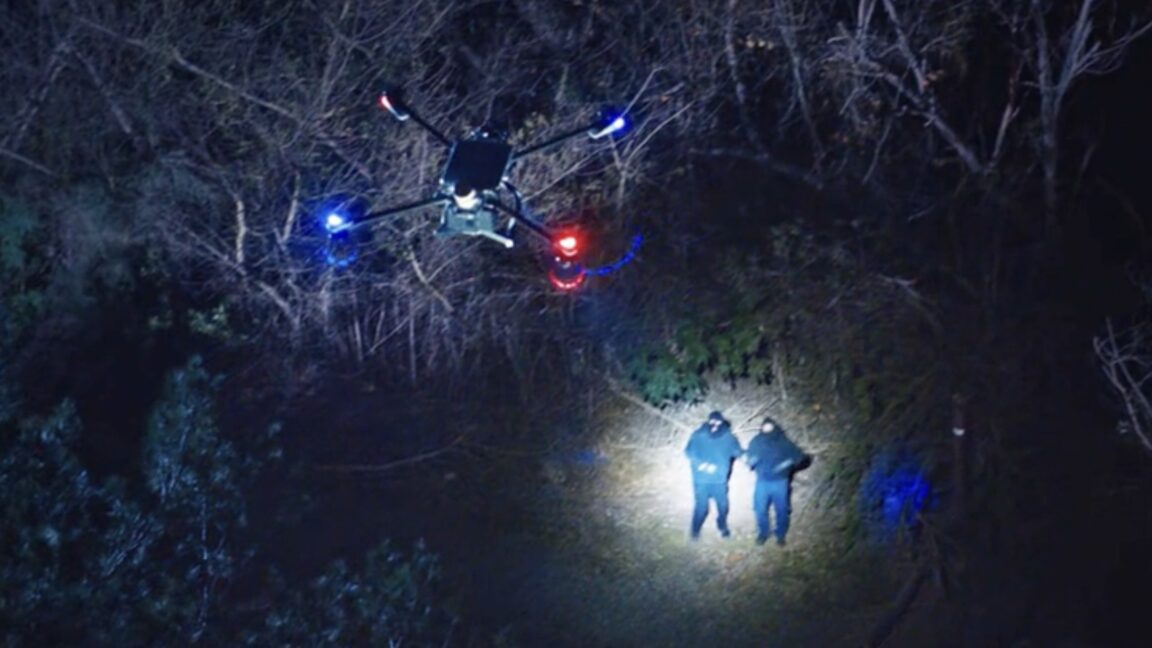
Guardian and its robotic "Guardian Station" charging nest, which automatically swaps batteries in under a minute. Credit: BRINC
What BRINC's Guardian Actually Does
Before getting into the implications, the specs deserve a close read. Guardian is not an incremental improvement on existing drone-as-first-responder (DFR) systems. It's a complete platform redesign that removes almost every practical limitation that constrained previous generations of police drones.
The headline figure is speed: 60+ mph, which BRINC says makes it "the first drone that can pursue vehicles." Current DFR drones top out around 35 mph and are limited to a 3-mile operational radius. Guardian extends that to an 8-mile radius, more than doubling the coverage area of any single deployment point. (BRINC press release, March 25, 2026)
Flight endurance climbs from an average of 25 minutes to 62 minutes - but the more significant change is the recharge cycle. Previous generation drones required 25 or more minutes of contact charging between flights. Guardian's "Guardian Station" robotic nest swaps batteries in roughly one minute, using automated arms to remove and replace the power pack without any human in the loop. For practical purposes, this means a Guardian deployment can maintain near-continuous aerial coverage over a target area with a single drone.
Guardian - Key Specifications
The connectivity upgrade is arguably the most strategically significant change. Every previous generation of DFR drone relied on either cellular LTE or proprietary radio links - both of which have geographic coverage gaps and are susceptible to jamming or network outages. Starlink integration on every Guardian unit means the drone operates with a reliable data link "virtually anywhere on earth," according to the company. That includes rural areas, mountainous terrain, and situations where cellular infrastructure is damaged or unavailable.
The camera system is equally serious: 4K video with 640x total zoom, dual high-definition thermal zoom cameras (a first for a drone of this size class), a 1,000-lumen spotlight, and a built-in laser rangefinder. BRINC says a trained operator can maintain a "clear view from over a thousand feet away" - above the altitude where the drone would be clearly audible or visible from the ground. The siren system outputs sound three times louder than a police car's at the drone's operational frequency.
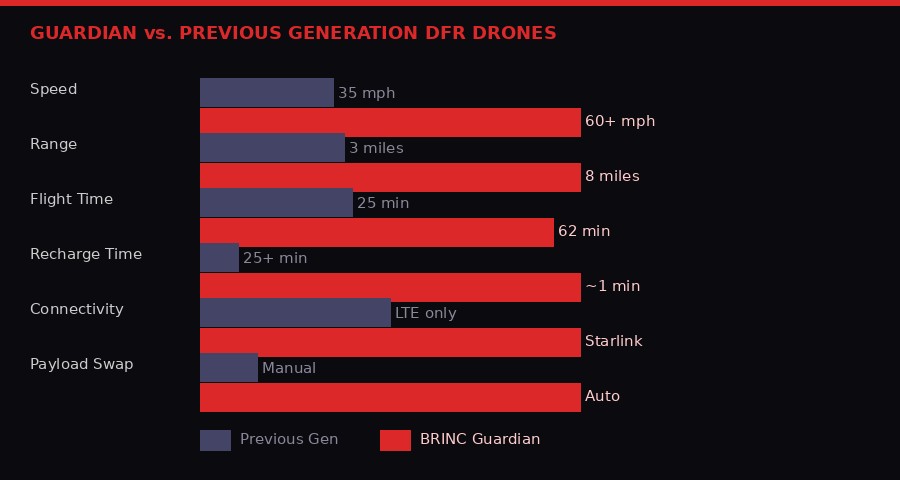
Guardian versus prior-generation Drone as First Responder capabilities. The improvements are not incremental - they represent a category shift. Source: BRINC, industry reports | BLACKWIRE PRISM
The AI Dispatch Layer
Hardware specs alone don't capture what BRINC is building. The deeper story is integration - specifically, how Guardian connects to existing law enforcement command infrastructure through AI-powered dispatch systems.
Last year, BRINC announced a strategic alliance with Motorola Solutions, which is now the exclusive North American reseller of BRINC's DFR technology, including Guardian. That partnership is not simply a sales agreement. It involves deep integration between Guardian and Motorola's CommandCentral Aware platform - the software that runs the command centers of thousands of American police departments. (Motorola Solutions press release, 2025)
Within that system, Motorola's Assist AI listens to incoming 911 calls and identifies keywords - "heart attack," "allergic reaction," "shots fired" - and automatically determines whether and what type of payload-equipped drone should be deployed. The decision pipeline from 911 call to drone launch is designed to operate without requiring a dispatcher to manually evaluate and authorize the deployment. The drone leaves its nest before any human officer could reach the scene.
"Agencies can get eyes on the scene faster, deliver lifesaving support before first responders arrive, and securely capture and store drone footage in our integrated digital evidence management software."
- Jeremiah Nelson, Corporate VP, Motorola Solutions
There's also an officer distress trigger: pressing the emergency button on Motorola's APX NEXT smart radio - the same radio worn by most American patrol officers - automatically dispatches a Guardian drone to the officer's GPS location. No dispatcher involvement required.
This is the architecture worth paying attention to. The drone isn't just faster hardware. It's a node in an automated decision-making system that can initiate aerial deployment of physical objects - cameras, medical payloads, a 1,000-lumen spotlight, a siren three times louder than a police car - based on AI analysis of a phone call.
Guardian can respond to a 911 call, deliver a defibrillator, scan a vehicle, illuminate a suspect, and return to recharge with minimal human intervention at any stage. Credit: BRINC
Sam Altman's Aerial Investment
BRINC's investor list warrants a separate paragraph. The company's backers include Sam Altman (OpenAI CEO), Alexandr Wang (Scale AI CEO), Dylan Field (Figma CEO), Index Ventures, and Motorola Solutions. Also on the cap table: Patrick Shanahan, former Acting Secretary of Defense, and Bradley Tusk, the political strategist turned tech investor who helped Uber survive regulatory battles across multiple US cities. (BRINC press release)
Altman's investment connects BRINC to the broader AI infrastructure ecosystem that OpenAI is building. It's probably not a coincidence that the AI dispatch system underpinning Guardian's operations shares conceptual DNA with the kind of automated agentic systems OpenAI has been commercializing. The keyword detection, automated decision routing, and drone deployment pipeline is, structurally, an AI agent operating in physical space.
Wang's Scale AI connection is equally notable. Scale AI's core business is labeling data for AI training - including the kind of computer vision data that enables aerial surveillance, target identification, and scene analysis from drone footage. There are obvious synergies between the two companies that don't require any explicit partnership agreement to manifest over time.
BRINC founder and CEO Blake Resnick, who is 25 years old, framed Guardian as an explicitly nationalistic product in the press release: BRINC builds all its products in the United States, has a vertically integrated supply chain, and is expanding into a new Seattle factory that more than doubles its production footprint. This is not accidental positioning. The company is marketing itself as the anti-DJI - an American answer to Chinese drone dominance in a market that law enforcement agencies are increasingly uncomfortable purchasing from foreign manufacturers.
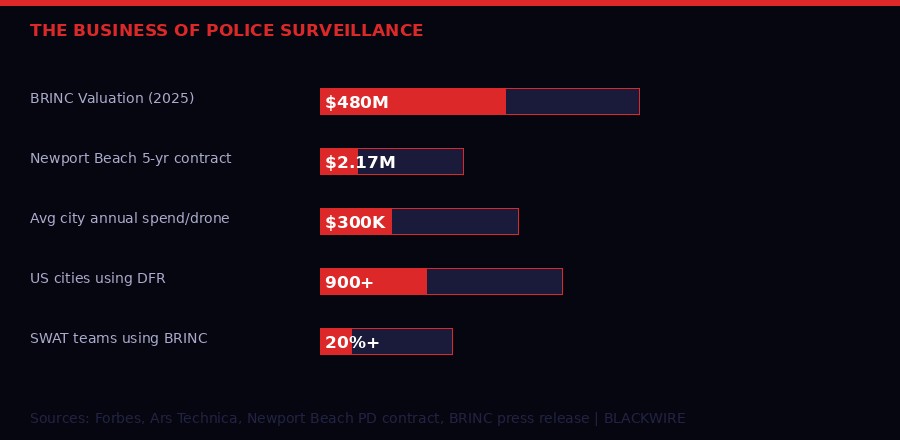
The economics of drone surveillance programs: contract values, city adoption rates, and BRINC's market position. Source: Forbes, Newport Beach PD contract, BRINC | BLACKWIRE PRISM
900 Cities, and Counting
The geographic footprint of BRINC's existing deployments is the context that makes Guardian's capabilities significant rather than merely impressive. The company's drones are currently operating in more than 900 American cities - a number that has been growing steadily as the "drone as first responder" model has become normalized in US law enforcement.
The financial model is well-established. Cities typically pay several hundred thousand dollars per year per drone under multi-year service contracts, with total contract values scaling into the millions as agencies add drones and capabilities. Newport Beach, California signed a $2.17 million, five-year contract for seven drones in 2024. (Police1, 2024) At roughly $60,000-70,000 per drone per year, and with Guardian offering substantially greater capabilities, upgrade contracts are likely to command premium pricing.
The Redmond, Washington Police Department, already an existing BRINC customer, described Guardian as "a completely new and different airframe" and called it "a huge step in DFR innovation and possibility" in a statement to Ars Technica. Jill Green, a department spokesperson, characterized the new model as a category leap rather than an incremental upgrade.
DFR programs have expanded in part because they've demonstrated measurable impact on response times. In cities like Chula Vista, California - one of the pioneering DFR departments - drone response times average under 90 seconds from call to visual on scene, compared to 5-10 minutes for a patrol car. Studies of early DFR programs have shown reductions in crime rates, faster medical response, and improved officer safety in high-risk situations. These results have made it politically easy for city councils to approve drone program expansions.
But the nature of what's being deployed has changed substantially. Early DFR drones were, functionally, flying cameras with limited range and battery life. Guardian is a persistent aerial platform with satellite connectivity, thermal imaging, vehicle pursuit capability, and AI-automated dispatch. The policy frameworks that authorized 2018-era DFR programs were not designed with 2026-era capabilities in mind.
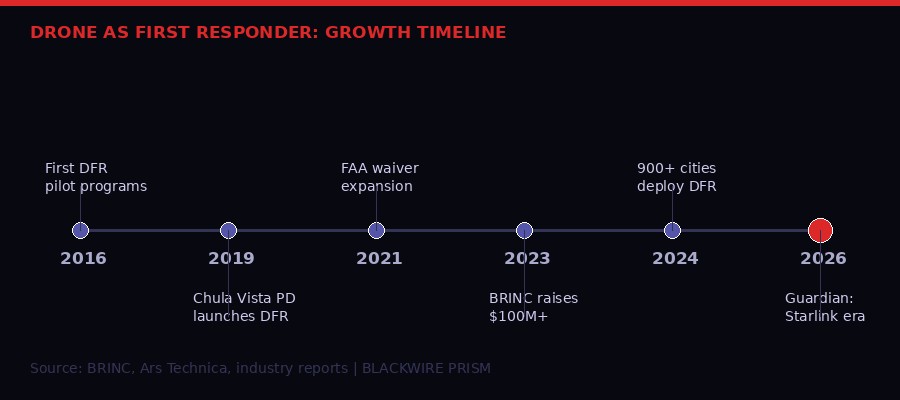
The DFR market has evolved from niche pilot programs to a normalized component of US law enforcement infrastructure in a decade. Guardian represents the most significant capability leap yet. Source: BRINC, Ars Technica | BLACKWIRE PRISM
The Surveillance Architecture Problem
Here's where the second-order analysis matters.
Individual drone deployments are authorized through a fairly well-defined chain: a 911 call triggers dispatch, a dispatcher or AI system evaluates the call, the drone launches. That's a reactive model. The problem is that a drone with 62 minutes of flight time, an 8-mile range, 640x optical zoom, dual thermal cameras, and a satellite uplink is not, in practice, limited to reactive use cases. It has the technical capability to conduct persistent area surveillance, track individuals over extended periods, and document activity that is public but was practically private due to the cost and difficulty of aerial observation.
The American Civil Liberties Union has argued for years that the "drone as first responder" framing is doing significant rhetorical work - that framing a surveillance drone as an emergency medical device (it can carry a defibrillator) obscures its primary function as an aerial surveillance platform. (ACLU, Domestic Drones)
Drone surveillance analyst Faine Greenwood, one of the few independent experts who tracks DFR programs, pushed back on some of BRINC's more aggressive marketing claims in comments to Ars Technica:
"Even if these claims are true (which I doubt at the moment), the speed/battery life is an incremental improvement over other comparable drone platforms. This is not a game-changer situation, and I don't see it as really changing the calculus for police who are on the fence about drones."
Greenwood's skepticism about the marketing claims is worth noting. BRINC's press release and product announcements have a tendency toward superlatives that aren't always immediately verifiable. The "first drone that can pursue vehicles" claim, for instance, is not obviously true if you include military or customs and border protection platforms in the comparison.
But the deeper concern isn't whether Guardian can truly hit 60mph in real-world conditions or whether its battery swap actually takes 60 seconds under operational stress. The concern is structural: a privately owned drone company, backed by the CEO of the world's most powerful AI company, has secured service contracts with over 900 American cities for persistent aerial surveillance platforms, and is now deploying an upgrade that removes almost every operational limitation that previously constrained the technology's use.
The regulatory framework governing this infrastructure remains fragmented. The FAA governs airspace and has granted blanket authorizations for DFR programs in many cities under its Part 107 rules and through specific BVLOS (beyond visual line of sight) waivers. Local city councils typically approve contract expenditures. There is no federal framework specifically governing the data retention, access, or use policies for the footage these drones collect.
The Starlink Dimension
Starlink's integration into Guardian is not just a connectivity upgrade. It represents a structural change in how drone networks relate to national infrastructure.
Until now, DFR systems were inherently local. A drone in Chicago depended on Chicago's cellular network, Chicago's radio frequency environment, and Chicago's local IT infrastructure to transmit footage and receive commands. Starlink integration creates a drone that is operationally independent of local infrastructure and directly connected to a SpaceX-operated global satellite constellation.
The practical benefits are clear: drones can operate in rural coverage gaps, during infrastructure disruptions (a common scenario in natural disasters), and in situations where local cellular networks are overloaded or compromised. BRINC explicitly markets Guardian's Starlink capability as enabling response "to calls up to eight miles away" - possible only because the communication link doesn't degrade with distance the way LTE does.
The security and oversight implications are less clear. Starlink-connected devices communicate through SpaceX's network infrastructure. The data routing, encryption standards, and government access procedures that govern drone footage transmitted over Starlink have not been publicly described by either BRINC or SpaceX. Law enforcement footage transmitted over a private satellite network raises questions that existing DFR data governance frameworks - already patchy - weren't designed to address.
There's also an interoperability dimension. If every BRINC Guardian in every city communicates over Starlink, the technical architecture exists for centralized data aggregation that would be impossible with locally siloed cellular-based systems. Whether BRINC uses or plans to use that architecture for anything beyond individual deployment telemetry is unknown. But the technical capability exists, and capability tends to be used.
Guardian patrols at altitudes where its 640x optical zoom keeps subjects under surveillance while remaining difficult to hear from the ground. Source: BRINC
The Chinese Drone War Subtext
BRINC's aggressive "Made in America" positioning is not incidental to the Guardian announcement. It's the core of the company's growth strategy.
For years, American law enforcement agencies have relied heavily on drones from DJI, the dominant Chinese consumer and commercial drone manufacturer. DJI's products are cheaper, more feature-rich, and better-supported than most American alternatives. But starting around 2020, the US government began pressuring agencies to move away from DJI hardware over data security concerns - specifically, concerns that DJI's connectivity infrastructure could route footage through servers accessible to the Chinese government.
Congress passed the American Security Drone Act of 2023, which prohibits federal agencies from purchasing drones manufactured in China or Russia and from those countries' companies. State and local agencies are not covered by the same restrictions, but federal grant funding for law enforcement technology increasingly comes with DJI exclusion clauses.
BRINC has positioned itself to be the primary beneficiary of this shift. Its founder has been explicit about the strategic framing: this is an American company building American-made products for American law enforcement, at a moment when Chinese alternatives are becoming politically untenable. (Forbes, Dec 2025)
The Motorola Solutions partnership amplifies this. Motorola's radio systems are the standard communication infrastructure in American law enforcement - nearly every department in the country uses Motorola hardware at some point in its communication stack. A DFR drone integrated into Motorola's command center software is a drone that fits into the existing workflow without requiring any department to learn new systems or procure separate infrastructure.
Guardian's production expansion into a new Seattle factory and its vertically integrated supply chain are both signals that BRINC is positioning for the kind of volume contracts that come with being a national defense infrastructure vendor rather than a startup selling products at the margin.
DRONE AS FIRST RESPONDER: KEY MILESTONES
What Comes After Guardian
The DFR technology trajectory has been consistent: each generation removes practical constraints that limited the previous generation's use, and each removal expands the scope of what's technically possible in ways that outpace the policy frameworks governing use.
The generation before Guardian was limited by range, battery life, and connectivity. Those limits, however imperfect, created natural boundaries. A drone with a 3-mile radius and 25 minutes of flight time isn't a surveillance grid - it's a point tool for specific incidents. Guardian with an 8-mile radius, 62 minutes of flight time, satellite connectivity, and robotic battery swap can cover an entire city's core from a single deployment point, maintaining continuous aerial presence for as long as the operator chooses.
The logical next capability additions are predictable from the current trajectory. Computer vision-based person tracking - maintaining a lock on a specific individual's movements across a drone's entire field of view - is already commercially available and is used in military DFR applications. Integration with facial recognition databases would allow a Guardian drone to identify specific individuals from altitude without any officer intervention. Neither of these capabilities requires any additional hardware beyond software updates to Guardian's existing sensor suite.
BRINC's current system connects to Motorola's AI keyword detection for 911 dispatch. The same AI integration layer could, technically, connect to predictive policing software that flags locations or individuals as elevated risk based on historical crime data. This wouldn't require BRINC to build any new functionality - it would require the Motorola Solutions integration layer to accept triggers from additional data sources.
None of this is speculation about what BRINC plans to do. It's analysis of what becomes technically trivial once the hardware and connectivity infrastructure is in place. That's the surveillance architecture problem in its clearest form: the capabilities that are concerning are not the ones being announced today. They're the ones that become obvious incremental additions once the foundational infrastructure is normalized.
BRINC is, by its own account, building the permanent aerial surveillance layer for American cities. The company is explicit that Guardian enables "true 24/7 drone readiness without human intervention." It describes Guardian Station as providing continuous coverage as a product feature, not as a policy question.
That framing - 24/7 readiness as a feature, not a governance question - is the clearest signal of where this technology is heading and how fast it's getting there.
The Bottom Line
BRINC's Guardian is a genuinely impressive piece of hardware that will save lives. The ability to get a defibrillator to a cardiac arrest victim before an ambulance arrives, or to give officers real-time aerial intelligence during a dangerous situation, or to locate a missing child using thermal cameras at night - these are real, documented benefits of DFR programs, and Guardian extends them substantially.
It is also the latest and most capable iteration of a technology that is constructing a permanent aerial surveillance infrastructure over American cities, operated by a private company, backed by the AI industry's most powerful figures, integrated into AI-automated dispatch systems, and governed by a patchwork of local contracts and FAA waivers that were not designed for this level of capability.
Those two things are both true simultaneously, and neither cancels out the other. The question worth asking - before Guardian enters production and before service contract renewals lock in another generation of upgrades - is whether the policy frameworks governing this infrastructure are adequate for what's actually being deployed.
Guardian enters production later this year. The December 2028 Mars launch window doesn't negotiate; neither does the hardware upgrade cycle in American law enforcement. By the time the governance conversation catches up to the technology, the technology will already be somewhere else entirely.
Get BLACKWIRE reports first.
Breaking news, investigations, and analysis - straight to your phone.
Join @blackwirenews on TelegramSources: BRINC press release (PR Newswire, March 25, 2026); Ars Technica reporting by Cyrus Farivar (March 25, 2026); Forbes valuation profile (December 2025); Newport Beach PD contract documents (Police1, 2024); ACLU domestic drones policy; Motorola Solutions press release (2025); FAA Part 107 regulations and BVLOS waiver documentation. All financial figures as reported by cited sources.