None Can Run Away: 1,800 Civilians Dead in Burkina Faso's Hidden War as the World Looks the Other Way
A 316-page Human Rights Watch report documents ethnic cleansing, mass executions, and crimes against humanity in a conflict the global media barely registers. The junta kills twice as many civilians as the jihadists it claims to fight.

The Sahel region stretches across West Africa, home to some of the deadliest and least-reported conflicts on Earth. Photo: Pexels
While the world fixates on Iran missile strikes and oil prices, a 316-page document landed on desks at the United Nations, the African Union, and the European Commission on Thursday morning that should have stopped every diplomat in their tracks. Human Rights Watch published what may be the most comprehensive account of mass atrocities in West Africa since the Rwandan genocide documentation - a forensic, 450-interview investigation into the armed conflict in Burkina Faso that reveals a scale of horror that "mind-boggling" barely begins to describe.
The headline figure: more than 1,800 civilians killed since January 2023 by both the country's military junta and the Al Qaeda-linked armed group JNIM. That number is likely a significant undercount. Burkina Faso's military government has systematically destroyed the ability of journalists, aid workers, and human rights monitors to operate in the country. What researchers documented across 57 verified incidents represents a floor, not a ceiling.
The most damning finding is not that jihadists are killing civilians - that is horrible but known. It is that the government forces supposedly defending the population have killed more than twice as many civilians as the insurgents they claim to fight. The Burkinabe military and its allied Volunteers for the Defense of the Homeland (VDP) militias have carried out systematic ethnic cleansing of Fulani communities. Entire villages emptied. Men blindfolded, hands bound, shot in the back of the neck. Women and children executed. Property looted and burned.
This is not a secret conflict in some inaccessible corner of the planet. Burkina Faso is a country of 23 million people. It shares borders with six nations. It was once a functioning democracy. Now it is a charnel house run by a 36-year-old army captain who seized power in a coup, and every international body that should care has effectively looked the other way.
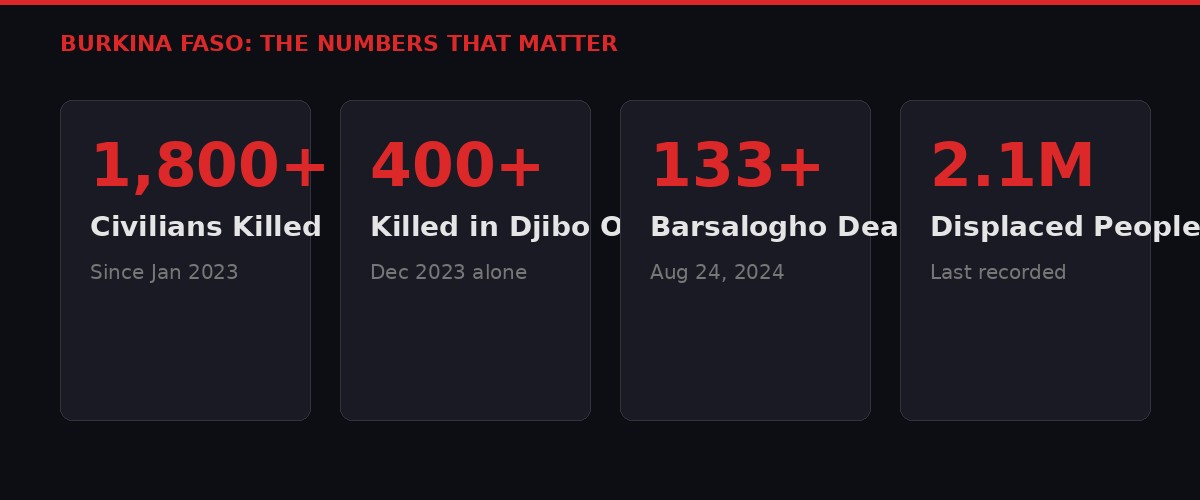
The numbers behind Burkina Faso's hidden war - data compiled from Human Rights Watch's 316-page report
Operation Tchefarri 2: The Djibo Massacres

The northern Sahel region of Burkina Faso, where the deadliest atrocities have been documented. Photo: Pexels
The single deadliest documented event occurred in December 2023 in the northern Sahel region, near the town of Djibo. The Burkinabe military launched what it called "Operation Tchefarri 2" - the name translates to "Warriors' Honey" in Fulfulde, the language spoken by the Fulani people who were its primary targets. Over the course of the operation, soldiers and VDP militiamen swept through approximately 16 villages. They killed more than 400 civilians.
The Human Rights Watch report contains testimony from survivors that reads like evidence from a war crimes tribunal - because that is exactly what it should become. A 35-year-old woman told researchers how the militia opened fire without warning on a group of civilians. Her two daughters were killed on the spot. She was shot, along with her 9-month-old son. As she lay bleeding, unable to move, she heard a militia member issue an order to the others.
"Make sure no one is breathing before heading out."
This was not collateral damage. This was not a firefight that went wrong. This was a systematic sweep through civilian communities with the explicit intent to kill everyone present. The operation targeted Fulani villages specifically because the military had designated the entire ethnic group as suspected JNIM sympathizers. In the logic of the Burkinabe counterinsurgency, being Fulani was evidence enough of guilt.
Researchers verified the December 2023 massacres through satellite imagery showing destroyed structures, thousands of hours of audiovisual footage, survivor and witness interviews, and official documents. The pattern was consistent across all 16 villages: soldiers and militia arrived, gathered civilians, separated men from women, and executed the men. In many cases, they then killed women and children as well. In several villages, no survivors were left to provide testimony - the evidence comes from people who fled before the sweep reached them, or who returned afterward to find the dead.
The Djibo area had already been a flashpoint. JNIM had besieged the town itself for months, blocking supply routes and trapping an estimated 300,000 people in what aid workers described as an open-air prison. The military's response to the jihadist siege was not to break the blockade and deliver supplies. It was to punish the surrounding Fulani communities for allegedly allowing JNIM to operate in their midst. The civilians were trapped between two armed forces, both of which viewed them as the enemy.
No investigation was opened into Operation Tchefarri 2. No commander was disciplined. The Burkinabe government initially denied the operation had taken place at all. When evidence became impossible to suppress, officials described it as a legitimate counterterrorism operation in which "terrorists were neutralized." The word "civilian" never appeared in official accounts.
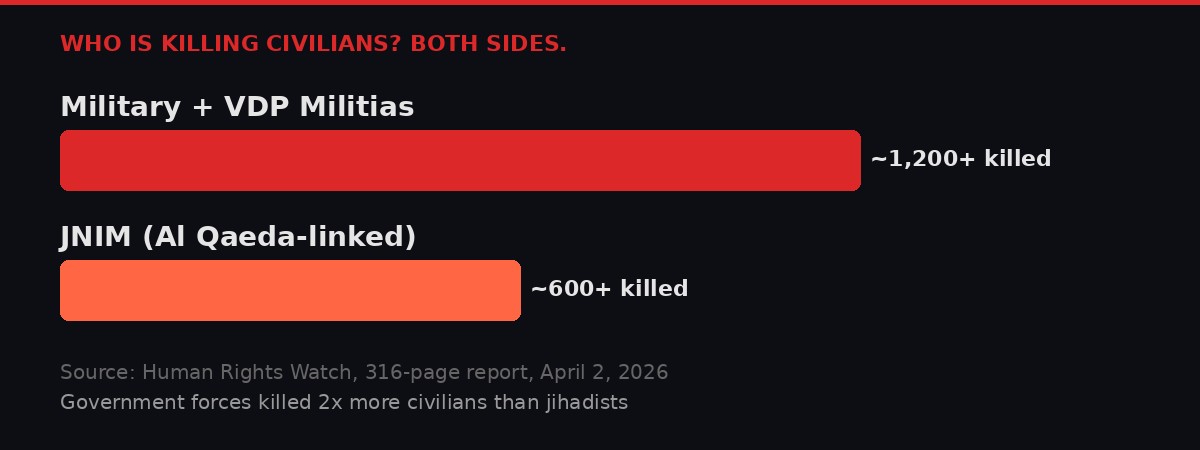
Government forces have killed roughly twice as many civilians as the jihadist group they claim to be fighting. Source: Human Rights Watch
The Ethnic Cleansing of the Fulani

Across Burkina Faso, entire Fulani communities have been forcibly displaced from ancestral lands. Photo: Pexels
The targeting of Fulani people is not incidental to the Burkinabe counterinsurgency. It is the strategy. Human Rights Watch documents a pattern that amounts to ethnic cleansing under international law - the deliberate and systematic removal of an ethnic group from a geographic area through violence, threats, and destruction of property.
The Fulani are the largest pastoralist ethnic group in West Africa, numbering roughly 40 million across the Sahel. In Burkina Faso, they represent approximately 10% of the population. Their traditional lifestyle - semi-nomadic cattle herding - takes them through remote areas where JNIM also operates. This geographic overlap has been weaponized by the junta. Military intelligence briefings obtained by researchers show that commanders were given orders to treat Fulani settlements as hostile territory regardless of any actual evidence of insurgent activity.
The VDP militia system has amplified the ethnic dimension. The Volunteers for the Defense of the Homeland were established in 2020 as a civilian auxiliary force - essentially, the government armed local men and gave them license to fight JNIM. The recruits are overwhelmingly drawn from non-Fulani ethnic groups, particularly the Mossi majority. The VDPs receive minimal training, no oversight, and near-total impunity. They have become, in effect, ethnic militias with state backing.
One incident documented in the report occurred in November 2023 in the western village of Basse. Government-allied militias killed 13 Fulani civilians, including six women and four children. A 41-year-old man who survived described returning to find the aftermath.
"All the bodies, except for that of my son, were grouped together in the courtyard, blindfolded with their torn clothes and their hands tied behind their backs - riddled with bullets. My son was lying on his stomach. He had been shot in the back of the neck."
Survivors consistently report that attackers invoked the president's name during massacres. VDP militiamen told victims: "It's Ibrahim Traore who sent us to kill you." Whether that represents a direct chain of command or the militia's understanding of implied authorization is a question for prosecutors. Either way, it establishes that the perpetrators believed they were acting with state sanction.
The displacement figures are staggering. The last consolidated count, from March 2023, estimated 2.1 million internally displaced people - nearly 10% of the country's population. That number has almost certainly grown, but the junta stopped cooperating with organizations that track displacement. UNHCR estimated 5.9 million people needed humanitarian assistance in 2025. The International Organization for Migration reports that thousands have been displaced in all 13 of Burkina Faso's regions. The conflict is not contained. It has metastasized across the entire country.
JNIM: The Other Side of the Slaughter

JNIM has besieged dozens of towns across Burkina Faso, cutting off food and medical supplies to hundreds of thousands. Photo: Pexels
The Human Rights Watch report is unflinching in its documentation of JNIM's atrocities as well. The Al Qaeda-linked group Jama'at Nusrat al-Islam wa al-Muslimin - translated as the Group for the Support of Islam and Muslims - has waged an insurgency across the Sahel since 2017. In Burkina Faso, it controls territory estimated at roughly half the country. Its tactics include mass killings, sieges of civilian towns, destruction of infrastructure, improvised explosive device campaigns, and forced recruitment.
The Barsalogho massacre of August 24, 2024 stands as the single deadliest incident attributed to JNIM. Fighters attacked the central town, killing at least 133 civilians, including dozens of children. Many of the victims were not combatants in any sense - they were civilians who had been conscripted by the military to dig defensive trenches around the town. The military forced them to work, then failed to protect them when JNIM attacked.
"They shot continuously, as if they had plenty of ammunition. People were falling like flies. They came to exterminate us. They did not spare anyone."
A 39-year-old survivor spoke those words to researchers. Five members of his family died in the attack. Videos taken by JNIM fighters themselves - uploaded to social media as propaganda - show dozens of bloodied men with shovels and pickaxes lying dead in the trenches they had been forced to dig. The soldiers stationed at a nearby military base either fled or were killed. An ambulance dispatched from the base was captured by JNIM.
JNIM's strategy extends beyond direct killing. The group has besieged dozens of towns across Burkina Faso, blocking all movement of goods and people. In besieged towns, residents face starvation, lack of medicine, and complete isolation from the outside world. JNIM plants IEDs on roads, destroys bridges, poisons water sources, and demolishes communications infrastructure. The goal is not just military control - it is the total subjugation of civilian populations.
The food security situation is dire. FEWS NET estimated that 1.5 to 2 million people required food assistance during the February-May 2025 period. The Cadre Harmonise projected 2.8 million people would face food insecurity from June-August 2024, including 423,000 in the emergency phase. These are numbers from before the conflict's most recent escalation. The real figures today are unknown because the junta has expelled or restricted most of the organizations that would collect them.
JNIM's supreme leader, Iyad Ag Ghaly, is already wanted by the International Criminal Court for alleged crimes committed in Mali in 2012-2013. Human Rights Watch has now identified four additional JNIM commanders who may bear command responsibility for atrocities in Burkina Faso and should be investigated.
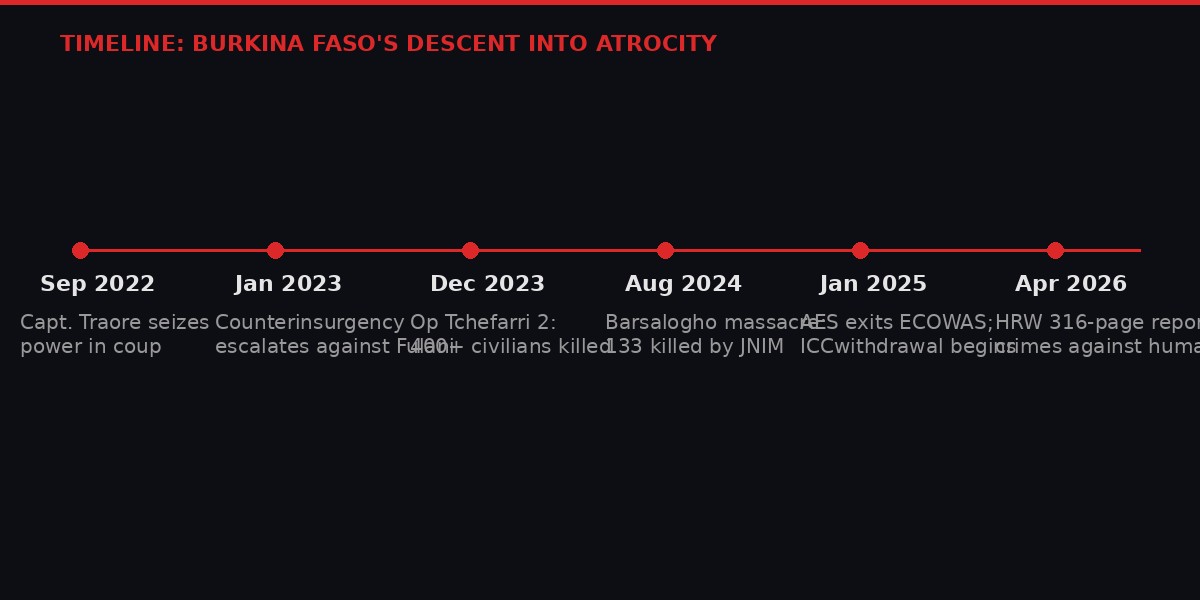
From coup to crimes against humanity: the timeline of Burkina Faso's descent
Captain Traore and the Architecture of Impunity

The military junta under Captain Ibrahim Traore has systematically dismantled accountability mechanisms. Photo: Pexels
Captain Ibrahim Traore was 34 years old when he seized power in September 2022, overthrowing a military government that had itself taken power in a coup just eight months earlier. Burkina Faso's second coup in a year made Traore the youngest head of state in the world. He has since built a personality cult modeled partly on Thomas Sankara - the revolutionary Burkinabe leader assassinated in 1987 - and partly on the strongman populism of his Russian allies.
Human Rights Watch names Traore directly. As supreme commander of the armed forces, he bears potential command responsibility for the atrocities committed by the military and VDP militias. The report identifies six senior Burkinabe military commanders who may be liable under the doctrine of command responsibility. These are not low-ranking soldiers committing freelance atrocities. The pattern of violence is too systematic, too widespread, and too consistent across different regions to be anything other than policy.
The junta has constructed a comprehensive system of impunity. Victims and their families told researchers they do not trust national justice institutions and cannot access them. Government officials have either denied or actively minimized allegations of abuse. No credible investigation has been opened into any of the 57 incidents documented in the report. The military's own internal accountability mechanisms - if they ever existed - are nonfunctional.
Traore's government has simultaneously waged war on the messengers. A relentless crackdown on independent media, political opposition, and civil society has created what HRW describes as "an atmosphere of terror" that severely restricts the flow of information about the conflict. In March 2025, intelligence services arrested journalists Sanogo and Ouoba. Other reporters have been forcibly conscripted into the military - effectively disappeared into the ranks of the institution they were investigating. Exiled journalists and activists have been placed on wanted lists. Foreign correspondents have been expelled.
The media blackout is not a side effect of the conflict. It is a deliberate strategy to prevent documentation of atrocities. When Human Rights Watch conducted its research, it had to interview many sources outside Burkina Faso - in Benin, Cote d'Ivoire, Ghana, and Mali - because witnesses and survivors had fled and conducting interviews inside the country was dangerous for both researchers and subjects.
The result is a near-total information vacuum. Major international outlets barely cover Burkina Faso. When they do, the stories are buried beneath coverage of the Iran war, the US-China trade fight, and the Artemis II mission. The people being killed in Djibo and Barsalogho and Basse do not trend on social media. Their deaths do not move markets. They die in silence, and the silence is engineered.
The Sahel Alliance: Russia's New Playground

The Alliance of Sahel States has redrawn the geopolitical map of West Africa - with Russia filling the vacuum left by departing Western forces. Photo: Pexels
Burkina Faso's impunity crisis exists within a larger geopolitical realignment that has fundamentally changed the security architecture of West Africa. In January 2024, Burkina Faso, Mali, and Niger - all three ruled by military juntas that seized power in coups - jointly announced their withdrawal from ECOWAS, the Economic Community of West African States. The departure was finalized in January 2025. The three countries formed the Alliance of Sahel States (AES), a new bloc explicitly oriented away from Western partnerships and toward Russia.
The Wagner Group - now rebranded as the Africa Corps following Yevgeny Prigozhin's death - has deployed personnel across all three AES countries. In Mali, Russian mercenaries have been implicated in their own civilian massacres. In Burkina Faso, the Russian presence is less visible but no less significant. Moscow provides military equipment, training, political cover at the UN Security Council, and a ready-made information warfare apparatus that amplifies anti-Western sentiment and pro-junta narratives across social media.
The AES countries took an even more dramatic step in September 2025: they announced their withdrawal from the Rome Statute of the International Criminal Court. The withdrawal takes a year to process, meaning any crimes committed on Burkinabe territory still technically fall under ICC jurisdiction during the transition period. But the signal was unmistakable. The juntas were dismantling the last international mechanism that could hold them accountable for atrocities. Legal scholars have noted the irony of the stated rationale - the AES framed the withdrawal as resistance to "Western-aligned, neo-colonial justice" and proposed creating a Sahelian Criminal Court as an alternative. No details of this alternative court have materialized. Dr. Owiso Owiso, a legal scholar in international law, has argued the real motive is transparent: the military juntas want to "avoid exposure to the ICC through performative Pan-Africanism because of their countries' own human rights violations."
France, the former colonial power that once maintained military bases across the Sahel, has been expelled from all three countries. French troops withdrew from Burkina Faso in 2023 and from Niger in 2024. The European Union, which had funded counterterrorism programs in the region, has seen its influence collapse. The United States maintained a drone base in Niger until the junta ordered American forces out in 2024.
The departure of Western security partners has not been replaced by effective Russian support. The jihadist insurgency has expanded, not contracted, since the AES countries pivoted to Moscow. JNIM controls more territory today than it did when French forces were present. Civilian casualties have risen. The Russian-trained forces have proven no more capable of protecting civilians than their Western-trained predecessors - and considerably less accountable.
The HRW report essentially documents the consequences of a security vacuum filled by impunity. When international monitoring collapses, when press freedom is destroyed, when the ICC is rejected, and when the only external patron is a government that itself massacres civilians, the result is predictable. The civilians of Burkina Faso are living that result.
The Humanitarian Catastrophe Behind the Numbers

Humanitarian organizations are struggling to reach besieged communities as the junta restricts access and JNIM blocks supply routes. Photo: Pexels
Behind every statistic in the HRW report is a humanitarian emergency that ranks among the worst on the planet but receives a fraction of the attention and funding. The numbers tell part of the story: 5.9 million people in need of humanitarian assistance in 2025, according to UNHCR. An estimated 2.1 million internally displaced - a figure that predates the worst of the violence. Non-state armed groups controlling roughly half the country. Cities under siege. Supply convoys dependent on military escorts that are themselves targets of attack.
The International Rescue Committee includes Burkina Faso on its annual Emergency Watchlist. FEWS NET, the famine early warning system, has flagged multiple regions as approaching emergency-level food insecurity. The EU's humanitarian aid operations describe a country where "vulnerability is extremely high in areas isolated from the rest of the country due to insecurity, where residents are dependent on irregular supply convoys organized by the Burkinabe Defense and Security Forces."
Those supply convoys have become weapons in themselves. The military controls what gets through and what does not. Communities suspected of sympathizing with JNIM - which in practice means Fulani communities - can be cut off from food, medicine, and clean water as collective punishment. JNIM, for its part, blocks convoys entirely in areas it controls, creating parallel zones of starvation.
Children bear a disproportionate share of the suffering. UNICEF has reported that hundreds of thousands of children are out of school in conflict-affected areas. Schools have been attacked by both sides. Teachers have fled or been killed. An entire generation of Burkinabe children is growing up without education, without security, and in many cases without adequate nutrition. The long-term consequences - radicalization, poverty, further instability - are entirely predictable and entirely unaddressed.
Healthcare has collapsed in large parts of the country. Clinics have been destroyed or abandoned. Medical supplies cannot reach besieged areas. Women give birth without any medical assistance. Preventable diseases kill children who would survive in peacetime. The Medecins Sans Frontieres teams that once operated in northern Burkina Faso have been forced to reduce their presence due to security threats.
The aid community faces a grim paradox. The people who most need help are in areas controlled by armed groups or under military operations where access is denied. The areas where aid workers can operate safely are the areas with the least need. The result is that international assistance flows around the crisis rather than into it, and the people in the center of the violence are left entirely alone.
What Accountability Looks Like - And Why It Isn't Happening

International justice mechanisms are being systematically dismantled in the Sahel even as atrocities escalate. Photo: Pexels
Human Rights Watch's recommendations are specific and actionable. The organization calls on the ICC's Office of the Prosecutor to open a preliminary examination into alleged war crimes and crimes against humanity committed by all parties in Burkina Faso since September 2022. It names President Traore and six military commanders as potentially liable for command responsibility. It names JNIM leader Iyad Ag Ghaly and four JNIM commanders. It calls on governments to impose targeted sanctions against abusive commanders.
The obstacles to accountability are formidable. The ICC withdrawal, while not yet effective, has created political cover for the junta to reject any cooperation with international investigators. The Burkinabe justice system is controlled by the military. Witnesses fear for their lives. Evidence is being systematically destroyed. The media crackdown means that new atrocities go unreported. The information environment is designed to prevent accountability from ever beginning.
The international community's response has been, in a word, negligible. The African Union issued a statement of "grave concern" about the AES withdrawal from ECOWAS in February 2024. It has taken no meaningful action on atrocities. The UN Security Council cannot act because Russia - the juntas' patron - holds veto power. The EU has imposed some sanctions on Wagner-linked individuals but has taken no specific action against Burkinabe military commanders. The United States, consumed by its war in Iran and domestic political crises, has not made Burkina Faso a priority.
Philippe Bolopion, executive director of Human Rights Watch, put it as directly as possible in the report's release: "The scale of atrocities taking place in Burkina Faso is mind-boggling, as is the lack of global attention to this crisis." He added: "The world needs to recognize the magnitude of the atrocities unfolding in Burkina Faso to bring them to an end."
The 316-page report is titled "None Can Run Away." The name comes from a phrase used by perpetrators during the massacres - a taunt directed at civilians who had nowhere to flee. It also describes the current predicament of millions of Burkinabe civilians caught between a junta that kills its own people and an insurgency that slaughters anyone in its path. There is no safe direction. There is no functioning justice system. There is no international protection force. There is, increasingly, no one watching.
On the day the report was published, the world's media was focused on Trump's Iran war speech, oil prices crossing $110 a barrel, the Artemis II translunar injection burn, and the one-year anniversary of Liberation Day tariffs. The 1,800 dead civilians of Burkina Faso did not trend. The 400 people massacred near Djibo did not make the evening news. The ethnic cleansing of the Fulani did not prompt emergency sessions at the Security Council.
The report exists. The evidence is documented. The commanders are named. The legal framework for prosecution is established. What is missing is the single ingredient that has always been missing in the prevention of mass atrocities: the political will to act. Every day that will is absent, the count rises.
Get BLACKWIRE reports first.
Breaking news, investigations, and analysis - straight to your phone.
Join @blackwirenews on Telegram