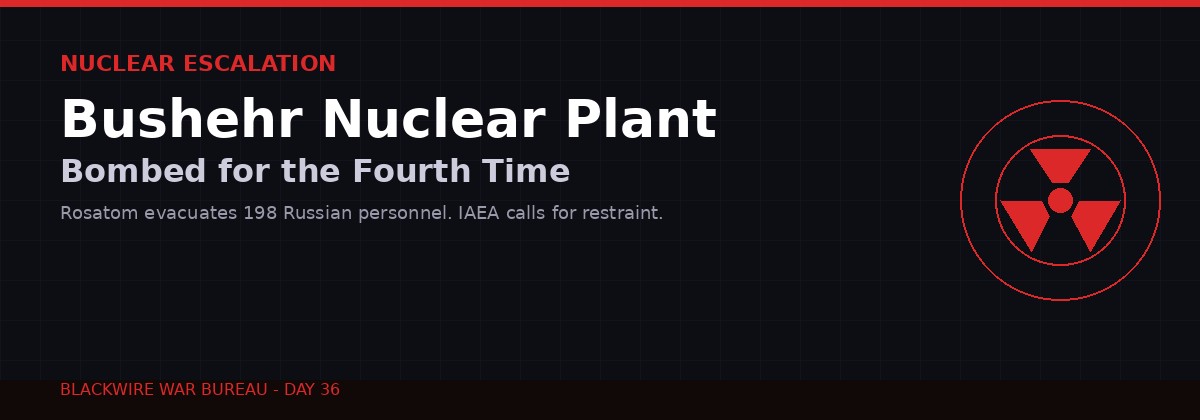
A projectile struck near Iran's Bushehr Nuclear Power Plant on Saturday, April 4 - the fourth time in 36 days that the facility has been targeted since the US-Israel war on Iran began on February 28. The International Atomic Energy Agency confirmed the strike, noting one person was killed and an auxiliary building was damaged. No radiation increase was detected. IAEA via X, Apr 4
But the story is not just about what did not happen. The story is about how close the world is edging to what could happen. Four strikes on Iran's only operational nuclear power plant, each one building on the last. A city of 250,000 people surrounding the facility. Russian nuclear technicians being evacuated in the largest single wave since the war started. And the head of the global nuclear watchdog using language that has not been heard since Chernobyl.
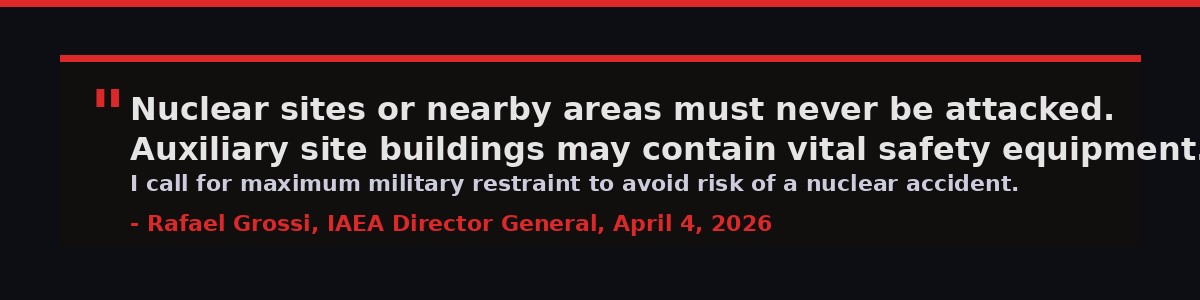
"Nuclear sites or nearby areas must never be attacked," IAEA Director General Rafael Grossi said in a statement posted to X. He added that auxiliary buildings at such sites "may contain vital safety equipment" and reiterated his call for "maximum military restraint to avoid risk of a nuclear accident." IAEA statement, Apr 4
Nobody is listening.
WHAT HAPPENED: THE FOURTH STRIKE
Saturday's strike hit a location close to the Bushehr Nuclear Power Plant in the coastal city of Bushehr, located on the Persian Gulf roughly 1,200 kilometres south of Tehran. The Atomic Energy Organization of Iran (AEOI) confirmed an "auxiliary" building on the plant's grounds was damaged. A member of the security personnel was killed by projectile fragments. AEOI via X, Apr 4
Iran's Foreign Minister Abbas Araghchi, who has been documenting the attacks on his personal X account, said Bushehr had been "bombed" four times since the war began. He sharply criticised what he called a global failure to respond to the attacks on civilian nuclear infrastructure. FM Araghchi via X, Apr 4
The IAEA confirmed no increase in radiation levels following the strike - a crucial piece of information that nonetheless understates the severity of the situation. The main reactor building was not directly hit. But each strike that falls closer, each piece of auxiliary infrastructure that sustains damage, erodes the safety margins that nuclear engineers rely on.
The Bushehr plant is Iran's only operational commercial nuclear power plant. It was built with Russian assistance through Rosatom, Iran's state nuclear counterpart, and generates approximately 1,000 megawatts of electricity for the Iranian grid. The city of Bushehr - population 250,000 - surrounds it on three sides. Al Jazeera, IAEA background documentation
The Bushehr plant is located 80km from Kuwait, the closest Gulf country to Iran. If the reactor core were breached and a significant radioactive release occurred, prevailing Gulf winds could carry contamination across Kuwait, Bahrain, Qatar and the UAE within hours. The 1986 Chernobyl disaster contaminated large parts of Europe from a single reactor event. Bushehr operates with similar-generation VVER-1000 reactor technology.
ROSATOM'S 198: READING THE EVACUATION
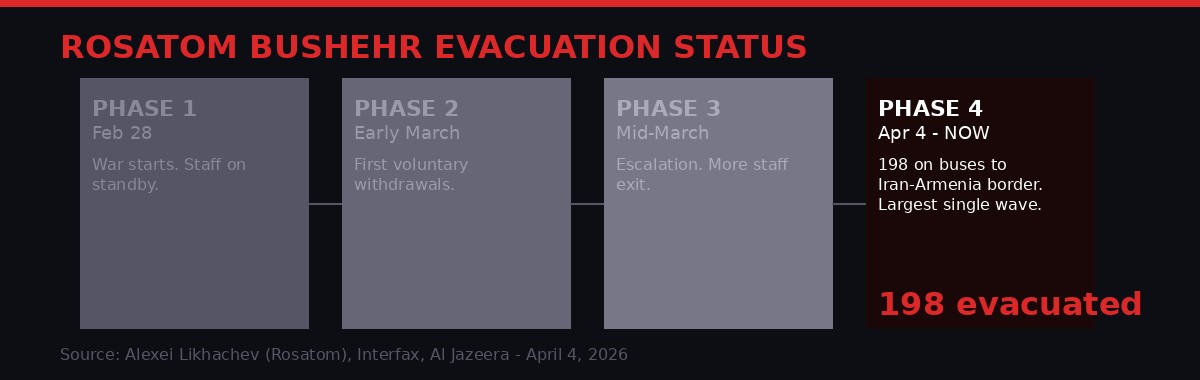
Alexei Likhachev, the CEO of Russia's state nuclear corporation Rosatom, confirmed that 198 Russian personnel were evacuated from the Bushehr plant on Saturday, boarding buses toward the Iranian-Armenian border. "As planned, we began the main wave of evacuations today, about 20 minutes after the ill-fated strike," he told Russia's Interfax news agency. Interfax, Apr 4
He was careful to note that Saturday's mass evacuation had been planned before the strike. Rosatom has been withdrawing staff in phases since the war began. The latest wave - 198 people, described by Likhachev as "the largest wave of evacuation" - represents a decisive shift in how Russia is assessing the risk to its personnel.
Russia's involvement at Bushehr runs deep. Moscow has been operating the plant under a service agreement since its completion in 2011, providing fuel, maintenance and technical expertise. The Iranian-Russian nuclear partnership at Bushehr is one of the most significant energy deals between the two countries - a relationship that has grown considerably since Russia's 2022 invasion of Ukraine and subsequent Western sanctions on Moscow. Al Jazeera, Reuters background
The evacuation is not merely a safety measure. It is a signal. When Russia begins pulling its nuclear technicians out of an active war zone in waves of nearly 200 people, it is signalling that the risk level at Bushehr has crossed a threshold the Kremlin is no longer comfortable with. Moscow has not publicly condemned the strikes on Bushehr. But the evacuations speak louder than any statement.
The routes out are limited. Buses heading toward the Iranian-Armenian border must travel through territory that has itself been subject to military activity. Armenia - which shares a land border with both Iran and Russia - has become an unlikely transit corridor for Russian nationals exiting Iran since the war began. Multiple sources, Al Jazeera, Interfax
There is a secondary strategic dimension to the Rosatom withdrawal that goes largely undiscussed. Russian technical personnel at Bushehr are not interchangeable. The VVER-1000 reactor at Bushehr requires specialised maintenance, fuel handling and control systems expertise that took years to develop. An extended absence of Rosatom technical staff does not just reduce Bushehr's day-to-day safety margin - it raises the question of what happens if the reactor needs emergency intervention and the people who know how to do it are no longer there. Likhachev did not address this publicly. IAEA background, Rosatom technical documentation
FOUR STRIKES: A TIMELINE OF NUCLEAR PROVOCATION
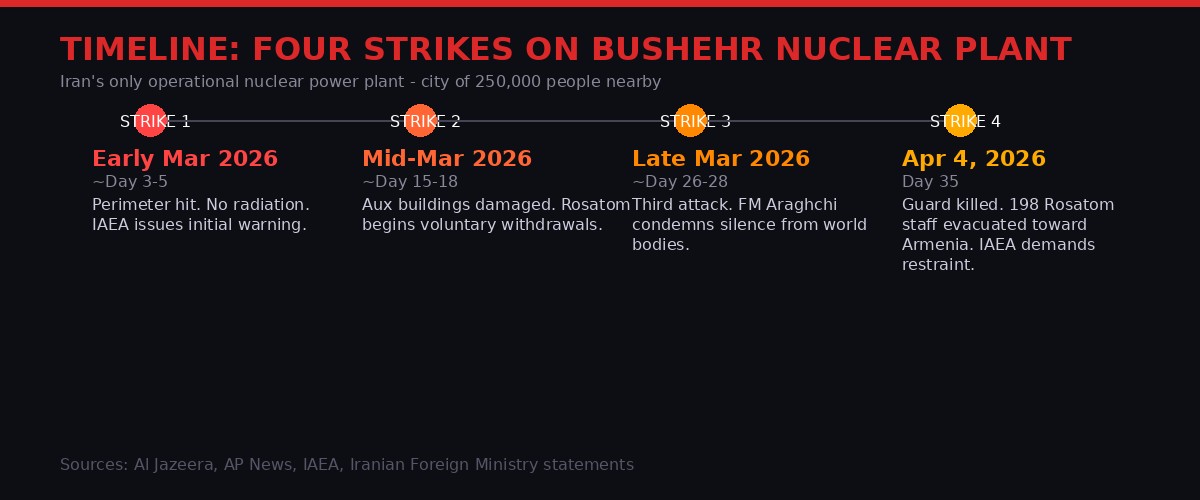
The first strike on Bushehr occurred in the opening days of the war, approximately Day 3 to Day 5. The perimeter of the facility was hit. The IAEA issued an initial statement. No radiation was detected. The strike was condemned in formal language and then, essentially, forgotten by the international community's news cycle.
The second strike, somewhere around Day 14 to Day 18 in mid-March, caused damage to auxiliary buildings. Rosatom began the first voluntary withdrawal of non-essential staff. Iran's government registered another formal protest. The IAEA intensified its monitoring.
The third strike, in late March around Day 26 to Day 28, drew a sharper response from Iranian Foreign Minister Araghchi, who went public with a pointed criticism of the world's silence. He documented the attack on Bushehr in a series of posts that listed the cumulative pattern of strikes on Iranian nuclear and energy infrastructure.
The fourth strike on Saturday, Day 35, killed a security guard and triggered the largest single Rosatom evacuation of the war. The IAEA director general issued his most urgent statement yet. Iran's government condemned the attack. The US and Israel said nothing specific about Bushehr. Al Jazeera day-36 wrap, AP News, IAEA
What the four strikes share, beyond their target, is a pattern of escalating proximity. Each has been described as hitting "near" or "close to" the main reactor building. The gap between "near" and "in" is the gap between a security incident and a regional catastrophe.
"Tehran says it is the fourth attack near the nuclear plant amid the US-Israel war on Iran." - Al Jazeera, April 4, 2026
Iran's position is that the strikes on Bushehr are part of a deliberate pattern of targeting civilian infrastructure that constitutes war crimes under international law. The US and Israeli position - to the extent either government has stated one - is that Bushehr and the surrounding area contain military-relevant infrastructure. Neither position changes the physics of what happens if a reactor coolant system is breached. Al Jazeera, AP News background
THE WIDER GULF INFRASTRUCTURE CAMPAIGN
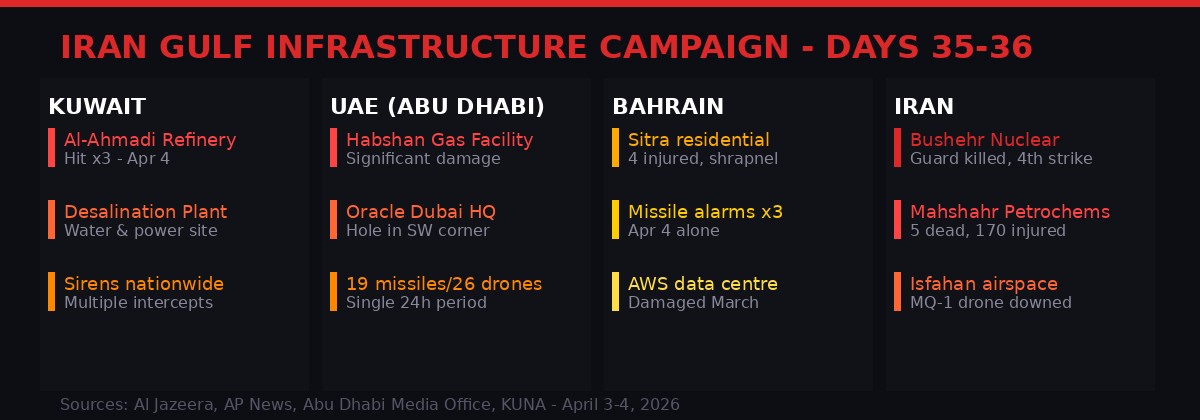
The fourth Bushehr strike did not happen in isolation. It was part of a simultaneous escalation across the entire Gulf region on Days 35 and 36 that targeted energy infrastructure, water systems, technology companies and civilian areas with unprecedented breadth. Al Jazeera day-35 and day-36 summaries
In Kuwait, the Al-Ahmadi oil refinery - one of the largest in the Middle East - was struck for the third time. Hours later, a Kuwaiti power and desalination plant was hit by an airstrike. Kuwait's state news agency KUNA reported fires in operational units at the refinery. Iran denied targeting the desalination plant, with the Islamic Revolutionary Guard Corps blaming Israel. The IRGC's denial came in a statement that simultaneously condemned what it called Israel's "inhuman" attack on "water desalination centres." KUNA, Al Jazeera, Apr 4
Kuwait's vulnerability is geographic as much as military. The country sits approximately 80 kilometres from Iran's coastline - the closest Gulf state by distance. Al Jazeera's Malik Traina, reporting from Kuwait City, noted that this was the third refinery strike and that civilians across the country were on "high alert." A British ground-based air defence system is reportedly being discussed for deployment in Kuwait, following talks between Crown Prince Sheikh Sabah Khaled and UK Prime Minister Keir Starmer. Al Jazeera, KUNA, Apr 4
In the UAE, the picture was grimmer. Abu Dhabi's Habshan gas facility - the country's largest natural gas processing complex - suffered what the Abu Dhabi Media Office described as "significant damage" after debris from an intercepted projectile sparked fires. Operations at the facility were suspended. An Egyptian national was killed. Four others - two Pakistani nationals and two Egyptian nationals - were wounded. Abu Dhabi Media Office, Apr 4
The UAE air defence system intercepted 19 ballistic missiles and 26 drones in a single 24-hour period around Day 35, according to the country's defence ministry. At least two UAE service members have been killed and 191 people of various nationalities injured since the war began. The scale of the Iranian missile and drone campaign against the UAE has been extraordinary by any historical measure. UAE Defence Ministry, Al Jazeera
Oracle's Dubai headquarters was also struck. Footage verified by the Associated Press showed a large hole in the building's southwestern corner. The Dubai Media Office attempted to characterise it as minor debris damage. Oracle did not respond to requests for comment. The IRGC has explicitly named major US technology companies as legitimate targets, accusing them of involvement in intelligence operations against Iran. Amazon Web Services had two UAE data centres struck in earlier attacks and a third Bahrain facility damaged by a nearby drone strike. AP News, Apr 4
In Iran itself, simultaneous US-Israeli strikes hit several petrochemical plants in Khuzestan province's Mahshahr Petrochemical Special Economic Zone. Israeli Prime Minister Benjamin Netanyahu confirmed Israel struck the Mahshahr complex, describing it as infrastructure that "helps to fund the war." AP News, Al Jazeera, Apr 4 Iranian state media reported five people killed and 170 injured. The Bandar Imam petrochemical complex - which produces chemicals, liquefied petroleum gas, polymers and other products - was struck and sustained damage. The Fajr 1 and 2 petrochemical companies and nearby facilities were also hit, according to Fars news agency. Iran's Mehr news agency, Fars news agency, Apr 4
Iran's IRGC also shot down what it described as an MQ-1 drone over central Isfahan province. Isfahan is home to Iran's underground uranium conversion facility and a nuclear research site - sites that were among the first bombed when US-Israeli strikes began in June 2025. The MQ-1 shootdown adds to Iran's weekend tally of military successes, which includes the downing of two US warplanes - an F-15E Strike Eagle and an A-10 Warthog - on Day 35. Al Jazeera, Apr 4
WAR TOLL: 36 DAYS OF KILLING
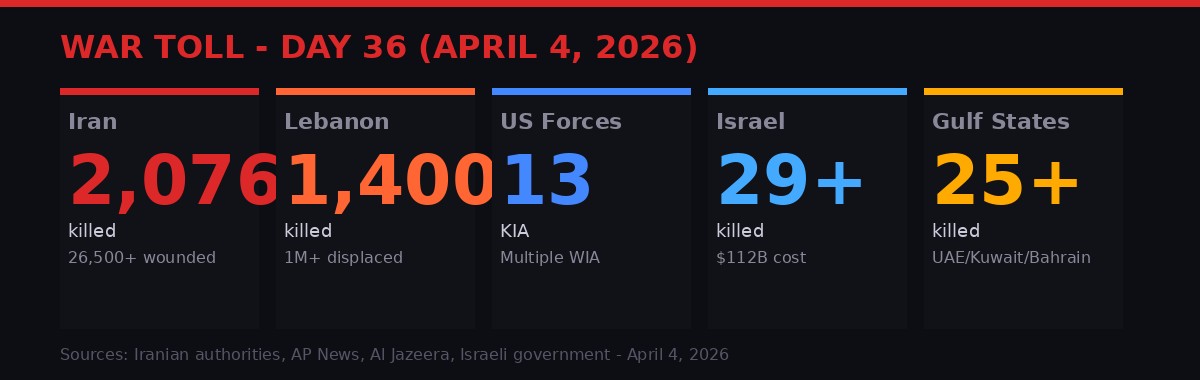
The cumulative toll as of Day 36 is staggering. Iranian authorities report 2,076 people killed and 26,500 wounded inside Iran since the war began on February 28. Al Jazeera day-36 summary
Lebanon has suffered more than 1,400 dead and over one million displaced people. Israel has killed 10 of its own soldiers on the Lebanese front. Hezbollah has continued to strike Israeli forces and artillery positions in southern Lebanon. Israel destroyed two critical bridges in Lebanon's Bekaa Valley on Day 36 - a move intended to restrict Hezbollah's logistical corridors. Israeli attacks on southern Lebanon also struck two young girls and damaged a hospital in the Tyre area, according to Al Jazeera. AP News, Al Jazeera, Apr 4
In Israel itself, 19 people have been reported dead and the economy has absorbed an estimated $112 billion in costs since the war began. Seventy-eight percent of Jewish Israelis still support the war against Iran in recent polling, though analysts warn that number may erode. Schools across Israel have remained closed. An Iranian missile attack struck residential areas in central Israel, causing damage and sparking fires at an industrial site in the Negev region. Al Jazeera, Apr 4
Thirteen US service members have been killed in the conflict. A fourteenth may be unaccounted for - the missing crew member from one of two US warplanes shot down by Iran on Friday, Day 35. An F-15E Strike Eagle went down over the mountainous Kohgiluyeh and Boyer-Ahmad province in southwestern Iran. Iran's state television called on residents of the province to hand over any "enemy pilot" to police and offered a reward for the missing American. A US Black Hawk helicopter involved in the search was itself hit by Iranian fire but remained airborne, according to US media reports. AP News, Al Jazeera, Pentagon notification to House Armed Services Committee
Trump's reaction was characteristic. He posted on social media: "Remember when I gave Iran ten days to MAKE A DEAL or OPEN UP THE HORMUZ STRAIT. Time is running out - 48 hours before all Hell will reign down on them." Iran's response, through General Ali Abdollahi Aliabadi of the country's joint military command, was equally blunt: "The doors of hell will be opened to you" if Iran's infrastructure is attacked further. AP News, Apr 4
DIPLOMACY: THREE MEDIATORS AGAINST A DEADLINE
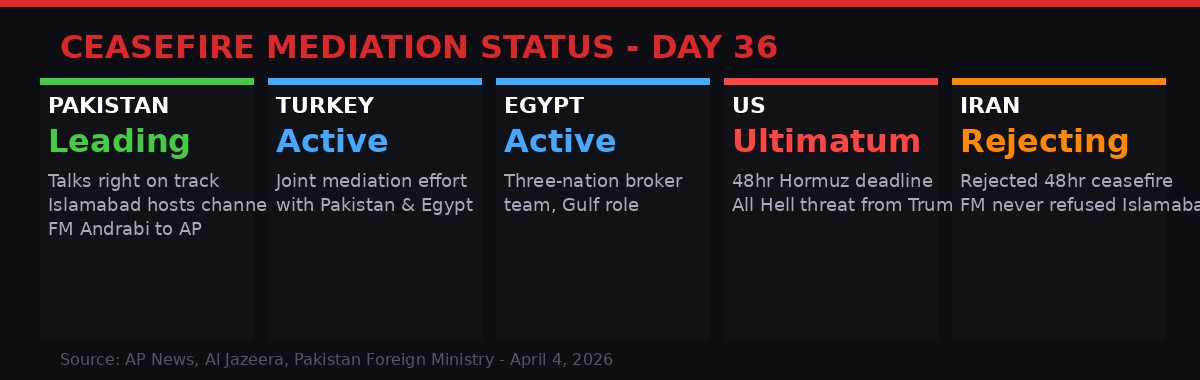
There is a ceasefire track. It runs through Islamabad, and it is fighting against every military development for relevance.
Pakistan's Foreign Ministry spokesperson Tahir Andrabi told the Associated Press that his government's efforts to broker a ceasefire between the US and Iran are "right on track" after Islamabad announced last week that it would host talks between the two parties. Mediators from Pakistan, Turkey and Egypt are working to bring Washington and Tehran to the negotiating table. AP News, Apr 4
A proposed framework reportedly involves a cessation of hostilities to allow diplomatic settlement - not a full peace deal, but a pause. Two sources described the outline to AP: a regional official involved in the efforts and a Gulf diplomat briefed on the matter, both speaking on condition of anonymity. AP News, Apr 4
Iran's Foreign Minister Abbas Araghchi said Iranian officials "have never refused to go to Islamabad." That is not the same as agreeing to go. It is a diplomatic formulation designed to keep the door ajar while the war continues. Iranian President Masoud Pezeshkian simultaneously accused Washington of hypocrisy, questioned US sincerity on diplomacy, and appealed to Finland's president over Trump's threat to bomb Iran "back to the Stone Ages." Al Jazeera day-36 summary, AP News
Tehran separately rejected what Iran's semi-official Fars news agency reported was a US proposal for a 48-hour ceasefire. The US did not confirm or deny the report. The simultaneity of a ceasefire rejection and a ceasefire mediation track underscores how fractured decision-making on both sides has become. Fars news agency via Al Jazeera, Apr 4
Trump's 48-hour Strait of Hormuz ultimatum expires Monday. Iran controls the strait. One-fifth of the world's oil supply passes through it, along with significant volumes of liquefied natural gas. Iran's parliamentary speaker Mohammad Bagher Qalibaf issued a separate veiled threat Friday targeting a second strategic waterway - the Bab el-Mandeb Strait, which links the Red Sea to the Gulf of Aden and the Indian Ocean. More than one-tenth of seaborne global oil and a quarter of container ships pass through the Bab el-Mandeb. If Iran moves to threaten that chokepoint simultaneously with Hormuz, the energy and shipping crisis would reach a level that makes current oil prices look cheap. AP News, Al Jazeera, Apr 4
"Which countries and companies account for the highest transit volumes through the strait?" - Iran's Parliamentary Speaker Mohammad Bagher Qalibaf, threatening the Bab el-Mandeb. Via AP News, April 4, 2026
THE NUCLEAR QUESTION NOBODY IS ANSWERING
There is a conversation that should be happening at the highest levels of global diplomacy that is, as far as any public record shows, not happening. It concerns the Bushehr nuclear power plant and what happens if a fifth or sixth or tenth strike finally breaches the containment structures that have so far protected the reactor core.
Bushehr operates a VVER-1000 pressurized water reactor, a Russian design considered one of the safer civilian reactor types. It has multiple passive safety systems. The IAEA's "no increase in radiation" confirmations after each strike are genuine, not spin. But those assurances rest on the assumption that future strikes continue to miss the reactor building itself and its most critical cooling and safety systems.
Four strikes in 36 days. The fourth killed a guard and damaged an auxiliary building. The question of what the fifth strike hits is not theoretical. It is a matter of trajectory, targeting precision, and probability - all variables that shift with every additional sortie flown over Bushehr.
The IAEA's monitoring capacity is limited in a war zone. Rafael Grossi's statements grow more urgent with each strike, but the agency has no enforcement mechanism. It cannot deploy inspectors to an active combat zone. It can monitor radiation readings remotely. It can issue statements. It can plead. That is the full extent of its power. IAEA background documentation
The 2011 Fukushima disaster - triggered by an earthquake and tsunami, not a missile - contaminated significant portions of Japan's Pacific coastline and required a multi-decade remediation effort. The fallout affected global food markets, Pacific Ocean monitoring, and Japanese domestic politics for years afterward. Fukushima happened on a small island nation far from other major population centers. Bushehr sits in the Persian Gulf, surrounded by the most densely transited energy corridor on Earth, 80 kilometres from Kuwait, adjacent to waters through which one-fifth of the world's oil supply moves.
The regional consequences of a Bushehr nuclear accident - even a partial one - would not be containable by any existing mechanism. The Gulf Cooperation Council states would face evacuation decisions affecting tens of millions of people. Global shipping through the Strait of Hormuz would stop entirely. The psychological and economic fallout would dwarf the physical contamination by an order of magnitude.
Nobody in Washington, Tel Aviv, or Tehran is talking about this publicly. The IAEA director general is talking about it in the strongest terms available to him. He is being ignored by all three governments.
WHERE THINGS STAND: THE 48-HOUR CLOCK
Trump's deadline expires Monday. Iran has rejected it. The search for the missing US pilot continues in mountainous southwestern Iran - a search that involves military assets operating over hostile territory with an active air defence threat. Two warplanes are down. Bushehr has been struck four times. The Habshan gas facility in Abu Dhabi is damaged. Kuwait's biggest refinery has been hit for the third time. Oracle's Dubai headquarters has a large hole in its wall. Rosatom's buses are rolling toward Armenia.
The Pakistan-Turkey-Egypt mediation track is the only live diplomatic channel. Whether it survives the coming 48 hours depends on whether either side wants it to survive. Iran's FM Araghchi is still talking about Islamabad. Trump is still talking about hell raining down. Both statements are simultaneously true. AP News, Al Jazeera, Pakistan Foreign Ministry, Apr 4
The war began 36 days ago on February 28. In those 36 days, it has escalated in a straight line - ground that looked like a ceiling became floor. Each new development that seemed like a limit was surpassed within days. The first US service member killed. Then ten. Then thirteen and possibly fourteen. Two US aircraft down - the first shot down by enemy fire in over 20 years, according to AP News. A nuclear plant struck four times. A Russian nuclear corporation evacuating its workers in the largest single wave of the conflict.
There is a line somewhere between "escalation" and "irreversible." The world is moving toward it, incrementally, strike by strike, drone by drone, body by body.
The IAEA's Rafael Grossi knows where that line is. He is screaming about it with every statement he issues.
Nobody is turning around.
Get BLACKWIRE reports first.
Breaking news, investigations, and analysis - straight to your phone.
Join @blackwirenews on TelegramSOURCES
- Al Jazeera: "Projectile hits near Iran's Bushehr nuclear plant, killing one: IAEA" - April 4, 2026
- Al Jazeera: "Iran war: What is happening on day 36 of US-Israeli attacks?" - April 4, 2026
- Al Jazeera: "At least one killed at UAE's Habshan gas facility after intercepted attack" - April 3, 2026
- Al Jazeera: "Kuwait desalination plant, oil refinery hit by missile and drone strikes" - April 3, 2026
- Al Jazeera: "Israeli attacks on southern Lebanon kill two girls, damage hospital" - April 4, 2026
- AP News: "Trump sets Strait of Hormuz deadline as Iran offers reward for missing US pilot" - April 4, 2026
- AP News Live Blog: "US and Iran race to find missing crew member from downed military plane" - April 4, 2026
- AP News: "US military jets hit in Iran war are the first shot down by enemy fire in over 20 years" - April 4, 2026
- IAEA Director General Rafael Grossi statement via X - April 4, 2026
- Atomic Energy Organization of Iran (AEOI) statement via X - April 4, 2026
- Rosatom CEO Alexei Likhachev via Interfax news agency - April 4, 2026
- Iran FM Abbas Araghchi via X - April 4, 2026
- Pakistan Foreign Ministry spokesperson Tahir Andrabi to AP - April 4, 2026
- KUNA (Kuwait News Agency) - April 4, 2026
- Abu Dhabi Media Office - April 3-4, 2026
- Iran's Mehr news agency, Fars news agency - April 4, 2026