The Romanian Broker: How Vitalie Buzdugan Built a Sanctions-Proof Empire Inside Lukashenko's Belarus
He lives among the elite on Tsikhaya Street in Minsk, runs fifteen companies across an economy ruled by a sanctioned dictatorship, shares business partners with Russia's strike drone industry, and deflects every question. His Romanian passport is his most valuable asset.
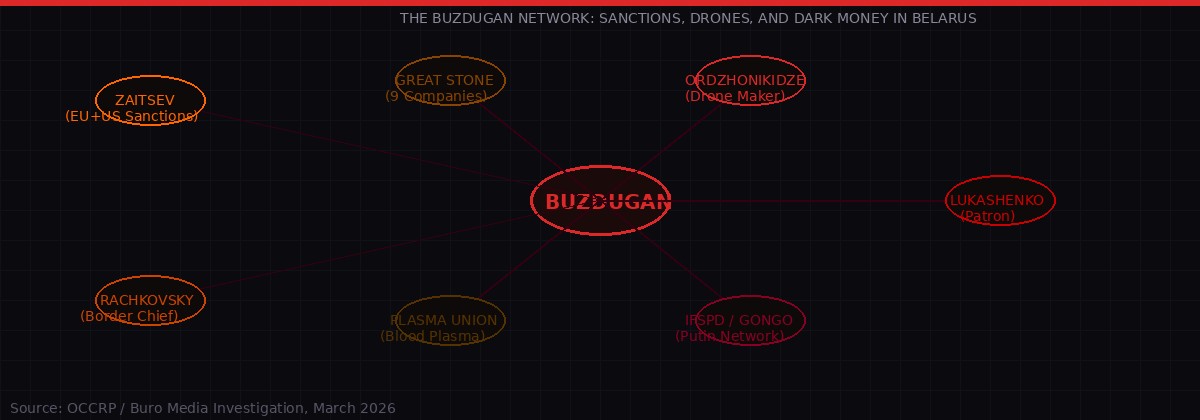
The Buzdugan network: 15 companies in Belarus, sanctioned business partners, and a direct link to Russia's strike drone industry. (BLACKWIRE analysis based on OCCRP/Buro Media data)
The northwestern outskirts of Minsk hold a particular kind of real estate. In Soviet times, party nomenklatura settled there. Later, foreign ambassadors. Then Aleksandr Lukashenko moved his residence nearby, and the men around him followed. In the years since, an elite district has grown up around Drazdy Estate and a smaller neighboring enclave called Tsikhaya Street - "Quiet Street" in Belarusian. In the early 2000s, it was still a village with rundown buildings. Today, fashionable villas line it and the address confers a kind of status that money alone cannot buy in Minsk.
One of the men who settled here is not a Belarusian oligarch. He is not a former KGB official. He is not a Lukashenko family member. He is a Romanian businessman named Vitalie Buzdugan, born in 1973, holder of an EU passport, and the operator of what a new investigation by independent outlet Buro Media - published this week and reported by the Organized Crime and Corruption Reporting Project - describes as a sprawling empire of at least fifteen companies buried inside Belarus's economy.
Buzdugan owns three apartments on Tsikhaya Street alone, property records reviewed by Buro's partners at CyberPartisans confirm. Total estimated value: nearly $800,000. He holds another apartment on Prytytskaha Street. He is registered as the controlling interest in companies spanning medicine, construction, technology, tourism, agriculture, and culture. Many of those companies are directly or indirectly linked to Alexander Zaitsev - a Belarusian oligarch sanctioned by both the European Union and the United States for bankrolling the Lukashenko regime. Others link back to Igor Rachkovsky, former head of Belarus's State Border Committee and a reported longtime friend of Lukashenko's son Viktor.
And one of them - a pharmaceutical joint venture called Plasma Union - connects Buzdugan's Belarusian network to a man whose other company manufactures the strike drones currently being used by Russian forces in the war against Ukraine.
When journalists from Buro Media reached Buzdugan by phone, he denied any involvement in the businesses and stated he had never engaged in joint projects with Zaitsev. Then he ended the call.
The Architecture of the Empire
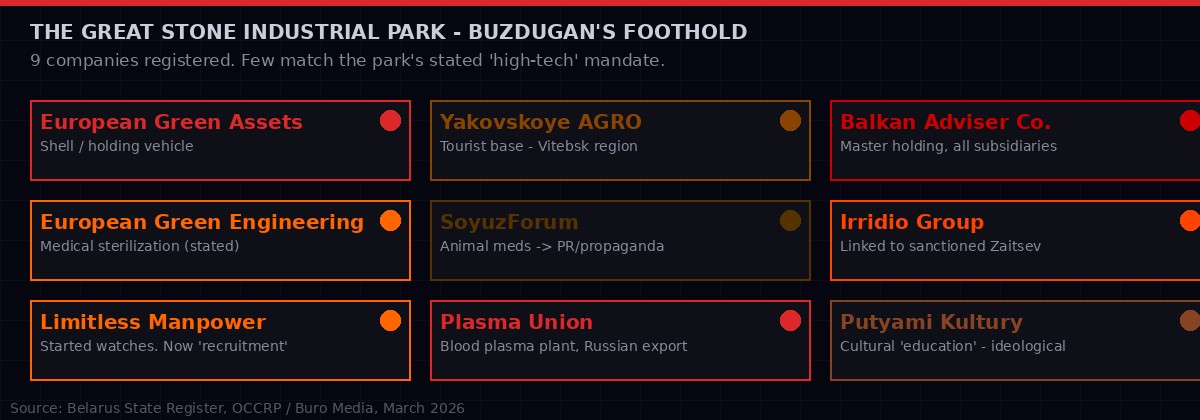
Nine of Buzdugan's companies are registered in Belarus's Great Stone Industrial Park - despite few appearing to match its stated high-tech mandate. (BLACKWIRE / Buro Media / Belarus State Registry data)
Buzdugan's Belarusian footprint runs through a single holding entity: Balkan Adviser Company, which he founded in the early 2000s originally with a Romanian presidential sponsor and a former Lukashenko security guard. Today he is the sole owner. Through it, he controls or holds significant stakes in at least fifteen enterprises scattered across the Belarusian economy.
The most striking concentration is inside the Great Stone Industrial Park - a special economic zone on the outskirts of Minsk established under a joint Belarus-China development agreement. The park offers substantial tax breaks and preferential regulatory treatment. Nine of Buzdugan's companies are registered there, according to the Buro Media investigation. The stated purpose of Great Stone is to attract high-technology industries. Buro noted pointedly that few of the Buzdugan entities appear to match that description.
The companies registered in and around his network read like a map of deliberate obscurity. European Green Assets is a shell holding vehicle whose current ultimate beneficiary is Buzdugan, but which previously held stakes owned by companies tied to Zaitsev - ties that were severed only after EU sanctions landed in 2021. Underneath it sits European Green Engineering, ostensibly in medical sterilization. Then there is Limitless Manpower, which began selling watches, pivoted to pharmaceuticals, and currently presents itself as a recruitment agency. Yakovskoye AGRO operates a tourist base in the Vitebsk region. SoyuzForum started in animal medicines, passed through Zaitsev-linked UAE ownership, and now does public relations - including having Buzdugan personally hand out awards at a children's film festival in 2023.
Tatsiana Buzdugan, his wife, runs SoyuzForum and another subsidiary, Putyami Kultury - "Paths of Culture" - which Buro describes as a "cultural and educational institution." In March 2025, Vitalie Buzdugan attended the "White Russia" conference under its banner. The conference was dedicated to the USSR's victory in the Great Patriotic War. Among those present: Dmitry Medvedev, Natallia Kachanava, and Igor Siarheyenka. When Buro journalists called Tatsiana Buzdugan for comment, she stated that the family was not involved in any company ownership in Belarus. Property and corporate records say otherwise.
The Drone Maker in the Machine
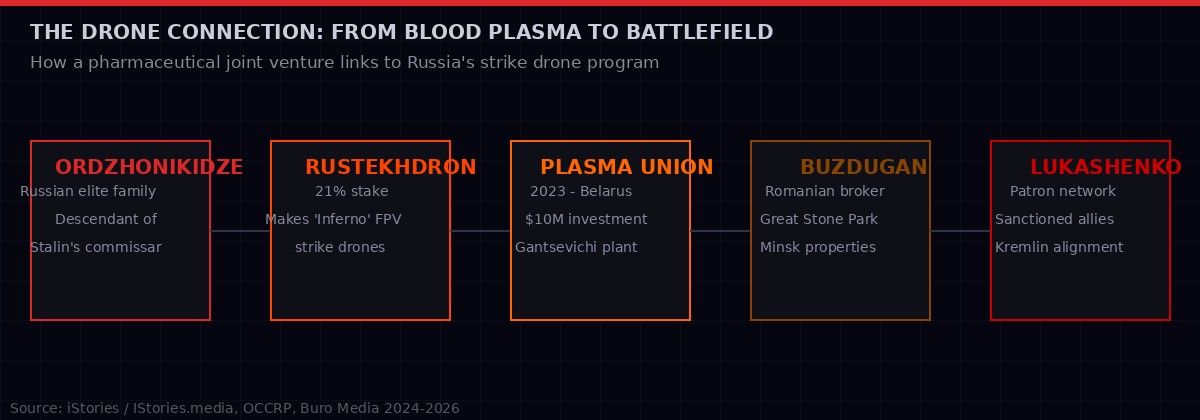
The connection chain: Buzdugan's pharmaceutical joint venture in Belarus links directly to Alexei Ordzhonikidze, co-owner of Rustekhdron - maker of the 'Inferno' FPV strike drones used by Russian forces in Ukraine. (BLACKWIRE analysis)
The most operationally alarming thread in the Buro investigation leads from a blood plasma plant to a Russian military drone factory.
Plasma Union was established in 2023. Its stated purpose is the manufacture of medicines derived from blood plasma. A letter obtained by Buro's journalists - containing excerpts from the minutes of a December 2023 Health Ministry meeting - reveals the company proposed a $10 million investment in a manufacturing plant in the Belarusian town of Gantsevichi. The minutes also record that Plasma Union intended to build a second facility inside the Great Stone park. The ministry document explicitly notes that "partners from the Russian Federation" would export the entirety of the plant's output. All of it. To Russia.
Those Russian partners include Alexei Ordzhonikidze.
Ordzhonikidze holds a stake in Plasma Union. He is also a co-owner of Rustekhdron - a company identified in a 2024 investigation by the Russian independent outlet IStories as the manufacturer of the "Inferno" FPV strike drone, which Russian state media confirmed had been deployed in combat in Ukraine as of January 2024. The Inferno is a first-person-view drone with a five-kilometer range, four-kilogram payload capacity, nine slots for grenades, and a downward-facing camera for precision drops. It is designed to kill people.
The lineage of the Ordzhonikidze family deserves examination. Alexei Ordzhonikidze is the descendant of Sergo Ordzhonikidze, one of Stalin's closest commissars. His father is a Russian diplomat and secretary of Russia's UNESCO commission - the same father who was publicly outraged in November 2022 when UNESCO moved to protect Ukrainian borsch as cultural heritage during the full-scale invasion. His uncle, the elder brother of his father, remembers as a child riding on the back of Lavrentiy Beria, head of Stalin's secret police. The family's proximity to power across Soviet and Russian history is not metaphorical; it is structural and multigenerational.
Alexei himself held senior positions at R-Pharm, Russia's largest state pharmaceutical supplier. IStories previously revealed that the founder of R-Pharm, Alexei Repik, allowed Vladimir Putin's daughter Katerina Tikhonova to use his private aircraft. Ordzhonikidze and Repik both served on the leadership of "Delovaya Rossiya" - Business Russia, a Kremlin-aligned business lobby.
When this man becomes the Russian partner in a blood plasma plant that will export entirely to Russia, established in Belarus through a network run by a Romanian businessman with ties to Lukashenko's inner circle, the pharmaceutical framing becomes difficult to take at face value.
How the Sanctions Gap Was Engineered
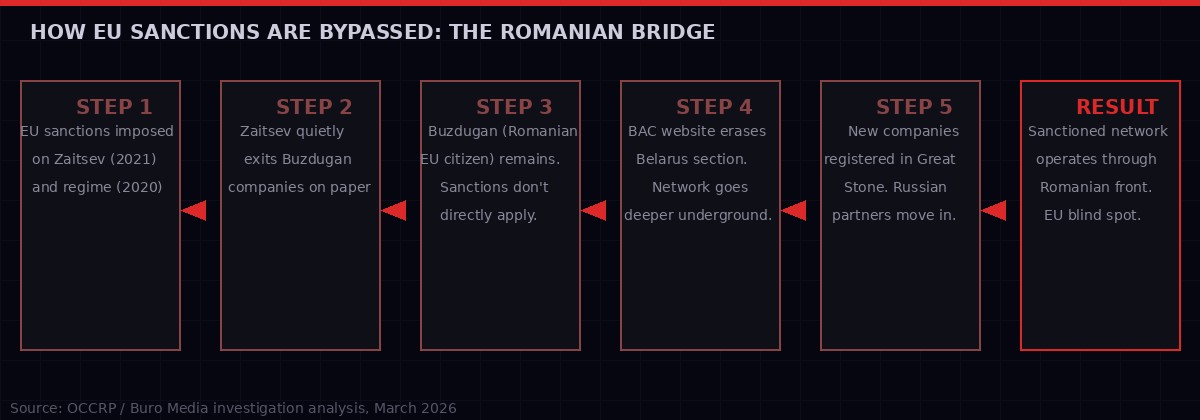
The evasion architecture: EU sanctions target Belarusian nationals and entities, but an EU-citizen intermediary like Buzdugan creates a legal gap that is difficult to close without specific designation. (BLACKWIRE analysis)
Understanding why Buzdugan's network has operated without direct sanction targeting requires understanding what Western sanctions against Belarus actually do - and what they deliberately cannot reach.
The EU's sanctions regime against Belarus, expanded significantly after Lukashenko's fraudulent 2020 election and the subsequent crackdown on civil society, primarily targets Belarusian nationals and entities directly tied to the regime. EU citizens, including Romanian nationals like Buzdugan, are not automatically prohibited from operating businesses in Belarus. What triggers sanctions is evidence of specific conduct - financing the regime, facilitating human rights abuses, circumventing existing designations - sufficient to meet the legal threshold for individual listing.
Alexander Zaitsev met that threshold. He was listed by the EU in 2021 and by the US in 2022. On paper, his exit from Buzdugan's companies followed shortly after each designation. The Buro investigation documents this pattern precisely: Zaitsev held stakes in European Green Assets between 2018 and 2022 - the exit coinciding with sanctions pressure. UAE-registered companies tied to Zaitsev held stakes in SoyuzForum until they too were removed.
But Buzdugan remained. And his companies - now nominally sanitized of sanctioned-entity ownership - continued operating in the same ecosystems, with the same Belarusian state connections, serving the same functions.
In parallel, the Romanian parent company BAC quietly erased its Belarus operations from its public website after 2020. The archived version of bac-romania.com from 2019 shows a Belarus section prominently, with Minsk listed among the company's operational branches and the outline of Belarus on its geographic footprint map. The current website shows nothing of the kind. The branch itself, however, according to Belarus's Unified State Register, remains active.
Matei Paun - the Romanian investor who co-founded the Belarusian advisory company with Buzdugan in 2008 - has taken a different approach to the problem. He is now denying any meaningful involvement, telling Romanian journalists he "never signed a contract with Belarus" and "never received a single penny" from the Belarusian state. His explanation: he allowed the company to use his name as a "marketing strategy" to appear more credible to Western investors. Paun's significance in the story is heightened by the fact that he sponsored Nicusor Dan - Romania's president elected in 2025 - financially and logistically, and was photographed with Dan during the election campaign and present at the president's inaugural reception.
Buzdugan himself has taken no such accommodating position. He openly expresses sympathy for Lukashenko, continues building his empire, and in Buro's characterization, actively promotes narratives of the "Russian world."
The GONGO Layer: Fake Civil Society, Real Kremlin Access
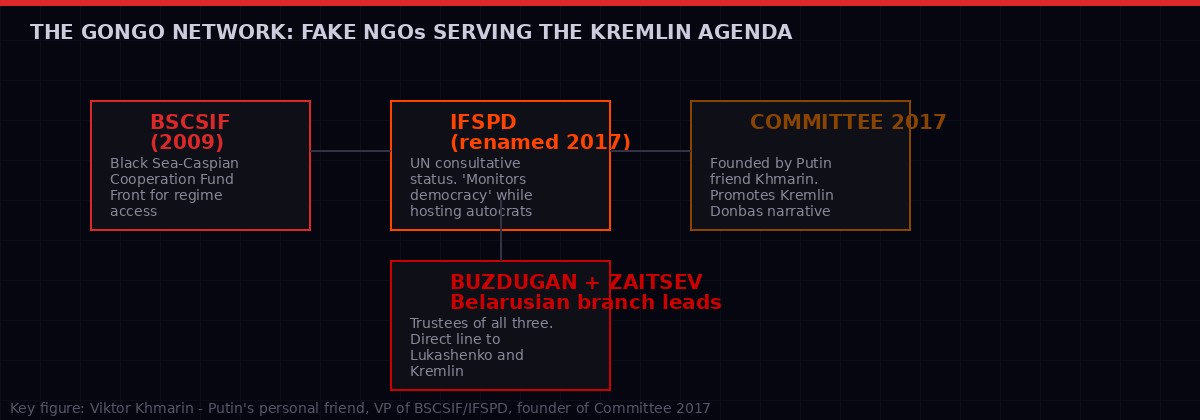
Three government-organized NGOs - BSCSIF, IFSPD, and Committee 2017 - link Buzdugan to Putin's inner circle and Kremlin influence operations. One holds UN consultative status. (BLACKWIRE / OCCRP)
Buzdugan's operational role extends beyond commerce. A layer of fake civil society organizations - known in the field as GONGOs, Government-Organized Non-Governmental Organizations - wires him into the infrastructure of Kremlin-aligned influence networks at the highest levels.
The International Fund for Black Sea-Caspian Sea Cooperation and Partnership, known as BSCSIF, was established in Romania in 2009. It presents itself as a multilateral civil society forum. Viktor Khmarin has served as its Vice-President from the beginning. Khmarin is a friend of Vladimir Putin since their student days. He was a witness at Putin's wedding. He married a Putin relative. He is, in other words, not a civil society figure in any conventional sense.
According to the Adevarul newspaper, Khmarin brought Buzdugan into the BSCSIF in 2012. Buzdugan became the Belarus representative. By 2014, Alexander Zaitsev had joined him in that capacity.
That same year, a BSCSIF delegation visited Minsk and held meetings with the Belarusian Ministry of Foreign Affairs, the Ministry of Economy, the State Committee for Science and Technology, the National Academy of Sciences, and the National Olympic Committee. The delegation also met with Lukashenko himself. He described BSCSIF as "a very solid organisation" and expressed satisfaction with the activity of the Belarusian representatives - specifically naming Buzdugan and Zaitsev.
In 2017, the BSCSIF was renamed the International Fund for Sustainable Peace and Development - IFSPD - "due to the expansion of its participants' geographical reach beyond the Caspian and Black Sea regions." The IFSPD currently holds special consultative status with the UN Economic and Social Council. Its stated mandate includes monitoring "the democratisation process, human rights and freedoms, the process of consolidation of civil society, freedom of the media and expression."
The Belarus branch, led by Vitalie Buzdugan, monitors those things in a country that ranks among the most repressive in Europe, where journalists are imprisoned, opposition leaders are in exile or jail, and elections are fraudulent by design.
Linked underneath the IFSPD sits Committee 2017, co-founded by Khmarin. Ukraine's Argument outlet described it as "one of many Russian GONGOs that promotes the Kremlin agenda by focusing on the Donbas issue under the guise of an international public initiative for peace, friendship and traditional values." Buzdugan and Zaitsev served as trustees of Committee 2017 as of 2016. So did Ilham Rahimov, an Azerbaijani multimillionaire and another Putin friend and classmate.
This is not a web of business relationships. It is a web of influence architecture, constructed deliberately across multiple countries and multiple institutional facades, with Buzdugan occupying the crucial Romanian hinge - the EU member state legitimacy that the network requires to function.
How He Got There: The Romanian Origins
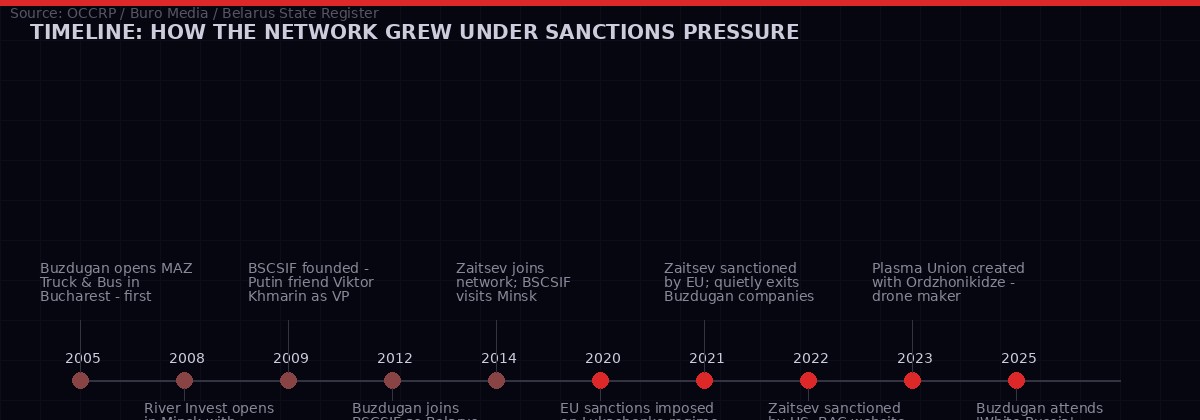
Timeline: From Buzdugan's first Belarus trade links in 2005 through the GONGO network, sanctions evasion, and the Plasma Union drone connection. (BLACKWIRE / OCCRP timeline)
The Buro investigation traces Buzdugan's Belarus connection back to at least 2005, when he opened MAZ Truck & Bus in Bucharest - a company that facilitated Romanian sales of vehicles manufactured by the Minsk Automobile Plant, a major Belarusian state enterprise. He had been running businesses in Romania since the early 2000s, and several already had commercial ties to Belarus.
The connection deepened in 2008 when Romanian investor Matei Paun decided to enter the Belarusian market and chose Buzdugan as his local guide. River Invest was established in Minsk that year. Its third founder was Aliaksandr Mironau - a former officer of Lukashenko's personal security service.
The nature of the contacts River Invest accessed from the start tells the story. Romanian economist Andrei Caramitru described in an interview with Adevarul how Paun had offered him an opportunity in the venture, promising "major funding and projects" in Belarus thanks to an "almost exclusive relationship" with Lukashenko himself. In 2009, the company signed an agreement with the Belarusian state on waste processing technology. In 2010, it announced a 23-million-euro plan to monitor Belarus's gambling industry, a project Lukashenko had personally championed.
From that foundation of elite access, Buzdugan's footprint expanded steadily. Company registrations, property acquisitions, GONGO roles, and state conference appearances trace a two-decade arc of deepening entrenchment in a system that the rest of the EU increasingly viewed as a pariah - and which used Buzdugan as a bridge precisely because he held a passport that made him theoretically beyond reach.
The Triangle: Romania, Belarus, and Russia
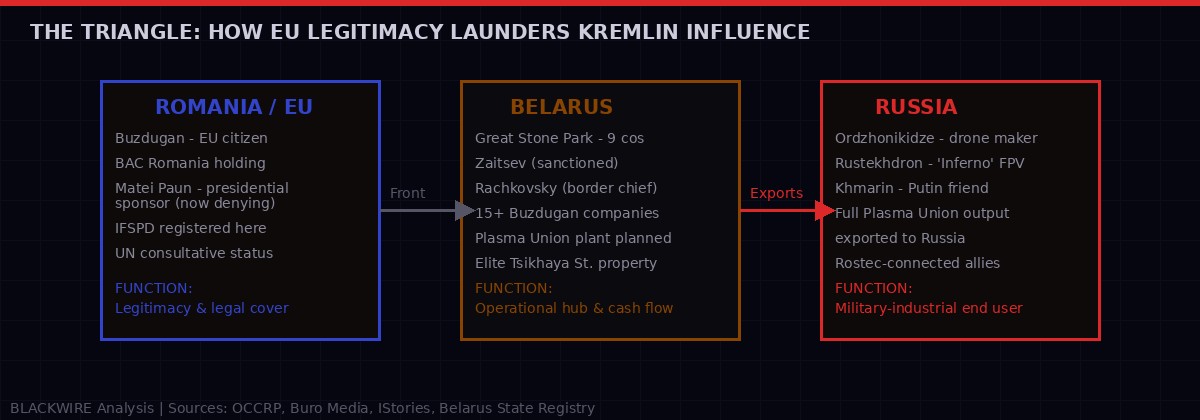
The operational triangle: Romania provides EU legitimacy and legal cover; Belarus provides the operational hub and financial flows; Russia provides the military-industrial end demand. (BLACKWIRE analysis)
The full picture that emerges from the Buro Media investigation and its supporting documentation is not primarily about one Romanian businessman's unusual career choices. It is about a structural feature of the European sanctions architecture that authoritarian states have learned to exploit systematically.
The Kinahan cartel exploited Dubai's regulatory tolerance to embed in the global fight sports industry and Iranian oil shipping. Russian oligarchs exploited British Virgin Islands shell structures for two decades. Belarusian regime insiders now appear to exploit the EU's inability to sanction its own citizens absent specific designations of conduct - using EU-passport holders as permeable membranes between the sanctioned economy and the global financial system.
Buzdugan is not unique in this respect. He is an example of a pattern. A Romanian national operating fifteen companies inside a sanctioned dictatorship, maintaining properties in the elite districts where regime insiders live, sitting on the boards of Kremlin-aligned fake NGOs, co-founding pharmaceutical ventures with men whose other businesses manufacture weapons killing Ukrainians, and attending conferences with Medvedev and Lukashenko's state ideology apparatus.
Every piece of his business portrait, taken individually, can be explained away or litigated. The shell company structure. The sanitized ownership. The cultural association. The pharmaceutical plant. Taken together, they describe something that Western intelligence agencies have a word for and Western sanctions regimes have, so far, failed to designate: a front man.
When Buro Media journalists called Buzdugan's wife Tatsiana, she said the family owned nothing in Belarus. When they called Vitalie Buzdugan himself, he denied any involvement in the businesses, denied any joint projects with Zaitsev, and declined to answer further questions.
The property records, the corporate registry, the state conference attendance, the GONGO trustee listings, and the Ministry of Health documents about the Plasma Union plant say otherwise. This is the particular power of denial when the records are public. You can say anything. The documents don't move.
What Happens Next: Accountability and Exposure
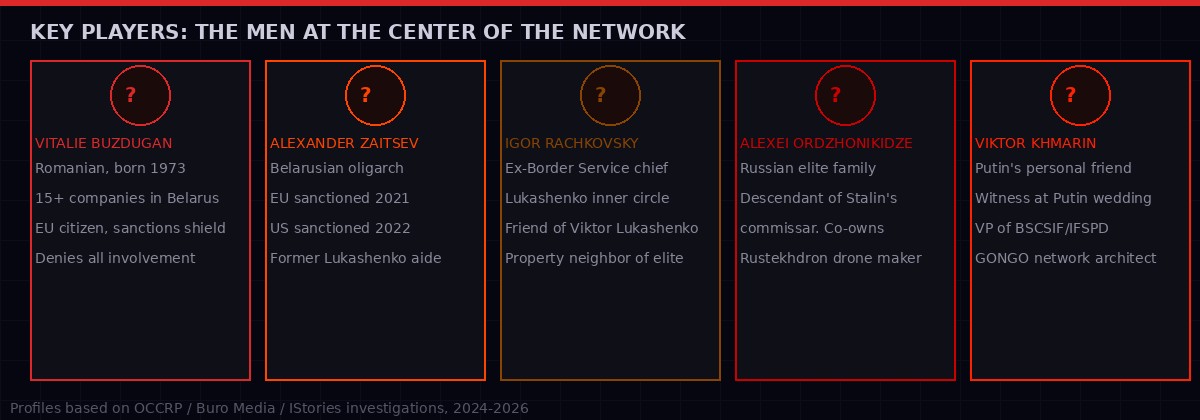
The key players: Buzdugan, Zaitsev, Rachkovsky, Ordzhonikidze, and Khmarin - each connecting a different thread of the network to a different power center. (BLACKWIRE profiles)
The Buro Media investigation, published in coordination with OCCRP on March 23, 2026, represents the first comprehensive public mapping of the Buzdugan network in English. Its implications for sanctions enforcement are immediate and concrete.
The European Union's sanctions against Belarus include provisions for adding individuals who "facilitate" sanctioned persons or who benefit from or support Lukashenko's regime. The key legal question for EU authorities is whether the Buzdugan network's documented relationships with Zaitsev - whose sanctions designations explicitly cite his role as a regime sponsor - constitute facilitation sufficient for listing. The timeline of equity exits suggests awareness of that threshold; it does not suggest innocence about the underlying network's purpose.
The Plasma Union connection creates a separate and more urgent problem. If a company with Belarusian corporate registration, established with a Russian partner who co-owns a strike drone manufacturer, plans to export its entire output to Russia, the question of whether the "pharmaceutical" framing reflects the genuine end use of the facility becomes one for intelligence agencies and prosecutors, not just journalists.
The IFSPD's UN consultative status presents a third dimension. The United Nations Economic and Social Council, to which Buro Media sent a request for comment that had not been answered at time of publication, grants that status to organizations that meet specific criteria about independence and civil society purpose. An organization whose Belarus chapter is led by a man building a commercial empire inside a dictatorial state, whose vice-president is a Putin intimate, and whose linked organizations explicitly promote Kremlin geopolitical narratives represents a potential abuse of that status that the UN body has yet to confront publicly.
Romania presents its own political sensitivity. President Nicusor Dan was elected in 2025. His financial backer, Matei Paun - the man who co-founded the original Belarusian advisory company with Buzdugan - is now publicly distancing himself from his Belarus history, calling it a "marketing strategy." Romania is an EU and NATO member. Its authorities have available to them the same corporate registry information that Buro Media's journalists read. What they do with that information is a question that the investigation's publication makes impossible to pretend they have not been asked.
Vitalie Buzdugan, in his Minsk apartment on Quiet Street, surrounded by the villas of the nomenklatura, has spent two decades building something that worked in the gaps between rules, between jurisdictions, between what can be proven and what can be designated. He is Romanian enough to avoid automatic sanction. He is embedded deeply enough to provide genuine value to the people who need the gap he occupies.
That gap is now, at least, illuminated.
SOURCES: This investigation is based on reporting by Buro Media, published March 23, 2026, and reported by the Organized Crime and Corruption Reporting Project (OCCRP). Property data was obtained by CyberPartisans and reviewed by Buro journalists. Corporate registry information is drawn from the Belarus Unified State Register. Russian drone manufacturer background is sourced from iStories.media (IStories), January 2024. Romanian political context draws on reporting by Digi24 and Adevarul. All quoted statements from principals reflect their public denials as reported by Buro Media investigators.
TIMELINE: THE BUZDUGAN NETWORK
Get BLACKWIRE reports first.
Breaking news, investigations, and analysis - straight to your phone.
Join @blackwirenews on Telegram