Erased From Home: How Global Capital Is Buying Out Cape Town's Oldest Muslim Community
Bo-Kaap has stood at the foot of Table Mountain since enslaved Cape Malay people built it more than 230 years ago. It survived British colonialism. It survived apartheid. Now Airbnb, remote-working tech salaries, and foreign investment cash are doing what centuries of institutional violence could not: pushing the families who built it out the door, one house at a time.

Bo-Kaap's brightly painted houses have become one of Cape Town's most photographed landmarks - and one of its most contested postcodes. (BLACKWIRE illustration)
Just after sunrise on a March morning, the adhan drifts down from the minaret of the Auwal Masjid, South Africa's oldest mosque. Built in 1794 by freed slaves on the slopes below Table Mountain, its call has shaped the rhythm of Bo-Kaap for more than two centuries. The neighborhood's low cobblestone streets, stacked with candy-colored houses in tangerine, cobalt, and mint, look exactly as they have for generations.
But the sounds inside those houses are changing. Moving trucks arrive. Estate agents knock. WhatsApp groups fill with messages about another family selling up, another young person forced to rent in Mitchells Plain or Bellville, townships 20 kilometers from the neighborhood their grandparents built.
Cape Town is experiencing a property boom unlike anything in its modern history. The beneficiaries are foreign investors, Airbnb operators, and the growing wave of remote workers - digital nomads earning British pounds and American dollars - who have discovered that South Africa's weak rand makes the city almost impossibly affordable for them, and almost impossibly expensive for everyone else.
For Bo-Kaap, a community whose very existence is an act of historical resistance, the economics of 2026 are producing a displacement that the architects of apartheid, for all their cruelty, never quite managed to complete.
By the Numbers
The Heritage That Couldn't Be Demolished
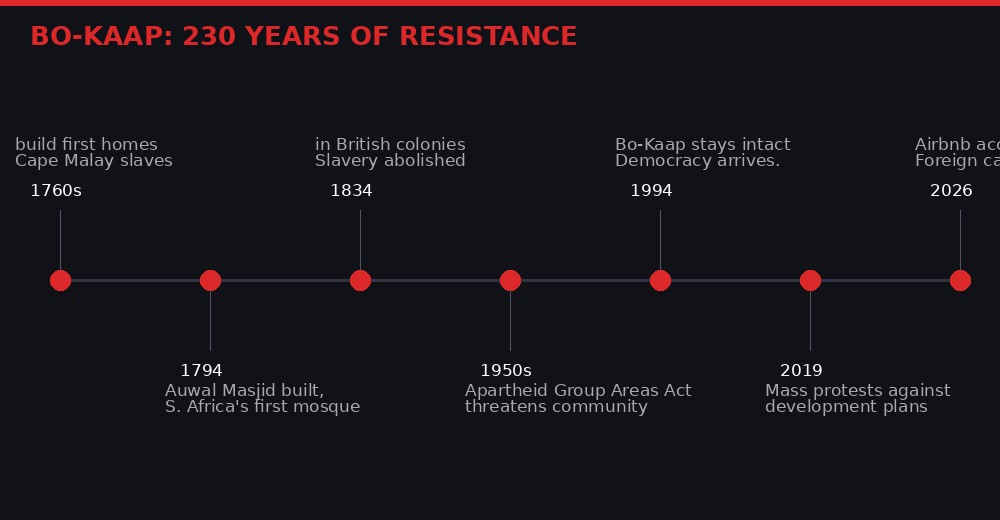
230 years of survival - from slavery to apartheid to the economic pressures of 2026. (BLACKWIRE / Historical record)
To understand what is being lost in Bo-Kaap, you need to understand what it took to build it.
The community's origins lie in the brutality of the Dutch East India Company's slave trade. From the mid-17th century onward, enslaved people were brought to the Cape Colony from across the Indian Ocean world - from present-day Indonesia, Malaysia, India, Madagascar, and Mozambique. They were known collectively as the "Cape Malays," a term that flattened enormous cultural and geographic diversity but eventually became a source of identity and pride.
Denied the right to practice Islam openly under Dutch colonial rule, they worshipped in secret. When the British Empire took control of the Cape in 1795 and eventually abolished slavery in 1834, freed people clustered in the area at the foot of Signal Hill known as the Schotsche Kloof - what became Bo-Kaap. They built the Auwal Masjid in 1794, South Africa's first mosque, before emancipation was even official. The neighborhood's colorful houses weren't an aesthetic choice born in tourism brochures - they were a statement of liberation, families painting their homes for the first time after being forbidden from owning property under colonial rule.
The neighborhood survived apartheid, though not without scars. The Group Areas Act of 1950 forcibly removed millions of South Africans from mixed-race communities, demolishing the District Six neighborhood just kilometers away. Bo-Kaap was largely spared - partly through bureaucratic accident, partly through the stubborn presence of families who simply refused to go.
"The hard-fought battles of our ancestors come to nought. It is, culturally speaking, a dire state of affairs when the people who built something can no longer afford to live in it." - Yasser Booley, eighth-generation Bo-Kaap resident and photographer, speaking to Al Jazeera, March 2026
Today, Booley is 50 years old. His family has lived in Bo-Kaap for eight generations. He documents the neighborhood with his camera, trying to preserve in image what is increasingly disappearing in practice. He watched extended families who once lived within a few streets of each other scatter across the city. He watched mosques and schools become landmarks surrounded by vacation rentals.
"The biggest changes I have seen are the slow choking of my living culture through the accelerated sale of homes to high net worth individuals, the majority of whom have no connection to the place or the culture," Booley told Al Jazeera this month.
The word he keeps coming back to is "choking." Not demolition, not eviction, not violence. Something quieter and in some ways harder to fight. An economic strangulation that leaves the buildings standing and empties out the people.
The Airbnb Economy and the Math That Makes Communities Disappear
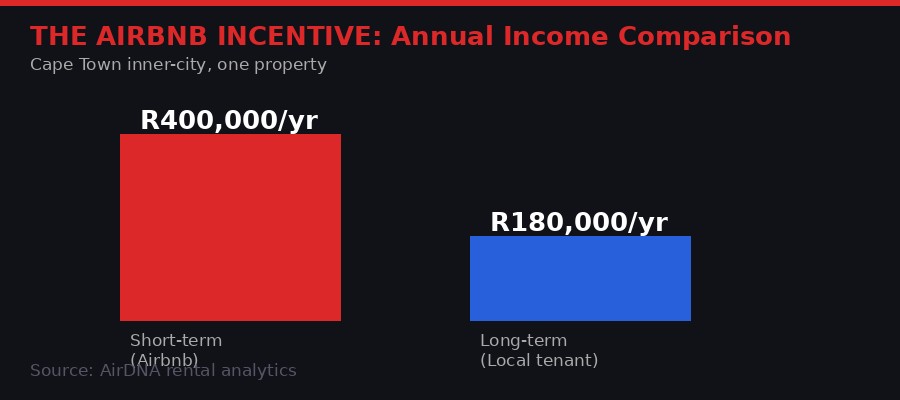
The gap between short-term and long-term rental returns creates a powerful economic incentive to displace local tenants. (BLACKWIRE / AirDNA data)
The math is not subtle. According to rental analytics firm AirDNA, a property in Cape Town's inner city listed on Airbnb can generate more than 400,000 rand - roughly $24,000 - per year. The same property rented long-term to a local tenant earns between 144,000 and 216,000 rand ($8,640 to $13,000) annually. That gap - up to R220,000 in annual income difference - is the financial engine driving displacement.
Cape Town now has over 31,000 active short-term rental listings, with around 26,000 on Airbnb alone, according to AirDNA figures. The highest concentrations cluster around the central business district - exactly where communities like Bo-Kaap sit.
A property owner in Bo-Kaap faces a genuine economic choice. Rent to a local family at the going rate, watch property valuations rise, pay higher municipal rates, and see your margins shrink. Or list on Airbnb, cater to tourists and remote workers with foreign currency, and nearly double your annual return. No individual owner making that calculation is necessarily acting maliciously. The system makes it rational to displace.
This is not unique to Cape Town. The same dynamic has hollowed out neighborhoods from Barcelona to Reykjavik, from New Orleans to Lisbon. But in Cape Town, the dynamics are amplified by a rand that has weakened significantly against major currencies, by sky-high unemployment that leaves most South Africans perpetually priced out, and by the particular cruelty of displacing a community whose very presence is an assertion of historical survival.
For property sellers, the math looks different but reaches the same conclusion. One-bedroom homes that sold for around 1.6 million rand eight years ago now routinely list for 2.5 to 3 million rand, according to data from the Bo-Kaap Civic and Ratepayers Association. That is a price tag equivalent to $135,000 to $160,000 - well beyond what the average South African earns in a decade.
The broader Cape Town market confirms the scale. Data from the Seeff Property Group shows foreign buyers alone accounted for about 2.8 billion rand - roughly $168 million - of the 11.3 billion rand ($679 million) in property sales across the Atlantic Seaboard and City Bowl in the past year. International money is not a minor factor in this market. It is driving approximately a quarter of all transactions.
Who the Digital Nomad Visa Was Designed For (And Who Pays the Price)
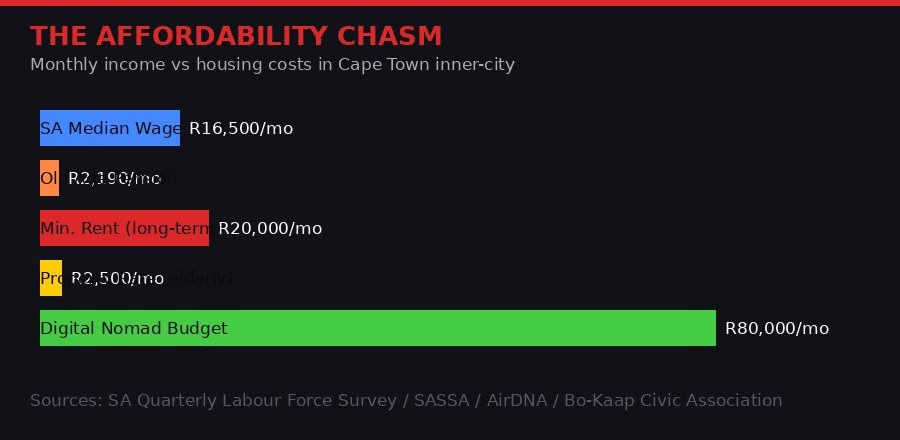
The affordability chasm between South African wages and Cape Town housing costs widens every year. (BLACKWIRE / SA Labour Force Survey data)
In 2024, the South African government introduced a digital nomad visa, allowing foreign remote workers employed overseas to live in the country for extended periods. The policy was framed as an economic win - foreign professionals spending money, boosting tourism, creating demand for local services.
The logic is not entirely wrong. Digital nomads do spend money. They hire cleaning services, eat at local restaurants, contribute to tax revenue. But they also rent apartments. And when someone earning a European or American salary rents in a neighborhood where the median monthly wage is around 16,500 rand (roughly $900), according to South Africa's Quarterly Labour Force Survey, the results are predictable.
A remote worker earning 60,000 rand per month equivalent - a modest salary by British or American standards - has four times the disposable income of a typical Cape Town professional. They can absorb rental increases that would push a local family out of the city entirely. Their presence in the market creates a price floor that local earners simply cannot meet.
Cape Town-based housing advocacy organization Ndifuna Ukwazi has documented what it calls the emergence of a "working homeless" class - people who hold full-time jobs and still cannot secure stable housing in the inner city because wages have not kept pace with rental inflation. Research estimates that more than 90 percent of Cape Town households cannot afford property in the City Bowl area where housing prices have risen far faster than wages. Some families in peripheral townships spend approximately 40 percent of their income on transportation just to reach their jobs in the center.
The Digital Nomad Displacement Pattern
- South Africa's digital nomad visa introduced in 2024 allows foreign remote workers to live in the country for extended periods
- Median monthly South African salary: approximately R15,000-R18,000 ($800-$950), per the Quarterly Labour Force Survey
- Long-term rentals in central Cape Town: frequently exceed R20,000 ($1,200) per month, often substantially higher
- A digital nomad earning a modest European wage can afford 3-4x what local professionals can pay
- Cape Town welcomed approximately 3.3 million international travelers in 2025, according to Airports Company South Africa
- Property values across Cape Town have risen by an average of around 10 percent per year, consistently outperforming other South African metros
The City of Cape Town, when asked about the pressures bearing on Bo-Kaap, offered a response that was technically accurate and politically evasive. Spokesperson Luthando Tyhalibongo told Al Jazeera that the city has experienced population growth of "almost a million new residents from semigration and other forces of urbanisation" over the past decade, and that housing affordability is shaped by "wider economic conditions." He noted that the City has "released more land for affordable housing than in the last 10 years."
What the statement did not address was what happens to communities that already exist in prime inner-city locations while that new housing is being built somewhere on the periphery. The people being displaced from Bo-Kaap now cannot wait for a pipeline of affordable housing that may or may not materialize in a decade.
The Elderly, the Rates, and the Tax of Survival
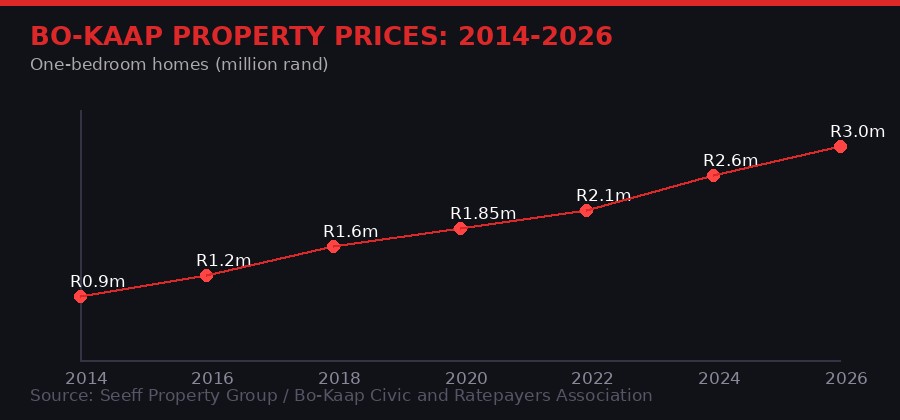
Property prices in Bo-Kaap have more than tripled since 2014, pricing out multiple generations of the community's families. (BLACKWIRE / Seeff Property Group data)
If Airbnb and foreign buyers are the most visible face of displacement, there is a quieter mechanism targeting the community's most vulnerable members: property rates.
As market valuations rise, the City of Cape Town reassesses properties and adjusts municipal rates accordingly. For a family that has owned their home for generations, having it suddenly valued at 2.5 million rand is not a windfall - it is a liability. Their property rates bill rises with the valuation, whether or not the family has any income increase to match.
According to Sheikh Dawood Terblanche, chairperson of the Bo-Kaap Civic and Ratepayers Association, the consequences for elderly residents on fixed incomes are severe. "For pensioners on fixed incomes, the resulting property rates are often higher than their monthly pensions," he told Al Jazeera. "Many are forced to sell simply because they can no longer afford the 'tax of living' in their ancestral homes."
South Africa's state old-age pension sits at approximately 2,190 rand per month, paid through the South African Social Security Agency. In a neighborhood where property rates alone can exceed that figure, the pension provides no buffer. A widow whose family has lived in Bo-Kaap for four generations faces a stark arithmetic: stay and fall into debt, or sell to the investor who keeps calling with cash offers.
"Residents report being frequently approached by agents with high-cash offers, often targeted at elderly homeowners and the vulnerable. The pressure is intense and constant." - Sheikh Dawood Terblanche, chairperson, Bo-Kaap Civic and Ratepayers Association, speaking to Al Jazeera, March 2026
This targeting of elderly homeowners is not accidental. Estate agents working on behalf of investors understand that an 80-year-old on a state pension with a home worth 2.5 million rand is in a structurally weak position. The cash offer relieves an immediate burden while completing the community's erasure. The transaction is legal. The ethics are harder to defend.
Property rates across Cape Town as a whole have surged by nearly 500 percent over the past decade in some areas, even as median wages have risen by a fraction of that figure. For homeowners who bought generations ago and have no mortgage debt, the rising valuation looks like wealth on paper. In practice, for those who cannot sell - who would have nowhere affordable to go - it is a bill they cannot pay and a trap they cannot escape.
What the 2019 Protests Achieved and Didn't

The community has fought back at every stage - but legal protections have not kept pace with economic pressures. (BLACKWIRE illustration)
This is not a community that has been passive in the face of its displacement. In 2019, thousands of Bo-Kaap residents took to the streets in one of the neighborhood's most sustained protests, opposing large-scale property developments they believed would permanently alter the area's character. The demonstrations drew national media attention and eventually produced a real legal achievement: Heritage Protection Overlay Zone status for Bo-Kaap, designed to protect its distinctive architecture and streetscape from demolition.
The HPOZ designation was a genuine win. It means a developer cannot tear down Bo-Kaap's colored houses and replace them with a glass-and-steel apartment block. The bones of the neighborhood - the cobblestones, the minarets, the pastel facades - are legally protected.
What the designation cannot do is keep families inside those protected houses. Heritage law preserves the container. It has no tool to keep the contents from being replaced. The house itself survives. The family that built it does not have to.
Ndifuna Ukwazi has continued advocacy on housing affordability at the policy level, filing reports and engaging the city government on the structural mismatch between wages and rents. The Bo-Kaap Civic and Ratepayers Association has launched education campaigns, going door to door to advise elderly residents of their rights and warn them about predatory cash offers. These efforts are real and they matter. They are also fighting uphill against the financial gravity of a global property market that has decided Cape Town is a good investment.
The structural protections that would actually address the crisis - rent controls, property rates caps for long-term residents, restrictions on short-term rental platforms in heritage zones, social housing programs within the inner city rather than on its periphery - require political will that the City of Cape Town has not yet demonstrated. Cape Town has consistently prioritized its image as an internationally competitive, investor-friendly city. That image depends in part on the very authenticity that communities like Bo-Kaap provide. The city photographs the colored houses. It is less enthusiastic about subsidizing the people inside them.
The Same Story, Different Postcode
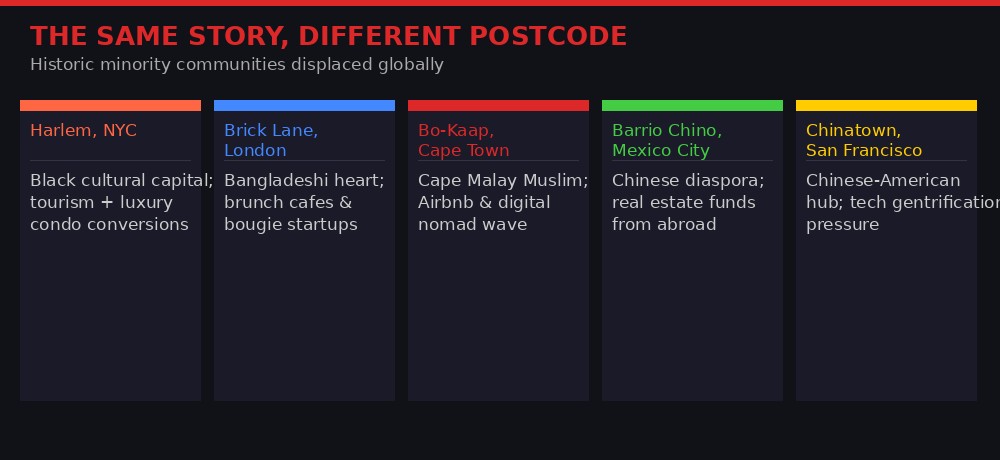
From Harlem to Brick Lane, the erasure of historic minority communities by capital follows a recognizable pattern. (BLACKWIRE illustration)
Bo-Kaap is not the only community navigating this particular grief. Across the world, historic minority neighborhoods built by people who had nowhere else to go are being converted into amenities for the globally mobile rich. The pattern is consistent enough to be a template.
In Harlem, New York, a neighborhood that was the capital of Black American cultural life for a century has seen sustained luxury development pressure since the 2000s, pushing longtime Black residents further up the island and into the outer boroughs. In London's Brick Lane, the heart of the Bangladeshi community has been slowly colonized by brunch cafes and creative agencies that celebrate the neighborhood's "vibe" while the community that created that vibe moves to Tower Hamlets and Newham. In Mexico City's Barrio Chino, Chinese-diaspora families who have lived in the neighborhood since the early 20th century face pressure from real estate funds betting on the area's growing trendy appeal.
What connects these cases is the same basic dynamic: a historic minority community creates something valuable - culture, character, atmosphere, a sense of authentic place. That value attracts tourism, media attention, and investor interest. The investment drives up prices. The original community can no longer afford to stay. The thing that made the neighborhood valuable in the first place begins to disappear, replaced by a kind of cultural museum exhibit where the exhibits are restaurants and Instagram murals rather than living people.
San Francisco's Chinatown, under sustained pressure from the tech economy, offers a cautionary end-state. The neighborhood retains its famous gates, its dim sum restaurants, and its role as a tourist destination. It has lost much of its residential population to surrounding tech-worker gentrification. It is preserved as a sight rather than a community. The families who built it eat their dim sum elsewhere.
"The living heritage, its people are not protected. The houses of Bo-Kaap remain - but for Booley, what is disappearing is far harder to preserve. 'The existential loss of the physical environment responsible for the passing on and the survival of a unique culture formed in the shadow of Table Mountain.'" - Al Jazeera, quoting Yasser Booley, March 18, 2026
This is the endpoint Bo-Kaap's community is fighting to avoid. A neighborhood whose colored houses appear on thousands of Instagram feeds every day, a neighborhood that draws 3.3 million international tourists to Cape Town per year, a neighborhood that has become part of the city's global brand - gradually hollowed of the Muslim, Cape Malay, multi-generational, working-class families who are the reason it looks the way it does.
What It Means to Stay, and What It Costs
For Yasser Booley, staying in Bo-Kaap is not simply a housing choice. It is an act of defiance, a continuation of the defiance that built the neighborhood in the first place. His family has been there for eight generations. He has watched his generation leave. He documents what remains.
"I wake up like a normal person and live my life like a normal person," 15-year-old Aguara, a teenager profiled in a separate AP story about youth identity in Argentina, told reporters about her own identity. The line is from a different context - but the sentiment is something Bo-Kaap's young residents would recognize. They, too, wake up and live like normal people, trying to stay in the neighborhood they grew up in. The world does not always cooperate.
Staying has real costs. Families who could sell their homes for 2.5 million rand and live comfortably elsewhere choose not to because their identity, their social network, their mosque, their entire lived world is rooted in these specific streets. That choice is honored in the community but it cannot be legislated or sustained indefinitely against market pressure that shows no sign of easing.
The call to prayer still rises five times a day from the Auwal Masjid's minaret. The cobblestones are still there. The painted houses - ochre and sage and deep blue - still climb the slopes of Signal Hill exactly as they have for 230 years.
But the families inside them are doing the math. And for more of them, every year, the math no longer works.
Terblanche puts it plainly: "The community absolutely views the current situation as a form of economic displacement. While residents are not being forcibly removed by law, a quieter form of displacement is under way - driven by rising property prices, escalating municipal rates and the broader cost of living."
Quieter than a bulldozer. No less complete.
What Would Actually Help (and Why It Probably Won't Happen)
There is no mystery about what policies would meaningfully protect communities like Bo-Kaap. Urban planners, housing advocates, and economists have documented the toolkit repeatedly. The question is whether any government will use it.
Rent stabilization for long-term residents in heritage zones would cap the rate at which landlords can raise rents, reducing the incentive to flip properties toward short-term rental or higher-income tenants. It does not freeze rents permanently - it prevents the kind of overnight 40-percent increases that push families out in a single renewal cycle. Several European cities, including Berlin and Vienna, have implemented versions of this. Cape Town has not.
Short-term rental registration requirements and caps, as introduced in cities from Amsterdam to New York, limit the number of properties that can operate as full-time Airbnb listings in specific residential zones. They do not ban Airbnb - they prevent an entire neighborhood's housing stock from being converted into hotel inventory. The City of Cape Town has discussed such measures. It has not implemented them in Bo-Kaap or elsewhere.
Property rates relief for long-term residents - particularly elderly homeowners on fixed incomes who have lived in a neighborhood for decades - is a direct intervention against the mechanism forcing pensioners to sell. South Africa has some provision for this through the Municipal Property Rates Act, but application is inconsistent and the relief amounts are modest relative to the rates increases driven by market valuations.
Social housing within the inner city, rather than exclusively on the urban periphery, would allow displaced families to remain close to their communities, workplaces, mosques, and schools. The City's land release program is beginning to address this, but the scale and pace have not matched the rate of displacement.
None of these interventions are radical. All of them have been implemented in various forms in various cities. All of them would require the City of Cape Town to prioritize the continuity of existing communities over maximizing property values and investor returns. That is ultimately a political choice - and it is one the city has consistently made the other way.
Booley's question cuts through the policy debate: "Can the people who built Bo-Kaap still afford to live in it?"
Right now, the honest answer is: barely, and for a shrinking number of them, not for much longer.
Get BLACKWIRE reports first.
Breaking news, investigations, and analysis - straight to your phone.
Join @blackwirenews on TelegramSources
- Al Jazeera: "In Cape Town's historic Bo-Kaap, homes under siege from rich foreign buyers," March 18, 2026
- Seeff Property Group: Cape Town property sales data, Atlantic Seaboard and City Bowl, 2025-2026
- AirDNA: Short-term rental analytics, Cape Town market, 2025-2026
- South Africa Quarterly Labour Force Survey: Median wage data
- South African Social Security Agency (SASSA): Old age pension figures
- Airports Company South Africa: International traveler statistics, 2025
- Ndifuna Ukwazi: Cape Town housing affordability research
- Bo-Kaap Civic and Ratepayers Association (BKCRA): Community statements and data
- City of Cape Town spokesperson Luthando Tyhalibongo: Written response, March 2026
- Municipal Property Rates Act (South Africa)