CERN's Biggest Week in a Decade: New Particle, Antimatter on the Road, and a $16B Successor Collider
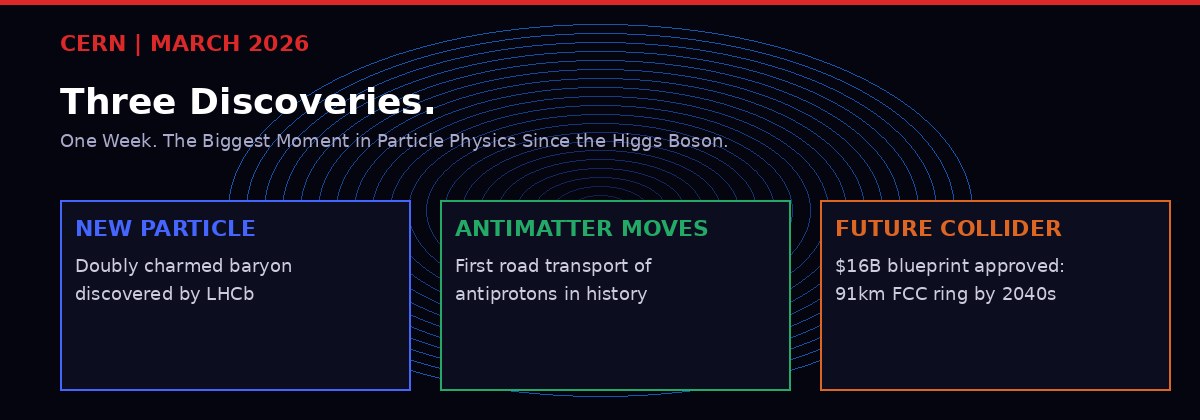
In the same week, physicists at CERN transported antimatter down a public road for the first time in history, announced the discovery of a new subatomic particle not seen before, published the full blueprint for a $16 billion replacement for the Large Hadron Collider, and confirmed the most advanced upgrade to that same collider had begun full-scale testing. Any single one of these events would have cleared front pages. All four happened simultaneously, and the wider world barely noticed.
The clustering is not a coincidence. It reflects a strategic push by the European Organization for Nuclear Research to cement its scientific authority at a moment when US federal funding for research is under pressure from the Trump administration's sweeping cuts, and when geopolitical fault lines are making international science cooperation harder to sustain. CERN is making noise because it needs to. But the noise it's making is real.
This is what happened, what it means, and why the second-order effects reach far beyond the physics lab.
The New Particle: An 80th Hadron and What It Actually Tells Us
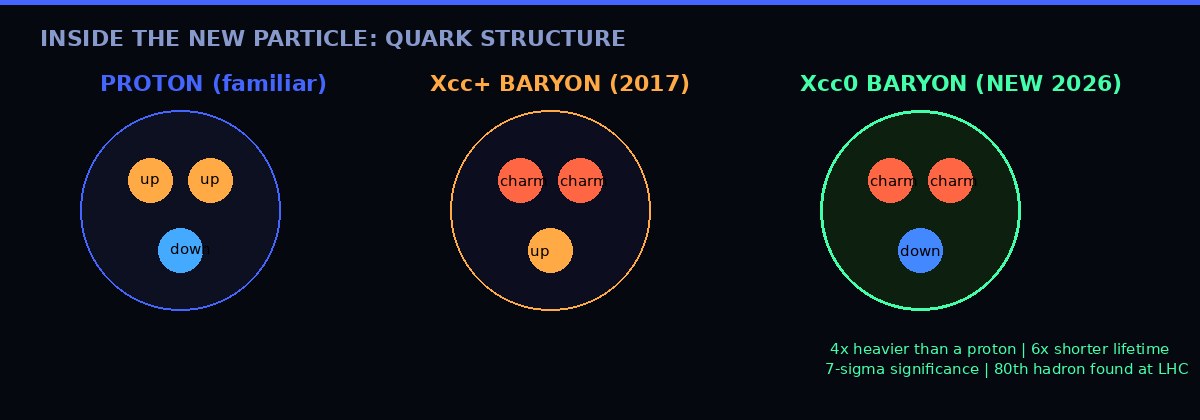
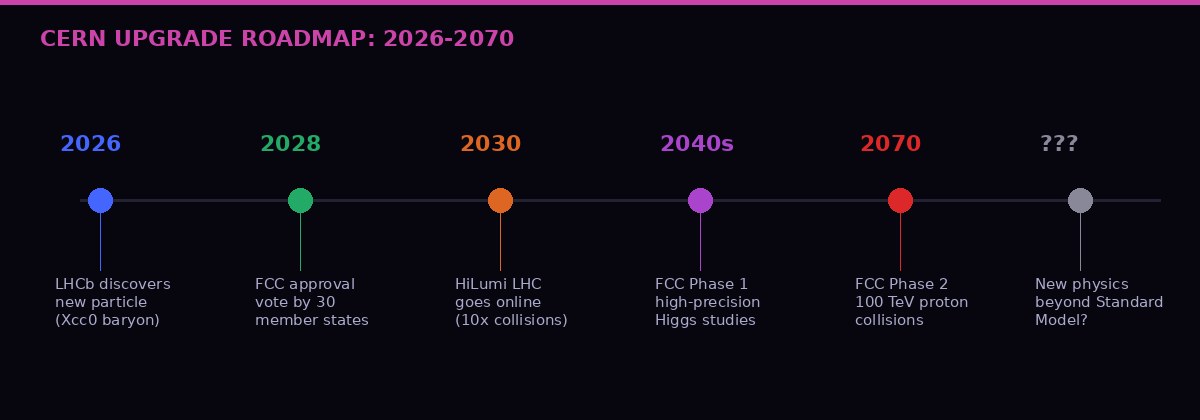
On March 17, the LHCb collaboration at CERN published the discovery of a new baryon - a composite particle made of three quarks - consisting of two charm quarks and one down quark. The particle is called the Xcc0 (pronounced "xi-cc-zero"), and it is the 80th hadron ever discovered at the Large Hadron Collider. The announcement came at the Moriond conference, one of high-energy physics' most prestigious annual gatherings.
The discovery carries a statistical significance of 7 sigma - well above the 5-sigma threshold required to claim a confirmed discovery in particle physics. To put that in terms that matter: at 5 sigma, there is roughly a 1 in 3.5 million chance the signal is noise. At 7 sigma, you're dealing with odds that make that look generous. This is not a tentative result. It is a discovery.
Why This Particle Matters
- First observed: Data from Run 3 of the LHC, after 2023 detector upgrades
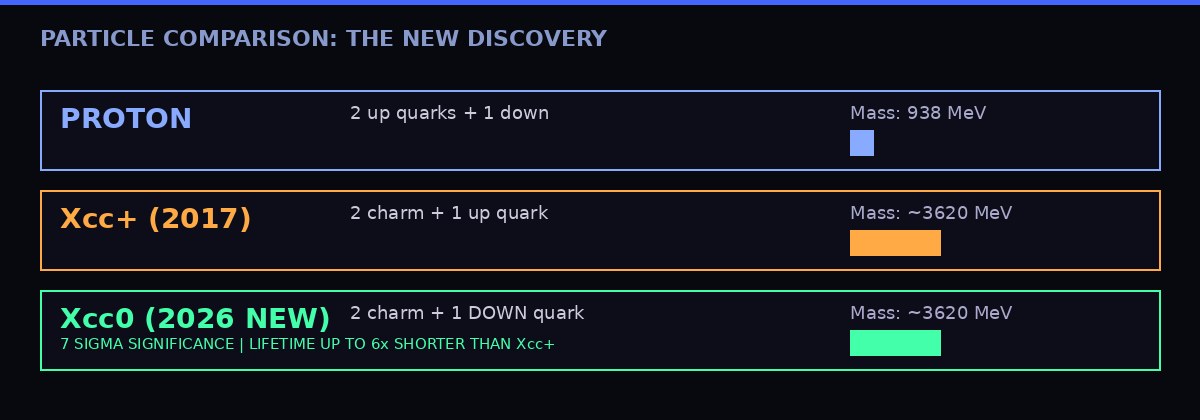
- Composition: Two charm quarks + one down quark (vs. proton's two up + one down)
- Mass: Approximately 3,620 MeV - roughly 4 times heavier than a proton
- Lifetime: Predicted to be up to 6 times shorter than its sister particle, the Xcc+
- Significance: 7 sigma (discovery threshold is 5 sigma)
- Total hadrons at LHC: 80 (this is the 80th)
The Xcc0's predecessor, the Xcc+, was first observed by LHCb back in 2017. That particle has two charm quarks and one up quark. The new particle swaps the up quark for a down quark - a seemingly minor change with significant consequences for how the particle behaves. Complex quantum effects mean the Xcc0's lifetime is dramatically shorter, making it far harder to detect. The fact that it was found at all is a testament to the detector upgrades completed in 2023.
Quarks are the fundamental building blocks of matter, and they come in six varieties: up, down, charm, strange, top, and bottom. They combine in groups of twos (mesons) and threes (baryons) to form the hadrons we know. Most hadrons are unstable - they decay in fractions of a second. The LHCb experiment is uniquely designed to capture these fleeting signals, using its geometry to detect particles that decay slightly downstream from the collision point.
"This is the first new particle identified after the upgrades to the LHCb detector that were completed in 2023, and only the second time a baryon with two heavy quarks has been observed." - Vincenzo Vagnoni, LHCb Spokesperson, CERN, March 2026
The practical application of this discovery is not a new fuel source or a medical treatment. Particle physics doesn't work like that. What the Xcc0 gives physicists is a precision test case for quantum chromodynamics (QCD) - the theoretical framework that describes how quarks are bound together by the strong nuclear force. The doubly charmed baryons are particularly useful test cases because the two heavy charm quarks move slowly relative to the lighter quark, making the system tractable for certain types of QCD calculation.
Think of it this way: every time physicists discover a new particle, they get to check their theory against reality. Every successful prediction the Standard Model makes is a confirmation that we understand something fundamental about the universe. Every discrepancy is potentially a doorway to new physics. The Xcc0 is another data point. And data points, at this level of precision, compound into understanding.
Antimatter Goes Mobile: The First Road Test That Could Rewrite Physics Labs
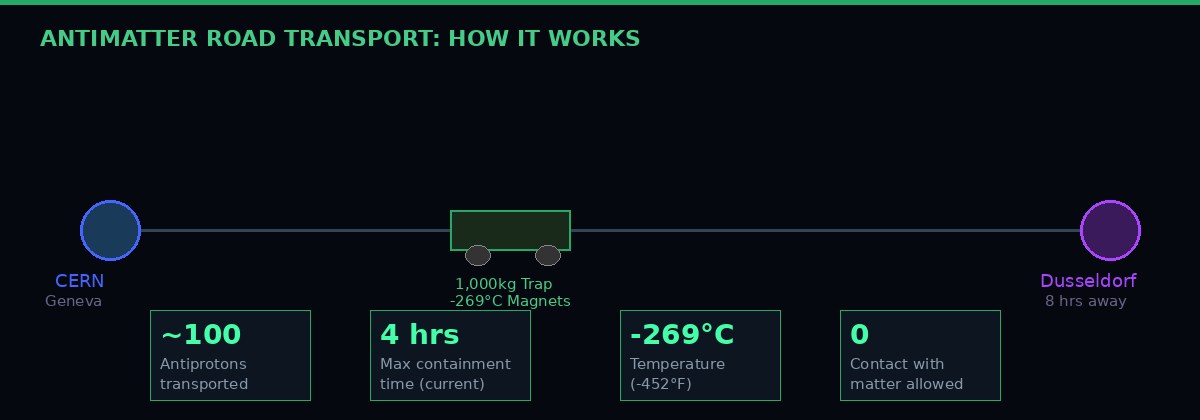
On March 24 - the same week as the particle discovery - CERN scientists loaded approximately 100 antiprotons into a specially engineered 1,000-kilogram containment unit, put it on a truck, and drove it around Geneva for half an hour. The AP confirmed the experiment succeeded. Antimatter has never been transported by road before. Ever. In the entire history of physics.
The reason this has never been attempted is straightforward: antimatter annihilates on contact with regular matter. If an antiproton touches the inner wall of its container - made of, inevitably, matter - it disappears in a flash of energy. The challenge is keeping the antiprotons perfectly suspended in a vacuum, held in place by supercooled electromagnets at minus 269 degrees Celsius, while simultaneously absorbing every vibration, jolt, and bump of a public road.
The containment unit is called a "transportable antiproton trap." It uses superconducting magnets cooled to near absolute zero by liquid helium to create a magnetic field that suspends the antiprotons in a vacuum without touching anything solid. The trap weighs a full metric tonne, is compact enough to pass through standard laboratory doors, and can sustain the antiprotons for about four hours without external power.
Four hours is the current limiting factor. The ultimate goal is to transport antiprotons from CERN's Antiproton Decelerator - the only facility in the world that produces and stores low-energy antiprotons - to Heinrich Heine University in Dusseldorf, Germany. That drive is eight hours. The Tuesday test was the first step: prove the trap can survive road conditions at all.
Why does Dusseldorf want antiprotons? Because CERN's research environment is magnetically noisy. The LHC and its surrounding detectors create electromagnetic interference that makes precision measurements of antimatter properties difficult. Heinrich Heine University offers a quiet environment where physicists can study antiprotons in detail - measuring their properties with extreme precision to look for tiny differences between matter and antimatter.
That last sentence carries enormous weight. The Standard Model of physics predicts that matter and antimatter were created in equal quantities during the Big Bang. If they were, they should have annihilated each other completely, leaving nothing. The universe should not exist. The fact that it does means something is different between matter and antimatter - some asymmetry that allowed matter to win. Finding that asymmetry is one of the deepest unsolved problems in physics.
"The trap is supposed to contain these antiprotons no matter what: if the truck stops, if it starts again, if it has to slam on the brakes - all that." - Sophie Tesauri, CERN Spokeswoman, March 2026
The ability to transport antimatter to other labs would democratize antimatter research. Right now, if you want to study antiprotons, you go to Geneva. That's the only place on Earth that has them. Mobile antimatter opens the possibility of distributed research - different labs studying different properties without having to queue for time at the world's single antimatter factory. It's the physics equivalent of going from one mainframe to a network of computers.
The technical challenge ahead is extending the trap's battery life from four hours to eight-plus. CERN's Smorra team is already working on that. The Tuesday test proved the containment concept works under real-world conditions. The next step is endurance.
The $16 Billion Blueprint: Europe Bets on the Future Circular Collider
The same week, CERN officially published the full feasibility study for the Future Circular Collider - a proposed particle accelerator that would make the Large Hadron Collider look modest. The blueprint, ten years in development, lays out the physics case, engineering requirements, environmental impact and projected costs for a machine that would tunnel beneath the French-Swiss border and Lake Geneva in a ring 91 kilometers in circumference.
For comparison: the Large Hadron Collider runs through a 27-kilometer tunnel. The FCC would be 3.4 times larger. In terms of energy, the difference is even starker. The LHC smashes protons together at 13 trillion electron volts (13 TeV). The FCC's second phase would reach 100 TeV - nearly eight times more powerful - opening energy ranges that have never been probed.
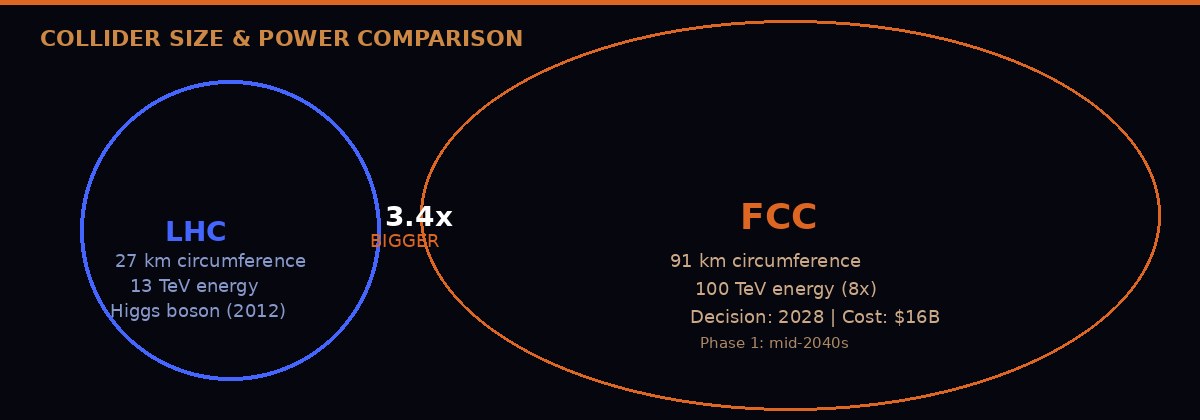
The FCC is planned in two phases. Phase 1 - targeted for the mid-2040s - would collide electrons and positrons at precisely controlled energies, enabling extremely high-precision studies of the Higgs boson and other known particles. This is about measuring what we already know to extraordinary accuracy, looking for tiny deviations that could hint at new physics beyond the Standard Model. Phase 2 - targeted for around 2070 - would switch to proton-proton collisions at 100 TeV, actively hunting for new particles and phenomena at the energy frontier.
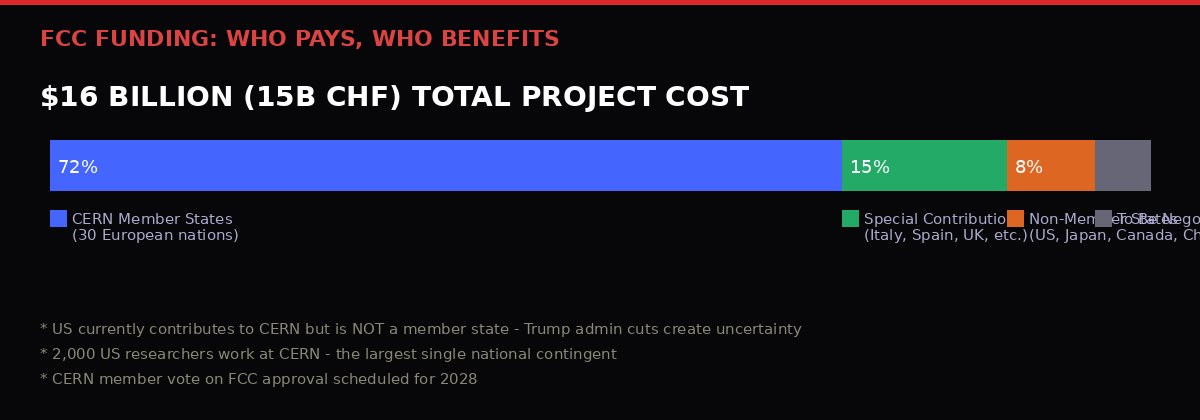
The cost is 15 billion Swiss francs, approximately $16 billion US at current exchange rates. The primary funding comes from CERN's 30 European member states, with additional contributions from non-member partners including the United States, Japan, Canada, and China. A vote by member states on whether to formally approve the project is scheduled for 2028.
FCC Key Facts
- Circumference: 91 kilometers (reduced from the originally proposed 100km)
- Average depth: 200 meters below the surface
- Tunnel diameter: 5 meters
- Phase 1 energy: Electron-positron collisions (high precision Higgs studies)
- Phase 2 energy: 100 TeV proton-proton collisions (8x the LHC)
- Cost: 15 billion Swiss francs (~$16 billion USD)
- Approval vote: 2028 by CERN member states
- Phase 1 start: Mid-2040s
- Phase 2 start: Around 2070
- US involvement: 2,000 US researchers currently use CERN - largest national contingent
The Trump administration variable hangs over the FCC like a question mark. The Biden administration in 2025 pledged US support for FCC collaboration and construction. Trump's aggressive cuts to academic and scientific funding - combined with tariffs disrupting international partnerships - create uncertainty. CERN Council president Costas Fountas said he had been told by US National Science Foundation and Department of Energy staff that they were, in their own words, "under the radar of the cuts of the Trump administration." That's an odd reassurance. "Under the radar" is not the same as "safe."
US scientists form the single largest national group working at CERN. If US funding for European physics collaboration dries up, American physicists lose access. That is not primarily Europe's loss.
"History of physics tells that when there is more data, the human ingenuity is able to extract more information than originally expected." - Giorgio Chiarelli, Research Director, Italy's National Institute of Nuclear Physics
The scientific case for the FCC rests partly on known goals - studying the Higgs boson with unprecedented precision, mapping the properties of the W and Z bosons, testing the Standard Model to its limits - and partly on the logic of exploration. CERN Director-General Fabiola Gianotti was notably candid about the second category: "It's true that at the moment we do not have a clear theoretical guidance on what we should look for." The 100 TeV phase of the FCC is, in that honest framing, a bet on discovery - on the idea that pushing into unexplored energy ranges will reveal something we cannot yet predict.
The history of particle physics supports that bet. Every major collider ever built has found things no one anticipated. The LHC found the Higgs - but it also found hundreds of hadrons, exotic matter states, and precision results that have shaped theoretical physics for a decade. The FCC's argument is that at 100 TeV, the surprises will be proportionally larger.
HiLumi: The Upgrade That Runs While the FCC Is Still a Drawing
The FCC is decades away. But CERN's next major milestone is much closer. In late February, CERN announced the start of cryogenic cooldown for a 95-meter test stand - a full-scale replica of the critical new magnet system for the High-Luminosity LHC upgrade, known as HiLumi. The test stand represents the most critical pre-installation validation step in the HiLumi program.
HiLumi is not a new collider. It's a profound upgrade to the existing LHC that will increase the number of particle collisions - the "luminosity" - by a factor of ten. More collisions mean more data. More data means rarer phenomena become visible. The upgrade is scheduled to enter operation in 2030, following a Long Shutdown 3 that begins this summer.
The new technology being validated in the test stand is genuinely novel. The inner triplet beam-focusing magnets use niobium-tin (Nb3Sn) superconductors instead of the niobium-titanium magnets in the current LHC. Nb3Sn can sustain higher magnetic fields - essential for squeezing the beam tightly enough to increase the collision rate. These magnets have never been used in a proton accelerator before. The test stand is there precisely to validate that they work as expected when integrated with all the other HiLumi systems - cryogenic lines, power systems, alignment infrastructure - before any of it goes underground.
Mark Thomson, CERN Director-General, did not understate the significance:
"I don't think it is possible to overstate the importance and excitement of the High-Luminosity LHC, which is the largest project undertaken by CERN for the past 20 years. Coupled with advanced new data tools and upgraded detectors, it will allow us to understand for the first time how the Higgs boson interacts with itself - a key measurement that will shed light on the first instants and possible fate of the Universe." - Mark Thomson, CERN Director-General, February 2026
The Higgs self-coupling measurement Thomson refers to is a specific and profound goal. The Higgs boson was discovered in 2012. Since then, physicists have measured many of its properties. But they have not yet directly measured how the Higgs interacts with itself - a parameter that determines the shape of the Higgs potential, and therefore the stability of the vacuum in which our universe exists. If the self-coupling differs from Standard Model predictions, it could signal that the universe is metastable - sitting in a local energy minimum that could, given enough time or the right perturbation, transition to a lower-energy state with different physical laws. HiLumi is the machine that will make that measurement possible.
The Technology the World Doesn't Know It Owes CERN
The instinctive reaction to particle physics news from non-physicists is often some version of: "cool, but what does this do for me?" It's a fair question. The answer, historically, is that it does quite a lot - just on timescales and through pathways that are not immediately obvious.
The World Wide Web was invented at CERN by Tim Berners-Lee in 1989. He needed a way to share documents between physicists at different institutions. The internet existed; HTTP and HTML did not. That invention now underpins the global economy. CERN did not invent the web to make money. It invented the web because physicists needed it.
Medical imaging - specifically positron emission tomography (PET) scanning - derives directly from particle physics detector technology. The detectors developed to track particle collision products became the detectors that look for cancer in the human body. Proton therapy, which targets tumors with precision using proton beams, is a direct application of accelerator technology developed at facilities like CERN.
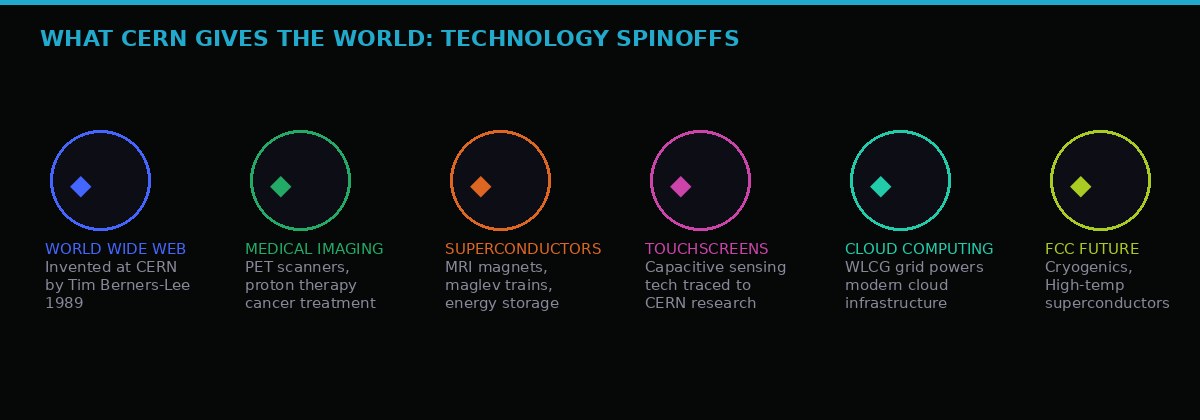
Superconducting magnets - the kind used to cool and focus particle beams - are now the core technology inside MRI machines. Every MRI scan anywhere in the world runs on technology evolved from magnet engineering at particle physics labs. Superconductors are also becoming central to proposed energy storage systems and transmission lines that could make renewable energy grids more efficient.
The computing infrastructure built to handle LHC data - the Worldwide LHC Computing Grid - is a direct precursor to modern cloud computing. The problem of distributing and processing petabytes of collision data across hundreds of institutions in dozens of countries drove innovation in distributed computing that shaped how the internet works today.
The FCC specifically promises to advance cryogenic engineering, high-temperature superconductors, and vacuum technologies. These have obvious applications in energy storage, quantum computing infrastructure, and next-generation medical imaging. The economic return on fundamental physics research is historically positive - not always predictably, not always quickly, but reliably over time.
The antimatter transport technology has a more specific potential application: antimatter-based cancer treatment. Antiproton therapy is theoretically more precise than proton therapy because antiprotons annihilate on impact, depositing energy in a highly localized way. Research on this application requires access to antiprotons at institutions far from CERN. The transportable trap is the enabling technology for that research to happen at all.
The Geopolitics of Big Science: Who Controls the Frontier
Particle physics has always been geopolitically charged. The Manhattan Project established the template: if you control fundamental physics, you control the frontier of weapons, energy, and strategic technology. The Cold War was, in part, a race to understand matter at its most fundamental level. CERN was itself founded in 1954 as a European response to that dynamic - a consortium that would keep Europe at the frontier of physics without any single nation controlling it.
That logic has not aged out. It has evolved.
The FCC's timing is not accidental. CERN published a major feasibility study at precisely the moment US federal science funding faces its most severe cutback in decades. The message, delivered through scientific papers and press releases rather than diplomatic cables, is clear: Europe is committed to leading fundamental physics through the 21st century regardless of what happens in Washington.
China's relationship with CERN is the other variable. China is not a CERN member state but contributes to specific projects and has benefited enormously from access to CERN data and collaboration networks. China is simultaneously building its own particle physics capabilities - the proposed Circular Electron Positron Collider (CEPC) is a direct competitor to FCC Phase 1, targeting similar precision Higgs measurements on a similar timeline. The two projects are not mutually exclusive - the physics community generally views them as complementary - but the funding and political attention are finite.
If the FCC is approved in 2028 and goes forward, CERN retains its position as the world's primary center of gravity for fundamental physics for at least the next 50 years. If it's not approved - if the political will among European member states weakens, or if US contributions dry up, or if cost estimates balloon during detailed engineering - the initiative passes elsewhere. These decisions, made by committees of physicists and government ministers in the late 2020s, will shape scientific leadership deep into the 22nd century.
What the Week Tells Us About the State of Particle Physics
Taken together, the events of this week sketch a portrait of particle physics at an inflection point. The LHC and its experiments are performing better than ever, producing results at a rate that justifies the upgrade investment. The new Xcc0 discovery, coming from data taken after the 2023 detector improvements, demonstrates that the LHCb upgrade program is paying dividends immediately.
The antimatter transport experiment represents a different kind of maturity - moving from discovery to deployment. The Antiproton Decelerator at CERN has spent years refining the production, deceleration, and trapping of antiprotons. The transportable trap is the result of that accumulated capability reaching a level where it can be packaged and shared. This is technology transfer within physics itself - taking a capability that existed only at one facility and making it mobile.
The FCC blueprint and HiLumi test stand both speak to a field that is planning on generational timescales. The physicists working on HiLumi will mostly retire before FCC Phase 2 produces results in the 2070s. Particle physics requires an unusual form of institutional continuity - decisions made today constrain what is possible for researchers who are not yet born. The FCC feasibility study is, among other things, a document about intergenerational responsibility in science.
There is a temptation, when reading about accelerators that cost tens of billions of dollars and take decades to build, to ask whether the money could be better spent. It's a legitimate question. But it misunderstands what particle physics research actually produces. The goal is not to build machines. The goal is to understand what everything is made of, and how it works, at the most fundamental level accessible to experiment. The machines are the only tools capable of that work.
The Standard Model of particle physics - the theoretical framework that explains all known particles and their interactions - is one of the most precisely tested theories in the history of science. It is also known to be incomplete. It does not account for gravity, dark matter, or dark energy. It does not explain the matter-antimatter asymmetry that allowed the universe to exist. It does not say why there are exactly three generations of quarks and leptons. Every experiment CERN runs is, at some level, an attempt to find the edge of the map.
This week, the map got a little bigger: one new particle marked, antimatter freed from its single known address, a future instrument commissioned to look further than anything built before. The edge is still out there. CERN just moved closer to it.
Get BLACKWIRE reports first.
Breaking news, investigations, and analysis - straight to your phone.
Join @blackwirenews on TelegramSources
- AP News: "CERN takes antiprotons for a spin in a truck" - March 24, 2026
- AP News: "The Large Hadron Collider is getting an even larger successor" - 2026
- AP News: "Scientists move forward with plans for giant new atom-smasher" - 2026
- CERN Official: "LHCb Collaboration discovers new proton-like particle" - March 17, 2026
- CERN Official: "HiLumi LHC: full-scale tests start" - February 23, 2026
- LHCb Outreach: "Observation of the doubly charmed heavy proton Xcc0" - March 2026
- Moriond EW Conference, March 2026: LHCb presentation slides
- CERN FCC Feasibility Study - published 2026