
The U.S. Capitol building. Rep. Sheila Cherfilus-McCormick faces expulsion after being found guilty of 25 ethics violations. | Pexels
The delta variant was killing hundreds of Americans every day. Hospitals were overwhelmed. The federal government was pouring emergency money into vaccination programs, trusting that healthcare contractors would do right by the public funds they received.
In the summer of 2021, Trinity Healthcare Services - a company run by the family of a Florida businesswoman named Sheila Cherfilus-McCormick - was supposed to receive $50,000 from the Florida Department of Emergency Management for COVID-19 vaccination staffing work. Instead, through what prosecutors describe as a paperwork error, they received $5 million.
They did not give it back.
Within two months, more than $100,000 had been spent on a 3-carat yellow diamond ring for Cherfilus-McCormick, federal prosecutors allege. The rest moved through a web of family members, friends, and outside organizations - before landing in the campaign accounts that would fund her successful run for Congress in a January 2022 special election.
On Friday, March 28, 2026, the House Ethics Committee found Cherfilus-McCormick - now a sitting third-term Democratic congresswoman representing Florida's 20th District - guilty of 25 of 27 ethics violations, including violations of campaign finance law, commingling of campaign and personal funds, and using her office to benefit political allies. The bipartisan panel of four Democrats and four Republicans emerged from a seven-hour public hearing to deliver the verdict. A punishment recommendation is coming in April.
Looming in the background: a potential expulsion vote, a federal criminal trial with 15 counts including money laundering, and a Democratic Party that cannot afford to lose a seat - but may not be able to afford to keep her.
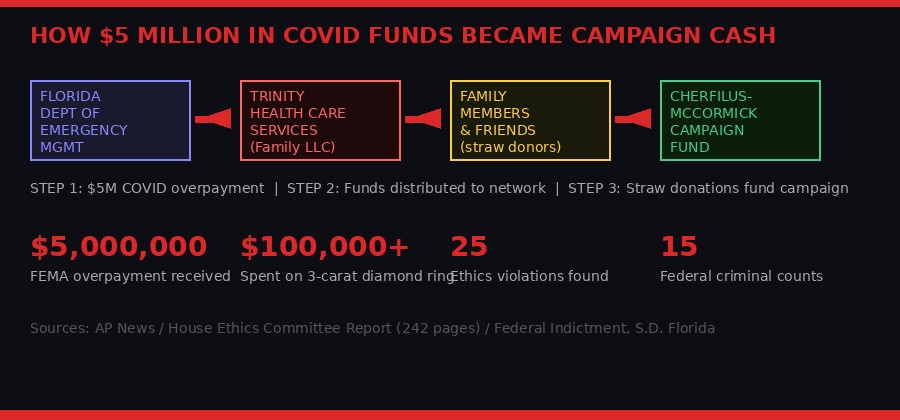
The alleged money trail: from Florida emergency funds through a healthcare company to straw donors and a campaign account. Source: DOJ Federal Indictment.
The COVID Contract That Changed Everything
Understand the origin of this case, and you understand why prosecutors believe it was never a simple mistake.
In 2021, Trinity Healthcare Services held a contract with the Florida Division of Emergency Management to register residents for COVID-19 vaccinations. The company was owned and operated by Cherfilus-McCormick's family - she herself was listed as CEO at the time. Her brother Edwin Cherfilus ran day-to-day operations.
The payment request was for $50,000. But according to federal prosecutors, due to an administrative error by the state agency, Trinity Healthcare received $5,000,000 - exactly 100 times the amount owed.
A private individual or company operating in good faith would have flagged the discrepancy immediately. At minimum, they would have returned the funds when contacted. Neither happened. Instead, according to the federal indictment filed in the Southern District of Florida, the money began to move.
The indictment says that within approximately two months of receiving the funds, more than $100,000 had been used to purchase a 3-carat yellow diamond ring for Cherfilus-McCormick. The ring purchase alone - documented in financial records - became a focal point of the prosecution's case, representing not just extravagance but conscious conversion of public emergency funds to personal use.
"Defrauding the federal government and disaster victims of $5 million is an automatic disqualifier from serving in elected office." - Rep. Greg Steube (R-FL), calling for Cherfilus-McCormick's expulsion in 2025
The Florida Division of Emergency Management eventually discovered the overpayment through routine auditing. The agency demanded the money back. Trinity Healthcare refused. In December 2024, the Florida DOFEM filed a civil lawsuit against Trinity Healthcare - ultimately reaching a settlement in which the company agreed to repay the full $5 million.
But by then, federal prosecutors were already building a criminal case. The civil settlement resolved the state's claim. It did nothing to address what investigators said was deliberate theft and money laundering.

Federal investigators pieced together bank records, text messages, and transaction data to trace how pandemic funds moved through the alleged scheme. | Pexels
Building the Campaign: Straw Donors and Laundered Money
Sheila Cherfilus-McCormick had political ambitions before the pandemic. She had run twice for Florida's 20th Congressional District seat - losing primary challenges in 2018 and 2020. The district, encompassing parts of Broward and Palm Beach Counties, is a heavily Democratic seat with a large Haitian-American constituency. When longtime Rep. Alcee Hastings died in April 2021 at age 84, the seat opened up - and Cherfilus-McCormick entered the special election race.
The critical problem: money. Congressional campaigns in competitive special elections require significant funding to stand out. Cherfilus-McCormick did not have it - not legitimately.
Federal investigators spent over two years reconstructing what allegedly happened next. The 242-page House Ethics Committee report, combined with the federal indictment, describes a multi-layered scheme to route the $5 million in COVID funds into her political operation.
The alleged mechanics went like this: Trinity Healthcare distributed the overpaid funds to various accounts held by family members and friends of Cherfilus-McCormick. Those individuals then made contributions to her campaign. By law, campaigns receiving large contributions from a single source through multiple donors in what amounts to a coordinated scheme are receiving illegal "straw donations" - donations designed to conceal the true source and circumvent campaign finance limits.
"The investigation found a mountain of evidence that showed Cherfilus-McCormick violated laws, ethical standards and rules for House members." - Sydney Bellwoar, Senior Counsel, House Ethics Committee, March 27, 2026 hearing
Perhaps most damning: bank records entered into evidence during the March 27 ethics hearing showed a pattern of funds flowing into Cherfilus-McCormick's campaign accounts shortly before filing deadlines - when campaigns are required to disclose their financial position - only to flow back out after the deadlines passed. This timing, investigators argued, was not coincidental. It was designed to mislead election filings about the actual strength and source of her financial backing.
Rep. Brad Knott (R-NC), a member of the ethics panel, read aloud from text messages during the public hearing that he said showed Cherfilus-McCormick was personally aware of the fund transfers into her account at strategic moments.
"You and I both know that sometimes evidence speaks for itself," Knott said, addressing the congresswoman's attorney directly.
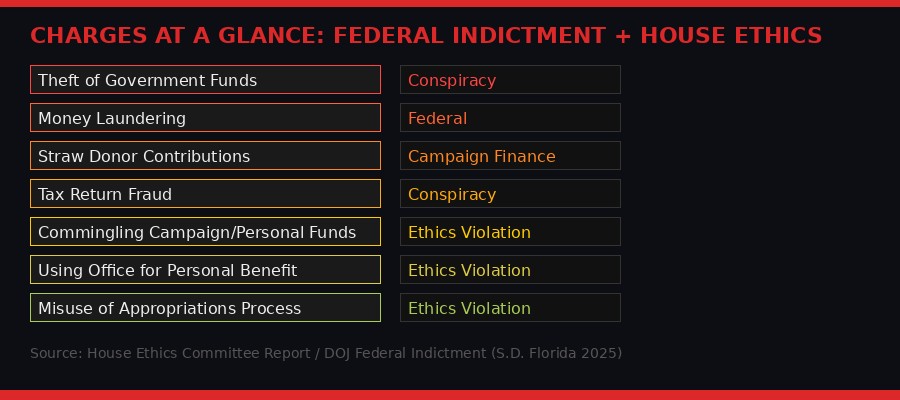
A breakdown of the charges facing Cherfilus-McCormick at both the federal and House Ethics levels. Source: DOJ indictment / House Ethics Committee report.
The Special Election Win and the Haitian Government Connection
Cherfilus-McCormick won the January 2022 special election by a razor-thin margin in the Democratic primary - a contest that drew nine candidates. She was elected to Congress with the support of Florida's 20th District, a seat previously held by Alcee Hastings for nearly three decades.
Her campaign presented itself publicly as largely self-financed - a savvy political narrative that suggested personal conviction and financial independence from special interests. In reality, according to the House Ethics Committee's investigation, the campaign was substantially funded through the diverted COVID money.
The Ethics Committee report exposed a second funding thread that investigators found particularly troubling: outside organizations run by friends and associates of Cherfilus-McCormick, including one entity that received significant funding from the Haitian government.
The involvement of a foreign government - even an allied one - in funding organizations connected to a U.S. congressional campaign raises serious questions under federal law. Foreign nationals and foreign governments are prohibited from contributing, directly or indirectly, to U.S. election campaigns. The Ethics Committee's report flagged this connection as a potential violation, though on the final count related to this particular allegation, the panel declined to find her guilty, citing insufficient direct evidence linking Cherfilus-McCormick herself to the specific decision-making around Haitian government funding.
Still, the 25 violations the panel did confirm represent one of the most extensive corruption findings against a sitting member of Congress in recent years. The last time the House held a comparable public ethics hearing was 2010, when then-Rep. Charles Rangel (D-NY) faced censure for personal finance violations.
Cherfilus-McCormick's attorney, William Barzee, appeared before the panel and argued vigorously that the scheme investigators described did not amount to wrongdoing. His central argument rested on a document - notably unsigned - that he said outlined a pre-existing profit-sharing arrangement between Cherfilus-McCormick and her family's healthcare business, entitling her to the funds she received.
"She is not guilty of these allegations. She is absolutely innocent. But she is in between a rock and a hard place right now." - William Barzee, attorney for Cherfilus-McCormick, March 27, 2026
The panel was skeptical. Rep. Mike DeSaulnier (D-CA), the top Democrat on the committee, said bluntly: "It strains credulity." The panel noted that the supposed profit-sharing agreement was the only basis offered for transferring millions of dollars, and that it appeared to be unsigned.
Barzee characterized Trinity Healthcare as a family enterprise that made decisions "around the kitchen table" - an argument that may carry more weight with jurors in a criminal trial than it did with a bipartisan panel of congressional colleagues who have spent two years reviewing bank records and text messages.

Cherfilus-McCormick faces 15 federal criminal counts in the Southern District of Florida, with a trial expected later in 2026. | Pexels
The Federal Case: 15 Criminal Counts and a Diamond Ring
The House Ethics Committee proceeding is separate from - and in many ways less severe than - the federal criminal case Cherfilus-McCormick faces in the Southern District of Florida.
Federal prosecutors indicted her in late 2025 on 15 counts. She was arrested, posted a $60,000 bond, and surrendered her personal passport. The arraignment took place in January 2026, with her attorney entering a not guilty plea on her behalf while she remained in Washington attending to congressional duties.
The full charge list reads like a corruption manual:
- Theft of government funds (conspiracy and substantive counts)
- Making and receiving straw donor contributions
- Money laundering (conspiracy and substantive counts)
- Aiding and assisting a false and fraudulent statement on a federal tax return
- Additional conspiracy counts tying the above offenses together
The tax fraud allegation adds another dimension: the indictment charges Cherfilus-McCormick and her 2021 tax preparer with conspiring to file a false federal return by claiming political spending and personal expenses as business deductions, and by inflating charitable contribution figures.
Taken together, the charges describe someone who allegedly used a pandemic emergency program as a personal ATM, then tried to cover the tracks across multiple financial channels - campaign finance filings, personal tax returns, and business records.
The timing of the federal charges drew a sharp response from Cherfilus-McCormick. "This is an unjust, baseless, sham indictment," she said after her arrest in 2025. "The timing alone is curious and clearly meant to distract from far more pressing national issues." She called it politically motivated and vowed to fight the charges in court.
Her previous attorney, David Oscar Markus, left the case earlier this year citing scheduling conflicts, after repeatedly requesting that her arraignment be postponed while she "resolved issues with her finances." Barzee, who took over the defense, argued after the arraignment that the DOJ should not have pursued the case after the civil settlement was reached. "It's surprising that the DOJ would take on a case after it's been resolved and after there was an agreement to repay all of the funds," he said.
Federal prosecutors evidently disagree. Repaying money after you're caught stealing it does not erase the theft, the laundering, or the tax fraud. A trial date is expected to be set following Congress's April recess.
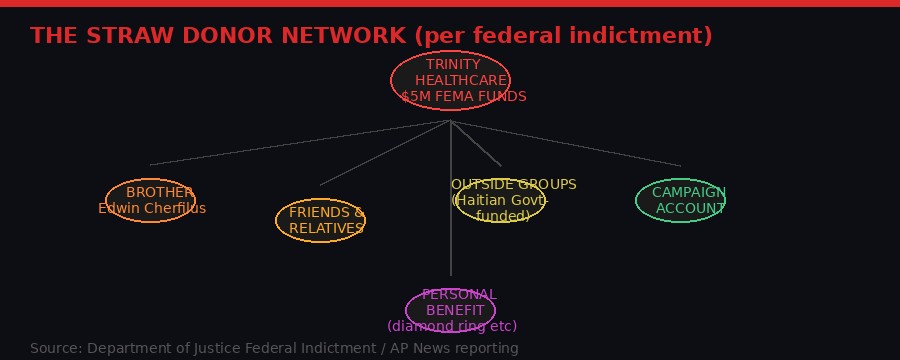
The alleged straw donor network connecting Trinity Healthcare's COVID funds to Cherfilus-McCormick's campaign. Source: DOJ Federal Indictment.
The Ethics Hearing: First Public Proceeding in 15 Years
Thursday's public ethics hearing was remarkable not just for what it found, but for the fact that it happened at all.
The last time the House Ethics Committee held a public hearing against a sitting member was in 2010 - the Rangel censure proceedings, which also that year included a hearing on allegations against Rep. Maxine Waters (D-CA), though that case was ultimately dismissed for lack of evidence. That is sixteen years of the committee operating primarily behind closed doors, with investigations that rarely surface publicly.
Cherfilus-McCormick declined to testify at the hearing, citing her Fifth Amendment right against self-incrimination - a right that protects her given the ongoing federal criminal case. Her attorney appeared on her behalf, making a series of procedural and substantive arguments that largely failed to move the panel.
The hearing grew tense. Barzee clashed repeatedly with committee members. He called the proceedings a "travesty of justice" for not allowing him to cross-examine witnesses or present competing evidence. He argued that denying his client the ability to mount a full defense while she faces parallel criminal charges placed her in an impossible position.
The panel declined to postpone. The committee moved through the hearing, the closed deliberation, and emerged in the early hours of Friday morning with its verdict: guilty on 25 counts.
Two charges were declined: one related to accepting political assistance from an organization connected to Haitian government funding, and one alleging she refused to cooperate with the ethics investigation. The committee evidently found the documentary evidence insufficient on both, even as the overall picture it painted was damning.
"She was entitled to that money. There was nothing nefarious or improper about that." - William Barzee, Cherfilus-McCormick's defense attorney
"It strains credulity." - Rep. Mike DeSaulnier (D-CA), top Democrat on the Ethics Committee, in response to the defense argument
The public nature of the hearing - the committee's decision to open its doors rather than issue a quiet report - signals the gravity of what investigators found. It is a statement by both parties that this case warranted sunlight.
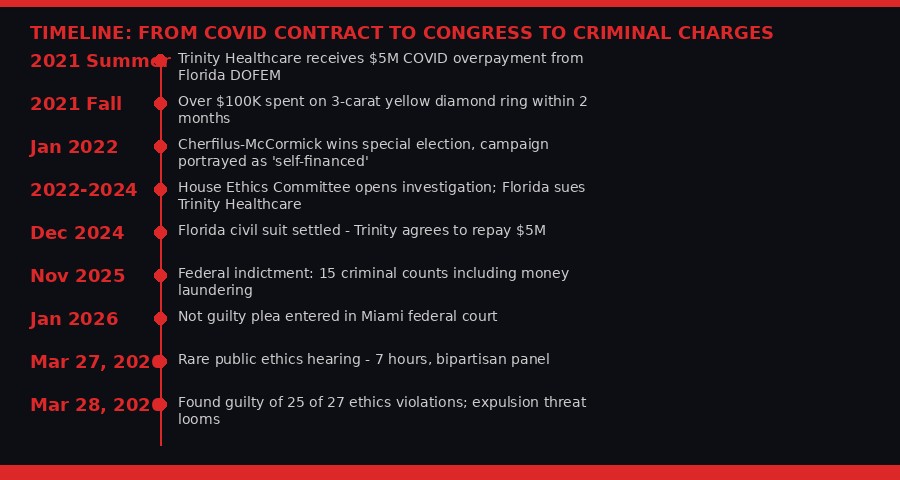
Five years from a questionable overpayment to a potential expulsion vote. Source: AP News / House Ethics Committee.
Can She Be Expelled? The Political Mathematics of Removal
The ethics ruling sets up what could become one of the most consequential votes in a House already operating on razor-thin margins.
Rep. Greg Steube (R-FL) announced Thursday that once the full Ethics Committee issues its formal punishment recommendation in April, he will file a floor resolution to expel Cherfilus-McCormick. Expulsion requires a two-thirds majority - 290 votes in a 435-member House. Republicans currently hold approximately 219 seats. They would need roughly 71 Democratic crossovers to expel her.
The precedent is fresh and instructive. In December 2023, the House expelled Rep. George Santos (R-NY) following a devastating Ethics Committee report. Santos had not yet been convicted of federal charges - the expulsion was based on the committee's findings alone. House Speaker Mike Johnson voted against expulsion at the time, citing concern about the precedent of removing members before criminal conviction. That argument failed: 311 members voted to expel Santos, including 105 Democrats.
Cherfilus-McCormick's case is in several ways more serious than Santos's. The dollar amounts are larger. The harm was arguably more direct - pandemic emergency funds diverted while Americans were dying. The bipartisan vote on the ethics panel suggests both parties can agree on the facts.
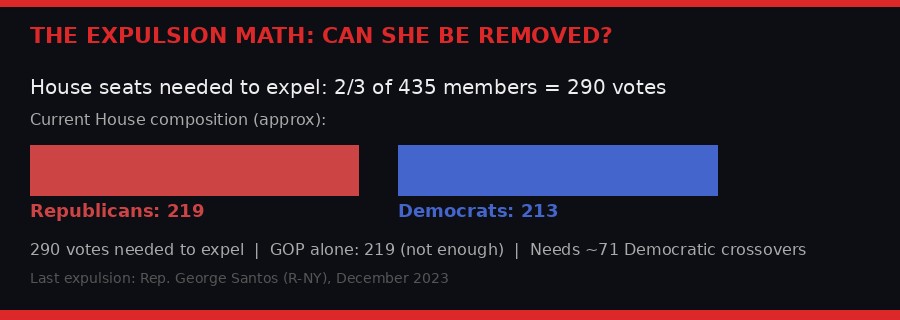
Republicans cannot expel Cherfilus-McCormick alone. They need roughly 71 Democratic crossovers - a politically fraught but potentially achievable threshold given the Santos precedent. Source: House composition data.
Democratic leadership has so far declined to condemn her. House Minority Leader Hakeem Jeffries moved swiftly to strip Cherfilus-McCormick of her position as ranking member of the Foreign Affairs Subcommittee on the Middle East and North Africa after the federal indictment dropped in 2025. But he and other senior Democrats have repeatedly said they want to let the ethics and legal processes play out before making further moves.
"Let's see what happens in the Ethics Committee," California Rep. Pete Aguilar, the third-ranked House Democrat, said as recently as this week.
That process has now concluded. The answer is: guilty. On 25 counts.
Not every Democrat is playing defense. Rep. Marie Gluesenkamp Perez (D-WA), a moderate who has built a political brand around accountability, posted to social media Friday morning: "Since she was found guilty, she should resign or be removed." Her statement may mark the opening of a crack within the Democratic caucus.
The stakes are not just symbolic. Cherfilus-McCormick is running for a fourth term. She represents a district that Democrats need to hold. If she is expelled, a special election would occur - giving Republicans a narrow window in a Democratic-leaning seat. That calculation cuts both ways: expel her and risk the seat temporarily, or keep her and run against a member under criminal indictment through the November elections.
The Santos Parallel
When the House expelled George Santos in December 2023 - before his criminal trial concluded - it established that a sufficiently damning Ethics Committee report could justify removal independent of criminal conviction. Santos faced fraud and identity theft charges. Cherfilus-McCormick faces money laundering of federal disaster funds. The committee reports are different in detail but similar in severity. Speaker Johnson voted against expelling Santos. Whether he would vote to expel a Democrat facing parallel circumstances is a question he has not yet been asked to answer publicly.
Trinity Healthcare and the System That Was Fooled
One aspect of this case that has received less attention than it deserves: the state agency that sent $5 million when it owed $50,000.
The Florida Division of Emergency Management's administrative error was the original crack that prosecutors say the Cherfilus-McCormick family drove a truck through. But that error was not unique. Across the country, pandemic-era emergency programs distributed hundreds of billions of dollars at unprecedented speed, with compliance structures that were deliberately loosened to get money out the door quickly. The result was an explosion of fraud.
The Department of Justice has prosecuted thousands of pandemic relief fraud cases since 2020. But the Cherfilus-McCormick case stands out because the alleged perpetrator used the money not just for personal enrichment - though the diamond ring is certainly that - but to purchase political power. To buy a seat in the institution that oversees the very federal programs from which the money was taken.
That circularity is not incidental. It is the point. Money stolen from the public was used to gain access to the public's legislature. A congressional seat purchased with laundered disaster funds is not just a corruption case. It is a corruption of democratic representation itself.

Prosecutors say Trinity Healthcare distributed COVID funds across a network of family members and associates who then donated to the campaign. | Pexels
The Office of Congressional Ethics had already flagged the anomaly in a January report: Cherfilus-McCormick's personal income in 2021 was more than $6 million higher than in 2020, driven by nearly $5.75 million in consulting and profit-sharing fees received from Trinity Healthcare Services. The sudden enrichment, timed precisely to the COVID overpayment, was the first clear signal that something was wrong.
An unsigned document - whose provenance has never been fully explained - was the only evidence offered to justify the transfer. The Ethics Committee found that explanation inadequate.
What Happens Next: Trial, Punishment, and the November Elections
Three parallel tracks are now converging on Cherfilus-McCormick.
The Ethics punishment: The full House Ethics Committee will reconvene after Congress returns from its two-week April recess. They will determine what formal punishment to recommend to the full House. The spectrum runs from censure - a formal rebuke - to expulsion. Given the scope and severity of the violations found, a censure alone would be widely viewed as inadequate. An expulsion recommendation would trigger the floor vote that Republicans are already demanding.
The federal criminal trial: With 15 counts in play, the federal case is expected to go to trial in 2026. Cherfilus-McCormick has pleaded not guilty and has repeatedly asserted her innocence. Her defense will likely center on the profit-sharing agreement argument and on attacking the government's ability to prove she personally knew the funds were stolen - rather than simply believing she was entitled to them as company profits.
But that argument faces significant headwinds. Text messages entered into evidence during the ethics hearing suggest personal awareness of fund timing. Bank records show the systematic movement of cash through a network of accounts at legally significant moments. Federal prosecutors in the Southern District of Florida have a strong track record on financial crimes cases, and a 242-page investigative report already exists to support their narrative.
The November elections: Cherfilus-McCormick is running for a fourth term representing Florida's 20th District. She has repeatedly said she will not resign. Her attorney says her focus is her constituents. But a member under federal indictment and found guilty of 25 ethics violations faces a fundamentally different electoral environment than she did in previous cycles. Florida's 20th is a safe Democratic seat in normal circumstances. Nothing about this is normal.
"I look forward to proving my innocence. Until then, my focus remains where it belongs: showing up for the great people of Florida's 20th District who sent me to Washington to fight for them." - Rep. Sheila Cherfilus-McCormick, statement after the ethics verdict, March 28, 2026
Whether her constituents share that assessment will be tested. In a district with a large Haitian-American population - a community that has faced its own crises, from the 2010 earthquake to ongoing political instability - the revelation that their representative allegedly accepted money from the Haitian government through intermediaries while steering pandemic funds into her own pocket carries a particular sting.
The Pattern: COVID Fraud and the Price of a Congressional Seat
Step back from the individual case, and a pattern emerges that should disturb anyone who cares about the integrity of emergency relief programs.
The pandemic created the largest emergency spending program in American history. Approximately $4.6 trillion in COVID-related spending passed through Congress between 2020 and 2022. Much of it was distributed at speed, with weakened verification requirements, through state intermediaries like Florida's DOFEM. The GAO estimated that fraudulent claims against just three of the major pandemic programs totaled between $100 billion and $135 billion.
The cases that have come to light involve small-time fraudsters, organized crime rings, and - as in the Cherfilus-McCormick case - individuals who used the proceeds to build political careers. The congresswoman is not the only elected official to face pandemic fraud allegations. She may not be the last.
The House Ethics Committee has now, in a rare public proceeding, documented with bipartisan rigor exactly how it was alleged to work in Florida's 20th. A state agency error. A family company that kept the money. A network of relatives and friends who laundered it into campaign contributions. An election victory. A congressional seat. And a diamond ring along the way.
The committee found her guilty. Federal prosecutors filed 15 counts. The question that remains is whether the House of Representatives - an institution with a documented aversion to ejecting its own members - will follow through on the accountability that the evidence demands.
George Santos was expelled before his trial ended. His crimes were real but relatively contained. The funds here were pandemic relief, meant for a public health emergency, and the alleged purpose was the purchase of democratic representation itself.
The April recess ends on April 27. The Ethics Committee meets shortly after. The vote will tell us what price Congress is willing to accept for a seat.
Get BLACKWIRE reports first.
Breaking news, investigations, and analysis - straight to your phone.
Join @blackwirenews on TelegramThis article is based on public court documents, the House Ethics Committee's published investigative findings, statements by committee members and attorneys entered into the public record during the March 27, 2026 hearing, and AP News reporting. Cherfilus-McCormick denies all wrongdoing and has pleaded not guilty to federal charges. She is entitled to the presumption of innocence in criminal proceedings.