China Fires Back: Beijing Opens Two Trade Probes as Supreme Court Kills Trump's Tariff Weapon
Beijing launched two formal trade investigations against the United States on Friday - a direct counter-move after the Supreme Court struck down Trump's sweeping tariffs and the administration scrambled to rebuild its economic arsenal through Section 301 probes. The trade war everyone thought was cooling just got much hotter.

Cargo containers at port - the arteries of US-China trade, now caught in the crossfire of dueling investigations. (Photo: Unsplash)
BEIJING/WASHINGTON - China's Ministry of Commerce confirmed Friday that it has opened two parallel investigations into US trade practices, targeting American policies that block Chinese goods, restrict technology exports to China, and suppress Chinese green energy competition. The move lands the same week that the Trump administration launched its own Section 301 probes into manufacturing in 16 countries - probes that listed China first.
The timing is not coincidental. After the Supreme Court struck down Trump's emergency-powers tariffs in February - wiping out $175 billion in import taxes in a single ruling - the administration has been racing to rebuild its trade architecture on new legal ground. China is watching every move and matching each one.
"We are concerned that the possible results of such investigations may interfere with or damage the hard-won and stable China-U.S. economic and trade relations," Li Chenggang, China's international trade representative, said at the close of high-level talks in Paris on Monday. Within days, that warning became action. [AP News]
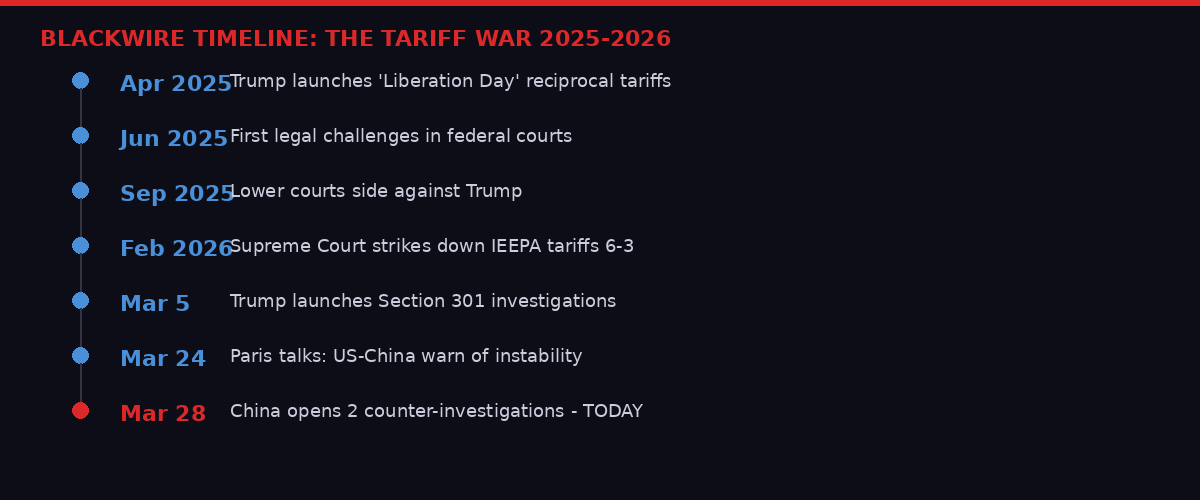
The escalation timeline: from Liberation Day tariffs to Supreme Court defeat to today's Chinese counter-probes. (BLACKWIRE/Graphic)
The Supreme Court's Bombshell and What Came Next

The Supreme Court struck down Trump's IEEPA tariffs 6-3 in February, upending a year of trade policy built on emergency powers. (Photo: Unsplash)
The Supreme Court's February ruling was one of the most consequential trade decisions in generations. In a 6-3 decision written by Chief Justice John Roberts, the court found that Trump's "Liberation Day" tariffs - imposed under the International Emergency Economic Powers Act - were unconstitutional. "The Framers did not vest any part of the taxing power in the Executive Branch," Roberts wrote. [AP News]
The ruling wiped out approximately $175 billion in import taxes that the court struck down and threw into question the fate of another $133 billion-plus in tariff revenues already collected. Companies including Costco have lined up in lower courts demanding refunds. The 10-year economic impact of the now-invalidated tariffs had been estimated at $3 trillion.
Trump responded with fury and defiance in equal measure. He called the six justices who ruled against him "fools and lapdogs" who were "very unpatriotic and disloyal to our Constitution." He signed an executive order the same day imposing a 10% global tariff under a different statute - one legally capped at 150 days, expiring July 24. Then he turned to Section 301.
"Their decision is incorrect. But it doesn't matter because we have very powerful alternatives."
- President Donald Trump, following the Supreme Court ruling [AP News]
US Trade Representative Jamieson Greer announced the Section 301 investigations on March 5, examining excess industrial capacity, government subsidies, and labor suppression in 16 trading partners. China leads the list. A second Section 301 probe targets goods made with forced labor, covering dozens of countries. The administration has also floated additional probes covering digital service taxes, pharmaceutical pricing, and ocean pollution.
Senate Republican leader Mitch McConnell, in a rare rebuke, cheered the court's decision. "Congress' role in trade policy, as I have warned repeatedly, is not an inconvenience to avoid," he said. Even former Vice President Mike Pence praised the ruling. The trade war, which Trump built on executive authority, suddenly had a constitutional ceiling.
What China Is Actually Probing

Beijing's Ministry of Commerce launched both probes on Friday in direct response to US Section 301 investigations. (Photo: Unsplash)
China's two new investigations are not symbolic. They are legal frameworks that can produce trade remedies - tariffs, restrictions, or retaliatory measures - with real teeth.
The first probe examines US policies that restrict Chinese goods from entering the American market. This covers the entire architecture of existing US tariffs, export controls, and sanctions that have accumulated across multiple administrations. It also targets US restrictions on the export of advanced technology products to China - everything from semiconductor equipment to AI chips. This gives Beijing formal grounds to respond to any escalation in chip export controls.
The second investigation targets barriers to Chinese green energy exports. This is a direct challenge to US policies that have effectively shut Chinese electric vehicles, solar panels, and battery technology out of American markets. The green energy angle is strategically important: Chinese companies like BYD now outsell Tesla in global markets, and Washington has built increasingly high walls to keep them out of the US. [AP News]
Both probes carry timelines. They are expected to run six months, with an optional three-month extension. That brings China's findings to September or October 2026 - deep into US midterm election season. That calendar may not be accidental.
China's Two New Trade Probes at a Glance
- Probe 1 - Market Access: Examines US policies restricting Chinese goods from entering the US market and blocking exports of advanced technology to China
- Probe 2 - Green Energy: Investigates barriers to Chinese green energy exports - EVs, solar panels, battery technology
- Timeline: 6 months, extendable by 3 months - results landing in US midterm election season
- Legal basis: China's Foreign Trade Law and Anti-Foreign Sanctions Law
- Goal: Build formal legal foundation for retaliatory trade measures if US tariffs escalate
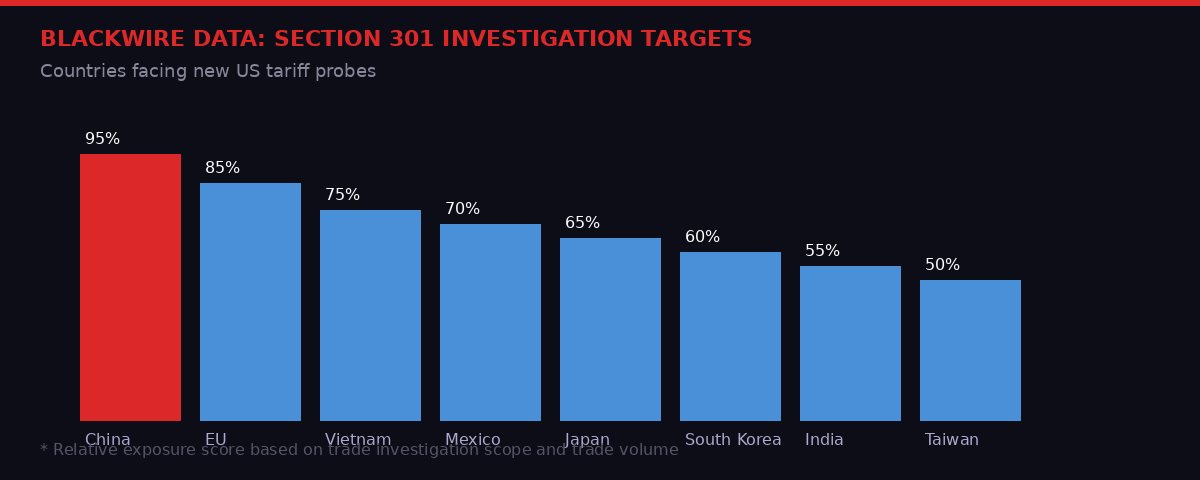
Relative exposure of countries targeted in Trump's Section 301 manufacturing probe - China leads the list. (BLACKWIRE/Graphic)
The Paris Warning That Went Unheeded

Paris hosted high-level US-China trade talks last week - a meeting Treasury Secretary Bessent called "constructive." Beijing saw it differently. (Photo: Unsplash)
Monday's Paris talks were meant to stabilize things. Treasury Secretary Scott Bessent led the US delegation. China's trade representative Li Chenggang led Beijing's side. The stated goal: lay groundwork for a Trump visit to Beijing, originally planned for around April 9, that has since been delayed due to the Iran war.
Bessent came out calling the talks "constructive" and noting they showed "the stability in the relationship." He added: "The purpose of these meetings is to prevent any retaliation." [AP News]
Li's read of the same meeting was far more guarded. China, he said, had expressed "serious concern" about the Section 301 investigations and warned they could "interfere with or damage the hard-won and stable China-U.S. economic and trade relations." He said both sides "agreed to make efforts to keep the tariffs stable."
Within days of that meeting, Beijing filed its counter-probes. Either the talks failed, or the probes were already in motion before the talks concluded. Either possibility is concerning. The diplomatic channel that Bessent claimed as a success did not prevent China's escalation - it may have only delayed it by a few days.
US Trade Representative Greer tried to project calm after Paris. "We started these talks, really, by giving them a preview of what we're doing on U.S. trade policy as we adjust to the Supreme Court," he told journalists. "We don't want to prejudge them, and we had a good conversation with our counterparts about that process." [AP News]
Beijing heard that preview. And then it responded.
The Iran War Complicates Everything

Oil tankers navigating the Persian Gulf - China needs Iranian oil, the US needs Chinese cooperation to reopen the Strait of Hormuz. (Photo: Unsplash)
The trade confrontation is unfolding against the backdrop of the Iran war, now entering its second month. The Strait of Hormuz remains largely closed to traffic. Oil prices have soared. The global economy is absorbing dual shocks: the ongoing conflict and the unresolved tariff architecture that Trump is scrambling to rebuild.
China sits at the center of both problems. Beijing is one of Iran's largest oil customers and has refused to join any coalition against Tehran. It has demanded that the US not drag it into the conflict. At the same time, Trump had been planning a high-profile visit to Beijing - his first as a sitting president since 2017 - that was supposed to signal a new phase of managed competition.
That visit is now delayed indefinitely. Bessent tried to frame any postponement as logistical rather than diplomatic. "If the president's visit is postponed, it would have nothing to do with the Chinese making a commitment to the Straits of Hormuz," he insisted. "The postponement, if it happens, would be because the commander in chief of the United States military believes that he should stay in the United States while this war is being prosecuted." [AP News]
The optics, however, tell a different story. A planned summit delayed by a war in which China backs the other side's key ally, happening simultaneously with dueling trade investigations - this is not the "stability in the relationship" Bessent was describing. It is structural fragility wearing a diplomatic mask.
And the economic stakes of the Hormuz closure keep rising. Every week the strait stays closed, oil prices climb. Every week prices climb, Trump's political position weakens. His presidency was built on delivering lower costs to American consumers. Instead, Americans are paying more for gas, for goods, for groceries - and the Supreme Court has just told him his central economic weapon was illegal.
What Section 301 Actually Means - And Its Limits

Section 301 investigations were a primary tool of Trump's first term - but their 1974-era legal framework comes with strict procedural requirements. (Photo: Unsplash)
Section 301 of the Trade Act of 1974 gives the US Trade Representative authority to investigate "unreasonable or discriminatory" trade practices by foreign governments and impose tariffs or other remedies. Trump used it aggressively in his first term, and those tariffs survived legal challenge. That is why his team is reaching for it again now.
But Section 301 has procedural requirements that the emergency-powers approach bypassed. There must be investigations. There must be public comment periods. There must be findings. The process takes months - potentially longer than the 150-day emergency tariff that expires July 24. Greer acknowledged the administration is "keying off" the new investigations based on that deadline and wants to bring "potential options" to Trump "as soon as possible." [AP News]
Even if the investigations move quickly, they will almost certainly face their own legal challenges. The Supreme Court's February ruling placed new limits on executive trade power. Challengers will immediately test whether Section 301, used this broadly, passes the same constitutional scrutiny that IEEPA did not. There is no guarantee it does.
Meanwhile, the trade frameworks that Trump negotiated with the EU, Japan, South Korea and others - the 15% rates that replaced the IEEPA tariffs before the court struck those down too - are in legal limbo. Greer said those frameworks "stand on their own" and are separate from the new investigations. Whether courts agree remains to be seen.
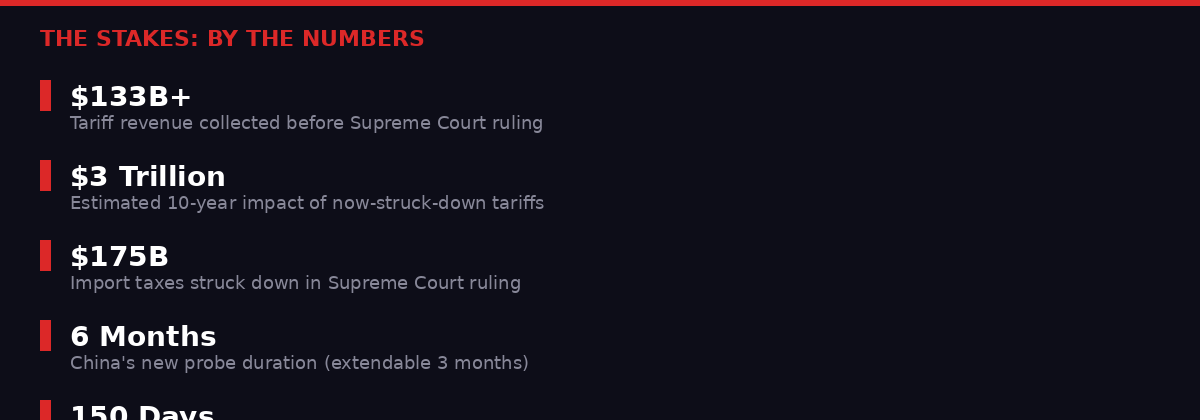
The scale of what is at stake in the US-China trade confrontation. (BLACKWIRE/Graphic)
The Political Calculus Going Into Midterms

Midterm elections loom in November - and the trade war timeline now collides directly with campaign season. (Photo: Unsplash)
The political calendar makes all of this more explosive. Midterm elections are in November 2026. China's investigation results land in September or October. Trump's emergency 10% tariffs expire July 24. Section 301 findings could take until late 2026 to produce formal tariff recommendations. The entire trade architecture is in motion during an election cycle.
Trump's tariffs have never been popular. An AP-NORC poll taken after Trump announced his worldwide Liberation Day tariffs found that 76% of Americans believed the policies would increase consumer goods prices - a damaging finding for a president elected on an inflation mandate. Another January poll found roughly 6 in 10 Americans said Trump had gone too far on tariffs. [AP News]
Democrats have already built a campaign theme around "tariff refunds" - the billions in taxes collected before the Supreme Court struck down the IEEPA tariffs. The court majority pointedly did not rule on whether refunds were required, leaving that question in lower courts. Kavanaugh's dissent warned the process could be "a mess." That mess will play out in campaign ads.
For Trump, the challenge is to rebuild a trade policy that achieves his economic nationalism goals while surviving constitutional scrutiny, managing China's escalating counter-probes, and not handing Democrats ammunition on prices heading into November. Those are not compatible objectives. Something has to give.
Republican lawmakers who were already uneasy with the tariffs - at least seven senators have publicly expressed concern - now face a trade landscape where the president's preferred tools have been struck down and he is reaching for instruments with more procedural friction and less certainty. McConnell's statement was unusually pointed: "Its path forward is crystal clear: convince their representatives under Article 1."
What the Investigations Mean for Businesses on Both Sides

Importers, exporters, and multinationals operating across the US-China supply chain face months of uncertainty as dual investigations proceed. (Photo: Unsplash)
For companies caught in the crossfire, the picture is grim. Importers who paid tariffs under the now-struck-down IEEPA framework are lined up in courts seeking refunds, with no certainty about timing or outcome. Companies that built pricing models around the post-IEEPA 10% emergency tariff now face its July 24 expiration. Companies planning China operations must factor in Beijing's new probes potentially producing additional retaliatory barriers.
Chinese EV makers, solar manufacturers, and battery companies face continued exclusion from the US market - which is explicitly what China's green energy probe is designed to challenge. The probe itself will not produce results before late 2026, but it builds the legal record for future action. For Chinese companies, it is a signal that Beijing intends to push back hard on the exclusions that have kept them out of North American markets.
US tech companies operating in China have the most to lose from the technology transfer provisions of China's first probe. Restrictions on "advanced technology products" - semiconductors, AI hardware, chip-making equipment - have been tightening steadily. China's investigation positions those restrictions as actionable trade violations, creating grounds for Beijing to impose its own restrictions or tariffs on US tech firms in China.
Companies like Apple, which relies on Chinese manufacturing while selling into both markets, face the prospect of being caught in crossfire from both sides simultaneously. The Biden-era semiconductor restrictions, which the Trump administration has maintained and expanded, are precisely the kind of "advanced technology export restrictions" that China's probe is targeting.
The Next Six Months: Three Scenarios

The trajectories of the US-China trade war will shape the global economy through the end of 2026 and beyond. (Photo: Unsplash)
The trade confrontation could resolve in several ways over the next six months, none of them clean.
Scenario one: managed de-escalation. Trump visits China, eventually, and the two sides negotiate a truce - a framework that pauses the investigations on both sides in exchange for market access commitments. This is the scenario Bessent was gesturing at in Paris. It requires the Iran war to de-escalate, Trump's domestic political position to stabilize, and Xi Jinping to offer enough for Trump to claim victory. All three conditions are uncertain.
Scenario two: parallel escalation. Both sides' investigations conclude with findings that justify new measures. The US imposes Section 301 tariffs in late 2026. China imposes its own remedies on US goods and tech companies. Trade between the two economies fragments further. This is where the trajectory currently points if diplomacy fails.
Scenario three: legal paralysis. Trump's Section 301 tariffs face immediate court challenges and are blocked by injunction before they take effect. The administration is left with only the 150-day 10% tariff, which expires July 24, and no viable replacement before the midterms. China's probes proceed but produce no response because there is nothing to respond to. Trade policy becomes a constitutional and legal standoff.
What is clear is that the era of Trump unilaterally reshaping global trade through executive decree is over. The Supreme Court said so in February. China heard it too. The game now requires building through institutions, process, and law - exactly the constraints that the tariff strategy was designed to bypass.
Beijing has filed its investigations. They have six months. So does the Trump administration's 10% tariff. The calendar runs out at the same time. What happens when both expire will define the economic environment heading into a pivotal American election.
Get BLACKWIRE reports first.
Breaking news, investigations, and analysis - straight to your phone.
Join @blackwirenews on Telegram