Coinbase's Seed Phrase Trap: Security Researchers Call It an Official Phishing Template
Coinbase is telling Commerce users to enter their 12-word seed phrases on a live web page ahead of a March 31 shutdown. Blockchain investigators say it's the same workflow scammers use - except this time, it's official.

Coinbase's Commerce wallet shutdown has created a security nightmare for crypto merchants. Photo: Pexels
Coinbase is shutting down its Commerce payment product on March 31, 2026. That part is routine. What is not routine is the recovery flow the company built for merchants who need to move their funds before the deadline.
The flow asks users to open their Commerce dashboard, navigate to Settings and Security, reveal their 12-word seed phrase, and paste it into a withdrawal tool at withdraw.commerce.coinbase.com. That is the sequence that has security researchers furious.
A seed phrase is not just a password. It is the master key to every asset in a self-custody wallet. Whoever has it controls everything. Enter it on any page - official or not - and the risk window is open. Enter it on a page that even resembles Coinbase's branding, and you have trained yourself to trust an attack vector that scammers have used to drain billions.
The contradiction is blunt. Coinbase's own wallet documentation tells users: "Never paste it into any website." Coinbase's own help pages say the company will never ask for a recovery phrase. Coinbase's own security warnings call any seed-phrase request the opening move of a scam.
Then Coinbase built a page asking for exactly that.
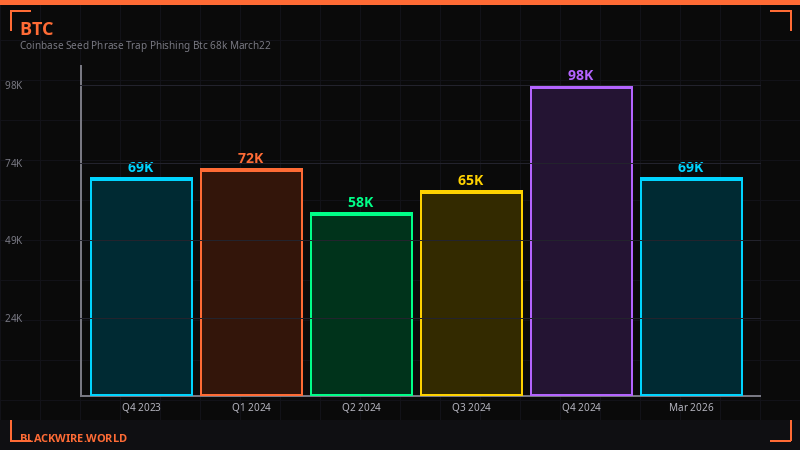
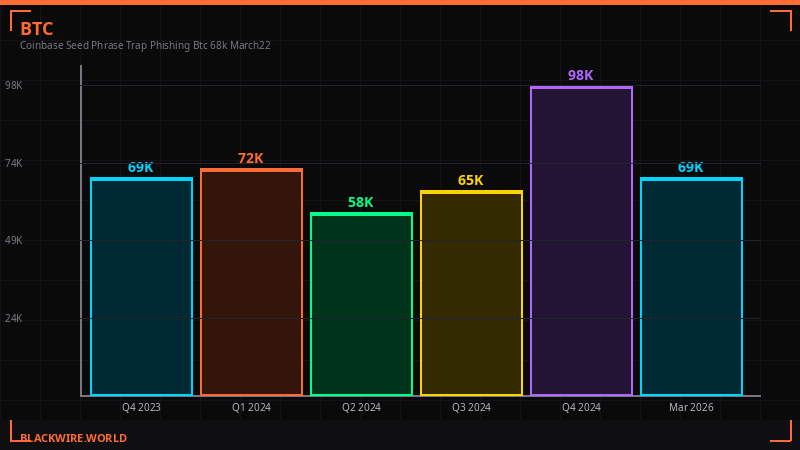
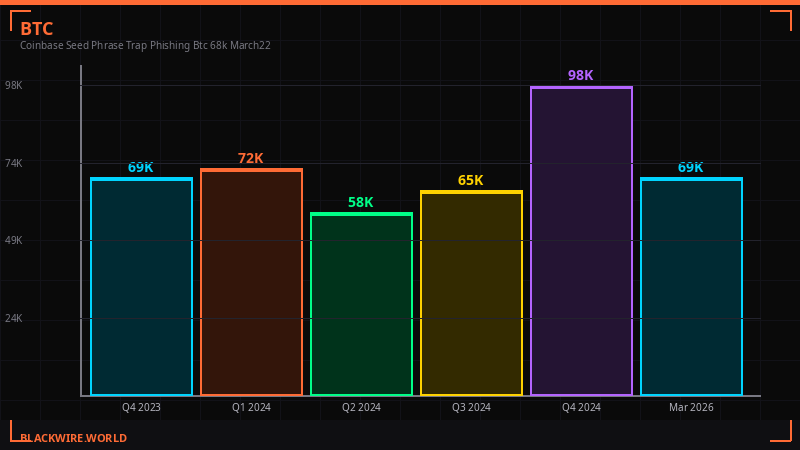
Crypto markets on March 22, 2026 - BTC $68,448, down 3.04% on the day. The Coinbase security story landed into an already bruised market.
The Flow That Broke the Security Rule
The context matters. Coinbase's Commerce product is a merchant payment tool that lets businesses accept crypto. It holds funds in self-custodial wallets - meaning Coinbase does not control the private keys. When Coinbase shuts the product down, users with funds in those wallets need to move them manually.
For merchants who backed up their wallet to Google Drive, Coinbase's transition guide explains the exact steps. Go to the Commerce dashboard. Open Settings and Security. Click to reveal the 12-word seed phrase. Then use the withdrawal tool at withdraw.commerce.coinbase.com to move funds to another address.
The company says this is especially important for merchants who received Bitcoin or other UTXO-based assets, because those balances may be harder to surface in standard wallet software without the original seed.
The technical explanation is sound. Coinbase genuinely cannot access the funds because it does not hold the keys. The only way to move money out of a self-custody wallet is to use the seed phrase. The company is not lying.
But the security implication of what the page teaches users to accept is the problem that every researcher who looked at it immediately identified.
"While the link is from the official Coinbase website, directly asking users to transmit their mnemonic phrase to verify assets is extremely foolish." - 23pds, Chief Information Security Officer, SlowMist
SlowMist founder Yu Xian went further. He said he was so puzzled by the page that he initially wondered whether the Coinbase subdomain itself had been compromised. That is the reaction of a professional who has spent years analyzing phishing attacks - he looked at an official Coinbase page and thought it might be a hack.
ZachXBT, the blockchain investigator who has tracked hundreds of millions in crypto fraud, put the systemic risk into one sentence:
"So basically Coinbase has an official page live threat actors can use to target Coinbase users via seed phrase social engineering if they wanted?" - ZachXBT, blockchain investigator, via X
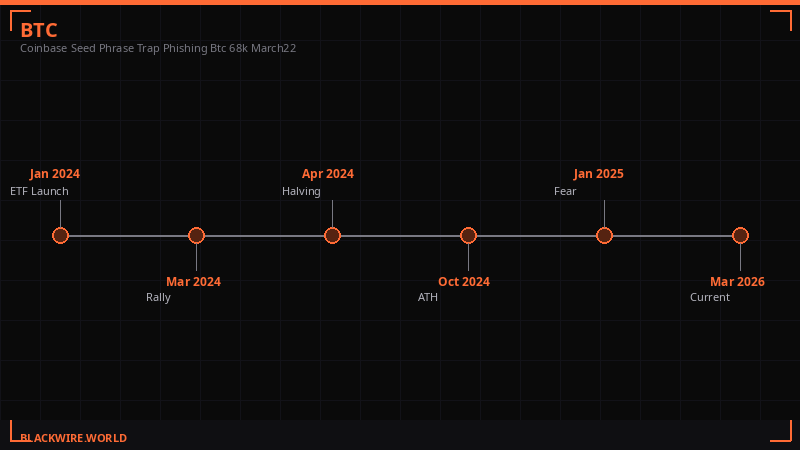
Coinbase's security incident history - from the 2021 account breach to the 2025 social engineering campaign and now the 2026 seed phrase controversy.
The Phishing Template That Coinbase Built
The SlowMist team identified a second, more specific problem beyond the conceptual contradiction. The Commerce recovery page reportedly has a flawed sitemap configuration that would allow an attacker to clone the front end and deploy a near-identical page on a lookalike domain.
That is not a hypothetical threat. It is the exact mechanism behind the most effective crypto phishing operations running today. The attack chain looks like this:
A scammer registers a domain that looks like coinbase-commerce-withdraw.com or withdraw-coinbase.io. They copy the visual layout of Coinbase's legitimate withdrawal page. They send a targeted email to Coinbase Commerce merchants warning them about the March 31 deadline - the same deadline that is real and widely known. The email links to the fake page. The merchant, already primed by Coinbase's legitimate communications to expect this flow, enters their seed phrase. The wallet is drained.
Every component of that attack is now easier because Coinbase built the original. The urgent deadline is real. The flow is documented on Coinbase's official help pages. The expectation that seed-phrase entry is safe in this context has been established by the company itself.
Security researchers describe this as "social engineering scaffolding" - when a company's own legitimate communication creates the behavioral and psychological conditions that make its users easier to attack.
What Every Coinbase Commerce User Must Know Right Now
- Never click email links directing you to any seed-phrase flow. Navigate to coinbase.com directly and manually.
- Check the domain carefully - the legitimate tool is at withdraw.commerce.coinbase.com. Any variation is fake.
- Coinbase will never email you asking for your seed phrase. If an email says it will, it is a scam regardless of how convincing it looks.
- Deadline is March 31, 2026. If you have funds in a Commerce wallet, move them before that date using only the official Coinbase website.
- UTXO-based assets (Bitcoin, Litecoin) require extra care - they may not appear in standard wallet imports without the original seed phrase used correctly.
The $300 million annual figure for Coinbase-related social engineering losses comes directly from ZachXBT's research, published in 2025. That number represents the damage from attacks that were less sophisticated than what the Commerce recovery flow now enables - attacks that did not have an official Coinbase page to point to as a behavioral template.

The Coinbase Commerce recovery flow has introduced a new attack vector that researchers say legitimizes seed-phrase entry workflows for scammers. Photo: Pexels
A History That Makes This Worse
If Coinbase had a clean security track record, the Commerce situation would still be a serious design mistake. But Coinbase's breach history hangs over every new security controversy the company generates.
In May 2025, Coinbase disclosed that cybercriminals had bribed overseas support agents to steal customer data and use it for social-engineering attacks. The company said fewer than 1% of monthly transacting users were affected - a number that sounds small until you consider Coinbase's user base runs into the tens of millions. The breach gave attackers verified customer lists, phone numbers, and account details they used to impersonate Coinbase staff in calls and messages.
Brian Armstrong, Coinbase's CEO, pledged to reimburse customers who were tricked into sending funds to attackers as a result of that breach. The company did not disclose the total cost.
Before that, Coinbase's 2024 annual report filed with the SEC acknowledged a 2021 breach in which third parties obtained login credentials and personal information for at least 6,000 customers by exploiting a vulnerability in the account recovery process. The company reimbursed impacted customers approximately $25.1 million in that incident alone.
Three significant security incidents in five years is not an anomaly. It is a pattern. And that pattern is now the backdrop against which the Commerce seed-phrase controversy lands.
Coinbase Security Record - Key Incidents
There is a question worth asking: at what point does a pattern of security failures constitute a structural problem rather than a series of unfortunate events?
Coinbase has the engineering resources, security talent, and legal budget of a multi-billion-dollar public company. It had months to design the Commerce shutdown. Multiple teams reviewed the migration flow before it went live. The decision to build a seed-phrase entry workflow on a web page was not an oversight by a junior developer - it was a deliberate design choice made by a company that had already experienced $25.1 million in breach liability and $300 million in annual user losses from the same category of attack.
Macro Backdrop: BTC at $68k, Fed Hike Bets Rising
The Coinbase security story lands into a crypto market that is already under pressure from every direction.
Bitcoin was trading at $68,448 on Sunday, down 3.04% on the day and down 4.54% over the past week. Ethereum fell 3.69% to $2,076. Every major asset in the top 10 was red. The TRUMP meme token - which carries political and sentiment baggage beyond pure market dynamics - dropped 5.18% to $3.17, now down more than 20% over the past week.
The macro picture driving those moves is not getting easier. Brent crude surged above $109 last week as Middle East tensions escalated around the Strait of Hormuz, which handles approximately 20% of global oil and LNG supply. US crude touched $98. The EIA's baseline assumption that Brent eases below $80 by Q3 is now widely viewed as too optimistic.
That oil price shock fed directly into Fed rate expectations. Two days after the Fed held its target range at 3.50%-3.75% on March 18, Bloomberg-based pricing climbed above 60% odds of a rate hike by October. CME FedWatch put year-end hike odds at roughly 40%. The odds of a rate cut in April fell from 17% in February to exactly 0%.
Fed rate expectations have inverted completely - from cut bets to hike bets within weeks, driven by $109 Brent crude and sticky PCE inflation. Source: CME FedWatch, Bloomberg.
The 10-year Treasury climbed to roughly 4.37%. The 30-year reached its highest since September. The S&P 500 headed into its fourth straight weekly loss. Global equity funds shed $20.3 billion in the week through March 18, with $24.78 billion leaving US equity funds alone. Money market funds absorbed $32.57 billion globally - cash, yielding close to 4%, is actively pulling capital out of risk assets.
Bitcoin faces the scenario that CryptoSlate's macro analysts described as its "most hostile environment of all" - moderate inflation that is sticky enough to keep the Fed tight, but not severe enough to force emergency cuts that would send money flooding back into risk assets. In this corridor, Bitcoin trades like a high-beta tech stock rather than a digital gold hedge.
Spot US Bitcoin ETF flows confirmed the sentiment shift in real time. After $199.4 million in inflows on March 17, the combined ETF complex saw $253.7 million in outflows across March 18-19, per Farside Investors data.
Britain's Bond Panic Adds Another Layer
Beyond the United States, the macro environment is fracturing in ways that complicate the global picture for Bitcoin even further.
UK public sector net borrowing hit £14.3 billion in February - up £2.2 billion from a year earlier and the second-highest February reading since records began in 1993. Total public sector net debt stands at £2.88 trillion, equivalent to 93.1% of GDP. The Bank of England held its Bank Rate at 3.75% and warned that the latest energy shock would push inflation back up to 3% to 3.5% over the next couple of quarters while raising household fuel and utility costs.
The immediate consequence for UK households is arithmetic. The Bank of England's own data showed the average rate on household instant-access deposits at 2.02% in January. Against the Bank's own near-term CPI forecast of 3% to 3.5%, that means cash is running below inflation by roughly 1 to 1.5 percentage points. The purchasing power of cash savings is declining in real terms, guaranteed.
UK fiscal indicators paint a grim picture: 93.1% debt-to-GDP, 1.8 million mortgages resetting, and gas futures pointing to a 35-40% Ofgem cap increase. Source: ONS, Bank of England.
The household pain channel is also accelerating. UK Finance estimates that approximately 1.8 million fixed-rate mortgages will expire in 2026. The Office for National Statistics already showed inflation running at 3.7% for mortgagors in Q4 2025 - before the Bank's latest warning that energy costs would push prices higher still.
The argument here is not that UK savers are about to flood into Bitcoin. The argument is subtler. When the traditional safe havens - government bonds, cash savings accounts - are visibly eroding real purchasing power, the conversation about alternative stores of value changes in tone. Bitcoin gains relevance not because it is a perfect substitute for gilts, but because the case for automatically trusting the sovereign stack is getting harder to make.
That argument runs into the same macro headwind that Bitcoin faces in the United States. A credible Bitcoin hedge narrative works when central banks are trapped between inflation and financial repression - when easing looks inevitable even if delayed. In 2026, that argument is building. But in the near term, the oil shock and tightening financial conditions are winning.
SEC Clarity That Nobody Traded
The week produced one significant piece of news that should have been bullish and wasn't - the SEC and CFTC joint guidance that gave crypto its clearest regulatory framework in years.
SEC Chairman Paul Atkins announced a token taxonomy that separates digital commodities, digital collectibles, digital tools, payment stablecoins, and digital securities. The agency explicitly acknowledged that most crypto assets are not themselves securities. The release addressed staking, airdrops, mining, and wrapped versions of non-security assets - giving the industry a broader operational map than it has had under federal law in its entire existence.
Under any normal conditions, that would have been a catalyst. Exchanges could now list tokens with more confidence. Founders could structure launches with clearer legal baselines. The discount that US regulatory uncertainty attached to crypto valuations should have compressed.
Bitcoin barely moved.
The explanation from CryptoSlate's analysis is precise: traders have moved on from the question of whether this SEC is friendlier than the last one. They are now asking whether the rules will survive the next administration, survive litigation, and survive Congress. Regulatory goodwill from a single agency - no matter how welcome - does not answer those questions.
Even Citigroup cut its 12-month targets for both Bitcoin and Ethereum, citing stalled US market structure legislation. The CLARITY Act negotiations produced what sources described to Politico as "an agreement in principle," but the yield clause that could unravel the deal remains contested.
The market's non-reaction to genuine regulatory progress tells you something important about where crypto's risk premium is currently priced. The upside from regulatory clarity has already been partially absorbed. The uncertainty about whether that clarity holds is not.

SEC clarity on crypto asset classification arrived this week but markets barely reacted - traders now want Congressional legislation, not agency guidance. Photo: Pexels
What the Coinbase Situation Actually Signals
Pull back from the immediate security controversy and the Coinbase Commerce situation signals something larger about how the industry has developed.
Coinbase is the largest US crypto exchange, a publicly listed company under SEC oversight, and one of the central institutions through which mainstream America holds digital assets. When Coinbase's own migration documentation creates a workflow that security experts describe as an official phishing template, the problem is not just technical. It is cultural.
The crypto industry has spent years arguing that it is maturing - that it has built the compliance infrastructure, security practices, and institutional credibility to deserve mainstream adoption. The Commerce seed-phrase situation is evidence that those claims are uneven at best.
A company that has lost $300 million in annual user funds to social engineering should have had a forensic focus on any user-facing flow that involves seed phrases. The fact that a migration guide exposing a 12-word master key on a live web page was apparently designed, reviewed, and published without triggering an internal security escalation is a governance failure, not just a product mistake.
The deadline is March 31 - nine days away. Coinbase has not issued a public response to the criticism from SlowMist, ZachXBT, and 23pds as of publication. If the company updates the migration flow before the shutdown, the immediate risk window narrows. If it does not, the phishing attacks that security researchers are predicting will begin as soon as the first scammer spins up a clone of the recovery page.
In the meantime, anyone with funds in a Coinbase Commerce wallet needs to move them before March 31 using only the official site, accessed directly - not through any email link, not through any search result, not through any message from anyone claiming to be Coinbase support.
That is not a new rule in crypto. It has always been the rule. The problem is that Coinbase just made it much easier to break.

Security researchers say the Coinbase Commerce recovery page provides a behavioral template that scammers can clone on lookalike domains. The March 31 deadline creates urgency that makes the attack more effective. Photo: Pexels
Market Outlook: Watching the Same Three Variables
For the rest of March and into April, every crypto trader is watching the same three variables that have driven price action for the past month.
First, oil. Brent crude at $109 is not a sustainable backdrop for the Fed to hold rates steady, let alone cut. If Middle East tensions ease and the Strait of Hormuz disruption scenario recedes, oil falls, rate hike expectations soften, and risk assets recover. If the situation escalates, WTI toward $110 and Brent above $120 becomes the working scenario - and in that environment, risk assets face sustained pressure regardless of how friendly the regulatory environment is.
Second, US core PCE. The Fed's March decision to hold was accompanied by an updated PCE forecast of 2.7% for 2026 - above target but not yet a crisis. Bank of America has put the threshold for a credible hike case at core PCE above 3.2%, combined with unemployment near 4.5% and oil in the $80-100 range. If the next print comes in hot, the hike bets that are already above 40% could move higher fast.
Third, Congressional progress on stablecoins and market structure. The CLARITY Act agreement-in-principle is fragile. If the yield clause breaks the deal, the regulatory window that the SEC and CFTC opened this week will be less durable than markets need it to be. If Congress moves, even slowly, the discount on US crypto exposure compresses.
Bitcoin at $68,448 is in a position that traders describe as "not broken but not building" - holding above the $65,000 level that has been key support for weeks, but failing to recover the $74,000 zone that marked the March high. The ETF flow data suggests institutional appetite is present but not aggressive. Long-term holders have not capitulated. Short-term traders are positioned defensively.
The Coinbase security story is a distraction in the price sense - it does not change the macro variables that are actually moving markets. But it is not irrelevant. Exchange-level trust incidents affect retail sentiment at the margin, and retail sentiment is exactly what Bitcoin needs to recover above $70,000 with conviction.
Market Snapshot - March 22, 2026
The bottom line: crypto faces a hostile macro setup in the short term, a fragile regulatory window in the medium term, and a structural security problem at its largest US exchange that is nine days away from becoming a live phishing campaign. None of these individually break the market. Together, they explain why the path above $70,000 is not yet clear.
Watch oil. Watch the next PCE print. And if you have money in a Coinbase Commerce wallet, get it out now - through the official site, accessed directly, with nobody helping you do it.
Get BLACKWIRE reports first.
Breaking news, investigations, and analysis - straight to your phone.
Join @blackwirenews on TelegramSources: CryptoSlate, SlowMist (Yu Xian / @evilcos, 23pds / @im23pds), ZachXBT (@zachxbt), Coinbase Help Center, Coinbase 2024 Annual Report (SEC EDGAR), Bank of England Monetary Policy Minutes March 2026, ONS Public Sector Finances February 2026, UK Finance Mortgage Market Forecasts, EIA Short-Term Energy Outlook, CME FedWatch Tool, Farside Investors Bitcoin ETF Flow Data, IMF Working Paper on Crypto Cycle and US Monetary Policy (2023), BIS Quarterly Review March 2026, Reuters.