Democracy's Crypto Purge: UK Bans It, Canada Follows, and Bitcoin Bleeds Through a $17 Trillion Meltdown
Two Western democracies moved this week to keep crypto out of politics - as the asset class bled through one of the worst macro environments since 2022.
Two governments. One week. One message: crypto is a democratic threat. As Bitcoin slid below $67,000 and $300 million in leveraged longs got torched, Britain and Canada quietly rewrote their election rules - banning digital asset donations before the next vote. This is how the week ended.
The timing was too clean to ignore. On March 25, UK Prime Minister Keir Starmer imposed an immediate moratorium on cryptocurrency donations to political parties, citing risks of hidden foreign money flowing through digital assets. Three days later, Canada's federal government introduced Bill C-25 in the House of Commons - the Strong and Free Elections Act - doing the exact same thing under different flags.
Meanwhile, Bitcoin dropped to two-week lows. The Nasdaq 100 entered correction territory. Oil held above $100. The Federal Reserve, which the market believed would be cutting rates by now, is instead watching inflation expectations rebuild and doing nothing. A 40% probability has emerged that no cuts happen in 2026 at all. And across the global mining sector, companies burning $80,000 to produce each bitcoin are quietly converting their data centers to run AI instead.
This was the week that clarified where crypto stands in 2026: politically suspect in the West, financially stressed at the protocol level, and structurally transforming at the infrastructure layer. The numbers, policies, and deals tell the story.
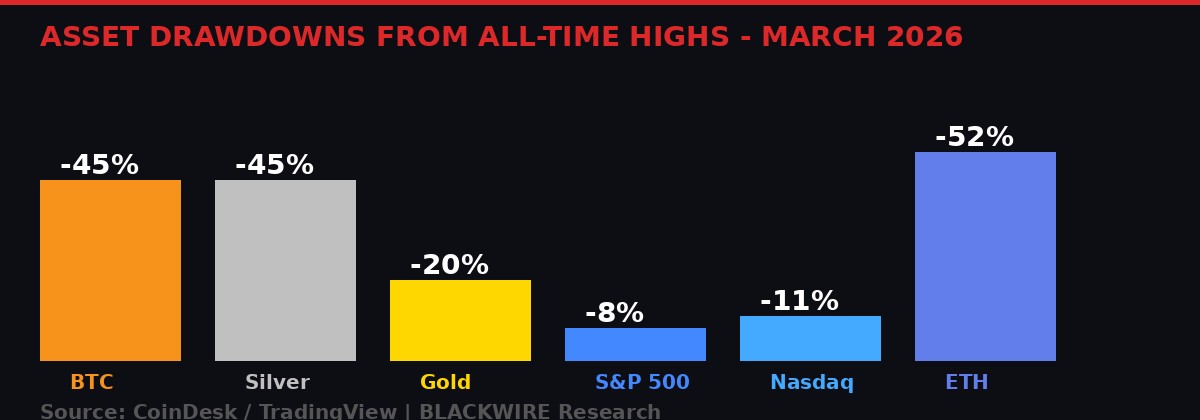
Bitcoin and Silver are both down 45% from peak. ETH is down 52%. The Nasdaq has just entered correction territory at -11%. Gold is holding better at -20%.
The UK Move: Starmer Bans Crypto from Politics Immediately
On March 25, the UK government did not announce a consultation period. It did not issue a green paper. It imposed an immediate moratorium on cryptocurrency donations to political parties - effective the same day. The ban covers all sizes, all coins, all parties.
The trigger was the Rycroft Review, commissioned by the government to assess foreign interference risks in British politics. Former senior civil servant Philip Rycroft recommended the pause, framing it as regulation needing to catch up with technology rather than a permanent exclusion. But the practical effect is the same: the moment the Representation of the People Bill passes Parliament, crypto donations become a criminal matter with penalties up to twice the value of the contribution plus £100,000 for corporate violations.
"I wasn't here to look out for the interests of any political party. I was here to look out for the interest of our democratic processes." - Philip Rycroft, author of the Rycroft Review
The target, barely disguised, was Reform UK and its leader Nigel Farage. Farage's party had emerged as the clear polling frontrunner heading into the next general election. The Rycroft Review raised concerns about the difficulty of tracing crypto donations back to their sources - specifically whether foreign money could flow through digital wallets to domestic parties with minimal detection.
Members of Reform UK walked out of Parliament during the announcement. Starmer twisted the knife, suggesting publicly that Farage "would say anything, no matter how divisive, if he is paid to do so."
The ban captures the specific political tension of this moment: crypto has become a right-wing fundraising tool in the West - from US Republican PACs to UK populist parties - and center-left governments are responding by cutting off the tap entirely. Whether that survives legal challenge is another question. The policy is now law in practice if not yet in statute.
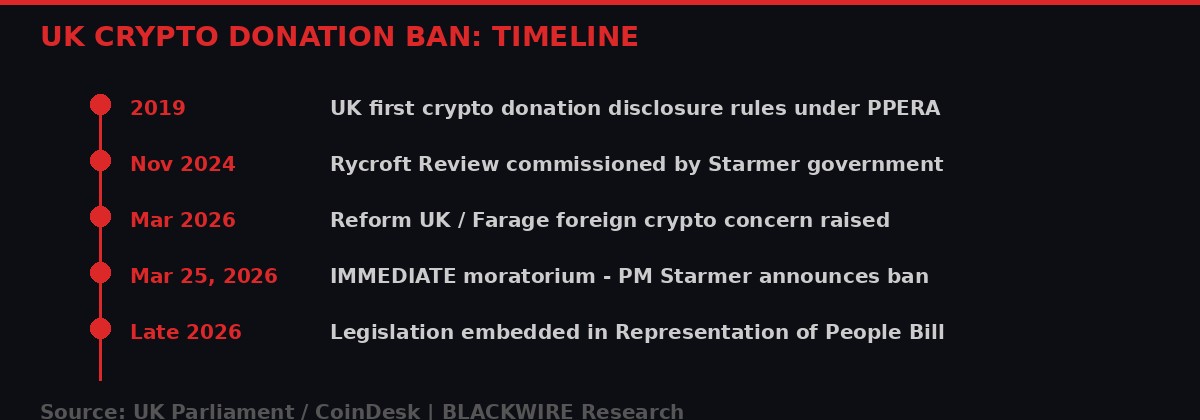
The UK's path from 2019 disclosure rules to 2026 full ban - driven by the Rycroft Review and concerns about Nigel Farage's Reform UK fundraising.
Canada's Bill C-25: Fixing a Problem That Never Existed
Three days after Starmer's announcement, Canada's federal government introduced Bill C-25, the Strong and Free Elections Act. The bill explicitly bans Bitcoin and all other cryptocurrencies as political contributions - along with money orders and prepaid payment products - citing their shared quality of being difficult to trace.
The irony: no major Canadian federal party has ever publicly accepted a cryptocurrency donation. In the 2021 and 2025 federal elections, Elections Canada reported zero crypto contributions. The 2019 framework that permitted them came with conditions - public identification for donations over $200, no tax receipts, no privacy coins, mandatory liquidation to fiat before spending. In practice, the entire framework was dormant.
But Canada's Chief Electoral Officer grew increasingly uncomfortable with the theoretical exposure. A June 2022 post-election report recommended tightening the rules. By November 2024, the position had shifted to recommending an outright ban, citing the "fundamentally difficult" challenge of identifying crypto contributors and the pseudo-anonymity that even compliant blockchains can offer through mixing services or offshore wallets.
"Contributor identification is fundamentally difficult when dealing with cryptocurrency, and pseudo-anonymity creates transparency challenges that are incompatible with the transparency requirements of our electoral financing regime." - Chief Electoral Officer of Canada, November 2024 recommendation
Bill C-25 follows a predecessor that died in January 2025 when Parliament was prorogued. This is the second attempt to enact the same provisions. If passed, recipients get 30 days to return, destroy, or convert any crypto donations received in violation of the ban. Maximum penalties reach twice the value of the contribution, plus $100,000 for corporations.
The bill is at first reading in the House of Commons as of this writing. It is expected to pass with cross-party support - there is no powerful crypto lobby in Canada comparable to what exists in Washington.
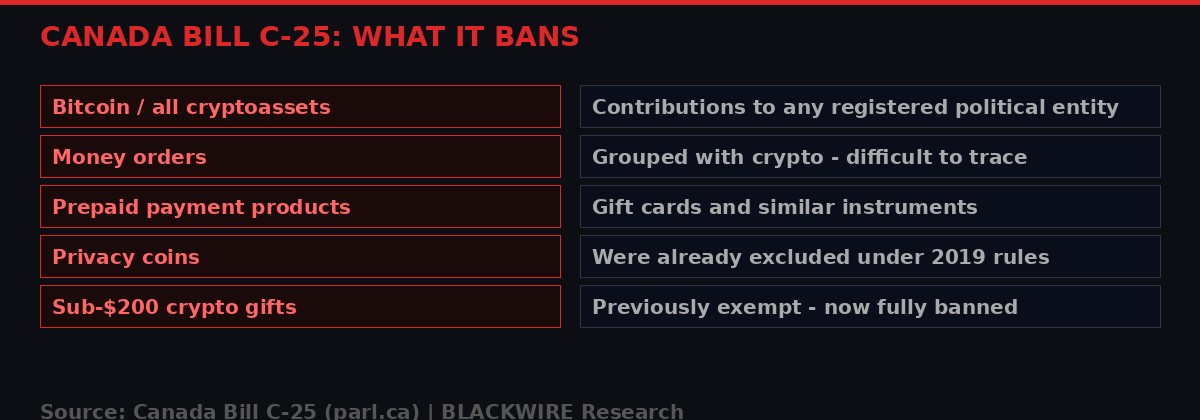
Canada's Bill C-25 covers all cryptoassets, money orders, and prepaid cards - grouping them together as instruments that resist transparent donor identification. Previously sub-$200 crypto gifts were exempt; that exemption is eliminated.
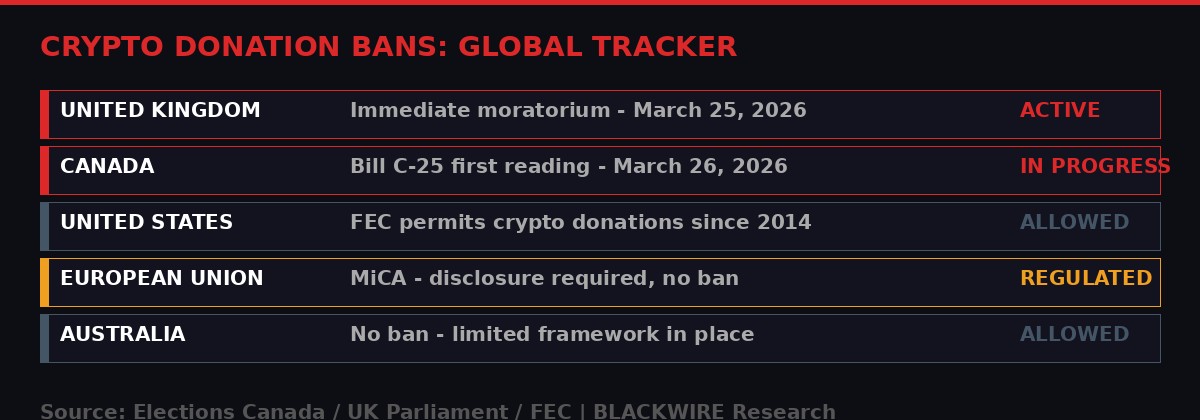
The global picture: UK and Canada are moving to ban. The US still permits crypto donations under FEC guidance dating to 2014. The EU requires MiCA disclosures but has no ban. Australia has no formal framework.
Bitcoin Breaks Down: $300 Million Liquidated, Retail Flees
The political news landed on top of a market already in distress. Bitcoin fell below $67,000 on Thursday and extended losses toward $66,000 through the end of the week, reaching levels not seen since early March. The CoinDesk 20 Index lost 2.2% in 24 hours to its lowest point since March 9.
The derivatives data was unambiguous about what happened. Nearly $300 million in long futures positions were liquidated versus just $50 million in shorts - a 6-to-1 ratio skewed toward crowded bulls who had been positioned for an Iran-war price rally that never materialized. According to CoinDesk data, this marked the fifth time in 10 days that longs absorbed near-$300 million in punishment.
The pattern since late February has been consistent: markets open Monday on relief that a "Black Monday" event did not occur over the weekend, averaging around 3% gains. By Thursday and Friday, those gains get methodically repriced as oil stays high, geopolitical uncertainty persists, and no ceasefire emerges in the Strait of Hormuz. The Iran war pattern has become a weekly rhythm of false hope and repeated loss.
On-chain data from Glassnode confirmed what the futures said. The Accumulation Trend Score by cohort showed retail wallets under 10 BTC leading the capitulation. Wallets holding under 1 BTC posted a score of 0.11 on a scale where 1 equals aggressive accumulation. Wallets holding 1 to 10 BTC scored 0.05 - the floor of distribution pressure. Larger holders, particularly whales with 1,000 to 10,000 BTC, sat neutral around 0.5, neither accumulating nor distributing at scale. The market's internal structure tells the same story as the liquidation data: retail is selling, whales are waiting.
Bitcoin options worth over $15 billion expired Friday on Deribit. The $75,000 strike that had acted as a price magnet through much of March is now gone as a factor. Risk reversals on Deribit showed puts trading at a 6 to 8 volatility point premium to calls across all expirations - persistent demand for downside protection that markets have not yet finished pricing.
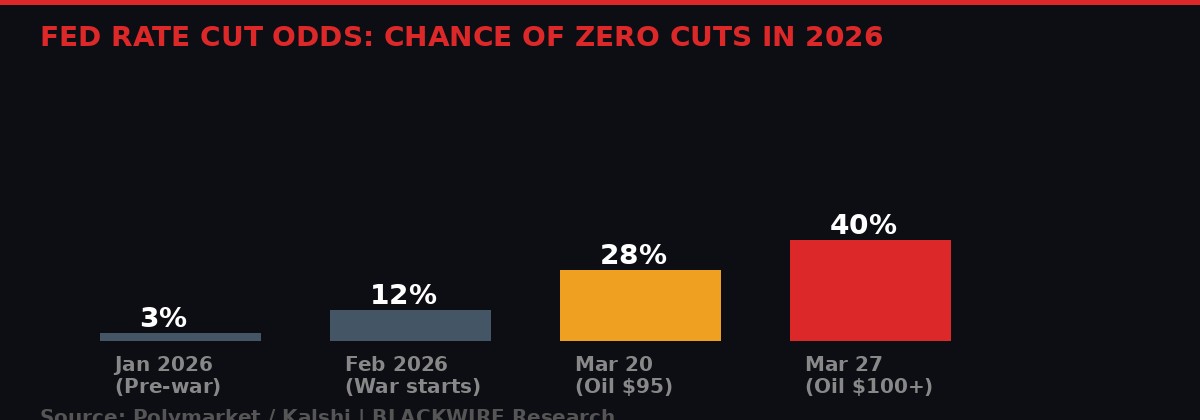
The probability of zero Fed rate cuts in 2026 has surged from 3% in January to 40% by late March - driven entirely by oil above $100 and Iran war inflation fears. Rate cut expectations that formed Bitcoin's bull case are collapsing.
The Macro Kill Shot: Oil at $100, Treasury Yields at 4.5%, Rate Cuts Dead
The single biggest variable crushing crypto and equities this month is not the Iran war itself - it is what the Iran war has done to oil and, through oil, to monetary policy expectations.
Oil crossed $100 per barrel in mid-March and has held above that level through the end of the month, driven by fears that the Strait of Hormuz conflict could restrict one of the world's most critical shipping lanes. That fear has proven more durable than the optimists expected. Every Monday that Iran does not de-escalate keeps oil bid, keeps inflation expectations elevated, and keeps the Federal Reserve boxed in.
On prediction markets including Polymarket and Kalshi, the probability of zero rate cuts in 2026 has risen from under 3% in January to approximately 40% as of late March - a transformation of the monetary policy landscape that has repriced almost every risk asset in its path. The 10-year Treasury yield climbed to nearly 4.5% - close to a one-year high - before Richmond Fed President Tom Barkin and Philadelphia Fed President Anna Paulson made cautious remarks that pulled it back briefly.
"Energy prices remain closely linked to inflation expectations. The recent surge has led to a meaningful shift in monetary policy pricing, with previously anticipated Federal Reserve rate cuts for the year largely reversing toward expectations of renewed tightening." - Luke Deans, Senior Research Associate, Bitwise
Asset manager Bitwise published analysis this week arguing that Bitcoin's drawdown may already reflect the tighter monetary environment - that BTC responded early to the liquidity withdrawal and is now "valuation-compressed" relative to equities that are still unwinding from January highs. The Mayer Multiple, which compares Bitcoin's spot price to its 200-day moving average, sits in the lower percentiles of its historical distribution, suggesting the rerating is more advanced in crypto than in stocks.
The numbers tell the story starkly. Bitcoin is down 45% from its October 2025 all-time high of $126,000. Silver has fallen 45%. Gold is down roughly 20%. The Nasdaq 100 is in correction territory at -11% from January highs. The S&P 500 is down 8.5%. Ethereum has lost 52% from peak. Roughly $17 trillion in combined market cap has been erased from the Magnificent Seven alone since January's peaks - a figure that dwarfs any single geopolitical catalyst and reflects a genuine repricing of liquidity-dependent assets.
Crypto stocks amplified the pain on Friday. Coinbase fell nearly 7%. Gemini dropped almost 9% in one of its steepest single-day losses. Galaxy slid 7%. Robinhood lost 6%. Strategy (formerly MicroStrategy) and Twenty One Capital each fell around 6%. Bitcoin miners, which trade as leveraged proxies for BTC price and AI infrastructure sentiment, posted 5% to 8% losses across the board - Riot, CleanSpark, IREN, HIVE, and Hut 8 all in that range.
The Miner Implosion: $79,995 to Mine What Sells for $66,600
The bitcoin mining sector is in its deepest crisis in years, and this week's CoinShares Q1 2026 mining report quantified the damage precisely. The weighted average cash cost to produce one bitcoin among publicly listed miners rose to approximately $79,995 in Q4 2025. Bitcoin is trading at roughly $66,600 as of this writing. That is a loss of approximately $13,395 per bitcoin mined.
This is not a margin squeeze. This is structural break. The economics of Bitcoin mining at current difficulty and current prices do not work for any operator using mid-generation hardware paying standard electricity rates. Miners running mid-generation machines need power costs below $0.05 per kilowatt-hour just to stay cash-profitable - a threshold that rules out most of the United States market, where power costs typically range from $0.06 to $0.09 per kilowatt-hour in data center environments.
Hash price, the metric measuring miner revenue per unit of computing power, hit an all-time post-halving low of roughly $28 to $30 per petahash per day in early March. The network peaked at approximately 1,160 exahashes per second in early October 2025 and has since declined to roughly 920 EH/s, with three consecutive negative difficulty adjustments - the first such streak since July 2022.
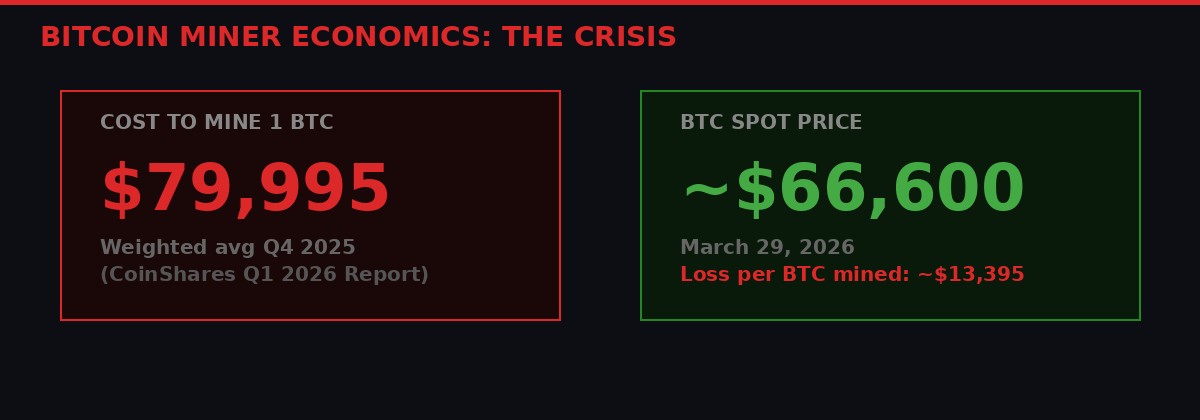
The cost-price gap is the defining crisis of Bitcoin mining in Q1 2026: it costs $79,995 on average to mine one BTC that sells for ~$66,600. The math forces the industry's hand - and the hand is pointing toward AI infrastructure.
The response across the industry has been a wholesale pivot toward artificial intelligence infrastructure. And the capital commitments are staggering. Over $70 billion in cumulative AI and high-performance computing contracts have now been announced across the public mining sector, according to CoinShares. CoreWeave's deal with Core Scientific alone is worth $10.2 billion over 12 years. TeraWulf has $12.8 billion in contracted HPC revenue. Hut 8 signed a $7 billion, 15-year lease for AI infrastructure at its River Bend campus. Cipher Digital - formerly a pure-play miner - issued $1.7 billion in senior secured notes in November to fund an AI buildout alongside Google-backed Fluidstack, causing its quarterly interest expense to surge from $3.2 million for the first nine months to $33.4 million in Q4 alone.

The $70 billion AI pivot: miners have signed infrastructure deals with hyperscale cloud providers that dwarf their mining revenues. Core Scientific, TeraWulf, Hut 8, and Cipher are now primarily data center operators - mining is the legacy business.
Listed miners could derive as much as 70% of their revenue from AI by the end of 2026, up from roughly 30% today. Core Scientific's AI colocation revenue already accounts for 39% of total revenue. The valuation market has already priced the bifurcation: miners with secured HPC contracts trade at 12.3 times next-twelve-month sales. Pure-play miners trade at 5.9 times. The market pays more than double for the AI exposure.
Financing the transition has required selling the asset the machines were built to produce. Publicly listed miners have collectively reduced their BTC treasuries by over 15,000 BTC from peak levels. Core Scientific sold roughly 1,900 BTC worth $175 million in January. Bitdeer reduced its treasury to zero in February. Riot Platforms sold 1,818 BTC worth $162 million in December. Even Marathon - the largest public holder at 53,822 BTC - quietly expanded its policy in its March 10-K filing to authorize sales from its entire balance sheet reserve, partly driven by pressure on its $350 million bitcoin-backed credit facility where the loan-to-value ratio climbed to 87% as prices fell toward $68,000.
The irony is structural and almost poetic. The mining companies that secure Bitcoin's network are selling Bitcoin to fund the infrastructure buildout for an AI competitor that requires no blockchain, no proof-of-work, and no miners. If prices do not recover to $100,000, CoinShares forecasts the transition accelerates - and the bitcoin mining sector as it existed for the past decade continues to dissolve into something else entirely.
Morgan Stanley Enters the ETF War at 14 Basis Points
In the middle of the carnage, Morgan Stanley filed an amended S-1 with the SEC proposing to price its spot bitcoin ETF - MSBT - at 14 basis points. That would make it the lowest-cost bitcoin ETF on the market if approved, undercutting Grayscale's Bitcoin Mini Trust at 15 basis points and BlackRock's iShares Bitcoin Trust at 25 basis points.
The math for investors is simple. Spot bitcoin ETFs are functionally identical products - each holds bitcoin and tracks its price. Cost is one of the few variables that differentiate them. A financial advisor can shift client exposure between ETFs with a single trade, keeping the same risk exposure while lowering annual fees. At scale, even 1 basis point differences move billions of dollars. The fee war that has defined ETF markets for a generation has now fully arrived in crypto.
Morgan Stanley's wealth management arm oversees trillions in client assets. Its adviser network is one of the largest in the US. Even marginal allocation changes across that base - 0.1% of assets redirected - could represent tens of billions flowing toward MSBT and away from higher-cost incumbents. That is the competitive threat that every existing bitcoin ETF sponsor is now pricing.
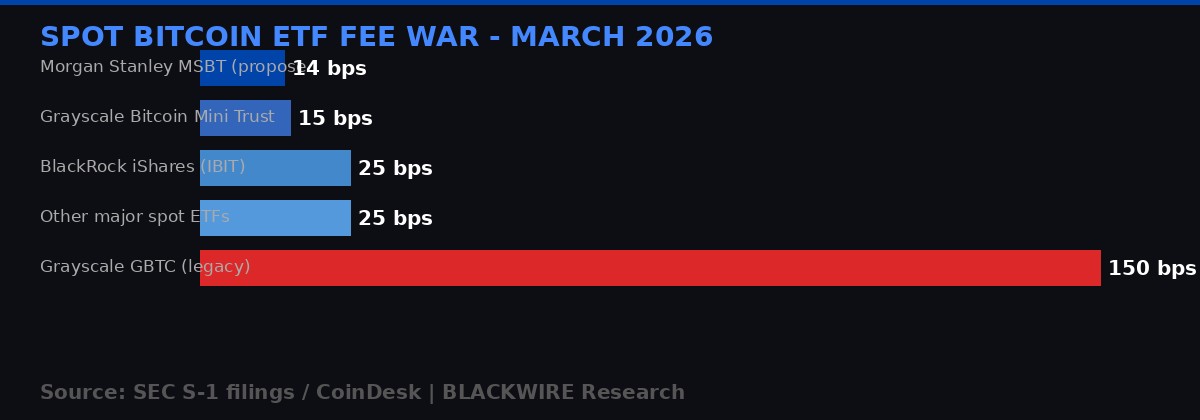
Morgan Stanley's proposed 14bps fee undercuts Grayscale Mini (15bps) and BlackRock IBIT (25bps). At Morgan Stanley's asset scale, 1 basis point difference could represent billions in redirected flows. Legacy GBTC at 150bps continues to hemorrhage assets to lower-cost competitors.
The New York Stock Exchange has already issued a listing notice for MSBT, signaling the product could begin trading quickly once the SEC gives approval. If approved, MSBT would be the first spot bitcoin ETF issued directly by a major US bank - a symbolic watershed for an asset class that most of those same banks were refusing to touch as recently as three years ago.
Bitcoin ETFs saw $171 million in outflows on Thursday alone - the largest single-day outflow in three weeks - as the macro environment weighed on institutional demand. The IBIT that attracted billions through February is now seeing cooling inflows. The timing of Morgan Stanley's entry, into a week of outflows and price weakness, is either bravely contrarian or illustrates a firm that has been working through regulatory channels for months and cannot time its SEC filings around market conditions.
Either way: the fee compression trend has one more move left. At 14 basis points, Morgan Stanley is establishing a new floor. Other providers will face pressure to respond. The race to the bottom in ETF fees ultimately benefits long-term bitcoin holders who want index-like exposure at minimum cost - and signals how mainstream the asset class has become regardless of its current price.
What Comes Next: The Variables That Decide Q2
The setup heading into April is defined by three variables that are interacting in real time and none of which have near-term resolution.
First: oil. The Strait of Hormuz situation has not meaningfully improved. Iran has not de-escalated. Until oil drops back below $90 - or a credible ceasefire framework emerges - inflation expectations stay elevated and the Federal Reserve stays boxed. Every week the conflict continues is another week that rate cut expectations erode further.
Second: Bitcoin's price floor. CoinShares has modeled a scenario where BTC stays below $80,000 through Q2. In that environment, hash price stays suppressed, more miners capitulate to AI conversion or outright shutdown, difficulty continues to decline, and the network's security budget shrinks. The $66,000 to $70,000 range is where the math stops working for most of the mining sector. If Bitcoin does not recover, the industry transformation accelerates - and the structural selling from miner treasury liquidations creates persistent overhead supply. Next-generation hardware from Bitmain (S23 series) and Bitdeer (SEALMINER A3) operating below 10 joules per terahash could provide relief in H1 2026 if deployed at scale - but deploying them requires capital that most miners are directing toward AI.
Third: regulatory momentum. The UK and Canada actions this week signal a direction of travel for Western democracies on crypto-in-politics. If the US midterm cycle - which begins in earnest in Q3 2026 - triggers a bipartisan push to restrict crypto campaign donations, the political climate around the entire asset class shifts. That would not directly affect crypto's price, but it affects the "crypto is inevitable" narrative that institutional buyers have used to justify allocation growth through 2024 and early 2025.
On the bull side: Bitwise's "compression" argument has some technical merit. Bitcoin has absorbed a 45% drawdown while the Nasdaq has only just entered correction territory. If equities reprice downward toward Bitcoin's relative valuation compression rather than the reverse, the cross-asset setup changes. Morgan Stanley's ETF entry is a demand unlock at institutional scale that has not yet fully priced in. And CoinShares' forecast that hashrate reaches 1.8 zetahashes by year-end depends on a $100,000 BTC - achievable if geopolitics normalize faster than the current oil price implies.
The week that ended on March 29 was not a turning point in either direction. It was a clarification. Crypto is under political pressure in the West. Its production economics are structurally broken at current prices. Its institutional infrastructure - ETFs, banking, prime brokerage - is accelerating regardless. The asset is simultaneously being written out of democratic finance and written into the biggest financial plumbing of the 21st century. That tension does not resolve quickly. It compounds.
Watch the Hormuz shipping data. Watch Marathon's loan-to-value ratio on that $350 million credit facility. Watch whether Morgan Stanley's MSBT approval comes before or after the next leg down. The numbers will tell you where this goes.
Get BLACKWIRE reports first.
Breaking news, investigations, and analysis - straight to your phone.
Join @blackwirenews on Telegram