Day 44, Record Broken: The DHS Deal That Died at Dawn and the Congress That Ran
A deal negotiated through the night collapsed before breakfast. Congress packed its bags and left town for two weeks. And on Sunday, the Department of Homeland Security shutdown became the longest in American history - 44 days, surpassing a record set just five months earlier. Fifty thousand airport security workers still haven't been paid. No resolution is in sight.

TSA security lines have stretched by 40% at major airports as unpaid screeners call out in record numbers. (Pexels)
A Deal Born at 2 AM, Dead by Noon

The U.S. Senate passed a partial DHS funding deal by voice vote just after 2 AM Friday - then senators flew home. (Pexels)
Senate Majority Leader John Thune had spent weeks in grinding negotiations. Democratic senators wanted restrictions on ICE after two Americans were shot dead by federal agents during protests in Minneapolis. Republicans wanted the agency fully funded. The gap seemed unbridgeable.
Then, in the dark hours of Friday morning, a compromise appeared. The Senate deal would fund TSA, FEMA, the Coast Guard, and most of the Department of Homeland Security - but exclude the Immigration and Customs Enforcement deportation operations and parts of Customs and Border Protection. No new restrictions on agents would be imposed. Democrats would get the ICE funding freeze; Republicans would keep enforcement intact.
Senators passed it by voice vote just after 2 AM. Thune said he was proud of the deal. Senators headed to airports, confident the House would follow.
"We can get at least a lot of the government opened up again and then we'll go from there." - Senate Majority Leader John Thune, R-S.D., shortly after the deal passed
Asked whether he had cleared the deal with House Speaker Mike Johnson, Thune said the two had texted.
"I don't know what the House will do," Thune said.
He was about to find out.
As House Republicans woke Friday morning to news of the Senate's overnight maneuver, a conference call erupted. Dozens of members - moderates and conservatives alike - called in to voice fury. Rep. Nick LaLota of New York put it bluntly: "The Senate chickened out." He accused senators of having left only "three to five" members on the floor to pass a deal in the middle of the night just to make it home for recess.
By early afternoon, Johnson strode out of his office and publicly torched the compromise. He called it "a joke." He said the Senate had left him in the dark. He said the House would chart its own course. The Senate's carefully negotiated deal was dead before lunch.
"This gambit that was done last night is a joke. I have to protect the House, and I have to protect the American people." - House Speaker Mike Johnson, R-La., Friday afternoon
Hours later, the House passed its own bill - a short-term measure that would fund all of DHS including ICE through May 22, with no concessions to Democrats. It passed 213 to 203, almost entirely on party lines. The Senate, already gone, was unable to vote on it. Senate Democratic leader Chuck Schumer called the House bill "dead on arrival."
Congress then left for a two-week spring recess.
Forty-Four Days: How a Record Broke Again
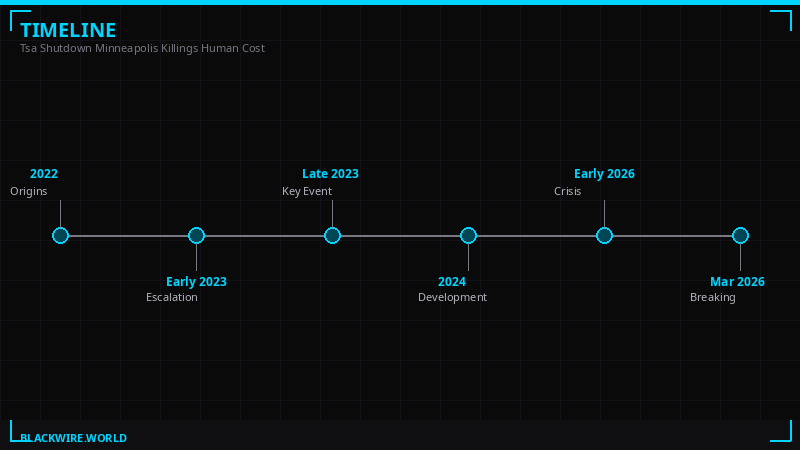
The DHS shutdown of 2026 has now surpassed the previous all-time record by at least one day, with no end date visible. (BLACKWIRE infographic)
To understand how America arrived here, the calendar matters. The DHS shutdown began on February 14, 2026 - Valentine's Day - when Congress failed to pass a full funding bill for the department. That same group of 50,000 TSA workers had already been through a 43-day federal government shutdown just months earlier, in fall 2025. They had endured a brief four-day lapse in early 2026. This was their third work stoppage in under six months.
On Sunday, March 29, the current shutdown hits 44 days. That surpasses the 43-day record from the fall 2025 federal shutdown - itself the longest in U.S. government history at the time. Both records now belong to DHS workers alone.
Unlike a full federal shutdown, this funding lapse affects only the Department of Homeland Security. The rest of the federal government was funded separately. But DHS houses some of the most operationally critical agencies in the country: TSA, FEMA, the Coast Guard, Customs and Border Protection, ICE, and the Secret Service. Because their work is considered essential, TSA officers legally cannot stop working. They are compelled to show up, scan bags, and screen passengers - and receive nothing.
More than 480 have quit rather than continue. TSA's acting administrator, Ha Nguyen McNeill, warned Congress on March 26 that if the walkout rate keeps climbing, the agency may have to close terminals entirely at some airports.
"At this point, we have to look at all options on the table. And that does require us to, at some point, make very difficult choices as to which airports we might try to keep open and which ones we might have to shut down." - Ha Nguyen McNeill, TSA Acting Administrator, March 26 congressional testimony
The People Working for Nothing
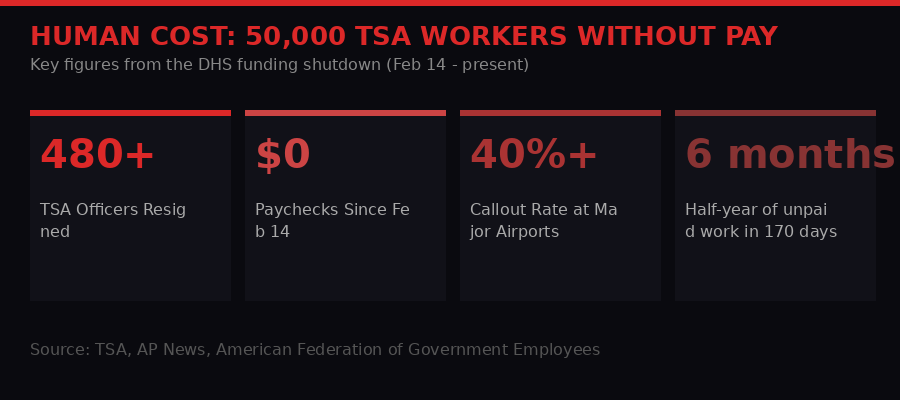
50,000 TSA workers have gone without pay since February 14. Airport security staffing is deteriorating in real time. (BLACKWIRE infographic)

Staffing shortfalls have produced wait times exceeding 40% above normal at multiple major U.S. airports. (Pexels)
The abstractions of congressional procedure become viscerally real when you hear from the workers themselves.
Taylor Desert, a seven-year TSA officer at Indianapolis International Airport, stopped at a food bank before her morning shift this week. She loaded bags of meat, eggs, vegetables and dairy products into her car. "I never thought I would be in a position where, working for the federal government, I would need to go to a food bank to supplement my groceries," she told reporters.
Her last full paycheck arrived February 14. She has held off on wisdom tooth surgery - she can't get time off during the shutdown anyway, and isn't sure she can cover what insurance won't pay. After 40 days with no income, she set a hard limit for herself: 21 more days, and she'd seek another job.
At Orlando International Airport, married TSA agents Oksana and Deron Kelly both work security while raising two young children. Their savings are gone. Deron has been moonlighting as a DoorDash driver since the fall shutdown. He has considered quitting. "It's very mentally exhausting," Oksana said. "How do we even decide between being able to feed our kids or come to work?"
In Boise, Idaho, Rebecca Wolf - a 53-year-old TSA officer who joined the agency after the September 11 attacks as a path out of homelessness - now fears she may face homelessness again. She tries not to cry in front of her grandchildren, ages 11 and 6. "They don't understand why grandma's crying," she said. "I try not to cry in front of them, but sometimes it's just too much."
Hydrick Thomas, president of the AFGE union council representing TSA workers, delivered a blunt message to reporters this week: "Stop asking me about the long lines. Ask me if somebody's gonna eat today."
TSA starting pay is approximately $34,500 a year. The average salary ranges from $46,000 to $55,000. These are not highly paid workers. A 2024 Government Accountability Office report found the agency has some of the lowest morale in the entire federal government, driven by low pay and persistent workplace frustrations. Repeated shutdowns are not improving those numbers.
The Minneapolis Thread: How Two Deaths Froze a Budget

Protests following the Minneapolis ICE shootings created a political fault line that has frozen DHS funding for 44 days. (Pexels)
To understand why this shutdown is happening at all, you have to go back to Minneapolis.
The Trump administration launched what DHS described as its largest immigration enforcement operation ever - Operation Metro Surge - in the Minneapolis-St. Paul area in early 2026. It targeted undocumented immigrants and generated headlines and protests. During that operation, federal officers shot and killed two people: Renee Good and Alex Pretti, both U.S. citizens who were protesting the raids. A third shooting involved Julio Cesar Sosa, whose case is also under investigation.
The killings sparked national outrage and became a political inflection point. Senate Democrats declared they would not fund ICE operations until the Trump administration accepted accountability - reforms including requiring federal agents to wear visible identification, prohibiting raids near schools and churches, and requiring judicial warrants rather than administrative warrants for home searches.
The Trump administration and House Republicans refused. ICE's operations were not only legally valid, they argued, but vital to the president's immigration enforcement mandate. Accepting limits on ICE, they said, was capitulating to lawbreakers and their allies.
The impasse hardened. Weeks of negotiation produced nothing. The Senate's Friday deal - which excluded ICE funding but imposed no new restrictions - was the furthest either side had moved. The House killed it within hours.
Meanwhile, Minnesota officials sued the Trump administration this week for access to evidence in the shootings. Hennepin County Attorney Mary Moriarty said the federal government "reneged on its promise to cooperate with state investigations." A court order is being sought to compel the administration to share evidence.
"We are prepared to fight for transparency and accountability that the federal government is desperate to avoid." - Mary Moriarty, Hennepin County Attorney, March 24, 2026
The Justice Department has opened a civil rights investigation into the Pretti killing. In the case of Renee Good, DOJ declined to investigate - a decision Moriarty and state officials called an abdication of responsibility. DHS claims Good's death was justified because she "weaponized her vehicle" against officers.
The Republican Rupture
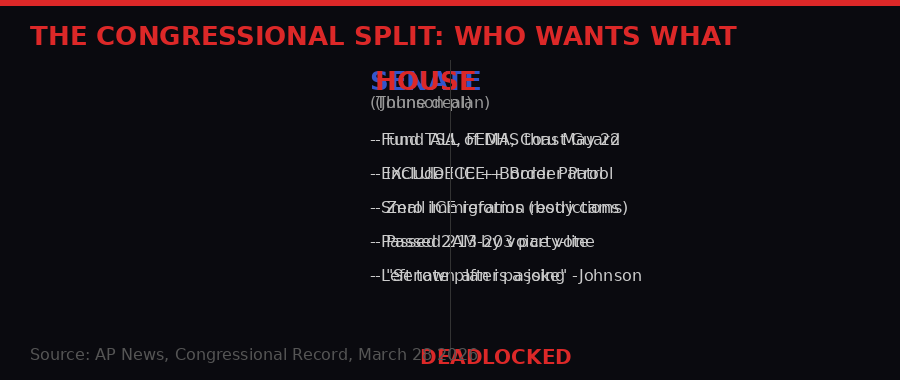
Senate Republicans wanted a partial deal. House Republicans wanted nothing less than full ICE funding. The gap between chambers has never been wider. (BLACKWIRE infographic)
The collapse of the Senate deal exposed something that Republican leaders have worked hard to keep quiet: the House and Senate GOP caucuses are not operating in sync, and the rift is widening.
Thune spent more than a week in close negotiations with Democratic senators, including direct White House involvement at some points. He believed he was close to something that could work. When the deal passed by voice vote, there appeared to be no objections from either party.
What Thune apparently did not have was a hard commitment from Johnson. The two had exchanged text messages. Thune acknowledged he did not know what the House would do. That turned out to be a catastrophic gap.
Johnson, facing his own caucus - many of whom view any ICE funding limitation as an unacceptable precedent - had no room to accept the Senate deal. Conservative members viewed the Senate's middle-of-the-night maneuver as a betrayal. Rep. Virginia Foxx of North Carolina called the Senate plan "nothing more than unconditional surrender masquerading as a solution." LaLota called senators cowards.
The House then passed its own bill - full DHS funding through May 22 with zero immigration concessions - and dared the Senate to reconvene. The Senate had already left Washington. Schumer said the House bill would not get the 60 votes needed to break a filibuster. The two chambers are now on completely different legislative planets, separated by a two-week recess, with no active talks scheduled.
Trump's role has been characteristically murky. He signed an executive action Friday to pay TSA workers using funds with "a reasonable and logical nexus to TSA operations" - a legally improvised move designed to relieve airport pressure. DHS Secretary Markwayne Mullin said workers should see paychecks "as early as Monday." But the executive action does not end the shutdown. It does not fund ICE. It does not fund FEMA or the Coast Guard at their normal operating levels. It is a bandage, not a fix.
"America's air travel system has reached its breaking point." - President Donald Trump, memo authorizing emergency TSA payments, March 28, 2026
Trump had appeared to signal support for the Senate deal, or at least had not publicly opposed it - a silence Thune likely interpreted as a green light. After Johnson killed the deal, the White House stayed quiet. Trump supported the House version, a spokesperson said. He had spoken with Johnson.
TSA on the Brink: Airport Infrastructure Under Stress

Long security queues at major U.S. airports have been building for weeks as TSA absenteeism rises. Some airports have seen callout rates above 40%. (Pexels)
The operational reality of 44 days without funding is now visible in airports across the country.
Multiple airports have reported callout rates exceeding 40% - meaning nearly half the scheduled screeners don't show up. Those who do face equipment that isn't being serviced and managers who are also working without pay. The agency's inspector general noted this week that 11 secondary checkpoint lanes at major airports have been closed to consolidate operations. Lines have grown by an average of 37% at the ten busiest U.S. airports compared to pre-shutdown baselines, according to internal TSA figures shared with congressional staff.
The most immediate risk is terminal closures. McNeill testified that the agency is actively modeling which airports can be maintained if absenteeism continues to climb. Smaller regional airports are the most vulnerable. Some have already been informed to prepare contingency plans. If a regional airport closes its TSA checkpoint, all commercial passenger flights are grounded - there is no legal way to fly without security screening.
The Coast Guard is also affected. Ships are being crewed at minimum staffing. Maintenance schedules have been delayed. Multiple cutters that would normally be on patrol are docked because their crews can't afford gasoline for their commutes. FEMA has cut back its deployment readiness posture heading into spring - a period when tornado season and flooding risk are highest.
Cameron Cochems, a TSA union leader in Boise who works seasonal side gigs to supplement his income, said the agency's resilience is not infinite. "Every day I come to the airport and I look at the food drive, see what things I can get for my family," he told the AP. His wife was laid off two weeks ago. Both their incomes have evaporated simultaneously.
More than 170 days out of the past calendar year, TSA workers have either been working without pay or have faced the threat of it. The GAO's 2024 workforce report warned this cycle was unsustainable and would accelerate attrition. Those warnings were accurate.
The Road Back - and Why It Doesn't Exist Yet

Congress is now on a two-week spring recess. No floor votes on DHS funding are possible until lawmakers return around April 14. (Pexels)
The mechanics of ending this shutdown are straightforward in theory and nearly impossible in practice.
Both chambers must pass identical legislation. The president must sign it. Right now, the Senate passed one bill and the House passed a completely different bill. Each chamber's leadership has called the other's bill unacceptable. Congress is on recess for two weeks. Even if leadership wanted to reconvene early, they would need to summon members from their home districts, which is politically awkward and operationally complex.
The path most observers identify as viable - a clean continuing resolution that funds all of DHS with no immigration policy riders attached - cannot pass the Senate with 60 votes because conservative Republicans would not support anything that looks like leaving ICE unfunded. It cannot pass the House because Republicans would not accept any bill that doesn't fund ICE. Democrats won't vote for ICE funding without policy changes. The geometry doesn't work.
Trump's executive action paying TSA workers creates a new dynamic. If screeners start receiving paychecks, the immediate political pressure to resolve the shutdown drops. Travelers stop experiencing crisis-level delays. Public attention shifts. The incentive for Congress to act - which was already weak - gets weaker. The agencies that can't be patched by executive action (FEMA, the Coast Guard, CBP) will continue to degrade, but more slowly and less visibly than airport security lines.
Rep. Brian Fitzpatrick of Pennsylvania, a moderate Republican, expressed frustration at the impasse with unusual bluntness: "This takes two chambers to get the job done. Apparently, there's not enough communication between those chambers."
Senate Democratic leader Schumer said Democrats were "proud of holding the line." Senate Appropriations Chair Susan Collins of Maine said Democrats were "intransigent and unreasonable." Neither side showed any sign of movement.
"I felt like from the beginning, they just didn't want to get to 'yes.'" - Senate Majority Leader John Thune, R-S.D., after the vote collapsed, March 28, 2026
SHUTDOWN TIMELINE: HOW WE GOT HERE
The November Clock: Why This Is About More Than DHS

With midterm elections approaching in November, both parties are calculating how the shutdown plays with voters. Republicans are divided on strategy. (Pexels)
Every day the shutdown continues, Congress is making a political bet.
Republicans are betting that voters care more about immigration enforcement than about airport lines and unpaid federal workers. The party's internal polling has consistently shown that immigration is among the top issues for Republican primary voters. Cutting a deal that gives Democrats anything - even the symbolic exclusion of ICE from a funding bill - risks those members facing primary challenges from the right. For many House Republicans, that calculus makes capitulation impossible.
Democrats are betting the opposite: that the human toll of the shutdown - the food banks, the evictions, the airport chaos - will eventually outrun the politics of immigration. They point to the Minneapolis shootings as evidence that unchecked ICE operations carry real consequences. They believe accountability measures are not extreme demands but basic law enforcement standards.
Both bets are being made as the Iran war dominates the front pages and public attention is divided. With oil above $100, a $200 billion war spending request pending, and American troops being wounded at Saudi air bases, the DHS funding fight has been somewhat crowded out of the national conversation. That may actually be helping Republicans, whose House majority relies on keeping the immigration issue alive and preventing any deal that looks like a concession.
There is also a longer-term institutional question. Trump's executive action to pay TSA workers through emergency authority is novel and legally contested. No president has previously claimed the power to unilaterally redirect funds to pay federal employees during a congressional funding lapse. If the action holds up in court, it may reduce the leverage Congress has over essential-agency workers in future shutdowns. If it gets struck down, TSA workers lose their paychecks again - possibly mid-week.
For the 50,000 workers waiting to see whether their Monday paycheck arrives, and for the 480-plus who have already given up and quit, the constitutional questions matter less than the rent check. The congressional calendar shows the earliest possible floor vote is around April 14, when members return from recess. If no deal is struck before then - and nothing in the current political environment suggests one is coming - the record that broke on Sunday will keep extending into territory American history has never seen before.
Congress left. The airport lines didn't.
KEY FIGURES IN THE SHUTDOWN FIGHT
- Mike Johnson (R-La.), House Speaker - Rejected the Senate deal, passed his own full-DHS bill. Positioned himself as the hardliner. Faces pressure from conservatives to not concede on ICE.
- John Thune (R-S.D.), Senate Majority Leader - Negotiated the deal that collapsed. Said he "texted" Johnson but didn't secure his buy-in. His credibility as a dealmaker is damaged.
- Chuck Schumer (D-N.Y.), Senate Minority Leader - Says he is "proud" of holding the line on ICE. Called the House bill dead on arrival.
- Hakeem Jeffries (D-N.Y.), House Minority Leader - Said the Senate-passed bill would clear the House if Johnson allowed a vote. Called for an immediate end.
- Ha Nguyen McNeill, TSA Acting Administrator - Warned Congress on March 26 that airport closures may be necessary if the shutdown continues.
- Markwayne Mullin, DHS Secretary - Said TSA workers would see paychecks from Trump's executive action "as early as Monday."
- Mary Moriarty, Hennepin County Attorney - Sued the Trump administration for access to evidence in the Minneapolis ICE shootings. The legal battle underlying the entire political fight.
Get BLACKWIRE reports first.
Breaking news, investigations, and analysis - straight to your phone.
Join @blackwirenews on TelegramSOURCES
- AP News - "How the Homeland Security deal unraveled and split Republican leaders," March 28, 2026
- AP News - "Trump signs executive action to pay TSA employees," March 28, 2026
- AP News - "TSA officers share what life is like working for a $0 paycheck," March 2026
- AP News - "Hundreds of TSA officers quit instead of working without pay," March 2026
- AP News - "TSA boss warns of airport shutdowns as funding fight persists," March 26, 2026
- AP News - "Minnesota officials sue Trump administration over shooting deaths," March 24, 2026
- U.S. Government Accountability Office, TSA Workforce Report, 2024
- Congressional Record, March 28, 2026
- American Federation of Government Employees, press statements, March 2026