Sue First, Launch Second: DJI's Patent Blitz and the $496 Drone Designed to Bury Insta360
On the same day DJI launched its 8K 360-degree flagship drone - the Avata 360 - at a price that undercuts the only existing competitor by more than $1,100, a lawsuit the company filed three days earlier was working its way through the Shenzhen court system. The timing is either coincidence or the most aggressive product launch in drone history. The evidence suggests the latter.

The Launch That Changed the Numbers

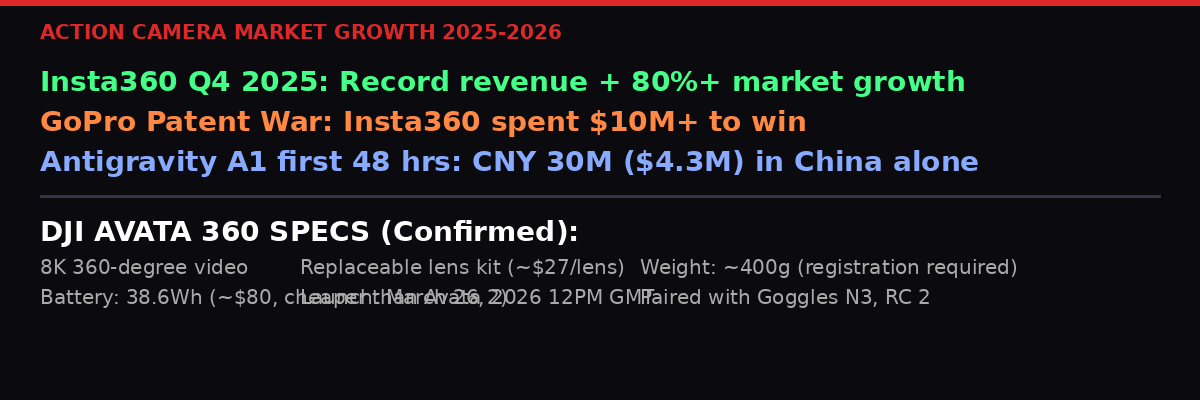
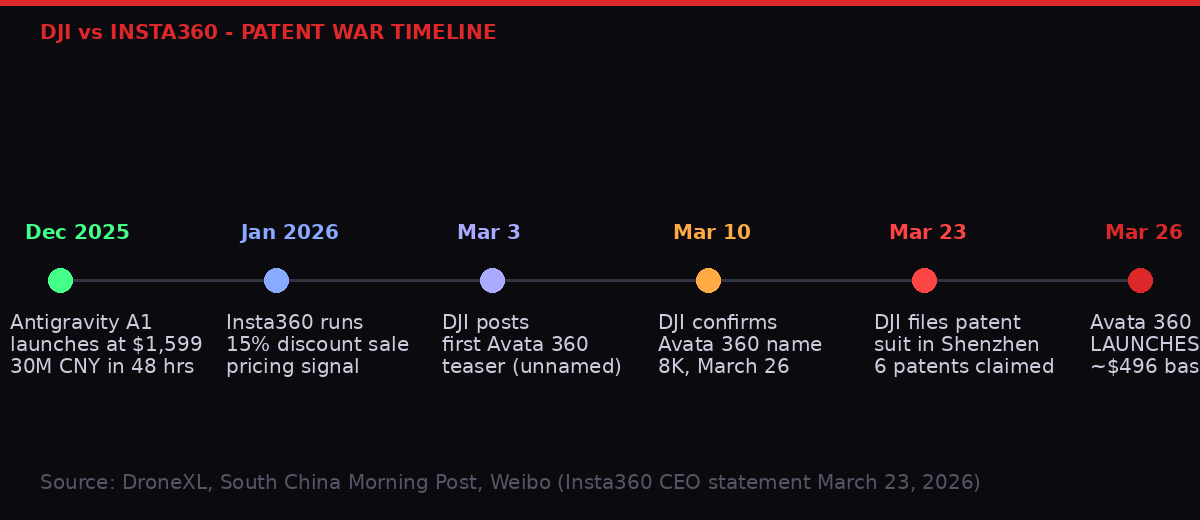
Until March 26, 2026, the 360-degree FPV drone market had exactly one serious commercial product: the Insta360 Antigravity A1, a technically impressive machine that launched in December 2025 and sold CNY 30 million ($4.3 million) in its first 48 hours on the Chinese market, according to Insta360 CEO Liu Jingkang's public Weibo statement. At $1,599 for the drone alone, it was priced like a pro tool for the creators who needed omnidirectional aerial footage without swapping camera rigs mid-flight.
That pricing made commercial sense when you were the only option. Then DJI announced the Avata 360.
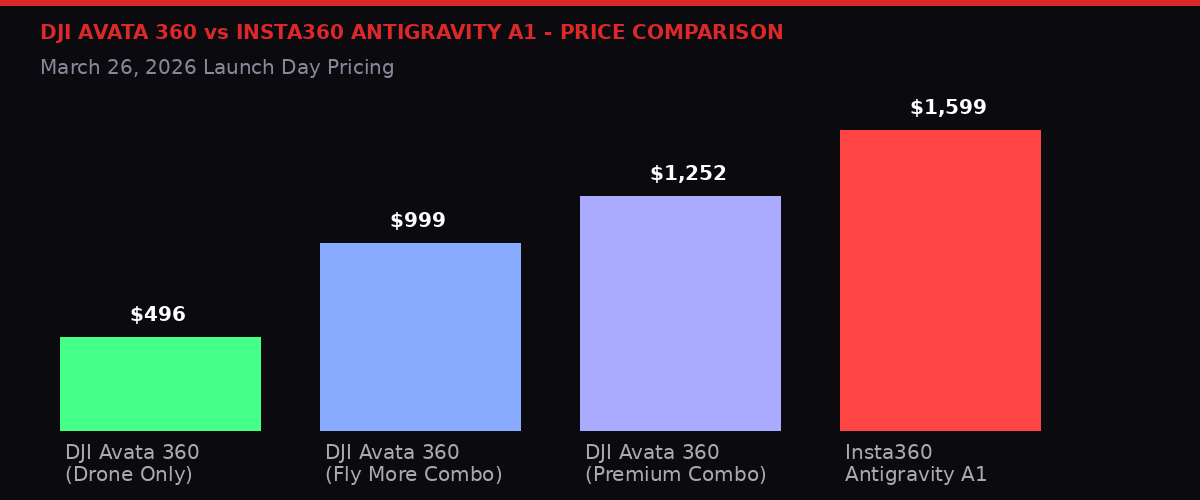
Leaked pricing from a European retailer, first reported by DroneXL's Jasper Ellens on March 11, placed the Avata 360 drone-only at €459 - roughly $496 at current exchange rates. The Fly More Combo including DJI's RC 2 controller came in at €939. The top-tier Premium Combo with the Goggles N3 and RC 2: €1,159. That top configuration, fully specced out, still costs less than the Antigravity A1 on its own.
According to DroneXL's reporting on Chinese supply-chain sources via Weibo, China pricing is set at CNY 2,988 (~$426) for the base drone, with DJI's historical 15-40% markup over Chinese prices suggesting US base pricing in the $489-$528 range. Official figures were confirmed at the March 26 noon GMT launch event.
"At €459, DJI is not just competing - they're sending a message. The message is that the Antigravity A1's pricing was always temporary." - DroneXL analysis, March 15, 2026
The Avata 360 is an 8K flagship. It shoots omnidirectional 4K video. Its lens kit is replaceable - €50 for two lenses and tools, roughly €25 per swap. That last detail matters to anyone who has scratched an action camera lens on a bad FPV landing and paid full replacement prices. The battery is a 38.6Wh cell priced at roughly €70 - more capacity at lower cost than the 31.8Wh battery from the Avata 2 at €100. The drone sits near 400 grams, meaning airspace registration applies in most markets, but that weight class is standard for serious content creators already navigating those rules.
Three Days Earlier: The Lawsuit

On March 23, 2026, three days before the Avata 360 launch, DJI filed a patent ownership lawsuit against Arashi Vision - the parent company of Insta360 - in the Shenzhen Intermediate People's Court. The case targets six patents. The Shenzhen court accepted the filing, according to the South China Morning Post, which broke the story. Arashi Vision shares fell 7% on the day of the announcement, to CNY 181.15 ($26.23), as the broader Shanghai market dropped 3.6%.
The legal theory DJI is deploying is specific to Chinese intellectual property law. Under Chinese patent statute, innovations created within one year of an employee leaving a company - if directly related to their previous duties - are legally considered to have been created for the original employer. DJI's claim is that some of Insta360's drone patents were created by former DJI engineers within that window.
A person familiar with the matter told Yicai Global that cross-referencing inventor names between Chinese domestic patent filings (where some inventors were listed as "requesting anonymity") and international PCT filings (where full disclosure is required) reveals former core DJI research and development engineers. The patents reportedly cover flight control systems, structural design, and image processing technologies central to drone operation.
DJI did not respond to requests for comment at time of filing. The company's silence on the substance contrasted sharply with the loudness of the legal action and the product launch happening in the same week.
Chinese Patent Law: The One-Year Rule
- Under Chinese IP law, patents filed within 12 months of leaving a company can be claimed by the former employer
- The invention must relate to the employee's previous job responsibilities
- This provision exists to prevent trade secret theft via departure and rapid patent filing
- DJI's case marks the first time the company has filed a patent ownership dispute in China, per the South China Morning Post
- The Shenzhen Intermediate People's Court is the primary venue for tech IP disputes in China's hardware hub
Liu Jingkang Fires Back

Liu Jingkang posted a detailed, point-by-point response to the lawsuit on Weibo within hours of the filing becoming public. His statement covers four distinct lines of defense, and each one contains a disclosure worth examining.
On the substance of the patents themselves: Liu says the most significant drone patent at issue covers a one-click "building dive" flight effect for FPV drones - a narrow feature that lets pilots execute a specific cinematic shot with a single button press. He says the idea originated with him and that he was personally involved in its development and approval. He also notes the feature was never implemented in any Insta360 product because current flight restrictions make it impractical. His position, stated plainly: "If DJI wanted this patent, they could've just asked for it."
On the anonymous inventor filings: Liu explains that Insta360's standard practice is to withhold inventor names in early Chinese domestic filings and disclose them in required international PCT applications. The stated purpose is to delay exposing technical staff names to recruiter databases. He says this practice applies across all Insta360 patents, not specifically those involving former DJI employees. "If our motive were as DJI claims, we wouldn't have used these names at all," he writes.
On the age and relevance of the patents: Liu says most of the disputed drone-related patents were filed four to five years ago, and that Insta360's product roadmap has evolved significantly since then. "Many patents have never been used," he writes.
And then the most pointed disclosure of all.
"We completely understand why giants like GoPro and DJI are suing us. It's the mindset of market leaders when they're losing share. On the flip side, many features on DJI's 360 cameras and thumb cameras have been called out by media as 'copy' or 'strikingly similar.' Last year we roughly calculated that DJI products would actually fall under our own patents - but we never sued them." - Liu Jingkang, Insta360 CEO, Weibo statement, March 23, 2026
28 Patents and a Warning
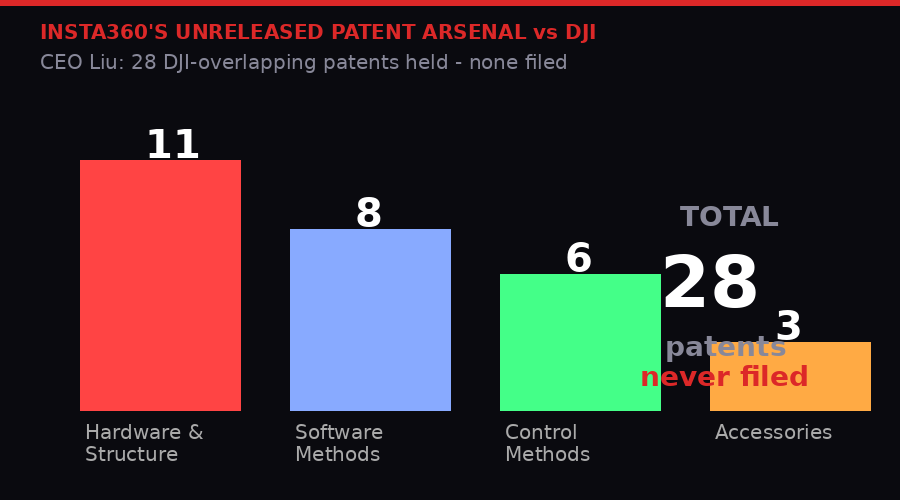
The number Liu put on the table is 28. That is the count of Insta360 patents that, in the company's own internal analysis, would encompass DJI products. The breakdown: 11 hardware and structural patents, 8 software-method patents, 6 control-method patents, and 3 accessory patents. Insta360 has chosen not to file suit on any of them.
Liu's explanation for that restraint is worth quoting directly: "As a smaller company with limited resources, we choose to invest in R&D first rather than lawsuits." He frames the decision as strategic rather than legal - Insta360 grows by building things, not by fighting in court.
That restraint has a clearly stated limit, however. Liu says Insta360 would only deploy that 28-patent arsenal if its ability to innovate or ship products is directly threatened - with a specific example: if Insta360 were somehow blocked from making drones.
The timing of that example is impossible to ignore. The Avata 360 launches the next day. Insta360's only drone product, the Antigravity A1, now has a direct competitor priced at roughly 31% of its cost. The CEO of the company that makes the Antigravity A1 has just publicly identified 28 patents that cover DJI products and stated the precise condition under which he would use them.
This is not coincidence. This is signaling. And DJI's silence on the patent details suggests they got the message.
The GoPro Precedent
Liu explicitly referenced Insta360's prior patent fight with GoPro - noting the company spent over $10 million USD in overseas legal proceedings and won. He says the same mindset applies to DJI. For context: GoPro was once the dominant action camera brand. After several rounds of patent litigation and failed product cycles, GoPro's market position has diminished significantly while Insta360 has grown. Liu's message to DJI is implicit but clear: we have fought this fight before and we know how to win it.
The Drone Market Is Now a War Zone

The action camera and drone market grew more than 80% in the 12 months ending Q4 2025, according to Liu's Weibo post. That figure is extraordinary and reflects a genuine consumer appetite for the kind of immersive aerial footage that neither GoPro nor traditional FPV drones could deliver alone. The Antigravity A1's launch proved the demand was real: CNY 30 million in 48 hours on the Chinese market is not niche territory.
DJI watched that launch and started the clock. The Avata 360 project was already underway - its development timeline and the two March teaser videos confirm that much - but the patent lawsuit three days before launch wasn't product strategy. It was legal strategy deployed as a psychological weapon in the week of maximum attention.
The practical effect of the price gap is severe. Insta360 ran a 15% discount on the Antigravity A1 in January 2026, according to DroneXL reporting. A discount of that magnitude, ahead of a known competitor launch, signals awareness rather than confidence. The A1 at $1,359 (after 15% off) still costs more than twice the DJI Fly More Combo at €939. And the discount period is presumably over, with the A1 back at $1,599 on launch day for its direct competitor.
Content creators - the actual buyers in this market - now face a genuinely difficult choice. The Antigravity A1 had over a year of head start, user reviews, and established workflow integrations. The Avata 360 brings DJI's ecosystem, which means Goggles N3 compatibility, RC 2 controller, and connection to millions of existing DJI users who already have accessories and muscle memory. That ecosystem pull is not trivial. For a creator already using DJI gear for their primary drone work, adding the Avata 360 at $496 is effectively free from an accessory-investment perspective.
The Timeline: From First Tease to Patent War
What DJI Is Actually Doing Here

The conventional read on DJI's lawsuit is that it represents genuine IP protection - a company defending the work its engineers produced before they left for a competitor. That reading is possible. Chinese IP law exists specifically for this scenario and DJI is using it as intended.
The less charitable reading is that the lawsuit serves as a launch-week distraction and a market-disruption tool. A patent case in Shenzhen will take months to resolve, minimum. The Antigravity A1 remains fully available for purchase in the US and globally throughout the proceedings - Liu confirmed this explicitly. No injunction has been sought, and no product has been blocked.
What the lawsuit did accomplish on March 23: it placed Insta360 in a defensive position during the week their only drone product faces its first direct competition. It consumed Insta360's CEO's attention for at least one full day of public response-writing. It created negative news coverage for Arashi Vision in the week of maximum drone-market attention. And it dropped the company's stock price 7% two days before DJI's own product launches.
The price strategy requires separate analysis. DJI has done this before in other categories. When DJI entered the consumer action camera market, it priced aggressively to gain foothold against established players. The Avata 360 at €459 is not priced to make money on the drone itself. At that price point, DJI is buying market share, ecosystem lock-in, and the permanent retirement of any premium pricing power Insta360 had built with the A1's early mover advantage.
The mechanism is: you buy the Avata 360 at $496. You buy the Goggles N3 from DJI. You buy the RC 2 from DJI. You buy replacement batteries, lens kits, and accessories from DJI's ecosystem. You become a DJI customer who has no particular reason to buy from Insta360. The drone is the gateway drug. The accessories and ecosystem are the margin.
This is a textbook platform play, applied to a hardware product category. And it works because DJI already has the platform.
Insta360's Options Are Real But Narrowing

Liu's Weibo statement makes clear that Insta360 is not preparing to fold. The company recorded its best Q4 in history in 2025. It has "7-8 new products" scheduled for 2026, including at least one more drone. It beat GoPro in court and has $10 million-plus in litigation experience. And it holds 28 patents it has calculated would cover DJI's products.
But the fundamental problem is structural. Insta360 cannot match DJI's pricing at equivalent margin. DJI is an Alphabet-backed, vertically integrated hardware manufacturer with industrial-scale production capacity and a decade-long head start on drone component manufacturing. Insta360 built the Antigravity A1 as a premium product because premium pricing was the only viable margin model for a company its size producing hardware at that complexity level.
The options available to Insta360 now:
Option 1 - Hold price on the A1, compete on differentiation. The Antigravity A1 has user reviews, established workflow integrations, and software features developed over a product generation head start. Some buyers will pay the premium for proven hardware. But "some buyers" is not a scaling strategy when your competitor is priced at 31% of your retail price.
Option 2 - Reduce price significantly. Insta360 ran a 15% discount in January. A more aggressive cut - say, down to $999 - would narrow the gap to the DJI Fly More Combo pricing range. This destroys margin and signals a reactive posture, but it keeps Insta360 in the conversation for value-conscious buyers.
Option 3 - Accelerate the next drone. Liu mentions another drone in Insta360's 2026 roadmap. If that product brings technical capabilities the Avata 360 lacks - better stabilization, longer battery life, features only achievable with Insta360's spherical imaging expertise - it could reopen the differentiation gap. Technical leadership is Insta360's strongest historical advantage.
Option 4 - Deploy the 28-patent arsenal. Liu defined the condition under which this happens: if Insta360 faces "real, substantial blockage that prevents us from launching new products." That condition has not been met by the current lawsuit. But if DJI escalates, or if a court ruling threatens Insta360's drone production, the counter-filing becomes automatic.
Most likely outcome: some combination of 2 and 3. Insta360 lowers A1 pricing to compete in the mid-tier, while rushing the next-generation drone to re-establish technical separation. The 28-patent reserve stays holstered unless DJI escalates beyond pricing competition into existential legal threat.
The Second-Order Effects Nobody Is Talking About

The immediate story is DJI vs. Insta360. The more significant story is what happens to the 360-degree content market when the barrier to entry for aerial spherical video drops from $1,599 to $496.
For three months, professional 360-degree aerial footage was the exclusive domain of creators who could justify nearly two thousand dollars for a drone with no established tutorial ecosystem, no proven accessories supply chain, and no widespread post-production workflow. That is a small audience. At $496, with DJI's tutorial library, repair network, and ecosystem of 400-series accessories, the audience is every intermediate drone pilot who already owns DJI gear.
That market expansion benefits not just DJI but the entire 360-degree video software industry - platforms like GoPro's Fusion Studio, Insta360's own app ecosystem, and third-party editors that support spherical video formats. More aerial 360-degree footage means more demand for tools to edit and distribute it. The pie grows.
The second effect is on US-China tech competition. The DJI Avata 360 launch happens while the US government continues to evaluate potential restrictions on DJI products under national security frameworks. The Protecting Americans from Foreign Adversary Controlled Applications Act - the same legislative vehicle used to threaten TikTok - has been discussed in the context of DJI's drone hardware. DJI drones are already banned for US federal government and military use. An aggressive expansion into consumer 360-degree video hardware, backed by a Chinese-law patent strategy against a competitor, adds another data point to that regulatory conversation.
Third: the replaceable lens system. This seems like a minor technical feature but carries significant market implications. DJI adding user-replaceable lenses to the Avata 360 is the first major commercial drone to offer this capability at the consumer tier. If the feature proves popular - and there's no reason it won't, given how many drone lenses get scratched in the first month of use - it sets a new standard expectation for action camera hardware. Insta360 will face pressure to offer the same on its next product.
Fourth: what this does to the action cam tablet wars further upstream. GoPro is already under pressure. Its camera division has been squeezed by Insta360's 360-degree products for two years. If DJI now colonizes the drone-with-camera market at Insta360's expense, GoPro loses both of its remaining competitive advantages simultaneously: the brand premium and the distribution advantage. GoPro's partnership revenue with Meta for Quest headset integration has been one of its remaining growth vectors - a compressed drone camera market accelerates GoPro's forced pivot toward software subscriptions and away from hardware margins entirely.
What Happens Next

The Shenzhen court case will not resolve quickly. Chinese IP litigation involving complex patent ownership disputes - particularly those requiring cross-referencing of domestic and international filing records, employee testimony, and engineering documentation - typically takes 12 to 24 months for initial rulings at the Intermediate People's Court level. DJI knows this. Insta360 knows this. The lawsuit's primary function in the short term is not to win an injunction; it's to exist as a cloud over Insta360's operations, financing, and hiring.
The Avata 360 reviews will begin shipping within days. Early hands-on reports from drone media will determine whether DJI's 8K 360-degree quality matches Insta360's benchmark or falls short on metrics like stabilization, low-light performance, and stitching quality at high speed. If the Avata 360 matches the A1 on image quality, the A1 is discontinued within 18 months. If DJI shipped something technically inferior at a much lower price, Insta360 retains its professional market while ceding the consumer tier - a defensible position, though not the growth trajectory the company planned.
Liu's Weibo statement projects confidence, and it probably reflects genuine internal conviction. Insta360 has won against larger opponents before. It has a deeper patent bench than DJI expected to face. And it has seven or eight products coming in 2026 that span beyond drones entirely - gimbal cameras, lavalier microphones, new series of action cams. Insta360 is not a one-product company, and it did not build its Q4 2025 record revenues on drone sales alone.
But the structural asymmetry is real. DJI has pricing power Insta360 cannot match, an ecosystem Insta360 cannot replicate at current scale, and a legal system in their home market that they appear comfortable weaponizing. The fact that this is DJI's first-ever patent ownership suit in China - per the South China Morning Post - makes the timing in the same week as the Avata 360 launch all the more telling.
This is not a coincidence. This is a coordinated market strategy executed simultaneously on two fronts: legal and commercial. And it launched today.
Get BLACKWIRE reports first.
Breaking news, investigations, and analysis - straight to your phone.
Join @blackwirenews on Telegram