DOGE Goes Nuclear: How Silicon Valley's Move-Fast Playbook Invaded America's Most Dangerous Regulator
A 31-year-old DOGE lawyer with no nuclear experience is running meetings at the NRC. He hands out branded hats from companies the agency is supposed to regulate. Over 400 safety experts have quietly walked out the door. And the man who pushed this all through said it in plain language: "Assume the NRC is going to do whatever we tell the NRC to do."

The Nuclear Regulatory Commission is not a household name. But it is the reason the United States has not had a major nuclear accident since Three Mile Island in 1979. That 47-year safety record is now being stress-tested in real time, as the Trump administration applies a Silicon Valley deregulatory philosophy to one of the most technically demanding oversight bodies in the world.
The driver is AI. To power the data centers feeding the artificial intelligence boom, the administration wants to quadruple US nuclear output. To get there faster, it has decided the people who built and maintained the regulatory system around nuclear safety were obstacles rather than assets. ProPublica reviewed records and interviewed current and former officials for a deep investigation published this week, offering the most detailed picture yet of what has actually happened inside the NRC since January 2025.
What those records show is not a careful reform. It is a demolition: inexperienced political appointees overruling career nuclear engineers, ethics violations brushed aside, independence stripped away, and thousands of pages of safety regulations being rewritten so fast that even people who support the goals admit "everything just kind of gets lost in a mush."
The Man in the Room

Seth Cohen is 31 years old. He is five years out of law school. He has no meaningful background in nuclear law, nuclear physics, or nuclear energy policy. In the summer of 2025, he walked into the Idaho National Laboratory - the birthplace of American commercial nuclear power - and convened a technical meeting about nuclear reactor licensing. He was there because Elon Musk's Department of Government Efficiency had sent him.
During that meeting, when career officials raised concerns about radiation exposure in Utah near a proposed test site, Cohen responded with the kind of flippancy that should alarm anyone who has read the Fukushima accident reports.
"They are testing in Utah. I don't know, like 70 people live there." - Seth Cohen, DOGE operative, at Idaho National Laboratory meeting, summer 2025 (ProPublica)
When a staffer pushed back that there were "lots of babies" - referring to the elevated radiation sensitivity of infants and pregnant women - the room descended into uncomfortable jokes. "They've been downwind before," someone quipped. Another staffer noted, drily: "This is why we don't use AI transcription in meetings."
Cohen then made the broader agenda unmistakable. In the same meeting, he told the assembled Department of Energy officials: "Assume the NRC is going to do whatever we tell the NRC to do."
The NRC is supposed to be an independent agency. Its independence is not a procedural nicety. According to nuclear safety experts - and the lessons of both Chernobyl and Fukushima - regulatory independence is what prevents "regulatory capture": the process by which the watchdog starts protecting the industry it oversees rather than the public. Cohen's statement was not a slip. It was a statement of policy. By November 2025, he was appointed chief counsel for nuclear policy at the Department of Energy, with oversight of a broad nuclear portfolio.
The Exodus of Expertise
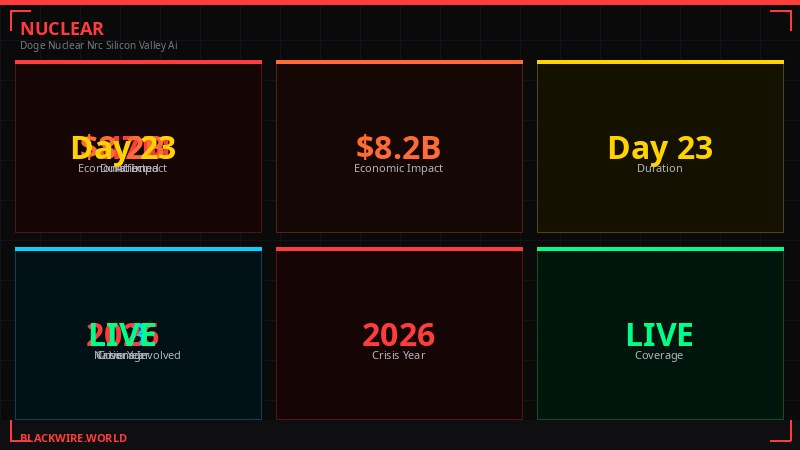
The numbers from ProPublica's analysis of staffing data from the NRC and the Office of Personnel Management are stark. Over 400 people have left the Nuclear Regulatory Commission since Trump took office. The departures are not random: they are concentrated in the teams that handle reactor safety and nuclear materials, and among veteran staffers with ten or more years of experience.
This is not natural turnover. When an organization loses its most experienced domain experts faster than it can replace them, institutional knowledge does not just decline - it evaporates in ways that take decades to rebuild. The muscle memory of how to catch safety problems, how to read a reactor operator's license application for the gaps that can lead to accidents, how to run an emergency preparedness exercise that finds real weaknesses rather than paper ones - that lives in people, not in documents.
And the incoming class? Nearly 60 new arrivals in Trump's first year, compared to nearly 350 in Biden's final year. The pipeline is not just slowing. It has nearly stopped.
The exits include the most senior leadership. In August 2025, the NRC's top attorney resigned and was replaced by an oil and gas lawyer, David Taggart, who had been working on DOGE budget cuts at the Department of Energy. The executive director for operations, Mirela Gavrilas, a 21-year NRC veteran, retired after getting "boxed out of decision-making," according to a person familiar with her departure. Trump fired NRC Commissioner Christopher Hanson in June 2025 - the first time a sitting NRC commissioner had ever been fired - after Hanson publicly argued for agency independence.
"The regulator is no longer an independent regulator - we do not know whose interests it is serving. The safety culture is under threat." - Allison Macfarlane, former NRC chair (Obama administration), to ProPublica
The Hat Incident and What It Reveals

When Cohen and his DOGE team arrived at NRC headquarters - a cluster of nondescript office towers across from a Dunkin' Donuts in suburban Maryland - he brought along two colleagues: Adam Blake, an investor who had recently founded an AI medical startup with a background in real estate and solar energy, and Ankur Bansal, the president of a company that made software for real estate agents. Neither had nuclear experience.
Career NRC officials were, in the words of several interviewed by ProPublica, blindsided. "They were talking about quickly approving all these new reactors, and they didn't seem to care that much about the rules - they wanted to carry out the wishes of the White House," one NRC lawyer said. That lawyer resigned.
Then Cohen started handing out hats.
The hats were branded merchandise from Valar Atomics, a nuclear energy startup that is one of the companies currently seeking NRC approval to build a new reactor. Cohen was distributing free promotional gear from a company the NRC was actively supposed to be regulating. NRC ethics officials flagged it as a probable conflict-of-interest violation. The symbolism was impossible to miss, as one former official explained to ProPublica:
"Imagine you live near a nuclear power plant, and you find out a supposedly independent safety regulator - the watchdog - is going around wearing the power plant's branded hats. Would that make you feel safe?" - Former NRC official, speaking to ProPublica
Valar Atomics is not just any startup. Its angel investors include Palmer Luckey, founder of the defense contractor Anduril, and Shyam Sankar, the chief technology officer of Palantir - the data company embedded in Immigration and Customs Enforcement's deportation operations. The firm is also one of three nuclear reactor companies that sued the NRC last year in an attempt to strip it of its authority to regulate their reactors entirely, proposing to replace federal oversight with state-level regulators instead.
Before the Trump administration, lawyers watching the case were confident the courts would dismiss it quickly. Under the new administration, senior officials pushed for a settlement negotiation. The career NRC lawyer working the case quietly left the agency.
Silicon Valley Capital Meets Nuclear Infrastructure
To understand why this is happening, you have to follow the money and the ideology simultaneously, because in this case they are inseparable.
The AI boom has created a power demand problem that has no clean short-term solution. Training and running large language models, processing the inference requests from hundreds of millions of users, and building out the agent infrastructure that major tech companies now bet their futures on - all of this requires enormous amounts of reliable, always-on electricity. Renewables like wind and solar are variable. Natural gas is cheap but carbon-intensive. Nuclear power is the only carbon-free baseload energy source that can deliver the scale and reliability AI data centers need.
A number of Silicon Valley's most powerful figures reached the same conclusion at roughly the same time. Billionaires Peter Thiel and Marc Andreessen - both with investments in nuclear energy companies and both influential Trump supporters - became vocal advocates for stripping away the NRC's perceived excess caution. Andreessen camped out at Mar-a-Lago after Trump's 2024 election win, helping select administration staff. Thiel personally vetted at least one candidate for the Office of Nuclear Energy in late 2024, according to people familiar with those conversations.
Their argument is not entirely without merit. The NRC's regulatory framework was largely designed for the large light-water reactors that dominated US nuclear construction in the 1970s and 1980s. Small modular reactors (SMRs) and advanced reactor designs - buried underground, passively cooled, far smaller in scale - may genuinely require different regulatory approaches. The agency has been slow to create licensing pathways for these new designs, and some of that slowness has nothing to do with safety and everything to do with bureaucratic inertia.
The bipartisan ADVANCE Act, signed by President Biden in 2024, already acknowledged this: it modified the NRC's mission statement to ensure the agency "does not unnecessarily limit" nuclear energy development. Even some traditional nuclear critics have moved toward supporting carefully expanded nuclear power as a climate tool.
But there is a vast difference between thoughtfully modernizing a regulatory framework and installing people who pass out branded merchandise from companies they're supposed to be watching, who respond to concerns about radiation exposure to babies with dismissive jokes, and who announce that the regulator will simply do "whatever we tell" it to do.
Rewriting the Rulebook - At Sprint Speed

This spring, the NRC is releasing thousands of pages of new rules governing everything from safety plans to emergency preparedness to the procedures companies must follow when objecting to a reactor license. The process is being driven at a speed that even insiders who support the direction of travel describe as dangerous.
"It's hard to know if they are getting rid of unnecessary processes or if it's actually reducing public safety," said one official working on reactor licensing, speaking anonymously for fear of retaliation. "And that's just the problem with going so fast - everything just kind of gets lost in a mush."
CNN reported in March that draft rules being circulated inside the NRC propose a 56 percent cut to the time spent on emergency preparedness inspections at nuclear facilities. Emergency preparedness is not administrative overhead. It is the system that determines whether people near a reactor can be safely evacuated if something goes wrong. It is the system that failed at Fukushima - where inadequate tsunami planning led directly to a meltdown that displaced 150,000 people and cost an estimated $200 billion in cleanup costs that are still being paid today.
The White House has also dispatched lawyers from the executive office of the president to monitor the rulemaking process at the NRC - a step previously unheard of for an independent regulator. One of those lawyers is Nicholas Gallagher, a recent NYU law school graduate whom ProPublica had previously identified as a DOGE operative at the General Services Administration. Another is Sydney Volanski, a 30-year-old recent law school graduate who first gained public attention in high school for campaigning against the Girl Scouts of America, which she accused of promoting "Marxists, socialists and advocates of same-sex lifestyle."
The White House maintains that "zero lawyers from the Executive Office of the President have been dispatched to work on rulemaking." But NRC lawyers were told in October that Gallagher and Volanski would be joining them, and both appear on the regular NRC rulemaking calendar invite, according to ProPublica's reporting.
The new rules are being routed through an office overseen by Russell Vought, Trump's budget director and cost-cutting strategist - another move described as previously unheard of for an independent regulatory agency.
What Emergency Preparedness Cuts Actually Mean
Emergency preparedness inspections at nuclear plants verify that evacuation routes are viable, that communication systems work, that plant staff can execute shutdown procedures under stress, and that local emergency services know what to do if the worst happens. A 56% cut in inspection time is not a bureaucratic efficiency - it is fewer drills, fewer discovered gaps, fewer corrected weaknesses. The American public lives within the evacuation zones of 93 operating nuclear reactors.
The Lessons History Keeps Teaching
The United States last had a serious nuclear incident 47 years ago. The reason that streak exists is not luck. It is the product of a regulatory culture built specifically because of what went wrong at Three Mile Island - and then reinforced by the global lessons from Chernobyl in 1986 and Fukushima in 2011.
The lesson of Chernobyl was partly about reactor design, but more fundamentally about a culture where operators could not say "I don't know" or "something is wrong" without career consequences. Where the pressure to keep reactors running outweighed the pressure to acknowledge uncertainty. The Soviet system's inability to tolerate dissent inside a nuclear plant contributed directly to the accident sequence that killed 30 workers immediately and exposed hundreds of thousands to elevated radiation.
Fukushima's lesson was about regulatory capture - the cozy relationship between Japan's nuclear industry and its oversight body that produced safety assessments that systematically underestimated flood risks. Investigators found that plant operators and regulators both knew a major tsunami was possible. Neither had the institutional independence or incentive structure to force a serious reckoning with that risk before it materialized.
"Political operatives have been inserted into the senior leadership team to the point where they could significantly influence decision-making. I just think that would be a dangerous proposition." - Scott Morris, 32-year NRC veteran (retired May 2025), to ProPublica. Morris voted for Trump twice and supports nuclear expansion.
The current situation at the NRC has structural similarities to both failure modes. Career staff who raise concerns are, according to multiple officials, afraid to voice dissenting views. "It feels like being a lobster in a slowly boiling pot," one official told ProPublica. "If somebody is raising something that they think that the industry or the White House would have a problem with, they think twice."
Three different NRC officials independently used the same metaphor - slowly boiling water - to describe their experience. That is not a coincidence. It is a distress signal from inside an institution whose culture of independent technical judgment is being dismantled in real time.
The AI Angle Nobody Is Talking About

Here is the second-order effect that most coverage is missing: the same AI industry that is driving the demand for nuclear power is also driving the ideological framework that is being used to justify stripping away the safety culture around it.
The "move fast and break things" philosophy is not inherently wrong. It has produced real advances in software, logistics, and consumer technology. But it contains an unstated assumption: that the things you break are recoverable. A failed app can be rolled back. A failed startup can be wound down. A nuclear accident cannot be rolled back. Contaminated land around Chernobyl will remain inside an exclusion zone until the 2060s at the earliest. Japan is still managing the cleanup at Fukushima, 15 years later, with no certain end date.
The AI industry understands iterative deployment and fast feedback loops. It does not have a cultural framework for managing failure modes that are irreversible and geographically catastrophic. Applying its instincts to a domain where the feedback loop for getting something wrong is measured in decades of contamination and cancer mortality - that is not innovation. That is category error.
Nvidia CEO Jensen Huang projected at GTC this week that AI infrastructure spending will top $1 trillion in chip purchases alone through 2027. (TechCrunch) That scale of energy consumption has no clean solution that doesn't run through nuclear power. The industry's hunger for power is real and urgent. But that urgency does not justify what is happening to the people and institutions whose entire purpose is to make sure the reactors fueling that hunger don't fail in ways that poison neighborhoods for generations.
The Conflict-of-Interest Map
- Marc Andreessen - investment in nuclear energy companies; helped select Trump administration staff; NRC now being reshaped toward industry preferences
- Peter Thiel - personally vetted at least one Office of Nuclear Energy candidate; investment in nuclear sector
- Palmer Luckey (Anduril) - angel investor in Valar Atomics, a company currently seeking NRC reactor approval and which sued the NRC to reduce its oversight
- Shyam Sankar (Palantir CTO) - angel investor in Valar Atomics
- Seth Cohen (DOGE/DOE) - distributed branded Valar Atomics merchandise to NRC staff; flagged as likely ethics violation; Cohen declined to comment
Even Supporters Are Worried

The most striking aspect of this story is not that critics of Trump's nuclear policy are alarmed - they were always going to be. It is that people who voted for Trump, who support nuclear expansion, who have spent careers arguing for faster reactor licensing, are raising the same warnings.
Scott Morris worked at the NRC for 32 years, rising to the second-highest career operations position. He voted for Trump twice. He broadly supports nuclear deregulation. He retired in May 2025 in the wave of departures from the agency, and he has since begun speaking publicly about what he witnessed.
"Political operatives have been inserted into the senior leadership team to the point where they could significantly influence decision-making," Morris said. "I just think that would be a dangerous proposition."
Judi Greenwald, president and CEO of the Nuclear Innovation Alliance - a nonprofit that actively supports many of the regulatory changes the Trump administration is pushing - expressed her own concerns about the speed and method. "You have to make sure you don't throw out the baby with the bathwater," she said.
Brett Rampal, senior director of nuclear and power strategy at Veriten and a genuine critic of the old NRC slowness, offered the most charitable reading: "I think the NRC has been frozen in time. It's a great time to get unfrozen and aim to work quickly."
But even Rampal's framing - unfreezing and moving quickly - implies a calibrated transition. What is happening instead is a wholesale personnel purge, ethics violations, White House lawyers embedded in rulemaking for an independent agency, and a 56 percent cut to emergency preparedness inspections. That is not unfreezing. That is something else.
Many longtime nuclear energy supporters are quietly lobbying their contacts in the Trump administration, trying to explain that an independent, credible regulator is not an obstacle to nuclear expansion - it is a prerequisite. Public acceptance of new reactor construction, which is what the industry urgently needs, depends on people believing the safety process is real. The moment a community near a proposed reactor site stops trusting the NRC's independence, permits become impossible to obtain. The lawsuits multiply. The timelines explode.
Discrediting the watchdog to build nuclear plants faster could easily end up making it impossible to build nuclear plants at all.
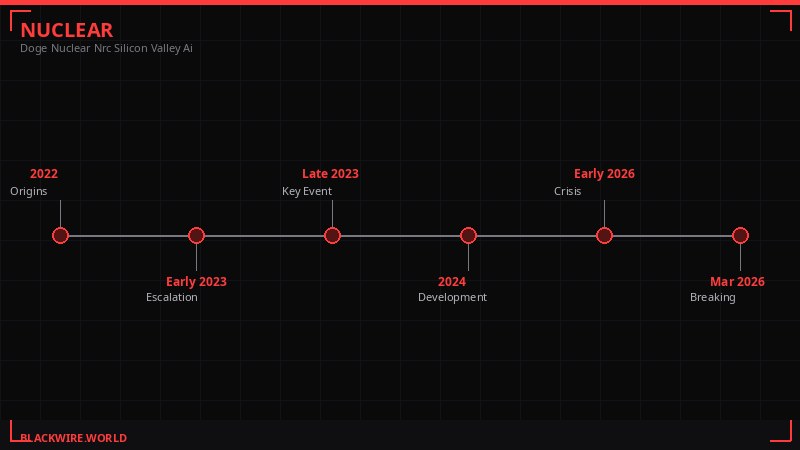
Timeline: How We Got Here
Trump fires NRC Commissioner Christopher Hanson - first time an NRC commissioner has been fired in the agency's history. White House explanation: "All organizations are more effective when leaders are rowing in the same direction."
Seth Cohen (DOGE) convenes meeting at Idaho National Laboratory. Tells officials: "Assume the NRC is going to do whatever we tell the NRC to do." Downplays radiation risk near test sites. NRC visits begin; Cohen distributes Valar Atomics branded hats - flagged as ethics violation.
NRC's top attorney resigns; replaced by oil and gas lawyer from DOGE DOE team. Federation of American Scientists counts: nuclear office at DOE has lost about a third of its staff.
NRC lawyers informed that White House executive office lawyers - Gallagher and Volanski - will join their rulemaking process. NRC becomes first independent agency to have its rulemakings routed through Russell Vought's office.
Cohen appointed chief counsel for nuclear policy at the Department of Energy. ProPublica count: over 400 NRC staff have departed since Trump took office. New hiring nearly halted.
Executive director Mirela Gavrilas, 21-year NRC veteran, retires after being boxed out of decision-making. First time in 20+ years NRC withdraws from Atomic Safety and Licensing Board proceedings, citing "limited resources."
CNN reports draft rules circulating inside NRC propose 56% cut to emergency preparedness inspection time. Spring rulemaking release: thousands of pages of new regulations. ProPublica publishes full investigation; NRC declines to comment.
What Happens Next

The NRC expects over two dozen new license requests from small modular and advanced reactor companies in the coming years. These are genuinely different machines from the light-water reactors that make up most of the current US fleet. Many are designed with passive safety systems that eliminate some of the accident pathways that plagued earlier designs. Some bury the reactor underground. Some run at much lower pressures. Some use different coolants entirely.
There is a real argument that these machines deserve a regulatory pathway tailored to their actual risk profile rather than one inherited from 1970s-era large reactor designs. The bipartisan ADVANCE Act recognized this. The NRC had started developing new frameworks for them before the current upheaval began.
But here is the problem: a licensing process conducted by an agency that has lost most of its experienced staff, whose remaining engineers are afraid to raise safety concerns, whose independence has been visibly compromised by political appointees distributing branded merchandise from applicant companies - that process will not produce trustworthy results. Not because the regulations will necessarily be wrong on paper, but because the institutional capacity to apply them competently and independently will have been hollowed out.
Nuclear power plants operate for 40 to 80 years. The licensing decisions being made today will have consequences that outlast every person currently in the Trump administration, every current member of Congress, and every current AI company's market capitalization. The knowledge that was built into the NRC over 50 years - the institutional memory, the safety culture, the accumulated case law of what can go wrong and how to prevent it - does not regenerate quickly once it has been dispersed.
Scott Morris, the 32-year NRC veteran who voted for Trump twice and supports nuclear expansion, put the stakes plainly in his description of the agency he left: "It feels like being a lobster in a slowly boiling pot."
He is not talking about paperwork. He is talking about the thing that has kept 93 American nuclear reactors from causing a catastrophe for 47 years. And he is describing it being heated from the outside, slowly, by people who have decided that the AI industry's power needs are more urgent than the institutional infrastructure that makes safe nuclear power possible in the first place.
They may be right that the NRC needed reform. They are demonstrating, in real time, that this is not what reform looks like.
Get BLACKWIRE reports first.
Breaking news, investigations, and analysis - straight to your phone.
Join @blackwirenews on Telegram