The Purge: How Bondi's DOJ Killed 23,000 Criminal Cases to Chase Immigrants Instead
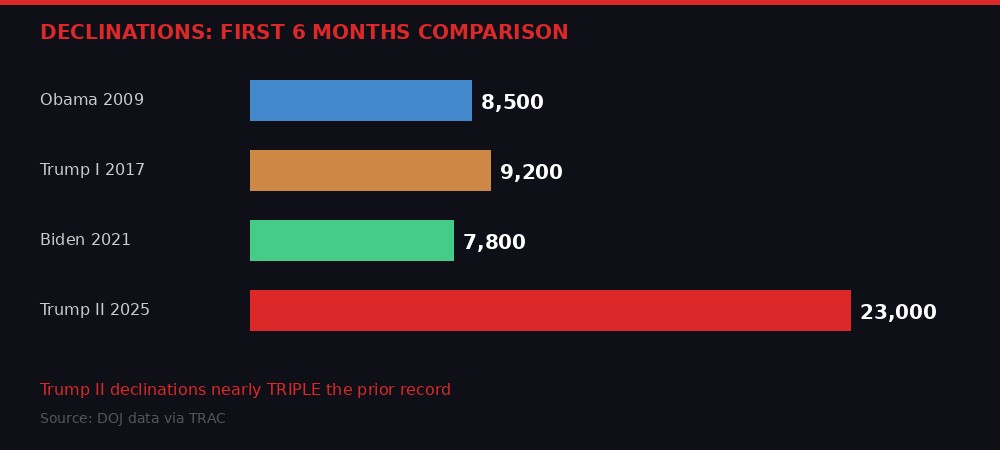
In the first six months of her tenure, Attorney General Pam Bondi's Department of Justice quietly dropped more than 23,000 criminal investigations - terrorism probes, fraud cases, drug trafficking operations, corruption inquiries - and redirected those resources to a single obsession: immigration enforcement. A devastating ProPublica analysis of two decades of DOJ data exposes the largest mass abandonment of federal criminal cases in modern American history.
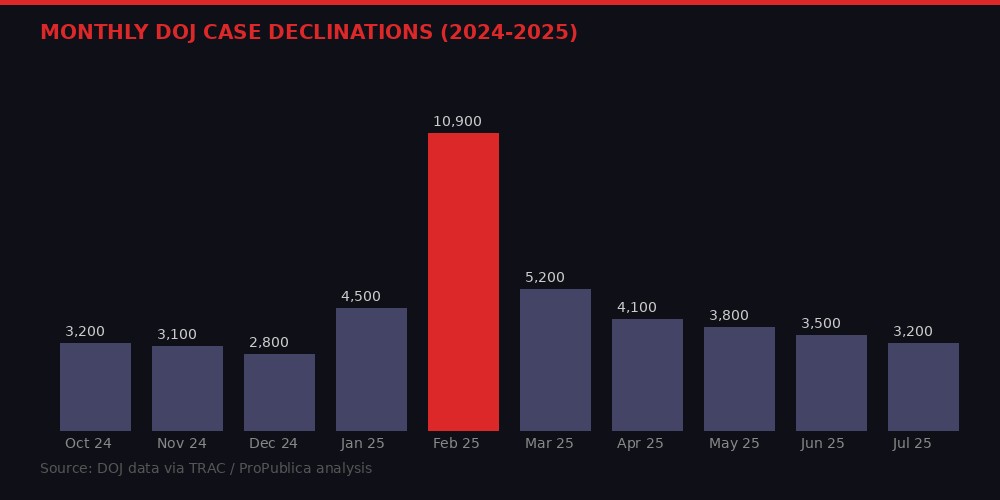
The numbers are not ambiguous. They do not require interpretation. In February 2025 alone - Bondi's first full month as attorney general - the DOJ declined nearly 11,000 cases. That is the highest single-month total since at least 2004, when modern record-keeping began. The previous record was 6,500 declinations in September 2019, during Trump's first term. Bondi didn't just break the record. She obliterated it.
What was dropped? Not paperwork backlogs. Not administrative cruft. These were active criminal investigations referred to the DOJ by the FBI, the Drug Enforcement Administration, the IRS Criminal Investigation Division, and other federal law enforcement agencies. Some had been built over years. Some involved ongoing undercover operations. Some were weeks away from indictments.
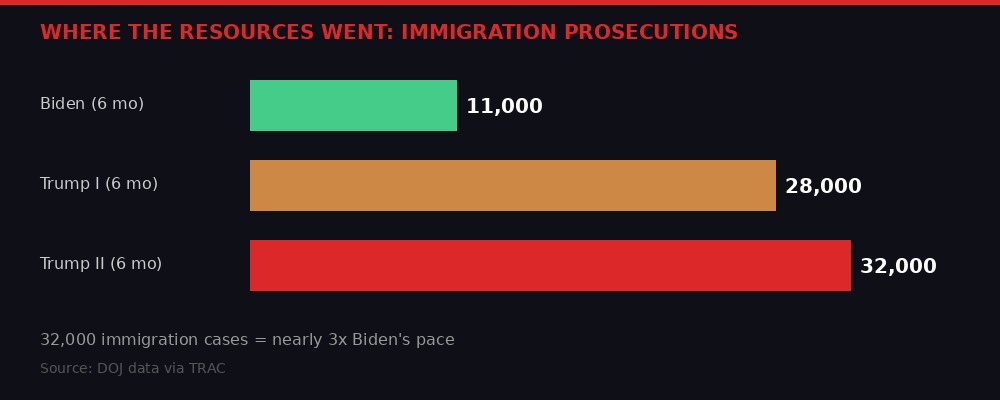
All of them were killed to free up prosecutors for immigration cases. In those same six months, the DOJ filed 32,000 new immigration prosecutions - nearly triple Biden's pace and 15 percent above Trump's own first term. The trade was explicit: for every immigration case the department picked up, it threw something else away.
The 10-Day Memo
The purge didn't happen organically. It was ordered from the top.
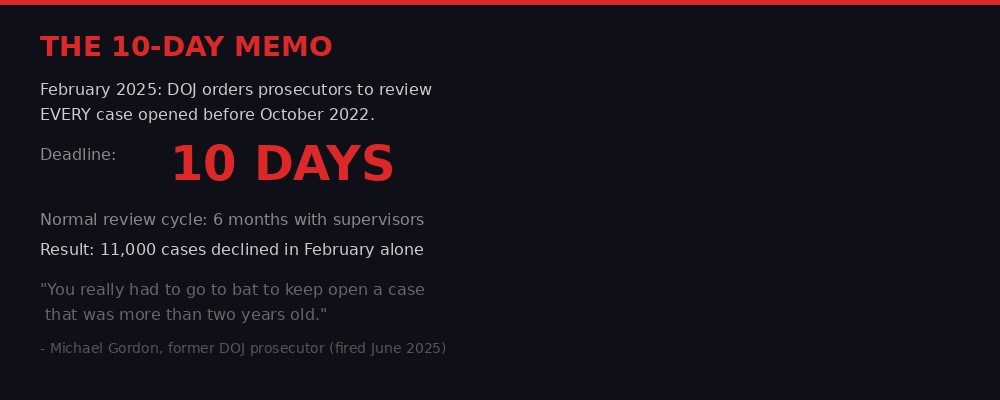
In February 2025, shortly after Bondi's confirmation, the Department of Justice issued an internal directive requiring every U.S. Attorney's office to review all open criminal cases launched before October 2022 and determine whether to keep or close them. The review was to be completed within 10 days.
Ten days. For cases that had been under investigation for two, three, sometimes four years.
Former DOJ prosecutors told ProPublica this was unprecedented. The normal cadence for case review is roughly every six months, conducted collaboratively between line prosecutors and their supervisors. Nobody could recall a mass review order with a 10-day window. The effect was predictable and almost certainly intended: prosecutors who could not justify keeping a case open in a single paragraph on a master spreadsheet watched it get killed.
"The office was pushing us to close everything by a certain date so that when they had to report up to D.C. they had a low number of open cases. You really had to go to bat to keep open a case that was more than two years old."- Michael Gordon, former DOJ prosecutor, fired June 2025
Gordon's account is corroborated by multiple former colleagues. He described a culture where Washington higher-ups constantly demanded data about specific case types - not to understand them, but to weaponize the numbers. "It was either 'give us stats we can use to make ourselves look good' or 'give us the stats to show how bad things are in this area,'" Gordon said. "It was never productive fact-finding."
Gordon was fired in June 2025. He has filed a lawsuit alleging political motivation. The government has moved to dismiss, arguing jurisdictional grounds. The case remains pending as of this writing.
The DOJ's official explanation for the spike? A spokesperson told ProPublica it was part of "an effort to clean, remediate, and validate data in U.S. Attorneys' case management system." They described it as reviewing "pending criminal matters opened prior to the 2023 fiscal year" and called the declinations "a direct result of our efforts to run the agency in a more efficient manner."
Efficiency. That is the word the Department of Justice chose to describe the abandonment of terrorism investigations, drug trafficking probes, and fraud cases involving patient abuse at nursing homes.
The Drug Betrayal: 5,000 Cases and the Fentanyl Lie
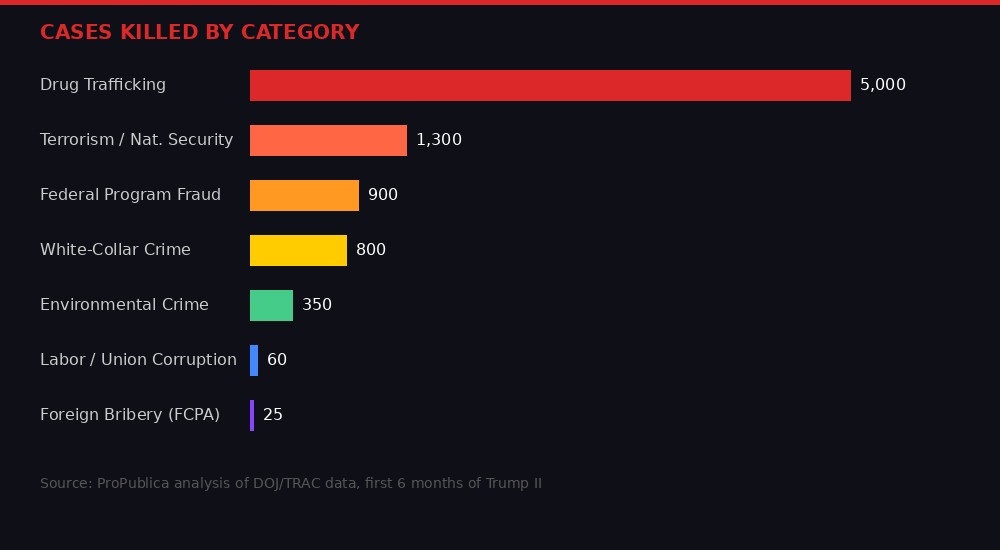
No category was hit harder than drug enforcement. The DOJ declined to prosecute nearly 5,000 federal drug law violations in the first six months - 45 percent more than the average of the three prior new administrations. This happened while President Trump was publicly declaring fentanyl a "scourge" and signing executive orders labeling it a weapon of mass destruction.
The contradiction is not subtle. The president who built his immigration rhetoric around fentanyl - who claimed migrants were flooding the border with synthetic death - ordered his Justice Department to drop thousands of drug cases to free up prosecutors for border prosecutions. The actual fentanyl pipeline investigations? Those were the ones getting killed.
Joseph Gerbasi, a 28-year veteran of the DOJ's Narcotic and Dangerous Drug Section, watched this happen in real time. He had spent years building cases against major suppliers of fentanyl precursor chemicals in India and China - the upstream architecture of the opioid crisis. When Bondi arrived, his team was ordered to pivot away from these cases and focus on Tren de Aragua, a Venezuelan gang the Trump administration had designated a foreign terrorist organization.
"Tren de Aragua was not anywhere close to the scale or impact of the cartels we were focused on. But we were told to generate those cases."- Joseph Gerbasi, retired acting deputy chief for policy, DOJ Narcotic and Dangerous Drug Section (28 years)
Gerbasi described being ordered to fly investigators to small towns to pursue local gangs allegedly affiliated with Tren de Aragua - cases that "never would have merited a full-scale federal investigation" under normal prioritization. The message from leadership was clear: political visibility mattered more than criminal impact.
"It told me that decisions were going to be based on political appearances and not based on the merits of where investigative resources should be placed," Gerbasi said. He retired in March 2025 after nearly three decades. The DOJ declined to comment on his remarks.
"All of the building blocks of what would become successful prosecutions were pulled out," he said. The move had an "overwhelming deflating effect on morale."
Consider what this means in practice. The United States government was actively building cases against the chemical suppliers in India and China who manufacture the raw ingredients for fentanyl. These are the organizations whose products ultimately kill 70,000 Americans every year. Those cases were killed. Instead, prosecutors were reassigned to chase Venezuelan gang members in towns most Americans have never heard of - because those cases generated headlines that aligned with the administration's immigration narrative.
The fentanyl crisis didn't get addressed. It got branded.
Terror Cases: 1,300 Investigations Abandoned
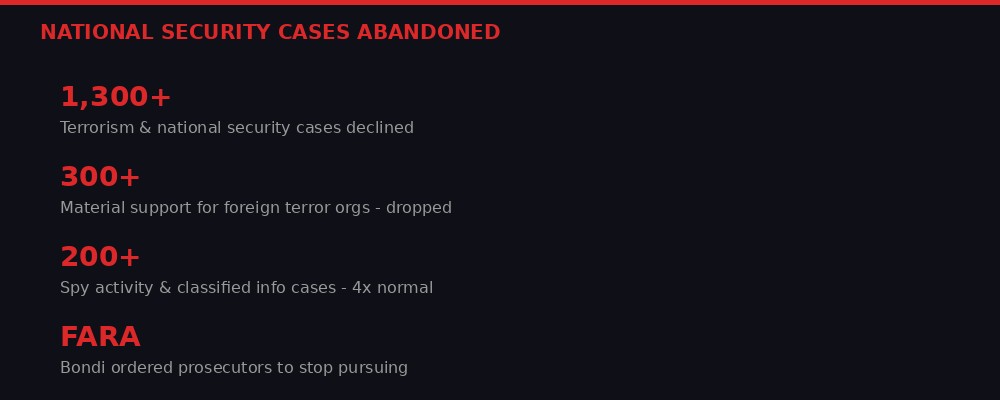
The administration that promised to "make America safe again" dropped more than 1,300 terrorism and national security cases in its first six months. That is nearly twice what was typical at the start of recent new administrations, regardless of party.
Domestic terrorism was the hardest-hit program. But the damage extended far beyond domestic threats. Just over 300 cases involving charges of providing material support to foreign terrorist organizations were also dropped. These are cases involving Americans suspected of funding or aiding groups like ISIS, al-Qaeda, and their affiliates.
The national internal security program - which handles spy activity and classified information breaches - saw more than 200 declinations. That is four times the normal rate. Some of these cases involved serving as an unregistered foreign agent, a charge that Bondi explicitly ordered prosecutors to stop pursuing unless it involved "conduct similar to more traditional espionage by foreign government actors."
The implications of that directive are staggering. The Foreign Agents Registration Act (FARA) was designed precisely to catch the gray-zone influence operations that characterize modern espionage - lobbyists secretly working for hostile governments, think-tank analysts funded by foreign intelligence services, media operatives spreading state-directed narratives. Bondi effectively told prosecutors to ignore all of it unless someone was literally passing classified documents to a foreign handler.
"The Trump DOJ has been used as a political weapon. It's a question of prioritizing resources. Are they going to be used for national security threats or to prosecute his political enemies and critics?"- Jimmy Gurule, former federal prosecutor and George W. Bush appointee to the U.S. Treasury Department
Gurule's observation is worth sitting with. He is not a Democratic operative. He served under George W. Bush. He spent his career investigating terrorism financing. When he says the DOJ is being weaponized, he is speaking from direct experience with what normal national security enforcement looks like - and how far this administration has departed from it.
The 200-plus abandoned spy cases are particularly alarming in context. The United States is currently at war with Iran. Russia continues its invasion of Ukraine. China is accelerating military operations in the South China Sea and Taiwan Strait. In every one of these theaters, the adversary has active intelligence networks operating on American soil. The DOJ just told those networks that the risk of prosecution has been cut by 75 percent.
The Fraud Paradox: DOGE vs. Reality
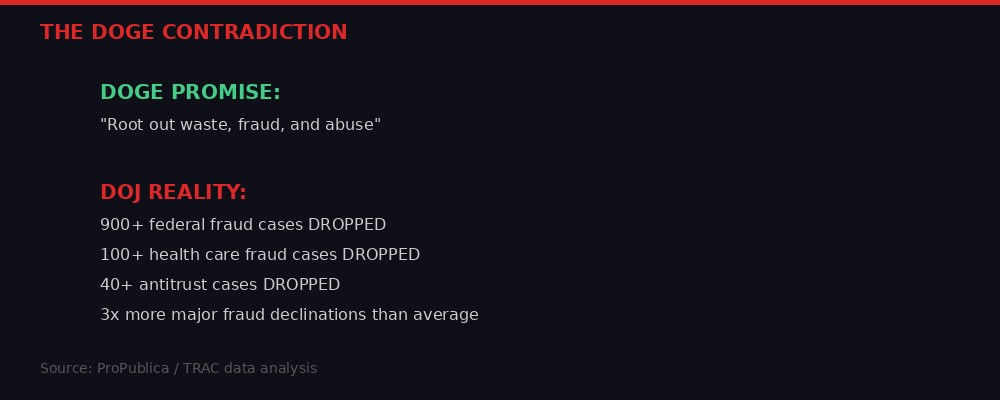
Perhaps no aspect of this story is more absurd than the fraud numbers. While Elon Musk's Department of Government Efficiency operatives were making headlines for rooting out "waste, fraud, and abuse" in federal spending, Bondi's DOJ was simultaneously dropping more than 900 cases of federal program or procurement fraud.
That is three times as many major fraud declinations as the average of comparable periods under prior administrations. The cases included a mortgage lender accused by multiple state regulators of defrauding the Federal Housing Administration, whose case was dropped due to "prioritization of federal resources and interests." Over 100 health care fraud cases were killed under the same rationale - even though the Trump administration publicly declared health care fraud enforcement a priority.
The Antitrust Division dropped more than 40 cases in six months - more than double the number declined by the three prior new administrations combined over the same window. Corporate monopolies that were under active investigation walked away free.
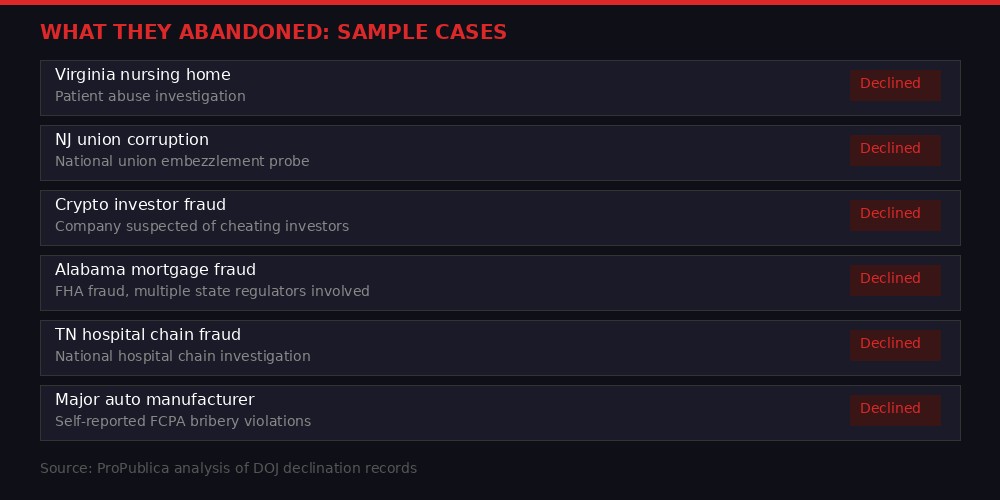
Among the specific cases abandoned: an investigation into a Virginia nursing home with documented patient abuse. Probes of fraud involving multiple New Jersey labor unions, including one opened after a top official of a national union was accused of embezzlement. An investigation into a cryptocurrency company suspected of cheating investors. Investigations in Tennessee into fraud at a national hospital chain and one of the largest Medicaid managed care companies.
None of these cases were trivial. All involved real victims - patients, investors, taxpayers. All had been deemed serious enough by federal law enforcement to warrant DOJ referral. All were killed in the name of efficiency.
Labor Racketeering: The Unions Get a Free Pass
The DOJ shut down more than 60 union corruption and labor racketeering cases - 2.5 times the number declined during Trump's own first term. Nearly half came from the New Jersey U.S. Attorney's office, historically one of the most aggressive in pursuing union corruption. Every single case was marked as declined for "insufficient evidence."
Grady O'Malley spent four decades as an assistant U.S. attorney in that office, building many of those cases from the ground up. He retired in 2023 and was disturbed to learn from former colleagues that the probes he spent years constructing were being systematically shut down.
"No one is assigned to do labor union cases, and the unions have every reason to believe no one is looking."- Grady O'Malley, retired AUSA, New Jersey (40 years at DOJ). O'Malley describes himself as a Trump supporter.
The detail about O'Malley's politics matters. This is not a partisan complaint. A Trump-supporting career prosecutor with four decades of service is telling anyone who will listen that the president's DOJ is abandoning the fight against union corruption - and that corrupt union officials know it.
The implications extend beyond the immediate cases. Federal prosecution serves a deterrent function. When prosecutors are assigned to watch an industry, that industry moderates its behavior. When the watchers leave, the watched stop caring. O'Malley's warning - that unions "have every reason to believe no one is looking" - is a prediction about future behavior, not just a lament about past cases.
The New Jersey U.S. Attorney's office declined to comment.
Foreign Bribery: The FCPA Surrender
In February 2025, Trump signed an executive order pausing new investigations under the Foreign Corrupt Practices Act - the law that prohibits American citizens and companies from bribing foreign officials to win business. The order directed the attorney general to review existing probes and "take appropriate action" to "preserve Presidential foreign policy prerogatives."
Bondi's DOJ shut down 25 FCPA cases in six months. That is more than the combined total dropped by the three prior new administrations over the same period. Among the abandoned cases: a major car manufacturer that had self-reported possible anti-bribery violations involving a foreign subsidiary. The company came forward voluntarily, disclosed potential crimes, and cooperated with investigators. The DOJ rewarded that transparency by dropping the case entirely, citing "prioritization of federal resources and interests."
The FCPA exists because American companies bribing foreign officials destabilizes allied governments, distorts international markets, and funds corruption networks that often overlap with organized crime and terrorism financing. When a multinational learns it can self-report a bribery scheme and face zero consequences, the incentive structure is obvious: bribe freely, and if caught, confess without penalty.
The executive order framing is revealing. Trump didn't argue the FCPA was unconstitutional or ineffective. He said pursuing bribery cases might interfere with his "foreign policy prerogatives." The implication is that some bribery is acceptable if it serves American diplomatic interests - or, more precisely, that the president alone should decide which bribery gets punished and which gets overlooked.
This is not deregulation. It is selective enforcement, which is worse. Deregulation at least applies uniformly. Selective enforcement means the DOJ becomes a tool for rewarding allies and punishing enemies. A company with political connections gets its FCPA case dropped. A company without them gets the full weight of federal prosecution. The law hasn't changed. Its application has been corrupted.
Environmental Crimes: Three Times the Abandonment Rate
The DOJ closed three times as many environmental crime cases as the Biden administration did in the same period, and 1.5 times as many as Trump's own first term. One-fifth of all dropped environmental protection cases were shut down for "prioritization of resources and interests."
This happened simultaneously with the reassignment and termination of prosecutors working on environmental cases. The environmental crime apparatus wasn't just deprioritized - it was dismantled. Attorneys were moved to other divisions or pushed out entirely, ensuring that even if policy changed in the future, the institutional knowledge required to build complex environmental cases would be gone.
The ProPublica investigation by Aaron Szabo - the same official who, as an oil and gas lobbyist, helped draft industry arguments against methane regulations before being appointed to run EPA's methane program - adds another layer. The people dismantling environmental enforcement are the same people who lobbied against it from the private sector. They didn't change their goals when they entered government. They just gained access to better tools.
Environmental crime prosecution is uniquely complex. These cases require specialized scientific expertise, multi-year monitoring of pollution sites, coordination with state environmental agencies, and expert witnesses who can translate technical data for juries. When you fire the prosecutors who know how to do this work, you don't just lose current cases. You lose the ability to bring future ones. The damage compounds over time.
Communities downstream from polluters - often low-income, often communities of color - are the ones who pay the price. Their water stays contaminated. Their air stays toxic. Their children continue getting sick. The companies responsible have learned that the federal government is no longer interested in holding them accountable.
The FACE Act Reversal and the Broader Pattern
On her first day, Bondi ordered a review of criminal prosecutions under the Freedom of Access to Clinic Entrances Act, which prohibits illegal obstruction of abortion clinics and places of worship. The department dropped as many FACE Act cases in six months as the three prior new administrations combined. Bondi's stated focus was on "non-violent protest activity," although at least one of the closed cases was being investigated as a violent crime.
The irony deepened when the DOJ subsequently used the FACE Act to charge anti-ICE protesters and journalists in Minneapolis. The same law that couldn't be applied to people physically blocking abortion clinic entrances was suddenly robust enough to prosecute demonstrators at immigration raids. The law didn't change. The targets did.
This pattern - drop cases against preferred constituencies, weaponize the same statutes against critics - defines the Bondi DOJ. It is not a policy disagreement. It is a corruption of the prosecutorial function itself. When the government chooses which laws to enforce based on the political identity of the accused, the concept of equal justice ceases to exist.
The Institutional Damage: 300 Letters and Counting
Nearly 300 DOJ employees who have left the department under Trump signed an open letter describing the administration as "taking a sledgehammer" to the work of "protecting communities and the rule of law." The letter, published by The Justice Connection, represents attorneys with decades of combined experience across every division of the department.
Barbara McQuade, who served as a federal prosecutor in Michigan for two decades under both Republican and Democratic administrations, told ProPublica that while new administrations often arrive with "pet priorities," the changes under Bondi are qualitatively different. Previous transitions involved "modest adjustments in policy." Most decisions about enforcement priorities were made locally, by district U.S. attorneys in coordination with the FBI and other agencies. The current approach - mandating case closures from Washington on a 10-day timeline - has no precedent in her experience.
"We would revise those about every five years, not having anything to do with any administration, just because it made sense."- Barbara McQuade, former federal prosecutor, Michigan (20 years, Republican and Democratic administrations)
The exodus itself is part of the damage. When experienced prosecutors leave, they take institutional knowledge with them - knowledge about ongoing investigations, informant networks, legal strategies, and the relationships with state and local law enforcement that make complex cases possible. A new prosecutor assigned to a case abandoned by a departing colleague doesn't just pick up where they left off. In most cases, the case dies. The evidence grows stale, witnesses become unavailable, and statutes of limitations begin to run.
The DOJ's own response to ProPublica - that the mass declinations were about running the agency "in a more efficient manner" - reveals a fundamental misunderstanding of what the Department of Justice does. Criminal prosecution is not a manufacturing process that can be optimized for throughput. An efficient justice system is not one that processes the most cases. It is one that processes the right cases - the ones that protect public safety, hold powerful actors accountable, and deter future crime.
By that standard, the Bondi DOJ is the least efficient in modern history. It has freed drug traffickers, ignored terrorists, enabled fraud, and pardoned polluters. It has prosecuted record numbers of people for crossing a border while abandoning investigations into people who steal billions, poison water supplies, and fund enemy governments. That is not efficiency. It is a policy choice disguised as administration.
Timeline of the Purge
Trump inaugurated. DOJ overhaul begins immediately.
Pam Bondi confirmed as Attorney General. Issues "first day" directives including FACE Act review and immigration prioritization.
Internal memo orders review of ALL cases opened before October 2022. Deadline: 10 days. Nearly 11,000 cases declined in this month alone.
Trump signs executive order pausing new FCPA investigations. Bondi begins reviewing existing probes.
DOJ announces "turning a new page on white-collar and corporate enforcement." Environmental and antitrust prosecutors reassigned or pushed out.
Joseph Gerbasi, 28-year DOJ veteran, retires after being ordered to abandon fentanyl precursor investigations.
Michael Gordon fired from DOJ. Files lawsuit alleging political motivation. Government moves to dismiss.
Six-month mark: 23,000+ cases declined. 32,000 immigration cases filed. Nearly 300 DOJ employees sign open letter.
Open letter from 300 DOJ alumni published. Describes administration as "taking a sledgehammer" to rule of law.
ProPublica publishes full analysis of DOJ declination data spanning two decades. Scale of purge revealed.
What Comes Next
The 23,000 cases are gone. Most cannot be revived. Statutes of limitations will expire. Witnesses will move or die. Evidence will degrade. The informants who cooperated with federal agents - some at personal risk - now know that the government they trusted to act cannot be relied upon. Future informants will think twice before coming forward.
The drug networks that were under investigation have had more than a year to restructure. The fraudsters whose cases were dropped have had time to hide assets and destroy evidence. The foreign agents who were being tracked now know the DOJ isn't looking. The environmental polluters whose violations were being documented can continue operating with impunity.
Every one of these consequences was foreseeable. Every one was accepted as the cost of pursuing immigration prosecutions at triple the prior rate. The administration made a choice: 32,000 immigration cases were worth more than the combined weight of every terrorism probe, every drug trafficking investigation, every fraud case, every environmental prosecution, and every anti-corruption inquiry that was sacrificed to make them possible.
That is the math. 32,000 for 23,000. Immigration enforcement purchased with the abandonment of every other form of justice.
The question is not whether this trade was worth it. The question is who decided it was - and whether the country they left unprotected will ever hold them accountable.
Primary source: ProPublica analysis of DOJ declination data obtained from the Department of Justice and the Transactional Records Access Clearinghouse (TRAC), covering 2004-2025. Additional reporting from TRAC, DOJ press releases, court filings, and interviews with former federal prosecutors including Joseph Gerbasi, Michael Gordon, Barbara McQuade, Grady O'Malley, and Jimmy Gurule.
Get BLACKWIRE reports first.
Breaking news, investigations, and analysis - straight to your phone.
Join @blackwirenews on Telegram