March 31, 2026 • 14 min read
The Great Purge: How Bondi's DOJ Killed 23,000 Criminal Cases to Chase Immigrants
Terrorism probes. Fraud investigations. Drug trafficking cases. Union corruption. Environmental crimes. All abandoned in the first six months - sacrificed on the altar of immigration enforcement. A ProPublica data analysis exposes the most sweeping prosecutorial retreat in modern American history.
BLACKWIRE / CIPHER analysis of DOJ declination data
Twenty-three thousand criminal investigations don't just disappear. Somebody has to kill them.
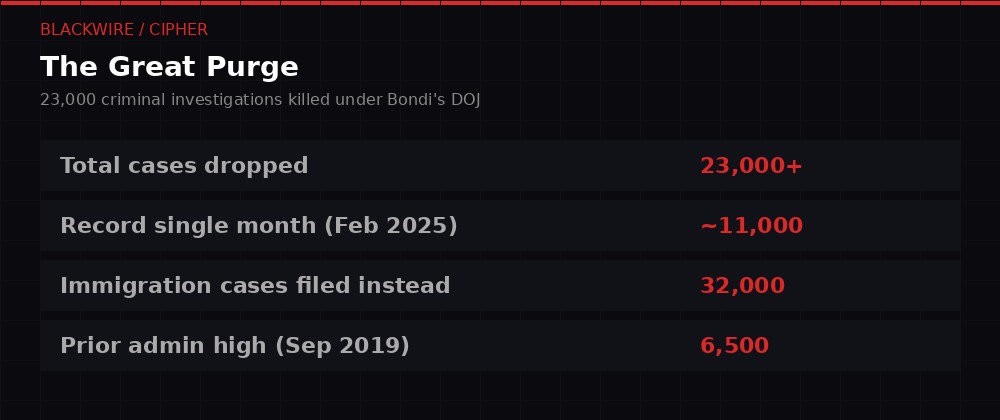
In the first six months of Attorney General Pam Bondi's tenure at the Department of Justice, her department quietly closed more than 23,000 criminal cases - abandoning investigations into terrorism, white-collar fraud, drug trafficking, union corruption, environmental crimes, espionage, and foreign bribery. The sheer scale of the purge has no precedent in at least two decades of DOJ data, according to an analysis by ProPublica that examined records obtained through the Transactional Records Access Clearinghouse (TRAC) and direct DOJ disclosures.
These were not stale files gathering dust. Many represented years of painstaking investigative work by FBI agents, DEA field teams, and federal prosecutors who had assembled evidence they believed warranted criminal charges. Some targeted nursing homes accused of abusing patients. Others tracked fentanyl supply chains stretching from chemical labs in China and India to American streets. Still others monitored union bosses suspected of embezzlement, corporate executives accused of bribing foreign officials, and companies allegedly defrauding the Federal Housing Administration.
All of them were deemed expendable. The reason, laid bare in internal memos and the testimony of current and former prosecutors: immigration enforcement needed the bandwidth. The Trump administration filed 32,000 new immigration cases in the same period - nearly triple the Biden-era rate and a 15% increase over Trump's own first term. The math is brutal. For every immigration case filed, roughly 0.7 criminal investigations died somewhere else.
The DOJ's official explanation, delivered through a spokesperson, framed the mass closures as routine housekeeping - "an effort to clean, remediate, and validate data in U.S. Attorneys' case management system." The department claimed it reviewed all pending criminal matters opened prior to fiscal year 2023, "which included updating the status of closed cases." This characterization strains credulity when set against the numbers. In February 2025 alone - Bondi's first full month - nearly 11,000 cases were declined for prosecution. The previous monthly record, set in September 2019, was 6,500. The spike wasn't gradual. It was a cliff.
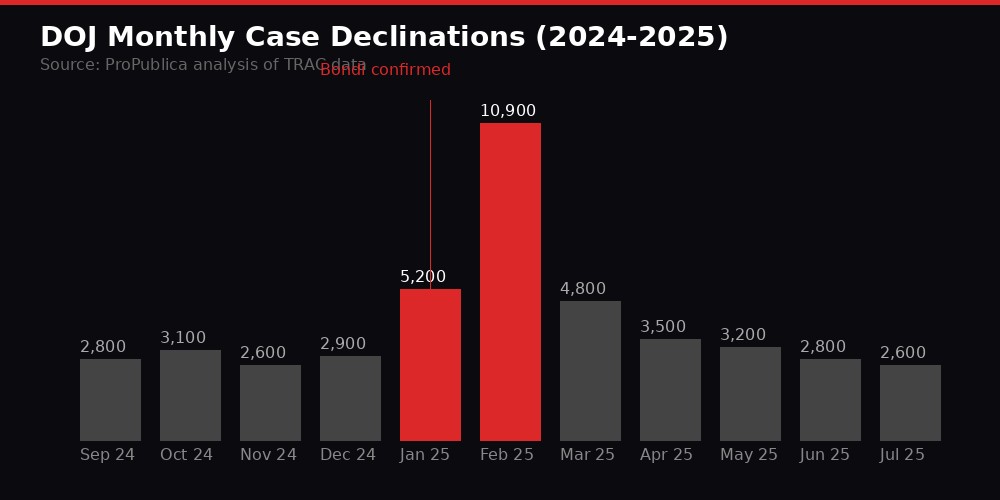
Monthly DOJ case declinations, 2024-2025. February 2025 shattered every record. Source: TRAC/ProPublica
The Ten-Day Memo
Timeline of key events in the DOJ case purge
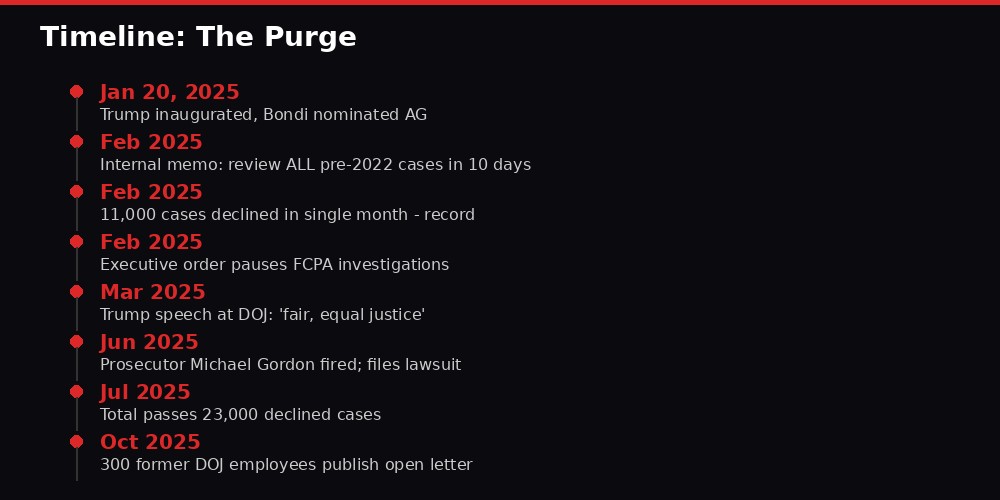
The purge began with a single directive. In February 2025, shortly after Bondi's confirmation, the DOJ ordered prosecutors across the country to review every open case launched prior to October 2022 and determine whether to close it. The review window: ten days.
Under normal circumstances, such reviews take months. Federal prosecutors typically examine their caseloads every six months with supervisors, weighing the strength of evidence, the significance of the case, and the likelihood of successful prosecution. This is the machinery of justice operating as designed - methodical, deliberate, cautious about throwing away work that might still yield results.
Ten days obliterated that process. Prosecutors were forced to make triage decisions at a pace that guaranteed many viable cases would be discarded. Former assistant U.S. attorney Michael Gordon, who worked Jan. 6 prosecutions before shifting to white-collar crime, described the environment in vivid terms to ProPublica. Supervisors would appear at his door with what he called "fire drills" - frantic demands from Washington for data about specific types of cases and charging decisions.
"It was either 'give us stats we can use to make ourselves look good' or 'give us the stats to show how bad things are in this area.' It was never productive fact-finding." - Michael Gordon, former DOJ prosecutor, to ProPublica
Gordon described an office culture where the imperative was to drive down the number of open cases as quickly as possible. Prosecutors had to enter basic information about any case they wanted to keep pursuing into a master spreadsheet, then fight to justify keeping it open. The burden of proof had effectively been reversed: instead of cases staying open until there was reason to close them, they were presumed dead unless someone actively defended them.
"The office was pushing us to close everything by a certain date so that when they had to report up to D.C. they had a low number of open cases. You really had to go to bat to keep open a case that was more than two years old." - Michael Gordon, former DOJ prosecutor
Gordon was fired from the DOJ in June 2025. He has filed a lawsuit alleging his termination was politically motivated. The government filed a motion to dismiss, arguing the federal court lacks jurisdiction. The case remains pending. The DOJ did not respond to questions about Gordon's comments or his lawsuit.
Former prosecutors who spoke to ProPublica said they had never seen anything resembling the February directive. Caseload reviews happen regularly. A department-wide order to flush the pipeline in ten days does not. The distinction matters because it reveals intent. This was not housekeeping. It was a policy choice disguised as administration.
The consequences were immediate and measurable. In February 2025, the DOJ declined almost 11,000 cases - a number so far outside historical norms that it registers as a statistical anomaly. The typical monthly range for declinations over the prior two decades rarely exceeded 4,000. Bondi's first month nearly tripled that ceiling.
The Drug War That Wasn't
Drug case declinations vs. prior administration averages
Donald Trump has built a political brand around drug enforcement. He has called fentanyl a "scourge" and a "weapon of mass destruction." He signed an executive order last December designating it as such. His rhetoric suggests an administration that would flood resources into dismantling drug networks.
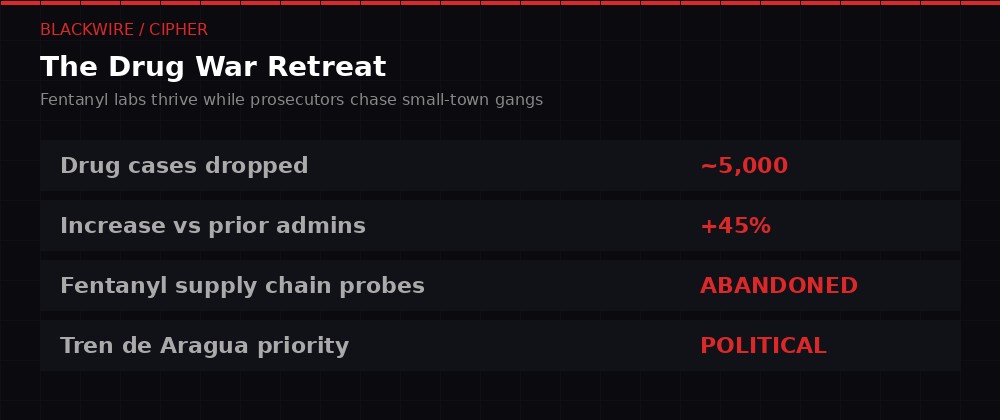
The numbers tell a different story. Under Bondi, the DOJ declined to prosecute nearly 5,000 cases of federal drug law violations, including trafficking and money laundering investigations. That figure represents a 45% increase over the average of the three prior new administrations in the same time window. The DEA agents and FBI investigators who built those cases over months or years found their work shelved without explanation or recourse.
Joseph Gerbasi spent 28 years in the DOJ's Narcotic and Dangerous Drug Section, retiring in March 2025 as acting deputy chief for policy. He had spent his final years building cases against major suppliers of fentanyl precursors in India and China - the upstream infrastructure that feeds American overdose deaths. After Bondi arrived, his team was ordered to abandon that work.
"All of the building blocks of what would become successful prosecutions were pulled out." - Joseph Gerbasi, former DOJ counternarcotics prosecutor (28 years), to ProPublica
The new priority, Gerbasi explained, was Tren de Aragua - a Venezuelan gang that the Trump administration designated a foreign terrorist organization. Prosecutors were ordered to generate cases against the group, sending investigators to small towns across the country to pursue local affiliates.
"Tren de Aragua was not anywhere close to the scale or impact of the cartels we were focused on. But we were told to generate those cases." - Joseph Gerbasi
The irony cuts deep. While the administration publicly declared war on fentanyl, it was simultaneously gutting the prosecutorial infrastructure designed to attack fentanyl supply chains. The investigators chasing chemical precursors in Mumbai and Guangzhou were reassigned to chasing street-level gang affiliates in rural America. This is not a strategic shift. It is a retreat decorated to look like an advance.
Gerbasi described the pivot as a morale killer. His team had spent years developing expertise in international drug supply chain prosecution - building relationships with foreign counterparts, mapping financial networks, developing sources. That institutional knowledge doesn't survive a reorganization. Once the team is scattered and the cases are closed, rebuilding from scratch takes years.
"It told me that decisions were going to be based on political appearances and not based on the merits of where investigative resources should be placed." - Joseph Gerbasi
The DOJ declined to comment on Gerbasi's remarks.
The National Security Blind Spot
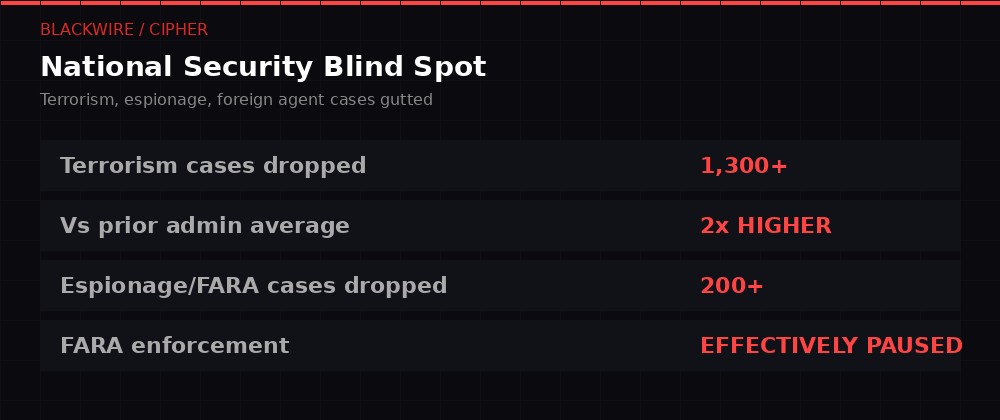
Terrorism and espionage case declinations - 2x the prior admin average
If the drug case numbers are troubling, the national security figures are alarming. Under Bondi, the DOJ declined more than 1,300 cases involving terrorism and national security - nearly double the typical volume at the start of recent new administrations. Domestic terrorism investigations were hardest hit, but the damage extended to every corner of the national security apparatus.
Just over 300 cases involving charges of providing material support to foreign terrorist organizations were dropped. These are not theoretical threats. Material support prosecutions target the financial and logistical networks that enable groups like ISIS, al-Qaeda, and their affiliates to plan and execute attacks. Each dropped case represents a node in a network that federal investigators deemed dangerous enough to open a formal investigation.
The espionage numbers are even more striking in proportional terms. The DOJ program handling national internal security - covering alleged spy activity and classified information security - saw over 200 declinations. That's four times the typical number in the first six months of a new administration. Some of these cases involved charges under the Foreign Agents Registration Act (FARA), which requires individuals working on behalf of foreign governments to register with the DOJ.
Bondi didn't just deprioritize FARA enforcement. She formally restricted it. In a directive to prosecutors, she ordered them to stop pursuing FARA cases unless they involved "conduct similar to more traditional espionage by foreign government actors." This effectively decriminalized the most common form of covert foreign influence: the lobbyist, consultant, or operative who advances a foreign government's agenda without registering. The distinction between a spy with a dead drop and a well-connected Washington consultant running influence campaigns for the Kremlin or Beijing may matter legally, but from a national security perspective, the latter is often more damaging.
Jimmy Gurule, a former federal prosecutor and George W. Bush appointee to the U.S. Treasury Department who investigated terrorism financing, described the decline in terrorism prosecutions as deeply troubling.
"The Trump DOJ has been used as a political weapon. It's a question of prioritizing resources. Are they going to be used for national security threats or to prosecute his political enemies and critics?" - Jimmy Gurule, former Bush Treasury appointee and federal prosecutor
The DOJ did not respond to a request for comment on Gurule's remarks.
The timing of these declinations is worth noting. They occurred during a period of escalating geopolitical tension - the early stages of the Iran conflict, ongoing Russian cyberattacks against NATO infrastructure, and persistent Chinese espionage operations targeting American technology companies and defense contractors. Gutting national security prosecution capacity during such a period is the institutional equivalent of disbanding the fire department during wildfire season.
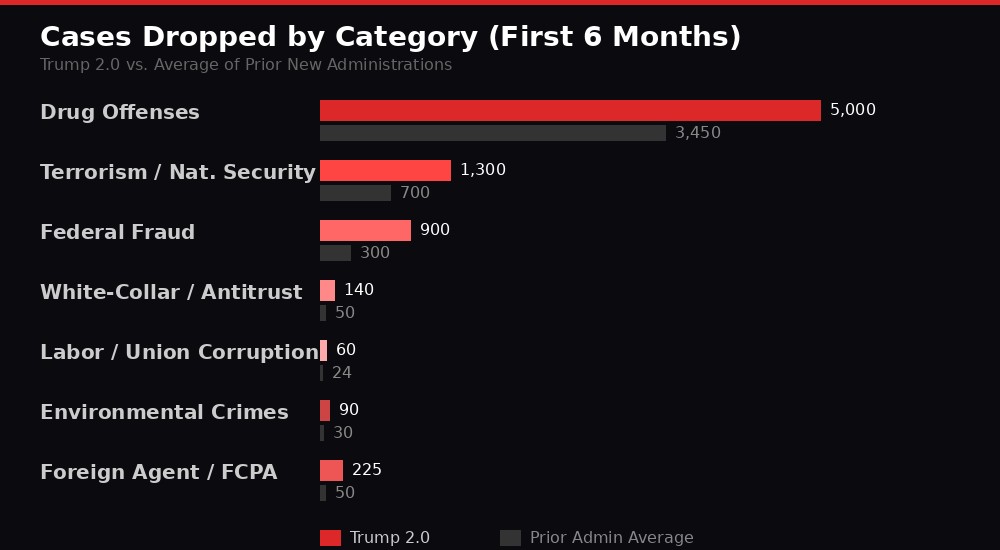
Case declinations by category: Trump 2.0 (red) vs. average of prior new administrations (gray). Source: TRAC/ProPublica
White-Collar Paradise: When Nobody Is Watching the Money
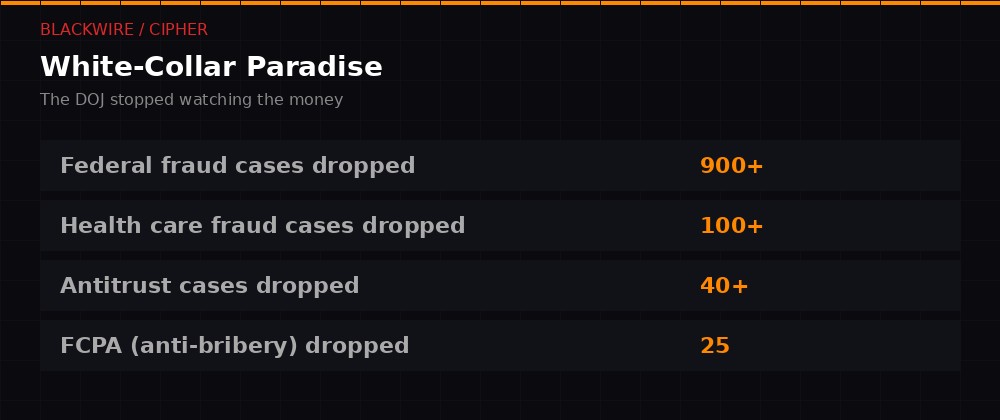
Federal fraud, antitrust, and FCPA case declinations
The Trump administration dispatched Elon Musk's Department of Government Efficiency (DOGE) operatives to root out waste, fraud, and abuse in federal spending. The rhetoric was aggressive. The reality, measured in prosecutorial action, was the opposite.
Under Bondi, the DOJ shut down more than 900 cases of federal program or procurement fraud. That's roughly three times the average of similar time periods under prior new administrations. Among the dropped cases: an investigation targeting a mortgage lender accused by several state regulators of defrauding the Federal Housing Administration. The case was closed due to "prioritization of federal resources and interests."
The DOJ also closed over 100 health care fraud cases despite the administration publicly declaring health care fraud enforcement a priority. In Tennessee, investigations into fraud at a national hospital chain and one of the largest Medicaid managed care companies were quietly abandoned. A spokesperson for the U.S. attorney in the Middle District of Tennessee said the office "does not comment on investigations that do not result in public charges."
The Antitrust Division - the federal government's primary mechanism for preventing monopolistic abuse - dropped more than 40 cases in Bondi's first six months. That's more than double the combined number declined in the same period by the three prior new administrations. In a political moment defined by public anger at corporate consolidation, the DOJ effectively stepped aside.
Perhaps the most revealing category is the Foreign Corrupt Practices Act (FCPA), which prohibits American citizens and companies from bribing foreign officials to gain business advantages. Trump issued an executive order in February 2025 pausing new FCPA investigations and directing Bondi to review existing probes. The department subsequently dropped 25 FCPA cases - more than the combined number abandoned by the three prior new administrations over the same window.
One of those cases involved a major car manufacturer that had self-reported possible anti-bribery violations involving a foreign subsidiary. The company had done the right thing by disclosing the issue to federal investigators. The DOJ rewarded that transparency by closing the case, citing "prioritization of federal resources and interests."
The message to corporate America is unambiguous: bribery is no longer a federal enforcement priority. Companies that self-report violations are wasting their time. The FCPA, one of the most important tools in the fight against international corruption, has been functionally suspended.
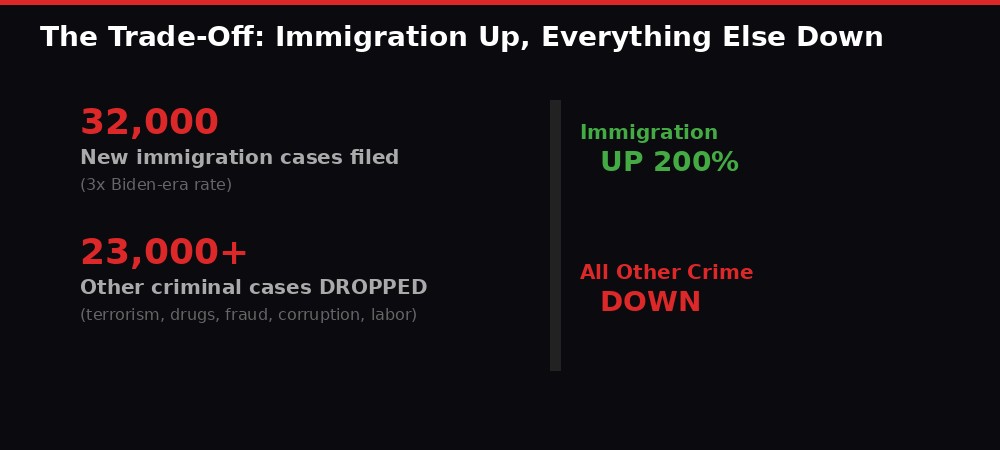
The arithmetic of the purge: immigration up, everything else down
Nobody Is Watching the Unions
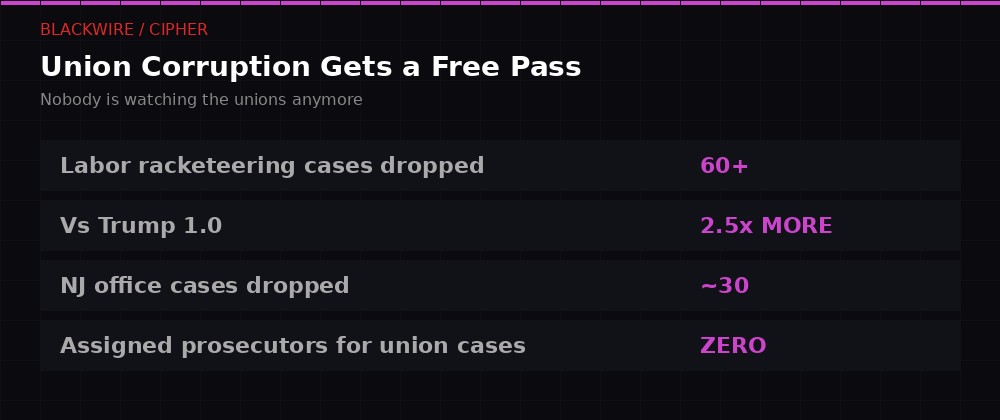
Union corruption enforcement gutted - 2.5x more cases dropped than Trump 1.0
The DOJ shut down over 60 union corruption and labor racketeering cases under Bondi - 2.5 times the number dropped in Trump's own first term. Nearly half of those cases came from the New Jersey U.S. attorney's office, which has historically been one of the most aggressive federal offices in pursuing union corruption.
Every single one of the New Jersey cases was recorded as declined for "insufficient evidence." This is a bureaucratic euphemism that obscures more than it reveals. These cases were opened because FBI agents and other investigators found enough evidence to believe a federal crime had been committed. "Insufficient evidence" at the declination stage typically means someone decided the case wasn't worth the resources to prosecute - not that the evidence disappeared.
Grady O'Malley, an assistant U.S. attorney who spent four decades in the New Jersey office overseeing union corruption prosecutions, retired in 2023. He was disturbed to learn from former colleagues that the office was shutting down the probes he and his team had built.
"No one is assigned to do labor union cases, and the unions have every reason to believe no one is looking." - Grady O'Malley, former AUSA (40 years), New Jersey, to ProPublica
O'Malley described himself as a Trump supporter - a detail that makes his criticism more striking, not less. He doesn't blame the president personally but worries that the decision to abandon union oversight will embolden the organizations he spent his career holding accountable. When federal prosecutors stop watching, the behavioral constraints they imposed through the threat of prosecution evaporate. Corruption that was suppressed by deterrence re-emerges.
The New Jersey U.S. attorney's office said it had no comment on the declination of labor cases.
Union corruption may not generate the headlines that terrorism or drug trafficking do, but its consequences are concrete and widespread. Embezzled union funds come directly from the paychecks of working people. Rigged contracts inflate costs that are passed on to consumers and taxpayers. Labor racketeering operations often intersect with organized crime. Abandoning oversight of these structures doesn't just let corrupt officials off the hook - it degrades the economic lives of the union members they're supposed to serve.
Environmental Crimes, FACE Act, and the Pattern of Selective Enforcement
The purge was not random. The categories of abandoned cases reveal a consistent pattern: enforcement priorities that aligned with the administration's political agenda were maintained or expanded, while priorities that conflicted with political allies or donor interests were gutted.
Environmental crime prosecutions illustrate this clearly. The DOJ closed three times as many environmental cases as the Biden administration and 1.5 times as many as Trump's own first term. One-fifth of the dropped environmental cases were specifically flagged as abandoned due to "prioritization of federal resources and interests." In a period of accelerating climate impacts, the federal government's primary tool for punishing polluters was deliberately blunted.
The prosecutors weren't just losing cases - they were losing their jobs. The DOJ reassigned and cut prosecutors working on environmental enforcement. The institutional capacity to pursue these cases is being systematically dismantled. Even if a future administration wanted to rebuild environmental prosecution, the expertise pipeline would take years to restore.
The Freedom of Access to Clinic Entrances (FACE) Act cases follow a different but equally revealing pattern. Bondi ordered a review of FACE Act prosecutions on her first day. The department subsequently dropped as many FACE Act cases in six months as the prior three new administrations combined over the same time frame. Bondi's order focused on "non-violent protest activity," though at least one of the closed cases was being investigated as a violent crime.
Meanwhile, the DOJ began charging anti-ICE protesters and journalists in Minneapolis under the same FACE Act - demonstrating that the statute itself wasn't the problem. The enforcement was selective. Anti-abortion activists got relief. Anti-ICE protesters got prosecuted. The law didn't change. The politics did.
Barbara McQuade, who spent two decades as a federal prosecutor in Michigan serving under both Republican and Democratic administrations, told ProPublica that while new administrations typically adjust enforcement priorities, those changes are usually modest and locally driven.
"We would revise those about every five years, not having anything to do with any administration, just because it made sense." - Barbara McQuade, former federal prosecutor (20 years), to ProPublica
What happened under Bondi was not a revision. It was a demolition.
The Immigration Pipeline: What the DOJ Built Instead
The 23,000 dropped cases didn't vanish into a vacuum. The resources that would have prosecuted them were redirected into a single category: immigration. The DOJ filed 32,000 new immigration cases in its first six months - nearly triple the Biden-era rate.
Immigration prosecution is, by design, a volume operation. The cases are typically simpler than terrorism or white-collar fraud investigations. They involve charges like illegal entry or illegal re-entry, and they move through the system quickly. From a purely statistical perspective, one immigration case produces roughly the same "case filed" metric as a complex multi-year fraud investigation. The numbers look the same on a spreadsheet. The institutional significance is radically different.
A counternarcotics prosecutor spending three years mapping a fentanyl supply chain from Guangzhou to Cincinnati is not interchangeable with an immigration attorney processing border crossings. The skills, relationships, institutional knowledge, and investigative infrastructure required for complex federal prosecution take decades to build. Redirecting those resources into immigration processing doesn't just mean fewer fraud cases - it means the erosion of the DOJ's capacity to handle sophisticated crime.
The administration has tried to have it both ways - claiming to fight fraud, terrorism, and drugs while systematically defunding the prosecutorial infrastructure that makes those fights possible. The contradiction is unsustainable. Either immigration enforcement is the priority and everything else suffers, or the DOJ maintains its full-spectrum mission. The numbers show which choice Bondi made.
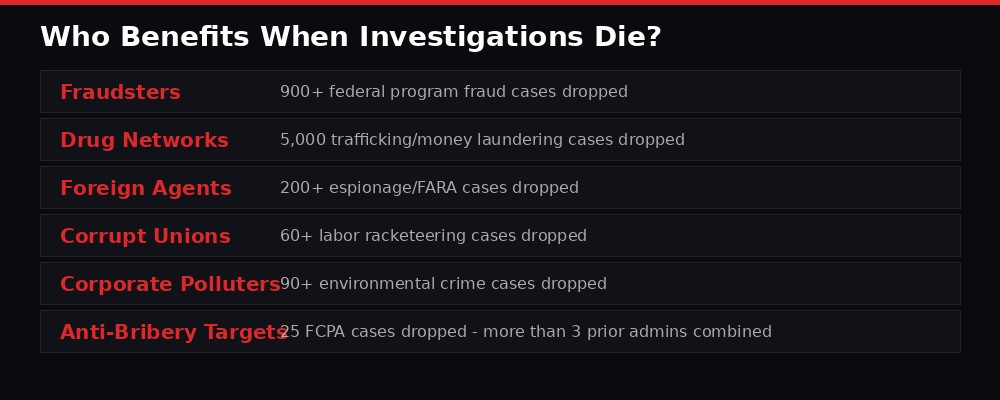
The beneficiaries of the purge - drug networks, fraudsters, foreign agents, corrupt unions
The Open Letter and the Exodus
Nearly 300 DOJ employees who left the department under Trump published an open letter in October 2025 describing what they'd witnessed. Their language was not diplomatic.
"[The Trump DOJ is] taking a sledgehammer to long-standing work to protect communities and the rule of law." - Open letter from ~300 former DOJ employees, published via The Justice Connection, October 2025
The letter described a department in retreat from its founding mission. Entire units were shuttered. Directives arrived ordering prosecutors to abandon pursuit of certain categories of crime. Thousands of lawyers quit or were forced out. The institutional culture of independence - the principle that prosecutorial decisions should be driven by evidence and law rather than political direction - was, in the view of these departing attorneys, being systematically destroyed.
The exodus is not unique to rank-and-file prosecutors. Senior officials, section chiefs, and career attorneys with decades of experience have left. Each departure takes with it institutional memory, case knowledge, and the professional relationships that make complex prosecution possible. A federal attorney who has spent fifteen years building rapport with counterparts at Interpol, the SEC, or the Bank of England's financial intelligence unit can't be replaced by hiring a recent law school graduate.
Trump, in his March 2025 address at the DOJ, characterized the changes as a necessary correction. He described the Biden era as a period of "surrender to violent criminals" and promised that his administration would restore "fair, equal and impartial justice under the constitutional rule of law."
The data tells a different story. The DOJ under Bondi has pursued fewer prosecutions of nearly every type of crime - from drug offenses to corruption to terrorism - than any new administration in its first six months dating back to 2009. The only category that went up was immigration. "Fair, equal and impartial justice" apparently has an asterisk.
What Dies When Investigations Die
The most dangerous consequence of the Great Purge isn't any individual case. It's the signal the purge sends to every category of criminal actor in America.
Drug traffickers now know that fentanyl supply chain investigations have been deprioritized. The DEA agents who tracked precursor chemicals from Asian labs to American distributors have been reassigned. The prosecutorial teams that would have converted those investigations into indictments have been disbanded.
White-collar criminals now know that the DOJ shut down 900 fraud cases and 40 antitrust investigations. Companies that might have thought twice about market manipulation or procurement fraud have received the clearest possible message: the watchdog is sleeping.
Foreign governments and their agents now know that FARA enforcement has been functionally paused. The 200+ espionage-related cases that were dropped signal that covert influence operations carry less risk than at any point in modern history. For nations like Russia and China, which invest heavily in political influence and intelligence collection in the United States, this is an open invitation.
Union officials suspected of corruption now know that nobody is assigned to watch them. The 60+ labor racketeering cases that were dropped - many of them built over years by a dedicated New Jersey prosecutor - will not be replaced. The unions have, in the words of that prosecutor, "every reason to believe no one is looking."
Environmental polluters now know that the prosecution infrastructure has been gutted and the prosecutors reassigned. Industrial facilities that might have invested in compliance to avoid federal prosecution can now calculate that the risk has been substantially reduced.
Deterrence works only when the threat of prosecution is credible. When 23,000 cases are dropped in six months - when the department issues a memo ordering the closure of multi-year investigations in ten days - the threat loses credibility across every category simultaneously. The criminal justice system doesn't just process past crimes. It prevents future ones through the implicit promise that violations will be detected and punished. Bondi's DOJ has broken that promise at a scale that will take years, possibly decades, to repair.
The Department's Defense and Its Limits
The DOJ's official position is that the declinations reflect a data cleanup exercise, not a policy shift. The spokesperson's statement - that the department reviewed all pending matters opened prior to fiscal year 2023 as part of an effort to "clean, remediate, and validate data" - is technically plausible in isolation. Agencies do periodically close stale files.
But the claim collapses under the weight of context. The ten-day review window is not consistent with a careful data validation exercise. The spike to 11,000 declinations in a single month - nearly double the previous record - is not consistent with routine housekeeping. The categorical breadth of the dropped cases - touching drugs, terrorism, fraud, espionage, labor, environment, antitrust, and foreign bribery simultaneously - is not consistent with a targeted cleanup of aged files.
The department noted that it charged "slightly more people with fraud in 2025 compared with the final year of the Biden administration" and that those cases involved larger financial losses. This is the bureaucratic equivalent of a magician's misdirection. The absolute number of fraud charges may be marginally higher, but the number of fraud investigations abandoned is triple the prior average. The cases that survived the purge may have been large, but the hundreds that didn't survive were simply erased from the pipeline.
The department also did not respond to questions about the types of cases declined. This silence is itself revealing. A department confident in the legitimacy of its declination decisions would welcome scrutiny of the categories involved. A department that knows those categories include terrorism, espionage, and fentanyl trafficking while the president claims to be fighting all three has every reason to stay quiet.
ProPublica's analysis determined that the increase in declinations is not the result of inheriting a larger caseload or receiving more referrals from law enforcement. The pipeline didn't get bigger. The department simply started throwing more of it away.
Follow the Math
The arithmetic of the Great Purge is not complicated. The DOJ under Pam Bondi made a clear, measurable choice: immigration enforcement over everything else. Not immigration enforcement alongside everything else. Over it. At its expense. Using the same finite pool of prosecutors, investigators, and institutional bandwidth.
The result is a Department of Justice that is simultaneously the most aggressive immigration enforcement operation in modern history and the weakest general criminal prosecution apparatus in at least two decades. Drug networks are larger. Fraud is less risky. Espionage is less costly. Union corruption is unwatched. Environmental crimes are unpunished. Foreign bribery is effectively legal.
That's not a policy choice anyone campaigned on. Nobody stood on a debate stage and said "I will gut terrorism prosecution to file more immigration cases." Nobody told voters "I will abandon 5,000 drug trafficking investigations so my attorney general can process border crossings faster." Nobody explained to the American public that "making America safe again" would require making white-collar fraud, labor racketeering, espionage, and environmental crime significantly safer for the people who commit them.
The 23,000 dead cases aren't statistics. They're open invitations. Every fraudster, every drug trafficker, every foreign agent, every corrupt union boss, and every corporate polluter in America has received the same message: the Department of Justice is looking the other way.
For how long remains to be seen. But the damage is already done.
Sources: ProPublica investigative report and analysis of DOJ/TRAC declination data (March 2026); TRAC (Transactional Records Access Clearinghouse) FOIA data; Interviews with former prosecutors Joseph Gerbasi, Michael Gordon, Grady O'Malley, Barbara McQuade, and Jimmy Gurule as reported by ProPublica; Open letter from approximately 300 former DOJ employees via The Justice Connection (Oct 2025); DOJ spokesperson statement; Trump executive orders on FCPA (Feb 2025) and fentanyl designation (Dec 2025); Bondi first-day memos on FACE Act and weaponization review.
Get BLACKWIRE reports first.
Breaking news, investigations, and analysis - straight to your phone.
Join @blackwirenews on Telegram