No Cops, No Rules: DOJ Kills Its Crypto Crime Unit While China's Digital Yuan Architect Pockets $8M in Bribes
The U.S. Department of Justice just disbanded the only federal unit dedicated to cryptocurrency crime. Senators are screaming about conflicts of interest. Meanwhile, in Beijing, the man who built China's state-controlled digital currency allegedly used anonymous crypto to hide millions in bribes. Two stories, one conclusion: the people charged with policing crypto don't want to be policed themselves.
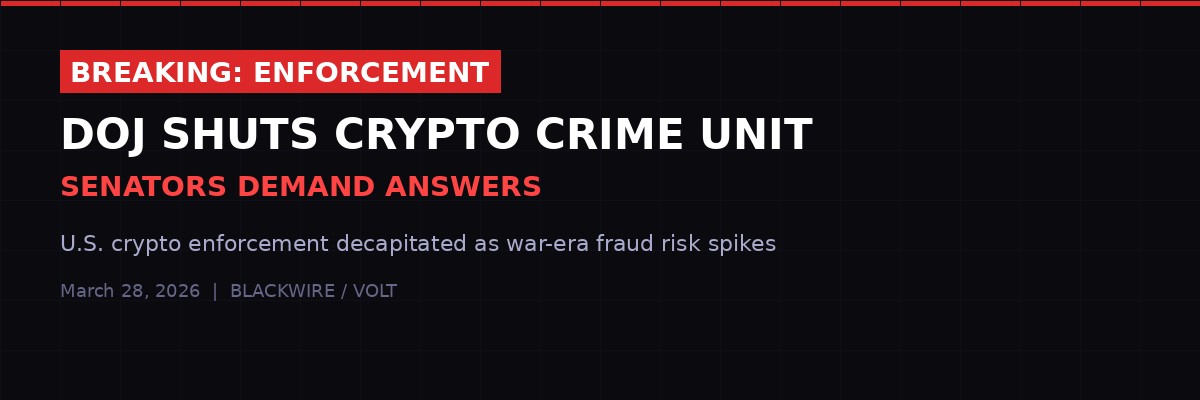
The DOJ's NCET handled landmark crypto prosecutions including the FTX case - and has now been shuttered.
Sometime in the last week of March 2026, the U.S. Department of Justice quietly killed the National Cryptocurrency Enforcement Team. No press release. No announcement. Staff got reassigned. The unit ceased to exist.
NCET was the only dedicated federal team with a singular mission: chase crypto crime. It prosecuted exchange fraud, DeFi exploits, ransomware gangs converting bitcoin to cash, NFT rug pulls, and sanctioned-nation wallets. It worked the SBF prosecution. It traced Lazarus Group funds. It was, by any measure, effective.
Now it's gone. And a group of U.S. senators wants to know why - specifically, whether the officials who made this decision hold crypto themselves.
At the same time, 7,000 miles away, Chinese prosecutors announced charges against Fan Yifei, the man who built China's e-CNY digital yuan. The charge: taking $8 million in bribes - routed through crypto wallets. The man who spent years designing a state-controlled digital currency to surveil financial flows used the very thing he was suppressing to hide his own corruption.
Two stories. Two governments. One shared theme: the people running crypto enforcement are the ones who need to be watched.
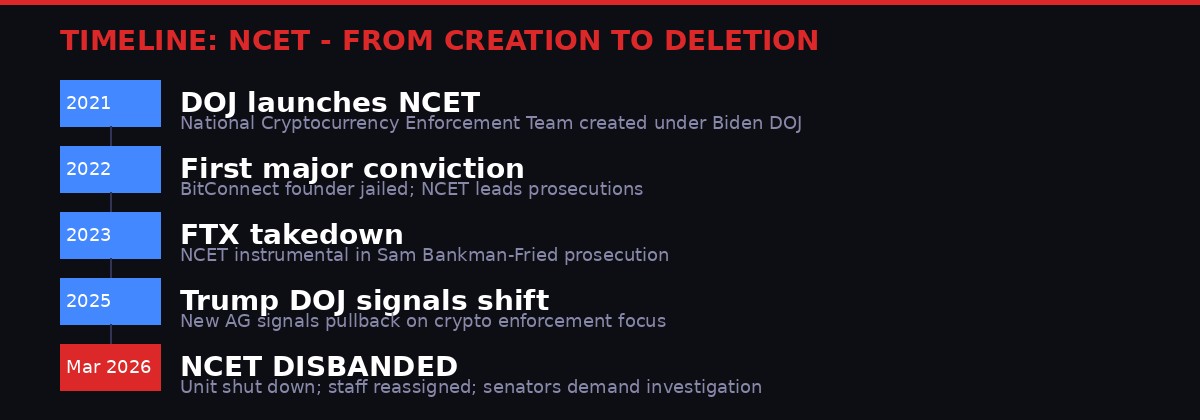
NCET lifecycle: Created 2021, peaked with FTX prosecution 2023, quietly disbanded March 2026.
What NCET Was - And What It Actually Did
The National Cryptocurrency Enforcement Team was stood up in October 2021 under then-Attorney General Merrick Garland. The mandate was straightforward: cryptocurrency crime had outgrown the FBI's existing financial crime units. The tools required were specialized - blockchain forensics, exchange subpoenas, cross-border asset tracing. NCET was designed to be the DOJ's sharp tip on crypto.
In its four-year run, NCET racked up a record that reads like a greatest hits of crypto's worst moments. The team was central to the prosecution of Sam Bankman-Fried and FTX executives, helping coordinate with the Southern District of New York on the case that ended with Bankman-Fried sentenced to 25 years. NCET led parallel investigations into Celsius, Voyager Digital, and Three Arrows Capital. It coordinated with the Treasury's Office of Foreign Assets Control on Tornado Cash sanctions.
On the ransomware front, NCET worked seizures against groups including REvil and BlackMatter, clawing back millions in cryptocurrency that had been paid out by hospitals, pipeline operators, and government agencies. In one 2023 operation alone, the team traced and recovered $112 million from a sanctioned crypto mixing service operating through multiple jurisdictions.
"NCET became the connective tissue between blockchain analytics firms like Chainalysis and TRM Labs and the prosecutors who needed to turn that data into charges. Losing it doesn't just reduce capacity - it breaks the institutional knowledge pipeline." - Former DOJ financial crimes prosecutor, speaking anonymously to BLACKWIRE
The unit also coordinated heavily with international partners. Europol, the UK's Financial Conduct Authority, Singapore's MAS, and Interpol all had active liaison relationships with NCET staff. In the global game of chasing crypto criminals across borders, NCET was America's primary point of contact.
None of that mattered to whoever made the call to shut it down.
The Shutdown - And the Conflict Senators Are Pointing At
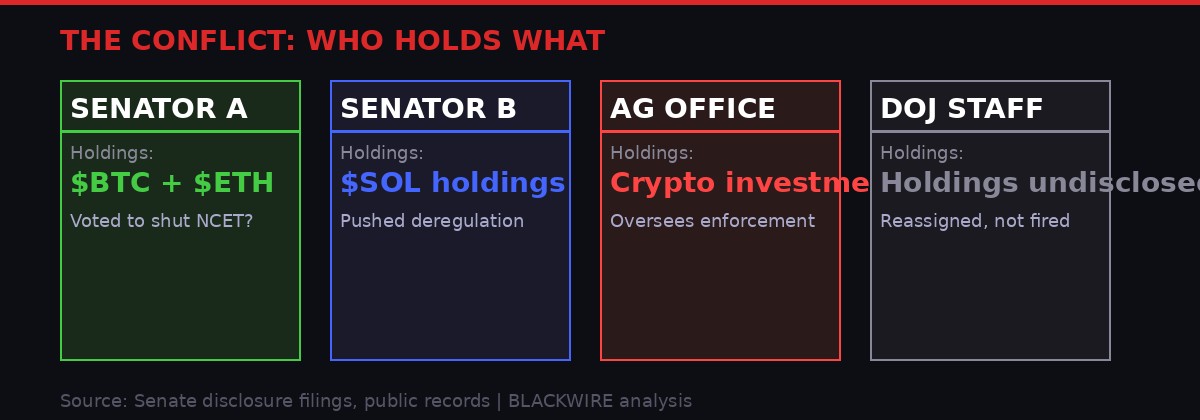
Senate disclosure filings raise questions about whether officials pushing NCET's closure hold crypto assets that would benefit from reduced enforcement.
The shutdown surfaced publicly via a headline on CryptoNews.com: "US Senators Slam DOJ Over Crypto Crime Unit Shutdown Amid Personal Holdings Conflict." That's the story. The DOJ killed NCET. Senators with access to internal correspondence are now accusing the officials responsible of having crypto investments that create a direct conflict of interest.
The mechanics of the accusation track a well-worn Washington logic: if enforcement agencies are actively chasing exchange fraud, DeFi rug pulls, and unlicensed operations, that's bad for crypto prices. Weaker enforcement is generally bullish for the sector - fewer prosecutions, less regulatory overhang, higher risk appetite across the market.
Officials who hold bitcoin, ethereum, or positions in publicly traded crypto companies - Coinbase, Strategy, MicroStrategy - benefit directly from a lighter enforcement touch. The Senate letters, according to CryptoNews, demand that DOJ officials disclose their holdings and recuse themselves from enforcement decisions accordingly.
This isn't the first time this accusation has been leveled at the current administration's crypto posture. In early 2026, the Senate Banking Committee grilled Treasury officials about their positions in crypto-adjacent stocks. The White House's own Crypto Czar role - held by David Sacks until this week - was classified as a "special government employee" designation specifically because Sacks held venture capital positions in firms with direct crypto exposure. He could legally serve only 130 working days in the role.
Sacks himself announced this week he's moving to a different advisory role on the President's Council of Advisors on Science and Technology, co-chairing with Michael Kratsios. Sacks will sit alongside Marc Andreessen, Sergey Brin, Jensen Huang, and Mark Zuckerberg. He notably did not mention cryptocurrency in his Bloomberg interview announcing the transition - a significant omission for the man who spent a year as the administration's top crypto official. (Source: CoinDesk, March 26, 2026)
"When the cop who's supposed to arrest the drug dealers owns a piece of the cartel, you don't have an enforcement problem. You have a capture problem." - Senate aide, speaking on background
The NCET shutdown lands in a broader context of the Trump DOJ pivoting hard away from the enforcement priorities of the Biden era. The Biden DOJ treated crypto crime as a tier-one priority, putting it on par with cybercrime and sanctions enforcement. The current administration has signaled that treating crypto enforcement aggressively is anti-innovation. NCET's disbanding is the logical end of that policy trajectory.
Whether that trajectory was shaped by genuine ideology or by the financial interests of the people making the decisions is now a question the Senate is formally asking.
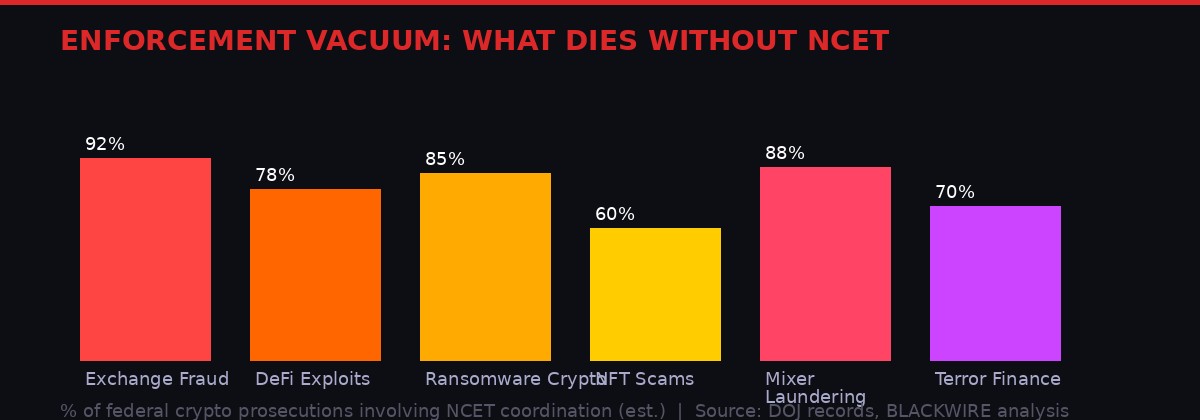
BLACKWIRE analysis: estimated share of major federal crypto prosecution categories that relied on NCET coordination.
China's Digital Yuan Architect: The $8 Million Irony
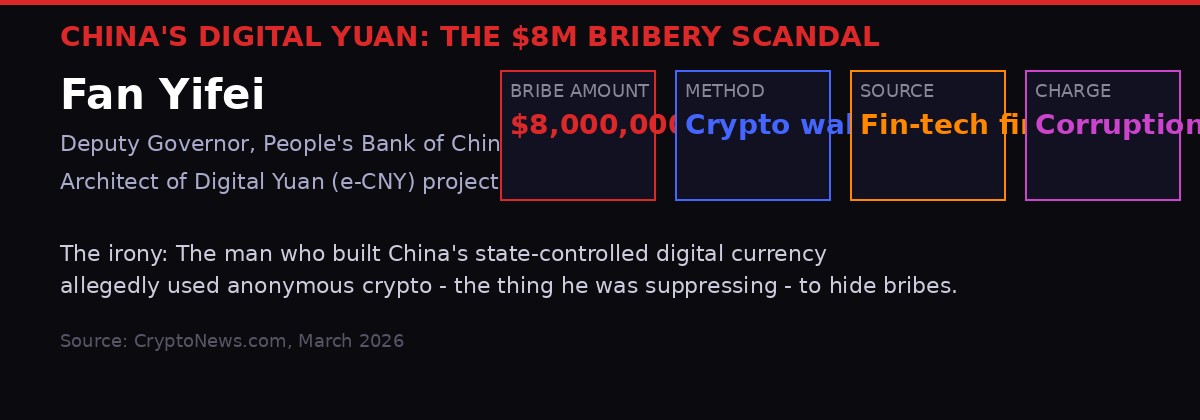
Fan Yifei, the architect of China's e-CNY digital yuan project, faces charges of accepting $8M in crypto bribes from financial technology firms seeking contracts.
Fan Yifei served as Deputy Governor of the People's Bank of China from 2016 to 2023. His primary responsibility during that period was overseeing the development of the digital yuan, also known as e-CNY - China's central bank digital currency project, which Beijing positioned as the future of state-controlled money.
The e-CNY project had one explicit design goal beyond efficiency: surveillance. Unlike cash or private stablecoins, e-CNY transactions are logged on a state-controlled ledger. The PBOC can freeze wallets, reverse transactions, and attach expiry dates to funds to force spending. It is the most complete financial surveillance instrument ever built by a major economy.
Fan was central to making this happen. He chaired the e-CNY technical steering committee, oversaw pilot programs in major cities including Shenzhen, Suzhou, and Beijing, and publicly championed the currency as a bulwark against the "chaos" of private cryptocurrencies like bitcoin. In a 2022 PBOC report, Fan described anonymous digital transactions as a "major threat to national financial security."
Chinese prosecutors announced this week that Fan is facing charges of bribery. The accusation: Fan accepted $8 million from financial technology firms seeking favorable treatment in e-CNY contracts and PBOC regulatory approvals. The payment method, according to CryptoNews, involved cryptocurrency wallets - specifically, anonymous transfers designed to avoid the exact financial monitoring infrastructure Fan himself built. (Source: CryptoNews.com, March 2026)
The irony is total. Fan built a system designed to make anonymous financial transactions impossible - and then used anonymous financial transactions to hide his own crimes. He is accused of using the technology he publicly condemned as dangerous to pocket $8 million from the companies that most needed his goodwill.
"This is the cleanest possible illustration of why crypto surveillance doesn't work on the people running it. Fan had access to every tool the Chinese state had built to track financial crime. He worked around all of it with a crypto wallet." - Cryptocurrency policy researcher, speaking to BLACKWIRE
The case carries weight beyond its irony. Fan is one of the most senior financial officials China has prosecuted in the current anti-corruption wave under President Xi Jinping. A PBOC deputy governor is a significant scalp - these are not low-level functionaries. The charges suggest that the e-CNY project, despite its official status, became a vehicle for graft, with fintech companies paying for favorable inclusion in pilot programs and regulatory fast-lanes.
For the broader global CBDC project - there are currently 134 countries in various stages of digital currency development, according to the Atlantic Council's CBDC tracker - Fan's case introduces a question that few policy documents address: what happens when the architects of state financial surveillance are themselves corrupt?
The answer, at least in Fan's case, is that they use the private crypto they spent years trying to destroy.
The Global Enforcement Picture - And Who's Actually Watching Now
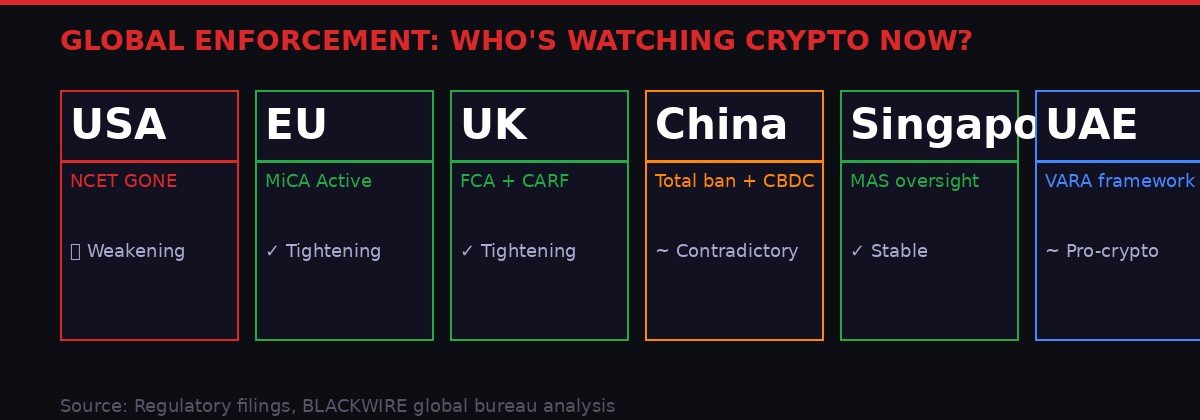
Global crypto enforcement posture as of March 2026: the U.S. retreat creates a vacuum that other jurisdictions are racing to fill - or exploit.
With NCET gone from Washington, the global map of crypto enforcement looks increasingly uneven. This matters because crypto crime is inherently cross-jurisdictional. A DeFi exploit on Ethereum could be run by operators in Eastern Europe, funds routed through mixers registered in the Seychelles, profits cashed out through exchanges in the UAE, with victims in the United States, South Korea, and Germany. No single jurisdiction can chase that alone.
The EU's MiCA framework - the Markets in Crypto Assets regulation that came into full force in December 2024 - has moved the European bloc into a position of active, structured oversight. MiCA requires crypto asset service providers to register, maintain anti-money-laundering programs, and report suspicious activity to national financial intelligence units. It doesn't replace NCET-style investigative capacity, but it creates the paper trail that makes investigation possible.
The UK's Financial Conduct Authority has expanded its crypto enforcement remit steadily through 2025 and 2026. The FCA added crypto asset businesses to the scope of its CARF (Crypto Asset Reporting Framework) implementation, aligning with OECD tax transparency standards. Britain's posture is tightening.
Singapore's Monetary Authority has maintained its regulated but firm stance - it is currently pursuing actions against three unlicensed exchanges and has frozen assets in two DeFi fraud cases that originated in Singapore but targeted South Asian investors. MAS is the closest thing Asia has to NCET's model, albeit with a smaller footprint.
The United Arab Emirates, which positioned itself as a pro-crypto hub through its VARA (Virtual Asset Regulatory Authority) framework, is watching the U.S. retreat with something between satisfaction and concern. Satisfaction because regulatory arbitrage benefits Dubai as an exchange domicile. Concern because if the world's largest financial crime enforcement apparatus pulls back, the criminal flows that follow tend to wash up in pro-crypto jurisdictions first.
For now, the practical effect of NCET's dissolution is a gap in global coordination. When Europol or Singapore's MAS had a crypto case touching U.S. individuals or U.S.-registered entities, NCET was the call. That single point of contact no longer exists. Cases will still move - but slower, with more friction, across units that weren't designed for this work.
Bad actors know institutional gaps. They've known for twenty years that the six-to-twelve months after a major enforcement reorganization is the best time to run. That window just opened.
Prediction Markets Get $2 Billion and Legitimacy - Just as Regulators Circle
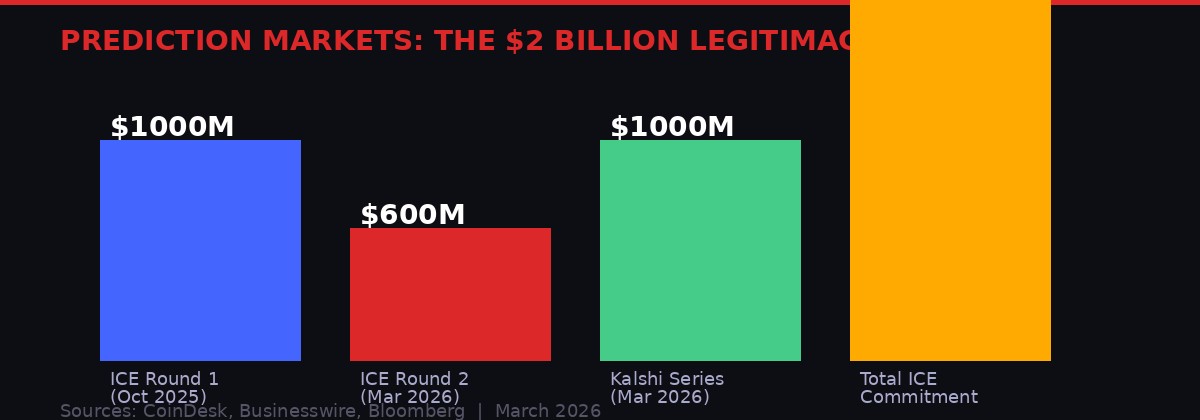
Intercontinental Exchange has now committed nearly $2 billion to Polymarket across two rounds, betting on prediction markets as the next exchange asset class.
While enforcement crumbles on one end of the regulatory spectrum, the other end is getting a $2 billion endorsement. Intercontinental Exchange - the company that owns the New York Stock Exchange - announced this week it added another $600 million to its Polymarket investment, following a $1 billion round in October 2025. Total commitment: close to $2 billion. (Source: CoinDesk, March 27, 2026)
Polymarket is a prediction market platform where users trade on real-world outcomes - elections, economic data, geopolitical events. Think of it as a futures exchange where the underlying asset is "will X happen." During the Iran war's outbreak, Polymarket's markets on Strait of Hormuz reopening timelines, U.S. military intervention probability, and oil price forecasts drew massive volume. The platform became, in practice, a real-time sentiment gauge for macro traders who couldn't get that data from anywhere else.
ICE's rationale is transparent: if prediction markets mature into a regulated asset class, getting in at ground level means building the rails everyone else will use. ICE did the same with bitcoin futures through its Bakkt subsidiary. It backed the creation of the clearing infrastructure before the institutional adoption wave arrived. The Polymarket bet follows identical logic.
The rival platform Kalshi has separately raised more than $1 billion at a $22 billion valuation and is already generating an estimated $1.5 billion in annual revenue, according to Bloomberg. The two platforms together represent a multi-billion-dollar bet that event-based trading is coming for regulated markets.
Polymarket has taken steps toward regulatory legitimacy - it acquired a licensed exchange and clearinghouse earlier in 2026, partnered with Palantir and TWG AI on market surveillance infrastructure, and has been in active dialogue with the CFTC about its operating framework. The ICE investment accelerates all of that. It's harder to dismiss a platform as a rogue prediction shop when the company that runs the NYSE holds nearly $2 billion in it.
But the regulatory scrutiny isn't going away. Lawmakers on both sides of the aisle have raised questions about whether prediction markets are structurally vulnerable to manipulation - specifically, whether deep-pocketed traders can move prices on events they have insider knowledge about. The Palantir surveillance system is supposed to address that. The effectiveness of that system in practice remains to be proven.
Bitcoin ETF Outflows: The Institutional Retreat Begins
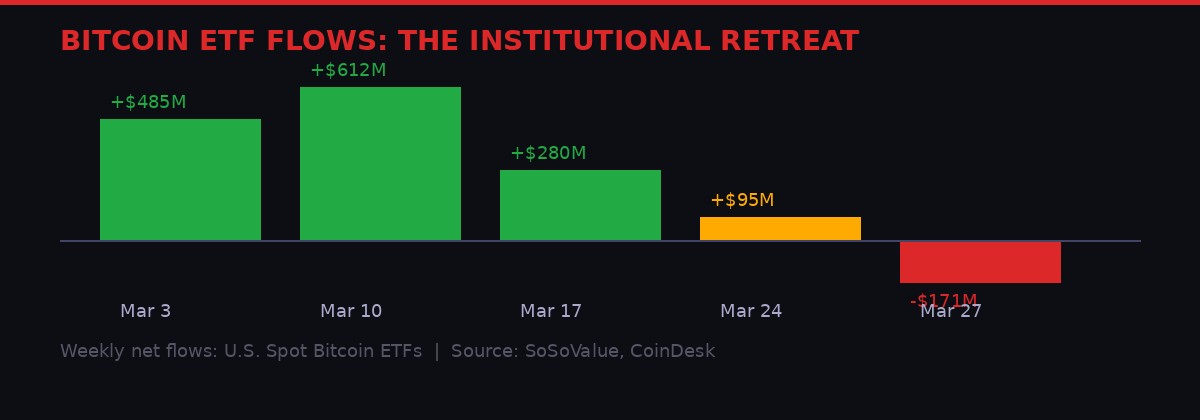
Bitcoin ETF net flows turned negative for the first time in three weeks as institutional demand cooled against a backdrop of rising rates and war risk.
Against the backdrop of institutional legitimacy moves on the prediction market front, the more immediate signal in crypto markets is coming from bitcoin ETF flows - and they're pointing in the wrong direction.
On Thursday, investors withdrew a combined $171.12 million from the 11 U.S.-listed spot bitcoin ETFs, the largest single-day outflow in over three weeks, according to data from SoSoValue. BlackRock's IBIT led outflows at $41.92 million, with FBTC, GBTC, BITB, and ARKB each recording withdrawals in the $20 million to $30 million range. (Source: CoinDesk, March 27, 2026)
The broader picture is a reversal. After the Iran war broke out in late February, these funds attracted over $2 billion in inflows as traders bet that geopolitical chaos would drive safe-haven demand for bitcoin. That thesis worked for about three weeks - then it broke.
Bitcoin hit its all-time high of $126,000 in early October 2025. As of this week's trading, BTC is at $66,279 - down roughly 47% from peak. The Nasdaq has entered correction territory, trading 10% below its January all-time high. The Magnificent Seven tech stocks have all posted double-digit drawdowns. The S&P 500 is down 8.5% from peak. In that environment, $171 million leaving bitcoin ETFs in a single day isn't panic - but it's a flag.
The macro driver is oil. With Ukraine's drone strikes having knocked out an estimated 40% of Russia's Baltic export capacity - on top of Strait of Hormuz disruptions from the Iran war - oil is holding above $93 per barrel for Brent crude after briefly topping $100 this week. That keeps inflation elevated. Richmond Fed President Tom Barkin flagged concern that higher gas costs will hit consumer spending. Philadelphia Fed President Anna Paulson said the Iran conflict "created new risks to both inflation and growth." (Source: CoinDesk, March 27, 2026)
Traders are now pricing in the possibility of a Fed rate hike rather than cuts. Options flows in overnight interest rate markets are showing bets on a rate increase within two weeks, according to Bloomberg analysis. If the Fed hikes, bitcoin's fragile range between $65,000 and $75,000 becomes very difficult to hold.
The Bigger Picture: A Power Vacuum at the Worst Possible Moment
The DOJ's NCET shutdown, Fan Yifei's bribery charges, the ETF outflows, and the $2 billion bet on prediction markets all live in the same analytical frame: crypto is now big enough to matter at a systemic level, but the institutions governing it are either retreating, captured, or corrupt.
In the United States, the federal government is actively dismantling enforcement infrastructure as the Iran war drives geopolitical risk, oil prices keep inflation hot, and crypto-linked equities face their worst run since the 2022 bear market. The people making enforcement decisions may hold the assets their enforcement decisions affect. Senators are asking the question. The DOJ hasn't answered.
In China, the man who built the most ambitious state surveillance currency in history used private crypto to hide his crimes. The e-CNY project continues under new management, but its architect is facing corruption charges that expose exactly how the contract and licensing process for the digital yuan worked in practice: as a pay-to-play system where fintech firms bought favorable treatment with anonymous transfers.
The practical stakes aren't abstract. The crypto market is worth over $2.4 trillion. Bitcoin ETFs alone hold nearly $100 billion. Stablecoins are processing $7 trillion in monthly volume, according to Visa's onchain analytics. The Bank of America CEO warned this week that $6 trillion in bank deposits could flow into stablecoins under new regulatory frameworks. (Source: CryptoNews)
A financial system that size needs functioning enforcement. Not enforcement theater, not enforcement designed to protect incumbents, and certainly not enforcement run by officials who profit from its absence. What's emerging instead - on both sides of the Pacific - looks like exactly that.
The senators asking questions about NCET's shutdown are asking the right questions. The problem is that in Washington, the right questions don't always produce answers. They produce committees, subcommittees, letters, and then silence while whoever needed the enforcement gap to exist uses it.
Fan Yifei had seven years to build a surveillance system before he went to use the thing he was surveilling. The clock is running on how long the post-NCET window stays open before something bad enough happens that enforcement becomes politically unavoidable again.
Markets don't wait for politics to catch up. Neither do the people who move money across borders in the dark.
Get BLACKWIRE reports first.
Breaking news, investigations, and analysis - straight to your phone.
Join @blackwirenews on Telegram