The Codec That Was Never Free: Dolby Sues Snapchat - and the Internet May Never Be the Same

The open video codec promise is under legal siege. (Pexels)
The internet runs on a promise that was always a little too convenient to be true. For eight years, the Alliance for Open Media told developers, startups, and streaming platforms that AV1 - its next-generation video codec - was royalty-free. Build on it. Ship on it. Scale it to a billion users without a licensing department or a legal team on speed dial. Google said it. Amazon said it. Netflix, Apple, Microsoft, Mozilla - all of them signed on.
On March 24, 2026, Dolby Laboratories tested that promise against federal courts in Delaware and against business courts in Rio de Janeiro. The target was Snapchat. The weapon was four patents originally filed by General Electric - patents that Dolby acquired in 2024 when it bought GE's entire video licensing portfolio - and that Dolby now argues read directly on techniques buried inside AV1.
This is not a niche IP dispute. The outcome will determine whether AV1 can continue its climb toward becoming the universal baseline for internet video. It will decide whether platforms like Meta, Discord, Amazon, and potentially every browser that ships AV1 support need to start writing checks - or face injunctions. And it exposes a quiet reality that Big Tech has spent a decade trying to obscure: declaring a standard "royalty-free" does not make it so.
What AV1 Is, and What It Was Supposed to Be

AV1 was designed to power the next generation of internet video infrastructure. (Pexels)
AV1 was released in 2018 by the Alliance for Open Media (AOMedia), a consortium that reads like a who's-who of internet infrastructure: Google, Amazon, Apple, Meta, Netflix, Microsoft, Mozilla, Samsung, and Intel are all members. The codec was built to outperform HEVC (H.265) - which had become the dominant high-efficiency video standard - while avoiding the mess of competing patent pools and licensing demands that had made HEVC a nightmare to deploy at scale.
HEVC delivered roughly 50% better compression than its predecessor H.264. But it came with strings attached. Multiple organizations - MPEG-LA, Access Advance, and others - held portfolios of patents they claimed were essential to the standard. Streaming companies faced overlapping demands, unclear FRAND (fair, reasonable, and non-discriminatory) obligations, and real risk of injunction in major markets. The result was that many services either delayed HEVC adoption or deployed it selectively, relying instead on older H.264 for broad compatibility.
AV1 was designed specifically to break that deadlock. AOMedia members pooled their own relevant patents under a royalty-free license, drafted a permissive BSD-3 software license for the reference implementation, and published it all openly. The promise was clean: use AV1, pay nothing, scale freely.
Eight years later, AV1 is in Chrome, Firefox, Edge, Safari, and virtually every major streaming platform's encoding pipeline. YouTube began defaulting to AV1 for desktop streams years ago. Netflix uses it aggressively for 4K content. Snapchat added AV1 support to its camera pipeline to deliver better quality at lower bitrates - critical for a platform where 5 billion photos and videos are exchanged every single day, and roughly 90% of Snapchat Stories content is video.
The problem Dolby has now exposed is that the royalty-free pledge only covers patents held by AOMedia members. Dolby was never an AOMedia member. It never contributed to the AV1 standard. It made no licensing promises regarding AV1 - because it had no obligation to.
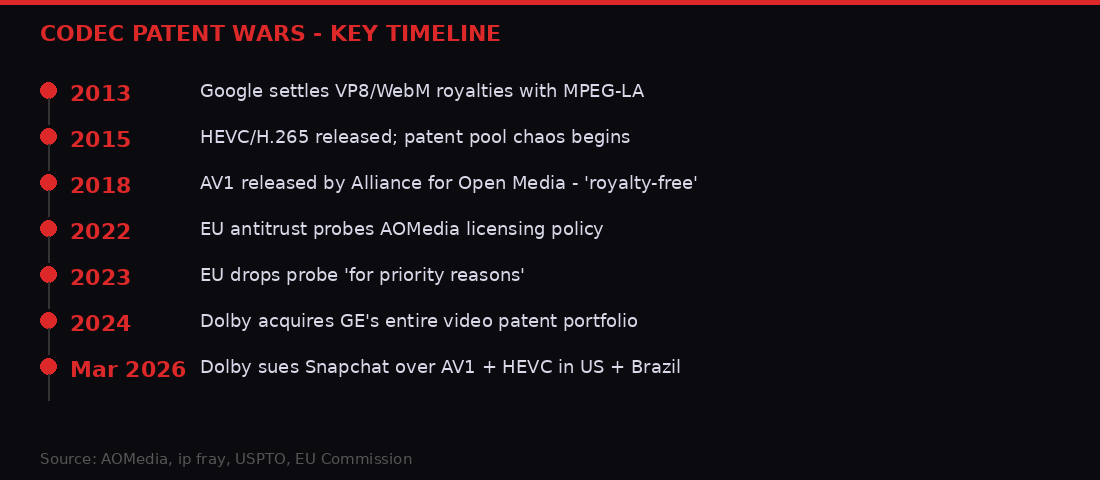
Key moments in the decade-long codec patent conflict. (BLACKWIRE/PRISM)
The Lawsuit: What Dolby Is Actually Claiming

The case was filed in Delaware and Rio de Janeiro courts simultaneously. (Pexels)
Dolby filed in US District Court for the District of Delaware under case number 1:26-cv-00317. It also filed two separate cases in the Rio de Janeiro State Court - one for AV1 and one for HEVC - in what legal observers say is a deliberate effort to keep arguments manageable and prevent FRAND defenses from contaminating each other across standards.
The four US patents at the center of the case were originally developed and filed by General Electric's licensing division. Dolby acquired GE's entire video patent portfolio in 2024, according to IP analyst Florian Mueller, who broke the case details for IP Fray. The move was a significant escalation in Dolby's patent strategy - and in retrospect, looks like preparation for exactly this kind of enforcement action.
The critical legal framing here is that Dolby never participated in the development of AV1. Because of this, Dolby never signed AOMedia's patent license. It is therefore not bound by any royalty-free commitment for that standard. More importantly for Snap's legal team: because Dolby's FRAND pledges for video patents relate specifically to standards it helped develop, there may be no FRAND constraint at all on its AV1 demands.
That means, in theory, Dolby can demand any royalty rate it chooses for AV1 implementations. It can seek an injunction preventing Snapchat from using the codec entirely. And it has simultaneous cases running in Brazil - a country known for courts that move quickly on preliminary injunctions.
"Only because Big Tech says a codec should be royalty-free doesn't mean that it is. Given that all codecs use somewhat similar techniques, the risk of an infringement of patents belonging to parties who did not offer royalty-free licenses is substantial." - Florian Mueller, IP Fray
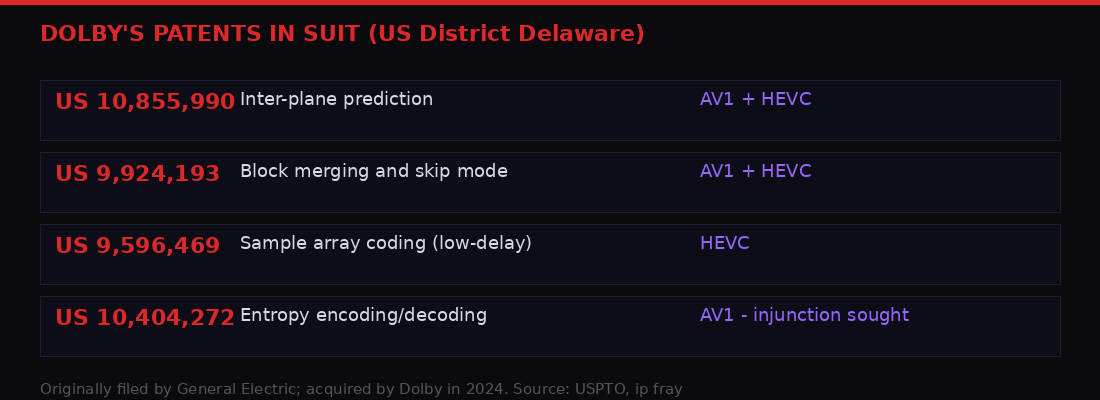
The four GE-derived patents Dolby is asserting against Snap in Delaware. (BLACKWIRE/PRISM)
Why Snapchat? The Strategic Logic of This Target

Snap processes 5 billion photos and videos per day - making its AV1 exposure substantial. (Pexels)
Snap is an interesting target. It is not the biggest AV1 user. YouTube, Netflix, and Amazon Prime Video dwarf Snapchat in raw video volume. But Snap has specific characteristics that make it tactically useful for a patent licensing campaign.
First, Snap is vulnerable in a way that the tech giants are not. At a market cap of roughly $7.5 billion as of early 2026 - far below its $100 billion-plus peak in 2021 - Snap cannot simply absorb years of litigation and a potential injunction the way Google or Amazon can. The threat of having AV1 video encoding blocked in a major jurisdiction is existential for a company whose business model depends on frictionless video sharing at massive scale.
Second, Snap is not an AOMedia member. It implemented AV1 as a downstream user of the open standard, without negotiating a direct patent license with Dolby or any other non-AOMedia patent holder. Access Advance, the patent pool that includes Dolby's video patents through its Video Distribution Pool (VDP), had not previously taken action against video streamers - only against hardware device manufacturers. Dolby's lawsuit against Snap breaks that pattern and sends a clear signal to every major streaming service and social platform that deployed AV1.
Third, Brazil matters. Brazilian courts have become increasingly significant in global patent enforcement. They can issue preliminary injunctions quickly - and a PI blocking AV1 in Brazil would be significant given Latin America's growing importance to platforms like Snap. Filing there simultaneously with Delaware forces Snap to fight on two fronts at once.
Peter Moller, CEO of Access Advance, was direct about the enforcement rationale in a statement quoted by IP Fray:
"When companies implement advanced technologies without securing the appropriate licenses, they undermine the collaborative framework that enables innovation. Enforcement actions like this one enable innovators to defend their intellectual property rights and ensure that they're properly compensated for their work."
The subtext: Snap knew the patent landscape was disputed and deployed anyway. That choice now has a price tag attached.
The Bigger Picture: Who Is Actually Exposed
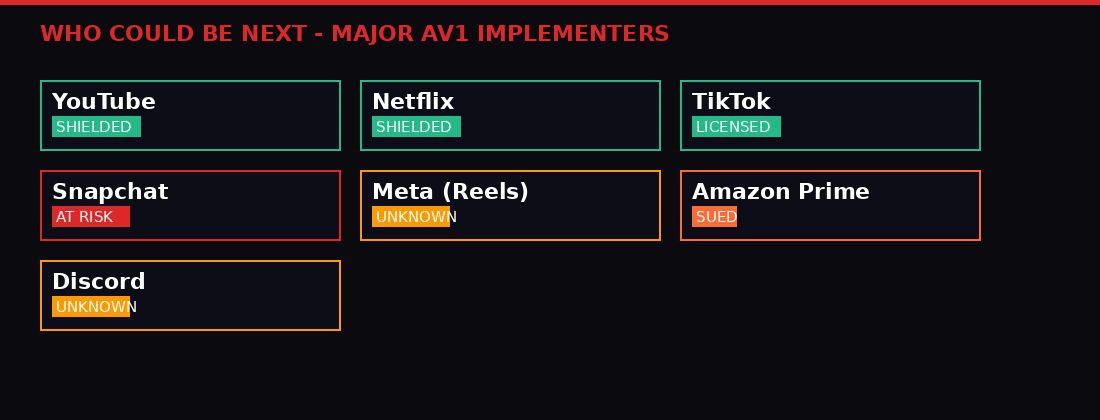
The AV1 patent exposure map as of March 2026. (BLACKWIRE/PRISM)
Dolby v. Snap is the first AV1 patent lawsuit filed against a video streaming service. It is unlikely to be the last. Understanding the exposure map requires separating the different categories of potential defendants.
AOMedia founding members - Google, Amazon, Apple, Netflix, Microsoft, Meta - hold cross-licensing relationships within the AOMedia patent pool. They are partially shielded, though this only covers AOMedia members' patents. A Dolby-type action from a non-member could still reach them.
VDP licensees are in better shape. ByteDance (TikTok) and Tencent (WeChat) are both licensors and licensees of Access Advance's Video Distribution Pool, according to IP Fray's July 2025 reporting. This means TikTok's video stack, which is heavily AV1-dependent, has coverage for at least this pool's patents.
Unlicensed streamers and platforms are the real exposure zone. Discord began rolling out AV1-encoded video calls in 2023 to reduce bandwidth. Twitch uses AV1 for its highest-quality streams. Reddit deploys AV1 for video posts. None of these platforms are AOMedia members, and their licensing status with non-member patent holders like Dolby is unclear.
Amazon is already being separately sued. InterDigital filed against Amazon Fire streaming devices over AV1 implementation, running parallel to the Dolby-Snap case. According to Ars Technica, a PDF of the InterDigital complaint has been made publicly available, alleging patent infringement by devices that support AV1.
The AV1 Royalty-Free Promise: How Big Tech Built a Legal Fiction

The open-source promise of AV1 never covered patents held by companies that weren't in the room. (Pexels)
To understand how the industry ended up here, it helps to understand how codec standardization actually works - and why the "royalty-free" label was always more marketing than law.
When a standards body creates a codec, member organizations contribute patented technologies they believe are necessary for the standard to function. In exchange for having their patents baked into the standard (and therefore implemented everywhere), contributors typically agree to license those patents under FRAND terms. This is how MPEG-LA works for H.264 and H.265.
AOMedia took a different approach. Members contributed patents under a genuinely royalty-free license - you can implement AV1 using their IP and pay nothing. This was possible because companies like Google, Amazon, and Netflix had both the scale and the strategic interest to give away patent rights. They collectively process so much video that even a tiny per-device or per-stream royalty would cost them billions annually. Making AV1 royalty-free was, for them, a competitive move that also happened to benefit the open web.
The problem is that AV1 did not exist in a vacuum. Video compression techniques follow patterns that have been understood and patented for decades. Inter-frame prediction. Block partitioning. Entropy coding. Transform coding. These building blocks appear in every modern codec. Companies that developed video compression technology independently - including GE, which Dolby later acquired - may hold patents on these fundamental techniques without ever having participated in AV1's design.
From a legal standpoint, Dolby does not need to prove it contributed to AV1. It needs to prove that AV1's implementation infringes its patents. The "royalty-free" label that AOMedia applied to AV1 only covers what AOMedia members chose to license. It says nothing about what Dolby, or any other non-member holding relevant patents, must do.
"The legal framework around video codecs is well established, and incorporating patented technology carries clear licensing obligations. Labeling a codec 'royalty-free' does not eliminate underlying patent rights." - Peter Moller, CEO, Access Advance
Mueller elaborated the structural risk in his IP Fray analysis:
"With AV1, it could turn out that there are far more patent holders out there with essential patents but no FRAND licensing obligation. In that case, they could theoretically ask for anything, even extortionate amounts, up to the point where someone would then stop implementing AV1. And the really bad thing here is that someone could purposely make prohibitive royalty demands for AV1 in order to discourage use of the standard."
That last scenario - a deliberate campaign to make AV1 commercially unviable - remains theoretical. But it is no longer purely hypothetical.
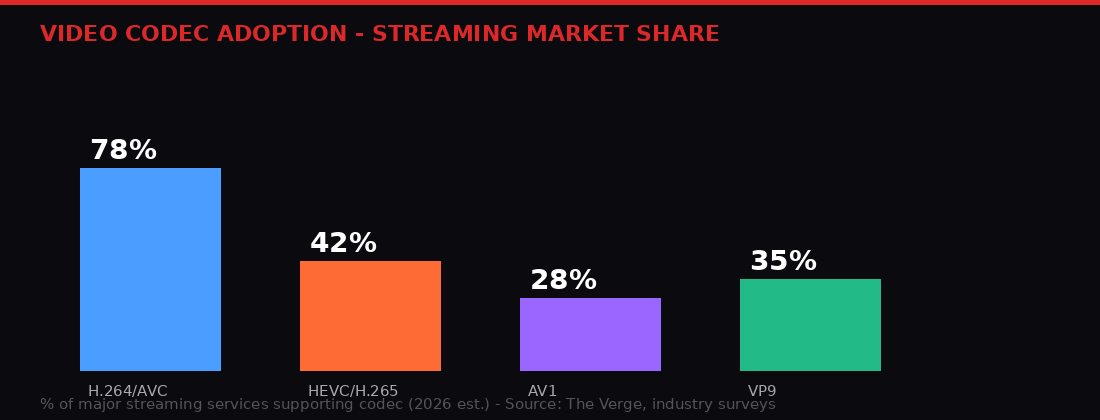
AV1 has made significant inroads but still trails H.264 in overall deployment. (BLACKWIRE/PRISM)
The EU Connection: A Probe That Was Dropped, But Not Closed

European regulators previously probed AOMedia's licensing structure but dropped the investigation in 2023. (Pexels)
The Dolby lawsuit revives concerns that European Union antitrust regulators raised in 2022. The European Commission opened an investigation into whether AOMedia's licensing policy - the mechanism by which founding members contributed patents royalty-free while potentially squeezing out non-members - violated EU competition rules.
The investigation was closed in 2023 "for priority reasons," according to a statement from EU spokespersons reported by Reuters. Critically, the commission added that "the closure is not a finding of compliance or non-compliance." That language matters. The EU did not clear AOMedia. It simply moved on to other priorities - likely the explosion of AI regulation, the Digital Markets Act implementation, and platform investigations that occupied Brussels through 2024 and 2025.
Dolby's lawsuit against Snap now reframes the question the EU was examining. If courts in the US and Brazil find that Dolby's patents are valid and infringed by AV1 implementations, it raises the question of whether AOMedia's campaign to market AV1 as unconditionally "royalty-free" misled developers and platforms into assuming a legal clearance that does not exist. That is the kind of theory that antitrust regulators - in Brussels or in Washington - could find interesting.
For now, the EU angle is speculative. But the Dolby case has put AOMedia's political and legal position back in the spotlight. If Dolby wins - or if it extracts a settlement from Snap that establishes precedent for licensing payments - the lobbying pressure on Brussels to reopen the investigation could intensify.
Second-Order Effects: What This Does to the Open Web

The AV1 case could reshape how open-source standards are built and promoted. (Pexels)
Even if Dolby's specific claims fail in court - even if the patents are ruled invalid, or not infringed by AV1's particular implementations - the lawsuit has already done damage. The mechanism is uncertainty.
Every developer building a new platform that handles user video now has to price in legal risk that did not exist eight years ago. Every startup that accepted the "royalty-free" pitch and built AV1 into its core video stack now has to evaluate whether Access Advance's VDP license is worth buying for protection against a category of risk they thought was eliminated. Every venture firm evaluating a video-heavy startup now has to ask the question about codec IP exposure that it previously didn't need to.
The systemic effect is a potential slowing of AV1 adoption at exactly the moment the codec was consolidating its position. AV1 still lags H.264 significantly in overall deployment - the codec that works everywhere, that every device supports, that carries the vast majority of video on the internet - but it had been gaining ground steadily. The lawsuit introduces friction into that trajectory.
There is also the standards development paradox to consider. The appeal of AV1 was that it gave the industry a path out of HEVC's licensing mess. If the outcome of the Dolby case is that AV1 turns out to have its own licensing mess - just one that took eight years to fully materialize - then the incentive to invest in the next open codec standard is diminished. Why pour engineering resources into building something "royalty-free" if a company that wasn't in the room can show up a decade later with patents on fundamental techniques?
The alternative - which AOMedia's founding members would prefer - is that the industry accepts that "royalty-free" means "free within the AOMedia ecosystem" and builds a comprehensive licensing clearinghouse for the remaining holdout patents. But that requires patent holders outside AOMedia to cooperate, and cooperation requires compensation. Which brings you back to: this was never free.
What Happens Next: The Legal Road Ahead

Delaware and Brazilian courts will both shape the outcome on different timelines. (Pexels)
The two fronts of this litigation move on very different timelines. In the United States, patent cases in the District of Delaware - one of the most active patent courts in the country - typically take two to four years from filing to trial. Preliminary injunctions are possible but rarely granted in patent cases absent clear evidence of irreparable harm. Snap has time to mount a defense.
Brazil is different. The Rio de Janeiro courts Dolby chose have authority to issue preliminary injunctions early in proceedings. IP Fray noted that both Brazilian cases have PIs requested as of filing. If a Brazilian court issues a PI blocking Snap from using AV1-encoded video in that market, it could happen within months rather than years - creating immediate commercial pressure on Snap to negotiate rather than litigate.
The likely resolution path is a licensing deal rather than a court-decided precedent. Snap almost certainly needs to take a VDP license from Access Advance; the only question is what it costs and whether Dolby can extract maximum leverage in negotiations by threatening injunctive relief in both jurisdictions simultaneously. That leverage is real and growing.
For the broader AV1 ecosystem, the watch list includes:
- Whether AOMedia responds with patent pledges - If member companies can demonstrate that Dolby's patents are already covered by prior art or by cross-licenses within the AOMedia framework, the threat diminishes. AOMedia has been notably quiet since the filing.
- Whether other patent holders emerge - Dolby is likely not the only non-member holding AV1-relevant patents. The lawsuit creates a template. Others will be watching the outcome before deciding whether to act.
- Whether InterDigital's Amazon case establishes separate AV1 damages precedent - InterDigital's concurrent AV1 action against Amazon Fire devices runs parallel to the Dolby-Snap case. If either delivers a significant damages award, it calibrates what AV1 licensing actually costs.
- The GPU and hardware ecosystem - Many video cards and SoCs have AV1 hardware decode acceleration built in. If AV1 patent liability extends to hardware, it implicates NVIDIA, AMD, Intel, and Apple Silicon - companies with far more resources than Snap but also far more exposure.
The immediate tactical pressure is on Snap. But the strategic implications extend to every platform that built its video future on a promise that was always, legally speaking, only as good as the room where it was made.
Timeline: How We Got Here
Alliance for Open Media releases AV1 codec under royalty-free license. Major streaming platforms begin adoption.
AV1 becomes default on YouTube for desktop. Netflix begins AV1 4K rollout. Snap integrates AV1 for camera pipeline.
European Commission opens antitrust probe into AOMedia licensing policy. Investigation targets potential abuse of market power by Big Tech members.
EU drops AOMedia probe "for priority reasons" - without a finding of compliance. AV1 continues to grow. Hardware decode acceleration becomes widespread.
Dolby acquires General Electric's entire video patent licensing portfolio. The acquisition includes patents GE had filed on fundamental compression techniques relevant to multiple codec standards.
Dolby files patent infringement complaints against Snap in US District Court for Delaware and in two Rio de Janeiro business courts simultaneously. Both US and Brazil cases include requests for preliminary injunctions.
IP Fray, Ars Technica, and technology press cover the filing. AOMedia has not issued a public response. Snap has not commented. The case enters pre-discovery phase in Delaware.
Get BLACKWIRE reports first.
Breaking news, investigations, and analysis - straight to your phone.
Join @blackwirenews on Telegram