The Toll Booth: Transportation Lobbyists Fund Sean Duffy's Son-in-Law as DOT Regulates Their Industries
A 26-year-old podcaster with no policy record is running for Congress in Wisconsin. Dozens of lobbyists, PACs, and executives with active business before the U.S. Department of Transportation have donated to his campaign. His father-in-law is the Secretary of Transportation. Follow the money.

Washington, D.C.: where access to power is bought, sold, and carefully laundered through family members. Photo: Pixabay
The $16 billion Hudson Tunnel Project running between Manhattan and New Jersey has nothing obvious to do with a Republican primary race in northern Wisconsin. It is a massive infrastructure undertaking - a joint venture between two states, tied up in federal funding, subject to the whims of the U.S. Department of Transportation's budget decisions.
And yet, after the White House froze federal grants for the tunnel project last fall - citing concerns about diversity and equity provisions in the contract - lobbyists working on behalf of the tunnel donated $2,500 to a 26-year-old political novice running for Wisconsin's 7th Congressional District. That novice is Michael Alfonso. Alfonso has no record on transportation policy. He worked in construction and podcasting. He has zero sway over the Hudson Tunnel.
But his father-in-law controls it entirely. Sean Duffy, Secretary of the U.S. Department of Transportation, oversees the $89 billion DOT budget, the Federal Aviation Administration, the Federal Railroad Administration, the Maritime Administration, and virtually every grant, license, and regulatory decision affecting the industries that have been writing checks to Alfonso's campaign.
A ProPublica investigation published March 18, 2026, traced dozens of contributions to Alfonso from lobbyists, corporate PACs, and executives whose companies have active, ongoing business with Duffy's department. What makes the pattern striking is not that any single donation broke the law - none did. What is striking is that so many donors with DOT interests who had never previously given to Duffy or his predecessor in Wisconsin's 7th district suddenly found Michael Alfonso worth funding.
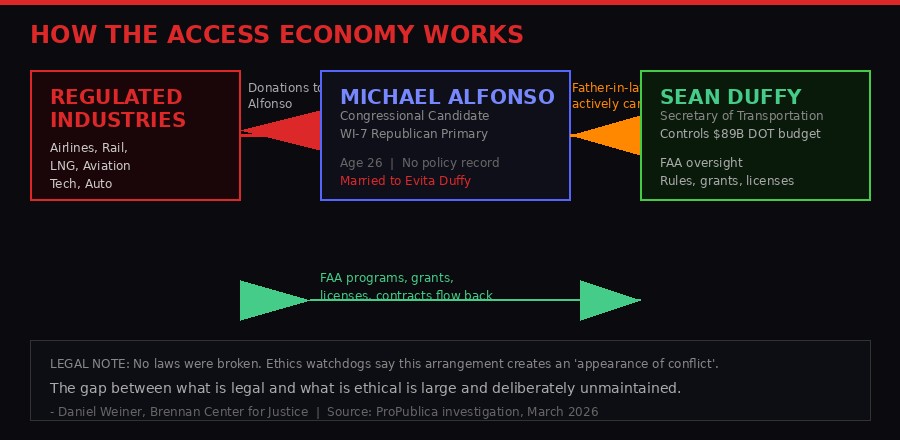
BLACKWIRE analysis: How regulated industries route access payments through a family connection. Source: ProPublica, FEC, DOT records. Graphic: BLACKWIRE.
The arrangement has no formal name. Ethics watchdogs call it a textbook "access economy" scheme. You cannot bribe a Cabinet secretary directly - that is a crime. But you can donate to his son-in-law's campaign, appear at the same fundraisers where the secretary is listed as "special guest," and wait to see whether the regulatory environment improves for your business. The law, as Daniel Weiner of the Brennan Center for Justice put it, provides "very little constraint."
"The law, as it stands, provides very little constraint. There's a very large gulf between what is legal and what is ethical. Obviously, this raises numerous ethical questions." - Daniel Weiner, Director of Elections and Government Program, Brennan Center for Justice
The Candidate: Podcaster, Construction Worker, Cabinet Secretary's Son-in-Law

The anatomy of an "access" candidacy: family connections, industry money, and a seat that regulatees want to be seen supporting. Photo: Pixabay
Michael Alfonso is 26 years old. He graduated from the University of Wisconsin in 2022 with a mathematics degree. He then moved to Florida to work as a producer for Dan Bongino's podcast - one of the more prominent pro-Trump media operations in conservative media. He has no prior experience in government, no legislative record, and no formal background in transportation, aviation, rail safety, or any of the other policy domains that Duffy's department governs.
What Alfonso has is family. He met his future wife, Evita Duffy, while both were in middle school in Wausau, Wisconsin - the same city where the 7th Congressional District is anchored. They married in 2022 at one of Donald Trump's New Jersey golf courses. Trump attended the wedding. That is when, by Alfonso's own account, he and the future president first met.
By the time Alfonso announced his congressional run in November 2025, the family connection was already doing work. Duffy himself had held Wisconsin's 7th district seat for almost a decade before resigning in 2019 to become a television commentator. His successor, Tom Tiffany, is now running for Wisconsin governor, creating an opening. Alfonso stepped in - armed with a $1 million super PAC funded directly from Duffy's former campaign committee, the same fundraising consultant Duffy used, and his father-in-law's active presence on the trail.
At Alfonso's first campaign event in Wausau in November 2025, Sean Duffy was listed as a "special guest." A December fundraiser at a hotel in Green Bay - near Lambeau Field - featured Duffy in attendance. The formal invitation carried a careful legal disclaimer: "Sean Duffy is not soliciting funds in connection with this event." The secretary did not formally ask for money at the event. He just stood there, in his official capacity as one of the most powerful men in American transportation regulation, while the regulated industries wrote the checks.
The Lobbyist Network: Who Is Writing the Checks, and Why
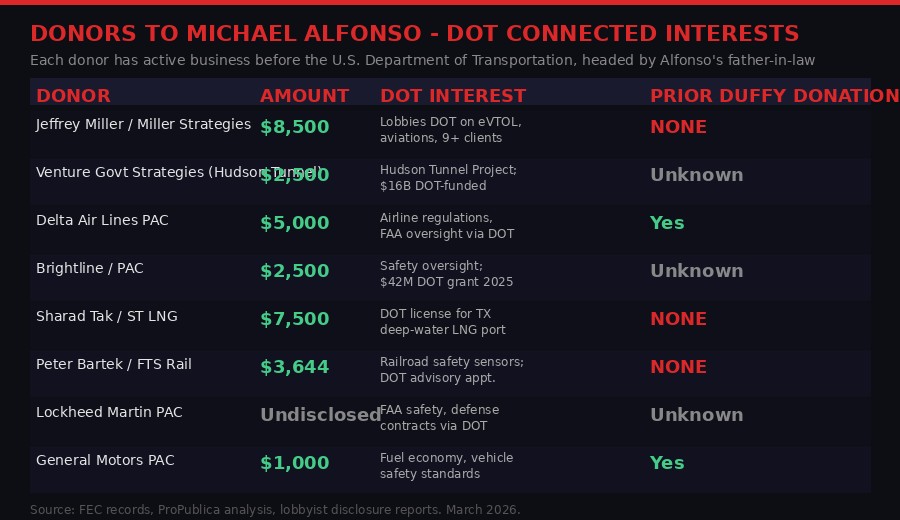
Selected donors to Michael Alfonso's campaign and their active business before the Department of Transportation. Source: ProPublica, FEC records. Graphic: BLACKWIRE.
The most revealing case involves Jeffrey Miller, a lobbyist and finance chair of Trump's most recent inaugural committee. In December 2025, Miller and his firm's chief operating officer donated a combined $8,500 to Alfonso's campaign - the maximum permissible amount under FEC rules. Lobbyist disclosure reports show that Miller Strategies lobbied the Transportation Department in 2025 on behalf of at least nine companies, one New York county, and one Native American tribe. His clients' issues included airport signage regulation, aviation permitting for a developer building a supersonic airliner, and advocacy for Archer Aviation - a company developing electric vertical takeoff and landing aircraft, or eVTOL technology.
Neither Miller nor his firm had any prior record of donating to Duffy or to Tom Tiffany, who held the same Wisconsin seat. Their connection was not to the district or the candidate - it was to the regulatory apparatus the candidate's father-in-law commands.
On March 5, 2026 - weeks after Miller's donation - Duffy announced a first-of-its-kind FAA pilot program for eVTOL technology, covering 26 states and eight demonstration projects. Archer Aviation, the company Miller had lobbied for, was selected to participate. Duffy celebrated the announcement personally, posting a video declaring that eVTOLs would enable "Ubers in the air" - a vision that, if it becomes regulatory reality, would be enormously valuable to Archer and to Miller's other clients in the aviation sector.
Miller did not respond to ProPublica's requests for comment.
"As far as the $200 billion, I think that number could move." - Pete Hegseth, Secretary of War (on a different scandal, illustrating the scale of unaccountable spending across the Trump Cabinet, March 2026)
The pattern repeats across multiple donors. Sharad Tak, CEO of ST LNG - a company seeking a Maritime Administration license to build a deep-water liquefied natural gas port off the coast of Texas - attended Duffy's December fundraiser in Green Bay and donated $500. His wife, Mahinder Tak, who was not present at the event, donated an additional $7,000. Neither had previously given to Duffy or Tiffany. ST LNG's licensing application is currently pending before the Maritime Administration, an agency inside Duffy's department.
When a ProPublica reporter asked a Tak associate whether the LNG port license had any bearing on the donations, the response was: "Absolutely not." That may be entirely sincere. The structure of access-economy corruption does not require corrupt intent on any individual's part - only a functioning market in which proximity to power has a price, and everyone in the room understands the exchange rate.
The Brightline Case: Safety Grants and Campaign Cash

Brightline, a Florida high-speed rail operator with 180+ pedestrian deaths since 2017, received a $42M safety grant from Duffy's DOT in September 2025. Brightline's PAC donated to Alfonso in December. Photo: Pixabay
The Brightline case is particularly sharp in its sequencing. Brightline is a Florida high-speed passenger rail operator with a catastrophic safety record. Since 2017, the service has struck and killed more than 180 pedestrians or drivers at grade crossings - an extraordinary casualty rate. The company has been under pressure from Congress, from local advocates, and from federal safety regulators to address the problem.
In July 2025, Duffy appeared before a congressional committee and promised to work to "drive down the number of deaths" at Brightline crossings. In September 2025, his department announced $42 million in safety grants for the rail line under a DOT safety improvement program. Brightline described the deaths at crossings as primarily attributable to suicides and "reckless" behavior by pedestrians.
In December 2025, Brightline's political action committee donated $2,500 to Michael Alfonso's congressional campaign. This is not the kind of donation one makes to a 26-year-old first-time candidate in a northern Wisconsin district based on his position paper on rail policy - a subject Alfonso has not addressed publicly. It is the kind of donation one makes to a candidate whose father-in-law distributes $42 million in grants to your industry.
ProPublica found that Brightline, T-Mobile, and Lockheed Martin - all of which donated to Alfonso - did not respond to requests for comment. Lockheed noted on its website that it "complies with all applicable laws and regulations with regard to its political and public policy activities."
T-Mobile, for its part, is working on a DOT project to enhance critical 5G infrastructure. Lockheed Martin is subject to FAA safety regulations and holds lucrative government defense contracts. Neither had a visible prior connection to Wisconsin's 7th congressional district. Both have every reason to maintain goodwill with the family that controls the regulatory and grant-making machinery of American transportation.
The Hudson Tunnel: Frozen Federal Funds and Grateful Lobbyists

The $16 billion Hudson Tunnel Project - a vital piece of Northeast infrastructure - has been caught in the Trump administration's pattern of freezing, releasing, and threatening federal funding. Photo: Pixabay
The Hudson Tunnel Project is one of the most consequential infrastructure projects in the United States. The existing tunnels running under the Hudson River between New Jersey and Manhattan were damaged by Superstorm Sandy in 2012 and are operating on borrowed time. The $16 billion replacement project would serve hundreds of thousands of commuters and effectively act as a critical artery for the Northeast Corridor - the most heavily used passenger rail line in North America.
In the fall of 2025, the White House froze federal funding for the project, citing concerns about diversity and equity provisions in the contract language. The DOT - Duffy's department - is the federal agency that controls the funding spigot. A court later ordered the money released, but as of March 2026, the bistate commission overseeing construction warned it could face funding disruptions again in upcoming months if federal disbursements are not maintained.
Shortly after the freeze, representatives from Venture Government Strategies - a lobbying firm with clients directly interested in the tunnel project - donated a combined $2,500 to Michael Alfonso's campaign. Venture Government Strategies did not respond to ProPublica's inquiries.
Here is the architecture of the arrangement. An important client - the Hudson Tunnel Project and the interests behind it - is dependent on continued federal support from the Department of Transportation. The secretary of transportation is the father-in-law of a congressional candidate. Donating to that candidate costs $2,500. Failing to donate to that candidate costs nothing, legally. But the regulated industry has learned, through decades of Washington practice, that investments in proximity are rarely wasted.
The Legal Gap: What Is Permitted and What It Costs
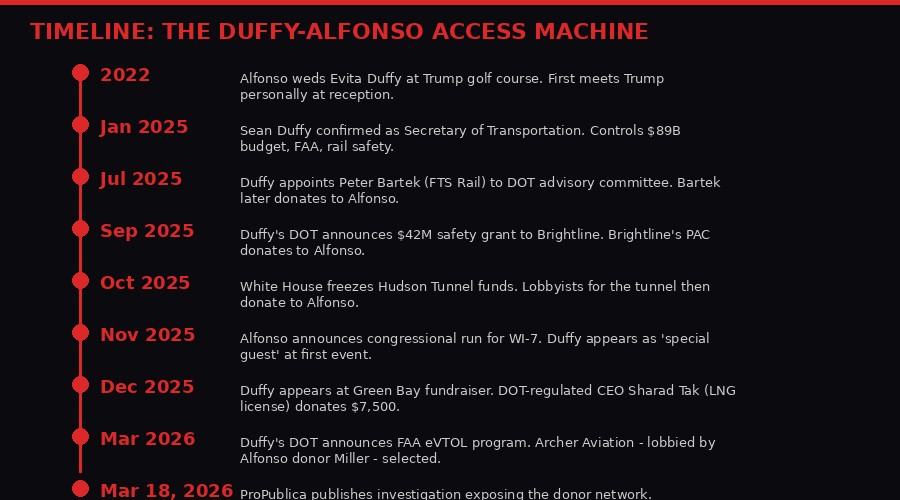
The chronology of grants, regulatory decisions, donor appointments, and campaign donations reveals a consistent pattern across multiple industries. Source: ProPublica, DOT press releases, FEC records. Graphic: BLACKWIRE.
What Sean Duffy is doing is not illegal. This is worth stating plainly, because the line between legal and corrupt in American political finance runs through this exact territory, and those who profit from blurring it rely on that ambiguity.
The law permits a Cabinet secretary to campaign for a family member, so long as he does so on personal time, without using government resources, and without explicitly linking official actions to campaign contributions. Duffy has done none of the prohibited things. He appeared at fundraisers as a "special guest." He drove a GM Corvette in a promotional video and praised the car on social media; weeks later, GM's PAC donated to Alfonso. He announced an FAA eVTOL program that benefited a company lobbied by an Alfonso donor. In none of these cases can a direct transaction be proven.
What Duffy has created is something more structural - a permanent signal to every industry under DOT jurisdiction that the secretary's goodwill has a measurable, legal, safe price point. That price is a check to his son-in-law.
This is not a new pattern in American politics. During Duffy's first Trump administration, Transportation Secretary Elaine Chao faced similar questions about apparent preferential treatment of Kentucky - the home state of her husband, Mitch McConnell, then Senate majority leader - in infrastructure grant decisions. Chao's office denied favoritism. The pattern continued.
Under Barack Obama, Agriculture Secretary Tom Vilsack faced questions about his wife's congressional campaign and potential conflicts with USDA operations. In that case, Vilsack maintained strict personal separation from her fundraising.
The Duffy situation is different in one important respect: he is not maintaining separation. He is attending the fundraisers. He is the draw. The caveat on the invitation - "Sean Duffy is not soliciting funds" - is a legal disclaimer, not a description of what is happening in the room.
"This troubling case calls into question the effectiveness of some of our first lines of defence against suspect financial activity." - UK Labour MP Phil Brickell, commenting on a separate but structurally similar case of regulatory capture through family proxy entities (OCCRP/Finance Uncovered, 2026)
Peter Bartek, founder of FTS Rail - a company that manufactures railroad safety equipment - donated $3,644 to Alfonso's campaign in November 2025. Bartek had never previously given to a candidate in the 7th district. What he had done, in July 2025, was receive an appointment to a DOT advisory committee - a position Duffy personally approved. When ProPublica asked Bartek about his donation, he said he had simply read about Alfonso's campaign and liked what he saw.
"I like Secretary Duffy very much," Bartek said, "and I thought very simply, boy, if he's anything like his father-in-law, it would be nice to support him as well."
That sentence captures the entire system in a single quote. You support the son-in-law because you like the father-in-law. You like the father-in-law because he gave you an advisory committee seat and his department oversees your company's products and safety certifications. Nobody made any corrupt agreement. The market made one for them.
Structural Corruption: When the Market Does the Bribing
American political corruption has evolved dramatically since the Watergate era, when reformers wrote the modern campaign finance laws. The old model - brown envelopes, direct payments to officeholders, quid pro quo agreements - still exists, but it has been largely displaced by something harder to prosecute and equally corrosive.
The new model operates at a systemic level. No single actor is corrupt. No single payment buys a specific favor. Instead, a web of relationships, fundraisers, advisory appointments, and grant announcements creates a mutual understanding between regulatory power and regulated industry. The understandings are never explicit. They do not need to be. Everyone in the room already knows what the donations are for.
This is what the Brennan Center's Daniel Weiner meant when he said there was "a very large gulf between what is legal and what is ethical." The legal architecture of American campaign finance has been systematically redesigned over the past three decades - through court decisions like Citizens United, through the proliferation of super PACs and dark money groups, through the weakening of disclosure requirements - to make exactly this kind of arrangement not only possible but unremarkable.
Every industry subject to federal regulation is expected to participate. Pharmaceutical companies fund the relatives and allies of the officials who approve their drugs. Defense contractors fund the relatives and allies of the officials who sign their contracts. Transportation conglomerates fund the relatives and allies of the Transportation Secretary. The absence of a direct quid pro quo is the point - it allows every participant to deny the obvious while the transactions proceed.
General Motors illustrated the dynamic with particular clarity. In mid-December 2025, Sean Duffy posted a promotional video on social media driving a limited-edition $200,000 Corvette, enthusiastically showcasing the car's performance and a travel application GM had built in partnership with the DOT. The video functioned as a free advertisement for the company, appeared on the Transportation Secretary's official social media account, and generated 130,000 views. A couple of weeks later, GM's political action committee donated $1,000 to Michael Alfonso's campaign.
GM regularly lobbies DOT on fuel economy standards, vehicle safety mandates, and emissions regulations - all domains where billions of dollars turn on regulatory decisions. The company had given to Duffy when he held the congressional seat. The donation to Alfonso maintained the relationship, at what is, for a company of GM's scale, a trivially small price.
The Northwoods Future PAC: A Million-Dollar Inheritance
Beyond the individual donor network, Alfonso benefits from a structural financial advantage that reflects the systemic nature of the arrangement. The Northwoods Future PAC - a super PAC supporting Alfonso's candidacy - was seeded with $1 million from Duffy's former campaign committee. Under U.S. campaign finance law, a former officeholder can transfer funds from their campaign committee to a super PAC supporting a related candidate. The $1 million transferred to the Northwoods Future PAC is, in a meaningful sense, a direct transfer of political capital from Sean Duffy to Michael Alfonso.
Alfonso is also using the same fundraising consultant - Kirstin Hopkins - that Duffy employed during his congressional campaigns. The candidate has been endorsed by President Trump, whom he first met at his own wedding, which was held at a Trump golf course. The infrastructure of the campaign is not that of a political novice building something from scratch - it is the inherited apparatus of an established political operation handed to a family member.
Alfonso raised just over $305,000 through his own campaign committee by the end of 2025, the last available filing period. That is a modest sum for a congressional primary, in a district that has not been genuinely competitive in years. But the real financial advantage is structural: the $1 million super PAC, the established donor network, and the implicit signal that contributions to Alfonso are contributions to the political standing of the Secretary of Transportation.
What This Looks Like From Inside the Regulated Industries
To understand why this pattern is both pervasive and durable, it helps to think about it from the perspective of the industries being regulated.
If you are the CEO of a company seeking a Maritime Administration license to build a deep-water LNG port - an approval that could be worth hundreds of millions of dollars in commercial value - you are watching everything the Transportation Secretary does. You know who his family is. You know his son-in-law is running for Congress. You know that attending a campaign fundraiser where the secretary is present is not illegal, that a $7,500 donation from you and your wife is not illegal, and that it is also not nothing.
You are not, in your own understanding, bribing anyone. You are building relationships. You are being a good citizen of the political ecosystem. Everyone in your industry does the same thing. If you do not do it and your competitors do, you have placed yourself at a disadvantage in an environment where goodwill matters and animosity costs money.
The result is a system that operates without conscious corruption at any individual node, but produces outcomes indistinguishable from systematic corruption at the structural level. Regulatory decisions favor connected industries. Grant programs are announced that benefit donors' clients. Licensing applications move forward. Family members get elected. The loop closes and starts again.
Elaine Chao, the first Trump administration's Transportation Secretary and the wife of Senate Majority Leader Mitch McConnell, became a national symbol of this dynamic. A 2020 investigation by the New York Times found extensive evidence that her department had steered grants toward Kentucky projects at McConnell's request, that she had used staff time for personal tasks including projects that benefited her family's shipping company, and that her conduct had prompted an inspector general investigation. Chao resigned two days after the January 6, 2021 Capitol attack - before any of those findings resulted in consequences.
The lesson her successors drew was not that the conduct was wrong. The lesson was that resignation timing is important.
The Brass Tacks: Alfonso, the 7th District, and What Comes Next
Wisconsin's 7th Congressional District covers the northern part of the state - a large, rural district that has been reliably Republican since the Tea Party wave of 2010. Duffy held it from 2011 to 2019. Tom Tiffany held it until his gubernatorial run created the opening Alfonso is now seeking to fill. It is not a swing district. Winning the Republican primary is effectively winning the seat.
Alfonso's candidacy has irritated some Wisconsin Republicans who feel the seat is being handed to a family connection rather than earned by a candidate with local roots or policy credentials. His website lists twelve policy priorities - education, health care, immigration, agriculture, and generational issues among them. Transportation policy, the domain his father-in-law controls, does not appear.
But the industries funding his campaign are not interested in his position on transportation policy. They are interested in the relationship. A member of Congress who is Sean Duffy's son-in-law has, in a Republican-controlled government, a permanent line to the Transportation Secretary. The regulated industries are not buying his vote - they are buying access to the network.
Alfonso pledged loyalty to Trump in an Oval Office meeting after announcing his candidacy. "I promised him that I would always be America first, I would always fight for his agenda and that nobody would ever outwork me," Alfonso told podcaster Mark Halperin. He married into the Trump social universe in 2022, at a golf course bearing the president's name. He has positioned himself as a generational loyalist - young, reliable, safe.
What the transportation industry has bought, at $2,500 to $8,500 a donor, is a seat at that table for the next decade. That is, by any reasonable accounting, an extraordinary return on a modest investment.
Get BLACKWIRE reports first.
Breaking news, investigations, and analysis - straight to your phone.
Join @blackwirenews on TelegramSources and Methodology
This report is based on ProPublica's March 18, 2026 investigation by reporters including data from Federal Election Commission records, lobbyist disclosure filings, DOT press releases, and the Sayari commercial-intelligence platform. BLACKWIRE has independently reviewed and analyzed the structural dynamics described.
Primary sources cited include: ProPublica's original investigation (March 18, 2026); Federal Election Commission contribution database; U.S. Department of Transportation press releases including the March 2026 eVTOL announcement; the Brennan Center for Justice statement by Daniel Weiner; Taxpayers for Common Sense policy analysis; and Transportation Secretary Duffy's official social media accounts.
BLACKWIRE also drew on historical context from reporting on former Transportation Secretary Elaine Chao, the New York Times investigation into DOT grant steering toward Kentucky (2020), and the Office of Government Ethics framework for Cabinet member conflicts of interest.
No evidence was found that Duffy made explicit quid pro quo promises to donors or that Alfonso personally coordinated donation solicitations with his father-in-law's regulatory activities. The structural analysis stands independently of individual intent.