Eid Under Siege: Muslim Communities Mark Holy Days Amid Rising Hate and War
Sunday, March 22, 2026 - Sydney / Montreal / Tehran

Families gather for Eid and Iftar across the world as surveillance cameras and security guards become unwanted fixtures at mosques. / Pexels
A police surveillance trailer sits parked outside the Imam Ali bin Abi Taleb Mosque in Lakemba, south-western Sydney. On its roof, 360-degree cameras scan the street. Inside, thousands of families break their Ramadan fast together, passing dates down long rows of tables, whispering prayers before eating. Outside, the cameras roll. (BBC News, March 2026)
This is Eid ul-Fitr in 2026 - the celebration at the end of Ramadan that is supposed to mark joy, renewal, and gratitude. Instead, across Australia, Canada, and a war-torn Iran where Nowruz falls under the shadow of missiles, Muslim communities are navigating something harder: how to celebrate when the world has made celebration feel like defiance.
The numbers are hard to ignore. Islamophobic incidents in Australia have surged 636 percent since Hamas attacked Israel on October 7, 2023, according to the Islamophobia Register Australia. That means an average of 18 documented cases of anti-Muslim harassment, threats, and attacks every single week. And those are only the reported ones.
Simultaneously, Canada's Supreme Court this week began four days of hearings on Quebec's Bill 21 - a secularism law that has effectively barred hijab-wearing teachers and turban-wearing police officers from working in their professions. Muslim women in Quebec describe a province that has made them feel, as one woman told the BBC, "like an outsider in my own home."
And in Iran - whose Persian New Year of Nowruz fell on March 20th - families who would normally be deep-cleaning their homes, shopping for new clothes, and setting Haft Sin tables are instead listening for air raid sirens. The country has been under US and Israeli bombardment since February 28th. According to the US-based Human Rights Activists in Iran, 3,114 people have been killed, including at least 207 children.
Three stories. One through-line. The year's holiest season for hundreds of millions of people is playing out against a backdrop of fear, legal exclusion, and active warfare.

Community Iftar events have drawn record attendance this Ramadan as families seek safety in numbers. / Pexels
Lakemba: When Celebration Requires Security Guards
Gamel Kheir has been organizing community events in Lakemba for years. The Lebanese Muslim Association secretary knows the drill - book the venue, arrange the food, coordinate the volunteers. But this Ramadan he added two items to his checklist that should never appear on one: private security and a police surveillance request.
"We are going through very challenging times at the moment for the Muslim community and Australia in general," Kheir told the BBC. "If ever there was a need for communities to come together and break bread, I would say this year is more important than ever."
That sentence contains its own quiet tragedy. The need for togetherness has never been greater, but the conditions for togetherness have never felt more precarious. The streets around the mosque during Eid should be filled with children in new clothes, elders greeting each other by name, the smell of food drifting from restaurants. Instead, cameras watch from elevated poles while families eat inside.
The statistics that drove Kheir to request police presence tell a grim story. Before October 7, 2023, the Islamophobia Register Australia documented roughly 2.5 incidents per week - already a concerning baseline for a country that prides itself on multiculturalism. That figure exploded after Hamas's attack on Israel triggered a global escalation in anti-Muslim sentiment: 636 percent increase to 18 documented cases per week. (Islamophobia Register Australia, 2026)
"We should be alarmed and very concerned - it's really the tip of the iceberg," said Nora Amath, the Register's executive director. "These numbers are an under-representation of the real issue. There are many, many people who do not report for a number of different reasons."
Fear of not being believed. Fear of retaliation. Fear that reporting makes you more of a target, not less. The documented cases are the ones who had enough energy left to file.
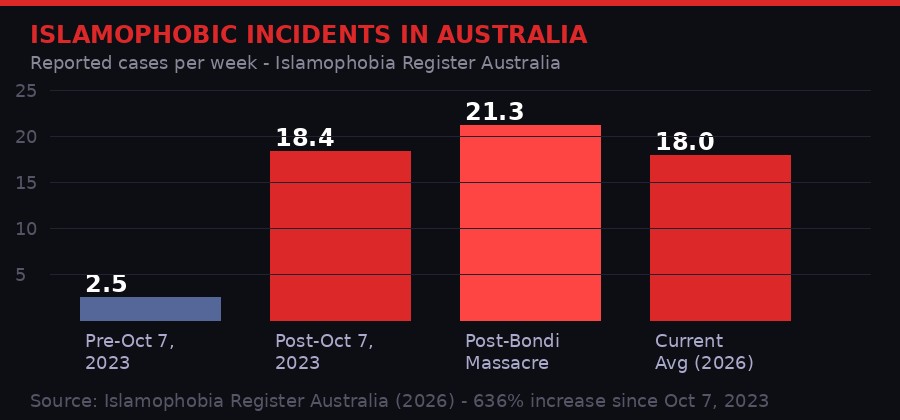
Reported Islamophobic incidents per week in Australia from pre-Oct 2023 baseline through current 2026 average. Source: Islamophobia Register Australia.
Dr Moshiuzzaman Shakil, a Bangladeshi doctor who lives in Lakemba with his wife, offers the kind of specific, human-scale story that statistics cannot hold. After the Bondi Beach massacre in December 2024 - where gunmen killed multiple people at a Hannukkah celebration in what police described as an attack driven by "Islamic state ideology" - one of his disabled clients let him go. The reason given: "Are you a Muslim?"
He confirmed he was. He lost the client. That is what 636 percent actually looks like at ground level - a man who cares for people with disabilities, who moved to Lakemba because it feels like home, losing work not because of anything he did, but because of what he is.
"After the Bondi attack, some people thought Muslims were terrorists." - Dr Moshiuzzaman Shakil, Bangladeshi doctor, Lakemba, Sydney
The Bondi massacre sent shockwaves through both communities it touched. Australia's Jewish community - already traumatized by a years-long rise in antisemitism that the Executive Council of Australian Jewry says has quintupled since October 7, 2023 - was devastated. And the Muslim community, in the weeks after Bondi, watched Islamophobic incidents spike by another 201 percent.
Both communities are suffering. Both feel unsafe. And yet, in the political conversation, they are frequently pitted against each other rather than recognized as sharing a common experience of targeted hate. The Prime Minister came to Lakemba mosque to mark Eid ul-Fitr. He was booed. That image - a political leader attending a celebration and being heckled by the people he came to honor - says something about how far trust has collapsed.
Sydney's Multicultural Fault Lines Go Deep
Australia's self-image as "one of the most successful multicultural societies in the world" has always carried a footnote. The White Australia Policy - which actively limited non-white immigration - was not abolished until 1973. That is recent history. People who were alive when those restrictions were lifted are still alive today.
The Cronulla riots of 2005 are another reference point that keeps surfacing in conversations about Muslim-Australian identity. A crowd of roughly 5,000 people gathered on Cronulla Beach after a reported assault by men described as "of Middle Eastern appearance," then violently attacked people they believed to be Lebanese Muslims. Retaliation came. The week left scars that have not healed.
"I think this community has been in trauma since the Cronulla riots," Kheir told the BBC. "Every time an episode happens now, we sit back and curl into the fetal position thinking: 'Oh God, please don't be a Muslim person that just perpetrated that offence.'"
That sentence captures something rarely spoken aloud: the exhausting collective guilt-by-association that Muslim Australians carry. Every terrorist attack, every violent crime linked to Islamic extremism anywhere in the world, sends a wave of dread through communities who had nothing to do with it but who know they will be judged for it.
About 61 percent of Lakemba's population is Muslim, according to the 2021 census. Restaurants offer Mandi chicken and Middle Eastern staples. Shop signs are in Arabic and English. For many Muslim Australians, Lakemba is the "comfort zone" - the place where they can exist without performing constant identity management for a majority that sometimes views them with suspicion.
- Lisa Robicheau, Muslim woman in Quebec, Canada
Canada's Supreme Court and the Law That Made Teachers Choose Between Their Faith and Their Work

Canada's Supreme Court in Ottawa began four days of hearings on Quebec's Bill 21 this week - a case with ramifications beyond religious symbols. / Pexels
In Montreal, Lisa Robicheau describes her life as "stuck between a rock and a hard place." The 41-year-old single mother of two works in an English-language Montreal school as a contract support worker for students with disabilities. She wears a hijab. Her job is currently exempt from Quebec's Bill 21 - but that exemption comes with conditions, and those conditions have made her future in her own city feel like a question she cannot answer.
Bill 21, passed by Quebec's provincial government in 2019, bars certain public sector workers - teachers, principals, judges, police officers - from wearing religious symbols at work. Supporters call it a logical extension of Quebec's laicite tradition, the secularism rooted in the Quiet Revolution of the 1960s when Quebecers deliberately separated public institutions from the Catholic Church that had dominated them. Critics call it discrimination with a legal fig leaf.
This week, Canada's Supreme Court began four days of hearings on a constitutional challenge to the law. Thirteen challengers brought the case, including the Canadian Civil Liberties Association, the National Council of Canadian Muslims, the World Sikh Organization of Canada, and the English Montreal School Board. (BBC News, March 22, 2026)
The case is bigger than Bill 21 itself. Quebec passed the law using the "notwithstanding clause" - a built-in mechanism in Canada's constitution that allows provincial governments to override certain Charter rights, including freedom of religion and equality rights. Lower courts upheld Bill 21 specifically because of this clause. Now the Supreme Court must decide not just whether the law is discriminatory, but whether the notwithstanding clause should have limits at all.
That question - can a province legally override fundamental rights? - is about far more than headscarves. It is about the architecture of Canadian democracy itself.
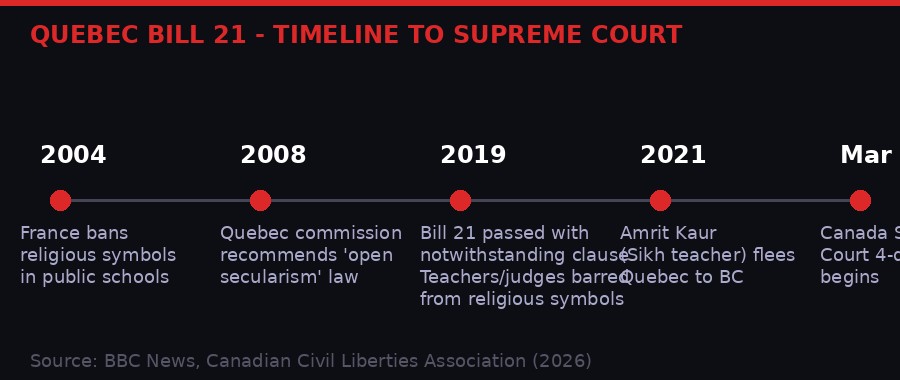
Key milestones in the journey of Quebec's secularism law from France's 2004 ban through to Canada's Supreme Court hearing this week.
Researcher Nadia Hasan at York University in Toronto has spoken to more than 400 Muslim women in Quebec about Bill 21. Her findings are damning. Seventy-three percent said the law affected their ability to look for work. A similar proportion said they had considered leaving the province entirely. More than half reported experiencing racist remarks or prejudice at work. Many had been pushed toward employment in Muslim-owned businesses or private schools - what Hasan calls, with uncomfortable precision, a dynamic of "social segregation." (Nadia Hasan, York University, cited by BBC News, 2026)
Amrit Kaur, a Sikh teacher who grew up in Quebec and wears a turban, is one of the law's named appellants. In 2021 she wrote publicly that Bill 21 had "shattered" her future as an educator in her home province and forced her to flee "like a refugee" to British Columbia, where she now lives and teaches. She chose her faith over her hometown. That is the actual consequence of the law: people leaving. Talent leaving. History leaving.
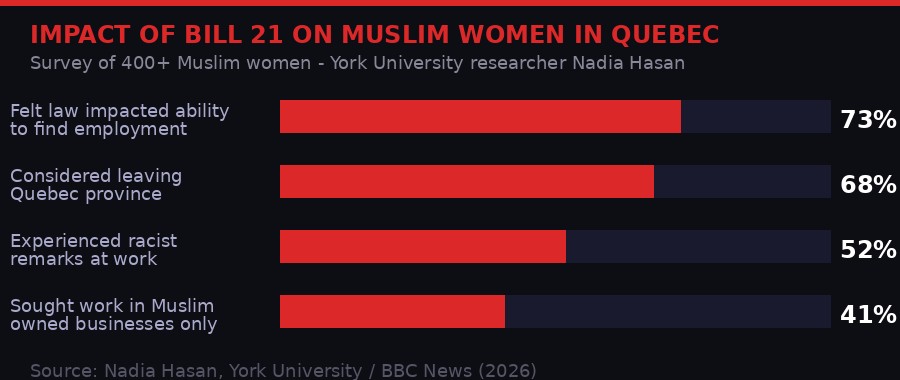
York University research surveying 400+ Muslim women in Quebec on the professional and personal impacts of Bill 21.
Quebec Premier Francois Legault's government is currently seeking to expand the law further - to cover all school staff, not just teachers, and to extend into daycare centers. It also wants to ban prayer in public spaces. If the Supreme Court upholds Bill 21, that expansion becomes significantly easier to pursue.
Polls show a majority of Quebecers support the current law. David Rand, president of a Montreal atheist group, argues that "religious convictions are no more sacred or untouchable than political convictions" and that public sector workers should set them aside in professional settings. He predicted that a ruling forcing Quebec to scrap the law would trigger "massive protest."
Elizabeth Elbourne, a historian at McGill University, frames the law as a product of Quebec's particular historical relationship with religion - specifically the trauma of clerical control before the 1960s, and the ongoing anxiety about preserving French-language identity in an anglophone continent. The law reflects real history. The question is whose history it chooses to protect, and whose it asks to disappear.
"I've spent the majority of my life here, but it never feels like home. I am constantly being treated like an outsider." - Lisa Robicheau, 41, Montreal, on life as a hijab-wearing woman in Quebec
Nowruz in the Dark: Iranians Mark New Year Under Bombardment

Iranians have celebrated Nowruz - one of humanity's oldest festivals - for more than 3,000 years. This year it fell on March 20, three weeks into active bombardment. / Pexels
Mina lives in Damavand, northeast of Tehran, where she moved with her family to get away from the worst of the strikes. She spoke to BBC Persian this week about Nowruz - the Persian New Year that fell on March 20th, the spring equinox, a celebration 3,000 years old.
"We'd be busy getting ready - cleaning the house, shopping for new clothes, sweets and snacks," she said.
Then she paused.
"This year? Every day feels so long. It's like I've lost track of time."
Iran has been under continuous US and Israeli bombardment since February 28th. The Human Rights Activists in Iran, a US-based monitoring group, reports 3,114 deaths including 1,354 civilians and at least 207 children. Iran has responded with attacks on Israel and US-allied Gulf states. The Strait of Hormuz - through which roughly 20 percent of the world's oil flows - has been partially closed. Trump threatened this week to "obliterate" Iran's power plants if it does not reopen the waterway within 48 hours. (BBC News, Al Jazeera, March 22, 2026)
Into this walked Nowruz - one of humanity's oldest and most joyful festivals. Celebrated by Persians, Parsis, Kurds, Armenians, Azerbaijanis, Tajiks, Kazakhs, Uzbeks, and dozens of other cultures across central Asia and the Middle East, Nowruz means "new day." It marks the arrival of spring, the rebirth of nature, and the beginning of the new year. Families deep-clean their homes to sweep out the old year's bad luck. They set Haft Sin tables - seven symbolic items starting with the letter S - and make wishes for health, happiness, and fresh starts.
The last time Iranians marked Nowruz under wartime conditions was the 1980s, during the eight-year Iran-Iraq War.
This year's festival is quieter, more fragmented. Some families have evacuated Tehran entirely. Markets that should be packed with Nowruz shoppers are largely empty. Parmis, a woman in her 20s still in Tehran, went to get her nails done on March 17th - an ordinary Nowruz preparation ritual. She was in the salon when a loud explosion went off. Nobody flinched. They had adapted.
"I feel like some are still carrying on despite everything, like me. I was in the salon when a loud explosion went off, and no-one even flinched." - Parmis, Tehran, speaking to BBC Persian, March 2026
Mina's son Amir captured the economic dimension that rarely makes headlines: "People are losing their jobs with the war. My biggest worry is our country's infrastructure." He added something bleaker: "At this rate, there might not even be much left of Iran. I don't want this to be our last Nowruz."
Not everyone in Iran grieves the same way. Some Iranians who oppose the Islamic Republic have found a complicated, painful solidarity with the strikes. Ramtin, a man in his 30s in Tehran, told BBC Persian: "What's the point of Nowruz? If the Islamic Republic stays in power, we have to live with endless hardships. Nowruz is always there, comes and goes. This time, the Islamic Republic must go."
His view represents a real division inside Iran - between those who mourn what is being destroyed and those who see destruction as the only possible path to something better. That division is not simple to summarize, and journalists who reduce it to either pure victimhood or tacit approval of the strikes are missing the layered, agonizing reality of what it means to want your country's regime to fall while watching your country's infrastructure crumble around you.
Maryam, another Tehran resident, chose a third response: defiance. She went out and bought items for her Haft Sin table anyway. "There were people out buying things for Haft Sin. I saw flowers and some street vendors. But no, it's not like it was in previous years," she said. "At the same time, this is a tradition that happens once a year, and we must celebrate it."
A Global Pattern: When Holy Time Becomes Political Time
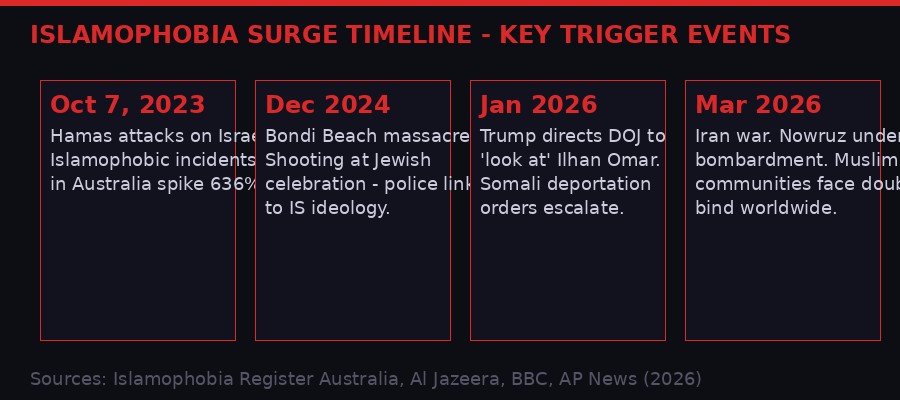
Key events driving the global surge in anti-Muslim incidents from October 2023 through the Iran war of March 2026.
These three stories share geography and proximity but they also share something structural: the way that external political violence gets redirected at Muslim communities as collective punishment.
When Hamas attacked Israel in October 2023, Australian Muslims - most of whom had nothing to do with Hamas, have never been to Israel or Palestine, and hold a wide spectrum of political views on the conflict - saw Islamophobic incidents jump 636 percent. When a gunman killed Jewish Australians at Bondi Beach in December 2024 and police described an IS-linked motive, Islamophobic incidents spiked another 201 percent. When Trump escalated his rhetoric about Somali immigrants and directed the DOJ to investigate Congresswoman Ilhan Omar in January 2026, mosques in Minnesota reported a surge in threats.
The mechanism is consistent: a violent act associated with any version of Islam anywhere in the world generates immediate suspicion and hostility toward Muslims who are near the person doing the targeting. That a Bangladeshi doctor in Sydney and a Somali-American congresswoman in Minnesota have no ideological connection to an Islamic State-inspired gunman in Bondi is not a concept that hate operates within.
Quebec's Bill 21 is a slower, more institutionalized version of the same logic. It does not require a specific violent incident to justify itself. It arrives dressed in the language of secularism and civic neutrality. But its practical effect - making visibly Muslim women (and Sikh men, and Jewish people wearing kippot) choose between their faith expression and their careers - produces the same result: a signal that belonging in public life requires erasure of identity.
"The targeting of Australians based on their religious beliefs is not only an attack on them, but it's an attack on our core values." - Australian Prime Minister Anthony Albanese, responding to Islamophobia Register report, 2025
Albanese's words were the right ones. But the Prime Minister who said them also attended an Eid gathering and was booed. That disconnect - between official language and lived experience - is what communities are navigating.
The Islamophobia Register's Nora Amath has called for urgent action. The Special Envoy to Combat Islamophobia, Aftab Malik, released a report in September 2025 recommending systematic intervention. The recommendations exist. The question is whether the political will exists to act on them before the next spike in incidents - which history suggests will come the next time any Muslim anywhere does something that makes global news.
The Diaspora Dimension: When Home Becomes Two Impossible Places

For diaspora communities, Eid 2026 carries additional weight: watching a homeland at war while navigating discrimination in adopted countries. / Pexels
There is a particular texture to being part of a diaspora during a war in your country of origin. The BLACKWIRE culture bureau covered elements of this in the weeks after Iran strikes began - the Iranian diaspora checking their phones for news of relatives they cannot reach, the grief of watching familiar cities appear in smoke-filled footage. That story does not stop when Nowruz arrives. It intensifies.
For Iranian Australians, Iranian Canadians, and Iranian communities across Europe and North America, Nowruz 2026 arrives with a double weight. They are watching Iran being bombed from countries that are participating in, enabling, or at minimum not opposing the bombardment. They are grieving for relatives who send messages about air raid sirens. And they are navigating this grief in communities where, depending on their visible Muslim identity, they may simultaneously be facing Islamophobia from neighbors who perceive all Muslims as enemies.
Shirin, a young Iranian woman in Tehran, told BBC Persian: the war coinciding with Nowruz "makes me sad beyond words." She did not elaborate. She did not need to. The phrase itself carries everything - the collision of one of humanity's oldest expressions of hope with one of modernity's most brutal expressions of power.
The word "diaspora" comes from the Greek for scattering - seeds scattered by wind, forced to take root wherever they land. What Nowruz 2026 reveals is that those seeds are still being scattered. New communities are being formed under duress - Iranians leaving Tehran for safer cities within Iran, Quebecers like Amrit Kaur leaving their home provinces because the law has made their lives untenable, Australian Muslims retreating more fully into the safety of Lakemba's "comfort zone."
The scattering continues. The festival of return - which is what Nowruz has always been, a festival celebrating the return of light and warmth after winter - becomes bittersweet when return is not available.
What Gets Lost When Celebration Requires Courage

Community Eid events this year required security planning that organizers describe as deeply unnatural for what should be pure celebration. / Pexels
The most corrosive effect of sustained discrimination is not the dramatic incidents - the threats, the assaults, the legal restrictions. It is what happens to the ordinary texture of daily life when belonging becomes conditional.
Gamel Kheir organizing community Iftar should be a logistical exercise about food and tables. It became a security exercise about cameras and guards. That transformation - from planning celebration to planning protection - represents a cost that is paid in something harder to measure than statistics. It is paid in the quality of joy available in a given moment.
Lisa Robicheau re-enrolling in university to find a different career because Quebec law has put a ceiling on her original one is not just a labor market statistic. It represents years of redirected energy, reconsidered futures, ambitions bent to accommodate the preferences of a provincial government that decided visible Muslim identity is incompatible with public service.
Maryam in Tehran setting out her Haft Sin table despite the bombardment is an act of preservation - an insistence that meaning survives even when the infrastructure that normally carries it is under attack. It is also an act that costs something. The act of celebrating under threat is not the same as the act of celebrating freely. Both are valuable. Only one is full.
The Islamophobia Register reports 18 incidents a week in Australia. Canada's Supreme Court is about to render judgment on a law affecting thousands of professionals. Iran's civilian death toll climbs. Nowruz happened and spring arrived on schedule, indifferent to human politics as it always is.
The question - the one that the statistics and the legal briefs and the testimonies all eventually arrive at - is whether the societies receiving these communities are willing to make celebration possible, or whether belonging will continue to require courage that it should never have needed.
In Lakemba, families shared dates in the shadow of surveillance cameras and managed, despite everything, to pray together. That is something. It is not enough.
Key Events: Islamophobia Surge 2023-2026
Get BLACKWIRE reports first.
Breaking news, investigations, and analysis - straight to your phone.
Join @blackwirenews on Telegram