
Four years in, El Salvador's emergency decree has created a generation of children growing up behind a different kind of fence. (Pexels)
The Orphaned Generation: Four Years of El Salvador's Emergency Decree and 100,000 Children Left Behind
In the courtyard of a church in El Rosario, a town about an hour east of San Salvador, sixteen-year-old Sarita holds a golden medallion of Saint Benedict against her white school uniform. She wears it every day. She never takes it off.
The pendant is not just devotion. It is a thread connecting her to the father she has not spoken to in two years - a man arrested under El Salvador's state of emergency decree and held without trial ever since. He used to wear one just like it.
"Sometimes I just shut myself in my room," Sarita told Al Jazeera. "I just kneel down and start crying and crying, looking at photos of my father."
Sarita is not an anomaly. She is one of an estimated 60,000 to 100,000 children in El Salvador who have lost one or both parents to the most aggressive mass incarceration campaign in the Western Hemisphere. On March 27, 2026, the decree turned four years old. It has been renewed 48 consecutive times. Over 90,000 Salvadorans sit in cells - many without charges, without lawyers, without any clear path to release.
The government calls it a security miracle. Families call it state-sponsored orphaning.
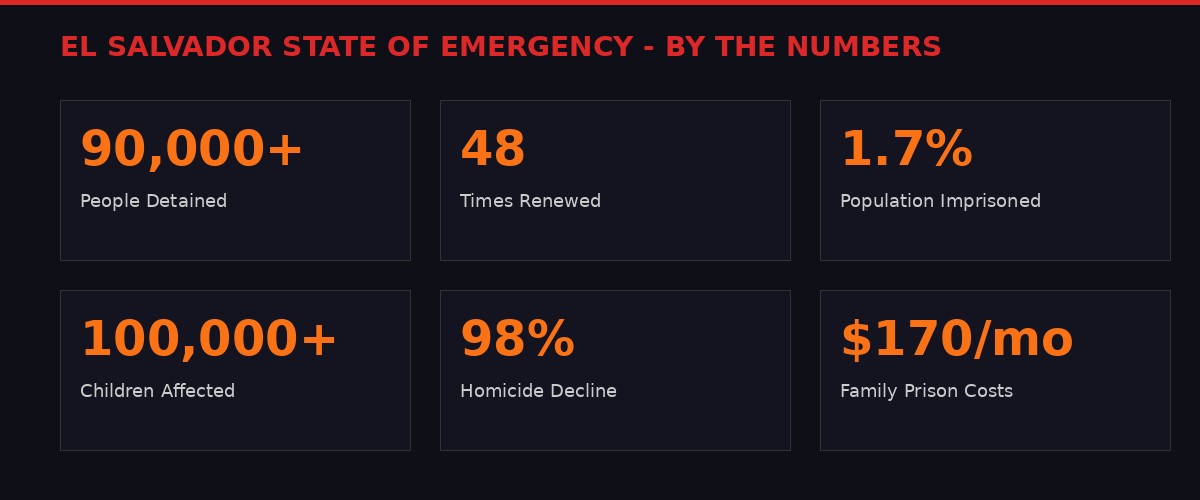
Four years of emergency powers in El Salvador - the numbers that define a generation. (BLACKWIRE Infographic)
The Day Everything Changed

March 26, 2022: the day El Salvador recorded 62 murders. The emergency decree followed within 24 hours. (Pexels)
To understand what El Salvador is today, you have to go back to a single weekend in late March 2022. On Saturday, March 26, gang violence surged across the country with a brutality that shocked even a population accustomed to bloodshed. Sixty-two people were murdered in a single day - a death toll not seen since El Salvador's twelve-year civil war ended in 1992.
MS-13 and Barrio 18, the transnational gangs that had carved El Salvador into territorial fiefdoms for decades, unleashed coordinated attacks across multiple neighborhoods. The country's daily death count, which had been dropping, suddenly spiked to numbers that made international headlines.
President Nayib Bukele's government responded with overwhelming force. On March 27, 2022, the Legislative Assembly approved a state of emergency - formally called the "regimen de excepcion" - suspending key constitutional rights. Freedom of assembly was curtailed. The right to legal defense was suspended. Police and military could arrest anyone on suspicion of gang affiliation without a warrant, without explaining the charges, and without granting access to an attorney.
What was declared as a 30-day measure has never ended. Every month since March 2022, the assembly has renewed the decree. As of March 27, 2026, the count stands at 48 consecutive renewals - four unbroken years of suspended civil liberties.
In the first month alone, over 9,000 people were swept into custody. By the end of 2022, the number had climbed past 50,000. By 2024, it exceeded 75,000. Today, the detained population stands above 90,000 - roughly 1.7 percent of El Salvador's entire population of 6.3 million, giving the country the highest incarceration rate on Earth, nearly double that of Cuba, the next closest nation.
The crackdown drew immediate international attention. Human rights organizations documented mass roundups in poor neighborhoods where soldiers would seal off entire blocks, detain every young man they could find, and transport them to overcrowded facilities. Identification was haphazard. Evidence was thin or nonexistent. The calculus was simple: if you lived in a gang-controlled area and fit a certain profile - young, male, tattooed, poor - you were a suspect.
The Mega-Prison and the Spectacle of Control

El Salvador's CECOT mega-prison holds 40,000 inmates in conditions that human rights groups have called inhumane. (Pexels)
Central to Bukele's security theater is the Centro de Confinamiento del Terrorismo - CECOT - a mega-prison built in Tecoluca that can hold up to 40,000 inmates. Completed in early 2023, CECOT was designed to be a statement: El Salvador would not merely arrest gang members; it would disappear them into a facility specifically engineered for maximum-security isolation.
The prison's design is deliberately austere. Cells hold dozens of inmates on concrete slabs. Natural light is minimal. Communication with the outside world is severely restricted. Families have reported going months without any contact with detained relatives - no phone calls, no letters, no visits.
Bukele used CECOT as a propaganda tool, flooding social media with drone footage of shaven-headed inmates in white jumpsuits marching in formation. The images went viral internationally, drawing praise from hardline security advocates and horror from human rights groups. Bukele himself leaned into the spectacle, posting about the prison on his personal social media accounts and inviting foreign leaders to tour the facility.
The prison also became a tool of US foreign policy. In March 2025, the Trump administration deported more than 230 Venezuelan migrants to CECOT under a controversial deal with Bukele's government - a move that sparked legal challenges and was later partially reversed by federal courts. Former detainees who were eventually released described the conditions as "hell," reporting physical and psychological abuse during their imprisonment (PBS NewsHour, July 2025).
But CECOT represents only the visible tip of a much larger carceral system. Dozens of facilities across the country hold the remainder of the 90,000-plus detainees, many in conditions that predate and fall below even CECOT's grim standards. Overcrowding is endemic. Medical care is scarce. At least 300 people have died in custody since 2022, according to estimates compiled by Cristosal, a Salvadoran human rights organization - though the actual number is believed to be higher, as the government restricts access to detention statistics.
The Innocence Problem

Mass trials of up to 900 defendants at once have become routine in El Salvador's judiciary - a system designed for volume, not justice. (Pexels)
Bukele himself has acknowledged that innocent people have been arrested. In November 2024, the president estimated that approximately 8,000 people had already been released after being wrongfully detained. But advocacy groups say that number vastly understates the problem.
The Movement for the Victims of the State of Exception - known by its Spanish acronym MOVIR - has documented thousands of cases of people arrested with no evidence of gang involvement. Farmers, construction workers, street vendors, bus drivers - people whose only shared characteristic was poverty and proximity to gang-controlled territory.
Samuel Ramirez, MOVIR's founder, has become one of the most vocal critics of the decree's continuation. His position is blunt: you cannot call yourself the safest country in the hemisphere while maintaining a permanent state of emergency.
"In four years under the state of emergency, we are without human rights, without fundamental guarantees. The regime has eliminated all of these rights. Bukele contradicts himself when he says we are the safest country. Only a country in permanent conflict can have a permanent state of emergency." - Samuel Ramirez, MOVIR founder (Al Jazeera, March 2026)
The judicial process - if it can be called that - has been restructured to handle the sheer volume. In 2023, Bukele's government authorized mass trials of up to 900 defendants at a time. Defense lawyers, where they are permitted at all, have minutes to review cases. Evidence presentation is perfunctory. Acquittals are rare.
International legal observers have compared the system to military tribunals, noting that the presumption of innocence has been effectively inverted. Under El Salvador's emergency framework, detainees must prove they are not gang members - a near-impossible task when the evidence against them is often nothing more than a neighbor's anonymous tip or their presence in a particular neighborhood.
A new wave of political repression has also emerged alongside the anti-gang operations. According to PBS NewsHour reporting from July 2025, more than 100 human rights advocates, journalists, lawyers, academics, and environmentalists have fled El Salvador, driven out by government surveillance, threats, and in some cases, direct arrest. Critics of the decree are now treated with the same suspicion as the gangs the decree was meant to target.
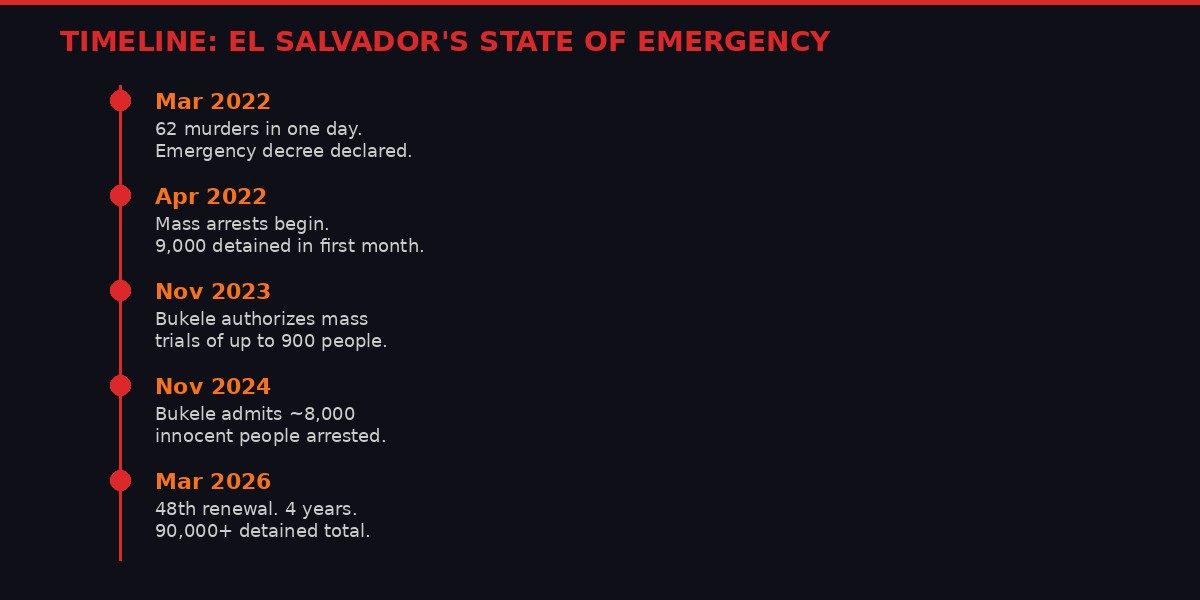
From temporary measure to permanent reality - four years of El Salvador's emergency decree. (BLACKWIRE Infographic)
The Children Left Behind

An estimated 60,000 to 100,000 children have lost parental support since the emergency decree began. (Pexels)
The most devastating consequence of the mass incarceration campaign is the one Bukele's government almost never discusses: the children.
MOVIR estimates that approximately 60,000 children have lost one or both parents to detention since 2022. Other organizations, including Azul Originario, a San Salvador-based nonprofit that works with affected youth, place the number closer to 100,000 or higher. The discrepancy reflects the difficulty of counting affected children in a country where the government actively discourages research into the decree's collateral damage.
The stories follow a heartbreaking pattern. A father is taken during a neighborhood sweep. The mother, if she is still in the picture, must now work longer hours to compensate for the lost income. Children are left in the care of grandmothers, aunts, older siblings - or, in the worst cases, no one at all. Those without family support may end up in government institutions run by CONAPINA, El Salvador's child protection agency, where advocates have documented abusive conditions.
Fatima Gomez, 47, has been raising her son's two daughters - ages 10 and three at the time of his arrest in 2022 - since he was taken. The eldest daughter carries visible psychological wounds.
"When she sees soldiers and police, she starts crying and runs inside. She says they are going to take all of us, too." - Fatima Gomez, grandmother caring for two granddaughters after her son's arrest (Al Jazeera, March 2026)
A psychologist with Azul Originario, who requested anonymity due to fear of government reprisal, described a consistent pattern among the children she treats: anxiety disorders, depression, social withdrawal, refusal to attend school, and a profound fear of authority figures.
"Sometimes they don't want to do any physical activity or any studying. They don't want to spend time with other children or go outside. They're afraid of authorities, because some of them experienced the authorities taking their parents away." - Anonymous psychologist, Azul Originario (Al Jazeera, March 2026)
Rubidia Hernandez knows this pattern intimately. Her 21-year-old son was arrested in August 2022, leaving behind a two-year-old daughter whose mother was already absent. Hernandez, now in her late fifties, took the child in. The girl - now six - asks constantly when her father is coming home.
"There are moments - as a father, as a mother - when you feel like maybe you can't go on anymore," Hernandez said. "She always asks me, 'When is my daddy coming? I need him to come.'"
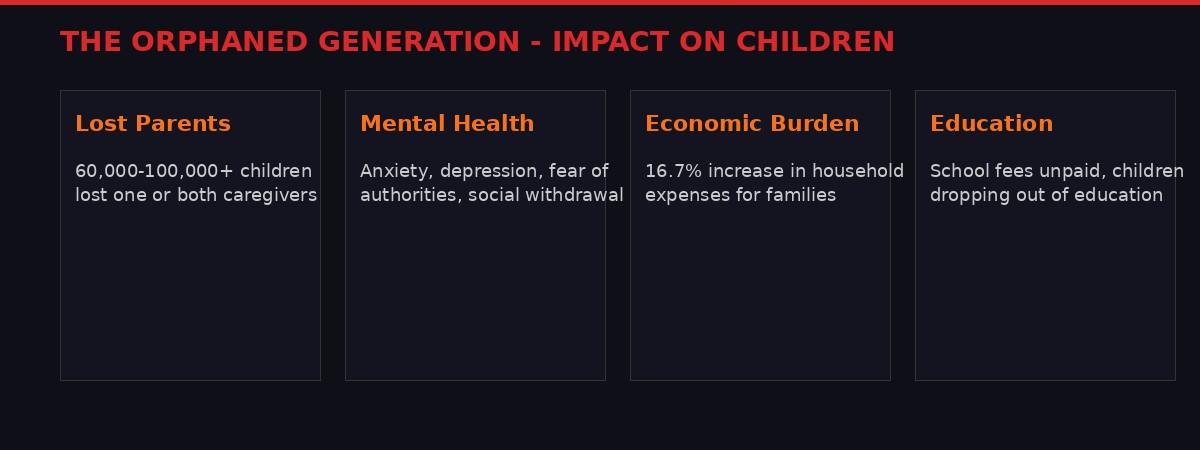
The hidden toll: how mass incarceration is reshaping an entire generation of Salvadoran children. (BLACKWIRE Infographic)
The Economics of Imprisonment

Families spend an average of $170 per month to keep imprisoned relatives fed and clothed - costs the state refuses to cover. (Pexels)
Since the state of emergency began, El Salvador has stripped its prisons down to the bare minimum. The government provides two small meals per day to inmates. Everything else - additional food, clothing, hygiene products, medicine - must be supplied by families.
The cost averages $170 per month. In a country where the minimum wage is approximately $365, that means nearly half of a low-income family's earnings can be consumed by keeping a single imprisoned relative alive and clothed. For families who have lost their primary breadwinner to detention, the math is devastating.
Azul Originario's 2023 research documented that affected households face an average increase of 16.7 percent in expenses over a six-month period - expenses that are borne almost entirely by women, who shoulder the dual burden of working to survive while caring for children whose parents are locked away.
For Hernandez, who is raising her six-year-old granddaughter, the financial pressure is relentless. School fees run about $40, plus the cost of uniforms and supplies. She works odd jobs to cover the basics. There is no government support for families of detainees - in the official narrative, these families do not exist as a category worthy of assistance.
The economic ripple effects extend far beyond individual households. Entire neighborhoods have been hollowed out by the arrests. In communities where young men made up the majority of the workforce - in construction, agriculture, street vending, transport - their removal has created labor vacuums that further depress local economies. Businesses that depended on their patronage have closed. Markets have shrunk. The communities that were already the poorest before the decree are now poorer still.
International remittances, which account for roughly 24 percent of El Salvador's GDP, have shifted in purpose. Money that once funded small businesses or home improvements now goes to prison support and child care. The World Bank estimated in 2025 that the emergency decree's downstream economic effects have cost the country approximately $800 million in lost productivity and redirected household spending.
The Bukele Paradox

Despite growing domestic protests, Bukele maintains approval ratings above 80 percent. The paradox of popularity built on fear. (Pexels)
Perhaps the most confounding aspect of El Salvador's emergency decree is that it remains popular. Bukele consistently polls above 80 percent approval, making him one of the most popular leaders in the Americas. His social media following is enormous. He is copied and admired by politicians across Latin America and beyond.
The reason is straightforward: the violence stopped. From 2015 to 2024, El Salvador's homicide rate fell by 98 percent. A country that was once the murder capital of the Western Hemisphere now has a murder rate lower than that of many US cities. For Salvadorans who spent decades living in terror of MS-13 and Barrio 18 - who paid "renta" (extortion) to gangs just to keep their businesses open, who buried children killed in crossfire, who could not walk certain streets after dark - the change is not theoretical. It is physical, immediate, and real.
This creates a moral knot that no external observer can easily untangle. The people who most loudly support the emergency decree are often the same people who suffered most under gang rule. They know the arrests have swept up innocents. They know the prisons are inhumane. They know children are suffering. But they also know what life was like before - and they are not willing to go back.
A 2025 survey by CID Gallup found that 72 percent of Salvadorans supported the continuation of the state of emergency, even when presented with information about human rights violations. Among respondents who had personally experienced gang violence - which included roughly 60 percent of the population - support rose to 84 percent.
This dynamic has paralyzed domestic opposition. Political parties that criticize the decree are immediately tagged as "pro-gang" by Bukele's extensive social media apparatus. Candidates who question the arrests lose elections by enormous margins. The political incentive structure now rewards only one position: more arrests, more prisons, more emergency powers.
International criticism has had minimal effect. When the United Nations High Commissioner for Human Rights called for the decree's end in 2024, Bukele responded by posting a mocking tweet that received more engagement than the UN's official statement. When the Inter-American Commission on Human Rights issued precautionary measures on behalf of detainees, El Salvador ignored them.
The Export Model

From Ecuador to Honduras, Bukele's playbook is being copied across Latin America - with all the same risks. (Pexels)
El Salvador's experiment has not stayed within its borders. The "Bukele model" - emergency decrees, mass incarceration, mega-prisons, social media spectacle - has become a template for leaders across the region.
Ecuador declared its own state of emergency in January 2024 after a surge in gang violence, explicitly citing El Salvador's approach as inspiration. President Daniel Noboa deployed the military into prisons, declared gang organizations as terrorist groups, and launched mass arrest operations in Guayaquil and other cities. The results have been mixed: violence has decreased in some areas but surged in others, and Ecuador's prison system, already overburdened, has descended into deeper crisis.
Honduras, under President Xiomara Castro, adopted a modified version of the emergency framework in late 2024, deploying military forces to gang-controlled neighborhoods in Tegucigalpa and San Pedro Sula. Guatemala has debated similar measures. In all cases, Bukele's apparent success - the dramatic drop in homicides - serves as the primary selling point, while the human rights costs are framed as acceptable trade-offs.
The pattern extends beyond Latin America. Philippines President Ferdinand Marcos Jr. has publicly praised Bukele's approach, drawing comparisons to his predecessor Rodrigo Duterte's drug war. In Africa, Rwandan officials have cited El Salvador as a model for maintaining security through concentrated state power. Even European far-right politicians have invoked Bukele's name when arguing for harder immigration and crime policies.
Experts who study authoritarian trends are alarmed by the model's spread. Geoff Thale, president of the Washington Office on Latin America (WOLA), has argued that Bukele's approach works as a short-term political strategy but creates long-term institutional damage that takes decades to repair.
The fundamental question - whether mass incarceration without due process can permanently reduce violence, or whether it merely displaces and delays it - remains unanswered. El Salvador is the experiment's first full-term test case. The results won't be clear for years.
Voices from the Frontline

Near Cuscatlan Park in San Salvador, families of detainees gather every Saturday to demand answers about their loved ones. (Pexels)
Every Saturday near Cuscatlan Park in San Salvador, a small group of women gathers. They carry printed posters with the faces of their sons, husbands, and brothers. Each poster bears the same word: "Inocente."
Sara de Perez, 54, is Sarita's grandmother. She has attended these gatherings since her son was arrested two years ago. He has not been convicted of any crime. He has not had a trial. She does not know when - or if - he will come home.
"My son used to wear one like this too," she says of Sarita's Saint Benedict medallion, her voice catching. The medallion is the only tangible connection the family still has to him. Letters are not permitted. Visits have been denied. Phone calls are impossible.
The women at Cuscatlan Park represent a cross-section of Salvadoran society that the government would prefer to keep invisible. They are mothers of construction workers arrested during sweeps. Wives of bus drivers detained at checkpoints. Sisters of men whose only crime was having a tattoo - not a gang tattoo, but any tattoo - in a neighborhood where soldiers were filling arrest quotas.
NGO workers who support these families operate under constant threat. The psychologist from Azul Originario who spoke to Al Jazeera did so anonymously because colleagues who have publicly criticized the decree have been arrested, surveilled, or forced to flee the country. Samuel Ramirez of MOVIR continues his advocacy work with full knowledge that he could be detained at any time.
The fear extends to journalists. Since 2022, at least 14 journalists have left El Salvador citing government intimidation. El Faro, the country's most prominent independent news outlet, relocated parts of its operation after its newsroom was placed under surveillance. International press access to prisons is tightly controlled, with journalists required to submit to government-approved tours that critics describe as "choreographed performances."
For the families who remain, the struggle is both public and deeply private. Rosalina Gonzalez, 59, protests every week for her two sons - Jonathan and Mario - who were both arrested on February 19, 2025. Neither has been charged. Neither has been tried. She does not know which facility holds them.
"You learn to live with the pain," Gonzalez told reporters at a recent protest. "But you never stop feeling it. You just learn to carry it."
What Comes After

The question hanging over El Salvador is not whether the emergency will end - but what kind of country will exist when it does. (Pexels)
Four years into the state of emergency, the most uncomfortable question is the one nobody in power is willing to answer: what happens when it ends?
If - and it remains a significant "if" - the decree is ever lifted, El Salvador will face a reintegration crisis with no modern precedent. Over 90,000 people will need to be either tried and convicted or released. The judicial system, which has been engineered for mass processing rather than individual justice, is not equipped for either scenario.
Released detainees will return to communities that have moved on without them. Jobs they once held will be filled or eliminated. Children they left behind will have grown up with other caregivers, or without caregivers at all. Relationships will have fractured. The psychological damage - to both the detained and those they left behind - will take a generation to heal, if it heals at all.
The economic costs of mass incarceration will also come due. El Salvador currently spends an estimated $450 million annually on its expanded prison system - money diverted from education, healthcare, and infrastructure. The country's international credit rating has been under pressure, and foreign investment has cooled as concerns about rule of law deepen.
And then there are the children. The 60,000 to 100,000 young people who have grown up without parents during their most formative years. Research on the long-term effects of parental incarceration on children is extensive and grim: higher rates of depression, anxiety, substance abuse, academic failure, and involvement in the criminal justice system. The very children Bukele's decree was supposed to protect from gang violence are now statistically more likely to experience it - not because the gangs recruited them, but because the state removed the people who were supposed to keep them safe.
Hernandez, the grandmother raising her six-year-old granddaughter, says the solution is simple. She does not want new programs or international aid or policy papers. She wants her son back.
"We need our son to be free because he was the one who worked. He always looked out for us." - Rubidia Hernandez (Al Jazeera, March 2026)
In the church courtyard in El Rosario, Sarita still wears her Saint Benedict medallion. She prays every night for her father. She studies because he told her to. She cries because he is not there to tell her anything anymore.
She is sixteen. She has been waiting since she was fourteen. The decree, as of this writing, shows no sign of ending.
The generation being forged in El Salvador's emergency will define the country for the next fifty years. Whether they emerge as the children of a nation that chose security over justice - or the generation that demanded both - is a question that 100,000 young faces are still waiting to answer.
Get BLACKWIRE reports first.
Breaking news, investigations, and analysis - straight to your phone.
Join @blackwirenews on Telegram