CIPHER BUREAU - CORRUPTION & DARK MONEY
The Fox in the Henhouse: How an Oil Lobbyist Captured the EPA and Gutted America's Methane Rules
Aaron Szabo spent years ghost-authoring the fossil fuel industry's attacks on federal methane regulations. Then he got the job of writing those regulations himself. PDF metadata, internal emails, and closed-door meeting records reveal the most brazen case of regulatory capture in modern EPA history.
BLACKWIRE / CIPHER BUREAU - April 3, 2026 - Washington, D.C.

The oil and gas industry is the largest industrial source of methane emissions in the United States. Photo: Pexels
In January 2022, a lobbying group called the American Exploration and Production Council submitted a comment letter to the Environmental Protection Agency. The letter attacked proposed methane emissions controls as "burdensome" - using that exact word ten times across its pages. It called for "flexibility" to weaken leak-detection requirements. It cast doubt on the science behind the rules' climate benefits. The letter bore no individual author's name.
But buried inside the PDF metadata - the invisible fingerprints that document-creation software stamps onto every file - was a name: Aaron Szabo.
At the time, Szabo was a registered lobbyist for Ovintiv, one of the AXPC's member companies. He was being paid to fight the very regulations that letter attacked. Three years later, in January 2025, Szabo walked through the doors of EPA headquarters as an adviser to the agency's new administrator, Lee Zeldin. Within months, the Senate confirmed him as assistant administrator of the Office of Air and Radiation - the office that writes and enforces the nation's methane rules.
The man the industry paid to argue against the rules now controls the rules. Internal emails, calendar entries, and records of closed-door conversations obtained by ProPublica and reviewed by BLACKWIRE paint a picture of regulatory capture so complete it would be difficult to parody. This is the story of how the American oil and gas industry didn't just influence the EPA - it installed its own operative at the controls.
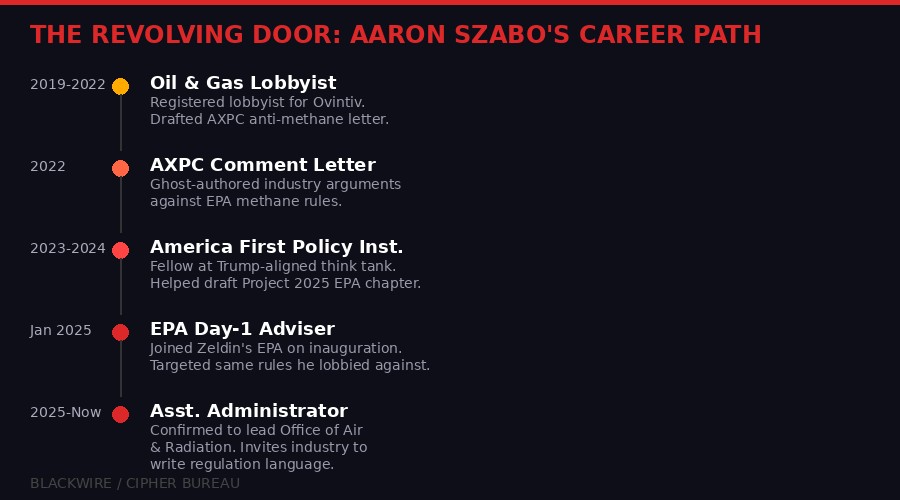
BLACKWIRE / CIPHER BUREAU - The revolving door in motion: from lobbying payroll to government authority in three years.
I. The Ghost Author

The AXPC comment letter bore no author name. PDF metadata told a different story. Photo: Pexels
The American Exploration and Production Council represents some of the largest methane emitters in the United States. Its membership roster reads like a who's who of the fossil fuel extraction business: ConocoPhillips, Diversified Energy, Hilcorp, Devon Energy, and others. When the Biden-era EPA proposed strict new controls on methane emissions from oil and gas operations in 2021, the AXPC mounted a sophisticated lobbying campaign to gut them.
The January 2022 comment letter was a central weapon in that campaign. It didn't merely object to the rules. It provided a detailed, technical roadmap for weakening them - pushing for less frequent leak monitoring, cheaper detection methods, and broad exemptions for certain types of equipment. The language was careful, legalistic, designed to give sympathetic future regulators the bureaucratic cover they would need to roll back the restrictions.
Szabo's name doesn't appear anywhere in the letter's text. But PDF metadata - the information that word processing and document creation software automatically embeds into files - identified him as the document's author. This is a detail that would have gone unnoticed by most readers, but it is the kind of digital breadcrumb that investigative journalists and watchdog organizations have learned to check.
At the time he drafted those arguments, Szabo was a registered federal lobbyist. Disclosure filings show he lobbied on behalf of Ovintiv, a Denver-based oil and gas producer and AXPC member. He also maintained lobbying relationships with other clients in the oil and chemical sectors. His job, in the most literal sense, was to weaken environmental regulations on behalf of the companies that profit from weaker rules.
The Biden administration was unmoved. The EPA finalized its methane regulations in December 2023, projecting they would reduce methane emissions from oil and gas operations by nearly 80 percent. It was one of the most significant climate actions of the Biden presidency, and it represented a direct rebuke to the industry's lobbying campaign - including the very arguments Szabo had drafted.
But the AXPC and its allies were not defeated. They were waiting.

Methane, the primary component of natural gas, traps 80 times more heat than carbon dioxide. Venting and flaring remain widespread. Photo: Pexels
II. The Pipeline to Power

Washington's revolving door between industry and government has rarely spun this fast. Photo: Pexels
Between 2023 and 2024, while the Biden EPA moved to implement the methane rules he had fought, Szabo found a new home: the America First Policy Institute, a Trump-aligned think tank that served as an intellectual staging ground for the second Trump administration. AFPI was staffed with former Trump officials and industry allies who spent those years drafting deregulatory blueprints for a potential return to power.
Szabo's contributions were not abstract. He is thanked by name in the EPA chapter of Project 2025, the Heritage Foundation's comprehensive policy manual for the second Trump term. That document laid out a detailed plan to dismantle federal climate regulations, including the methane rules. When asked about his role during his confirmation hearing on March 5, 2025, Szabo offered only that he had provided "general advice and thoughts" on the Clean Air Act. He declined to elaborate further.
The confirmation hearing itself was a study in strategic omission. Szabo submitted ethics disclosures listing the oil, natural gas, and chemicals companies he had lobbied for - as required by law. But in his testimony, he reframed his industry work in anodyne terms that stripped out any reference to climate policy or methane regulation. "I learned how regulated entities comply with the federal government's thousands of regulations and policies," he told the committee. "I also saw firsthand that the people working in these companies want to ensure the environment is properly protected."
The gap between that description and the reality of ghost-authoring aggressive anti-regulation comment letters is the gap between disclosure and transparency. The ethics forms technically complied. The testimony technically didn't lie. But the picture presented to the Senate was incomplete in ways that matter.
Senator Sheldon Whitehouse, the ranking Democrat on the Senate Environment and Public Works Committee, was blunt in his assessment. "Now he can do Big Oil's dirty work from inside the EPA," Whitehouse told ProPublica. It was a striking accusation from a sitting senator - and one that subsequent events would thoroughly vindicate.
On January 20, 2025 - Day One of the second Trump administration - Szabo walked into EPA headquarters as a senior adviser to new administrator Lee Zeldin. He had gone from drafting the industry's attack on methane rules to occupying an office three doors from the official who would decide those rules' fate. The transition took less than three years.
III. The Industry Gets Its Meeting

Within three weeks of Trump's inauguration, Szabo's staff was meeting with the very lobby group whose letter he had authored. Photo: Pexels
The speed at which the EPA's posture changed under Szabo's influence is documented in internal records. By February 6, 2025 - less than three weeks after Trump's inauguration - Szabo's staff held their first meeting with AXPC representatives. The agenda: the industry group's petition to "reconsider" the Biden-era methane rules. The same rules Szabo had attacked as a lobbyist. The same rules the AXPC had failed to block through public comment.
Calendar entries and emails obtained through public records requests by Fieldnotes, a watchdog organization that investigates the oil and gas industry, reveal at least two additional meetings between Szabo's office and AXPC in the months that followed. By July 2025, Szabo himself was listed as a "required attendee" for a meeting with AXPC CEO Anne Bradbury - the same executive who had publicly warned that methane regulations would "undercut US production."
The tone of these meetings, as described by participants, went far beyond routine government-industry consultation. Records of closed-door conversations reviewed by ProPublica captured oil industry representatives describing the new EPA as openly sympathetic to their agenda.
"Mr. Szabo assured us that the EPA is focused on these rules and doing everything that can be done to limit the damage they will cause." - Internal newsletter from a major oil industry trade group to its members, describing a meeting with Szabo's office
Lee Fuller of the Independent Petroleum Association of America was even more effusive. On a conference call with industry representatives, Fuller described his meeting with Szabo's team in terms that would alarm any government ethics watchdog.
"It was one of the more fascinating meetings that we've ever had, just because they were suddenly willing to talk to us. And they're also suddenly willing to talk about things that we've been trying to get them to do for years, and they've never even let it kind of come onto the radar screen." - Lee Fuller, IPAA, on a conference call with industry representatives
"Suddenly willing to talk" is one way to describe it. Another way: the person who ghost-authored the industry's position paper was now the government official receiving their requests. The IPAA declined to answer specific questions from ProPublica but linked to a September 2025 letter publicly asking the EPA for exceptions to the methane rules. The letter's requests mirrored the talking points Szabo had drafted in 2022.
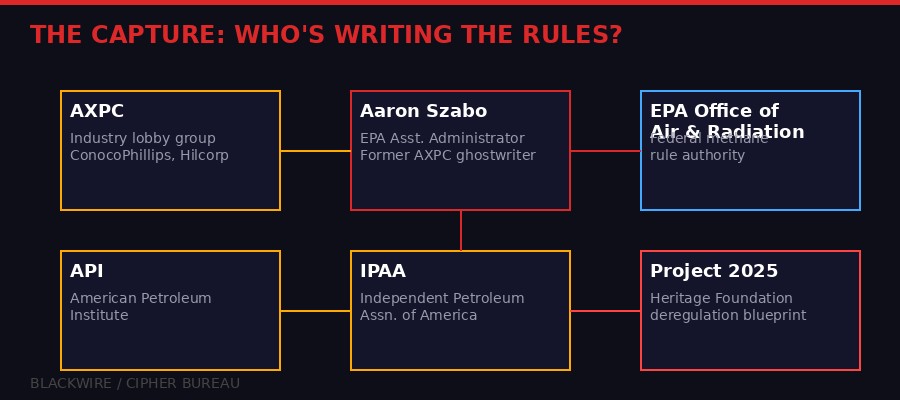
BLACKWIRE / CIPHER BUREAU - The network: trade groups, a lobbyist-turned-regulator, and the office that writes America's air pollution rules.
IV. "Suggested Reg. Text Language"

Internal emails show the EPA invited the oil industry to submit specific regulatory language for adoption. Photo: Pexels
Regulatory capture, in its crudest form, means an industry taking control of the agency meant to regulate it. In its most sophisticated form, the industry doesn't just influence the rules - it writes them. The EPA under Szabo appears to have crossed that line.
Internal emails obtained by ProPublica show that Szabo's office didn't merely consult with oil industry groups about the methane rule revisions. It invited them to submit actual regulatory language - the specific legal text that would become federal law.
In one email exchange, Mike O'Connor of the American Petroleum Institute wrote to an EPA official: "We had a call several weeks back re. pneumatics on temporary equipment. EPA had informally requested input on this topic and any suggested reg. text language. We are providing the attached draft document as informal input to EPA's inquiry."
Pneumatic devices in oil and gas operations are a major source of methane emissions. The API's draft document called for a number of exemptions that would reduce the industry's compliance costs. This was not a public comment submitted through the normal rulemaking process. It was a private exchange, an informal request from inside the EPA for the regulated industry to draft its own regulations.
The pattern extended beyond the API. In a June 2025 email, an EPA official reached out to O'Connor to discuss "alternative leak-detection methods," using language that echoed the AXPC comment letter Szabo had authored years earlier. The official spoke of "the additional flexibility we would like to pursue" - the same "flexibility" the industry had demanded and the Biden EPA had rejected.
A former EPA career official, speaking anonymously to describe confidential internal discussions, offered a damning assessment of the shift. "I think their agenda was, from what I could tell, to do what industry wanted," the former official said of Szabo and other Trump appointees.
The EPA's response to these revelations was notably defensive. "Since when is it a bad thing for public officials to ask the public what they think?" the agency said in a statement. It insisted that Szabo "fulfilled all his ethical obligations to the letter" and had consulted with career ethics staff upon joining the agency.
But the issue was never whether Szabo checked the right boxes on ethics forms. The issue is structural: a system that allows the author of an industry lobbying document to become the government official who decides whether that document's recommendations become law. The ethics disclosures worked exactly as designed. They just weren't designed to prevent this.
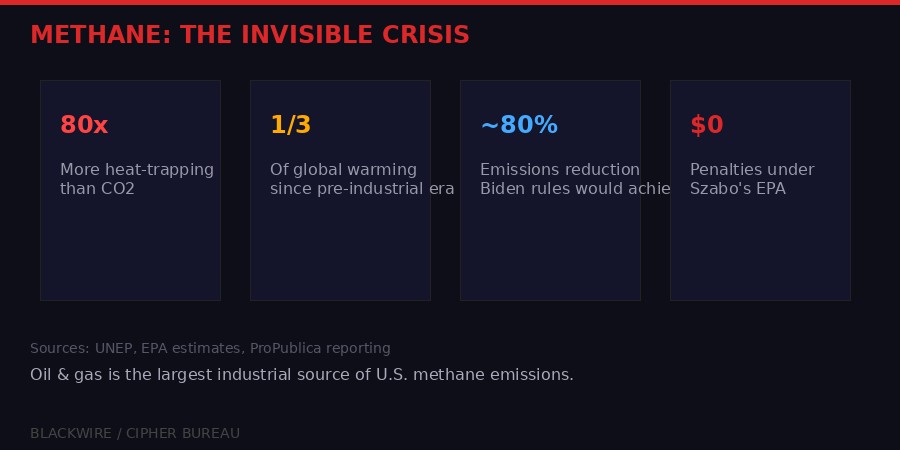
BLACKWIRE / CIPHER BUREAU - Methane is a climate superpollutant. The rules Szabo is gutting would have cut emissions by nearly 80 percent.
V. The Science They're Burying

Satellite imagery has revealed methane super-emitter events invisible from the ground. The new EPA is not looking for them. Photo: Pexels
The stakes of what is being dismantled cannot be overstated. Methane is not a minor pollutant or an abstract policy debate. It is, by the scientific consensus of every major climate research institution on Earth, the single fastest lever humanity has to slow global warming in the near term.
The numbers are stark. Methane traps approximately 80 times more heat than carbon dioxide over a 20-year period, according to the United Nations Environment Programme. It is responsible for roughly one-third of the rise in global temperatures since preindustrial times. And because methane breaks down in the atmosphere within about a decade - compared to centuries for CO2 - reducing methane emissions produces faster climate benefits than almost any other intervention.
The oil and gas industry is the largest industrial source of methane emissions in the United States. The sources are both accidental and intentional: leaks from aging pipelines, malfunctioning valves, corroding wellheads, and the deliberate venting of gas when it is uneconomical to capture and sell. Satellite imagery has increasingly documented "super-emitter" events - massive methane plumes from individual facilities that dwarf official estimates.
The Biden EPA's methane rules were designed to attack this problem at scale. They required oil and gas operators to conduct more frequent inspections for leaks, upgrade equipment that chronically released methane, and eliminate routine venting and flaring at new and modified facilities. The EPA estimated the rules would reduce methane emissions from covered sources by nearly 80 percent - a figure that, if achieved, would represent one of the single largest climate mitigation actions in American history.
Under Szabo's leadership, the Office of Air and Radiation has already delayed multiple compliance deadlines, pushing them into 2027 and beyond. The office is actively working to "revise" the rules in ways that align with the industry's longstanding wish list: less frequent monitoring, cheaper detection technologies, broader equipment exemptions, and relaxed standards for what constitutes an actionable leak.
Meanwhile, the Trump administration has taken an even more radical step that puts the entire framework at risk. In early 2025, the EPA moved to repeal the "endangerment finding" - the legal determination, first made in 2009, that greenhouse gases endanger public health and welfare. That finding is the legal foundation for the EPA's authority to regulate greenhouse gas emissions at all, including methane. Without it, the agency's power to impose any emissions controls on the oil and gas industry would evaporate.
The repeal is currently being challenged in federal court. But its mere existence signals the administration's ultimate ambition: not just weaker rules, but no rules at all. Szabo's incremental revisions may turn out to be a holding action, a way to maintain the appearance of regulation while the legal ground is cleared for total deregulation.
VI. Project 2025: The Blueprint Nobody Read

Project 2025's EPA chapter laid out a detailed plan to dismantle environmental protections. Szabo is thanked by name in it. Photo: Pexels
Aaron Szabo's appointment did not happen in a vacuum. It was part of a coordinated effort, years in the making, to place industry-aligned operatives throughout the federal regulatory apparatus. The blueprint for that effort was Project 2025, the Heritage Foundation's 920-page policy manual for the second Trump administration.
The EPA chapter of Project 2025 lays out a systematic plan to roll back environmental protections. It calls for repealing the endangerment finding, eliminating the EPA's enforcement of greenhouse gas emissions standards, and transferring regulatory authority to states that are more sympathetic to industry interests. It recommends restructuring the Office of Air and Radiation - Szabo's current office - to prioritize "cooperative federalism" over federal enforcement.
Szabo is thanked by name in that chapter. He did not write it alone - the chapter was authored by Mandy Gunasekara, a former EPA official under the first Trump administration - but his acknowledged contribution to its climate policy sections places him squarely within the network of operatives who designed the deregulatory playbook now being executed.
The broader pattern is significant. Project 2025 was not a set of aspirational policy wishes. It was an operational plan, complete with personnel recommendations, agency restructuring proposals, and specific regulatory targets. The methane rules were one of those targets. And the person selected to execute their rollback was someone who had already spent years fighting them from the industry side.
During his confirmation hearing, Szabo downplayed his Project 2025 involvement, saying only that he provided "general advice and thoughts" on the Clean Air Act. Senators on the committee did not press him further. The hearing lasted less than two hours. He was confirmed on a largely party-line vote.
The speed and smoothness of Szabo's confirmation reflects a broader reality about the Senate's capacity - or willingness - to scrutinize regulatory appointees. The revolving door between industry and government is not new. What is new is the directness of the connection: from ghost-authoring a lobby group's attack on specific rules, to a think tank fellowship designing the deregulatory strategy, to running the office that implements that strategy. The pipeline was seamless.
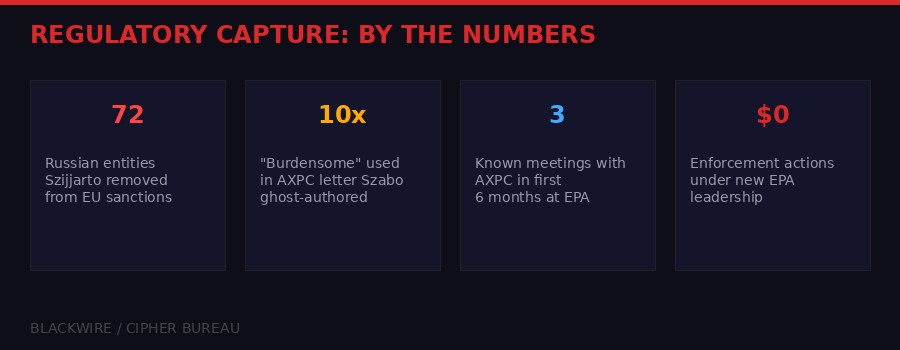
BLACKWIRE / CIPHER BUREAU - By the numbers: the scale of industry influence inside federal agencies.
VII. The Broader Pattern: Capture Across the Administration

The EPA is not the only agency where former industry lobbyists now write the rules they once fought. Photo: Pexels
Szabo's story is not an isolated case. It is the most well-documented example of a pattern that extends across the second Trump administration, where former industry lobbyists and advocates have been installed in regulatory positions that directly govern their former clients' interests.
At the Department of Energy, former fossil fuel executives have been placed in positions overseeing renewable energy programs they previously lobbied against. At the Department of the Interior, officials with financial ties to mining and drilling companies now approve permits for those same companies. At the Federal Energy Regulatory Commission, appointees with deep industry connections oversee the approval of natural gas pipelines and export terminals.
This is not the standard Washington revolving door, where officials move between government and private sector over the course of decades-long careers. This is something more specific: the deliberate placement of individuals into positions where they can immediately reverse the policies they were paid to oppose. The cooling-off period that once served as a buffer has been compressed to near-zero in some cases, with lobbying activity ending only when government service begins.
The legal framework meant to prevent such conflicts is riddled with gaps. Federal ethics rules require disclosure of prior lobbying relationships and impose limited recusal requirements. But they do not prohibit an individual from overseeing policy areas where they recently lobbied, as long as they don't work on "particular matters" involving specific former clients. The distinction between "particular matters" and "general policy" is elastic enough to drive a tanker truck through - which is precisely what has happened.
When Szabo met with AXPC and API representatives to discuss methane rules, he was arguably working on "general policy" rather than "particular matters" involving Ovintiv, his former client. The ethics rules, as written, permit this. Whether they should is a different question entirely.
Former EPA career staff describe the current environment as unprecedented. One former official, speaking on condition of anonymity, told reporters that the agency had effectively become an extension of the industries it was created to regulate. "I think their agenda was, from what I could tell, to do what industry wanted," the official said. This is not a characterization of bureaucratic drift or policy disagreement. It is a description of institutional capture.
VIII. What's Being Lost

Communities near oil and gas operations bear the health costs of methane and associated pollutants. Photo: Pexels
Methane doesn't exist in isolation. When it leaks from oil and gas equipment, it often brings along volatile organic compounds - benzene, toluene, ethylbenzene, xylene - that are known carcinogens and respiratory toxins. Communities near oil and gas operations, disproportionately low-income and communities of color, bear the direct health burden of these emissions.
A 2024 study published in the journal Environmental Health Perspectives found that residents within one mile of active oil and gas wells had significantly elevated rates of respiratory illness, cardiovascular disease, and certain cancers compared to the general population. The Biden EPA's methane rules were designed, in part, to reduce these co-pollutant exposures alongside the climate benefits.
Rolling back those rules doesn't just affect atmospheric methane concentrations. It affects the air quality in specific communities - the Permian Basin in Texas and New Mexico, the Denver-Julesburg Basin in Colorado, the Uinta Basin in Utah, Appalachian communities in Pennsylvania and West Virginia. These are places where people live next to the infrastructure that leaks, vents, and flares methane around the clock.
The EPA under the Biden administration estimated that the full implementation of its methane rules would prevent approximately 58 million tons of methane emissions over the regulations' first 15 years. The monetized climate benefits were estimated at tens of billions of dollars. The health co-benefits - reduced hospital visits, fewer premature deaths, lower rates of childhood asthma - were estimated separately and also ran into the billions.
These are the numbers that Szabo's office is now working to erase. Not by disputing them directly - that would require engaging with the science - but by delaying compliance deadlines, weakening monitoring requirements, and expanding the universe of equipment and operations that are exempt from the rules entirely. The effect is the same: the emissions continue, the health impacts accumulate, and the communities that bear the cost have no seat at the table where the decisions are made.
What they have instead is an EPA assistant administrator who once ghost-authored the industry's arguments for why those costs don't matter enough to justify regulation.
IX. The Ethics of the Ethics System

Federal ethics rules were not designed to prevent the kind of capture now underway at the EPA. Photo: Pexels
The EPA's defense of Szabo is revealing in what it concedes. The agency did not deny that he ghost-authored the AXPC letter. It did not deny that his office solicited regulatory language from the industry. It did not deny that former industry representatives described their meetings with his staff as "one of the most fascinating" they had ever had. Instead, it made two claims: that Szabo complied with federal ethics requirements, and that consulting with the public is not "a bad thing."
Both claims are probably true. And both are entirely beside the point.
The federal ethics system was designed for a world where the revolving door was a door - a transition with some degree of separation between the two sides. It was not designed for a scenario where an individual authors an industry lobby group's position paper, spends two years at a think tank refining that position into an operational government plan, and then takes a government position where he can implement that plan himself. The system caught none of this because it was not built to catch it.
The Office of Government Ethics requires financial disclosure. It imposes a two-year cooling-off period on lobbying one's former agency. It prohibits working on "particular matters" involving former clients. But these guardrails assume good faith at the margins - that individuals will not seek to exploit the gap between technical compliance and substantive conflict of interest. Szabo's career path represents an exploitation of that gap so elegant it could serve as a case study in administrative law courses.
Reform proposals exist. The Protecting Our Democracy Act, introduced in Congress in various forms since 2021, would extend cooling-off periods, broaden the definition of conflicts of interest, and impose stricter recusal requirements on former lobbyists. It has never received a floor vote in either chamber. The current Congress has shown no appetite for tightening ethics rules on executive branch appointees.
Until the rules change, the Szabo model will be replicated across every administration that sees regulatory agencies as instruments of the industries they nominally oversee. The pipeline from K Street to the corner office is open, paved, and entirely legal.
X. Follow the Money Forward

The financial beneficiaries of weakened methane rules are the same companies whose lobbyists now help write them. Photo: Pexels
The financial stakes of the methane rule rollback are immense. Compliance with the Biden EPA's regulations would have cost the oil and gas industry an estimated $1.1 billion per year, according to the EPA's own regulatory impact analysis. Those costs would have been borne disproportionately by the largest operators - the same companies represented by the AXPC, the API, and the IPAA.
By weakening those rules, Szabo's EPA is effectively transferring those costs from the industry's balance sheets to the atmosphere and the communities that breathe its air. This is not an abstract policy trade-off. It is a wealth transfer from public health to private profit, mediated by a regulatory process that the beneficiaries have captured from the inside.
ConocoPhillips, an AXPC member, reported $11.9 billion in net income in 2024. Devon Energy, another member, reported $3.7 billion. Hilcorp, privately held and thus not required to disclose earnings, is one of the largest private oil and gas producers in the United States. These are not struggling enterprises in need of regulatory relief. They are among the most profitable companies in the world, operating in an industry that received approximately $7 billion in direct federal subsidies in fiscal year 2024, according to the International Monetary Fund.
The $1.1 billion annual compliance cost that the Biden rules would have imposed amounts to a rounding error on these companies' combined revenue. Yet that cost was described as "burdensome" ten times in the letter Szabo authored. The word does a lot of heavy lifting when the entities claiming the burden are sitting on tens of billions in annual profits.
Meanwhile, the communities bearing the health costs of unregulated methane emissions have no comparable lobbying infrastructure. The residents of Odessa, Texas, or Weld County, Colorado, or Washington County, Pennsylvania, do not retain former EPA officials to draft comment letters on their behalf. They do not secure meetings with assistant administrators three weeks after Inauguration Day. They do not get invited to submit "suggested reg. text language" for the rules that govern the air they breathe.
The asymmetry is the point. Regulatory capture works precisely because one side of the equation has resources, access, and personnel that the other side cannot match. Aaron Szabo didn't break the system. He is the system working as designed - for the people it was designed to serve.
Key Findings
- Ghost authorship: PDF metadata identifies Aaron Szabo as the author of the AXPC's 2022 comment letter attacking EPA methane rules, which used the word "burdensome" 10 times.
- Rapid revolving door: Szabo went from oil industry lobbyist (2019-2022) to Trump think tank fellow (2023-2024) to EPA assistant administrator (2025-present) in less than three years.
- Industry-written rules: Internal emails show the EPA under Szabo invited the American Petroleum Institute to submit specific regulatory language for methane rule revisions.
- Project 2025 connection: Szabo is thanked by name in the EPA chapter of the Heritage Foundation's deregulatory blueprint.
- Compliance delays: The Office of Air and Radiation has already pushed multiple methane rule compliance deadlines into 2027 and beyond.
- Health impact: The Biden EPA estimated its methane rules would prevent 58 million tons of emissions over 15 years, with billions in climate and health benefits now at risk.
- Financial beneficiaries: AXPC member companies reported tens of billions in combined profits while claiming $1.1 billion in annual compliance costs was "burdensome."
Where This Goes
The Szabo case is not a scandal that will produce resignations or criminal charges. It is something worse: a perfectly legal operation that reveals how thoroughly the American regulatory system can be captured by the interests it exists to check. Every step - the lobbying, the think tank fellowship, the confirmation, the meetings, the "suggested reg. text" - followed the rules. The rules just aren't adequate to the task.
Federal courts may yet intervene. Environmental groups have already filed challenges to the EPA's methane rule delays and to the broader repeal of the endangerment finding. But litigation takes years, and in the meantime, the compliance deadlines keep getting pushed back, the industry keeps venting and flaring, and the planet keeps warming.
The immediate losers are the communities that live downwind of oil and gas operations. The long-term losers are everyone. Methane doesn't respect property lines, state borders, or the jurisdictional niceties of federal rulemaking. It enters the atmosphere and traps heat. The only question is how much, and for how long, and whether anyone with the power to stop it has any interest in doing so.
Right now, the person with that power ghost-authored the argument for why stopping it would be too "burdensome." He is Aaron Szabo. He runs the EPA's Office of Air and Radiation. And the industry he once lobbied for has never had a better friend inside the building.
Sources: ProPublica investigation (April 1, 2026), EPA regulatory filings, AXPC comment letter (January 2022), federal lobbying disclosures, Senate confirmation hearing transcripts (March 5, 2025), Project 2025 (Heritage Foundation), UNEP Global Methane Assessment, Fieldnotes watchdog records. BLACKWIRE's CIPHER Bureau verified all claims against primary source documents and public records.
Get BLACKWIRE reports first.
Breaking news, investigations, and analysis - straight to your phone.
Join @blackwirenews on Telegram