Contents
- The Conviction That Changed Nothing
- JPMorgan: The Bank That Defended Him Internally
- Jes Staley: The Banker Who Kept the Doors Open
- Leon Black: $158 Million After the Guilty Plea
- Deutsche Bank: The Slow Retreat
- Royal Lodge: Epstein's British Network
- Larry Summers and the Academic Establishment
- The Accountability Gap
The standard explanation for Jeffrey Epstein's survival as a prominent financier goes something like this: powerful men didn't know. They were deceived. He was charming and sophisticated. They had no idea what was happening.
The DOJ files released January 30, 2026 tell a different story.
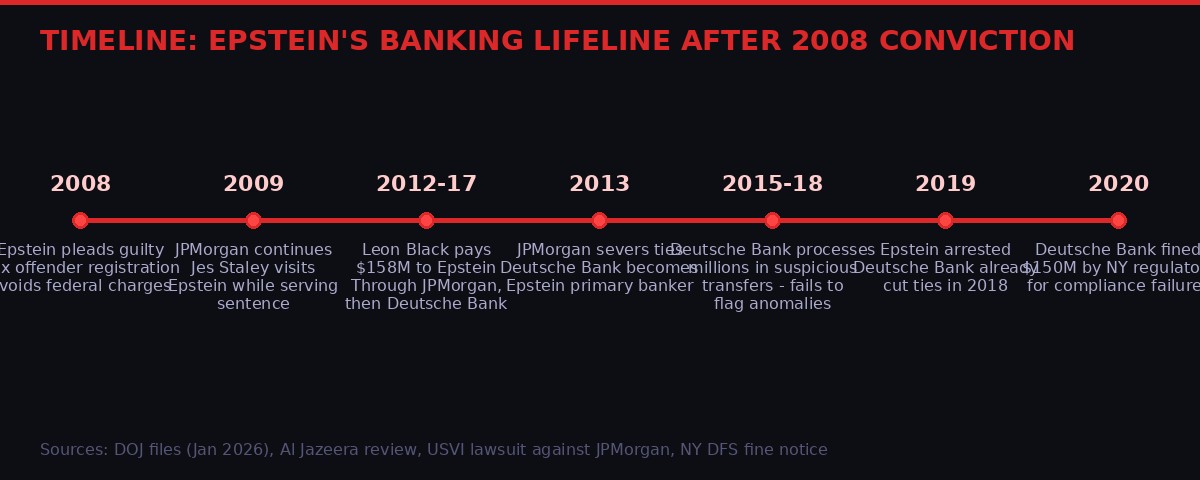
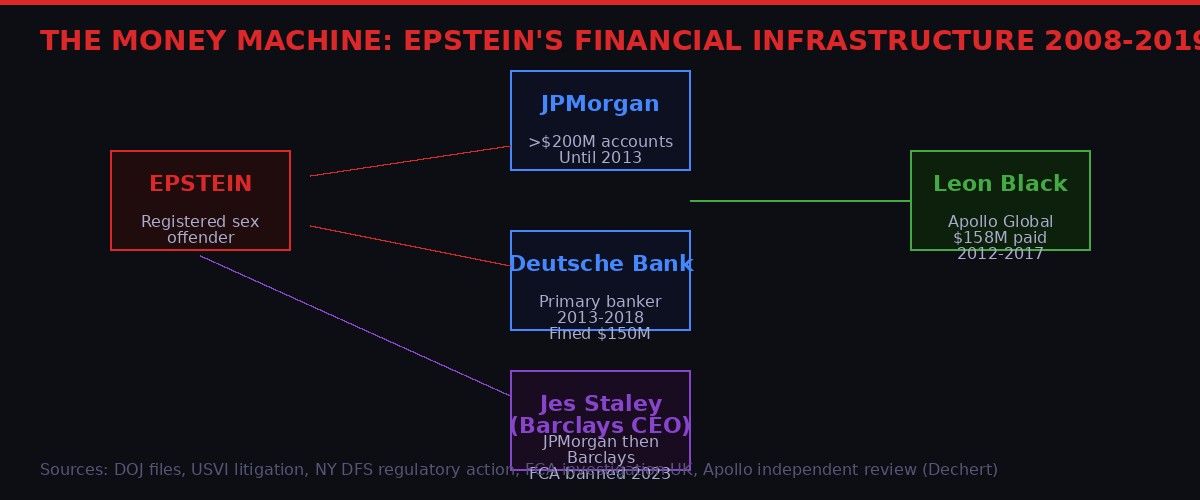
Epstein pleaded guilty in 2008 to procuring a minor for prostitution. He served fewer than 13 months, much of it on work release. He was a registered sex offender. None of that stopped JPMorgan Chase from holding accounts worth more than $200 million that generated significant revenue for the bank. None of it stopped Leon Black, co-founder of Apollo Global Management, from paying Epstein $158 million over five years. None of it stopped Deutsche Bank from becoming Epstein's primary banker after JPMorgan finally cut ties - and from doing so for another five years.
The question was never whether powerful people knew Epstein was a convicted sex offender. They did. The question was whether they cared enough to act on that knowledge. The files reveal that, for most of a decade, the answer was no.
The Conviction That Changed Nothing

In June 2008, Jeffrey Epstein entered a Florida courthouse and pleaded guilty to two state charges: procuring a minor for prostitution and solicitation of prostitution. Under a non-prosecution agreement that later became one of the most controversial plea deals in American legal history, he avoided federal sex-trafficking charges that could have carried a life sentence.
Alexander Acosta, the federal prosecutor who approved the deal and later served as Trump's Labor Secretary, reportedly told Trump transition officials that Epstein was "above his pay grade" and that he had been "told" Epstein was an intelligence asset. Acosta resigned in 2019 when the deal's details re-entered public scrutiny. Source: Miami Herald reporting; Senate confirmation hearings
What the plea deal did not do was end Epstein's financial life. His accounts at JPMorgan Chase held more than $200 million. His Rolodex of ultra-wealthy clients remained intact. His ability to offer financial advice, facilitate introductions, and operate as a fixer for the ultra-rich continued undisturbed.
Epstein had spent years cultivating a reputation as a financial wizard who managed money for billionaires. His client list included significant names from the worlds of hedge funds, private equity, and technology. That reputation - and the money it rested on - did not collapse with his conviction. It simply continued, because the institutions that could have ended it chose not to.
JPMorgan: The Bank That Defended Him Internally

The internal debate at JPMorgan over whether to keep Epstein as a client is documented in filings from litigation brought by the US Virgin Islands (USVI) against the bank. The USVI alleged that JPMorgan facilitated Epstein's sex-trafficking operation by continuing to process suspicious financial transactions despite red flags.
The bank settled that case. The terms and the specific internal communications made public offer a revealing look at how a major financial institution evaluated an ongoing relationship with a registered sex offender.
According to reporting by The New York Times, Jes Staley - then a senior executive at JPMorgan - acted as one of Epstein's strongest internal advocates, becoming his "chief defender" within the bank. Internal emails cited in court filings show executives debating whether Epstein was "an honourable person" and whether the banking relationship should continue.
Staley, the documents indicate, consistently argued that the relationship was safe. He was wrong, and the consequences of maintaining it would follow him for the rest of his career.
The USVI complaint alleges that JPMorgan processed suspicious transactions on behalf of Epstein without filing required suspicious activity reports, including payments to young women. The bank settled the USVI case and a related lawsuit brought by victims for significant sums, while stopping short of admitting liability for facilitating trafficking.
"JPMorgan allowed Epstein to operate a financial network that moved millions of dollars to further his criminal enterprise, despite clear warning signs." - US Virgin Islands complaint against JPMorgan Chase, cited in DOJ files review, Al Jazeera, Feb 2026
The practical consequence was stark. As long as Epstein remained a client of a global financial institution, he retained the infrastructure required to operate: processing payments, managing accounts, and presenting himself to the world as a legitimate financier. JPMorgan's name was that infrastructure.
Jes Staley: The Banker Who Kept the Doors Open

Jes Staley's relationship with Epstein extended well beyond routine banking. The DOJ files, reviewed by Al Jazeera, contain emails between the two men that are personal in tone and, in some instances, deeply troubling in implication.
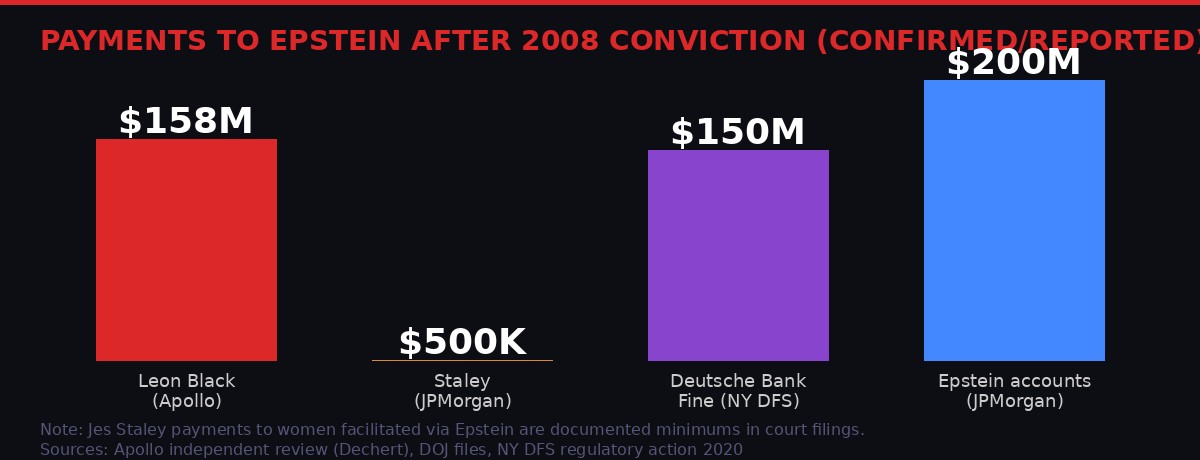
In January 2009, while Epstein was still serving his sentence, Staley visited Epstein's Palm Beach residence, according to JPMorgan's third-party complaint against Staley, which draws on USVI allegations. The complaint states that this visit "corresponded with Epstein wiring $2,000 to a woman with an Eastern European surname." Source: JPMorgan third-party complaint; DOJ files; Al Jazeera review Feb 25, 2026
In late August 2009, after Staley emailed Epstein saying he would be in London the following week, Epstein allegedly asked if he would "need anything." Staley allegedly replied: "Yep." The USVI complaint states that on August 31, 2009, Epstein wired $3,000 to the same woman he had paid in January.
The email exchanges became more explicitly coded over time. In July 2010, Epstein asked Staley: "What character would you like next?" - following a reference to "Snow White." Staley replied: "Beauty and the Beast." A separate email from an unidentified sender the same day stated that "the snow white was f***** twice as soon as she put her costume on."
That same exchange later featured prominently in regulatory scrutiny of the relationship by the UK's Financial Conduct Authority (FCA). When Staley moved to become CEO of Barclays in 2015, correspondence between Barclays and the FCA asserted that he had ceased contact with Epstein well before joining the British bank. The FCA found that assertion to be false. Staley had remained in contact with Epstein in the days leading up to the announcement of his Barclays appointment in October 2015.
In 2023, the FCA fined Staley and permanently banned him from holding senior roles in UK financial services. The regulator concluded he had been "reckless" in his representations about the nature of his relationship with Epstein. Source: FCA final notice; UK Financial Times reporting; DOJ files
Leon Black: $158 Million After the Guilty Plea
Of all the figures documented in the DOJ files, Leon Black's relationship with Epstein stands out for its scale and duration.
Black is the co-founder of Apollo Global Management, one of the world's largest private equity firms, overseeing hundreds of billions in assets. Between 2012 and 2017 - four to nine years after Epstein's conviction - Black paid Epstein approximately $158 million, according to an independent review commissioned by Apollo itself and conducted by the law firm Dechert. Source: Apollo Global Management / Dechert independent review, 2021
Apollo said the payments were for tax and estate planning advice. Critics questioned whether any advisory service could be worth $158 million. The Dechert review itself noted that the scale of compensation was "not appropriate," while concluding that Black had not acted improperly in a legal sense.
The DOJ files reviewed by Al Jazeera add new texture to that relationship. Documents show that Epstein advised Black during a sensitive personal dispute, helping arrange meetings and - according to other filings and reporting - suggesting surveillance as a dispute with a woman named Guzel Ganieva escalated.
In 2021, Ganieva publicly accused Black of sexual abuse and coercion, alleging that he introduced her to Epstein and attempted to pressure her into sexual contact with him. Black denied the allegations. He said the relationship with Ganieva was consensual and rejected the specific allegation about Epstein.
One document in the DOJ files is a draft transcript of a secretly recorded meeting on August 14, 2015, at the restaurant Le Bernardin in New York, between Black (identified as "JD") and Ganieva. In the transcript, Black confronts Ganieva about what he describes as a $100 million demand. He outlines "three different directions" the dispute could take. He proposes what he describes as a "15 million dollar package," including "a million dollars a year for 12 years" and an additional 2 million pounds to be invested for UK residency purposes.
If she goes public, he warns: "you could end up with nothing... and will probably land you in jail." At one point, he states: "But this is total extortion." Source: Draft transcript cited in DOJ files; Al Jazeera review Feb 25, 2026
Ganieva's 2023 lawsuit was dismissed by a New York court. Black has consistently denied wrongdoing. But the filing confirms that Epstein remained at the center of how one of Wall Street's most powerful figures managed a major personal crisis - in 2015, seven years after the guilty plea.
Black stepped down as Apollo's chairman in March 2021, shortly after the Dechert review concluded. He retained a significant ownership stake.
Deutsche Bank: The Slow Retreat

When JPMorgan finally cut ties with Epstein in 2013, Deutsche Bank stepped in. This was not an accident. Epstein was a wealthy client with a complex web of accounts. He was also, by this point, a convicted sex offender who had been the subject of public scrutiny and civil litigation.
Deutsche Bank became his primary banker anyway. It would retain him as a client until 2018.
According to reporting by The New York Times, payments from Leon Black to Epstein continued to flow through Deutsche Bank accounts. At least one transfer was reportedly flagged internally as unusual by bank employees. The bank did not file required suspicious activity reports in a timely manner.
In 2020, New York's Department of Financial Services (DFS) fined Deutsche Bank $150 million for compliance failures related to its handling of Epstein and other high-risk clients. The DFS found that the bank had processed millions of dollars in suspicious transactions, including payments to individuals described as young women, without adequate scrutiny. Source: NY DFS consent order, July 2020; NYDFS press release
"Deutsche Bank processed millions of dollars of suspicious transactions on behalf of Jeffrey Epstein without ever flagging them as suspicious, and for years failed to properly monitor his accounts." - Superintendent Linda Lacewell, New York Department of Financial Services, July 7, 2020
The DFS consent order noted specific failures: Deutsche Bank had access to public records about Epstein's criminal history. It had its own internal know-your-customer requirements. It had specific anti-money-laundering procedures. All of these systems were in place. None of them produced effective action during the years Epstein was a client.
Deutsche Bank acknowledged shortcomings in its controls and said it had since strengthened its compliance systems. It did not face criminal charges.
What the $150 million fine represents in practice is a cost of doing business. Deutsche Bank's 2019 revenue was approximately 23 billion euros. The fine - substantial by any ordinary measure - amounted to a rounding error on the balance sheet of one of the world's largest financial institutions.
Royal Lodge: Epstein's British Network

The DOJ files extend Epstein's financial network well beyond Wall Street. Emails reviewed by Al Jazeera suggest that Royal Lodge - the Windsor estate leased by Andrew Mountbatten-Windsor, formerly known as Prince Andrew - served as a structured venue for financial meetings in which Epstein played an advisory role.
On August 30, 2010 - after Epstein's conviction and registration as a sex offender - Andrew Mountbatten-Windsor convened what an email describes as "a big meeting of the way ahead of ME," scheduled for September 1 at Royal Lodge. Epstein was being consulted on the logistics and on the financial strategy to be discussed. Source: DOJ files email chain; Al Jazeera review Feb 26, 2026
The context appears to be the mounting financial distress of Sarah Ferguson, Andrew's then-wife. Emails reference Hartmoor, Ferguson's company, which appeared to be heading toward bankruptcy. Earlier correspondence from October 2009 shows a proposed settlement being forwarded to Epstein for review by a US lawyer "re the IP situation following a bankruptcy."
On July 12, 2010, an email informed Epstein that a sender would be "with PA at 1200 UK time at Royal Lodge (Windsor)" and that Epstein could join by phone. "PA" is how Mountbatten-Windsor is referred to widely throughout the Epstein files.
A February 2010 email shows Mountbatten-Windsor's then-representative discussing how Epstein had introduced a contact named David Stern - described as having "a great rolodex for China" - who was offering to help with a "wealth fund idea with China." Epstein was being used as a connector and validator for international business introductions, while serving as a registered sex offender.
Mountbatten-Windsor has stated publicly that he cut ties with Epstein in December 2010. The DOJ files complicate that timeline. In October 2013, Epstein wrote to David Stern - by then an aide to Mountbatten-Windsor - suggesting the former prince might want to host a dinner for a "very beautiful friend" visiting London. In April 2017, Stern emailed Epstein about organizing a "super" dinner at Windsor Castle. Source: DOJ files email chains; Al Jazeera Feb 26, 2026
In February 2026, British police searched Royal Lodge as part of an inquiry into whether Mountbatten-Windsor had shared confidential government material with Epstein during his time as the UK's trade envoy. He was briefly arrested on suspicion of misconduct in public office and released without charge.
The lodge now stands empty. Its lease has been surrendered. The Crown Estate concluded that the property's condition was so deteriorated that Mountbatten-Windsor was unlikely to receive the 488,000 pounds he was nominally entitled to for early surrender.
Larry Summers and the Academic Establishment

The banking system and the billionaire class were not the only institutions that kept Epstein operational after his conviction. The academic establishment played its role too.
Larry Summers served as US Treasury Secretary under President Clinton and later as president of Harvard University. He is one of the most influential economists of his generation, with ongoing influence over economic policy debates in Washington and beyond.
DOJ files released in late 2025 and early 2026 revealed the extent of Summers's correspondence with Epstein. The two men remained in regular contact. In one documented instance, Summers emailed Epstein asking for advice on "wooing women." Source: DOJ files; Harvard announcement; Al Jazeera Feb 25, 2026
Documents released in December 2025 showed that Summers had been designated as a successor executor in a 2014 draft of Epstein's will, according to the student newspaper The Harvard Crimson. Summers's spokesperson denied any knowledge of the matter.
Summers maintained contact with Epstein as late as July 2019 - one month before Epstein's second federal arrest. He had previously stepped down from the board of OpenAI over Epstein ties.
In February 2026, following Harvard's review of documents released by the DOJ, Summers announced he would resign as a professor at the end of the academic semester. Harvard accepted his resignation from his position as co-director of the Mossavar-Rahmani Center for Business and Government.
"I take full responsibility for my misguided decision to continue communicating with Mr Epstein." - Larry Summers, statement to US media, following DOJ file releases, late 2025
Summers has not been charged with any crime. He denies any wrongdoing beyond continuing to maintain a relationship with a man he has acknowledged he should have distanced himself from.
Also departing institutional positions over Epstein ties: Thomas Pritzker, chairman of Hyatt Hotels Corporation, who stepped down from that role in early 2026 following revelations in the DOJ files.
The pattern is consistent: individual relationships that persisted for years after 2008, normalized by the broader tolerance of elite institutions that continued to process Epstein's money, accept his introductions, and benefit from his network.
The Accountability Gap: What the Files Confirm

The DOJ files released in January 2026 - the most comprehensive public disclosure yet of the Epstein investigation's findings - establish several things with reasonable confidence.
First: Epstein's survival as a financial operator after 2008 was not accidental. It required sustained decisions by multiple major institutions to continue doing business with a convicted sex offender, despite internal red flags, regulatory obligations, and public knowledge of his crimes.
Second: those decisions were made by specific, named individuals - not faceless compliance departments. Jes Staley at JPMorgan. The account managers at Deutsche Bank who processed suspicious transactions. The advisors who arranged financial meetings at Royal Lodge. These were human choices, made by people who knew what they were doing.
Third: the regulatory and criminal consequences have been dramatically disproportionate to the harm enabled. Deutsche Bank paid $150 million. JPMorgan settled the USVI case and victim lawsuits. Jes Staley lost his banking license. Larry Summers resigned a professorship. Thomas Pritzker resigned a chairmanship.
No one who continued banking Epstein after 2008 has faced criminal prosecution for doing so.
The question the DOJ files ultimately raise - and do not answer - is structural. Epstein's operation required infrastructure. It required banks, accounts, the ability to move money across borders, and the cover provided by association with legitimate institutions and respected individuals. That infrastructure was provided willingly, by people who knew the minimum of what they were enabling.
The non-prosecution agreement of 2008 did not just let Epstein escape. It sent a message to every institution considering whether to maintain their relationship with him: someone important has decided this man should continue to operate. Act accordingly.
They did.
Timeline: Key Events in Epstein's Post-Conviction Financial Career

There is one more question the files leave hanging. Epstein's 2008 plea deal was extraordinary - an agreement that prosecutors have since acknowledged was improperly lenient, that concealed its terms from victims in violation of federal law, and that allowed a sex trafficker to register as a low-level offender.
The Epstein files contain the famous claim from Alexander Acosta that Epstein was "above my pay grade" and connected to intelligence. The FBI has not confirmed or denied any intelligence relationship. The CIA has not confirmed or denied it. No congressional inquiry has established whether such a relationship existed, or whether - if it did - it played any role in the leniency of the 2008 deal.
What the files confirm, without speculation, is simpler and more damning. A convicted sex offender spent a decade operating at the center of elite finance. The banks that kept his accounts, the billionaires who kept paying him, and the establishment figures who kept returning his calls all made individual choices to do so. Those choices had consequences for the people Epstein harmed. The reckoning, when it finally came, was measured in fines and resignations.
The infrastructure that allowed it to happen remains intact.
Get BLACKWIRE reports first.
Breaking news, investigations, and analysis - straight to your phone.
Join @blackwirenews on TelegramSources: US Department of Justice, Epstein files released January 30, 2026. Al Jazeera review of DOJ files, published February 25-26, 2026. USVI v. JPMorgan Chase (2022-2023). New York Department of Financial Services, Deutsche Bank consent order, July 7, 2020. UK Financial Conduct Authority, Jes Staley final notice, 2023. Apollo Global Management / Dechert independent review, 2021. Harvard Crimson reporting on Summers. Andrew Mountbatten-Windsor press statements. UK Metropolitan Police statements, February 2026.